





Until you attain the truth,
you will not be able to amend it.
But if you do not amend it,
you will not attain it. Meanwhile,
do not resign yourself.
José Saramago, The History of the Siege of Lisbon
Introduction
For as long as scholars have examined pre-modern indigenous Southeast Asian texts, they have met with the pressing question: How might one parse histories from myths? What, indeed, becomes of the very categories of the historical and the mythic, when indigenous texts blur the bounds between the two? The version of this debate that has played out in the study of Malay literature has revolved around the subject of Hikayat texts. Many Hikayat appear at first to hew partially to what modern-day scholars know of historical events from other sources, only for the text to subsequently career into fantastical story arcs. While scholars have laboured over the analytical standards by which they might evaluate the historicity of the various Hikayat, this article takes a different approach; and ultimately names Hikayat as histories.
The decision to treat Hikayat as histories bears considerable stakes, since it implicates the esteem that the academy grants pre-modern Malay thought in relation to the study of other contemporaneous global intellectual traditions. As it stands, the study of traditional Malay texts has fallen under the purview of philology and cultural studies: and seldom intellectual history as such. Implicit in these disciplinary classifications is first that Hikayat are not coherent intellectual traditions; and that they are supine manifestations of their surrounding socio-political environments, rather than themselves active political agents. Where some have acknowledged the role of Hikayat in Malay politics, they decline to treat these texts as members of a systematic intellectual tradition. Instead they have taken the middle road to see Hikayat as political myths: useful fictions of the past contrived to furnish ruling dynasties with the sacral basis of their power.Footnote 1 Yet lost in this approach is the crucial ability to take Hikayat seriously as producers of discursive truth: that organise the past to forge bonds between text and reality. Far from their being incidental and disorganised manipulations of facts of the past for political expediency, I consider Hikayat to be members of a complex historical tradition.
Committing to taking Malay Hikayat composition as modes of knowledge production involves making concomitant strides in methodology. Most fundamentally, it is crucial to consider how the poetics of Malay history-telling differ significantly from those of Western positivist history. Still, I do not take historicity to be something to determine a priori based on predetermined epistemic standards. Historicity is, itself, a historical subject. Myth and history are not qualities inherent to a text, but are subjects that are socially and materially redefined over time. Here I am concerned precisely with the social and material processes that relegated Malay Hikayat to the status of ahistorical fictions.
It was in the midst of colonial incursion upon the Malay world that many Hikayat were re-cast as mythical fictions rather than recognised as histories. With the help of print technology, colonial scholars and officials were able to effect a form of print colonialism. This was a mode of colonial hegemony that relied on mass print technology to disseminate discourse that trivialised indigenous knowledge claims; but that also galvanised large-scale shifts in the local media landscape away from the material and social conditions necessary for the continuity of indigenous knowledge production. In the case of the Malay world, colonial scholar-officials published and distributed printed treatises on Malay literature that attempted to domesticate indigenous texts into easy genre categorisations of either myth or history. These colonial scholars identified many Hikayat to be mere fictions, and in so doing neutralised the political claims that indigenous historians made in their compositions. Perhaps the more insidious effect of print colonialism’s onset in the Malay world was its ushering in a veritable age of print in the nineteenth and twentieth centuries. Malay society has traditionally been oral-oriented, in which principles of textual composition and consumption have their roots in oral tradition.Footnote 2 Come this age of print, however, practices of consuming and producing printed texts were so pervasive among the growing Malay world reading public that they precipitated new norms by which people approached texts of various mediums. Whereas many Hikayat had traditionally been purveyed orally either by penglipur lara (storytellers) or by royal courtiers, Malay consumers would approach even these oral texts differently than they previously had. As I shall argue, this new form of print-conditioned reading wrested from Malay readers a long tradition of indigenous history-telling.
I have chosen the Hikayat Anggun Cik Tunggal as my vehicle for exploring these questions. This Hikayat, the story of the Malay prince Anggun Cik Tunggal, first originated in the Minangkabau region of West Sumatra. As the story originated in the oral medium, it is impossible to identify exactly when the tale was first composed, although a 1914 print production of the Hikayat in Singapore made by the British colonial scholar Richard Winstedt suggests that it was purveyed through the high colonial period in the Malay world.Footnote 3 For several reasons, this Hikayat’s social life is emblematic of how print colonialism has wrought epistemic violence on the Malay world. This was a text that responded pointedly to both the traumatic memory of colonial encroachment in the Malay world, as well as the absurd present under colonial rule. Come the twentieth century, however, Winstedt would print the Hikayat Anggun Cik Tunggal as a school reader and brand its contents as fictional contrivement.
More than this, the study of the Hikayat Anggun Cik Tunggal is also archetypal of the methodological difficulties involved in understanding Malay oral histories. In order to comprehend how the Hikayat’s capacity to impart historical knowledge evolved as it transitioned to its print medium, it is necessary first to delineate the knowledge claims that the oral Hikayat had made. Present-day scholars inherit a similar issue that their colonial predecessors had attempted to tackle: How might one make sense of how Hikayat appear to straddle history and myth? The Hikayat Anggun Cik Tunggal, for instance, is hauntingly reminiscent of the traumatic 1511 Portuguese invasion of Melaka. In the text, a fictional Portuguese king spends only a moment’s thought deliberating the prosperity of the Malay kingdom in the story, before expeditiously proceeding to conquer it. The story’s Malay protagonists speak of their Portuguese enemies as tyrants, oppressors, and as possessors of numerous colonies.Footnote 4 By the story’s conclusion, there is irreversible tragedy, and the Malay royal line is severed forever: Just as the titular prince Anggun Cik Tunggal is formalising his marriage to his Malay betrothed, the Portuguese princess Kaca Bertuang appears and turns the newlyweds into gibbons. Consequently, Anggun Cik Tunggal is unable to further the family line, and a commoner takes the reins of his kingdom.
This was not hyperbole. In 1511 Portuguese had devastated Melaka and its ruling dynasty in a similar fashion. Prior to the Portuguese invasion, Melaka was a bustling entrepôt. Consolidating Melaka was thus key to the realisation of Portuguese ambitions to gain control of the Indian Ocean spice trade. Only two years after their first visit to Melaka, the Portuguese seized the port city, ousting its Muslim ruler. Most humiliatingly, the great kingdom of Melaka fell to a minuscule crew of fighters; after this embarrassing defeat the Sultanate of Melaka would never rise again, bringing an end to its Malay rule. In life — as in the Hikayat — a Malay kingdom is indelibly ruptured from its past political glory.
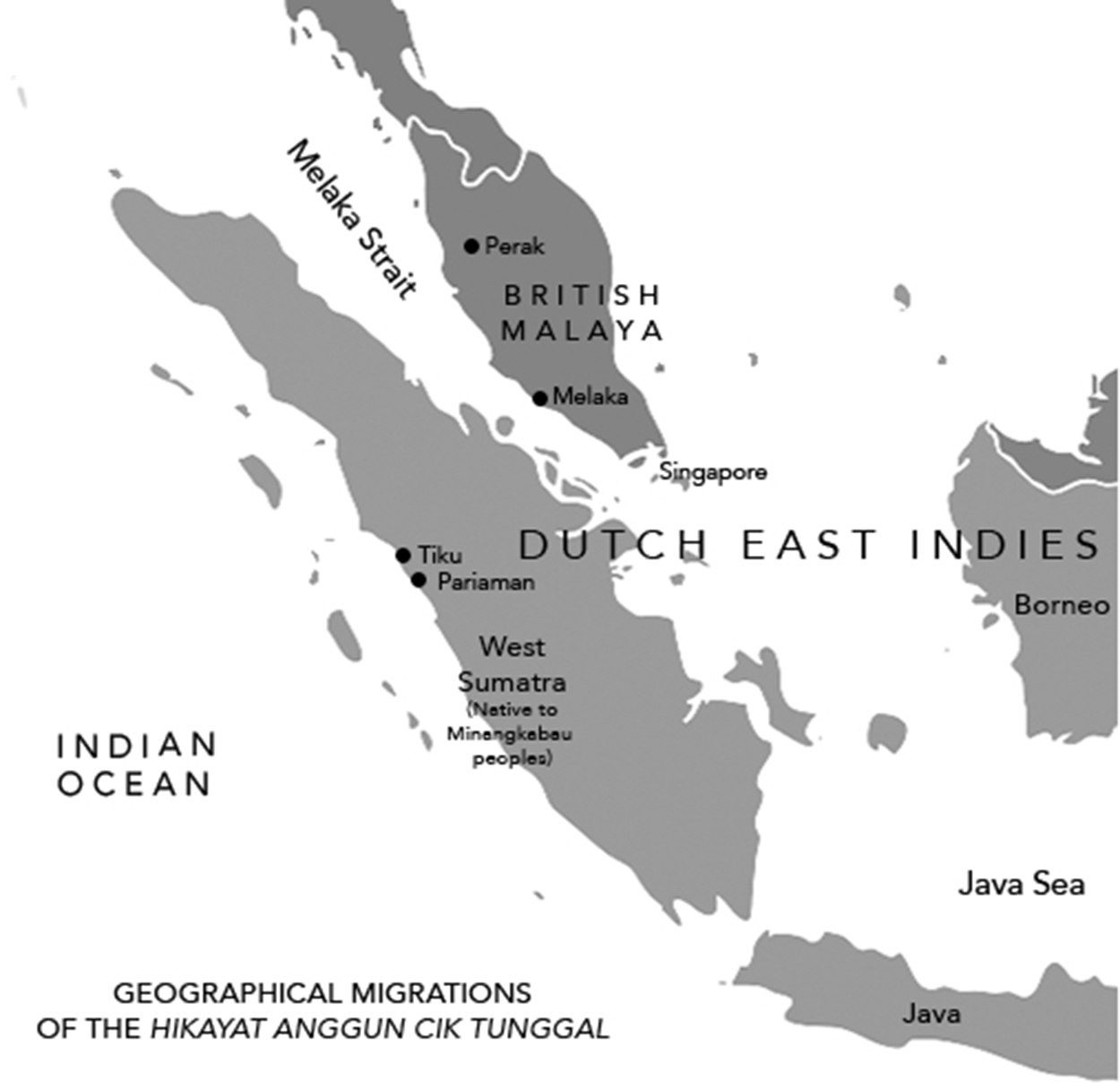
The facts of the Hikayat depart significantly from the facts of history in many ways, however. All known renditions of the Hikayat are set not in Melaka but in the land of Tiku Periaman, a polity whose name is a combination of the Minangkabau regions of Tiku and Pariaman: territories that the Portuguese had never invaded. Indeed, Minangkabau lay some hundreds of miles away from the site of the 1511 invasion, under the colonial ambit of another European power: the Dutch. For Minangkabau storytellers and audiences of the Hikayat Anggun Cik Tunggal, this was an intimate form of local history-telling: It is silsilah, or an account of genealogical descent. Minangkabau residents interviewed in the 1980s believed the story of the Anggun Cik Tunggal to be true, and held that the people living in the area were descendants of the storied prince and his betrothed, Gondan Gendariah. Moreover, they took some of the toponyms in the tale to correspond directly with places in their lived reality. For instance, they believed that the prince was born in the real-life village of Padusunan, near Pariaman, and that Gondan Gendariah had hailed from Cacang, near Tiku.Footnote 5 The Hikayat was so central in the Minangkabau cultural consciousness, that a Minangkabau migrant to Perak was documented to have continued to recite the tale there.Footnote 6 (Refer to Figure 1, on the Hikayat’s migrations across the Malay world.)
Map of the Hikayat Anggun Cik Tunggal’s Migrations Across the Malay World (Map by author)

Figure 1 Long description
A thematic regional map covering the Malay Peninsula and nearby islands, with north at the top. Large region labels include “BRITISH MALAYA” on the peninsula and “DUTCH EAST INDIES” across the islands to the south and east. Water bodies and passages labeled are “INDIAN OCEAN” at the left, “Melaka Strait” between the peninsula and Sumatra and “Java Sea” near the lower right. Labeled land areas and places include “Perak” on the peninsula; “Melaka” on the peninsula; “Singapore” near the southern end of the peninsula; “West Sumatra (native to Minangkabau people)” on Sumatra; “Tiku” and “Pariaman” on the west coast of Sumatra; “Borneo” to the right; and “Java” near the bottom. The map includes the title text “GEOGRAPHICAL MIGRATIONS OF THE HIKAYAT ANGGUN CIK TUNGGAL.” No legend, scale bar, or route lines are visible; the migration theme is conveyed through the labeled regions and place names.
Contemporary scholars of Hikayat such as this one, while declining to commit to the totalising categories of history and myth, by and large opt to take Malay texts to be limited mirrors into past political events. By their approach, Hikayat are valid sources of knowledge insofar as they corroborate with sources that are appreciably more objective in form. These sources are typically foreign (i.e., Chinese, European) in provenance, or are otherwise indigenous sources that cohere more cleanly with what colonists might recognise to be historical annals. In doing so, scholars have unconsciously recapitulated the artificial genre classifications that colonial scholars emplaced to distinguish Malay accounts that conformed with Western historical conventions, from accounts that do not.
Scholars of the Hikayat Anggun Cik Tunggal have largely attempted to draw equivalences between facts of the Hikayat with those of its Minangkabau political reality,Footnote 7 but this task is difficult to accomplish. As the Hikayat does not contain explicit references to local political affairs, it is impossible to pinpoint the exact time at which the oral Hikayat came about, or the specific political stimuli to which it responded. It is altogether misguided to embark in search of a smoking gun that tethers the Hikayat to a known incident in so-called material reality. Jane Drakard’s work on Minangkabau political culture has done much to de-privilege rationalist ideas that hold material expressions of power to be the truest form of political action. She has successfully argued that Minangkabau political actors negotiate political reality on the level of language and rhetoric.Footnote 8 Stated differently, the substrate of reality is political, and the means by which that reality is navigated is linguistic. That which is material, then, does not have a monopoly over what is really real in Malay history.
At most, we are able to make inferences about the political currents to which the Hikayat responded. One may conjecture from the provenance of existing editions of the story that oral storytellers in West Sumatra likely recited the Hikayat in the nineteenth century, at a point when Dutch colonists had begun to consolidate control over the Minangkabau region following a successful Dutch campaign to intervene into the inter-factional Padri War (1806–1837). A plausible surface-level interpretation of the Hikayat could thus take the tyrannical Portuguese in the story to correspond directly to the domineering Dutch presence in the region. Even with this interpretation in mind, the Hikayat Anggun Cik Tunggal continues to resemble a romantic fantasy. In the text, a Portuguese king, the White Viceroy, invades and desecrates the titular hero’s Minangkabau kingdom. Defeat is not to last: the Malay prince Anggun Cik Tunggal is able to quell the Portuguese forces and avenge his fallen kin, and he is remarkably successful. Although at first he is engaged to the Malay princess Gondan Gendariah, he eventually romances Kaca Bertuang, the princess of Portugal, and converts her to Islam. Out of reverent fear for the prince’s military might, the Queen of Portugal inducts Anggun Cik Tunggal into the Portuguese royal family. The Hikayat’s interpretation of Malay-European encounter would thus seem to grate against both the grim tragedy of the 1511 Portuguese invasion of Melaka, as well as its contemporaneous reality of the enduring Dutch presence in Minangkabau political life in the nineteenth and twentieth centuries.
To compound our interpretive difficulties even further, what survives of past recitations of colonial and precolonial Malay oral texts are written records that colonial scholars had commissioned in the nineteenth and twentieth centuries. How, then, might scholars work under these evidentiary limits to understand in their particular contexts the Malay political thought held in indigenous oral traditions? While one might be tempted to take the written Hikayat at face value as a direct source about how Malay oral historians of the past recited the text, there remains a fundamental disconnect between the logics of Malay texts and scholarly interpretations of them. Malay texts are, at their core, oral texts — in that they are composed along oral-oriented standards and logics, even if they may originate in the written medium — whereas present-day scholars are steeped in norms of consuming texts in the way of reading written and printed media. In founding their interpretations on visual, and not aural, readings of these Hikayat, scholars have cost the study of Malay intellectual history dearly.
This slippage in medium between Malay texts and their scholarly readings is not merely incidental to the interpretation of the texts’ contents. Rather, it generates considerable methodological challenges in uncovering these texts’ meaning. Michel de Certeau theorises the text not to be formed from processes of textual production. Rather, it is the very act of textual consumption that forms the text in question.Footnote 9 In this vein, since the listener of an oral text consumes the text very differently from how a reader of a written text does, oral and written texts fundamentally differ in form even if their linguistic content remains consistent. The way oral forms are consumed has created creative possibilities, and established long-standing traditions, for particular forms of reasoning and expression. Malay oral texts operate on poetic logics whose workings are specific to the oral medium and that depart from the interpretive principles of written and printed texts. This poses considerable methodological challenges to scholars bringing writing-conditioned expectations to the interpretation of an oral text.
This interpretive disconnect has greatly impeded efforts to recover the historicity of Malay texts. Here I work with the Hikayat Anggun Cik Tunggal to demonstrate a possible methodology by which we might unread Malay oral historical texts; to re-introduce them into their oral context and thereby interpret them on their own terms. I argue that re-situating Hikayat in their oral medium enables us to recover these texts’ function not as myths, but as histories.
Hikayat oral histories rely on the workings of their oral medium in order to purvey historical arguments. In consequence, Malay oral histories defy scholars’ expectations of epistemic standards — conditioned by norms of reading written and printed histories — that define a robust historical argument. As texts purveyed in the oral medium, Hikayat are wont to change with each re-telling. Oral histories are not conserved with rarified permanence in mind. In fact, the historicity of an oral history is dependent on the text’s ability to change constantly, to allow each fresh telling of the Hikayat to respond to evolving political demands of the day. Indeed, Malay oral histories are most compelling when they are able to comment on the politics of their contemporaneous time.
This interpretive strategy requires deliberate thinking against the grain of the epistemic assumptions of print-based historiography, and is ultimately a tremendously rewarding methodological tool. An unreading of the Hikayat Anggun Cik Tunggal uncovers a sophisticated oral history that related simultaneously the local histories of Melaka in 1511, and of colonial Minangkabau at the time of the text’s recitation. In telling both Melakan and Minangkabau history in one fell swoop, the Hikayat engendered a form of radical Malay solidarity that could respond to the historiographical demands of traumatic European colonisation.
It would be wise to remain circumspect that a reading of a singular edition of this Hikayat accounts for the full spectrum of meaning that different recitations may produce. Even so, there is great value in fleshing out the narratological contours of the Hikayat in this printed edition alone. I follow Jarrah Sastrawan in regarding a Hikayat’s summative historicity as formed by the complex interplay of various temporal devices layered one atop the other, to produce a temporal topology endemic to the text; in other words, a ‘set of structural relations between the moments in a narrative’.Footnote 10 It is hoped that sketching the temporal topology of this Hikayat may avail us the methodological tools for unreading other Malay texts and according them the esteem they deserve as histories.
Finally, this article shall trace the Hikayat’s social life after the advent of print in the Malay world, through to its transmission as a printed book. It was in print that this Malay history lost its historicity. I suggest that, as Malay intellectuals educated in colonial vernacular schools read oral histories like the Hikayat in their fixed printed forms, these texts were no longer able to change with each reading. Print-conditioned reading thus neutered the dynamism of Malay texts, and wrested Malay readers from a long tradition of indigenous history-telling.
Narrative time in the Hikayat
The key to considering the Hikayat’s truth on its own terms lies in appreciating how the Hikayat form relates the past to the present. This approach is first useful for confronting the seeming geographical inaccuracy in the Hikayat. Whereas in 1511 the Portuguese forces decimated the Melakan Sultanate, in the Hikayat it is not Melaka — but Tiku Periaman — that the Portuguese invade. Hayden White’s interpretation of Erich Auerbach’s concept of figural causation is helpful for clarifying the historical logic that underlies this geographical leap. White characterises figural causation as the relationship that a historian retroactively constructs between two events that are not related by material causation. By this logic, the chronologically preceding event is not the direct material cause of the subsequent event. The earlier event is thus said to pre-figure the other, such that one would have to understand the first in order to grasp the significance of the later event.Footnote 11 Likewise, understanding the chronologically later event renders one’s appreciation of the preceding event more complete. This theoretical frame is analogous to how Malay historians worked to negotiate colonial trauma.
By narrativising Portuguese conquest in a Minangkabau setting, Minangkabau producers of the Hikayat Anggun Cik Tunggal re-appropriated Melakan history in application to their own local context. These historians understood the 1511 Portuguese invasion of Melaka to pre-figure their particular experience of colonial encounter, since the Portuguese invasion was in no way a material cause for their own, chronologically later, colonial experiences under the Dutch. There manifests here a form of Malay regionalism as Minangkabau historians abstracted the 1511 invasion — a local Melakan instance of colonial trauma — as a defining episode of Malay-European encounter writ large. Therefore, one would have to first revisit the trauma of the 1511 Portuguese invasion that is so definitive of Malay-European encounter, in order to consider the later specific, local Malay encounters with Dutch colonial forces. What appears to be geographical slippage in the Hikayat’s treatment of the 1511 invasion is, in fact, local Minangkabau engagement with their present experience of colonisation. This is, to be sure, regionalism not in the sense of Benedict Anderson’s Imagined Community; the consciousness of a general (national) collective. Pre-figuration in the Hikayat Anggun Cik Tunggal suggests a kind of regionalism that hints at a network, not a sphere, of political consciousness: One draws from one polity’s local affairs to conceive of the local affairs of another.
Contextualising the Hikayat with respect to contemporaneous Minangkabau interests also brings the Hikayat’s fictional arc into historical perspective. In the Hikayat, what seems like the typical arc of a romance epic takes an unexpectedly tragic turn. At the end, the Malay kingdom of Tiku Periaman is in mourning over the loss of its royal line’s only surviving member. The kingdom passes into the hands of a commoner. Something more than simple tragedy, however, is at play here. Branding the Hikayat with the literary descriptor of tragedy is quite insufficient to account for how it poetically produces meaning, since it presumes that its narrative is finished and bounded by its text. In fact, the Hikayat’s narrative time was extremely permeable to real time; the events in the Hikayat even serve to re-define the political reality of its day. The Javanese babad tradition of history-telling makes for fruitful comparison, to explain how the Hikayat’s narrative events interacted with those in its real present time.
The Javanese babad historical tradition is prophetic in nature: Its teller composes a version of the past which, should it have come to pass, would create the conditions for the teller’s desired future. By re-constituting the past, the babad’s composer establishes a historical framework for an ideal future to come into being.Footnote 12 Jaka Tingkir, the titular character of the Babad Jaka Tingkir, looms large in the Javanese historical imagination as the founder of the Pajang Sultanate. Yet, Jaka Tingkir hardly appears at all in the babad that bears his name! He makes only a cameo appearance; and as a baby. Meanwhile, the bulk of the babad’s text provides an invented genealogy for Jaka Tingkir, peopled by marginal or problematic figures like a princely madman who vanishes after he is set on fire and a Javanese prince who is permanently exiled to China, scarcely the prestigious characters one would expect of a royal lineage.
Throughout one’s reading of the Babad Jaka Tingkir, one remains hyper-aware that the subject of the Javanese history was Jaka Tingkir himself: after all, it is he who lends his name to the title of the work. It was in this way that Jaka Tingkir retained a paradoxical centrality, even in his absence. Readers pieced together the imagined pasts of Jaka Tingkir’s ancestors and in so doing filled in Jaka Tingkir’s own biography as a king born of only marginally royal ancestors. The fictive genealogy provided for Jaka Tingkir thus sets the historical context for a possible future society that dares to erase the categorical difference between royals and commoners, the powerful and the disenfranchised; between religious authorities and religious deviants. In re-imagining Jaka Tingkir’s genealogy, the babad makes Jaka Tingkir its argument for social equalisation. Its composer(s) were responding to their own contemporary political reality; in the 1830s, the Dutch colonial powers tightened control over Javanese society by drawing rigid boundaries between socio-economic, racial and ethnic categories of people in Java. The babad reads, then, as a moral challenge to colonial control.
The historical poetics of the Hikayat Anggun Cik Tunggal operated in a similar manner. Real-world events do not occupy a privileged extratextual position as being really real outside the Hikayat itself. The Hikayat text responds to events in the real world as if they were directly continuous with the events in the Hikayat’s narrative time. For the Hikayat’s audience, reading or listening to its text at the turn of the twentieth century amidst Dutch high colonial rule, it would have been pressingly evident that European colonialism had politically ruptured the Malay world. Whereas Malay courts once had jurisdiction over their respective constituents, colonists now closely managed everyday public administrative affairs in the Malay world’s key urban centres. The state of dramatic socio-political rupture was a present absence in the Hikayat in the same way that Jaka Tingkir was in the Babad Jaka Tingkir, in that the matter of political rupture was simply assumed to be the main subject of the Hikayat Anggun Cik Tunggal’s telling of Malay-European encounter.
How did the events within the Hikayat’s text interact with political rupture in the real Malay world? In much of the Malay world, Islamic belief surrounding statecraft held that an ideal state should be absolutely tranquil. In the face of palpable deviation from this ideal, the kingdom’s ruling elite was burdened with the responsibility of accounting for the state’s integrity and tranquillity.Footnote 13 Such an expectation is evident in other historical accounts of state conflict, although such conflict need not have occurred with Europeans. For example, Raja Ali Haji penned the Tuhfat al-Nafis (The Precious Gift) in the aftermath of the clash between Bugis and the Malay kingdom of Johor. He re-imagined Bugis history — taking significant factual liberties as he did — to exonerate both the Bugis and Riau kings from any blame for the breakdown of Malay-Bugis relations, so to maintain the Bugis kingdom’s status as an ideal kingdom. The explanatory challenge that lay before the Hikayat Anggun Cik Tunggal was a similar one. The political disruption that European colonialism brought would have distorted local perceptions of the Malay state as one legitimised by its ability to ensure peace.
I suggest that the Hikayat Anggun Cik Tunggal explained away this contradiction between Malay political philosophy and political rupture in its own day. It did so by transforming external colonial threats into Malay subjects. In the text, Anggun Cik Tunggal is able to savour his conclusive victory over the Portuguese. He has killed the Portuguese White Viceroy. He is also adopted as a member of the Portuguese royal family, and thus inherits his fallen enemy’s kingdom. Moreover, Anggun Cik Tunggal woos Kaca Bertuang, the Portuguese princess, successfully; so successfully, in fact, that she converts to Islam. The following scene ensues:
Kacha Bertuang (…) brought forth a syair and this is how it sounded.
The syair that Kaca Bertuang recites not only signals a change in her professed faith, but ventures to indicate how she goes against her parents’ wishes and undergoes complete transformation into one who is of Anggun Cik Tunggal and his kin. In other words, Kaca Bertuang’s conversion allows her to masuk Melayu, to enter the Malay fold. From that point of the story on, the Hikayat’s audience takes Kaca Bertuang to be, for all intents and purposes, Malay.Footnote 15
Other events in the Hikayat’s narrative serve to further neutralise the foreignness of the threats levelled against Anggun Cik Tunggal: the foremost example being Anggun Cik Tunggal’s adoption by the Queen of Portugal, which made him rightful heir to the Portuguese kingdom. As the conclusion of the tale reveals, the incorporation of the Portuguese royals into Anggun Cik Tunggal’s Malay lineage is crucial for the Hikayat’s commentary on present-day political affairs.
With revenge squared away, Anggun Cik Tunggal returns home to (finally) wed his betrothed, princess Gondan Gendariah. The story, however, does not end on this happy note: The angry Portuguese princess Kaca Bertuang appears to transfigure Anggun Cik Tunggal into a gibbon for his philandering ways. The kingdom of Tiku Periaman is forever changed without its rightful heir. But, crucially, this tragedy of political disruption was not the result of foreign conquest. What finally causes the downfall of the Malay royal lineage in Tiku Periaman is not a colonial power or, indeed, any external source. Political rupture is, instead, a personal failing of Anggun Cik Tunggal to be faithful to the promise he has made his betrothed. His fate is tragic in the classic sense that it is a consequence of his own character flaws. The European Other — along with the threat it poses to the stability of Malay society — is completely consolidated into the Malay Self, which then is ultimately responsible for the end of royal rule in Tiku Periaman. Only by considering time’s contiguity with real time may we appreciate how the Hikayat processed colonial trauma by consolidating the European Other into a Malay frame of reference.
The Hikayat’s narrative differs from Western forms of history-telling in that it does not preserve a constant historical truth that stands independent from the moment of its telling, but is always a fresh prophetic telling. This characteristic of Malay history-telling has practical implications for tellers and tellings of history; for in order to remain responsive to contemporary events in the real world — and, indeed, in order to remain a piece of Malay history — a Hikayat would need to be constantly updated. Tellers of tales would have to constantly revise — and re-recite — the text in order for the historical effect of the Hikayat to endure.Footnote 16
To be sure, the need for constant revision to the Hikayat’s text is not directly equivalent to the need, in Western historical practice, to continually update the state of discourse in the study of the past. Rather, each update to a Hikayat text is a process meaningful unto itself: not least because Hikayat texts usually were oral recitations. For Shelly Errington, the performance of a Hikayat does not render the impermanent events of the past into permanent monuments in the present. Instead, the historian carries them into the present for just the duration of a performance.Footnote 17 Errington has argued that the Hikayat brings the past into the present, in the very sounding of the words that make up an account of the past. Quite unlike how language functions in Western history as an interface for speaking of the historical past, the words of a Hikayat do not stand apart from its subject. The very utterances of the recited Hikayat play a vital role in instantiating a piece of Malay history. As the Hikayat’s words are spoken, they gain presence in the world, and these sounded words bring the poetic meaning of the Hikayat text into existence. Yet, once its words are uttered, the text would not remain as an enduring monument to a fixed historical truth. Instead, tellers of tales would have to constantly revise — and re-recite — the text in order for the historical effect of the Hikayat to endure.
The accumulative logic of the Hikayat
The paragraphs above have explored how the Hikayat at large conveyed historical truth by managing a dynamic relationship with the affairs of real time. There remains, then, the following question: What is the logic that undergirds the way in which the Hikayat makes truth claims? Or, asked from a different perspective, what is — and is not — truth in the Hikayat?
Scholars of Indian Ocean texts have considered this problem of truth. For instance, Tony Stewart’s analysis of the Bengali pir katha approaches the truth-value of the epic romance to argue that these narratives do not operate by self-reflexive logics. Causative links between events in the story are, at best, tenuous; the Bengali pir katha move from one discontinuous episode to another to describe what befalls its characters from an external vantage point. No attempt is made to justify why an event is occurring; the story’s audience is granted a front-row seat to the story’s happenings just as they are told. The passage of time and space are, likewise, determined completely with respect to the protagonist’s actions.Footnote 18 The narratival logic of the Hikayat Anggun Cik Tunggal reveals a similarly unreflexive register: It accounts for miraculous acts with the deus ex machina that ‘the divine will of the most pure God on high’ had willed it so. The Hikayat’s logic is by no means causational, and is instead better described as contingent: It is, simply because it has come to be so.
What, then, is the undergirding logic of the Hikayat narrative, if not causative? We might look to what is perhaps most distinctive about Hikayat narrative form, its layers upon layers of extravagant detail, lavished upon numerous subject matters. Seen even on the most granular level of the sentence, details in the Hikayat pile up against one another. Take for example the following sentence, describing the princess Gondan Gendariah: ‘(She) was extremely beautiful without any rival in her generation, intelligent, learned, polite, pleasant, gentle was she in conducting herself at all times.’Footnote 19 Certainly, the text applies descriptive terms on a lavish basis. The use of synonyms (intelligent/learned, polite/pleasant/gentle) scarcely renders a descriptor redundant, but instead serves to amplify the importance of what is described.
The Hikayat’s plot employs not a causative logic, but an accumulative one. At the heart of such an accumulative mode of logic is the principle that the more something is repeated, the more important it is. Amin Sweeney’s fieldwork suggests that this has its roots in Malay oral tradition, since it is the time consumed in the telling of an event that advocates for its significance.Footnote 20 To borrow an analogy from the physical sciences, description increases the heft of a particular element in the tale, making it the narrative’s centre of gravity. Once an element of the narrative is established as central, subsequent narrative details enter into its orbit: such that details later on in the plot inevitably refer to it, albeit not on a causational basis. A useful example to consider is the following, in which Anggun Cik Tunggal dons the ceremonial dress of his father, Si-tompok Alam, a ruler hailing from a heavenly realm.
He (…) opened a box that was given to him by Gondan Genta Sari who had inherited it from the king from when he had descended from the land of the gods and goddesses. (…)
A pair of clothes was retrieved. He proceeded to don
Tucked at his waist was a keris named Sembilawari
(…) he then took up a pusaka (magical heirloom) sword which the prince had inherited through the lineage of his great-grandfather His Majesty Betara Guru Betara Kala, the sword was named Kipas Si-raja Tandang Sa-bentok Alang, and a fragment of the staff which Ain’uljan had received from the caliph of God who rules this earthly world. (…) Responded Princess Gondan Genta Sari, “You have indeed put on the dress of your father the king …”Footnote 22
The sheer excess of detail in the above passage is astounding. Material objects — from the prince’s sash to his sword — spell out his genealogy of the highest pedigree. He puts on garments and heirlooms that once were his father’s, but these objects trace Anggun Cik Tunggal’s genealogy further back, to his great-grandfather Betara Guru Betara Kala. Betara Guru and Betara Kala were localised forms of the Hindu gods Vishnu and Krishna: Betara Guru Betara Kala in the Hikayat might therefore be a combination of the two. The shirt that Anggun Cik Tunggal dons is composed of diamonds, arrayed to perfection. So perfect are they, in fact, that they are the very picture of Hassan and Hussein, the Prophet Muhammad’s treasured grandsons. The Hikayat text draws from a common store of personages — Qur’anic or otherwise — to pad on a mass of endorsements of Anggun Cik Tunggal’s legitimacy.
Such a description would do more than enough to afford Anggun Cik Tunggal legitimacy as ruler of Tiku Periaman. Indeed, the goal of such rich description was to grant Anggun Cik Tunggal unconditional victory as the text’s designated romantic hero. Throughout the rest of the Hikayat, snippets of this initial description of Anggun Cik Tunggal’s finery are strategically re-invoked before key moments of tension in the story. Tellingly, these are moments in which the prince is about to encounter each of his Portuguese adversaries for the first time: The decisive battle with the Portuguese forces, and the prince’s first meeting with the King of Portugal at court. The expenditure of great detail on describing Anggun Cik Tunggal has the effect of foregrounding in the prince’s transactions with Europeans the eventuality that his superiority shall come to be revealed.
Accumulative logic and the politics of historical genealogy (silsilah)
With the accumulative logic of the Hikayat in mind, we are in a better position to return to the main historical contributions that it makes, and the ways in which the text brought meaning into real-life political concerns. The poetic value of Anggun Cik Tunggal’s genealogy was not circumscribed within the bounds of narrative time. On the contrary, setting up the prince’s genealogy was crucial for the Hikayat text’s own function as a piece of genealogy (silsilah), as it was concretely historical in nature: The accumulated descriptions of the legendary Anggun Cik Tunggal’s pedigree bled into real time and influenced the Minangkabau political milieu of the real world. It was in this way that the Hikayat was able to meet the explanatory charge incumbent on it to answer: What was the cause for present-day colonial rule in Minangkabau?
First a word on the potency of royal genealogies in Malay world politics. Royal genealogies were important for legitimating political movements; the difference between the genealogies of living figures and those of legendary ones is marginal, since they proceeded along similar poetic lines. Considered in relation to the social landscape of Malay world society, Anggun Cik Tunggal belongs to a class of anak raja (young royals). Anak raja are the offspring of Malay sultans, who could have a great many children — in some cases, as many as 60 — by their wives. Expectedly, the size of royal families expanded out of control with each successive generation. In this way, the anak raja formed a veritable class on their own, with an occupational and economic predicament quite particular to them: Not every anak raja could assume political or administrative office in their domain, but at the same time it was unbecoming of them to descend in rank to that of the rakyat (common people).Footnote 23 Left in limbo, anak raja often were perceived as threats within their own realms as sources of potential opposition against those in power. In fact, in the eighteenth and nineteenth centuries anak raja played a vital role in the expression of dissent, and were popularly looked to as leaders of movements against misrule. While Malay society certainly frowned upon treason against the court, the participation of those of royal descent in a rebellion could not only justify it; but also support the imagination of an alternative political status quo.
The poetic impact of the anak raja’s genealogy was a centrepiece for these campaigns. even the genealogies of the lowest-born anak raja could be re-shaped such that their ancestral record vindicated presently-lodged political claims.Footnote 24 In fact, in West Sumatra where the Hikayat originates, the prestige of the Minangkabau dynasty (1347–1833) was a potent source of empowerment which motivated numerous anti-Dutch uprisings during the late seventeenth and early eighteenth centuries.Footnote 25
It is no surprise, then, that tellers of the Hikayat Anggun Cik Tunggal should devote so much attention to their description of Anggun Cik Tunggal’s genealogy. His genealogy is highly historical — in the Malay sense of history — as the fictional prince’s ancestral past is the Minangkabau ancestral past. More than that, historical genealogy is a tool employed to legitimate the political efforts of the present. As we do not know precisely how Hikayat’s audience received the story, we can only speculate about how they might have interpreted Anggun Cik Tunggal’s genealogy in their contemporaneous political context. Repeated invocations of the prince’s genealogy prior to moments of contact with the Portuguese suggest that this Hikayat had the poetic potential to legitimate real-life indigenous claims against European hegemony and dominance.
It is not difficult to identify the most extensive — and, by its accumulative logic, the most important — sequence in the Hikayat Anggun Cik Tunggal. Without contest, it is the wedding of Anggun Cik Tunggal and the Portuguese princess Kaca Bertuang. The 1914 print edition of the Hikayat text expends 10 whole pages out of a total of 159 describing the intimate happenings that ensue from the first pronouncement of their nuptial khutbah, to the eventual consummation of their marriage.Footnote 26 The scene is described in full: wedding guests, ceremonial foods and even the personnel running the festive game stalls in town. Anggun Cik Tunggal’s wedding to his long-betrothed princess Gondan Gendariah (whom we know of from very early in the story) is, in comparison, very brief: it lasts all of three pages in the printed text.Footnote 27
We find ourselves turning, again, to the previous discussion about Malay Self and European Other in the Hikayat. The Hikayat centralises in its narrative the induction of a once-aggressive European Other into a Malay royal lineage, and imbues this scene with great descriptive heft. Subsequent moments in Hikayat narrative time then enter the orbit of this nuptial event; they keep in their peripheral vision the fact that the Portuguese princess Kaca Bertuang and her family are now a part of Anggun Cik Tunggal’s genealogy and this means he has socially incorporated her into his own fold. As such, as Anggun Cik Tunggal is about to wed his Malay betrothed only for Kaca Bertuang transfigures him into a gibbon, the Hikayat’s audience does not interpret this as an external assault on the integrity of the Malay ruling elite. So stark is the conserved memory of the wedding scene where Kaca Bertuang converts to Islam and ‘becomes Malay’, that the audience easily understands Kaca Bertuang’s act of violence to be of an intimate nature. The final disaster that leaves the Minangkabau kingdom of Tiku Periaman in a state of political rupture without their rightful rulers is, after all, punishment for Anggun Cik Tunggal’s general amorous misbehaviour. While the story begins with political conflict between Malay and Portuguese kingdoms, it ends as a domestic tragedy, a broken promise between the Malay lovers Anggun Cik Tunggal and Kaca Bertuang.
This is directly instructive to the contemporaneous audience of the Hikayat as it was recited during the high colonial period. The Hikayat tackles the live question of whether the Minangkabau ruling order should retain its political mandate, considering how Dutch colonists have disrupted local autonomy in the area. To this, the Hikayat disarms the idea that European colonists had ever defeated Malay rulers to begin with; tragedy in Minangkabau is instead a result of its historic rulers’ personal failings.
The ethical language of everyday ritual life
Having considered the relationship between the Hikayat and real time writ large, as well as the underlying accumulative logic at play in the narrative, I turn to a subject of even greater granularity. Ritual life is the very stuff of the Hikayat, as it is precisely this that the storyteller accumulates in order to mark out a certain plot point as important: and to render the Hikayat an effective work of history. Yet, the composers of Hikayat revel in describing the ornate ritual and material life of their characters even in the lulls between sequences of action. The following scene unfolds after Anggun Cik Tunggal has directly confronted the Portuguese White Viceroy’s chief commander; Anggun Cik Tunggal and his crew lie in wait while the Europeans prepare their attack.
Bujang Selamat (…) mobilised the crew beating the summoning-gong and calling out with the canang gong for one and all to commence their food and drink. [Anggun Cik Tunggal] then also dined from a silver tray upon a pedestal and a gold-gilded plate a bowl of copper and gold and saucers forty-four in series, two he did take with each finger (…) after he had eaten he then took betel from its caddy and chewed it.Footnote 28
Rendered in thick description are not just the material possessions of the royal protagonist, but also the accoutrements of the prince’s page, Bujang Selamat: He beats the summoning-gong (pelaung), and calls out with the smaller canang gong. Even this slight detail is conserved to a remarkable degree: the order in which servants sound these gongs is never changed throughout the tale.Footnote 29
To be sure, the role of ritual and of ritual description in the Hikayat is considerably more complex than simply making one event more important than another by describing it in detail. Ritual life is deeply implicated in a complex Malay encyclopaedic tradition. In fact, in Malay history, ritual forms the very language of ethical and aspirational arguments. As illustrated earlier, the Hikayat was a vehicle for the transmission of traditional knowledge and custom. It is important to clarify, however, that ritual life in the Hikayat Anggun Cik Tunggal text was not merely a means to the end of conveying moral truth. The Hikayat was imbricated in a wider encyclopaedic epistemic tradition concerned with imparting instruction on how to behave in the Malay world’s social milieu. Take, for example, the excerpt below, which immediately follows Anggun Cik Tunggal’s betrothal to Gondan Gendariah:
Raja Anggun Che Tunggal then immediately rose and then he bathed accompanied by his pageboys, after he had bathed he returned to the palace to dine on his customary meal of rice.
The short interlude, consisting of a stepwise procedure for post-meal grooming, is bookended on both sides by the regular flow of the Hikayat narrative. Where contemporary print encyclopaedias would commonly index its constituent objects by alphabetical order, the Hikayat’s index is ritual behaviour in daily-life human situations.Footnote 31 In other words, details of Malay adat (custom) are presented in response to the needs of the immediate situation. The Hikayat’s coverage of adat is formidably extensive: It details the manner in which one should receive guests, take leave to set out for a journey, how to engage in courtship, and how to conduct oneself during communal meals.Footnote 32
While the Hikayat narrative features just a few individuals who carry out these practices in the recommended way, linguistic markers in the text generalise these processes as prescriptive for all of the Hikayat’s audience members. In the passage above, Anggun Cik Tunggal takes rice, but this meal is customary as a recommended course of action to break one’s fast after waking. Other texts employ the phrase demikianlah adat raja-raja (such is the custom of rajas) to momentarily transcend the first-person perspective of the narrative and to instead make a case for the typical.Footnote 33
The fundamental purpose of these encyclopaedic portions in the Hikayat is decidedly didactic. Drawing on the work of classicist Eric Havelock, Amin Sweeney has compared the Hikayat’s encyclopaedic function to Greek romance epic. Sweeney observes that both of these narrative forms were repositories of ethics, politics, history and technological knowledge required of the effective citizen.Footnote 34 Indeed, Hikayat narratives were instrumental in socialising members of Malay society. This function comes into greater relief when we consider the Hikayat’s place in the religious knowledge economy of the Malay world. Malay Islamic religious elites considered Hikayat stories useful vehicles for the kinds of knowledge that young people sorely needed but were loath to derive from boring religious books.Footnote 35 The main preoccupation of a storyteller would thus be to simultaneously entertain and educate.Footnote 36
What are the limits to considering the Hikayat Anggun Cik Tunggal as an encyclopaedic ritual text? Asked a different way: Does the Hikayat simply present fixed knowledge of Malay tradition and custom, or does the Hikayat play an active role in ongoing moral discourse in the Malay world?
Gijs Koster’s analysis of the Hikayat Anggun Cik Tunggal suggests the first response. Koster concludes that the Hikayat is, ultimately, a piece that edifies, re-enacts and represents Malay adat or custom. In Koster’s reading of the tale, Anggun Cik Tunggal is adept at abiding by custom in his dealings with men, and thus succeeds in the art of warcraft. On the flipside, the prince transgresses all manner of customary practice when he interacts with his many love interests; as a result, he eventually meets his unfortunate end. For Koster, the Hikayat is thus an example of the commemorative impulse at the heart of oral cultures.Footnote 37 In this commemorative mode of thought, ideological values are conceived to be in ideal perfection, as a complete and sacrosanct reality. The individual oral story in an indivisible world of adat is thus a small microcosm of this reality.Footnote 38 In other words, adat custom is a stable unit that forms a veritable moral to the Hikayat.
What happens, however, when foreign and colonial incursion presents storytellers with a new moral challenge? Koster’s meticulous study of how the actions of the Hikayat’s characters correspond — or do not correspond — to principles of adat is certainly useful for forming a general impression of how the Hikayat’s audience might form judgements about these characters. The status of adat as indivisible moral reality might not, however, be as stable as Koster has theorised. Moreover, the passive invocation of adat custom cannot exhaustively account for new moral challenges that the unknown future presents, with the incursion of colonial violence into Malay society. To this, I suggest that the Hikayat Anggun Cik Tunggal text is, in fact, engaged in active generation of moral knowledge in the Malay world. Specifically, it is the Hikayat’s descriptions of ritual life that gives language to that which is expressed in an aspirational register. The moral of the Hikayat is not told: instead, the moral is in its very telling.
It is productive, here, to invoke Mikhail Bakhtin’s writings on historical inversion as a literary device. By Bakhtin’s characterisation, aspirational statements — however abstract or ideological — are products of a historical inversion, in which something that can only be realised in the future is portrayed in the material terms of the past.Footnote 39 The future is ephemeral and deprived of the weightiness necessary for it to gain any rhetorical force, whereas the past and present are full of the requisite materiality and density. Therefore, the only way to make a persuasive argument for the realisation of what is envisioned in an aspirational register, is to express these future aspirations as a moral imperative that issues from the past.
The Hikayat Anggun Cik Tunggal appears to manifest Bakhtin’s theorisation, as it leverages the poetic value of placing the recent Minangkabau colonial past in the cast of an extremely detailed account of the 1511 Portuguese invasion of Melaka. It is the thick description of the Melakan past that lends narrative substance to the Hikayat’s imagination of the spectre of continued European presence in Minangkabau.
Additionally, it is through historical inversion that the Hikayat renders the European Other legible by local standards of political ethics. When it fleshes out an ethic for dealing with violence that issues from a foreign, European source, the Hikayat relies on images of Malay ritual life from the past and present to lend substance to this aspirational playbook. Save for their markedly different clothing, the Portuguese royals in the Hikayat behave just like Malay kings. When Anggun Cik Tunggal comes around to visit their palaces, they have betel in all assortments of containers at the ready, to entertain their guest. The Portuguese kings are also conversant in the practice of Malay poetry and principles of courtesy. The following scene unfolds as Anggun Cik Tunggal presents himself to the court of the King of Portugal for the first time:
The King of Portugal said, “O [Anggun Cik Tunggal] do not go into your ship anymore, I can instruct your wife and all the young royals to come over here, because I wish to hold a feast for another seven days and seven nights to fulfil my promise.” (….) [Anggun Cik Tunggal] then smiled at hearing the skillful clever and learned words which were as skillful as the aged wisdom of those people whose minds he had taken into his head without ever knowing their bodies.Footnote 40
By Malay customary standards, the King of Portugal demonstrates refinement of the highest order. The king does not have his guest take a detour back to their ship and volunteers instead to send his court pages over to the vessel to invite Anggun Cik Tunggal’s wife and crew into the palace. In addition, the King of Portugal shows himself to be hospitable; he has planned to host a grand banquet for the occasion of Anggun Cik Tunggal’s arrival. The Malay prince is suitably impressed. More than that, he recognises that he and the King of Portugal are not morally or ritually strangers to each other, for they are well able to interface through Anggun Cik Tunggal’s ancestral custom. The Portuguese king had never been acquainted with the Malay elders (‘without ever knowing their bodies’) but know their customs all the same (‘whose minds he had taken into his head’).
The Hikayat employs descriptions of ritual and concrete social transactions such as these, in order to place the European Other into a frame of reference familiar to a Malay audience in the present day. Without setting the Hikayat up in the frame of the familiar, it could never venture out on a limb to issue the novel question of how a history of Malay contact with European colonists should be interpreted and, accordingly, what an ethic of Malay-European contact should look like. To this open question the provisional answer that this Hikayat puts forward is that political rupture is not a result of defeat at the hands of European colonists, but instead a product of Malay elites’ personal failings to observe proper ritual behaviour.
The Hikayat Anggun Cik Tunggal is a historical text that defies the positivist expectations of its modern-day readers, in its discussion in the same breath of two histories that are spaced a strait — and centuries — apart. This article has so far systematically demonstrated how the Hikayat Anggun Cik Tunggal, and other Hikayat like it, might be interpreted as members of a sophisticated Malay oral historical tradition. The key to decoding the workings of such a tradition lies in re-centralising the text’s oral medium, which shaped the poetics of Malay history-telling. In the oral medium, the Hikayat was at liberty to change in response to an unfamiliar political present and an uncertain future under colonial rule.
Reading the literary: Malay oral histories in an age of print
The nineteenth and twentieth centuries were a key turning point for Malay oral texts like the Hikayat. Malay-language printing began to take off in the 1860s, facilitating the generation of an unprecedented amount of written material in British Malaya. Local- and colonial-owned printing presses produced texts at a hitherto unseen speed, catering to a Malay world reading public that expanded exponentially with rising literacy rates in the region.Footnote 41 The introduction of a print market to the Malay world in the nineteenth century created a tectonic shift in how people in the Malay world consumed media. Prior to their printing, oral texts like the Hikayat largely stayed in the oral medium, as texts that storytellers performed for a listening audience. Once put in the print medium, these oral texts had, for the first time, a mass reading public.Footnote 42 How did Malay audiences consume oral histories differently over this period? This question has definite stakes in particular for tellers and audiences of the Hikayat Anggun Cik Tunggal, as this narrative was a crucial tool that enabled them to process, and respond to, political developments in the region.
In the year 1914, aided by large-scale colonial print publication and a new system of Malay colonial education, the British colonial scholar Richard Winstedt produced a print edition of the Hikayat Anggun Cik Tunggal and had effectively retold the tale. Whereas past audiences of the Hikayat were mostly listeners, Winstedt’s was a mass reading public of unprecedented size. After transcribing an oral recitation of the Hikayat, Winstedt enlisted the help of a Malay village headmanFootnote 43 to render the text into a publishable prose form. One venue to which Winstedt distributed the Hikayat were British-run rural vernacular schools, where the Hikayat was positioned as a school reader to serve as a resource for cultivating literacy amongst colonially-educated Malay schoolchildren. The printed Hikayat Anggun Cik Tunggal (published as the Hikayat Anggun Che Tunggal) was a part of the Malay Literature Series, a collection of Malay-language texts produced under the auspices of the British colonial government of the Federated Malay States. The Series consisted of a motley crew of printed texts that spanned poetry collections, expository works produced with direct colonial patronage and, of course, traditional Hikayat narratives.
Colonial printing defined the very discourse around the Hikayat Anggun Cik Tunggal, and branded Malay oral texts like it to be literature devoid of epistemic value, rather than historical accounts. Winstedt extracted the Hikayat from its historically rich and polyvocal beginnings, and cast it instead as a representative of an essentialised Malay culture. The prefatory remarks to the Hikayat Anggun Cik Tunggal are shot through with phrases indicative of this goal of preserving authentically Malay texts. Winstedt emphasises the unimpeachable Malay sources of his printed Hikayat text: it was ‘taken down by the editor [Winstedt himself] from the lips of Pawang Ana and put into grammatical prose by Raja Haji Yahya’.Footnote 44 For him, ‘farcical tales and folk romances’ like the Hikayat Anggun Cik Tunggal were the ‘cream of Malay fiction’ because they did not resemble other, Hindu- and Islamic-inflected, texts that slavishly recycled Indian narrative models. Yet, he differentiated these folktales from Malay chronicles and histories, because of their fictional quality.Footnote 45 Hikayat literature thus occupied a coveted sweet spot: They were able to contrive an exciting world of fantasy, while patterning this imaginary world with Malay characters and objects. These pieces of Malay fantastical literature were what Winstedt was anxious to preserve. In the process, British colonial scholars concretised the category of Malay fiction, and invalidated the Hikayat Anggun Cik Tunggal’s participation in historical tradition.
The colonial construction of an essential category of Malay fiction was a purposeful one. Namely, it dovetailed neatly with strategies of British colonial control over Malay intellectual life. While British colonists established English-language medium schools in urban centres to raise the Malay traditional elite up into the ranks of the colonial bureaucracy, in rural areas colonists established vernacular educational institutions. These vernacular schools served the rural Malay populace that colonists intended to maintain as the core British Malaya’s agricultural production workforce. Often badly-resourced, the Malay vernacular education system served a dual purpose. First, it cut rural Malay youths off from attaining any form of cultural equivalence with the British that might be achieved through an English-language education.Footnote 46 Insidiously, colonial policymakers intentionally kept vernacular education at only the most rudimentary level, so as not to over-educate the rural Malay population whose livelihoods needed to be tethered to menial labour, and whose ties to the land and village were to be reinforced. Hikayat and their traditional settings were the perfect candidates to constellate the imaginations of this rural workforce. Like so, literature and the peasantry were coupled.Footnote 47 It was with this trajectory in mind that colonial officials commissioned the production and distribution of traditional Malay romances to be recorded and distributed in print. Vernacular education enshrined Malay culture, language and literature as vehicles to ethnicise and reinscribe the provinciality of the rural Malay populace, while simultaneously trivialising Hikayat as the rustic preoccupations of this non-elite class of menial workers.
Print technology did not only re-author discourses surrounding the historicity of oral texts; it also re-configured the fundamental basis on which Malay audiences consumed the text. While Malay world audiences approached oral texts with the expectation that they would change from performance to performance, literary works, on the other hand, acquired a certain textual fixity, because they participated in the Malay world book market as finished commodities altogether divorced from the processes involved in their production. Ian Proudfoot has called this change in modes of textual consumption the silencing of texts. He has argued that the consumption of most traditional Malay manuscripts were made complete only in performance: Syair ballads as sung accompaniment to a folk drama, and Hikayat folktale narratives as rhythmic recitation. The medium of print, however, effaced the specific performative contexts of each text, by pressing these different cultural forms into a single, undifferentiated receptacle. In print, texts were silenced; it no longer mattered how, where or when a piece of writing was read, because Malay readers consumed the text as a purely visual reading experience without imagining its performance context.Footnote 48 For Proudfoot, this phenomenon can be fully explained by reading practices taught in colonial institutions: Teachers presented their Malay students with readers — for instance, printed Hikayat folktales — with the intention of training students in the skill of literacy. School readers functioned as generic chunks of language that a literate student could sight-read without ever having seen the text beforehand.Footnote 49 For these purposes, the printed text was finished and unchanging.
Even beyond the schoolhouse, new norms of reading had begun to gestate. They would come to define the way Malay readers approached oral texts like the Hikayat. Print commerce in the Malay world brought something entirely novel to local reading practices: The sufficiency of the printed book as a text that can speak for itself without a live commentator introducing it. Textual consumption in the Malay world has historically been a thoroughly social affair, as the general populace would receive a text either through a storyteller’s recitation, or through communal readings of which.Footnote 50 A new authorial voice emerged in this world of print: wherein the author disassociated themselves from the text, and effectively desocialised the reader’s experience of interfacing with a real, living author through their words. From the nineteenth century, printed works in prose form were distinctively unreflexive: They usually featured a short preface where the author commented on the text: these prefatory remarks were spatially separated from the main body of the text. Henrik Maier argues that this paratextual strategy has had the effect of containing story in a preserve away from the figure of the author as a social actor responsible for drafting the text.Footnote 51 In the age of print the social life of a Malay text was considerably de-personalised; even the book’s own author declined to directly mediate the reader’s experience with the text.
Under new norms inflected by their readings of print books, Malay audiences began to look to texts as sufficient and complete stores of information. In traditional Malay society, Malay readers would not expect a book to contain the exhaustive sum of all the knowledge available about a particular subject of interest. Readers would rely instead on their teachers to complete the work of the text. For example, prior to the mass printing of Arabic-Malay dictionaries, these texts began as private manuscript notes that students compiled from their teachers’ instruction, jotted down with the purpose of supporting their further study of Arabic religious texts under these same teachers’ tutelage.Footnote 52 Later, as these dictionaries diffused into the wider mass print market, the printed Arabic-Malay dictionary took on a self-conscious tone: When the print dictionary offered its reader more than one definition of a term, the compiler took care to differentiate them with separate examples.Footnote 53 Compilers for print reference texts like these played a markedly different role from the student lexicographer, in that the former did not have knowledge of the educational contexts of their readers, and needed to anticipate a far wider range of needs amongst this diffuse reading public. With the extensive reach of print, the printed book needed to cover all bases and speak for itself: for there would be no telling if, once it had entered the hands of its prospective reader, there would be anyone to speak for it.
In the Malay world’s age of print, both textual producers and consumers understood printed texts to be discrete, desocialised, finalised — and therefore fixed as a definitive edition of the work. Malay readers applied this new form of reading to texts of all stripes, and this likely included printed editions of oral texts like the Hikayat Anggun Cik Tunggal. This had implications for the Hikayat’s role in Malay society. As argued above, in order for an oral history to function historically it would have to be capable of changing with the times. In reading the printed Hikayat as a fixed text, Malay readers precluded any expectation that the text would change or remain contemporaneously relevant; their readings of the Hikayat thus defused the text’s historical poetics.
Conclusion
What is incumbent on students of Malay oral texts on this side of their print history? How do we unread the literary norms of print consumption from our own interpretations of these texts? When approaching Malay historical narratives it is insufficient (and indeed, harmful) to proceed with a purely literary mode of analysis that does not call into question how a text’s ability to convey meaning changes over time, depending on its medium. This article has critically re-considered the nature of Malay oral histories, by unreading them: re-situating these texts in their oral medium, and re-inserting them into a wider Malay historical tradition whose continuity is contingent on the dynamicity of its oral medium.
The question of how Malay audiences consume oral histories in an age of print has definite stakes for tellers and audiences of these oral histories. Having re-interpreted the Hikayat Anggun Cik Tunggal in particular, what becomes apparent is that this Hikayat was a part of a tradition that saw no significant barrier between the past, the present and the future; between the text and reality. It is also a tradition that radically collapsed geographical separation between Melaka and Minangkabau, and told both their histories as one in order to respond both to the lasting trauma of initial colonial encounter and the enduring trauma of continued colonial presence in its contemporaneous time. Once Malay readers came to approach this Hikayat as ahistorical, as ‘literature’, they departed from a centuries-old Malay historical tradition that continually re-memorialised and negotiated political developments in the region. Recovering the Hikayat Anggun Cik Tunggal’s historical meaning — and naming the text as a history — is thus crucial, both to locate an indigenous intellectual history of colonial encounter, and to account for the processes of epistemic violence that wrested this intellectual tradition from a class of educated Malay readers.

 Open access

