Introduction
Polycystic ovary syndrome (PCOS) is a condition that affects fertility in women. It is an endocrine and metabolic disorder that is defined based on the Rotterdam criteria and includes two out of the following three signs; oligo- and/or anovulation, clinical and/or biochemical indications of hyperandrogenism, and polycystic ovaries. PCOS occurs in 6–10% of reproductive women and accounts for nearly 70% of infertility cases (Barbosa et al., Reference Barbosa, de Sá, Rocha and Arbex2016).
The pathophysiology of PCOS can be explained based on the condition of gonadotropin hormone, insulin resistance, and sex-hormone binding globulin (SHBG). Based on the condition of the gonadotropin hormone, Patients with PCOS experience impaired secretion of gonadotropin-releasing hormone (GnRH). This results in an increase in the ratio of the serum concentration of luteinizing hormone (LH) compared with follicle stimulating hormone (FSH), which triggers oligo-ovulation/anovulation. LH plays a role in androgen production in ovarian theca cells, whereas FSH plays a role in the aromatization of androgens to estradiol in granulosa cells. In patients with PCOS, high LH levels cause an increase in intra-follicular androgen levels and trigger follicular atresia, resulting in anovulatory conditions. In addition, there can be increased levels of free androgens in the blood causing symptoms of acne and hirsutism. The condition of insulin resistance in POCS triggers an increase in androgen production due to stimulation of LH in the ovary, it inhibits SHBG secretion in the liver, increases production of androgens in the adrenal glands, and triggers obesity (Wilson, Reference Wilson2008). Approximately half of the patients with PCOS are also obese or overweight (Fauser et al., Reference Fauser, Tarlatzis, Rebar, Legro, Balen, Lobo, Carmina, Chang, Yildiz, Laven, Boivin, Petraglia, Wijeyeratne, Norman, Dunaif, Franks, Wild, Dumesic and Barnhart2012). Obesity worsens the cardiometabolic condition in PCOS and triggers ovulation dysfunction, decreases implantation and pregnancy rates, increases miscarriage rates, and increases maternal and fetal complications (Wilson, Reference Wilson2008; Kini, Reference Kini2012; McCartney and Marshall, Reference McCartney and Marshall2016). Moreover, it has been reported that obesity also decreases the quality of oocytes, embryos, and pregnancy rates, in patients with PCOS and women who did not have PCOS (Dokras et al., Reference Dokras, Baredziak, Blaine, Syrop, Van Voorhis and Sparks2006; Bu et al., Reference Bu, Dai, Guo, Su, Zhai and Sun2013; Bailey et al., Reference Bailey, Hawkins, Missmer, Correia and Yanushpolsky2014; Huang et al., Reference Huang, Liao, Dong and Zhang2014; Kalem et al., Reference Kalem, Kalem, Sari, Ates and Gurgan2016; Wang et al., Reference Wang, Dai, Yang, Guo and Sun2016; Rehman et al., Reference Rehman, Mehmood, Ali, Shaharyar and Alam2018).
First-line infertility therapy for PCOS is lifestyle intervention or ovulation induction therapy with drugs such as clomiphene citrate and/or metformin. Laparoscopic ovarian drilling or gonadotropin stimulation are the second-line therapies, and in vitro fertilization (IVF) is a third line therapy when there is no response to medical treatment (Bergh et al., Reference Bergh, Moore and Gundell2016; Teede et al., Reference Teede, Misso, Costello, Dokras, Laven, Moran, Piltonen and Norman2018). It has been reported that obese women with PCOS require higher FSH dosages, have an increased likelihood of cycle cancellation, lower numbers of retrieved and matured oocytes, and decreased pregnancy rates compared with normal/lean patients with PCOS (Fedorcsak et al., Reference Fedorcsak, Dale, Storeng, Tanbo and Abyholm2001; Mulders et al., Reference Mulders, Laven, Imani, Eijkemans and Fauser2003). However, some studies have also shown there was no statistical difference regarding clinical pregnancy between normal/lean and obese type of PCOS (McCormick et al., Reference McCormick, Thomas, Maxwell, Williams and Aubuchon2008; Kalem et al., Reference Kalem, Kalem, Sari, Ates and Gurgan2016). There is still debate about whether PCOS compromises the quality of oocytes, and due to the contradictions among researchers about how weight affects patients with PCOS differently in oocyte and embryo qualities, and the success rate of IVF, we need to explore this field deeper.
Indicators of IVF success can be observed by the number of retrieved oocytes, quality of matured oocytes and embryos, pregnancy rates, miscarriage status, and live birth rates (American College of Obstetricians and Gynecologists, 1998; Beydoun et al., Reference Beydoun, Stadtmauer, Zhao, Russell, Matson and Oehninger2009). The aim of this study was to compare the effect of normal/lean weight women with PCOS with overweight/obese women with PCOS on an ICSI performance. We also aimed to gain further insights into how body mass index (BMI) in PCOS affected the dose and length of hormonal stimulation in IVF.
Materials and methods
We conducted this retrospective case–control study at the Royal IVF Clinic, Bali Royal Hospital, Indonesia. We used secondary data from medical records of all patients who matched our criteria and had undergone intracytoplasmic sperm injection (ICSI) treatment between 2015 and 2018. This research was approved by the local ethics committee of Udayana University (156/UN14.2.2.VII.14/LP/2019).
Data from 170 patients under the age of 38 years old and who had undergone ICSI were collected. The inclusion criteria were patients who had been diagnosed with PCOS in accordance with the diagnostic criteria of the Rotterdam consensus. Based on these criteria, patients with PCOS were selected who had two out of the three following criteria; anovulation (absence of vaginal bleeding for at least 6 months) or oligomenorrhea (interval menstrual period between ≥35 days and < 6 months), hyperandrogenism such as acne and hirsutism, and polycystic ovaries identified by ultrasound examination. Patients who had tubal occlusion based on hysterosalpingographic or laparoscopic examination, or infertile due to male infertility, were included in this study as control groups. Patients with endometriosis, poor hormonal responses, with any other causes of infertility, or aged above 38 years old were excluded from this study. We used ICSI in all groups to eliminate any bias of male infertility, we controlled selection bias using the inclusion and exclusion criteria. Confounding bias was controlled by design, matching the case and control groups in age, number of cycles, and type and duration of infertility. In total, 55 patients with PCOS and 115 patients without PCOS were selected for this study and these were then divided into two groups, each based on their BMI. BMI was calculated using the formula: weight (kg)/height (m2). Patients were classified as normal/lean with a BMI value between 18.5 and 24.9 kg/m2, and overweight/obese with a BMI value ≥25 kg/m2 (Purnell, 2008).
The resulting four groups consisted of 38 normal/lean patients with PCOS (group A), 17 overweight/obese patients with PCOS (group B), 98 normal/lean patients without PCOS (group C), and 17 overweight/obese patients without PCOS (group D).
In all patients, controlled ovarian hyperstimulation was performed using short antagonist protocols. Briefly, patients were administrated recombinant FSH (rFSH, Gonal F, Serono) based on age and follicle size. Ovulation stimulation was triggered using human chorionic gonadotropin (hCG, Pregnyl; Organon, Brussels, Belgium). At 2 h after oocyte retrieval, oocytes were denuded and all matured oocytes were inseminated by ICSI. All fertilized oocytes were cultured for 3 days in culture medium (G1, VitroLife). Two or three embryos were transferred on day 3 of culture.
The first parameters that we evaluated in this study were baseline characteristics (FSH, LH, prolactin and estradiol hormone levels), total rFSH dosage was used, the length of ovulation induction, endometrial thickness on the day of hCG administration, level of estradiol on last evaluation, number of follicles, number of oocytes retrieved, number of matured oocytes, number of oocytes fertilized, number of embryos developed, and the numbers of grades 1, 2 and 3 embryos.
Embryos were classified based on the modified grading by Dong et al. (Reference Dong, Liao, Wang and Zhang2013). Grade 1 embryos were defined as 4–6 cells on day 2, eight or more cells on day 3, equal, fragmentation <10%, and no multinucleated blastomeres; Grade 2 embryos were defined as 2–3 cells on day 2, 6–7 cells on day 3, equal or less equal, 10–20% fragmentation, and no multinucleated blastomeres; Grade 3 embryos were defined as 0–2 cells on day 2, 1–5 cells on day 3, unequal, fragmentation >25%, with or without multinucleated blastomeres. Grades 1 and 2 embryos were considered top-quality embryos.
The second outcomes measured were the instances of chemical pregnancy (level of hCG ≥50 mIU/ml), clinical pregnancy (gestational sac seen on USG), the implantation rate (the ratio of gestational sac/number of embryos transferred), and live birth rate (number of baby delivery/number of gestational sac).
Statistical analysis
Data were expressed as mean ± standard deviation (SD) or number (percentage) and analyzed using SPSS v.17.0. Means were analyzed using ANOVA for parametric data followed by Bonferroni correction if the data were normally distributed, or Games–Howell test if the data were not normally distributed; and Kruskal–Wallis test for non-parametric data. Proportions were compared using the chi-squared test. Odd ratio (95% CI) was used only for proportion data (chemical pregnancy, clinical pregnancy, implantation and delivery rates). All statistical significance was set as P < 0.05.
Results
Baseline characteristics
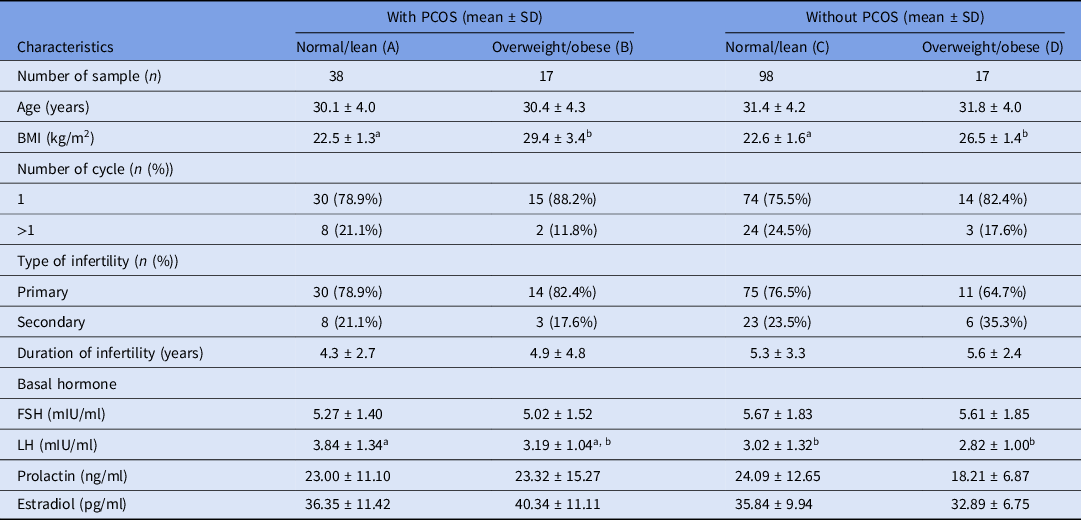
Baseline characteristics of PCOS and patients without PCOS are shown in Table 1. No differences were found in age, infertility type, number of ICSI cycles, type of infertility, and duration of infertility. There were significantly higher basal LH levels in group A compared with groups C and D (P < 0.01).
Baseline characteristics of normal/lean and overweight/obese patients with or without PCOS

a,b Different superscripts denote statistical difference (P < 0.01).
Ovarian stimulation parameters and IVF outcomes
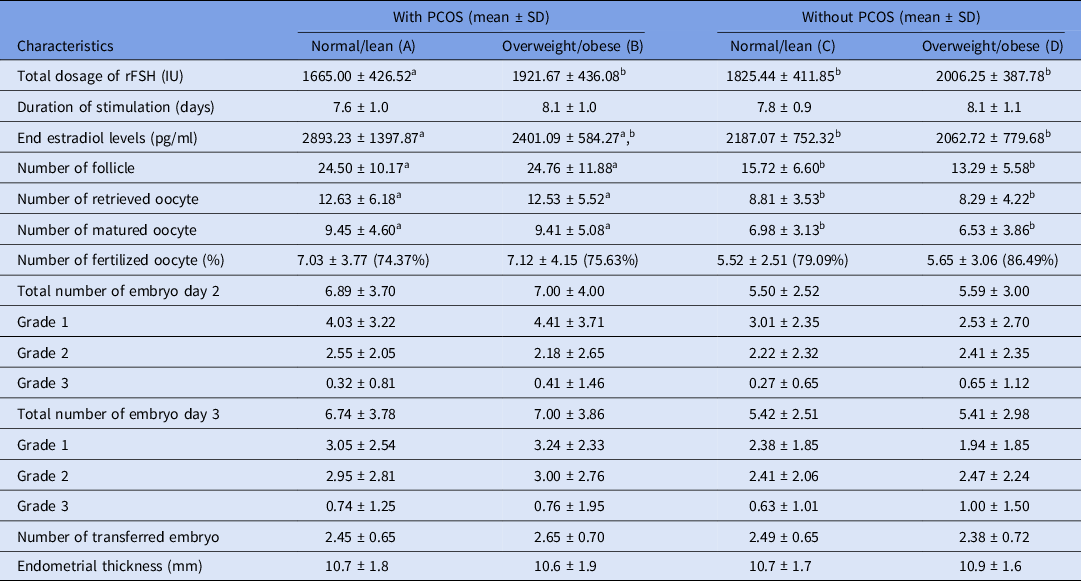
Total dosage of rFSH required was significantly lower in group A compared with groups B, C and D (P < 0.01) with end estradiol levels significantly higher in group A compared with groups C and D (P < 0.001; Table 2). There was no difference in duration of stimulation (days) among groups. There were, however, significantly higher numbers of follicles, retrieved oocytes, and matured oocytes in PCOS groups compared with the non-PCOS groups (P < 0.001), the number of fertilized oocytes did not differ significantly (Table 2). Moreover, there were no significant differences in the number of high-quality embryos on day 2 and day 3 among groups (Table 2). There was a slightly lower implantation rate in the overweight/obese non-PCOS group, however it was not significant compared with any other groups (Table 3). There was no significant difference in live birth rate among groups.
Ovarian response and embryo development of normal/lean and overweight/obese patients with or without PCOS

a,b Different superscripts denote statistical difference (P < 0.01).
ICSI Outcomes of normal/lean and overweight/obese patients with or without PCOS

Discussion
ICSI, which is part of the IVF treatment, could be an option for patients with PCOS to achieve pregnancy. The success of ICSI is not only influenced by uterus receptivity, but also by the quality of oocytes and development of embryos. Several studies have reported that obesity affects the quality of oocytes, embryos, and pregnancy rates in patients with or without PCOS (Dokras et al., Reference Dokras, Baredziak, Blaine, Syrop, Van Voorhis and Sparks2006; Bu et al., Reference Bu, Dai, Guo, Su, Zhai and Sun2013; Bailey et al., Reference Bailey, Hawkins, Missmer, Correia and Yanushpolsky2014; Huang et al., Reference Huang, Liao, Dong and Zhang2014; Kalem et al., Reference Kalem, Kalem, Sari, Ates and Gurgan2016; Wang et al., Reference Wang, Dai, Yang, Guo and Sun2016; Rehman et al., Reference Rehman, Mehmood, Ali, Shaharyar and Alam2018). In this study, we compared the success rate of ICSI in patients with PCOS and further classified whether obesity status would be exaggerated by the presence of PCOS, which compromises ovarian stimulation response and ICSI outcomes, such as embryo development, pregnancy, and live birth rates. We also examined these outcomes in overweight/obese patients without PCOS as controls to observe the effect of overweight/obesity itself.
In this present study, we observed that the normal/lean type patients with PCOS had higher basal LH levels compared with the non-PCOS groups. These results are similar to findings in previous studies that reported a significantly higher basal LH level in PCOS groups compared with non-PCOS groups (Beydoun et al., Reference Beydoun, Stadtmauer, Zhao, Russell, Matson and Oehninger2009; Wang et al., Reference Wang, Dai, Yang, Guo and Sun2016). Differences in basal LH obtained in this study, and in some previous studies, were consistent with the theory that LH levels in PCOS increased due to the disrupted production of GnRH (Kini, Reference Kini2012).
In this study the total dosage of rFSH given was significantly lower in normal/lean patients with PCOS compared with other groups. These results were consistent with previous studies that reported that the dosage of gonadotropin given in the normal/lean PCOS group tended to decrease compared with the levels in patients from the overweight/obese PCOS group to avoid the risk of ovarian hyperstimulation syndrome (OHSS) (Fedorcsak et al., Reference Fedorcsak, Storeng, Dale, Tanbo, Torjesen, Urbancsek and Abyholm2000). Obesity in patients with PCOS also affected ovarian stimulation during IVF and may be due to high intra-follicular concentrations of leptin produced by adipose tissue that cause relative gonadotropin resistance (Fedorcsak et al., Reference Fedorcsak, Storeng, Dale, Tanbo, Torjesen, Urbancsek and Abyholm2000; O’Neill et al., Reference O’Neill, Senapati and Dokras2015).
Based on the number of follicles, there was a significantly higher follicle number in PCOS groups than in non-PCOS groups. In PCOS, high LH levels trigger the formation of androgen hormones, which in turn cause follicular atresia. This causes anovulation, and triggers an increase in the number of small follicles. In addition, it is thought that increasing levels of anti-Müllerian hormone (AMH) play a role in the cessation of follicular development (Wilson, Reference Wilson2008; Rehman et al., Reference Rehman, Mehmood, Ali, Shaharyar and Alam2018; Kriedt et al., Reference Kriedt, Alchami and Davies2019).
Even though the numbers of follicles, retrieved oocytes, and matured oocytes were higher in the PCOS groups, the numbers of fertilized oocytes and high-quality embryos were the same between the PCOS groups and non-PCOS groups; this meant that more oocytes in patients with PCOS are not useable. This may happen because the quality of retrieved oocytes in patients with PCOS is compromised compared with patients without PCOS, such as decreasing the mitochondrial deoxyribonucleic acid (mtDNA) and disruption of mitochondrial structure in oocytes (Jia et al., Reference Jia, Li, He, Jia, Niu, Wang and Zhao2016).
Looking at pregnancy, implantation, and live birth rates, there were no differences among groups. These results are similar to previous studies that showed that there were no differences in success rates of IVF/ICSI between patients with or without PCOS (Beydoun et al., Reference Beydoun, Stadtmauer, Zhao, Russell, Matson and Oehninger2009; Jia et al., Reference Jia, Li, He, Jia, Niu, Wang and Zhao2016; Kriedt et al., Reference Kriedt, Alchami and Davies2019). In this present study, obesity also does not affect the success rate of ICSI in PCOS groups and non-PCOS groups, however obesity was related to an increased gonadotropin requirement. A previous study from Kalem et al. (Reference Kalem, Kalem, Sari, Ates and Gurgan2016) showed there were a significant reduction in retrieved oocytes and matured oocytes in obesity PCOS compared with lean PCOS. Moreover, Bailey et al. (Reference Bailey, Hawkins, Missmer, Correia and Yanushpolsky2014) showed obese patients with PCOS had decreased clinical pregnancies and live birth rates compared with lean patients with PCOS. In our study, the obesity effect could not be obvious because we had a very small sample size of obese patients (BMI ≥30 kg/m) in the PCOS group (n = 4) and control group (n = 5), and so combined the overweight and obese patients for each of these two groups. We found a decrease in the clinical pregnancy rate in overweight/obese patients without PCOS compared with normal/lean patients without PCOS, but this was not statistically significant. A study from Dokras et al. (Reference Dokras, Baredziak, Blaine, Syrop, Van Voorhis and Sparks2006) showed that morbidly obese patients without PCOS (BMI ≥40 kg/m2) had a higher cycle cancellation rate compared with normal/lean patients without PCOS, but they also showed no significant differences in live birth rates.
On IVF procedure, ovarian induction by a gonadotropin (rFSH) analogue resulted in a large number of retrieved oocytes, but could cause OHSS, therefore reducing the dosage could overcome this risk. Obese patients with PCOS required a higher dosage of gonadotropin compared with normal/lean patients with PCOS. We suggest that BMI status needs to be considered in patients with PCOS who undergo IVF treatment to achieve optimal outcomes. Even though the success rates of ICSI in PCOS did not differ significantly compared with the non-PCOS groups, prospective cohort studies with primary data are needed to show the causal factor that impacts the similarly high-quality embryo and pregnancy rates between PCOS and non-PCOS groups. The limitation of this study was the small sample size.
To conclude, normal/lean patients with PCOS require lower gonadotropin dosages. Obesity did not affect the success rate of ICSI, however it tended to increase the gonadotropin dosage needed in PCOS groups. Oocyte quality in patients with PCOS may be compromised compared with patients without PCOS, however no differences in pregnancy, implantation, and live birth rates were observed among groups. Future studies with bigger data samples are required to examine the effects of PCOS and obesity on long term health.
Acknowledgements
The authors would like to thank the Bali Royal Hospital (BROS) for provide the data and G.K. Heinemann for checking the manuscript for grammatical errors.
Financial support
None.
Conflicts of interest
None
Ethical standards
The authors assert that all procedures contributing to this work complied with the ethical standards of the relevant national and institutional committees on human experimentation and with the Helsinki Declaration of 1975, as revised in 2008. This research was approved by the local ethics committee of Udayana University (156/UN14.2.2.VII.14/LP/2019).