Introduction
Sudden sensorineural hearing loss (SNHL) is an otological emergency which afflicts approximately 5 to 20 per 100 000 patients annually in the United States.Reference Byl1 The true prevalence of sudden SNHL may actually be greater than reported, as some patients recover spontaneously within a few hours or days.Reference Simmons2 Diagnosis is usually based on patient history and on laboratory, audiological and imaging investigations, together with a high degree of clinical suspicion on the part of the physician. The audiological definition of sudden SNHL is a hearing loss of more than 30 dB in more than three contiguous frequencies over more than three days, in a healthy individual.Reference Wilson, Byl and Laird3
Proposed theories of the pathogenesis of idiopathic sudden SNHL include viral cochleitis,Reference Wilson, Veltri, Laird and Sprinkle4 vascular occlusionReference Horn, Himel and Selesnick5 and membrane disruption.Reference Simmons6 A recent review of autopsies of 27 casesReference Merchant, Adams and Nadol7 found that cases without recovery of hearing all shared a common abnormality, i.e. atrophy of the hair cells and the supporting cells of the organ of Corti, together with variable involvement of other structures, and without fibrous or osseous proliferation in the inner ear. The histopathological data do not support the theories of membrane disruption or perilymphatic fistulae. The hallmark of vascular insult to the cochlea is deposition of connective tissue and new bone,Reference Schuknecht8 which was observed in only two of 27 ears with idiopathic sudden SNHL.Reference Merchant, Adams and Nadol7 Evidence of direct viral invasion or infection of the inner ear is controversial. Recently, a new hypothesis has been suggested implicating pathological activation of cellular stress pathways, involving nuclear factor-kB within the cochlea. Pathologic activation of nuclear factor-kB can result in production of inflammatory cytokines and other stress-related proteins, which can disrupt the homeostatic balance of a cell or tissue.Reference Merchant, Adams and Nadol7 The use of new treatment modalities which counteract both the reported histopathology changes of idiopathic sudden SNHL and various possible pathogenetic factors may result in improved recovery rates.
Sudden SNHL is a unilateral process in 98 per cent of patients, with complete, spontaneous recovery being reported in between 32 and 65 per cent of cases.Reference Byl1, Reference Wilson, Veltri, Laird and Sprinkle4, Reference Mattox and Simmons9 Recovery rates depend largely on one's definition of ‘recovery’.
The literature on treatment of sudden SNHL includes therapies as diverse as carbogen inhalation, vasodilators, plasma expanders, diuretics, anticoagulation, magnesium, vitamins, benzodiazepines, intratympanic dexamethasone and combination therapy. In the United States, the use of corticosteroids as standard therapy is based on evidence from a 1980, placebo-controlled, double-blinded study by Wilson and colleagues.Reference Wilson, Veltri, Laird and Sprinkle4 Unfortunately, corticosteroids have multi-system adverse effects well known to clinicians and even to the public, e.g. gastrointestinal, endocrinal, neurological, cardiovascular, ophthalmic, haematological and musculoskeletal.Reference Doyle, Bauch, Battista, Beatty, Hughes and Mason10 Despite the current lack of evidence to support newer theories of sudden SNHL aetiology, such theories may still aid the development of new, safer treatment modalities.
Ozone (O3) has a molecular weight of 48 Da and contains a large excess of energy in its molecule (03 ! 3/2 02 + 143 kJ/mole).Reference Travagli, Zanardi and Bocci11 Within the most commonly used range of ozone concentrations (10–40 µg/ml blood), there are two classes of compounds.
The first is represented by the fast-acting reactive oxygen species. The fundamental reactive oxygen species molecule is hydrogen peroxide, which is a non-radical oxidant able to act as an ozone messenger. In physiological amounts, these molecules act as regulators of signal transduction and represent important mediators of host defence and immune responses.
The second class of compounds is due to lipid oxidation products, and is measured as thiobarbituric acid-reactive substances, which have a relatively long half-life and act mainly on parenchymal cells. Lipid oxidation products exert a neuroimmunomodulatory effect, with an associated feeling of well-being being reported by patients during ozone therapy.Reference Travagli, Zanardi and Bocci11–Reference Bocci13
Both classes of ozone compounds activate several biochemical, immunological and pharmacological mechanisms which mediate the biological and therapeutic effects of ozone.Reference Bocci13
According to the newer theories of sudden SNHL aetiology, the use of ozone may have therapeutic efficacy, as follows.
Ozone therapy is useful in treating both acute and chronic viral infections, because the reactive oxygen species generated are natural and effective agents which viral pathogens cannot resist.Reference Madej, Plewka, Madej, Nowak, Plewka and Franik14 Moreover, ozone therapy results in improvement in metabolic and immunological function, further contributing to a favourable outcome following acute viral infections. In this respect, ozone therapy may be effective in terms of the viral cochleitis theory of sudden SNHL.
Ozone therapy leads to an increase in levels of 2,3-diphosphoglycerate in oxyhaemoglobin, which shifts its dissociation curve to the right, increasing O2 delivery to hypoxic tissues. In this way, ozone therapy may be effective in terms of the vascular occlusion theory of sudden SNHL aetiology.Reference Di Paolo, Bocci, Salvo, Palasciano, Biagioli and Meini15
After ozonation, H2O2 freely diffuses into the cytoplasm and activates specific protein kinases which, by phosphorylating I[kappa]B bound to nuclear factor-kB, regulate its action and allow migration of the transcription heterodimer P50–P65 into cell nuclei, where it activates gene expression.Reference Di Paolo, Gaggiotti and Galli16 Ozone also induces up-regulation of antioxidant enzymes in several cell types, which effectively re-equilibrates the oxidant–antioxidant imbalance.Reference Di Paolo, Gaggiotti and Galli16 Therefore, ozone therapy may be effective in terms of the cellular stress hypothesis of sudden SNHL.
The aim of the present study was to investigate the safety and efficacy of ozone therapy in adult patients with sudden SNHL.
Material and methods
Study design
This randomised, double-blinded, placebo-controlled, clinical trial was conducted at Menoufiya University Hospital, Egypt.
Subjects
Forty-five patients with a clinical diagnosis of idiopathic sudden SNHL (according to the audiological definition of the condition)Reference Wilson, Byl and Laird3, Reference Wilson, Veltri, Laird and Sprinkle4 were enrolled in the present study between October 2004 and December 2006.
Men and women aged more than 18 years who were willing to give informed consent and to comply with the study protocol were eligible for enrolment if they had unilateral, acute onset hearing loss of greater than 30 dB in more than three contiguous frequencies over more than three days. The duration between the onset of hearing loss and the onset of treatment was less than one month. Enrolled patients also had no identifiable cause of hearing loss, as determined clinically and via investigation, and had no cranial nerve defects.
Patients were excluded if they had bilateral sudden SNHL, medical co-morbidities which contraindicated ozone therapy (e.g. thyrotoxicosis, favism, renal diseases or pregnancy). Patients with a known cause of sudden SNHL were excluded, e.g. Ménière's disease, idiopathic perilymphatic fistula, vestibular schwannomas, chronic otological disease or other pathological otoscopic findings. Patients were also excluded if they had any degree of hearing loss on the contralateral side. Other exclusion criteria included systemic co-morbidities (e.g. hypertension, diabetes or severe upper respiratory infection) and malignancy.
The study was conducted in accordance with good clinical practice rules, and was approved by the ethical committee of the Menoufiya University Hospital. All patients gave informed consent before initiation of study procedures.
During the initial interview, all patients underwent detailed medical history-taking and physical examination. The medical history included the onset and course of hearing loss, the presence of associated symptoms (e.g. tinnitus and vertigo), and symptoms caused by other cranial nerve deficits. Complete audiometric examination (including pure tone audiometry, speech audiometry and impedance audiometry) was performed at the initial visit.
Intervention
A master randomisation schedule was prepared by a worker not associated with the study, using permutated blocks of random numbers. The ozone infusion and the sterile, distilled water, placebo infusion were prepared by a qualified anaesthetist, who also acted as ozone therapy consultant to the study authors. The bottles containing ozone or placebo were serially numbered in a random fashion by a chemist not involved with the study. The serial number of the infusion corresponded to the serial number of the patient.
Patients were asked not to smoke or drink caffeinated beverages during the treatment course.
The study group (30 patients) underwent ozone therapy using auto-haemotherapy, the most commonly used technique. The procedure consisted of withdrawal of 100 ml of blood from the patient and then immediate treatment of the blood, for at least 5 minutes, with a gaseous mixture of 1:1 volume oxygen and ozone (the latter withdrawn by syringe from an ozone generator (LC Series, Corotec, Farmington, Connecticut (CT), USA)).Reference Di Paolo, Bocci, Salvo, Palasciano, Biagioli and Meini15 Citrate was used as an anticoagulant. The blood–gas mixture was then injected back into the patient by intravenous infusion.Reference Di Paolo, Bocci, Salvo, Palasciano, Biagioli and Meini15
The placebo group (15 patients) received an intravenous infusion of sterile, distilled water. Patients in this group had blood withdrawn before receiving intravenous sterile water. The collected blood was treated with citrate, labelled and stored in the blood bank by a worker not involved in the study. In the fifth and 10th sessions, patients received their stored blood instead of distilled water.
Ozonation of withdrawn blood was performed in a separate room (not the treatment room) by a technician not involved in the study. The ozonated blood bags (or the distilled water) and the infusion sets were covered with foil and labelled. Thus, the infusion contents were not apparent to the nurse (who administered the infusion protocol) or the patient. In this way, the patients, clinicians and treatment response assessors were unaware of the treatment allocation, i.e. the study was double-blinded.
Disposable equipment was used, including the syringe with which ozone was withdrawn from the generator and the sterile infusion set used to inject the blood–gas mixture. We performed two sessions per week for a total of 10 sessions, as per the ischaemia regimen of ozone therapy.Reference Di Paolo, Bocci, Salvo, Palasciano, Biagioli and Meini15
Outcome evaluation
Outcome was evaluated after the fifth and 10th treatment sessions. Patients who improved before completing all treatment sessions were advised to receive all 10 treatments.
The outcomes measures were as follows.
The first outcome measure was hearing gain, measured in decibels by pure tone audiometry at 0.5, 1, 2, 3 and 4 kHz for bone conduction and at 0.5, 1, 2, 3, 4 and 8 kHz for air conduction. The degree of recovery, indicated by hearing gain in decibels, was divided into three grades: good (i.e. hearing recovery >20 dB), fair (hearing recovery 5–20 dB) and poor (hearing recovery <5 dB).
The second outcome measure was pure tone averages (PTAs), defined as the average of thresholds at 0.5, 1, 2 and 3 kHz. The degree of recovery, as indicated by the final measurement after treatment completion, was divided into three grades: complete (i.e. final PTA <25 dB), incomplete (i.e. hearing improved but not to the level of complete recovery) and poor (i.e. no obvious hearing improvement (PTA <5 dB)).
The third outcome measure was speech reception threshold, measured in decibels. Improvement in this measure was graded in the same manner as PTA recovery.
The fourth outcome measure was speech discrimination level, expressed as a percentage. This measure was graded as improvement (i.e. >20 per cent increase in speech discrimination score) or no improvement (i.e. <20 per cent increase in speech discrimination score, or none).
The fifth outcome measure was subjective recovery, graded as complete, significant improvement or no improvement.
Clinical variables vs hearing outcomes
Data were collected on a number of clinical variables, in order to investigate their relation to hearing recovery following idiopathic sudden SNHL. These variables included: age; gender; time between onset of hearing loss and instigation of treatment; presence of other symptoms (e.g. tinnitus); initial degree of hearing loss (mild, 25–40 dB; moderate, 40–55 dB; moderately severe, 55–70 dB; severe 70–90 dB; or profound, >90 dB); and audiogram shape.
Analysis
All data were entered into a database by independent statistics personnel. Data were recorded on standard forms, entered into a microcomputer, edited and statistically analysed using the Statistical Package for the Social Sciences version 12.0 software. The chi-square test was used to study associations between two qualitative variables. A continuity correction was used for 2 × 2 chi-squared. Fisher's exact test was used for a 2 × 2 table when the expected frequencies were small. The level of significance for the exploratory analysis was 0.05.
Results
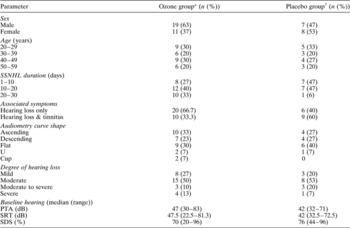
Forty-five patients were enrolled in the present study. The mean patient age was 39.7 years; the range was 20 to 59 years. Patient demographic and clinical data are presented in Table I.
Patients with sudden SNHL: demographic and clinical data

* n = 30; †n = 15. SSNHL = sudden sensorineural hearing loss; PTA = pure tone average; SRT = speech reception threshold; SDS = speech discrimination score
Outcome measurements
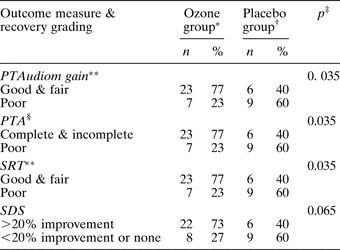
After treatment, the degree of hearing recovery as measured by hearing gain grades was significantly greater in ozone-treated patients compared with placebo-treated patients (p = 0.035) (Table II). Significant hearing recovery as assessed by PTA was observed in 23 (77 per cent) ozone-treated patients, compared with six (40 per cent) placebo-treated patients (p = 0.035) (Table II).Reference Wilson, Byl and Laird3, Reference Weng, Chen, Hsu and Tseng17 The post-treatment PTA was significantly more improved in ozone-treated patients compared with placebo-treated patients (p = 0.035) (Table II). Post-treatment speech reception thresholds were significantly more improved in ozone-treated patients compared with placebo-treated patients (p = 0.035). However, post-treatment speech discrimination levels were not significantly different in ozone-treated patients compared with placebo-treated patients (p = 0.065) (Table II).
Hearing recovery outcome measurements in sudden SNHL patients treated with ozone vs placebo

* n = 30; †n = 15. ‡By continuity correction chi-square test. **Recovery graded as good in 12 (40%) ozone-treated patients and three (20%) placebo-treated patients, and as fair in 11 (37%) ozone-treated patients and three (20%) placebo-treated patients. §Recovery graded as complete in 14 (47%) ozone-treated patients and two (13%) placebo-treated patients, and as incomplete in nine (30%) ozone-treated patients and four (27%) placebo-treated patients. SNHL = sensorineural hearing loss; PTAudiom = pure tone audiometry; PTA = pure tone average; SRT = speech reception threshold; SDS = speech discrimination score
Results for pure tone thresholds, PTA, speech reception thresholds and speech discrimination scores were internally consistent in recovered patients treated with ozone (22/23; 96 per cent), except for one patient (1/23; 4 per cent) who had a dramatic improvement in pure tone thresholds without any improvement in speech discrimination.
A subjectively determined significant recovery was reported by significantly more ozone-treated patients (22/30; 73 per cent) compared with placebo-treated patients (6/15; 40 per cent) (p = 0.03). Patients' subjective improvement was consistent with other measured outcomes. Twenty-eight patients (93 per cent) reported a subjective improvement after the 10th ozone treatment session; one patient (3 per cent) reported improvement after the fifth session and one (3 per cent) after the third session. All patients continued their treatment protocol for 10 sessions, except for one patient from the ozone group who reported complete recovery after the fifth session; this patient ceased treatment after the eighth session, with the same level of recovery.
Clinical variables vs hearing outcomes
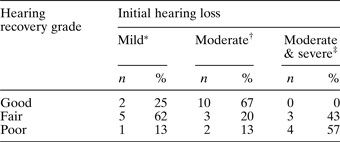
No statistically significant differences in hearing outcome were observed, comparing ozone- and placebo-treated patients, in relation to age, sex, time between onset of hearing loss and instigation of treatment, presence of other symptoms (e.g. tinnitus), and audiogram shape. In ozone-treated patients, the degree of hearing recovery was related to patients' initial level of hearing loss. Good hearing recovery was identified in 10/15 (67 per cent) ozone-treated patients with moderate initial hearing loss (Table III). Fair hearing recovery was obtained in five of eight (62 per cent) ozone-treated patients with mild initial hearing loss.
Hearing recovery grade by initial hearing loss, in sudden SNHL patients treated with ozone

* n = 8; †n = 5; ‡n = 7.
The small group sizes mean that non-significant results should be interpreted with caution.
Discussion
The efficacy of sudden SNHL treatment is difficult to study, for many reasons. Because of the high rate of spontaneous resolution,Reference Weng, Chen, Hsu and Tseng17 well controlled studies which compare patients randomised to receive either treatment or placebo are essential in order to document treatment-related improvement. The dearth of well controlled studies of sudden SNHL gives added weight to those that do exist.Reference Eisenman and Arts18 The low incidence of the disease is another obstacle to such research. This low disease incidence, together with strict inclusion and exclusion criteria, forced the authors of the present study to accept a small study size and an allocation ratio of 2:1 (treatment:placebo). Although both constitute a limitation of the present study, the absence of any difference in significant prognostic features between both groups decreases the risk of such an allocation ratio.
Although more of the placebo group patients reported tinnitus at the outset of the study, opinions on the value of this symptom in sudden SNHL are inconsistent.Reference Wilson, Byl and Laird3, Reference Mattox and Simmons9, Reference Weng, Chen, Hsu and Tseng17, Reference Eisenman and Arts18 While tinnitus does not appear to affect the outcome of sudden SNHL, many authors consider it a favourable prognostic sign.Reference Wilson, Byl and Laird3, Reference Eisenman and Arts18 Its presence may indicate that the cells were still functioning and therefore may recover.
High level evidence, such as that derived from a well conducted randomised, controlled trial, is rare enough, but such a novel positive finding is even better. In the current study of sudden SNHL, the use of ozone therapy resulted in significantly improved rates of hearing recovery (77 per cent), compared with placebo treatment (40 per cent). We surmise that this high success rate in ozone-treated patients was due to the congruence between its mechanism of action and the disease pathophysiology. We used multiple methods to measure hearing outcome, in order to comprehensively assess our patients' response to the novel treatment. The mean hearing gain, PTA, SRT and subjective recovery rates improved significantly in Ozone treated patients versus placebo.
Over the past few years, many authors have studied different drug treatment modalities for sudden SNHL, and have reported differing cure rates. Wilson et al. Reference Wilson, Byl and Laird3 conducted the only randomised, controlled trial of oral steroids compared with placebo treatment, resulting in oral steroids being adopted as standard US care for sudden SNHL; they found a 73 per cent recovery rate for patients with moderate hearing loss, compared with 58 per cent for an untreated control group. Aoki et al. Reference Aoki, Takegoshi and Kikuchi19 used a much higher dose of corticosteroid (1200 mg hydrocortisone, tapered over a three-week period) and observed a higher hearing recovery rate (87 per cent). However, the benefits of using corticosteroids as standard treatment of sudden SNHL must be weighed against their multiple side effectsReference Choung, Park, Shin and Cho20 and relative contraindications.Reference Choung, Park, Shin and Cho20, Reference Xenellis, Papadimitriou, Nikolopoulos, Maragoudakis, Segas and Tzagaroulakis21 In contrast, our use of ozone therapy (which has limited contraindications) resulted in a higher cure rate, together with no identifiable side effects or hazards during or after the treatment regimen.
Recently, many authors have investigated the use of intratympanic steroid therapy, in an attempt to avoid systemic side effects. Their hearing improvement results have been variable: 39 per cent when used after failure of an oral steroid regimen;Reference Choung, Park, Shin and Cho20 44 per cent when used as primary treatment;Reference Gianoli and Li22 48 per cent when used after failed intravenous steroids;Reference Xenellis, Papadimitriou, Nikolopoulos, Maragoudakis, Segas and Tzagaroulakis21 and 12 per cent when used for profound hearing loss.Reference Battista23 All these results represented limited success equivalent to that of placebo. The success rate of the present study exceeds those of all previous studies of intratympanic steroid injection, and was achieved without the hazards of intratympanic injection (e.g. temporary dizziness, tympanic membrane perforation, and otitis media due to stimulating the middle-ear mucosa).Reference Choung, Park, Shin and Cho20, Reference Gianoli and Li22
Previous studies have investigated the addition of antiviral medications to steroids; however, no additive effect on patient recovery has been observed (e.g. 50 per cent in Tucci and colleagues' study,Reference Tucci, Farmer, Kitch and Witsell24 and 78 per cent in Uri and colleague's studyReference Uri, Doweck, Cohen-Kerem and Greenberg25).
The addition of oral magnesium to traditional steroid treatment of idiopathic sudden SNHL may enhance hearing recovery. Gordin et al. Reference Gordin, Goldenberg, Golz, Netzer and Joachims26 found that addition of MgSO4 to carbogen resulted in a success rate of 66 per cent, compared with 50 per cent for carbogen alone.
The use of ozone, with its higher hearing improvement cure rate, had been demonstrated to stimulate cellular metabolism by accelerating glucose use, improving protein metabolism, converting unsaturated fatty acids into hydrosoluble compounds and increasing erythrocyte activity (i.e. increasing production of 2,3–diphosphoglycerate). It could thus be effective in terms of the cellular stress hypothesis of sudden SNHL.Reference Travagli, Zanardi and Bocci11, Reference Madej, Plewka, Madej, Nowak, Plewka and Franik14
The use of vasodilators has been proposed for the treatment of sudden SNHL, with the rationale of promoting blood flow and reversing the presumed vasospasm.Reference Gordin, Goldenberg, Golz, Netzer and Joachims26 However, the addition of vasodilators to steroid treatment for sudden SNHL has no favourable effect on hearing recovery.Reference Psifidis, Psillas and Daniilidis27 Systemic vasodilators do not appear to increase cerebral blood flow in vivo, and may in fact decrease blood flow to the inner ear. Ozone has been documented to affect the erythrocyte oxyhaemoglobin dissociation curve, and to have a vasodilator effect due to liberation of the endothelial relaxing factor NO. Both these effects enhance O2 supply to the tissues and correct the hypoxia of ischaemic areas, e.g. the inner ear.Reference Bocci13
Other treatment modalities have been tested, but with limited success; for example, 50 per cent for defibrinogenation therapy.Reference Suzuki, Furukawa, Kumagai, Takahashi, Matsuura and Katori28
The present study investigated the relation of various clinical variables to hearing recovery following sudden SNHL. The study findings clearly indicated the value of ozone treatment, regardless of duration of sudden SNHL. Results for ozone treatment of sudden SNHL compared favourably with those for some alternative treatment modalities, e.g. intratympanic dexamethasone or defibrinogenation therapy.Reference Simmons2, Reference Choung, Park, Shin and Cho20, Reference Suzuki, Furukawa, Kumagai, Takahashi, Matsuura and Katori28 In contrast, the findings of the present study do not match those for some other methods (e.g. antivirals, antivirals plus steroids, or vasodilator plus steroids) reported to significantly improve hearing outcomes following early presentation of sudden SNHL.Reference Xenellis, Papadimitriou, Nikolopoulos, Maragoudakis, Segas and Tzagaroulakis21, Reference Uri, Doweck, Cohen-Kerem and Greenberg25, Reference Psifidis, Psillas and Daniilidis27
When studying the effect of prognostic factors on hearing recovery following sudden SNHL, a greater controversy surrounds the significance of associated symptoms (such as tinnitus and vestibular symptoms). In the present study, tinnitus was not observed to have any effect on hearing recovery in ozone-treated patients. This finding is consistent with other sudden SNHL studies using different treatment modalities, e.g. steroids with antivirals,Reference Zadeh, Storper and Spitzer29 intratympanic steroid injection,Reference Choung, Park, Shin and Cho20 steroids with carbogen inhalation,Reference Cinamon, Bendet and Kronenberg30 very high dose steroid therapyReference Aoki, Takegoshi and Kikuchi19 and defibrinogenation therapy.Reference Suzuki, Furukawa, Kumagai, Takahashi, Matsuura and Katori28
In the present study, patients' initial degree of hearing loss significantly affected the clinical outcome of their treatment, comparing ozone- vs placebo-treated patients. This may be an effect of the size of the cochlear pathological lesion; there may be a minimal cochlear lesion size which can be corrected or reversed by treatment. This concept may also affect the efficacy of other treatment modalities, e.g. intratympanic steroids,Reference Xenellis, Papadimitriou, Nikolopoulos, Maragoudakis, Segas and Tzagaroulakis21, Reference Slattery, Fisher, Iqbal, Friedman and Liu31 antivirals plus steroids,Reference Tucci, Farmer, Kitch and Witsell24 and defibrinogenation therapy.Reference Suzuki, Furukawa, Kumagai, Takahashi, Matsuura and Katori28
• Proposed theories of the pathogenesis of idiopathic sensorineural hearing loss (SNHL) include viral cochleitis, vascular occlusion and membrane disruption
• Recently, a new hypothesis has been suggested implicating pathological activation of cellular stress pathways, involving nuclear factor-kB within the cochlea
• Multiple therapies exist for the treatment of sudden SNHL, but there is little evidence for their efficacy
• This paper describes the use of ozone therapy in idiopathic sudden SNHL
• Initial results are encouraging and deserve further clinical investigation
The majority of studies investigating other treatment modalities for sudden SNHL considered low frequency SNHL to have a better prognosis than high frequency loss, regardless of the method of treatment. This can be seen clearly in studies of steroids combined with magnesium,Reference Gordin, Goldenberg, Golz, Netzer and Joachims26 with antiviralsReference Tucci, Farmer, Kitch and Witsell24 and with vasodilators,Reference Psifidis, Psillas and Daniilidis27 and in studies of intratympanic corticosteroids.Reference Xenellis, Papadimitriou, Nikolopoulos, Maragoudakis, Segas and Tzagaroulakis21 One of the advantages of ozone therapy is its positive effect regardless of the type of hearing loss. This effect may be due to the multiple actions of ozone, throughout the auditory pathway at both cellular and organ levels, and via improved metabolic processing, immunomodulation and cytoprotection.
Conclusion
Ozone therapy is a significant treatment modality for idiopathic sudden SNHL. The present study found a statistically significant improvement in hearing recovery, comparing ozone-treated patients (77 per cent) with placebo-treated patients (40 per cent), without complications.