


1. Introduction
In the first Introduction of the Critique of the Power of Judgement, Kant introduces a new kind of autonomy to describe the legislative working of the judgement of taste – heautonomyFootnote 1 (see FI, 20: 225, compare CPJ, 5: 185–6, 288).Footnote 2 Unlike the autonomy of understanding and the autonomy of reason, which give laws to nature and freedom, respectively, the power of aesthetic judgement gives law solely to itself. In the two former cases, autonomy is objectively valid since the determining ground is a determinate concept/law. In the latter case, autonomy is ‘merely subjectively valid’, since the determining ground can ‘only be given in the feeling of pleasure’ (FI, 20: 225). With the Greek prefix ‘he’ as a third-person reflexive pronoun, Kant emphasizes the reflexivity of self-legislation (see van Emde Boas et al. Reference van Emde Boas, Rijksbaron, Huitink and de Bakker2018: 91, also Floyd Reference Floyd and Parret1998: 205). This leads to two problems. First, when he initially uses the concept of ‘autonomy’, and most significantly in moral philosophy, it already means a reflexive self-legislation, insofar as will is the author of the law and also subject to the law (see G, 4: 431, also CPrR, 5: 33).Footnote 3 With this in mind, exactly what specific kind of reflexivity is he talking about in terms of the heautonomy of taste? Is this reflexive structure of legislation necessarily connected with the aesthetic characteristic of judgements of taste? Second, in the published version of the Introduction, Kant does not limit the designation of heautonomy to aesthetic judgements any more but uses this concept to describe the working of the cognitive reflective judgement in a general (see CPJ, 5: 185). Thus, we face the questions, how can this kind of reflective judgement be determined and how does its self-legislation structurally vary from the self-legislation of judgements of taste? These problems can be formulated as follows: What is the uniqueness of self-legislation in taste that distinguishes it from morality and cognition on the one hand and from cognitive reflective judgements on the other?
At the end of the Introduction of the Critique of the Power of Judgement, Kant notes that the higher faculties contain autonomy in the sense that they contain a priori principles. The understanding contains the a priori principle of lawfulness for the faculty of cognition, reason contains the principle of final end for the faculty of desire, and the power of judgement provides the a priori principle of purposiveness for the faculty of feeling of pleasure and displeasure in the judgement of taste (see CPJ, 5: 198, also FI, 20: 246). In cognitive and moral judgements, legislation is grounded in concepts of understanding and moral law, respectively, according to which the subsumption of the particular under the universal can be objectively determined. However, the judgement of taste and the feeling of pleasure that grounds it cannot be determined by any determinate concept. Instead, they arise from a reflected mental state – a free and harmonious play between the imagination and understanding. This peculiar manner of legislation of the power of judgement through the free correspondence of the faculties is, according to Kant, ‘a lawfulness without law’ (CPJ, 5: 241, see also 270, 287, 317–18, 319),Footnote 4 and this kind of lawfulness is also called an ‘aesthetic purposiveness’ (5: 270, 322, 347, also 317–18). Thus, the crucial problem of the self-legislation of judgements of taste is to explain how the free play of the faculties functions purposively, or how this particular lawfulness without law becomes possible.
There are numerous discussions of the free play of the faculties, some of which focus on lawfulness. In 2006, Paul Guyer summarized different interpretations of the harmony of the faculties in terms of a division into three classes: precognitive, multicognitive, and metacognitive approaches. These approaches (and Guyer’s division) of the topic of free play are framed through their connection with cognition: the free play is considered as involving the first half of cognition where the last phaseFootnote 5 has not yet been completed; or a play among a multiplicity of cognitions on which one might settle in an eventual completion; or a completed empirical cognition that is the object of a cognition referring to a free play with regard to it. Hannah Ginsborg, whose interpretation can be classified as a precognitive approach, contributes an interpretation in terms of ‘lawfulness without a law’ (Reference Ginsborg1997: 74). She views this lawfulness as a primitive normativity that occurs not only in empirical cognition but also in the judgement of taste and explains it by considering the activity of the imagination as exemplifying a normative rule. Without doubt, a wealth of textual evidence shows that Kant’s argumentation regarding the universality of taste is grounded in the link with cognition, which justifies to some extent the above-mentioned approaches (see CPJ, 5: 217, 238–9, 289–90). However, there is a dilemma in these cognitive approaches: either the link is too strong, such that it can lead to an unacceptable conclusion that every cognitive object is beautiful (see Ginsborg Reference Ginsborg1997: 46; Allison Reference Allison2001: 187; Guyer Reference Guyer and Kukla2006: 172), or it is too weak, such that the conditions of cognition cannot provide ample justification for the universal validity of taste. Based on the weak connection problem, Guyer (Reference Guyer1997: 126) holds that Kant’s deduction of judgements of taste is not successful, and Allison (Reference Allison2001: 171) minimizes the aim of the deduction to the general possibility of judgements of taste rather than the legitimacy of individual judgements on particular occasions. Ginsborg’s interpretation partially resolves the tension between the autonomy of taste and its link with cognition by interpreting the imaginative activities as exemplary of rules and differentiating its free play from its governed activity under concepts in cognition. However, her interpretation has two problems: 1. her description of the free play does not truly give a reason why imagination and understanding go into this specific harmony and lawfulness, without any determination of concepts. After all, not every free play leads to harmony. Lacking an answer to this question, her interpretation cannot avoid the accusation of the stark connection problem. 2. She only focuses on the imaginative activity and downplays the function of understanding, which does not seem to be in accordance with Kant’s description of a reciprocal relationship of faculties in the free play. After all, ‘[u]nderstanding alone gives the laws’ (CPJ, 5: 241), so it must play an indispensable role in the lawful relationship.
I hold that these mainstream cognitive approaches are too external to explain the uniqueness of aesthetic heautonomy – the subjective condition for cognition in general is only a necessary but not a sufficient condition. I claim that aesthetic heautonomy can only be explained through an internal approach that focuses on the a priori principle of taste – subjective purposiveness. Although this principle is mentioned by most scholars, it is rarely thematized. As an exception, Rachel Zuckert emphasizes the principle of purposiveness (Reference Zuckert2007: 14), and she rightly points out the common future-directed structure of aesthetic experience and organic functions, which will be central to my own approach.Footnote 6 But I do not agree with her on three points: 1. she holds that the close connection of aesthetic with teleological judging lies in their common principle of purposiveness without a purpose. However, I think in the latter case, an intellectual purpose – a rational idea of the systematicity of nature or ‘a technique of nature’ (FI, 20: 205) – is presupposed.Footnote 7 In this sense, I do not think the ‘autonomy’ of teleological judgement truly deserves the name, since the application of reflective judgement is regulated by reason and so is not entirely independently self-legislative (see 20: 244). 2. Although I think her ‘objectivist’ (p. 181) interpretation of beauty is helpful and admit that consideration of actual characteristics of beautiful objects is of importance, I hold that the subjective aspect is more important and will focus on the free activities of the faculties in the subject’s mental state. As Kant says, ‘in such judging what is at issue is not what nature is or even what it is for us as purposive, but how we take it in’ (CPJ, 5: 350). Therefore, in contrast to Zuckert’s view that the purposiveness in taste is mainly exhibited in unifying distinct properties of objects as parts of a whole, I think it should be interpreted in terms of the reciprocal relationship between cognitive faculties (see Guyer Reference Guyer2009: 205). 3. Unlike Zuckert’s emphasis on the unity of the sensible properties of an object in aesthetic judging, which seems to be consequence-oriented, my interpretation is process-oriented. I think the purpose to be satisfied in the purposiveness in question is not to discern an order in diversity but to maintain harmonious mental activities.Footnote 8 In this sense, the critical point I advance in this article is that the purposiveness in judgements of taste is an internal one,Footnote 9 and this feature is the key to explaining the uniqueness of aesthetic heautonomy. This is because: 1. it explains why the harmonious play of imagination and understanding can be called a kind of lawfulness, that is, the internal purposiveness exemplarily determines the optimal proportion of the faculties in the free play; 2. it reveals how the reflexive self-legislation of the power of aesthetic judgement functions, that is, only when the purposiveness is for the use of the power of judgement itself, can the power of judgement be ‘both object as well as law’ (CPJ, 5: 288); and 3. it fully demonstrates the aesthetic characteristic of judgements of taste since Kant defines the aesthetic pleasure as ‘[t]he consciousness of the merely formal purposiveness in the play of the cognitive powers’ (5: 222).
Based on the similar principle of internal purposiveness in the cases of organisms and the judgement of taste, I use the self-formative structure of organisms to interpret the judgement of taste as a dynamically developing activity. The power of aesthetic judgement legislates to itself without given laws but finds and shapes its lawfulness as a self-discovering and self-formative determination in its own activity. This kind of autonomy can be regarded as a third kind of freedom between transcendental and practical freedom. On the one hand, aesthetic freedom has more positive content than the former as negative freedom; on the other hand, it is richer, more flexible, and more vital than the latter as positive freedom. Samuel Fleischacker also claims that the freedom of judgement is ‘a third concept of liberty’, which is ‘richer than the … negative liberty, and more sensible, as well as less dangerous, than the … positive liberty’ (Reference Fleischacker1999: 7). He uses the aesthetic power of judgement in political and moral judgement in the contemporary sense, which is much wider than Kant’s sense. I appreciate his creative employment of the aesthetic power of judgement in a broader sense and his treatment of it as guidance for us in seeking the purpose of our own lives.Footnote 10 However, my approach differs from his in a number of ways,Footnote 11 and I do not agree with him on two crucial points: 1. Like most scholars, he takes a cognitive approach to explaining aesthetic judgement. He holds that reflective and determining judgement are different sides of the same operation and that they always interplay with each other. In this sense, the only function of reflective judgement is to find a concept for the next stage of determining judgement. This might be true in empirical cognition but not in pure aesthetic judgement, which does not aim at a concept or necessarily generate one. 2. He understands ‘purposiveness’ as the systematicity of the world and the purpose to be satisfied as an objective purpose in the system of the world – although it is subjectively given. ‘Purposiveness without purpose’ is then the feeling as if we could see our purpose from a systematic perspective, and freedom of judgement means we can freely refine, alter, and transcend our currently blindly pursued purpose, and achieve harmony with the world. I value the dynamic process of seeking purpose in our life that he depicts but do not agree with him that the purpose to be satisfied in aesthetic judgement is an objective purpose in the system of the world – I think it is rather the judgement and the living subject itself, despite the importance of the latter’s being in a relationship with the world.
What follows comprises three sections. In section 2, I point out that the free play of the faculties does not necessarily lead to a purposive relationship and claim that only internal purposiveness, which concerns not merely the harmony of the faculties but also the self-maintenance of free play, constitutes the uniqueness of the judgement of taste. In section 3, I illustrate a temporally continuous and spirally developing structure in aesthetic experience through an analogy with the temporal structure in organisms. In section 4, I demonstrate that the self-legislation in the judgement of taste is a self-formative dynamic process and that the essential formative power behind this process is the power of life, which drives aesthetic agents to discover and determine the ways of life suitable to them. Based on these features of aesthetic heautonomy, I conclude in section 5, Kant’s aesthetic freedom can be regarded as a third kind of freedom that is different from and between transcendental and practical freedom.
2. The free play of faculties and internal purposiveness
Before delving into the concept of internal purposiveness, it is necessary to clarify a background question about the intentionality of pleasure in the judgement of taste. There are numerous discussions of this topic in Kantian scholarship (see Aquila Reference Aquila1979; Allison Reference Allison2001; Ginsborg Reference Ginsborg1990, Reference Ginsborg2003; Guyer Reference Guyer and Kukla2006; Zuckert Reference Zuckert2007; Cannon Reference Cannon2008). I cannot go into detail here, but only want to mark my position among these different theories. In a previous paper on this topic, I concurred with Aquila’s and Ginsborg’s ‘one act’ theory and their view on the intentionality of pleasure in a judgement of taste (see Aquila Reference Aquila1979, Ginsborg Reference Ginsborg1990; also Zuckert Reference Zuckert2007).Footnote 12 That is, I agreed that the act of free play of the faculties in a feeling of pleasure is identical to the act of reflection on the universal communicability of pleasure. Therefore, the act of judging something to be beautiful is a single and self-referential act that also claims its own universal validity and that is only manifested as a feeling of pleasure. I further claim that the intentionality of the feeling of pleasure concerns not only, in a cognitive sense, the purposiveness of the represented object for the subject’s judgement (belief) but also, in a conative sense, the self-maintenance of the mental state (desire). In terms of the legislative structure of the judgement of taste, my explanation also differs from Ginsborg’s external or ‘objective’ approach. I think we have to appeal to an a priori principle of the judgement of taste – subjective purposiveness.
When Kant talks about the principle of purposiveness, most of the time he uses the terms ‘subjective’ and ‘formal’ to describe it. By ‘subjective’, as opposed to ‘objective’, he means that it only concerns the subjective mental state but not the cognition of represented objects. This also indicates that the purposiveness can be determined empirically by feelings of pleasure but not by presupposed concepts. By using ‘formal’, Kant differentiates aesthetic from material purposiveness in satisfaction in the agreeable as well as in the good, where the suited purposes, whether sensible or intellectual, are already given. However, apart from these explicitly mentioned characteristics, there are some questions that are not explicitly addressed but are crucial for understanding this concept: 1. What is described as purposive in Kant’s work: nature, the represented object or the activity of cognitive faculties? 2. Whose purpose is served here: that of judgement, mental activity or the judging subject? 3. How is purposiveness without purpose possible, and how can the free play of faculties come into harmony? 4. What happens after the purposive accordance? Why do ‘we linger over the consideration of the beautiful without any further intention’ (CPJ, 5: 222) and why does the activity of the faculties maintain itself (see 5: 222, 242, 313), rather than come to an end with a cognitive achievement, such as in the acquisition of empirical concepts? The first two questions concern the different parties involved in this relationship, and the last two questions concern its dynamic mode and ground.
Within this frame, we can divide aesthetic purposiveness into three levels: 1. in terms of the parties involved, the representation of the object is purposive for the mental state of the subject, or for the judgement (see Allison Reference Allison2001: 53). Conversely, we can also say that our mental state is purposive for representing the object (see Ginsborg Reference Ginsborg1997: 71, also Allison Reference Allison2001: 128). 2. In terms of the interior mental state itself, and the two elements that compose the power of judgement as a whole, the harmonious interaction between imagination and understanding is reciprocally purposive. 3. But most importantly, as I shall claim, the harmony achieved in the free play of faculties is purposive for its own maintenance. These three levels connect with each other. The seemingly static relation in the first level can only be interpreted through the last two, which demonstrates its dynamic structure. To understand this structure, we begin with Kant’s theory of free play of the faculties.
Although I doubt that Guyer’s division of ‘precognitive’, ‘multicognitive’, and ‘metacognitive’, as an external description, can reveal the uniqueness of judgements of taste, if I have to pick a position among the three, I will take the multicognitive approach as a temporary choice – insofar as the ‘cognitive’ is only meant in a very weak way, that is, it refers only to conceptual possibilities but not real and objective cognition. Admittedly, our interpretation should operate within a cognitive framework, but it should also keep a distance from objective cognition – it does not matter if the free play occurs before or after cognition, since judgements of taste do not directly lead to nor are necessarily based on any concept or cognition. I agree with Allison in saying that ‘the imagination in its free play stimulates the understanding by occasioning it to entertain fresh conceptual possibilities, while, conversely, the imagination, under the general direction of the understanding, strives to conceive new patterns of order’ (Allison Reference Allison2001:171). As a faculty of concepts, the understanding does not spontaneously provide concrete determinate concepts to restrict imagination to a particular rule of cognition but only provides a general cognitive framework and functions passively as a sign of lawfulness to let the imagination avoid ‘ruleless’ (Anth, 7: 181) invention. As a faculty of intuition, the imagination apprehends the form of an object, produces ‘voluntary forms of possible intuitions’ (CPJ, 5: 240; see also 317) related to the given object, and unifies the manifold of intuition in a kind of spatiotemporal organization. This highlights the indeterminate interplay between the faculties, which can be attributed to the characteristics of taste that go beyond satisfying the necessary conditions for cognition. However, the difficulty remains of explaining how the free play of the faculties becomes a harmonious and lawful relation.
Unlike the majority of scholars, I do not think that the free play of the faculties necessarily leads to harmony. When Kant uses ‘free’ to describe the lawful relation between imagination and understanding or the activity of imagination, it is mostly with a negative connotation, that is, free from any purpose or the determination of understanding (see CPJ, 5: 241–2, 287, 296, 329–30). However, the free play of the imagination does not always end up in harmony with the understanding. After all, if it is truly a ‘free’ play without any predetermined outcome, it might play well (harmoniously) and it might play badly (inharmoniously): it is possible that the free play of imagination can be too wild to be constrained by the rules of understanding; it is also possible that imagination plays freely at the beginning but ends up with a determination by concepts. For example, when we appreciate ‘beautiful views of objects’, but not beautiful objects, ‘as for instance in looking at the changing shapes of a fire in a hearth or of a rippling brook’ (5: 243), imagination seems to mainly function only as invention, instead of apprehension. The given manifold continuously rouses fantasies, with which the mind regulates itself. Although the imagination plays freely, this free play is sustained by a charm but not its harmony with understanding. In Anthropology, Kant also notes that the phantasy of imagination can be out of control and totally ruleless. Another example of inharmoniousness is the judgements of the sublime, in which imagination plays freely at the beginning (5: 263) but ends up with ‘a deprivation of the freedom’ (5: 269).Footnote 13 There is a non-purposiveness between the imagination and understanding, through which a feeling of displeasure arises, but this displeasure stimulates the consciousness of our moral determination, which is purposive for the purpose of practical reason.
Notably, the fact that the free play of faculties cannot automatically be harmonious indicates an indispensable role of the understanding alongside the free play of imagination. Kant rarely speaks explicitly about the function of the understanding, and scholars (such as Ginsborg) also downplay it when they interpret the free play. However, when he opposes free play of the imagination to the lawfulness of the understanding, he implies that understanding does have a constraining effect (even unintentionally) on the imagination to keep it from the loss of control (such as in phantasy and genius) or loss of freedom (such as in the case of the sublime). Kant clarifies this constraining function in the case of genius. For beautiful art to be produced, genius must be combined with taste because one needs to bring the rich production of imagination ‘in line with understanding’ (CPJ, 5: 319). He writes, ‘[t]he combination and harmony of the two cognitive faculties, the sensibility and the understanding, which to be sure cannot manage without each other but which nevertheless cannot readily be united with each other without constraint and mutual harm, must seem to be unintentional and to happen on their own; otherwise it is not beautiful art’ (5: 321, Kant’s emphasis).Footnote 14 In general regarding interpretation of the free lawfulness of the faculties, I agree with Ginsborg’s view of it as involving a primitive normativity. However, unlike her, I attribute this normativity to the power of judgement, not only to the imagination. I regard the normativity in question as resting on a cooperation between the imagination and understanding and ‘the harmonious (subjectively purposive) occupation of both cognitive faculties in their freedom’ (5: 292), exemplifying an optimal proportion in which both faculties should interact with each other in their indeterminate relationship.
However, with respect to the main aim of this article, it is important to give due attention to the fact that, although a harmonious mental state can be achieved, it is not the only purpose to be satisfiedFootnote 15 in terms of the free play of faculties. The maintenance of the free and harmonious play itself must not be neglected. This is different from the logical purposiveness of nature. For example, in the formation of empirical concepts, we can find a determinate concept of tree through a cognitive reflection on given particulars, for example, birch, oak, and willow. The finding of the universal (in this case, a concept of tree) brings an end to the reflective activity once the task is accomplished. However, aesthetic reflection is a continuous process. In the judgement of taste, the achieved mental state only exemplarily represents one possibility of subjective purposiveness, in which the purposiveness of some characters of the represented object is detected by us and some voluntary forms of possible intuitions are produced by our imagination. The represented object can be further explored, and the free play of the cognitive faculties has to go on; only in this way, can they remain in a state of reciprocal stimulation and animation, and a harmonious relationship with new represented content can then be regained in the dynamic process. The difference between empirical cognition and aesthetic experience can be likened to the difference between a competitive game, where we stop when we win, and a noncompetitive game, where we do not stop as long as we have enough fun playing it. The harmonious mental state (the current as well as the future state), as the second level of purposiveness, is only possible through the third level of purposiveness (the self-maintenance of free play) (see CPJ, 5:222, 270–1).Footnote 16
Only in this scenario can the real meaning of the ‘internal purposiveness’ (CPJ, 5: 350; see also FI, 20: 249, CPJ, 5: 222, 347) be revealed – the purpose to be satisfied here is an internal one, that is, the sustenance of the mental activity itself. It is different from external purposiveness, such as in cases of practical purposiveness, which concerns either the fulfillment of sensible desires or the realization of moral ideas.Footnote 17
The internal purposiveness in the judgement of taste also differs, and it is worth noting, from another kind of internal purposiveness, namely, perfection as an objective purposiveness in adherent beauty, as suitability for an ‘internal purpose that determines its possibility’ (CPJ, 5: 230). There are two differences here. First, in the latter case, a concept of the object as a purpose ‘(in regard to what it ought to be)’ (5: 231) is already given in the aesthetic appreciation, while in the former case, no purpose is presupposed. Second, the purpose to be satisfied in the latter case concerns the object itself but not the subjective mental state or the reflective activity.
‘Internal purposiveness’ is a crucial term that Kant does not use very often and that is underestimated in Kantian scholarship. To clarify the idea in question, we need to explain Kant’s use of both ‘purpose’ and ‘internal purpose’. In the Critique of Practical Reason, Kant claims that ‘[t]o every power of the mind one can attribute an interest, i.e., a principle that contains the condition under which alone the power’s exercise is furthered’ (CPrR, 5: 119). Thus, not only do understanding and practical reason have their own interest – to cognize through determining our thinking with categories of understanding and to act morally through determining our will with the law of practical reason – but the power of reflective judgement is also interested in fulfilling its function, that is, finding the universal through reflecting on the given particular. In the case of taste, the power of judgement is interested in finding a universal state of mind by reflecting when apprehending the representation of a given object. There are two points to emphasize here. First, the purpose we talk about here is a to-be-discovered and a purpose to be satisfied. Since the judgement of taste presupposes no purpose, we can only detect a purpose in the very consciousness of purposiveness itself. This purpose cannot be detected in every aesthetic activity – after all, not every object can be judged as beautiful and the faculties do not play freely and harmoniously on every occasion. The purposiveness between the object and the subjective faculties is only ‘contingent’ (CPJ, 5: 190; see also 347). Only in a successful correspondence, which can be identified by us through a feeling of pleasure, ‘a causality in accordance with ends’ can be assumed as the ground of the state of mind so that we can explain its possibility (see 5: 220). Second, compared to logical reflective judgement, whose function is under the regulation of reason, aesthetic judgement has ‘its determining ground in the power of judgment all by itself (ganz allein)’ (FI, 20: 243), and the function of the faculty merely serves itself, without serving the unifying purpose of reason. Thus, the purpose here is an internal one. Specifically, as I suggest, the internal purposiveness in the judgement of taste can be understood as follows. In apprehension of a representation of an object, although the free play of imagination and understanding does not presuppose any purpose, it contingently enters a harmonious state and maintains itself as if it is designed to be so. Although they are not presupposed, it is precisely this harmony and self-maintenance that are to be regarded as the purpose to be satisfied in aesthetic purposiveness.
This conclusion may raise two problems. First, it seems to contradict Kant’s view on the disinterestedness of the judgement of taste – the latter should neither presuppose nor produce an interest (see CPJ, 5: 205, 210). However, this is not true as long as we distinguish the internal purpose just characterized from the sort of purpose rejected by Kant. The disinterestedness Kant talks about concerns interest in external objects (such as the existence of sensible objects in the case of pleasure in the agreeable or the realization of supersensible ideas in the case of pleasure in the morally good). By contrast, the interest contained in the judgement of taste bears on maintenance of the reflective activity internal to the judgement itself. The operation of this reflective activity can be regarded as an object of interest because, although it has nothing to do with the existence of an external object, it concerns the existence of the mental states of subjects. Kant defines phenomenal ‘existence’ (Dasein), ‘being’ (Existenz) and ‘reality’ (Wirklichkeit) in terms of perception (Wahrnehmung) (see CPR, A225/B272-3, A218/B273, A255/B273). The subjective purposiveness of the form of the object in taste is of course recognized through perception. But what is crucial is also that it is recognized ‘through reflected perception’ (CPJ, 5: 191, emphasis added; also 189, 236, 258), even though this perception is not a case of sensible intuition but rather of a feeling (Empfindung) of pleasure that arises through reflection.
A second question can be raised. If the reflective activity of aesthetic judgement is ‘to be maintained’, will the inner purposiveness in question not aim at a free play of imagination and understanding continuing forever? My answer is yes. Perhaps this answer seems absurd because aesthetic experience never lasts forever in reality. But, if we consider the judgement of taste from the transcendental perspective and if the object of taste is sufficiently beautiful and pure, ‘the imagination can play in an unstudied and purposive way’, and the object will be ‘always new for us and we are never tired of looking at it’ (CPJ, 5: 243). Of course, this is only an ideal case presupposing a transcendental perspective. In reality, there are various impediments to continuous free play. These can be objective or subjective. First, objects of taste cannot be that beautiful in reality; in that case, our imagination might play freely only for a short period, and we can obtain only temporary pleasure. For example, our aesthetic contemplation of Da Vinci’s Mona Lisa lasts much longer than that of a vulgar decorative painting. Alternatively, using Kant’s example, the beauty of nature in Sumatra can provide our taste with lasting nourishment, in contrast to that of a pepper garden (see 5: 243). Second, in terms of subjects, aesthetic judgements are very often not so pure in reality or our imagination is not so active so that we might remain in a state of pure aesthetic contemplation. We might turn our attention to other things because of sensible affection or sensible inclinations. For example, I stop appreciating a painting in a gallery because my attention is caught by the aroma of coffee; or I am aware that the painting that I appreciate is suitable for use in my lecture on aesthetics, so I take a picture of it. In the former cases, the judgement of taste is replaced by a judgement of the agreeable, and in the latter case, it turns into a judgement of the good.
In any case, as limited rational beings, we are always affected by the mechanical causal laws of nature and can never eliminate all of our sensible dimensions. However, no matter what the empirically given conditions are in reality, my claim is that, from the transcendental perspective, the free play of imagination and understanding can be aesthetically purposive only when it achieves the optimal proportion suitable for maintaining itself. The contrast between real aesthetic experience and transcendental aesthetic analysis is similar to the following case: there is always friction between two objects in reality; thus, motion cannot continue forever, but this does not change the theoretical fact that as long as a force is exerted on a static object, the object begins to move and will continue to move at the same speed.
3. Analogy between aesthetic experience and the growth of organic beings
Most of the time, when Kant uses the concept of internal purposiveness, he talks about perfection in the First Introduction and in the Critique of Aesthetic Judgement and organized beings in the Critique of Teleological Judgement, but not in regard to the judgement of taste. Comparing the internal purposiveness in the judgement of taste and that in organisms helps to clarify and vividly explain the internal structure of taste.
First, we must keep in mind the distinction that Kant makes between two kinds of internal purposiveness – with and without purpose. The purposiveness in the judgement of taste is formal and subjective since there is no purpose presupposed, while the internal purposiveness in perfection, in which a concept of a thing as end is presupposed, is objective and material (CPJ, 5: 226–8). The internal end ‘contains the ground of the possibility of the object itself’ (5: 227). He identifies organisms as instances of ‘inner natural perfection’, in which ‘natural ends’ (5: 375) are presupposed. However, it is worth noting that an organism exemplifies a special kind of, namely, a dynamic mode of perfection. Kant considers the concept of perfection as a concept ‘of the totality (allness) of something composite’ that can be constituted ‘through coordination of the manifold in an aggregate, or at the same time its subordination as grounds and consequences in a series’ (FI, 20: 228). Thus, the mode of perfection can be either static or dynamic. Kant often contrasts subjective purposiveness with any kind of perfection, thus refusing to accept the latter as the basis of the judgement of taste (see FI, 20: 227–8, CPJ, 5: 226–8). And when it is otherwise a part of aesthetic consideration, perfection is often static – it usually concerns a given product of nature or an artwork that is already considered completed, and so where the temporal process of production is not considered. For example, judging whether someone’s face is aesthetically perfect usually involves appeal to the combination of the five organs only at that moment. In contrast, organisms as instances of natural perfection are considered precisely as something unfolded in a temporal dimension.Footnote 18
An analogy can be made between judgements of taste and organisms because they both not only have an internal purposive structure, but those structures are also expressed in a temporal dimension. The agents here (regardless of whether their determinations are given) must develop themselves across time from an initial imperfect or indeterminate state to a final state of self-realization or self-determination. But unlike the preexisting idea of an organism, which is regarded as regulating the direction of its own growth, there is no idea presupposed in the judgement of taste. Rather, as aesthetic agents, we are able to be conscious of the purposiveness in question simply through reflection on our mental activities. We do not need an idea given from elsewhere in order to be conscious of the purposiveness in question. In these terms, we may say that organisms are considered as regulated by rational ideas because, otherwise, their construction and movement could not be explained, while we as aesthetic agents must be regarded as simply becoming aware of our own determination because, otherwise, the harmony and lingering characteristic of aesthetic judgement could not be explained.
Consider, first, organisms. Kant analyses organized beings in the following three aspects. First, their parts are possible only through their relation to the whole. Second, all parts are combined into a whole by being reciprocally causes and effects; indeed, ‘each part is conceived as if it exists only through all the others, thus as if existing for the sake of the others and on account of the whole’ (CPJ, 5: 373). Third, all parts of organized beings produce the other parts reciprocally, so organized beings have the capacity to self-organize and self-repair. Unlike a machine, which has motive power, an organized being has formative power (5: 374). In this way of looking at it, Kant differentiates natural organized beings not only from mechanical things that have no purpose of their own but also from the other two kinds of beings that have purposes – works of art and beings with souls. The purposes of works of art are set externally by artists, and the purposes of beings with souls are their souls rather than the self-preservation of their bodies.Footnote 19
Internal purposiveness in this dynamic mode can be considered in two dimensions: a horizontal relationship between reciprocally interacting parts of the whole and a vertical relationship among various and changing forms of the whole, which constructs a self-formative process. In this process, the object develops itself from its initial unrealized state to its final self-realization.
Despite the absence of a presupposed purpose, the subjective purposiveness in the judgement of taste has a dynamic structure that is similar to that of organisms. We can correspondingly analyze aesthetic experience in three aspects. First, we can identify a horizontal internal structure in aesthetic reflection. In terms of the relationship between whole and parts, Kant considers aesthetic judgement as the subsumption of the faculty of intuition (imagination) under the faculty of concept (understanding). We can regard the ‘procedure of the power of [aesthetic] judgment’ as a whole consisting of the relationship between the two parts of imagination and understanding (CPJ, 5: 292). In free play, imagination in its freedom and understanding in its lawfulness ‘stimulate and promote each other’ (5: 287) and the ‘subjective unity’ (5: 219) formed by the activities of the faculties triggered by a given representation can be regarded as a constantly self-strengthening and self-reproducing spiritual organism.
Second, in terms of the relationship between parts, although imagination and understanding do not produce each other reciprocally, they do have a reciprocal relationship in which every part in the whole is an end and a means at the same time. It might be true that according to Kant’s definition of organism, strictly, a judgement composed of imagination and understanding cannot be regarded as an organism because those parts do not generate each other. However, the analogy we make here does not need such a strict equation. Even Kant himself has made use of such an analogy to describe ‘the institution of the magistracies’ and ‘the entire body politic’ by way of comparison with organisms (see CPJ, 5: 375). In addition, even if the parts do not generate each other, the reciprocal relationship does change and promote their state. In this sense, they are ‘reciprocally the cause and effect of their form’ (5: 373).
Although Kant says that in the purposive activity of the mental powers, ‘the understanding is in the service of the imagination and not vice versa’ (CPJ, 5: 242), I consider this an exaggeration to distinguish the judgement of taste from theoretical cognition, where imagination is in service of understanding. However, in fact, in the judgement of taste, imagination also serves understanding in turn. Kant claims that in the judgement of taste the imagination is also ‘purposive in behalf of the contemplative understanding’ (5: 267). They promote and animate each other ‘reciprocally’ (5: 286, 287, also FI, 20: 231), and in this promoting relationship alone this state of mind preserves itself. Kant also refers to the purposiveness in aesthetic reflection as a ‘reciprocal subjective purposiveness’ (5: 286). This means that the given representation of the object is suitable not only for the purpose of imagination but also for the purpose of understanding, and both faculties function suitably for each other, that is, for the expansion of imagination and enrichment of understanding. Although imagination does not serve understanding as an instrument with its full realization, that is, determination of sensible intuitions with concepts, as in cognition, it unifies them through a ‘schema-like pattern’ (Allison Reference Allison2001: 50.), which provides the possibility of generating new concepts. Although imagination does not indulge itself in overly wild free play, as in fantasy (5: 243–4), it forms new patterns of order and exemplifies an optimal proportion in which it should interact with understanding in their indeterminate relationship. Just as the parts in organisms do not have independent functions and purposes, imagination and understanding also do not fulfill their own functions (free representation and strict determination, respectively) in the reciprocal relationship. They both release their partial right to make the relationship function.
Without serving each other intentionally, imagination and understanding achieve a reciprocal purposive relation in their free play, as if they have been designed to function that way. In this unifying activity, not only are the two faculties like parts promoting and stimulating each other but also the application of the power of judgement as a whole is maintained, and the subject’s ‘life-feeling’ (Lebensgefühl) ( CPJ, 5: 204) is strengthened. In this respect, we can consider the power of aesthetic judgement driven by productive and self-active imagination not only as ‘a motive power’ but also as ‘a self-propagating formative power’ (eine sich fortpflanzende bildende Kraft). Its product cannot be explained through the mechanical determination of a single power (such as understanding) but should be understood as ‘an organized and self-organizing being’ (5: 374).
The third aspect of our analogy between judgements of taste and organisms concerns the wholes in question in a vertical temporal dimension. The dynamic working of organisms and aesthetic experience in the judgement of taste can be clarified through an inference from Kant’s analysis of temporal structure in causal connection involving final causes. Kant of course distinguishes two kinds of causal connection – that of efficient causes and that of final causes. The former is mechanical causality, based on the rules of understanding, while the latter is a special kind of causality, based on objective purposiveness, that is, purposiveness with purpose. In contrast to the unidirectional, ‘always descending’ causal connection in the former case, Kant introduces a bidirectional connection to describe final causes, considering it as involving both ‘descending as well as ascending dependency’ (CPJ, 5: 372). He gives an example of purposiveness in the practical sphere to illustrate this connection: one builds a house as a rental property and receives rent by renting the built house. On the one hand, the house is the cause of the rent, and on the other hand, the representation of this possible income was conversely the cause of the construction of the house. Kant calls the former connection a ‘connection of real causes’ and the latter ‘that of ideal ones’ (5: 372–3).
This bidirectional connection can also be applied to teleological judgements about an organism, albeit with some adjustment. The above-mentioned purposiveness in practical contexts is external; that is, the purpose involved is presupposed artificially and extrinsically. Concretely, rent as the purpose is neither the internal purpose of the object (in this case, the house) itself nor the internal purpose of the subjective activity itself.Footnote 20 Therefore, the purpose and the activity are distinct, and the cause and the effect are different, so there are two opposite directional connections between these two items.
However, the purposiveness in organisms is internal, and its purpose is the organism itself (the whole as well as the parts) – it is ‘its own cause and effect’ (CPJ, 5: 370). According to Kant, ‘the connection of the causes can be judged at the same time as the result that is caused by the purpose’ (5: 373). In this way, the connections are internal to the organism itself. These internal and integrated connections lie vertically, on the one hand, in the relationship between the growing activity of an organism and its purpose of generation. The growing activity of an organism is the real cause of the realization of its generation, and the purpose of its generation is the ideal cause of its growth. On the other hand, these connections also lie, horizontally, in the reciprocal relationship between the whole and parts as well as among various parts – the whole of a tree and its parts connect reciprocally with each other as causes and effects, and different parts of a tree are also combined with each other into a whole in this way. In this case, the causal connections are not only bidirectional, as in external purposiveness in the case of praxis, but also circular because both connections are in the organism itself. We can illustrate the internalization of the bidirectional connection of final causes within a circle in the organism as follows, with a comparison with pragmatic-practical purposiveness. Notably, a circle here can represent only its horizontal-dimensional structure. If we add up the vertical dimension, then the growth of organisms can be regarded as a continuous spirally developing circle.

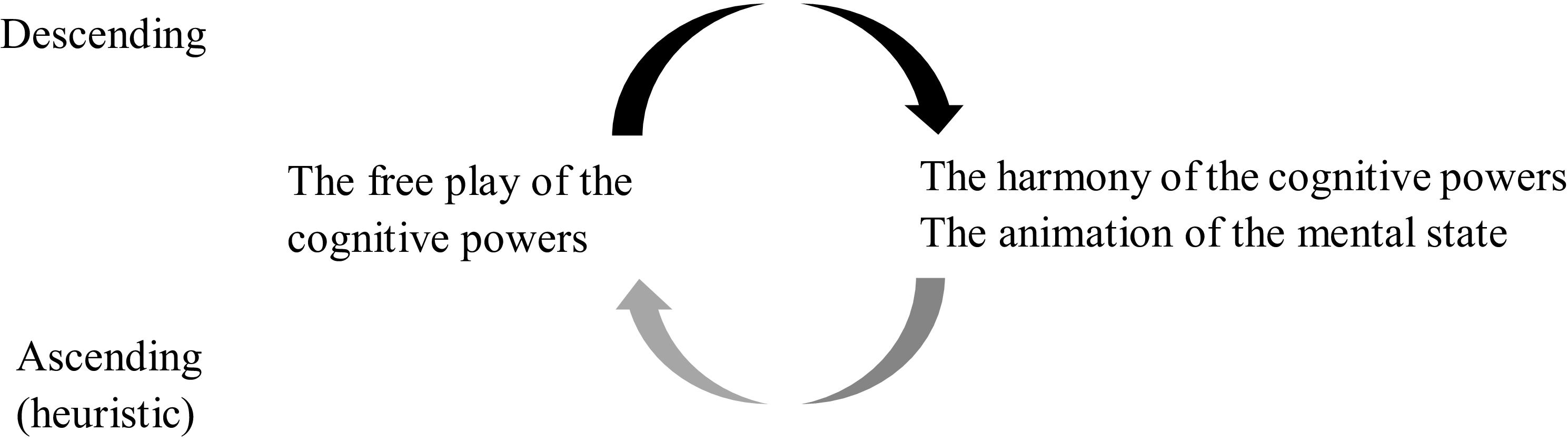
Similarly, we can apply the circular structure of internal purposiveness in the organism to the case of aesthetic experience. Aesthetic experience can be compared with the organism as a whole, and the self-strengthening and self-reproducing of the mental states within it can be compared with the dynamic involved in the growth of organisms. On the one hand, the free play of cognitive faculties is the cause of the feeling of pleasure, which is conceived through their harmonious relationship (the descending connection of real causes); on the other hand, the representation of the harmony between cognitive faculties can also be regarded as the cause of the free play itself (the ascending connection of ideal causes).
It is worth mentioning that the latter connection is not real but only heuristically assumed, since the judgement of taste has no purpose of achieving a state of harmony, and maintaining the free play is not the goal of free play. It is different from the presupposed purpose (self-organizing and self-maintaining) in the case of explaining organisms. We heuristically assume the harmonious mental state as a ground in order to explain the possibility of the purposiveness. The internal purposiveness in the judgement of taste can be illustrated as follows:
Corresponding to the subjective aspect of taste, the apprehended object is also endowed with a new temporal structure. An aesthetic object is not a unified manifold of intuitions; its content and form are continuously renewed. Since imagination produces new forms in terms of it, the manifolds of intuitions are not determined in one temporal order of schemata but search for new possibilities for unifying. Just as Jacinto Rivera De Rosales declares, Kant introduces a new form of temporal as well as spatial form here, which is winding and bowed. ‘It is no longer linear, but we experience time there as recursive and not only flowing (also in music), like Schiller says, time suspending in time; and we conceive space organically, in which not every point is the same and parts refer to the other parts and to the whole, and vice versa.’ (Rivera de Rosales Reference Rivera de Rosales and Höffe2008: 84–87)
By way of this sort of comparison with organisms, we can not only illustrate the working of the judgement of taste but also identify the reciprocal relation between the two levels of internal purposiveness in it: the harmony between understanding and imagination and the self-maintenance of the mental state. A reciprocal relationship between parts necessarily leads to the self-organization and self-formation of the whole, since when the parts are promoted, then the whole grows. Conversely, the parts in a self-formative whole must also be reciprocally related since a self-formative whole is not predetermined – otherwise, it would be a product of art (see CJP, 5: 373) and its possibility can only be constituted by the reciprocal relationship between the parts. Similarly, in the case of the judgement of taste, the harmonious mental state on the second level of purposiveness is necessarily connected with the third level of purposiveness (the self-maintenance of free play), and the former is only possible through the latter.
4. Self-legislation, self-discovery, and self-flourishing
The circular working of reflective activity illustrates not only the functioning of the judgement of taste but also the legislative process of the power of judgement for its own functioning. The aesthetic purposiveness, which is apprehended through the feeling of pleasure, is at the same time the determining ground of the judgement. As Kant said, the a priori principle of the judgement of taste is that it ‘is subjectively both an object and a law to itself’ (CPJ, 5: 288). Although this is circular, it is not tautological because new content is added to this cycle: the reflective activity ‘strengthens and reproduces itself’ (5: 222) through the reciprocal animation and mutual promotion of cognitive powers. The imagination is ‘productive and self-active’ (5: 240), the understanding is enriched with new conceptual possibilities, and the represented object is also endowed with new connotations through this reflection.
Hence, the uniqueness of aesthetic heautonomy lies in the self-reflexivity of the circular process. This self-reflexivity means not only that the legislator is identical to its object but also that the legislation is a creatively self-formative process. Since the judgement is both the legislator and the object of the legislation and the rules are not given in advance, it can create rules for itself only in and through the process of its own application. Christian Wenzel has illustrated the law-making process in the free play with an analogy to children’s play. Although they do not follow strict rules, their behavior is creative and makes sense. He quotes Wittgenstein to describe the scene, stating ‘Children make up the rules as they go along’ (Wenzel Reference Wenzel2005: 50).Footnote 21 This kind of spontaneous (as we might say) legislation is possible because the judgement of taste has an advantage in terms of its self-reflective structure, which organisms do not have.Footnote 22 As self-conscious aesthetic agents, we can discover the lawfulness by ourselves through reflection on our mental activities and vital state.
Further questions could be raised: What kind of lawfulness is in question? Why does this purposiveness occur? According to Kant, in teleology, objective purposiveness is regulated by natural ends presupposed by theoretical reason; in moral praxis, the objective ‘purposiveness that is at the same time law (Obligation)’ (FI, 20: 245) is determined by our final end. In sum, in objective purposiveness, the presupposed ends, which are at the same time the ends to be satisfied, are crucial, since they are the content and the ground of lawfulness, that is, they are the law. In contrast, there is no end presupposed in the judgement of taste, so no law is given. However, there are to-be-satisfied ends, ends of harmony and self-maintenance, which can be detected in formal purposiveness in the judgement of taste through the feeling of pleasure. And then we have new questions: Why should harmony and self-maintenance be considered purposes? Insofar as they are considered purposes, there must be some value in them. So why are they valuable and for what are they valuable?
An apparent answer given by Kant is the animation of the faculties and the promotion of the ‘feeling of life’ (Lebensgefühl) (CPJ, 5: 203, 277; see also 331–2), or ‘the powers of life’ (Lebenskräfte) (5: 245, 278). However, why do animation and the feeling of life become so important here? What kind of life are we becoming aware of as worth living? In the previous section, I mentioned Kant’s view that every faculty has its purpose. When the purpose of the faculties is fulfilled by, for example, acquiring knowledge or acting morally, life and its activities are promoted, and the feeling of pleasure can be felt (see 5: 188–9, also 244–5). But not only intellectual but also merely sensible representations are ‘modification[s] of the subject’ and ‘affect the feeling of life’ (5: 277). However, in cognition and moral praxis, the ends are objective (knowledge and morality) rather than subjective. Promotion of the feeling of life is not seen as an end but only as an epiphenomenon of the fulfillment of objective ends. In the case of agreeableness, of course, although sensible pleasure is subjective we are only passively affected, and so even if we pursue sensible pleasure the feeling of life, which differs from this pleasure, is not the end. As Kant notes, it is very possible that we ‘lose the feeling of life completely in mere enjoyment’ (Anth, 7: 274). Thus, reason could never be persuaded of an existence of a human being who lives merely for enjoyment (see CPJ, 5: 208). This means that, due to the antagonism between rationality and sensibility, the general feeling of life cannot function as an end in the above-mentioned cases. Only in the judgement of taste, in which rationality and sensibility harmonize, does one’s subjective and psychological state become sufficiently important to be considered a purpose to be satisfied. Thus, as unusual as it may seem in a reading of Kant, the a priori principle of subjective purposiveness has an empirical and sensible kernel.
More evidence of the centrality of empirical elements can be detected if we take a closer look at some of Kant’s formulations. Not only does Kant talk about promotion of the ‘feeling of life’ and ‘the powers of life’, but he also talks about ‘animation of the cognitive powers’ (CPJ, 5: 315; see also 219, 222, 238) or ‘promotion of the faculty of cognition’ (5: 287). This implies that the cognitive powers involved in the judgement of taste are not functioning in a purely a priori manner but reflect empirical conditions, which means they could be lifeless, defective or not in their complete function.Footnote 23 For example, imagination is not always as creative and active as it might in principle (a priori) be, and understanding might not exercise its full power of conceptual determination or possess as much content as it might. This seems pretty clearly to differ from Kant’s description of the higher cognitive faculties in his transcendental theoretical philosophy and moral metaphysics, where pure rational faculties are presumed to function in a state of perfection. By contrast, Kant’s emphasis on the empirical and presumably always imperfect working of the faculties brings out a too frequently underemphasized precondition in discussion of his ‘transcendental aesthetic’ (5: 270; see also 286).Footnote 24
This also connects with Kant’s claim that unlike the agreeable and the good, which are valid for animal and rational beings, respectively, ‘beauty is valid only for human beings, i.e., animal [beings that are] also rational beings’ (CPJ, 5: 210). In other words, only sensible-rational beings can capture and shoulder the unique way of aesthetic legislation. The uniqueness of our aesthetic life lies not only (from a negative perspective) in its independence from both the external determination of sensible affection and the internal determination of moral vocation but also (from a positive perspective) in its combination of sensible and rational characters. Independence of external determination just gives us the possibility to find our own determination as human beings, in which we do not have to transcend sensible givenness completely but can still maintain concern about our life (mental activity as well as ‘corporeal’ (5: 278) sensation) on the one hand, and where we are also not affected passively but create our aesthetic experience spontaneously on the other hand (see Lehman Reference Lehman2018: 230–4). Starting from a limited situation, we entertain ourselves in the appreciation of the object, not striving for any cognitive or practical accomplishment but only for self-preservation and self-discovery, that is, to determine which object is suitable for one, in which relationship with objects one can become animated, and which manner of contemplation is more suitable for ‘promotion … of the power of life’ and discovery of ‘the principle of life’ (5: 278).
Self-discovering and self-determination are only possible in this open and indeterminate process. But also, notably, self-determination is only an idea that cannot be fully achieved. When we make a judgement of taste, we only exemplarily find one suitable manner of animation, not an ultimate one. Unlike moral determination, which transcends time, aesthetic determination goes along with time and through time. The self-discovery process continues insofar as life continues. With the instruction of the feeling of pleasure, we are always searching for new determinability, in which a more meaningful mode of life and a more abundant image of the world, a deeper relationship with the world, can be found. In this way, the self-discovery process can also be seen as a process of self-flourishing.
Additional evidence from Kant’s practical philosophy can also help us to depict his view regarding the special character of human life. In the Metaphysics of Morals, Kant comments that we as humans also have ‘an end of … existence’ (MM, 6: 445), which is also called ‘a natural final end’ (Refl, 19: 99), as opposed to a moral final end. Correspondingly, he defines ‘humanity’ as ‘the capacity to set oneself an end’ (MM, 6: 392; see also R, 6: 26–7) and distinguishes it not only from animality but also from personality, which is a purely rational and moral capacity. As Lara Denis notes, the formulas of humanity that Kant uses here ‘direct us to guide our conduct by consideration of rational nature as a whole, not of the moral capacity alone’ (Denis Reference Denis1997: 325). Kant holds that human beings have a duty to themselves to cultivate their natural predispositions and to realize all sorts of ends, that is, not only moral but also nonmoral ends. However, to fulfill this duty, we must have the capacity to choose suitable predispositions to develop and the capacity to set ourselves suitable ends. This kind of ‘free’ choice is made without any presupposed determination but can nonetheless serve for our own determination and perfection as particular human beings. I have argued elsewhere that for this kind of free choice we must exercise a ‘rational’ faculty, distinct from theoretical understanding and practical reason, namely, precisely the power of aesthetic judgement. In this sense, self-determination as a precondition for self-perfection can be seen as a matter of aesthetic judgement – as a matter of judgement expressing a ‘taste for life’.Footnote 25
With this approach, I suggest, we have a new interpretation of Kant’s aesthetic ‘freedom’: it means not only exclusion of sensible affection in the negative sense but also spontaneous self-legislation in the positive sense. In the third Critique, Kant often talks of freedom of the imagination (see. CPJ, 5: 287, 296, 329–30). This freedom is opposed to the lawfulness of the understanding and has to that extent only a negative connotation. To be sure, he also talks about its active and spontaneous function in artistic creation. But of course imagination cannot legislate by itself, so it does not accord with Kant’s strict definition of positive freedom (autonomy) from the practical perspective. In some other parts of the third Critique, Kant also uses the concept of freedom to describe the relationship between imagination and understanding in general, speaking of ‘freedom … in play’ (5: 268), ‘the lawfulness of the power of judgment in its freedom’ (5: 270), ‘free power of judgment’ (5: 271), ‘free lawfulness’ (5: 240) and ‘free … purposiveness’ (5: 242, 292). Here, Kant does not speak of freedom specifically to refer to the activities and attributes of imagination as such, but to the overall operation of aesthetic judgement, in particular, considering the power of aesthetic judgement as self-legislative and so as a higher cognitive ability (see 5: 268). And it is in this way, finally, that we can define aesthetic freedom in the positive sense as the self-referential legislation of aesthetic judgement, that is, aesthetic heautonomy.
5. Conclusion
In the Critique of Pure Reason, Kant defines transcendental freedom as ‘a faculty of absolutely beginning … a series of its consequences’ (A446/B474), but this faculty can be regarded only as negative freedom, insofar as its causality is only regarded as independent of any determination by alien causes (the mechanical law of nature) but not as giving laws to itself (see G, 4: 446–7, MM, 6: 221). Only practical freedom as a self-legislative faculty contains positive freedom, insofar as it can prescribe laws to will according to the law of pure practical reason itself. However, this definition of positive freedom as autonomy not only seems too rigorous and narrow, since it only addresses the purely rational aspect of human existence, according to the demand of the universal law of the categorical imperative. But it also gives rise to what many at least regard as a serious problem – the ‘imputability problem’, that is, that the free agent cannot be morally responsible for her morally wrong actions, because an evil action cannot be legislated by pure practical reason (see Noller Reference Noller2021: 341). The reason for this lies in the fact that Kant does not differentiate between free will and free choice (Willkür) – or at least not in such a way as to characterize the latter as itself a kind of positive freedom – and so arguably does not truly have a concept of free rational choice.Footnote 26 But the notion of a capacity of free choice, we should note, is important not only for solving the imputability problem in moral philosophy but also for developing a theory of pragmatic principles with respect to morally neutral praxis. After all, apart from the limitation of morality, we as rational beings are also supposed to be able to determine our lives rationally and individually. A person only equipped with the autonomy of understanding and practical reason seems to be a hollow being who acts rightly and is good but cannot enjoy a real life. With my proposal in this article, I believe that I have shown how aesthetic autonomy provides a theoretical resource for building such a freedom, a third freedom – a creative and living freedom.
Unlike autonomy of the understanding and practical reason, in which the subject legislates to its own cognition and action under given and determinate objective laws, the autonomy of aesthetic judgement finds a law suitable for itself in the process of its own application. This lawfulness (purposiveness) is suitable not only for the promotion of the faculties of cognition but also for promotion of the feeling of life itself. Its law has no determinate content but merely shows us, through the feeling of pleasure, various possibilities for manifestation of lawfulness in our own subjective condition. As long as the free play between imagination and understanding achieves a harmonious relation, such a condition is universally communicable; it does not matter what particular intuitions the imagination thereby produces. The content of aesthetic experience can be not only diverse but also constantly changing. Imagination apprehends objects with its infinitely creative productivity, thereby reshaping its own boundaries as well as those of the understanding. This is because the legislation of the power of judgement in aesthetic reflection is not fixed under a given framework but finds its own possibilities and determinations in the process of interaction with objects. And so too therefore does the aesthetic agent. Appreciation of beauty is not about shaping people into scientific cognizers or moral actors but into a characteristic and tasteful humanity in a way that is more considerate of our life feelings and trajectory of growth. By its means, we can shape and discover ourselves in the fusion and collision of sensibility and intellect; we can accomplish an abundance and vividness of life in the dynamic process of aesthetic apprehension and reflection.
Acknowledgments
I thank Prof. Paul Guyer, Prof. Richard Aquila, and the anonymous reviewers for their helpful comments. I also appreciate Prof. Aquila for his kind suggestions on language polishing. This work was supported by the National Social Science Foundation under Grant number 22BZX124.


