Preterm infants are at high risk for developing sepsis. The potentially fatal course of sepsis prompts neonatologists to start empirical antibiotics as soon as nonspecific clinical signs are noted.Reference Vergnano, Menson and Kennea 1 – Reference Cantey and Patel 3 The choice of antibiotics is based on the most probable pathogenic spectrum in the NICU and the individual risk profile of the infant (eg, day of life, need for invasive measures, or colonization). The emerging problem of antimicrobial resistance also applies to the care of preterm infants.Reference Vergnano, Menson and Kennea 1 , Reference Greenhow, Hung and Herz 4 Clinical decision making therefore needs to be individually balanced between restricted use of third-line antibiotics and the risk of deleterious outcome due to therapeutic mismatch.Reference Kermorvant-Duchemin, Laborie, Rabilloud, Lapillonne and Claris 5 This balance is of particular importance during infection clusters or outbreaks, which are a well-described phenomenon in neonatal intensive care units (NICUs) worldwide.Reference Gastmeier, Loui and Stamm-Balderjahn 6 , Reference Härtel, Faust and Avenarius 7 Recently, a series of infection outbreaks in German NICUs was reported on national television channels and in newspapers. Public awareness resulted in significant consequences for the affected hospitals, eg, extensive screening of patients and personnel, closure of units, and states’ attorneys investigations into negligent manslaughter. Several media reports implied that thousands of infections and related deaths could have been prevented by improving basic hygiene measures in NICUs. This opinion affected the atmosphere of trust between families of highly vulnerable neonates and staff in many German NICUs.Reference Gastmeier 8 , Reference Gortner 9 Whether increased public awareness of infection outbreaks affects provider behavior (eg, antimicrobial prescribing) has never been investigated. Currently, more than 30% of very-low-birth-weight infants (VLBWIs, <1,500 g) born in Germany are born in centers of the German Neonatal Network (GNN). Thus, we used the GNN registry as a representative epidemiological tool to address our research question. Although the outbreaks involving NICUs were not part of GNN, we hypothesized that episodes of media coverage contribute to a long-term increase of broad-spectrum antibiotic prescription in the GNN community of neonatal care.
METHODS
VLBW Cohort
We performed a population-based cohort study of VLBWIs enrolled in 50 NICUs in Germany’s GNN. Data were collected between January 1, 2009, and December 31, 2014. The inclusion criteria were birth weight <1,500 g and gestational age ≥22+0 and <37+0 weeks. After written informed consent was obtained from the parents, infants were enrolled in the GNN by the attending physicians. A predefined clinical data set was then recorded on case report forms, and the data were sent to the GNN coordinating center in Lübeck. Basic data were also collected for those infants born in participating GNN centers but not enrolled in GNN: birth weight, gestational age, and major outcomes (eg, blood-culture–proven sepsis and death/cause of death). Reasons for nonenrollment included parents not asked to participate, parental refusal, and early death of infant. A physician specialized in neonatology monitored the data quality by annual site visits.
Outbreaks
We studied 3 nosocomial outbreaks with Gram-negative bacteria in German NICUs that resulted in strong repercussions in the national mass media:
-
1. August 2010. University Children’s Hospital Mainz, NICU. Pathogens: E.coli, Enterobacter spp. Source: contaminated parenteral nutrition components.Reference Bhakdi, Kramer and Siegel 10
-
2. November 2011. Children’s Hospital Bremen-Mitte, NICU. Pathogen: extended-spectrum β-lactamase (ESBL) producing Klebsiella pneumoniae. Source: biofilm in quarternary ammonium based disinfective solution dispenser.Reference Tuffs 11 , Reference Tuffs 12
-
3. October 2012. Charité University Hospital Berlin, Department of Neonatology, NICU. Pathogen: Serratia marcescens. Source: presumably mother with amniotic infection syndrome and identification of S. marcescens 3 months earlier, person-to-person contact.Reference Gastmeier 8
The involved institutions did not contribute to the GNN database during the study period.
The primary objective of this study was to evaluate the data for discharged infants in temporal association with an outbreak covered in the media (6 months before and 6 months after an outbreak). For our analysis, the start of an outbreak was defined as the first media coverage.
Media Analysis
Professional media database analysts (infoselekt* services, information, and media consulting; Stuttgart, Germany) evaluated all print media and online reports on the selected outbreaks within 31 days after the first outbreak report using search engines. The following items were included in the database searches: outbreak location (Mainz, Bremen, Berlin) AND [“baby(ies)” OR “preemie(s)” German: Frühchen) OR “newborn(s)” (German: Neugeborenes)] AND [“germs,” “bugs” (German: Keime) OR “bacteria” German: Erreger, Bakterien) OR “hygiene”].
Definitions
Postnatal antibiotic therapy was defined as antibiotic treatment of VLBWIs (number of neonates who got any dose of antibiotics per number of infants admitted and enrolled in GNN) for clinical suspicion of infection during the initial hospital stay. Prophylactic treatment to prevent central-line–associated bloodstream infection was not included in the analysis. We stratified antibiotic classes into penicillins (penicillin, flucloxacillin, ampicillin, ampicillin + sulbactam, and piperacillin), aminoglycosides (gentamycin, tobramycin, and amikacin), glycopeptides (vancomycin and teicoplanin) and carbapenems (meropenem, imipenem, ertapenem).
“Third-line antibiotics” were defined as any dose of carbapenems or piperacillin plus tazobactam. This definition reflects the prescription pattern for suspected sepsis in the majority of GNN centers. For first-line antibiotic therapy, common center policy recommends penicillins without β-lactamase-inhibitors plus aminoglycosides. Cephalosporins and glycopeptide antibiotics (eg, vancomycin and teicoplanin) are frequently used as second-line treatments. Other definitions of clinical characteristics and outcomes are described in the Online Supplementary Material.
Statistical Analysis
In our first analysis, we pictorially represented the secular trends of sepsis and antibiotic use (2009–2014). In our second analysis, we modeled the probability 1 versus 0 of getting a dose of third-line antibiotics as primary outcome around an outbreak using exposure time associated with media coverage). In this analysis, antibiotic exposure after an outbreak with strong repercussion in the media was compared to antibiotic exposure before an outbreak for 3 different time periods. To determine whether the outbreak was associated with a secular trend in antibiotic use, we performed a logistic regression analysis and included an indicator variable for linear time (ie, month of discharge); we then tested whether this variable interacted with the periods of outbreak (ie, discharge within 6 months after an outbreak).
Data analysis was performed using the SPSS 22.0 data analysis package (Munich, Germany). Differences between infants discharged before and after an outbreak were evaluated using the χ2 test, Fisher’s exact test, and the Mann-Whitney U test. P<0.05 was considered statistically significant for single tests.
Ethics
The study was approved by the ethics committee of the University of Lübeck (08–022) and the local ethics committees at each study center. Written informed consent was obtained from at least 1 parent on behalf of the infant enrolled in the German Neonatal Network.
RESULTS
Incidences of Sepsis with Time
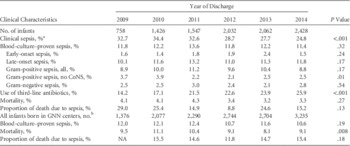
Our analysis included 10,253 VLBWIs enrolled in the GNN. As shown in Table 1, the incidences of clinical sepsis and blood-culture–proven Gram-positive sepsis (excluding coagulase-negative staphylococci) decreased with time in GNN centers. We noted a secular trend for an increase in the proportion of infants who received any dose of third-line antibiotics (14.2% in 2009 vs 25.9% in 2014; P<.001). Mortality decreased over time in infants born in GNN centers.
Sepsis Incidence According to Year of Discharge of Very Low-Birth-Weight Infants (VLBWIs) in the Multicenter Cohort (2009–2014)

NOTE. CoNS, Coagulase negative staphylococci; GNN, German Neonatal Network.
a All variables are expressed as percentages (denominator is no. of infants admitted and enrolled in GNN if not otherwise noted).
b A basic data set was documented for VLBWIs born in GNN centers but not enrolled in GNN including birth weight, gestational age, major outcomes, eg, blood-culture–proven sepsis, mortality, cause of death (from 2010). For the majority of nonenrolled infants, parents were not asked to participate in the GNN; other reasons included early mortality and refusal of parents to participate in the GNN.
Outbreaks and Responses
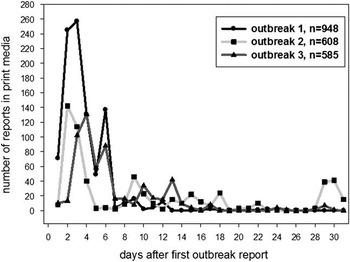
Our searches of media databases for reports within the first 31 days after an outbreak revealed 948 print reports for the first outbreak (Mainz), 608 print reports and 1,868 online reports for the second outbreak (Bremen), and 585 print reports and 2,394 online reports for the third outbreak (Berlin; Figure 1). The clinical data for infants discharged before and after each outbreak period are provided in Online Supplemental Table 1.
Quantitative analysis of print media reports on outbreaks in Mainz (1), Bremen (2), and Charite Berlin (3) within 31 days after the first outbreak report. Media databases search was performed including the following search requests: outbreak location AND [“baby(ies)” OR “preemie(s)” German: Frühchen) OR “newborn(s)” (German: Neugeborenes)] AND [“germs,” “bugs” (German: Keime) OR “bacteria” German: Erreger, Bakterien) OR “hygiene”].

Increased Use of Third-Line Antimicrobials 6 Months After Outbreaks
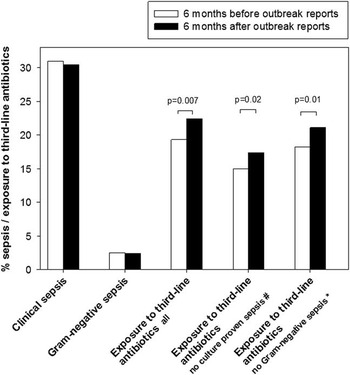
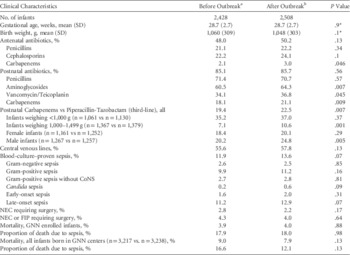
To determine the effects of the outbreak on antimicrobial use, we specifically analyzed data for VLBWIs discharged 6 months before the outbreaks (n=2,428) and 6 months after the outbreaks (n=2,508). We identified an increase in exposure among all GNN infants to third-line antibiotics after the outbreaks (19.4% vs 22.5%; P=.007). This trend particularly affected infants who were never diagnosed with any blood culture–proven sepsis (14.9% of 2,129 infants vs 17.6% of 2,158 infants; P=.02) and the subgroup of infants who never had Gram-negative sepsis (18.3% of 2,354 infants vs 21.2% of 2,435 infants; P=.01; Figure 2). Interestingly, we observed increased use of third-line antibiotics after outbreak reports in male infants (20.2% of 1,267 infants vs. 24.8% of 1,257 infants; P=.005) but not in females. In addition, infants with a birth weight of 1,000–1,499 g were more often treated with third-line antibiotics after outbreak reports (7.1% of 1,367 infants vs 10.6% of 1,379 infants; P=.001), whereas outbreaks had no effect on the treatment of infants weighing <1,000 g at birth (Table 2). We also noted increased exposure of infants to aminoglycosides and second-line agents (vancomycin or teicoplanin) after outbreaks. At the same time, incidence rates remained stable for any sepsis or necrotizing enterocolitis (NEC) or focal intestinal perforation (FIP) requiring surgery, which prompt clinicians to start empirical broad-spectrum antibiotics in VLBWIs, (Table 2).
Exposure of infants to third-line antibiotics in temporal association with outbreak reports in the public media. The proportion of infants with clinical sepsis, Gram-negative sepsis, and exposure to third-line antibiotics in temporal association with outbreak reports in the public media (0–6 months before an outbreak, n=2,428; 0–6 months after an outbreak, n=2,508; P values derived from Fisher’s exact test in univariate analysis) is shown. #The subgroup of infants without any blood-culture–proven sepsis included n=4,287 infants (n=2,129 vs n=2,158). *The subgroup of infants without Gram-negative sepsis included n=4,789 infants (n=2,354 vs n=2,435).

Sepsis Incidence and Treatments in Temporal Association With Outbreak Reports in the Public Media

NOTE. SD, standard deviation; CoNS, Coagulase negative staphylococci; NEC, necrotizing enterocolitis; FIP, focal intestinal perforation; GNN, German Neonatal Network.
a Before outbreak: data for all infants discharged 0–6 months before the outbreak were reported in the media.
b After outbreak: data for all infants discharged 0–6 months after the outbreak were reported in the media. P values are derived from Fisher’s exact test or Mann-Whitney U test if indicated (*).
Discharge in Temporal Association With Outbreaks Is a Risk Factor for Exposure to Third-Line Antibiotics
We performed logistic regression analysis including month of discharge as linear variable (2009–2014), discharge 0–6 months after outbreak as categorical variable, and exposure to any dose of third-line antibiotics as primary outcome (2,267 infants exposed to any dose of third-line antibiotics per 7,986 controls). Month of discharge as linear variable of time was associated with increased exposure to third-line antibiotics (OR, 1.01; 95% CI, 1.009–1.014; P<.001), whereas discharge within the 6-month period after outbreak reports independently contributed to this long-term trend (OR, 1.14; 95% CI, 1.017–1.270; P=.024).
Centers React Differently to Media Scrutiny
We noted a high variability between study centers with regard to administration of third-line antibiotics: median (95% CI) percentage of infants exposed to any dose of third-line antibiotics before outbreaks, 14.7% (95% CI, 15.3–22.8%); after outbreaks, 18.2% (95% CI, 17.7–26.2%), with an increase of 2.6% (95% CI, −0.8% to 5.4%). We analyzed the data for infants discharged January 2009 until July 2010 before any outbreak had attracted media interest (median exposure rate, 10.5%; interquartile range, [IQR] 6%–25%). We stratified the centers into “low rate” centers (≤10.5% of infants exposed to third-line antibiotics before first outbreak announced in public media) and “high rate” centers (>10.5% infants exposed to third-line antibiotics). Low-rate centers did not differ in prescription of third-line antibiotics in the selected time periods before and after outbreaks (109 of 909 [12.0%] vs 124 of 901 [13.7%]; P=.27). A trend toward higher rates of third-line antimicrobial use after an outbreak was noted in high-rate centers (357 of 1,486 [24.1%] vs 412 of 1,527 [27.0%]; P=.06). Center-to-center variability, however, is not necessarily dependent on media reports but is multifactorial. High-rate centers more frequently used antibiotics, central venous lines, and tracheal ventilation than low-rate centers and had higher sepsis rates (Online Supplemental Table 2).
DISCUSSION
This is the first population-based study to demonstrate that public awareness of infection outbreaks in NICUs directly affects provider behavior, ie, pressures physicians to prescribe unnecessary third-line antibiotics. This apparent change in prescribing behavior among GNN collaborators cannot be explained by epidemiological evidence. Specifically, we have demonstrated declining or stable incidence rates of sepsis or mortality over time while clinical risk parameters of GNN enrolled infants (eg, gestational age, birth weight) remained unchanged. The increased use of third-line antibiotics, particularly given to male infants and infants with a birth weight of 1,000–1,499 g is worrisome, and underlying causes need to be elucidated.
First, individual physicians may become risk averse when outbreaks occur. It has been proposed that neonatologists fear adverse outcomes in preterm infants with suspected sepsis because antibiotic treatment may not cover the offending organism.Reference Kermorvant-Duchemin, Laborie, Rabilloud, Lapillonne and Claris 5 , Reference Stone, Gupta and Loughrey 13 This concern is related to several diagnostic limitations in newborns including nonspecific clinical signs, lack of reliable biomarkers, and the low sensitivity of blood cultures. As a consequence, individual treatments may be prolonged or even changed to third-line antibiotics in infants who are not improving despite sterile cultures. In our setting, this trend particularly affects male infants who have a higher risk for clinical sepsis than female VLBWIs (33% vs 28%; P=.001). Overuse of third-line antibiotics after outbreak awareness in male infants puts them at additional risk, including antibacterial resistance and multidrug-resistant (MDR) colonization.Reference Cantey and Patel 3 , Reference Cotten, McDonald and Stoll 14 The same holds true for the less-susceptible population of VLBWIs with a birth weight of 1,000–1,499 g. To a greater extent, these infants are unnecessarily exposed to third-line antibiotics after outbreaks. The clinical significance of our observation is unclear, but our results offer a basis for an interesting hypothesis for future studies.
Second, the increased use of third-line antibiotics may be an institutional response with the individual physician serving as an instrument. Previous studies have documented similar differences among centers and have proposed that the choice of an antibiotic agent is made programmatically rather than based on the patient level of apparent illness.Reference Liem, Krediet and Fleer 15 Whether empirical antibiotic treatment in MDR-colonized patients needs to be adjusted is still a matter of debate.Reference Simon and Tenenbaum 16 Colonization screening and surveillance as well as local impulses may lead to increased use of third-line antibiotics in specific centers.Reference Haase, Worlitzsch and Schmidt 17 , Reference Anderson, Nicholas and Sprague 18
Third, NICUs have a disposition to antibiotic overtreatment during times of understaffing or overcrowding as well as a high degree of background colonization with resistant or potentially epidemic bacteria. Media attention may induce a “priming effect” (a term from the political literature),Reference Domke, Shah and Wackman 19 which results in a higher prescription rate of unnecessary antibiotics by physicians aiming to avoid an outbreak in their own NICU.
We are aware of several limitations in our study. First, GNN enrolls >30% of VLBWIs born in Germany. The large majority of university hospitals and tertiary-level NICUs in district hospitals are GNN collaborators. Thus, our cohort is representative of VLBWI care in Germany; however, data on infants not born in GNN centers were not available for our analysis. Second, we defined the start of an outbreak as the start of media coverage, and the infection outbreak in the involved institution may have begun earlier. In addition, medical doctors may not recognize each outbreak independently from the previous outbreak (ie, introducing a cumulative aspect of consecutive outbreaks). Third, a clustering effect of each individual NICU may have occurred but could not be evaluated from the data available for our observational study. Fourth, center-to-center variability is multifactorial and is not necessarily dependent on media reports (Online Supplemental Table 2). Center-to-center differences in perception of resistance patterns of the organisms or real changes in resistance patterns were not assessed. Future studies need to identify unknown variables affecting prescribing habits. Finally, we identified an association with time after outbreaks, and future studies need to investigate cause and effect by introducing prospective surveillance of prescribers.
Future Implications
There is an urgent need to incorporate the media toolbox into physician training and practice. Risk perceptions of both the public and healthcare professionals are context dependent. Thus, it is important that the scientific community and media cooperate to present a complete and balanced collection of facts. Media are occasionally blamed for sensationalist reporting and for neglecting important aspects of the complex pathophysiology of infections.Reference Gortner 9 For example, newspapers in the United Kingdom covered MRSA outbreaks with headlines such as “dirty hospital.”Reference Chan, Dipper and Kelsey 20 This phraseology creates a culture of blame because it implies that simple and clearly effective measures were not taken. In outbreak situations, parents of both colonized or infected and noncolonized or noninfected patients need to be informed in a privileged fashion. Otherwise, parents may create their own publicity, which is very easy in the era of online media. Physicians should clearly communicate individual risk profiles of babies. For example, the terms “colonization” and “infection” are often mixed up and should be clearly defined. Press conferences should follow a predefined timeline after an outbreak is identified to give the media the impression of structured access to complete information. The institution should present the outbreak team comprising the best specialists to the media, instead of the hospital heads alone.
To avoid overuse of third-line antibiotics in the future, we offer the following recommendations: First, more research into the predisposition to sepsis must be conducted. Preterm infants are often colonized with potential outbreak bacteria but do not get infected. There is an ongoing need to investigate risk profiles for individual guidance of care.Reference Carl, Ndao and Springman 21 Second, more antibiotic stewardship programs must be implemented. Multidisciplinary teams are required to objectively review the prescription of antibiotics to extremely vulnerable infants. Prospective surveillance of prescribers is urgently needed to determine why they chose third-line antibiotics. Large neonatal networks should be used as platform for benchmarking and effectiveness studies.Reference Cantey and Patel 3 Third, adequate staffing is an important requirement for quality of care. Hospital administrators and NICU directors should assess their staffing decisions to determine the nursing care required by the most vulnerable infants.Reference Harbarth, Sudre and Dharan 22
Finally, media are important convectors of information, and they hugely influence public perceptions and responses. This public interest can be used for educational purposes considering ongoing outbreaks and global challenges on antibiotic resistance. Instead of attacking each other, an objective dialogue between the scientific community and investigative journalists should be encouraged.
ACKNOWLEDGMENTS
The authors are indebted to all parents and their infants and to all nurses and doctors and study centers who participate in the GNN. Specifically, we thank Stefan Avenarius, Department of Pediatrics, University of Magdeburg; Kai Bockenholt, Children’s Hospital Cologne-Amsterdamer Strasse; Bettina Bohnhorst, Department of Neonatology, Hanover Medical School; Michael Dördelmann, Diakonissenhospital Flensburg; Silke Ehlers, Bürgerhospital Frankfurt; Corinna Gebauer Department of Pediatrics, University of Leipzig; Hubert Gerleve, Children’s Hospital Coesfeld; Freidhelm Heitmann, Children’s Hospital Bonn; Peter Groneck and Joachim Eichhorn, Children’s Hospital Leverkusen; Georg Hillebrand, MD, Children’s Hospital Itzehoe; Thomas Hoehn, Department of Pediatrics, University of Düsseldorf; Mechthild Hubert, Children’s Hospital Siegen; Helmut Hummler, Department of Neonatology, University of Ulm; Andreas Jenke, Children’s Hospital Wuppertal; Reinhard Jensen, Children’s Hospital Heide; Olaf Kannt, Children’s Hospital Schwerin; Helmut Küster, Department of Pediatrics, University of Göttingen; Reinhard Laux and Susanne Schmidtke, Children’s Hospital Hamburg-Barmbek; Ursula Lieser, Department of Pediatrics, University of Halle; Michael Mögel, Department of Pediatrics, University of Dresden; Jens Möller, Children’s Hospital Saarbrücken; Dirk Müller, Children’s Hospital Kassel; Jochen Reese, Children’s Hospital Eutin; Claudia Roll, Department of Pediatrics, University Witten-Herdecke, Children’s Hospital Datteln; Thomas Schaible, Department of Pediatrics, University of Mannheim; Stefan Seeliger, Children’s Hospital Neuburg/Ingolstadt; Hugo Segerer, Children’s Hospital St. Hedwig, Regensburg; Norbert Teig, Department of Pediatrics, University of Bochum; Ursula Weller, Children’s Hospital Bielefeld; Matthias Vochem, Olgahospital Stuttgart; and Jürgen Wintgens, Children’s Hospital Mönchengladbach.
We also extend our thanks to Anja Kaufmann, Birgit Schröder, Sabine Lorenz and Bea Hatje for data documentation and Michael Preuss for statistical support.
Financial support. This study was supported by the German government (Bundesministerium für Bildung und Forschung, German Ministry of Education and Research, grant no. 01ER0805). The funders had no role in study design, data collection and analysis, decision to publish, or preparation of the manuscript.
Potential conflicts of interest. Christian Gille, Christoph Härtel, Arne Simon, and Andreas Müller were members of the German commission KRINKO (Commission for Hospital Hygiene and Infection Prevention at the Robert Koch Institute) preparing the guideline for microbiological surveillance of VLBWIs in Germany. All other authors declare that there are no competing of interest, including no support from any organization for the submitted work, no financial relationships with any organizations that might have an interest in the submitted work in the previous 3 years, and no other relationships or activities that could appear to have influenced the submitted work.
SUPPLEMENTARY MATERIAL
To view supplementary material for this article, please visit http://dx.doi.org/10.1017/ice.2016.95.