Introduction
Social care services are becoming the subject of reform as welfare states across Europe face increasing pressures on existing provision and anticipate growth in future demand. Many countries are actively engaged in spatial reorganisations of care, developing integrated models of service provision, reviewing and adapting insurance-based schemes, or experimenting with models of ‘cash for care’. Those involved in reform within continental Europe look across the Channel to the UK experience, regarding it as a model to follow, a warning of what might be to come, or some uneasy mix of the two. This article focuses on the experience of reform in England and Wales, teasing out lessons from a recently completed programme of research commissioned by the Department of Health.Footnote 1 We begin by setting out the context of the reform programme (badged, like other UK reforms, as ‘modernisation’); set out a model used to analyse the dynamics of reform; and debate some implications for theorising welfare governance and citizenship.
The ‘modernisation’ of public services is a theme that has permeated UK policy discourse as it has sought the right levers for delivering its promises of public service improvement. Introduced in Labour's first term (Cabinet Office, 1999), it has extended across a range of sectors and services: the civil service, health, criminal justice, local government and others. However, it has also shifted in focus through successive stages of policy reform. The phenomenon of modernisation has attracted a range of analyses and critiques. Some argue that modernisation is a political discourse designed to persuade and motivate change (Finlayson, Reference Finlayson2003). Others see it as an ‘old-fashioned’ concept that does little to reflect the needs of a complex and ‘post-modern’ society (Stewart, Reference Stewart2003). Some commentators have suggested that modernisation is a way of extending the imperatives of New Public Management beyond the Thatcher reforms, while others have argued that the focus of modernisation has been as much about transforming citizens in line with the requirements of neo-liberalism as with changing institutions (Clarke and Newman, Reference Clarke, Newman, Steinberg and Johnson2004). Those who see less coherence argue that ‘modernisation’ is little more than labelling for a disparate reform programme (6 and Peck, Reference 6 and Peck2005). The disjunctures in modernisation have also been attributed to the contradictions and instabilities of the ‘Third Way’ (Giddens, Reference Giddens2000) in British politics (Newman, Reference Newman2001). These are not simply debates within the academic community. They are highly relevant to those involved in delivering social care reforms and to our analysis of the modernisation of adult social care. For example, we will argue that it is difficult to discern a coherent programme of modernisation in the successive policy reforms relating to social care in England and Wales. Moreover, the distinctive characteristics of the social care sector have important implications for how we understand the modernisation process, and for its outcomes.
Despite the charge that modernisation has not been a coherent programme of reform, it is nevertheless possible to trace its evolution within social care from the 1998 White Paper Modernising Social Services (DH, 1998) to Independence, Well Being and Choice (DH, 2005) and Our Health, Our Care, Our Say (DH, 2006). The current focus on personalisation, independence and choice brings social care to the forefront of the wider modernisation agenda and raises two important questions that we address in this article. First, how far do these shifts represent a fundamental change in welfare governance? Second, what are the implications for questions of citizenship? We address these questions in subsequent sections of this article. First, however, we set out some of the distinctive features of adult social care in England and its place in the wider modernisation agenda.
The modernisation of adult social care
Adult social care in England and Wales has a number of features that distinguish it from other public services and profoundly affect the dynamics and outcomes of modernisation processes. First, the boundaries between public and private care are blurred and unstable. Private citizens make very significant economic contributions to the total volume of adult social care provision through private purchase, co-payments and unpaid care labour. Many people – particularly older people – fund some or all of their social care services from their own resources. This includes people who are above the assets limit for publicly funded residential care and people whose levels of need are not considered severe enough to be eligible for publicly funded services (CSCI, 2006b; Help the Aged, 2007). Means-tested co-payments – 17 per cent of total spending on social care for older people (Comas-Herrera et al., Reference Comas-Herrera, Wittenberg, Pickard, Knapp, Challis, Fernández and Netten2004) – constitute further private contributions to the provision of adult social care. Friends and relatives provide by far the biggest volume of adult social care – on a largely unpaid basis. Although its value is marginally offset by a very low social security benefit for some carers, it contributes around £57 billion to adult social care (Carers UK, Reference Carers2002): equivalent to 75 per cent of the annual budget for the whole National Health Service.
A second distinctive feature of adult social care is that statutory agencies purchase a majority of formal services from an extensive market of charitable, voluntary, non-profit and for-profit providers. The latter, in turn, employ a highly differentiated and often very low-status workforce (Eborall, Reference Eborall2005; CSCI, 2006a). Unlike the NHS, where the purchase of core services from private providers has become significant only in the past few years, public sector funding for the private provision of social care dates back to the massive expansion of residential care in the 1980s (Lunt et al., Reference Lunt, Mannion and Smith1996) and the creation of distinct service markets. Large national and multi-national for-profit organisations increasingly dominate residential and nursing home provision. In contrast, providers of domiciliary and day care services are overwhelmingly small, local organisations. Pay rates are lower than in larger organisations, and problems of recruitment and retention restrict attempts to improve skills and status (Eborall, Reference Eborall2005). The rapid turnover of a significant minority of these agencies (CSCI, 2006a) suggests that some struggle to survive the dual pressures of local authority monopsony and tight labour supply (Laing and Buisson, 2005, quoted in CSCI, 2006a). The nature of social care markets, the mechanisms by which they operate, and the generally low status and skills of the staff who work within them, are all likely to affect the responsiveness of adult social care services to a range of more conventional modernisation ‘levers’ and the overall dynamics of modernisation processes (ODPM, 2004).
A third feature of adult social care is simultaneous production and consumption, with users playing active ‘co-production’ (Baldock, Reference Baldock1997) roles in both activities. Daly and Lewis (Reference Daly and Lewis2000) argue that care is the product or expression of a social relationship between care-giver and recipient. Writers such as Kittay (Reference Kittay1999) have also urged attention to these relational aspects of care. These conceptualisations of care as ‘co-production’ and ‘relationship-generated’ are as relevant to the care given informally by close relatives as to the care provided on a paid basis by employed social care workers.
These three features of adult social care in England and Wales – the widespread and unstable blurring of public and private boundaries; the extensive use of market mechanisms and the differentiated nature of the providers within that market; and the role of users in the co-production of social care – have a number of implications for the ambitions of modernisation. First, they suggest that simple managerial levers – economic incentives and funding penalties, performance targets and measures – may not be adequate or appropriate for bringing about changes in the patterns or nature of services, at least when used on their own. They also suggest that users and carers may play a distinctive – and potentially more active – role in the dynamics of modernisation. This is particularly likely given the active role that service user groups and social movements – of disabled people, mental health service users, people with learning disabilities, carers – have played in challenging professional paternalism and bureaucratic models of service delivery (Campbell and Oliver, Reference Campbell and Oliver1996; Spandler, Reference Spandler2004; Priestley, Reference Priestley2000). We return later to these themes. First, however, we describe the processes of adult social care modernisation, and contrast this with corresponding processes elsewhere in health and local government.
Modernisation: multiple trajectories of reform
Official ambitions for social care were set out in two key documents: the 1998 White Paper Modernising Social Services (DH, 1998); and the 2005 Green Paper Independence, Well Being, and Choice (DH, 2005). The 1998 document identified six main areas for improvement:
• weaknesses in the protection of vulnerable people;
• lack of coordination between services, especially health and housing;
• inflexible services;
• lack of clarity about service objectives and standards;
• lack of consistency between localities in the availability of services;
• inefficiency in the costs of services.
Proposed reforms that aimed to tackle these problems included strengthened inspection systems, improved training, the creation of a registration body for social care workers, better joint working between services and improvements in delivery and efficiency. Related measures included the introduction of National Service Frameworks in mental health (DH, 1999) and older people's services (DH, 2001), and the Fair Access to Care Services guidance (DH, 2002). All these aimed to improve consistency and transparency in access to, and the quality of, services.
The 2005 Green Paper, in contrast, highlighted the goals of helping people to maintain their independence, and giving them greater choice and control over how their needs are met. It emphasised the importance of the outcomes of social care: improved health and quality of life, making positive contributions to families and communities, exercising choice and control, freedom from discrimination, economic well-being and personal dignity (DH, 2005). Issues such as regulation and performance management, workforce development and improving the organisation and delivery of services were noted, but only in the context of the higher-order objectives of increasing personalisation, choice, control and other outcomes for service users.
These two documents reflect significant shifts in the scope and nature of the modernisation agenda within adult social care. First, there is a move away from improving the organisation, delivery and efficiency of services themselves and a greater emphasis on enhancing service user control and choice. Although the 1998 White Paper advocated the development of services ‘that are more sensitive to individual needs’ (DH, 1998: 31), this was to be achieved primarily through the introduction of more flexible commissioning and care management processes. In contrast, the 2005 proposals argue for the greater use of self-assessment, Direct Payments and the piloting of individual budgets (the Cabinet Office Strategy Unit's 2005 report on Improving the Life Chances of Disabled People proposed the latter). There was also a move from concerns over the consistency, organisation and efficiency of service inputs towards a greater focus on facilitating individual preferences and outcomes. Although largely a shift in emphasis, it is nevertheless noticeable and marked. The outcomes to which social care is now oriented include:
• fostering independence and control;
• promoting wellbeing and preventing ill health;
• protecting vulnerable adults;
• changing the culture of care;
• modernising the workforce. (DH, 2005)
These changes are significant in three ways. First, they put service users more clearly in control of their own care and thus centrally position them as active agents in the shifting dynamics of care – it is their choices that should increasingly shape future service patterns. Secondly, the emphasis on prevention and wellbeing reflects changing demographic patterns in which active older people become a focus for policy attention in order to prevent or delay future service use (DWP, 2005). This latter emphasis resonates with wider health promotion priorities and with estimates of the considerable savings to be made in future health service expenditure through investment in preventive activities (Wanless, Reference Wanless2002), despite the lack of robust evidence on the effectiveness and cost-effectiveness of preventive measures in social care (Godfrey, Reference Godfrey1999; Curry, Reference Curry2006). Finally, there is greater emphasis on the significance of people – staff, service users and informal carers alike – as key actors in determining the quality of experiences of care. As we will argue below, evidence from the MASC studies suggests that each of these points is undercut by a continuing focus on more traditional ‘levers’ of modernisation such as those set out in the 1998 White Paper.
These shifts in the goals of modernisation for adult social care have occurred not in isolation but against a backdrop of changes elsewhere in local government and the NHS. In local government the organisational separation of adults’ and children's social care services reflected the increasing centrality of children and childcare to Labour's ‘social investment’ policy agenda, as well as to a number of high-profile child abuse cases, suggesting a characteristic intermingling of proactive and reactive features of modernisation. In contrast, services to adults have lacked the same social investment policy focus and have often, consequently, been left behind. Thus increases in NHS funding over the past decade have not been matched by similar increases in social care funding, despite demographic pressures and cost increases above the rate of inflation (Age Concern, 2007). This latter phenomenon is not new; the history of the modern welfare state has been characterised by under-investment in social care, despite major shifts in responsibilities across the NHS-social care boundary (Glendinning and Means, Reference Glendinning and Means2004; Lewis, Reference Lewis2001).
The Modernisation of Adult Social Care research programme
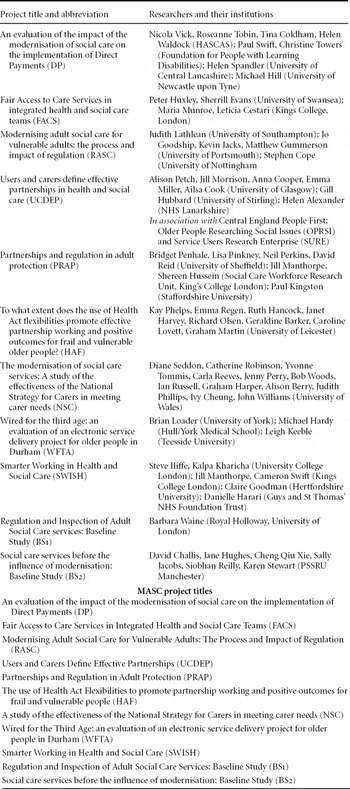
In attempting to capture the results of these different reforms, we now draw on the findings from a Department of Health-commissioned programme of research on the Modernisation of Adult Social Care (MASC). This comprised nine research projects and two baseline studies (Table 1). Reports from each of these studies, and the final programme overview report, are available from www.masc.bham.ac.uk.
The MASC research programme.

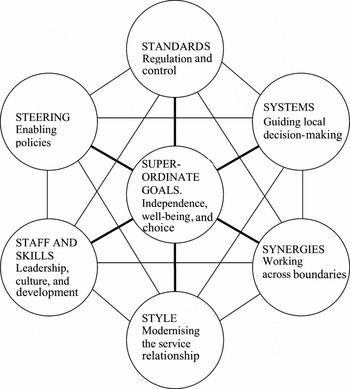
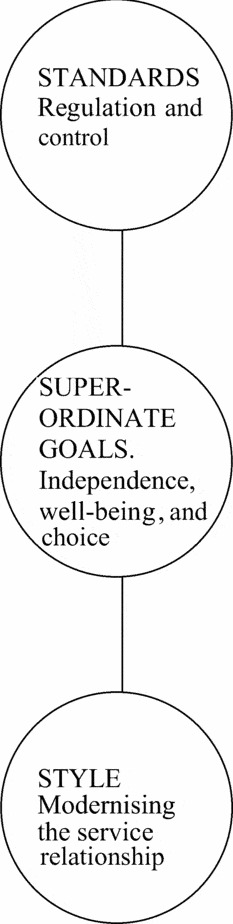
This article does not attempt to reflect the extraordinarily richness of the individual MASC projects. Rather, our purpose is to draw on the programme as a whole, to reflect on the processes and outcomes of modernisation in adult social care in England and Wales, and the potential for further future transformations. In presenting the findings to government and other policy stakeholders, we faced a number of challenges. One challenge was how to produce some coherence across what had been a very diverse series of projects. A second was how to stress the importance of the intersections between different policy areas and to highlight possible tensions between them. A third was how to present our report in a way that policy and practice audiences would find sympathetic. To resolve these different challenges we adapted the ‘7-S’ model developed by Pascale and Athos (Reference Pascale and Athos1981) and popularised by the McKinsey Company. Our adapted model (Figure 1) takes the form of a series of interdependent process factors, each of which contributes to the superordinate goals of social care:
Steering change – policy and implementation processes
Modernising systems – around assessment and access
Standards and protection – through regulation
Changing the style – towards more personalised models of care
Achieving synergies – through partnership working
Staff and leadership
Superordinate goals – independence, wellbeing, and choice
The model helps in understanding the dynamics of adult social care modernisation in two ways. First, it highlights the difference between transactional and transformational processes. Transactional processes – here understood as central government steering, the regulation of standards and systems for guiding decision-making and assessment – involve exchanges of rewards for compliance or performance. They imply an instrumental view of policy and implementation, one that assumes people and organisations act rationally within narrow conceptions of self-interest. They also assume hierarchical relationships between central government and local services and between commissioners and providers. This relationship generates policy guidelines, targets, standards, regulation, output-based commissioning, centrally determined access criteria and assessment frameworks – all processes that produce compliant behaviour and focus on the efficient delivery of outputs. Transformational processes, in contrast, involve values, attitudes and relationships. They include inter- and intra-organisational partnerships (synergies), relationships between service providers and users/carers (style), and the values and beliefs of those who commission and provide services (staff) – and, as we will argue, service users. Transformational processes have the capacity to generate commitment rather than compliance. They assume that a strong value base (in the form of superordinate goals) is of critical importance and emphasise factors such as organisational culture and leadership, staff motivation and workforce development. The transformational parts of the system increase in importance when policy problems are more complex and government control mechanisms are more ‘incomplete’ (Moore and Hart, Reference Moore and Hart1998).
Modelling the modernisation of adult social care.

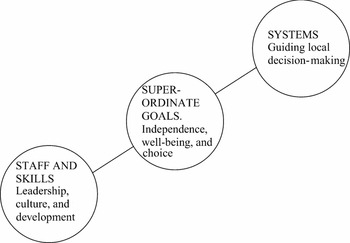
National consistency vs local leadership.

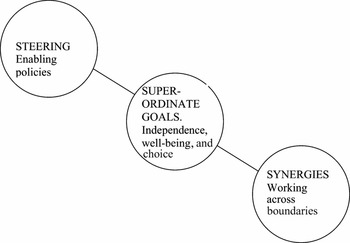
Creating synergies vs central policy steering.

User involvement vs regulation and cost-control.

At first glance, the differences between the 1998 White Paper and the 2005 Green Paper reflect a shift in emphasis from transactional to transformational processes. However, one of the findings of the MASC programme is the complex interaction between the transactional and transformational agendas. Initiatives with no clear legislative framework or performance indicator appear to have fared badly. Despite complaints about too much top–down pressure, coercion does ‘work’ and transactional interventions are needed to unblock traditional ways of working and to introduce new systems that can reflect changing social and political values. For example, the study on the implementation of the National Strategy for Carers (Seddon et al., Reference Seddon, Robinson, Tommis, Reeves, Perry, Woods, Russell, Harper, Berry, Phillips, Cheung and Williams2007) found no significant improvement for carers over the three years of the study; the absence of carers from the local government performance management framework was one reason for this. Consequently, the authors called for performance indicators for the NHS as well as local authorities relating specifically to carer support and the implementation of local carer strategies. Respondents in the Partnership and Regulation in Adult Protection study (Penhale et al., Reference Penhale, Perkins, Pinkney, Reid, Hussein and Manthorpe2007) similarly wished to see legislation on adult protection in order to standardise policy and practice, clarify responsibilities, hold agencies to account, and raise the profile of adult protection issues.
However, while transactional processes can unblock systems and direct attention towards specific policy requirements, they do not necessarily on their own deliver positive outcomes. The limitations of over-reliance on transactional processes were highlighted in studies on assessment (Huxley et al., Reference Huxley, Evans, Munroe and Cestari2006; Loader et al., Reference Loader, Hardy and Keeble2007), the modernisation of regulation (Lathlean et al., Reference Lathlean, Goodship, Jacks, Cope and Gummerson2007) and the 1999 Health Act flexibilities (Phelps and Regen, Reference Phelps and Regen2008). These studies found that an outcome-based approach – whether in regulation, assessment, partnership working or commissioning – was critical in overcoming the instrumentalism that has historically produced poor-quality and unsatisfactory services (Waine, Reference Waine2004). Achieving outcomes rather than outputs requires more attention to transformational processes. Across the MASC studies there was repeated emphasis on the need for training and development, communication and leadership, champions to lead change management processes and the development of networks to support cross-boundary working. However, the studies also suggest that, although the focus in Independence, Well-being and Choice is on local authority leadership, it is health service managers and practitioners who present the greatest barriers through their unfamiliarity with, and lack of commitment to, social care goals and services.
The second role for the ‘7-S’ model is in highlighting tensions between different modernisation goals and agendas. Here we explore three sets of tensions: between standards and regulation, around partnership working and around user involvement. Each of these tensions operates around a different ‘slice’ through the ‘7-S’ model.
Achieving consistency and equity
The modernisation of adult social care has sought to reduce variations in both the quality of services and the eligibility criteria used by different local authorities. Achieving this standardisation has involved increasing comparisons between the performance of different local authorities, elaborating central government guidance in the delivery of social care and reforming regulation and inspection processes. As the Fair Access to Care Services (FACS) study showed, modernisation has in this respect been largely effective (Huxley et al., Reference Huxley, Evans, Munroe and Cestari2006): there have been real gains in equity, coupled with a more effective use of resources (Audit Commission, 2003).
But currently only those with needs assessed as ‘critical’ or ‘substantial’ are normally able to access services. This potentially compromises the achievement of other modernisation goals by reducing opportunities to pursue preventative work and manage risk in relation to some service user groups: measures that may promote wellbeing and reduce costs in the long term. The study on the protection of vulnerable adults (Penhale et al., Reference Penhale, Perkins, Pinkney, Reid, Hussein and Manthorpe2007) therefore raised concerns about people denied access to safety or risk reduction strategies because their current needs are ‘below the threshold’.
Pressures on resources coupled with growing demand are likely to exacerbate the problems faced by care managers with limited capacity to purchase services that could prevent future ‘critical’ needs by promoting wellbeing or pursuing social inclusion agendas. Such dilemmas produce a proliferation of guidelines that are not well communicated to staff (Lyons, Reference Lyons2007; Newman and Hughes, Reference Newman and Hughes2007). The question here, then, is whether such problems should be resolved at a strategic level within local authorities or should be the focus of central government intervention (see Lyons, Reference Lyons2007: 101). However, both approaches are likely to reinforce the transactional dimensions of modernisation, leaving transformational agendas of staff development and user participation sidelined.
Creating synergies: the dynamics of partnership working
Positive outcomes for service users depend on high levels of service integration at the point of delivery. The study of users’ and carers’ views about partnerships (Petch et al., Reference Petch, Miller, Cook, Morrison, Cooper, Hubbard and Alexander2007) affirmed the importance of effective joint working in order to deliver the outcomes valued by users. Much has been achieved: the Health Act flexibilities (Phelps and Regen, Reference Phelps and Regen2008) provide a robust basis for partnership working that is beneficial both for the organisations concerned and for service users, who are enabled to regain mobility, get prompt access to equipment and experience improved physical and mental health. These outcomes appear universal and highly valued. They also led to users being able to regain independence such that they no longer needed support. This evidence is vitally important, given the preoccupation of much research with the processes of partnership working and the dearth of evidence on the benefits that partnerships can bring to users (Dowling et al., Reference Dowling, Powell and Glendinning2004).
Recent policy initiatives (Payment by Results in the NHS; Direct Payments, personalised and Individual Budgets in social care) may lead to renewed divergence, in terms of whether professionals (NHS) or end users (social care) have command over purchasing resources. In practice, the policy focus on solving problems in the acute health sector has been at the expense of the marginalisation of social care within a health paradigm; several MASC studies (Huxley et al., Reference Huxley, Evans, Munroe and Cestari2006; Vick et al., Reference Vick, Tobin, Swift, Spandler, Hill, Coldham, Towers and Waldock2006; Phelps et al., 2007; Lathlean et al., Reference Lathlean, Goodship, Jacks, Cope and Gummerson2007; Iliffe et al., Reference Iliffe, Kharicha, Manthorpe, Goodman, Harari and Swift2007) highlighted this danger. The national policy drives to require collaboration and interdependency between sectors may create significant new instabilities. The focus on the boundary between health and social care may undermine the importance of partnerships across a much wider range of services (LGA, 2005; Petch et al., Reference Petch, Miller, Cook, Morrison, Cooper, Hubbard and Alexander2007).
Changing the style: user involvement and engagement
Recent trends across the public sector have placed greater emphasis on user involvement, with some recognition of the flaws of consultative mechanisms and moves towards experimentation in more deliberative forms of engagement (Barnes et al., Reference Barnes, Newman and Sullivan2007). Social care has a reputation for having led the way, with innovations in engagement with service user movements serving as models for practice elsewhere. However, social care may begin to lag behind because of the tightening resource framework that is creating a narrowing focus on standards, performance and costs. The user voice here may be squeezed out.
Each of the MASC studies highlighted the significance of user engagement and involvement, most powerfully represented in Petch et al. (Reference Petch, Miller, Cook, Morrison, Cooper, Hubbard and Alexander2007). However, at critical points this remains under-developed. Several studies identified a lack of user involvement in policy development and regulatory processes (Lathlean et al., Reference Lathlean, Goodship, Jacks, Cope and Gummerson2007; Seddon et al., Reference Seddon, Robinson, Tommis, Reeves, Perry, Woods, Russell, Harper, Berry, Phillips, Cheung and Williams2007; Loader et al., Reference Loader, Hardy and Keeble2007). This clearly inhibits the development of a culture that assigns prominence to user- and carer-defined outcomes. Similarly, the importance of user advocacy groups and voluntary and community sector organisations as catalysts for change was repeatedly emphasised in the research. But Penhale et al. (Reference Penhale, Perkins, Pinkney, Reid, Hussein and Manthorpe2007) found a participation failure in Adult Protection Committees. The questions they raise about problems of representation, the management of potential conflicts of interest and the measurement of active and appropriate participation go far beyond that specific study. For example, the FACS study (Huxley et al., Reference Huxley, Evans, Munroe and Cestari2006) highlighted barriers to user involvement in assessment. Assisting with self-assessments will be an important part of future social care activity, but ‘it remains to be seen what the consequences of this are for both the service users and the workers; arguably it is the workers who have the most change to embrace’ (Huxley et al., Reference Huxley, Evans, Munroe and Cestari2006: 72)
Overall, those strands of modernisation focused on service user involvement have produced substantial innovation, but the position of users remains one of ‘Now you see them; now you don't’. This raises questions about the capacity of service users to influence the future dynamics of social care; blockages in the system may not be attributed simply to staff resistance or organisational inertia, but may derive from deeper tensions within the modernisation agenda. Thus, structural tensions exist between modernising policies designed to target resources more effectively in order to contain costs and those designed to produce positive outcomes for service users. The ‘choice’ agenda is at the interface between these imperatives. It cannot, alone, resolve them. This point is developed further below.
Independence, choice and control: the place of service users in modernisation
The changing place of service users in the process of modernisation has been a consistent theme in adult social care modernisation since 1997 and has placed the sector in the vanguard of developments around individualisation and personalisation. The 1998 White Paper made a commitment to ‘more personalised models of care’; the 2005 Green Paper aimed to ‘foster independence and control’. These related objectives are underpinned by a major transformation in the role of service users, to become active participants in the construction, production and management of their own social care. Service users are increasingly important actors in the dynamics of modernisation, rather than simply its imagined beneficiaries. However, the instabilities and uncertainties associated with this role may further influence future modernisation processes.
One of the main findings of the MASC programme is that user movements (whether led by service users or by articulate advocates) have been critical in transforming social care. Direct Payments were introduced as the result of disabled people's activism and these groups remain the most frequent users of this option. Access to adequately resourced peer support organisations is a critical factor in the take-up of Direct Payments (Vick et al., Reference Vick, Tobin, Swift, Spandler, Hill, Coldham, Towers and Waldock2006; Fernández et al., Reference Fernández, Kendall, Davey and Knapp2007). The study of the National Strategy for Carers (Seddon et al., Reference Seddon, Robinson, Tommis, Reeves, Perry, Woods, Russell, Harper, Berry, Phillips, Cheung and Williams2007) also identified the importance of adequate financial support to enable voluntary organisations to support carers and formulate plans for service improvement.
The introduction and extension of Direct Payments, as an alternative to social care services in kind, has been widely documented (Leece and Bornat, Reference Leece and Bornat2006; Vick et al., Reference Vick, Tobin, Swift, Spandler, Hill, Coldham, Towers and Waldock2006). Research has documented the success of this option, but has also examined the political, institutional and professional barriers to its wider use (CSCI, 2004; Pearson, Reference Pearson2006; Ellis, Reference Ellis2007; Fernández et al., Reference Fernández, Kendall, Davey and Knapp2007). Nevertheless, the 2005 Green Paper argued for the increased use of Direct Payments and for the introduction of a new cash-based option, Individual Budgets. Thirteen English local authorities are piloting Individual Budgets. Meanwhile, personalised budgets, originally introduced for people with learning disabilities, are also available in an increasing number of English local authorities.
Each of these mechanisms allocates resources to the service user. Determining this allocation offers opportunities for self-assessment and a more equitable and transparent basis for calculating the level of resources that each individual should receive (Glendinning, Reference Glendinning2007). The service user, with formal and/or family support, then deploys these resources in ways that best meet their needs. All these mechanisms assume an active role for service users, possibly supported by their families, in constructing support arrangements and in monitoring and quality control: the ‘transformation of citizens into both managers and entrepreneurs’ (Scourfield, Reference Scourfield2007: 112). They therefore epitomise the model of personalisation advocated by Leadbetter, who argues that:
by putting users at the heart of services, enabling them to become participants in the design and delivery, services will be more effective by mobilising millions of people as the co-producers of the public goods they value. (Leadbetter, Reference Leadbetter2004: 19)
The achievement of such goals requires service users to have access to information; however, the MASC programme offers little evidence that information is provided in meaningful ways (although there are important exceptions of good practice). The studies of the National Strategy for Carers (Seddon et al., Reference Seddon, Robinson, Tommis, Reeves, Perry, Woods, Russell, Harper, Berry, Phillips, Cheung and Williams2007) and the Implementation of Direct Payments (Vick et al., Reference Vick, Tobin, Swift, Spandler, Hill, Coldham, Towers and Waldock2006) highlight how access to information remains a critical variable. Experiments in the use of Electronic Data Systems appear to have some potential, but evidence so far suggests these are primarily for professional data sharing or for professionally driven assessment processes, with little service user involvement in their design (Iliffe et al., Reference Iliffe, Kharicha, Manthorpe, Goodman, Harari and Swift2007; Loader et al., Reference Loader, Hardy and Keeble2007). Increased internet access may facilitate user involvement in assessment – or moves towards self-assessment – in the future. However, Loader et al. (Reference Loader, Hardy and Keeble2007) suggest this may further privilege already advantaged service users. This finding supports the warnings of Lent and Arendt (Reference Lent and Arendt2004) that increased inequity could accompany increases in personalisation and choice; easy access to information for otherwise disadvantaged service users is key in reducing such risks.
The new roles for service users as active agents in the social care system carry significant risks: risks that have hitherto been borne by social care organisations and professionals. One risk involves managing finite public resources and associated responsibility for maximising efficiency and effectiveness in the use of those resources. A second risk arises from potential shortfalls in the stimulus and maintenance of new forms of supply in response to the demands expressed by newly empowered users seeking services and the danger ‘that individuals will end up in competition with each other over limited resources, an obvious example being personal assistants, who are in scarce supply’ (Scourfield, Reference Scourfield2007: 120). Hitherto, local authorities have been responsible for stimulating voluntary and independent sector social care provision and ensuring market stability through their commissioning and contracting arrangements. Individual purchasers will struggle to exercise similar levels of command over local provider markets as large local authority purchasers.
Social care, welfare governance and citizenship
In the introduction to this article we raised two questions. First, how far might the current emphasis on personalisation, independence and choice in adult social care represent a shift in welfare governance? And second, what might be the implications of this emphasis for questions of citizenship? Here we return to these questions in the light of the analysis presented in the article.
The current emphasis on personalisation, independence and choice in adult social care is now firmly embedded across government discourse, organisational missions and professional norms of good practice. Yet, as many of the MASC studies showed, these are unevenly inscribed in organisational and professional practice. In policy circles low take-up of initiatives such as Direct Payments for older people is presented in terms of a kind of battle: one between the forces for good (central government, acting in the interests of the public and on behalf of the social movements that have advocated change) and evil (local authorities who are viewed as slow to adapt, reluctant to change and defenders of entrenched interests inscribed in the block contract). Social care organisations and professional bodies in turn talk of resistance from staff, their reluctance to take risks and their continued reluctance to abandon their paternalist approaches of the past. The result, in both cases, is a temptation to strengthen implementation measures.
Our analysis in this article has, however, highlighted deeper issues of welfare governance that cannot be collapsed into the policy/implementation dynamic. Our development of the 7-S model enabled us to map important lines of tension within the social care system: for example, between a tightening of assessment and control systems and the capacity for local leadership and culture change; or between the regulatory framework and the need for flexibility within the service relationship. The trope of ‘partnership’ is particularly significant in that this not only suggests tensions within the social care system but also between different government priorities, and between different modernisation programmes. As we noted earlier, adult social care has been profoundly affected by modernising changes in the NHS, producing a subordination of social care modernisation to other imperatives. In this respect, the past decade has been no different from the entire post-war period, in which developments in health services have consistently driven changes in social care services (Glendinning and Means, Reference Glendinning and Means2004). Although willing to engage in broader partnerships, social care services have often remained unduly focused on the difficult challenges of managing boundaries, and controlling costs across the health and social care divide (LGA, 2007). These actions have significant implications for the trust on which effective partnerships depend (Rummery, Reference Rummery, Glendinning, Powell and Rummery2002). The White Paper Our Health, Our Care, Our Say (DH, 2006) identifies many positive points of integration between primary health and social care services, opening up opportunities to harness policy and professional concerns with preventing ill health and promoting independence. However, these potential opportunities risk remaining marginal to a service preoccupied with allocating increasingly scarce resources to those in most acute need. Attitudes towards collaboration and partnership with NHS services are also shaped by anxieties about the potential subordination of distinctive social care priorities to high-profile NHS targets. These anxieties are underpinned by the desire to sustain distinctive professional and epistemological paradigms and professional identities: care rather than cure and social rather than medical models (Hudson and Henwood, Reference Hudson and Henwood2002; Glendinning and Means, Reference Glendinning, Means, Bauld, Clarke and Maltby2006). The position of social care at the interface between a highly centralising government and the rhetoric (and to some extent the practice) of local autonomy and control has compounded these difficulties.
Such issues highlight the importance of the institutional and policy frameworks that constitute welfare governance. But we also want to raise a wider concern about the interaction of different governance regimes. Notions of independence, choice and control imply a shift of power to the service user: what elsewhere one of us has termed as a form of ‘self governance’, one of four governance regimes along with hierarchical, managerial and network governance (Newman, Reference Newman2001). The MASC studies suggest emerging tensions between policy aspirations for self-governance on the part of service users and a continuing dominant emphasis on managerial forms of governance. Self-governance depends, for its success, on longer-term capacity building supported by user-led peer and other community organisations, effective mechanisms for information-sharing and meaningful participation, co-production processes and developing skills for decision-making and management among a wide range of civil society actors. These are time-consuming activities, and require high levels of skill. They are not readily accommodated in neo-Taylorist styles of working and, above all, are not cheap. They also do not currently receive much recognition in performance and regulatory regimes, which inevitably focus on shorter-term delivery of easily measurable targets (Glendinning, Reference Glendinning2002; de Bruijn, Reference de Bruijn2002).
Aspirations for self-governance are also not easily reconciled with hierarchical governance regimes that emphasise consistency, standards, accounta-bility and protection – all issues that are high in the government's list of priorities. How might the tension between these different aspirations produce new dynamics in welfare governance? One possible response is that of government retreating from policy interventions and restructuring initiatives and allowing greater scope for local discretion, but retaining a role as protector of the people (as social care users) in a fragmented and a competitive marketplace. Given the current funding pressures, a distancing of government from local decision-making – and its consequences – seems a strong probability. But it could also be suggested that government, having attempted with only limited success to reform public services, is now turning away from ‘top–down’ levers that focus on changing structures and systems towards a reliance on service users themselves – as consumers in a new public service marketplace – to lever change through the ways in which they exercise choice. As Direct Payments and Individual Budgets become more firmly established, with groups of service users sharing their resources to purchase services in common or employing personal assistants from beyond the traditional social care workforce, hard questions will need to be asked about the place of standards and the role of regulation in ensuring equity and accountability.
In assessing the interaction between these different governance regimes, it is one thing to highlight tensions between them but another to look at deeper shifts in welfare governance that may be at stake. Here we want to turn to issues of welfare citizenship implied in the increasing stress on self-governance represented by the discourse of independence, choice and control. Much has been made in the policy literature – and academic writing – about the desirability of an ‘adult’ rather than a ‘dependent’ conception of citizenship – one that transcends the paternalism associated with bureaucratic and professional power:
Of course, the individual's own assessment of their needs might conflict with those of their professional assessor. At present, this is too often hidden. The individual's personal assessment must be transparent in this whole process. (DH, 2005, para. 4.16)
We will shift the whole system towards the active, engaged citizen in his or her local community and away from monolithic, top–down paternalism. (DH, 2006, para. 1.39)
We do not wish to challenge the importance of such aspirations. Rather, we want to examine a little more closely the concept of citizenship that is implicit in the shift towards self-governance. Underpinning this is a deeper trend that some have termed governmentality: creating citizens and communities as governable subjects (Dean, Reference Dean1999; Rose, Reference Rose1999; Clarke, Reference Clarke2005). As Kemshall explains, governmentality is ‘displaced to the microdomain of individual and locale, with the residual role of welfare agencies constituted as facilitating prudential choices through the provision of expert knowledge’ (Reference Kemshall2002: 132). Risks that were previously collectively managed become individualised, with service users expected to manage their own risks as active, responsible and enterprising citizens. Moreover, the poverty, deprivation and social exclusion that many disabled and older people experience (Cabinet Office, 2005) means that the choices open to them may be very limited indeed, particularly if they perceive themselves to be involuntary service users (Ferguson, Reference Ferguson2007).
The conception of citizenship underpinning many of these reforms is one in which responsibilities are emphasised (Dwyer, Reference Dwyer2006). Disabled people, frail older people, people with learning difficulties and others may therefore be winning citizenship rights just as the meaning of citizenship itself is changing towards more communitarian models. The interaction between liberal, republican and communitarian models of citizenship is of great interest to adult social care. Briefly:
Liberalism puts a strong emphasis on the individual, and most rights involve liberties that adhere to each and every person. Communitarianism puts strong emphasis on the community (or the society or the nation), whose primary concern is with the cohesive and just functioning of society. Republican theories in both their social and radical variants put emphasis on both individual and group rights and underline the role of conflict and contest in the expansion or construction of such rights. (Isin, Reference Isin and Isin2000: 4–5)
In social care we can trace elements of communitarian models of citizenship in the notions of care – and self care – as a duty or responsibility, and its contribution to social cohesion and wellbeing. The proliferation of service user involvement and empowerment strategies in recent years can be aligned to a republican model, while notions of choice invoke a liberal model of individual freedoms and entitlements. These are not, however, clear-cut distinctions. The drive for greater choice and control can be attributed to pressure from service user movements, especially those of disabled people, mental health service users and, to a lesser extent, carer organisations, and to alliances between these and radical professionals. There is a clear trace of republican citizenship here. But the dominant framing of such struggles has tended to be in the form of access to a public domain of liberal citizenship. This makes the notion of self-governance through independence, control and choice vulnerable to neo-liberal tendencies in the policy agendas of many ‘modernising’ welfare states especially, perhaps, in the UK.
The confluence between these different dynamics – social movement activism, liberal conceptions of citizenship, a communitarian emphasis on responsibilities and neo-liberal agendas of markets and consumer choice – produces a widespread unease. Such unease is traceable in debates about what kinds of choices are of most importance to service users: debates in part provoked by the results of research within the MASC programme. Choice of provider may be important but is not necessarily the key value expressed by service users. Choice of time (when care is provided), of carer (with continuity of care worker), of task (to accommodate variations in daily routines and capacities) and of type of support service are of prime importance, but do not receive the same emphasis in social care policy and practice (Petch et al., Reference Petch, Miller, Cook, Morrison, Cooper, Hubbard and Alexander2007). Choice to access the same facilities and services as ‘ordinary’ citizens – such as going to the cinema, pub or football match – also raises wider questions about the limits of political acceptability in how social care resources are used. It anticipates a direct confrontation between discourses of social inclusion and citizenship and popular conceptions of the lifestyles that it is appropriate for social care resources to support. Unease also pervades the debates on choice that have littered papers in UK social policy journals in recent years, debates that have highlighted the implications for questions of accountability, fairness, equity and other ‘public’ goods (for example, Clarke et al., Reference Clarke, Smith and Vidler2006, Reference Clarke, Newman, Smith, Vidler and Westmarland2007; Needham, Reference Needham2007).
Conclusion: policy, theory and research
This article has reflected back on a programme of policy-commissioned research. We have attempted to give a flavour of the valuable research that was produced within the MASC programme, and in doing so want to acknowledge both the work of individual research teams and commend their willingness to collaborate with each other and with ourselves during the course of the programme. But in this article we have also attempted to transcend the policy frameworks used in presenting the research to government, practitioners and other research users, in order to draw out wider issues concerning welfare governance and citizenship. In this conclusion we want to offer some comments on the process of working across the academic, policy and research boundaries: boundaries which each of the authors of this article crosses regularly in their work. Our comments focus first on questions of the models of knowledge and science that underpin policy related research; and second on the relationship between ‘policy’ and ‘theory’.
The MASC programme aimed to conduct policy-relevant but theoretically and methodologically robust research. One difficulty we faced lay in the different orderings of credibility and robustness associated with different research traditions. Research based on controlled experiments and other methods derived from the natural sciences are viewed as the most robust, especially in the health sector. However, these are of less value in many aspects of policy research in that they produce an objectified and de-contextualised set of research findings that, it is assumed, can be reproduced in other contexts. The history of policy transfer from one context to another, however, has not always been fruitful. Such methods also assume that the ‘subjects’ of research (service users, carers and other stakeholders) do not ‘make sense of’, interpret, or interact to change, their world. Striking a balance between properly ‘scientific’ methods that provide robust and replicable results, and developing methods that are best able to answer research questions in the context of a rapidly changing policy context, is a challenge that each of the MASC projects has sought to resolve in a way that gives credibility to their results.
A second difficulty was that policy research tends to be conducted in a context in which policy actors tend to want quick answers on ‘what works’ to inform future development, while researchers tend to always seem to say ‘ah, but it's more complicated’. In taking the time to understand and address these complications, researchers risk the danger that the policy agenda will move on. This is why different kinds of policy research are needed: some dealing with short-term evaluations of specific policies (answering ‘what worked’ questions), and some taking a longer-term and broader overview of the relationship between policy and action on a system-wide basis. It is in the latter that the value of the MASC programme lies: the commissioning of a programme, rather than a series of separate projects, enabled us to look across the social care system and highlight the interaction of different policy interventions. The longitudinal nature of the programme also enabled us to make statements about change processes and about the comparisons between research findings and the observations in the baseline studies. This is a long way from simple prescriptions about ‘what works’. However, such is the hegemonic status of this phrase in policy research that we decided, in the end, to use ‘Modernising adult social care – what's working’ as the title of the overview report.
The academic grounding of the research also yielded benefits. It enabled the projects to address both ‘what’ and ‘why’ questions using a mix of methodologies. ‘What’ questions are relatively easy to answer, and many of the MASC projects did so through large-scale survey data, by comparing the results to baseline data and/or by conducting longitudinal research. ‘Why’ questions are, however, more difficult. One approach requires sophisticated modelling of large-scale data around a number of different variables, an approach followed in at least two of the MASC studies, resulting in important data about correlations and associations. But to answer ‘why’ questions more fully, we have to turn to what Bevir and Rhodes (Reference Bevir and Rhodes2003, Reference Bevir and Rhodes2005) term an ‘interpretive’ approach. The idea of actors engaged in reasoning, or from different perspectives, ‘sensemaking’ (Weick, 1995) or ‘policy learning’ (Sabatier and Jenkins-Smith, Reference Sabatier and Jenkins-Smith1993) produces a much less instrumental view of the policy process, illuminating, for example, how the interface between government and organisations, managers and staff, front-line staff and service users is negotiated.
But such approaches tend to produce a mass of data that it is difficult to make sense of. And this difficulty is exacerbated when trying to look across multiple research projects all using a different mix of methodologies. As scientific advisers we struggled to find an integrative framework through which to present the results to policy and practice stakeholders, eventually developing the 7-S model we outlined earlier. This model was well received by research users, and has already been used in a number of presentations both within the UK and in continental Europe, as well as in some training events. However, it is based on a form of systems theory that produces some difficulties. One is that it suggests a system that has a natural tendency towards equilibrium and stability; change in one element will, it is assumed, have a transformative effect on other elements. This ignores the ‘sensemaking’ capacity of actors, who may be inclined to interpret new guidelines or policies in ways not envisaged by their originators, or who may introduce new ideas of their own that are not tightly coupled to other parts of the system. A certain amount of ‘loose coupling’ within the system is, it might be argued, necessary to foster innovation; though it may also be viewed in terms of implementation failure.
A second difficulty inherent in the 7-S model is that the extrinsic factors that influence or impact on particular elements of the system are rather too neatly tidied away. We can see that, for example, the ‘staff’ element of the model is shaped by direct governmental interventions (for example, new training opportunities, or the registration of social care workers) and other elements of the model itself (such as electronic systems that involve an element of ‘de-skilling’ of care work). However, factors extrinsic to the system are also significant. These include: labour market supply and demand, policies on migration, ‘activation’ policies and policies on welfare benefits, taxation and employment regimes, and changing views of the gendering of care work. Taking another example, the achievement of ‘synergies’ depends not only on the health and social care interface, but also by a range of seemingly extrinsic features that pull organisations back towards prioritising ‘putting their own house in order’ at the possible expense of collaborative success. Social care organisations are also part of the changing local governance system that includes organisations in criminal justice, culture, economic development, and the changing voluntary and community sector, while health is undergoing multiple modernisations, not all of which necessarily view social care as a top priority. Uncertainties in the future resourcing of social care, not addressed within the model, may produce longer-term policy instability. Even changes to the accounting rules can have considerable impact on views of future stability (Audit Commission, 2006).
In this article, then, we have highlighted a number of disjunctures and tensions within the modernisation of adult social care. In doing so we have looked beyond the policy-oriented systems model to wider theories of welfare governance. This, we argue, enables us to explore what happens as different regimes of power – hierarchical, network-based, managerial and self-governance – interact. All are present within the social care system in England and Wales. And, it might be argued, all are a necessary component of modernisation. But their interaction, and the instabilities these produce, create dilemmas for social care organisations and those who manage or work in them.
Finally, in exploring the dynamics of welfare governance and citizenship, we suggest that social care modernisation opens up ambiguous political spaces. ‘Progressive’ agendas that emerged from social movements, service user and advocacy groups have now taken centre stage in policy discourse, and are actively being pursued through a number of initiatives: Direct Payments, Individual Budgets, personalised services, and the enlargement of choice. However, these may, as we have suggested, also be vulnerable to cooption within neo-liberal imperatives towards individuation and the privatisation of public goods. There is currently a remarkable disparity between academic critiques of choice in health and education, on the one hand, and discussions of choice in social care, on the other. This disparity reflects different trajectories of reform and different perceptions of the professional–user relationship in different services. ‘Choice’ is now such a loaded term that fruitful conversations may not be possible. But a focus on welfare governance and the politics of citizenship perhaps provides a fertile terrain for future cross-disciplinary conversations in and beyond social policy.