


Introduction
Jeffrey Young and colleagues defined early maladaptive schemas (EMS) as dysfunctional, pervasive patterns, consisting of memories, emotions, cognitions and bodily sensations, developed during childhood or adolescence through interactions between adverse relational experiences and one’s temperament (Young et al., Reference Young, Klosko and Weishaar2003). The theory of EMS is still being empirically verified. Most research looks into the consequences of schemas. Authors focus mainly on finding relationships between schemas and various types of difficulties experienced both by people with different disorders (Bach and Farrell, Reference Bach and Farrell2018; Barazandeh et al., Reference Barazandeh, Kissane, Saeedi and Gordon2016; Flink et al., Reference Flink, Honkalampi, Lehto, Viinamäki, Koivumaa-Honkanen, Valkonen-Korhonen and Lindeman2018; Hawke and Provencher, Reference Hawke and Provencher2011) and healthy subjects (Carr and Francis, Reference Carr and Francis2010a, Reference Carr and Francis2010b; Roelofs et al., Reference Roelofs, Lee, Ruijten and Lobbestael2011; Mącik and Sas, Reference Mącik and Sas2015).
Relatively less research focuses on developing schemas. According to Young, the essence of schema formation is the interaction between the environment and temperamental characteristics. On the one hand, the environment (parental behaviour) may overcome the role of temperament (i.e. a child with an emotional temperament can become a strong person) or intensify his/her personality traits (the child will become even more sensitive). On the other hand, an extremely emotional temperament can prevail even in a very friendly and supportive environment, and be the cause of stronger schemas and, consequently, psychopathological symptoms (Young et al., Reference Young, Klosko and Weishaar2003). Only few studies focus on these assumptions more directly.
Some of them consider the role of early experiences, such as early childhood trauma or parental diseases (Cámara and Calvete, Reference Cámara and Calvete2012; Carr and Francis, Reference Carr and Francis2010a; Dale et al., Reference Dale, Power, Kane, Stewart and Murray2010; Gonzalez Diez et al., Reference Gonzalez Diez, Calvete Zumalde and Orue Sola2012; Griffiths, Reference Griffiths2014; Kaya Tezel et al., Reference Kaya Tezel, Tutarel Kişlak and Boysan2015). Most of these studies treat schemas as mediators or moderators in the context of a specific psychopathology, and focus mainly on consequences of early experiences and schemas. The authors conclude that trauma, neglect and abuse are significantly connected to schema severity, and both lead to more severe psychopathology (Greenfield and Marks, Reference Greenfield and Marks2010; Karatzias et al., Reference Karatzias, Jowett, Begley and Deas2016; Pietri and Bonnet, Reference Pietri and Bonnet2017; Smyth et al., Reference Smyth, Gardner, Marks and Moore2017). However, non-violent parental behaviour can also lead to more severe schemas and psychopathology. The study of Mącik and colleagues (Mącik et al., Reference Mącik, Chodkiewicz and Bielicka2016), conducted on healthy families, showed numerous strong positive correlations of daughters’ schemas and over-demanding and inconsistent mothers’ (but not fathers’) behaviour, and strong negative correlations – with mother’s and father’s accepting attitudes. Parental rejection or excessive control are significant factors in intensifying schemas (Muris, Reference Muris2006; Khajouei Nia et al., Reference Khajouei Nia, Sovani and Sarami Forooshani2014; Dale et al., Reference Dale, Power, Kane, Stewart and Murray2010), as well as motherly (Hoffart Lunding and Hoffart, Reference Hoffart Lunding and Hoffart2016) and fatherly overprotection (Monirpoor et al., Reference Monirpoor, Gholamyzarch, Tamaddonfard, Khoosfi and Ganjali2012). Lim and Barlas (Reference Lim and Barlas2019) also confirm the role of parental behaviour and EMS for depressive symptoms.
Some other studies point (more or less directly) to the role of temperament in schema intensity. Temperament is connected to various adaptive disorders, such as somatic symptoms of anxiety, feelings of increased stress (Fruehstorfer et al., Reference Fruehstorfer, Veronie, Cremeans-Smith and Newberry2012) or depressive symptoms (Hintsa et al., Reference Hintsa, Wesolowska, Elovainio, Strelau, Pulkki-Råback and Keltikangas-Järvinen2016). Perceiving everyday stress as dependent on a person (Sobolewski et al., Reference Sobolewski, Strelau and Zawadzki2001) and assessing one’s own social competences (Martowska, Reference Martowska2014) are also associated with temperament. This allows us to assume that there is a connection between schemas and temperament, provided that both are related to psychopathology or to negative self-thinking. However, this connection has been only partially confirmed so far. Eskedal and Demetri found that fearful and restrained children can make their parents take a condescending approach and thus strengthen an overprotective attitude (Eskedal and Demetri, Reference Eskedal and Demetri2006). Calvete discovered that temperament (mainly neuroticism) is a mediator between emotional abuse and schema severity, and plays an essential role in EMS genesis (Calvete, Reference Calvete2014). Mairet and colleagues also confirmed the role of neuroticism, mainly in the disconnection/rejection domain (Mairet et al., Reference Mairet, Boag and Warburton2014). Halvorsen and colleagues examined the function of temperament and EMS in predicting depression. They noted that a temperamental characteristic such as harm avoidance was positively related to most schemas, while self-direction was negatively related (Halvorsen et al., Reference Halvorsen, Wang, Richter, Myrland, Pedersen, Eisemann and Waterloo2009). Fischer et al. (Reference Fischer, Smout and Delfabbro2016) found that psychological flexibility fully mediated between parental styles and the strength of schemas. A systematic review of studies conducted by Lim and colleagues also confirmed the role of temperament for schema severity (Lim et al., Reference Lim, Barlas and Ho2018), due to its more biological, constitutional nature.
The above-mentioned studies confirm the importance of both temperament (especially weak and emotional features) and environment (in terms of parental attitudes/behaviours) for schema severity and psychopathology symptoms. However, most of them treat EMS as mediator/moderator in tested models. Authors premise their existence and strength, but cannot explain the way childhood experiences and temperament are connected to intensity of schemas, and how they develop. Consequently, we do not know what we can do and what is possible to prevent the development of strong schemas. Conducting studies on clinical samples can also reduce their usability in understanding factors important for schema severity. Experiencing difficulties such as depression, stress or anxiety may change the assessment of childhood and the self (Stopa and Waters, Reference Stopa and Waters2005). This may be why some research does not confirm the dependencies. Haugh et al. (Reference Haugh, Miceli and DeLorme2017) verified the role of both parental styles and temperament as EMS predictors and their contribution to the appearance of depression symptoms. They concluded that temperament has a significant effect on the relationship between parental style and depressive symptoms, but it may not play a significant role in the child’s reactions to negative parental behaviour, and thus in exacerbating schemas. However, people with depression may evaluate their temperament differently than while they were healthy, describing themselves as less lively or active. That it why it is important to verify the role of temperament and parental behaviour by testing healthy people. Besides, Young claims that schemas are present in all people, but to different extents. Therefore some people experience no psychological difficulties, some may complain of absence of meaning of life, and only some suffer different symptoms (Young et al., Reference Young, Klosko and Weishaar2003). If temperament plays an important role, some psychotherapy goals would be difficult to achieve. Until now, it has not been clear if relations between schema severity, early relational experiences and one’s temperament are the same in healthy people as in different clinical groups.
The aim of this study was therefore to test a healthy adult group to investigate the interrelations between participants’ parent’s behaviours towards them in childhood, temperament, and the intensity of EMS in adulthood. Therefore two main goals of the research were proposed. One goal is to check if positive parenting could be similarly significant as a negative one for developing schema. Based on the theory of schemas and on the previous research, it was hypothesized that Parents’ negative behaviours are more relevant for schema intensity than positive ones (H1). The second goal was to verify the role of temperament in the context of parenting. Due to constitutional, more biological nature of temperament it was hypothesized that temperament is linked to the parents’ behaviours but not directly to schemas (H2).
Method
Participants
A healthy adult sample was used to avoid links with a specific psychopathology, which could change the self-assessment. The study involved 400 people, 395 of whom were included in the analysis; 52.8% were women. The average age of the participants was 33.23 years (SD = 12.96; minimum = 18; maximum = 74). The age statistics did not differ significantly between the male and female groups.
The participants were recruited from adults who responded to an advertisement posted on the university intranet, social media or who were invited to join in by trained psychology students (older participants). Participants’ gender and age distribution was equal. In order to maintain the group’s non-clinical status, each person in the group was interviewed briefly. Having children was not an inclusion criterion, as participants were asked to report their own experiences of how they were parented in childhood. The criteria for exclusion from the group were: cognitive difficulties observed during the interview, ongoing neurological treatment, current or previous (within the last 2 years) serious somatic diseases suffered by the examined person or his/her close family member (in the case of cancer, in the previous 5 years); major life events such as mourning, a loss of job or divorce within the last 2 years; psychiatric diagnosis and/or treatment, as well as receiving psychological assistance/therapy at any point in life. All participants were volunteers, they completed paper questionnaires.
Design
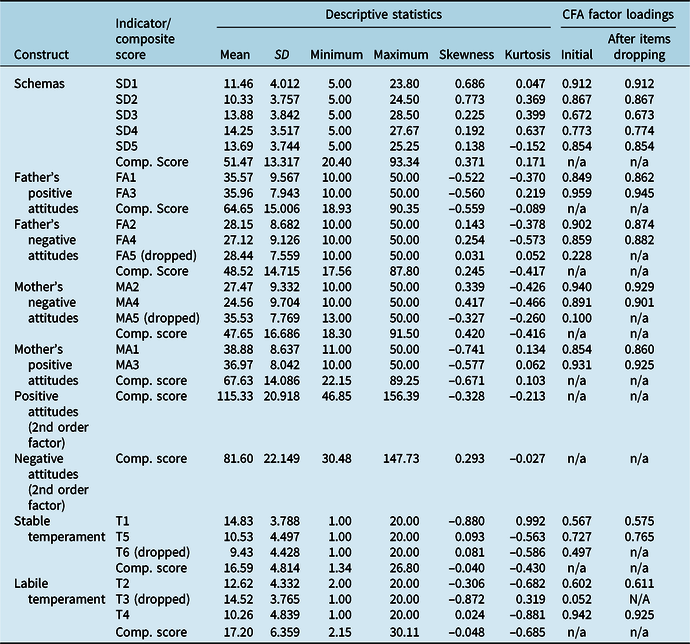
The following methods of measurement were applied (descriptive statistics and factor loadings for used variables are presented in Table 1).

Parental behaviour
This was assessed by the Questionnaire of the Retrospective Assessment of Parents’ Attitudes by Plopa (Reference Plopa2008), based on Roe and Siegelman’s (Reference Roe and Siegelman1963) typology. The tool consists of two 25-item versions: assessment of the father and of the mother. Each version gives information about five parental attitudes: acceptance-rejection (meeting/not meeting the needs of safe attachment based on unconditional acceptance of the child), over-demanding (absolute obedience even in small matters, the parent is critical and punitive), autonomy (allowing the child to build their own identity), inconsistent (the parent is unpredictable, passing from acceptance to irritability; a lack of clear boundaries and expectations) and over-protective (excessive amount of attention given to the child, a conviction that the child is incompetent and requires considerable help and support). The participants’ task is to refer from the adult’s perspective the way he/she was parented during childhood, using a 5-point scale, where 1 stands for ‘he/she was definitely not like that’, and 5 stands for ‘he/she was definitely like that’. Due to a significant and very high correlation coefficient and theory of parental attitudes, acceptance and autonomy were attributed to ‘positive style’ and over-demanding and inconsistent into ‘negative style’, as explained further. Obtained Cronbach’s alpha values were between 0.819 for maternal overprotection and 0.931 for father’s acceptance.
Temperament
This was assessed by the Formal Characteristics of Behaviour – Temperament Inventory (FCB-TI) of Strelau and Zawadzki (Reference Strelau and Zawadzki1995). The method consists of 120 statements with Yes or No responses. Temperament is assessed on six subscales: Briskness, Perseveration, Sensory Sensitivity, Emotional Reactivity, Endurance and Activity; each one consists of 20 items. Scores are calculated according to the key (accordant answer is ‘1’ point, discordant is ‘0’) with results of 0–20 points; higher scores indicate a greater magnitude of a given temperament characteristic. Obtained Cronbach’s alpha values were in range 0.803 for Briskness to 0.847 for Emotional reactivity.
Early maladaptive schemas
This was assessed by Young’s Schema Questionnaire – Short Form (YSQ-S3). The method consists of 90 statements which the tested person relates to on a 6-point scale where 1 stands for ‘completely false about me’ and 6 stands for ‘perfectly describes me’. The items are divided into 18 early maladaptive schemas allocated to five domains dependent on the kind of unsatisfied basic need (Young et al., Reference Young, Klosko and Weishaar2003):
-
(1) Disconnection and Rejection; five schemas: abandonment/instability, mistrust/abuse, emotional deprivation, defectiveness/shame, social isolation;
-
(2) Impaired Autonomy and Performance; four schemas: dependence/incompetence, vulnerability to harm or illness, enmeshment/undeveloped self, failure;
-
(3) Impaired Limits; two schemas: grandiosity, insufficient self-control
-
(4) Other Directedness; three schemas: subjugation, self-sacrifice, approval-seeking;
-
(5) Over-vigilance and inhibition; four schemas: negativity/pessimism, emotional inhibition, unrelenting standards/hyper-criticalness, self-punitiveness.
Cronbach’s alpha values were between 0.693 for self-sacrifice and 0.824 for failure.
Preliminary data analysis
Table 1 contains descriptive statistics of explicit variables used in the models, as well as descriptive statistics for latent variables – calculated as regression-weighted composite scores – with factor loadings from confirmatory factor analysis (CFA) used as weights. Additionally, the values of factor loadings from CFA for explicit variables were provided – low loadings were the basis for removing several variables from the measurement models, which were described later in the text (the removed variables are marked accordingly in Table 1).
In order to answer the research question, covariance-based structural equations modelling (CB-SEM) was conducted (using IBM SPSS AMOS 24.0). The intensity of schemas was treated as a dependent variable, and temperament and parental behaviours as explanatory variables.
Based on the assumptions of the applied diagnostic methods and the CFA confirmation analysis, the measured variables were grouped as described below. In the case of schemas, classification analyses were also performed (e.g. cluster analysis). It was found that the resulting groups did not significantly differ with respect to schema profiles – the configuration of schemas turned out to be very similar. The only difference was the intensity of these profiles. This phenomenon is typical of non-clinical samples, but some studies confirm the similarity of profiles also between clinical and non-clinical samples (Chodkiewicz and Gruszczyńska, Reference Chodkiewicz and Gruszczyńska2018). Therefore, in the tested models (cf. Models 1 and 2), the decision was made to use a latent variable explained by five domains of schemas, treated as observable variables, thus accounting for the overall severity of schemas, rather than their specific structures.
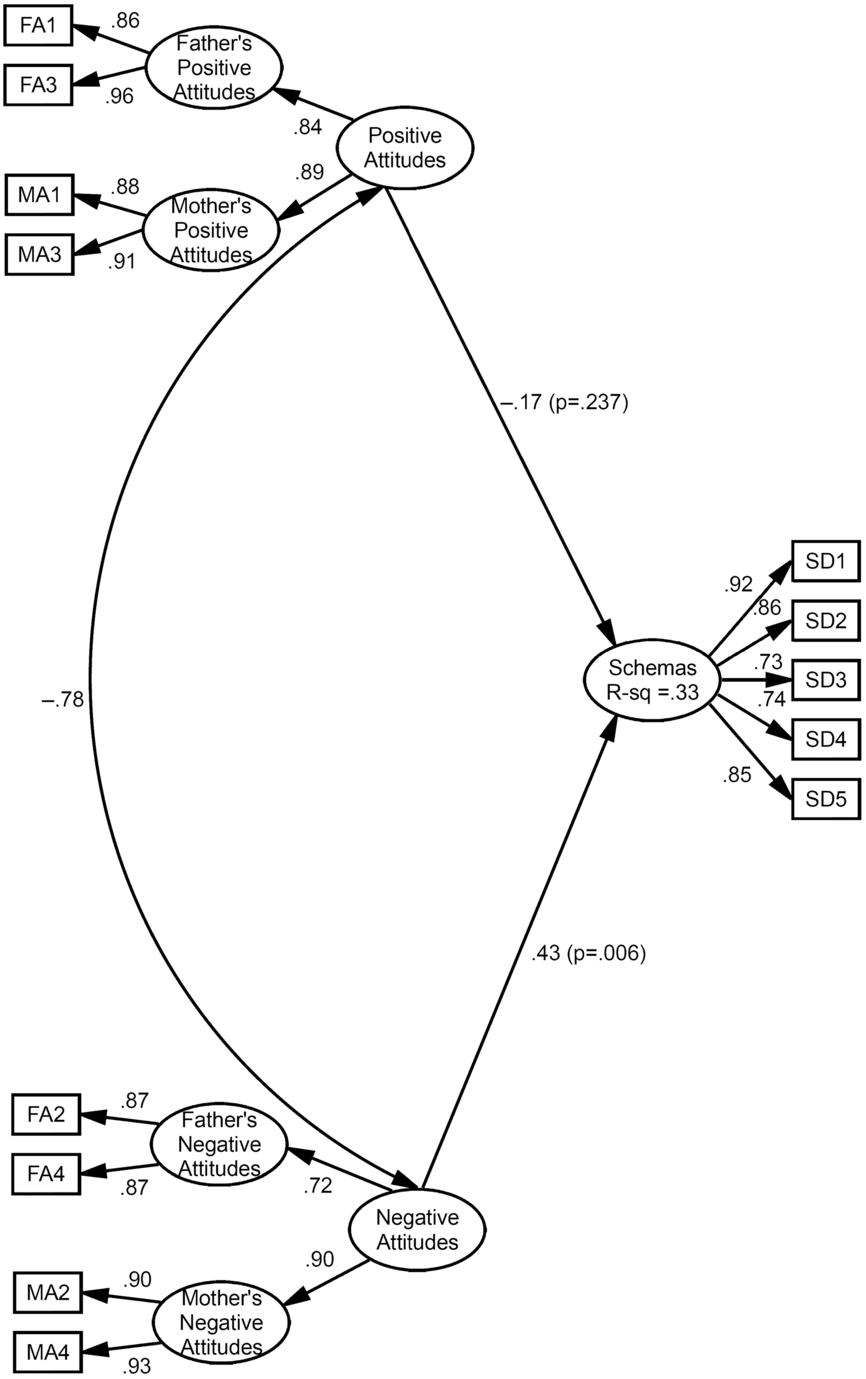
Parental attitudes in the first step were grouped, separately for the father and mother, into positive (Acceptance and Autonomy) and negative (Demands, Over-protective and Inconsistency), according to the questionnaire structure described by Plopa (Reference Plopa2008). In the next step, the path models also included two second-order factors combining the positive attitudes of the father and mother and the negative attitudes of both parents. Adopting such a solution is justified by the high factor loadings of variables which load second-order factors, as shown in Model 1 (Fig. 1, Table 1). The over-protective attitude, being positively correlated with both types of parenting with low factor loading and thus not differentiating, was removed from the models and did not form part of the analysis (see Table 1).
Model 1 – schemas explained by parental attitudes. Parental attitudes: FA, father attitude; MA, mother attitude; 1, acceptance; 2, over-demanding; 3, autonomy; 4, inconsistent. Schemas: SD, schema domain; 1, disconnection and rejection; 2, impaired autonomy and performance; 3, impaired limits; 4, other directedness; 5, over-vigilance and inhibition.

Temperament traits were also grouped into two latent variables: the stable (briskness, endurance, activity) and labile, weak temperament (perseverance, reactivity, sensory sensitivity), based on the description and recognition of these traits – such a combination of factors has not been tested so far. The analysis of factor loadings in the model indicated that the two scales Activity and Sensory Sensitivity had too low factor loadings (Table 1). Therefore, they were not included as components of latent variables but removed from the model and not examined in further analysis (Worthington and Whittaker, Reference Worthington and Whittaker2006).
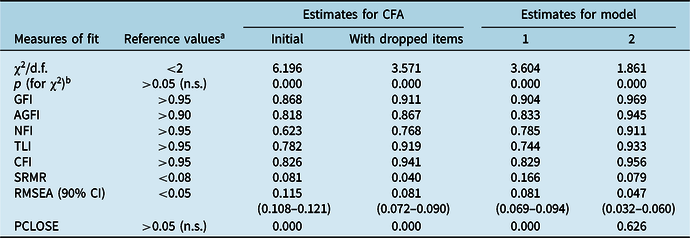
Matching the CFA models – the initial one and the one diminished by rejected explicit variables – was good (Table 4), which allowed for essential analysis.
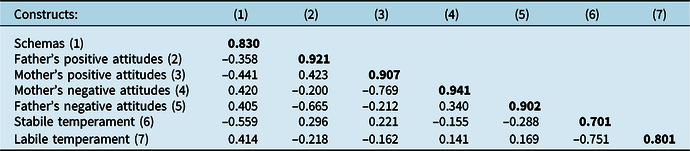
Positive and negative attitudes, as well as stable and labile temperaments, are highly negatively correlated, which confirms their dichotomous character. Moreover, there are no significant correlations between the attitudes of fathers and mothers, which can indicate independence from each other in terms of their parenting styles (Table 3).
Discriminant validity of measures – Fornell–Larcker criterion

Fornell–Larcker criterion data reported in the following way: numbers on matrix diagonal are square roots of AVE values, off-diagonal – correlations between constructs (Henseler et al., Reference Henseler, Ringle and Sarstedt2015).
Reliability and validity checks
The approach used has been validated on the study’s sample (effective n = 395) by reliability analysis as well as CFA to assess convergent (Table 2) and discriminant validity (Table 3).
Reliability and convergent validity of measures

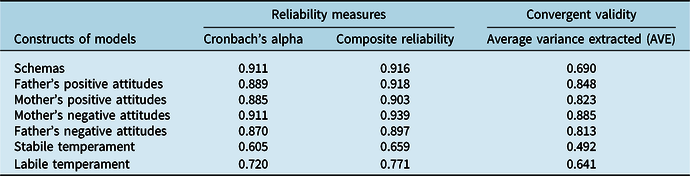
AVE > 0.5 suggest meeting convergent validity requirements.
The results of the validity checks are more than satisfactory. For all constructs except Stable temperament, the reliability measures exceed standard requirements [both Cronbach’s alpha and composite reliability (CR) coefficients are higher than the suggested 0.7; see Table 2]. Stable temperament is the only construct used that had an average variance extracted (AVE) slightly below the threshold value of 0.5 (being equal 0.492); the other indicators are also slightly below the recommended values, which suggests greater caution in making conclusions based on this construct. For other measures AVE ranges from 0.641 to 0.885, which suggests a high convergent validity of used measures (Table 2). Discriminant validity was assessed via the Fornell–Larcker criterion (Henseler et al., Reference Henseler, Ringle and Sarstedt2015) and met standard requirements – all correlations between measures are lower than square roots from AVE (Table 3), with only a minor problem with distinguishing the stable temperament from labile temperament (only in this direction – not vice versa).
Obtained validity checks results make possible the use of the constructs mentioned in structural equation modelling.
Results
Two structural models were tested in this study
Model 1
Model 1 (Fig. 1) includes only parenting styles to check this variable’s exclusive contribution to explaining schemas. Positive and negative parenting styles account for 33% of the variance in schema severity. Negative behaviours can be considered as a factor that increases the severity of schemas (standardised path coefficient = 0.43, p = 0.006), while the relationship between positive parenting styles and schemas is clearly weaker and does not reach a statistical significance level, although the direction of this relationship is in line with expectations. However, the goodness of fit statistics are weak and model is barely acceptable (RMSEA = 0.081; GFI = 0.904) (Hooper et al., Reference Hooper, Coughlan and Mullen2008; Iacobucci, Reference Iacobucci2010) (see Table 4).
Fit indices for CFA and estimated models

a Hooper et al. (Reference Hooper, Coughlan and Mullen2008), 53–59.
b For larger samples is often unreasonable to have not significant p (Iacobucci, Reference Iacobucci2010; 90–98).
d.f., degrees of freedom; GFI, goodness of fitness index; AGFI, adjusted goodness of fit index; NFI, normed fit index; TLI, Tucker–Lewis index; CFI, comparative fit index; RMSEA, root mean square error of approximation; PCLOSE, p-value for test of close fit (testing the null hypothesis that the population RMSEA is no greater than 0.05); n.s., not significant.
Model 2
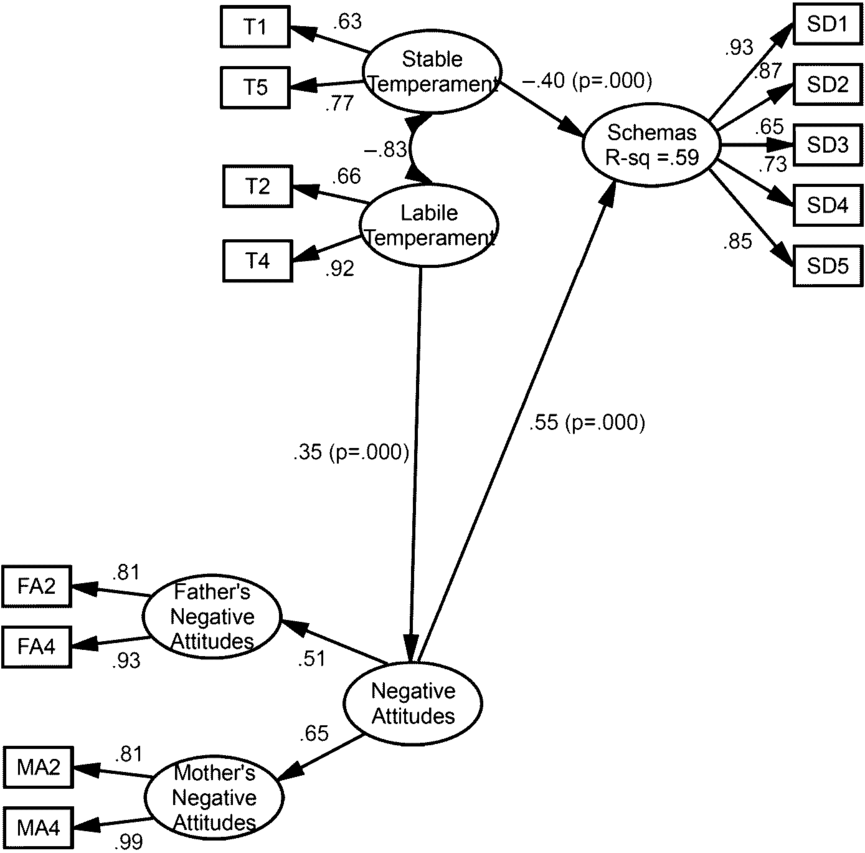
In view of Young’s theoretical assumptions and the postulated hypotheses, another two explanatory variables were added to parenting styles: stable and labile temperament. This resulted in Model 2 (Fig. 2).
Model 2 – schemas explained by parental attitudes and temperament. Parental attitudes: FA, father attitude; MA, mother attitude; 2, over-demanding; 4, inconsistent. Schemas: SD, schema domain; 1, disconnection and rejection; 2, impaired autonomy and performance; 3, impaired limits; 4, other directedness; 5, over-vigilance and inhibition. Temperament: T1, briskness; T2, perseverance; T4, emotional reactivity; T5, endurance.

The obtained indicators of goodness of fit were satisfactory (Table 4). The percentage of explained schema variance increased to 59%. Stable temperament traits are directly related only to schemas, and the path coefficient was strongly negative (–0.40; p = 0.000). The labile temperament traits were associated with negative parenting styles (0.35; p = 0.000), strengthening their relationship with schemas (0.55; p = 0.000). Positive parenting behaviours were not related to either schemas or temperament (path coefficients were insignificant), so they were removed from the final model.
The obtained results allow us to verify the previously made hypotheses:
Model 1 indicates that there is a positive (strengthening) correlation between the severity of schemas and negative parenting styles, while the connection with positive styles has a negative direction and its strength is weak. Model 2 also confirms the important role of negative parenthood for the severity of schemas, while positive parenting style is still irrelevant with regard to temperament. These results allow confirmation of the hypothesis that parents’ negative behaviours are more relevant for the schema intensity then positive ones.
Model 2 confirms the role of the labile temperamental traits as enhancing negative parenting behaviours, which secondarily increase the severity of schemas. At the same time, these temperamental traits are not directly related to schemas. However, the stable temperament traits are not linked to any type of parenting behaviour, but they are directly and negatively related to the intensity of schemas. Thus, the hypothesis the temperament is linked to the parents’ behaviours but not directly to schemas is only partially confirmed.
Discussion
The main aim of this study was to examine the interrelations between one’s temperament and the way of being parented during childhood in the context of schema severity. Results support Young’s assumption that schemas develop not only via negative parenting, but they also need vulnerable, labile temperament. The two tested models show the interrelations for better understanding schema theory.
The first aim was to verify if schemas can be explained only by perceived style of being parented as a child. Some earlier studies partially confirmed such correlations. Usually, more severe schemas are connected to more negative and simultaneously less positive parents’ behaviours (Dale et al., Reference Dale, Power, Kane, Stewart and Murray2010; Harris and Curtin, Reference Harris and Curtin2002; Khajouei Nia et al., Reference Khajouei Nia, Sovani and Sarami Forooshani2014; Thimm, Reference Thimm2010). Muris (Reference Muris2006) indicated that high levels of rejection, over-controlling, and anxiously protective behaviours, as well as low levels of acceptance and warmth are significantly related to the severity of EMS. The parenting styles in his study explained between 5 and 27% of the variance in the schemas, which is close to value obtained in Model 1 of the present study. However, this model does not confirm the role of positive parenting.
Similarly, after including temperament in the model (model 2), positive parenting is still not significant. Such insignificance of positive behaviours is worth considering. One possible reason may be the difference in tested participants. The studies mentioned above were conducted mainly in different clinical groups. In such cases, the schemas are usually stronger (Chodkiewicz and Gruszczyńska, Reference Chodkiewicz and Gruszczyńska2018), which can be connected with more severe negative parenting (Sheffield et al., Reference Sheffield, Waller, Emanuelli, Murray and Meyer2005). Highly critical, demanding or rejecting parents are rarely warm and accepting (Khajouei Nia et al., Reference Khajouei Nia, Sovani and Sarami Forooshani2014; Plopa, Reference Plopa2008; Roe and Siegelman, Reference Roe and Siegelman1963). The lack or small amount of positive behaviours and feelings received from parents is not good for a child and can lead to difficulties in functioning. However, typical parenting consists of different behaviours: parents are mainly accepting and supporting, but sometimes they can be critical, over-demanding or even rejecting. In this case schemas are weaker, because of positive attitudes towards a child. However, the child can remember mainly negative experiences because of their inconsistency with the positive parenting. Thus, positive parental attitudes may be non-important, if they are a typical parenting style, and only negative experiences become meaningful. On the other hand, Muris confirms the significance of positive parenting (lower acceptance – stronger schemas) in his study conducted on a non-clinical sample. It should be noted, however, that positive parenting in his study is significantly connected to schemas only in case of correlations method, while regression equations point to the role of rejection and over-controlling (Muris, Reference Muris2006). These results are similar to those obtained in presented study.
The next aim of this research was to check the role of temperament. As hypothesized, based on the earlier studies of Muris (Reference Muris2006), Mairet et al. (Reference Mairet, Boag and Warburton2014) and Haugh et al. (Reference Haugh, Miceli and DeLorme2017), labile temperament features are significant for schema severity. Muris’ study is the most similar to the presented research. He takes into account both parental rearing and temperament, and tested their significance for schema severity on a non-clinical sample. Both detrimental rearing and neuroticism explain up to 35% of the variance in most schemas (Muris, Reference Muris2006). However, Muris does not explain interrelation between variables.
In the current study, two dimensions of temperament were tested: stable and labile. Stable features are connected directly to schema severity and have no significant connections with parental behaviours, either positive or negative. This may mean that in the event of negative parental styles, the stable characteristics of a child’s temperament actually become a safeguard against the development of schemas. The child does not take a long time to overcome potential distress and easily copes with difficult emotions; temperamental endurance allows him/her to function effectively in adverse situations. Thus, the direct influence of stable characteristics can be explained as resistance to environmental stimuli and transferability between positive and negative experiences. It allows one not to constantly concentrate on negative emotions (Strelau et al., Reference Strelau, Oniszczenko, Zawadzki and Bodunov1995). It is in line with Young et al. (Reference Young, Klosko and Weishaar2003), that temperament can prevail over negative environment. The research of Epkins and Heckler (Reference Epkins and Heckler2011) and Verstraeten et al. (Reference Verstraeten, Vasey, Raes and Bijttebier2009) suggests that strong temperament (e.g. extraversion) can be a protective factor against psychopathology symptoms.
If the labile characteristics of temperament prevail (perseverance and emotional reactivity in the models), the child tends to have strong, excessive and long-lasting reactions, which are mentally burdensome and exhausting for him/her. It is interesting that the labile temperament is connected to negative parenting, but not with schemas directly. This type of temperament can reinforce parents’ negative behaviours. Such a child is usually anxious, emotional and insecure, and requires a lot of patience and care. For a parent with an inconsistent or demanding rearing style, or simply insecure of himself, a child with such traits will cause parenting difficulties and reinforce the behaviour characteristic of these parental styles. In turn, more intense negative parenting styles can enhance schemas. Besides, weak, reactive temperament enhances the importance of adverse parents’ behaviour. Criticism, distrust or similar adverse parental reactions are experienced by the child more intensely, and, consequently, have a greater importance for him/her.
On the other hand, Muris (Reference Muris2006) found that for some schemas (e.g. defectiveness or incompetence) only neuroticism is a significant predictor, not detrimental parenting. However, it is difficult to imagine that temperament by itself could influence the type of beliefs about oneself.
The labile temperament is strongly associated with experience. Experiencing emotions alone seems to be not enough to form or reinforce a schema, but related to the situation (in this case, negative and generating the same emotional climate), by continuous processing and strong reaction (Strelau and Zawadzki, Reference Strelau and Zawadzki1993), it is able to create an emotional and cognitive trace, which will have a significant part in creating schemas. Other studies also confirm this direction. Haugh and colleagues claim that research supports the assumption that the environment can override the child’s temperament, but the evidence that the temperament can override the environment and produce schemas, and consequently, psychopathology, is rather weak (Haugh et al., Reference Haugh, Miceli and DeLorme2017). Hudson et al. (Reference Hudson, Dodd and Bovopoulos2011) and Rioux et al. (Reference Rioux, Castellanos-Ryan, Parent and Séguin2016) have also obtained results confirming the moderating role of temperament between parental environment and psychopathological difficulties.
In conclusion, the presented results are in line with Jeffrey Young’s theoretical assumptions concerning schema-forming factors (Young et al., Reference Young, Klosko and Weishaar2003). Stable, strong temperament can be a protective factor, while labile and weak features may intensify the negative parenting and reinforce experiencing it by the child. Temperament, as a relatively persistent feature, may play a similar role in adulthood, reinforcing one’s emotions and feelings in the context of environment and maintain the schemas. Thus, it is important to assess the temperament for more effective schema therapy, both for better understanding the past, and for facing present difficulties by relieving the feeling of being unable to effectively cope. A labile, weak temperament should be treated as a risk factor for prolonged persistence of high-level schemas, while its stable features can be treated as protective factor.
Model 2 reflects these correlations and explains almost 60% of the variance in schema severity, which is a very high value, especially in the description of a non-clinical group. This is important information for therapists, as some of a patient’s characteristics, such as temperament, are difficult or even impossible to change.
Limitations of the study
The presented study, however, has several limitations. First of all, the presence of difficult situations, including those related to violence in childhood, was not controlled. According to Young, they have by far the most important influence on the formation of schemas. Moreover, the conclusions are based on studies of a non-clinical group. On the one hand, this is a clear advantage, as it confirms the assumptions about the sources of schemas in people without disorders. On the other hand, however, we cannot be sure that in different clinical groups the correlations will be the same or at least similar, so the results should not be generalized to patient populations.
The participants in the study are also limited to a one-country group, which may be significant in the context of assessing parental behaviour; in other cultures these assessments may be completely different due to, for example, different standards of child-rearing. On the other hand, Young emphasises that it is not so much the objective behaviours of parents that are important as the perception of these behaviours by children.
Another important limitation of this study is the self-description method of measurement, and in the case of parental styles it is additionally a retrospective assessment. Adults who already have their children can judge their parents from a different perspective – unlike when they were children. Moreover, memories can be significantly distorted by time or emotions that cannot be verified (Sheffield et al., Reference Sheffield, Waller, Emanuelli, Murray and Meyer2005). A similar limitation applies to temperament – the measurement of the present state does not allow for an unambiguous conclusion about temperament in childhood, as these characteristics, although relatively stable, can be modified in ontogenesis (Strelau et al., Reference Strelau, Oniszczenko, Zawadzki and Bodunov1995; Strelau and Zawadzki, Reference Strelau and Zawadzki1993). Such a research scheme was, however, adopted in similar studies (Calvete, Reference Calvete2014; Haugh et al., Reference Haugh, Miceli and DeLorme2017).
Explaining the intensity of schemas in terms of total score is a limitation on the interpretation of results, as it does not allow us to verify which parental behaviours in combination with which temperament characteristics are explained by individual schemas, or at least by their domains. However, Roe and Siegelman (Reference Roe and Siegelman1963) and Plopa (Reference Plopa2008) indicate that parental behaviours are not isolated and that, to a greater or lesser extent, all are observed in typical families. In this study, it was not possible to evaluate more specific relationships. Therefore, the direction of further research should focus on the intensity and type of needs faced by a frustrated child rather than the parenting style. The above limitations also determine the direction of further studies.
Acknowledgements
None.
Conflicts of interest
Dorota Mącik has no conflicts of interest with respect to this publication.
Financial support
This research was supported by the National Science Centre, Poland (grant number 2017/01/X/HS6/00232).
Ethics statement
Ethical approval was obtained from the John Paul II Catholic University of Lublin, Faculty of Psychology Ethics Committee for Scientific Research (reference 2016.09.06); all participants were informed about their rights.



Comments
No Comments have been published for this article.