

The structures of the correspondent banking systems in early nineteenth-century England and later nineteenth-century America were quite similar. In each the multitude of independent country or interior bankers were obliged to maintain accounts with bankers in the metropolis, London and New York respectively, to hold reserves and to clear and settle financial instruments used in intercity financial transactions. Such claims, bills drawn on London or drafts drawn on New York banks, served as the typical intercity or interregional means of payments and were cleared and settled through private arrangements, the clearing houses in London and New York (James and Weiman Reference James and Weiman2010; James Reference James, Hanes and Wolcott2012). These correspondent bank relationships also proved quite efficient in the transmission of financial distress from metropolis to countryside and vice versa. Panic demands for cash with the resultant cash drains to interior banks focused and intensified pressure on reserves of London and New York banks, especially of course on those which specialized as de facto bankers' banks.
In spite of the similarities in structure, the performances of the two systems were rather different. Panics were frequent and their extent widespread in late eighteenth- and early nineteenth-century England involving numerous bank failures. Even with his rather conservative assessments of ‘failure’, Pressnell (Reference Pressnell1956, p. 443) found in England between 1750 and 1830 at least 343 self-declared country ‘bankers’ failed – 334 of them between 1790 and 1826. Many bank failures have been attributed to inexperienced or incompetent country bankers in the early years of the profession, in a word partly idiosyncratic, but systemic influences were also quite strong. Unsurprisingly, the failures tended to cluster in periods of financial disruption, running to around 10 per cent of English and Welsh provincial banks in crisis periods (e.g. 1814/1816, 1825/1826). Disappearance rates of London banks, to be sure not necessarily all failures and direct consequences of the panics, ran even a bit higher, around 15 per cent or so in crisis periods. In contrast, overall failure rates of US banks during postbellum panics were remarkably low, well under 1 per cent. Wicker (Reference Wicker2000, p. 6) calculated that 0.042 per cent of banks failed in 1893 and only 0.0026 per cent in 1907.
Nevertheless, there was never a nationwide paralysis of the payments system such as had become regular events in postbellum America. Temporary suspensions of cash payments in times of panic were much more widespread and systematic in the United States than in England. They, to be sure, were the result of local decisions, but after restriction in New York banks elsewhere generally quickly followed. On such occasions local banks would agree in concert, and generally strictly illegally, not to pay out cash for their liabilities at par on demand for the nonce. Such temporary suspensions were staple strategies of American bankers in times of crisis. Temporary stoppages of cash payments certainly did occur at times in England, but they never reached the nationwide proportions experienced in the United States. They were generally idiosyncratic or local events. Newcastle banks, for example, jointly temporarily stopped payment in 1797. In London there was never a general suspension of payments during times of panic. Although systematic quantitative comparisons of the extent of stoppages of payments across countries are not possible, it seems most plausible to believe that the strategy was more systematically and widely pursued later in the United States than earlier in England.
Friedman and Schwartz (Reference Friedman and Schwartz1963, pp. 163–8) have most influentially argued in favor of suspension or restrictions of cash payments in times of panic as means of arresting bank runs and failures. This in turn helped to dampen declines in the money multiplier and the rate of monetary contraction. James, McAndrews and Weiman (Reference James, Mcandrews and Weiman2012), however, have pointed out one aspect of suspensions that definitely was not stabilizing: the resultant disruptions of the payments system. Local customers were unable to get cash to meet payrolls. At the intercity level, the timeliness and predictability of payments was disrupted, with the only alternative being shipping currency (if available), a process which clearly delayed final settlement of transactions. Such payments system disruptions would have had effects similar to those of severe adverse supply shocks. The English banking and payments system on the other hand managed to soldier on in times of panic, in spite of substantial failure rates, avoiding a nationwide collapse of the payments system. It seemed to have been ultimately more liquid, thereby preserving the system of payments in crises, than that of the United States in the national banking era (1863–1914).
In this article I examine the English banking system in financial crises over the late eighteenth and early nineteenth centuries. I shall argue that it was the Bank of England that was responsible for the greater liquidity in times of crisis of the English financial system even though it played no role in the payments system and no active stabilizing role. The plan unfolds as follows. Section I offers a brief survey of panics in late eighteenth- and early nineteenth-century England. I stop in 1825, after which time the structure of the banking system changed markedly (see Neal Reference Neal1998). The second section describes the place of the Bank of England in the financial system, while the third focuses on its rediscounting functions in times of crisis. The fourth section concludes.
I
Financial crises occurred with remarkable frequency in eighteenth-century England. T. S. Ashton (Reference Ashton1959) identified thirteen – in 1701, 1710, 1715, 1720, 1726, 1745, 1761, 1763, 1772, 1778, 1788, 1793, 1797.Footnote 2 In the first quarter of the nineteenth century we might add three more – 1810/11, 1815, 1825 (or perhaps five, counting 1803 and 1819). Hoppit (Reference Hoppit1986, pp. 51, 56) argued that before 1770 both their origins and effects were restricted to the areas of public credit and the national debt. Thereafter, crises became more general and encompassing, affecting the provinces as well as London. Panics and runs were often quite animated affairs involving volatile liability holders.Footnote 3 As Thomas Joplin (Reference Joplin1822, pp. 3–4) recounted:
When the slightest apprehension is entertained respecting their [the banks'] solvency, however groundless it may sometimes prove, a run upon them immediately takes place. That is, hundreds of people immediately crowd the doors of the Banks, to demand payment of the Notes they held, or to withdraw that money out of their hands, which they have deposited with them . . . Great however as the inconveniences are which the discredit of Banks and consequent runs upon them occasion, and great as are the calamities by which their failures are uniformly attended, they are, both in this country and Ireland, of very common occurrence.
Since I am interested here in their effects on the networks of payments relationships, I further restrict the examination to the period in which country banking had become widely established, beginning in the 1790s (however, for more on the infamous failure of the Ayr Bank and panic of 1772 see Rockoff Reference Rockoff2009).
Measuring the impact of these crises on the English banking structure is rather elusive. For one thing the extent of suspension or restriction of cash payments during crises was not generally or consistently reported. A more commonly used metric is the number of bank failures, but here too there is ambiguity. Pressnell (Reference Pressnell1956, pp. 443–8) argued that contemporary or later estimates of the number of bank failures were often overstated, resulting in turn in an exaggerated impression of the instability of the banking system and the unreliability of country banks. A more precise measure of the extent of financial catastrophe is the number of bankers who were found bankrupt. Bankruptcy proceedings were set in motion by a creditor of £100 or more who established a claim against the alleged bankrupt. A docket of bankruptcy was then struck, a commission of bankruptcy issued, and then by ‘gazetting’ (the announcement of failure in the London Gazette) the person was formally declared bankrupt (see Marriner Reference Marriner1980, pp. 354–5). On the one hand, not all banks which disappeared were necessarily associated with bankruptcy. On the other, separate commissions of bankruptcy might have been issued against each partner of a failed bank, thereby overstating the number of bank failures.
Space limitations preclude a detailed examination of factors leading up to or preconditions for the panics. Here I simply consider briefly the immediate events of financial crises between 1793 and 1825.
1793
Hoppit identified 1793 as the worst financial crisis of the century (1986, p. 55). The outbreak of war on the continent in 1792 caused uneasiness with rising bankruptcies and an unstable stock market marking the end of the year. But it was not until France declared war on Britain on 1 February 1793 that things collapsed. Beginning with the stoppage of a bank in Newcastle, panic spread across the countryside and to London as well. Lawson (Reference Lawson1852, p. 153; also, Baring [1797] Reference Baring1993a, pp. 17–19) contrasted the stoppages in Newcastle with the experience of the banks in Exeter which ‘stood their ground’. Newcastle notes were payable on demand, while ‘the banks in the West of England, on the contrary, very wisely issued notes payable 20 days after sight . . . This practice enabled the latter to communicate with their correspondents in London, in time to receive that degree of assistance in which they stood in need.’ In any case, because ‘confidence in their Banks vanished, every creditor was clamorous for payment’ and a failure of paper credit reduced ‘many respectable, prudent, and, ultimately, very solvent persons to the mortifying necessity of stopping payment’.
Although absolved by later scholars of contemporary charges of responsibility for the crisis (e.g. Pressnell Reference Pressnell1956, pp. 457–9; Hoppit Reference Hoppit1986, p. 57),Footnote 4 country banks nevertheless played prominent roles, with the emerging credit networks linking the provinces and the metropolis instrumental in its dissemination. The Bank of England increased discounting (more on this later) and the government issued Exchequer bills in denominations of £20, £50 and £100, with the proceeds loaned to ‘approved’ applicants who were in difficulties – a total of £2.2m.Footnote 5 Feavearyear (Reference Feavearyear1963, p. 186) observed that the mere declaration of war ‘brought down scores’ of country banks due to fears of an invasion, but Pressnell found such claims exaggerated. In the first month of the crisis he counted six country bank bankruptcies and 16 (23 counting branches) in all of 1793 (1956, pp. 444, 457–8). Another estimate claimed that a full one-fourth of country banks, or almost 100, had stopped payment.
1797
After the 1793 crisis country bank note issue fell off sharply. Henry Thornton put notes in circulation in 1793 as only half that in 1792, and by 1796 they still had increased to only two-thirds of the 1792 level (Feavearyear Reference Feavearyear1963, p. 186). On Saturday, 18 February 1797, many of the farmers at market day in Newcastle, responding to a local rumor, sold off their cattle at very low prices and went to the banks to cash in their notes in which they were paid. Faced with such a strong demand for cash, banks there in concert stopped payment on Monday the 20th, as did banks in Durham and Sunderland,Footnote 6 reports of which reached London on the Thursday. Meanwhile, on Tuesday (erroneous) reports had spread to London from Portsmouth of sightings of a French fleet. According to Lawson (Reference Lawson1852, p. 154), ‘confidence in many of the banks vanished; every creditor was clamorous for payment, which he insisted should be in gold, and which was complied with until the bankers in London were exhausted’.
[The] Bank of England accommodated themselves to circumstances, and furnished large supplies; but unfortunately the Bank directors caught the plague or panic; their nerves could not support the daily and constant demand for gold, and in order to check that demand they curtailed their discounts to an amount never before attempted. This determination on the part of the Bank and the extent to which it was carried, came like an electric shock, placed every part of the community in the most imminent danger…
Finally, on the morning of Saturday the 25th, news arrived of the landing of 1,200 French troops at Fishguard in Wales (the force surrendered without a fight), leading to a further run on the banks. At a noon meeting the Bank of England decided to suspend gold payments for its liabilities, and what had been regarded as a short-term response was to last 24 years. The suspension gave a marked fillip to the growth of country banking, both in terms of numbers and in note issue.
Country banks did not experience a general wave of failures. The Newcastle banks suspended early on as noted, but Pressnell identified only three failures (bankruptcies) in 1797, later in the year, with seven more between February 1798 and September 1799, all in rural areas.
1810/11
The run on and subsequent failure of the London bank of Brickwood & Co., ‘perhaps as solid a house as anyone in the city’, in July 1810 led to pressure on its country correspondents and resulted in the bankruptcy of Bowles & Co. of Salisbury. From there failures spread across western England – another bank in Salisbury, one in Dartmouth, one in Exeter and more in Devon. The run on a Chester bank (Messrs Rowton & Marshall) led in turn to the stoppage of its London agent, Messrs Dawes & Co. of Pall Mall. By the end of February 1811, 13 country banks had failed, mostly in southern and western rural areas (Pressnell Reference Pressnell1956, pp. 466–8). On top of this, Feavearyear (Reference Feavearyear1963, pp. 207–8) argued that the bursting of the credit bubble following the opening of South America at the end of 1810 put severe pressure on those in the cotton trade and thus on Lancashire and Glasgow bankers in particular. Again the contraction of country bank notes was dramatic, falling to £25.6m in the first half of 1811 (compared with £46.5m in the first half of 1809) and then recovering to £35.9m by the end of the year. A Parliamentary investigative committee recommended the same remedy as had been applied in 1793, small denomination Exchequer bills, £6m of which were issued in March 1811.
Bank failures continued in 1812/13 primarily in agricultural areas, but the bankruptcy of the London house of Messrs Boldero & Lushington with 12 correspondents on 2 January 1812 pulled down its Leeds correspondent, Messrs Fenton, Scott, Nicholson & Smith, and created serious difficulties for others such as Messrs Townend & Rishworth of Wakefield and Pease & Co. of Hull. Similarly, the failure of another London bank, Messrs Kensington, Styan & Adams, with 12 correspondents pulled down others as well (Pressnell Reference Pressnell1956, pp. 469–70).
1815/1819
The Battle of Waterloo on 18 June 1815 brought peace to Britain. The crash followed in the autumn, and then the ensuing commercial depression brought down numbers of banks. Between 1814 and 1817, 89 country banks failed with many others stopping payment temporarily. Over that period country bank notes outstanding fell by almost half as well (Feavearyear Reference Feavearyear1963, p. 211). Clapham (Reference Clapham1945, vol. 2, p. 59) wrote that in 1816 country banks were ‘going down right and left’. Hawtrey (Reference Hawtrey1919, p. 124) in addition identified 1818/1819 as a time of panic on both sides of the Atlantic (see also Hughes Reference Hughes1906, p. 23).
1825
The ‘great’ panic of 1825 was the most serious one of the first half of the nineteenth century.Footnote 7 Wentworth & Co., a leading Yorkshire banking firm, closed in November, and on Sunday the 27th partners of several London banking houses were called from church to supply gold to their country clients. By 1 December the rush to discount at the Bank was like that ‘for the pit of a theatre on the night of a popular performance’ and ‘Lombard Street was nearly filled with persons hastening to the different banks to draw money, or waiting in anxious fear of hearing of new failures’ (Clapham Reference Clapham1945, vol. 2, pp. 98–9; Feavearyear Reference Feavearyear1963, p. 236). Doubts grew about the stability of the firm of Sir Peter Pole, Thornton, Free, Down and Scott, a London bank with 44 country correspondents. Though in the eyes of the Governor of the Bank of England the bank had been ‘grossly mismanaged’, help in the form of a £400,000 loan was extended on Sunday morning (4 December). The governor and deputy governor counted out the sum personally to Henry Thornton Jr with no clerks present, the secrecy having been to avoid aid requests from other London banks. Reassuring the public was apparently not a consideration (Neal Reference Neal1998, p. 70). On Saturday the 10th the decision was made at Pole & Co. to stop payment, and the striking of a docket of bankruptcy against it was announced on the morning of Monday the 12th. That day runs began on country banks known to have been its correspondents along with other banks in the same or nearby towns.Footnote 8 Meanwhile numbers of country bankers had traveled to London in search of assistance.
In London there was ‘general consternation’, with even the military called out to contain a mob surrounding one bank (Hartley Reference Hartley1973, p. 33). ‘A universal bankruptcy was expected; the stoppage of almost every banking-house in London was looked for; and the whole city was panic-struck. Confidence and credit were almost entirely suspended’ (Lawson Reference Lawson1852, p. 66). On the Tuesday two more London banks, Messrs Williams, Williams, Williams & Burgess and Messrs Scott, Williams & Co. were forced to close. On Wednesday three more London banks failed: Sikes, Snaith & Co. (Mansion House St), Everett, Walker & Co. (Mansion House St) and Stirling, Hodsoll & Co. (Strand), making six London failures. Williams & Co. had 16 correspondents; Everett & Co., 20. Sikes & Co. had one, Watkins & Bricknell of Daventry (holding a London balance of £36,000), which also failed less than 24 hours later. The response of the Bank of England is described in Section III.
Clapham (Reference Clapham1945, vol. 2, p. 102) counted at least 73 of the ‘principal, not all’ banks in England and Wales that had suspended payments by the end of the year, some of which later resumed. By the end of the first week of the panic, 13 country banks had been bankrupted; by the end of December, the total had reached 33, excluding branches. A regional crisis developed in northern England after the first of the year. There were nine, six and seven failures there respectively in the months of January, February and March 1826. By late spring 60 country bank failures had occurred. The impact fell most heavily on smaller market towns, with some larger areas – Lancashire, Leeds, Newcastle – emerging essentially unscathed (Clapham Reference Clapham1945, vol. 2, p. 102; Pressnell Reference Pressnell1956, pp. 485–8). However, within a year after the panic the number of banks in Bristol had halved from ten to five even though there had been only one bona fide failure (Cave Reference Cave1899, p. 24). In the second quarter of 1826 the number of all bankruptcies, including those delayed ones of the ‘strong swimmers in their agony’, reached its maximum (Clapham Reference Clapham1945, vol. 2, p. 102).
II
The Bank of England sat at the apex of English banking, but its purview was limited essentially to the capital. Its notes circulated primarily in the London area; its discount customers and drawing account clients were Londoners. The chief functions of the Bank according to John Horsley Palmer, Governor of the Bank in 1832, were as follows: ‘To furnish the paper money with which the public act around them, and to be a place of safe deposit for the public money, and for the money of individuals who prefer a public body like the Bank to private bankers’ (Horsefield Reference Horsefield1949, p. 145).Footnote 9 As for notes (not legal tender until 1833), they were of relatively large denominations and by no means acceptable everywhere. Indeed they did not circulate in any volume outside London (a radius of 30 miles around the capital is sometimes cited). Thomas Joplin of Newcastle (1822, p. 32), for example, observed, ‘Bank of England notes would not pass in most parts of the kingdom, as where local notes can be had, no person in the more northern counties will take a Bank of England note if he can help it.’ Increasing forgeries also damped the appeal of Bank of England notes relative to country notes, which were thought to have been less easily forged. Before 1797, when the smallest denomination was £5, forgeries were virtually unknown, but between 1797 and 1815 there were 257 capital convictions and 321 more for possessing forged notes. The zeal with which the Bank pursued convictions and executions of forgers did not endear it to much of the public (Fetter Reference Fetter1965, pp. 71–3).Footnote 10
Within London, however, Bank of England notes constituted the bulk of the paper circulation. Banks there also used them (along with specie) to settle balances at the Clearing House and increasingly held them as reserves. The Bank did not pursue money supply targeting. Rather, notes were issued to whatever extent was necessary in order to satisfy ‘the legitimate needs of commerce’, as determined by the demand for discount of ‘good’ bills at 5 per cent (Morgan Reference Morgan1943, pp. 4–5). As for deposits, by the turn of the nineteenth century still relatively few banks maintained accounts with it. In 1793 only 20 to 25 out of 65 London banking houses kept accounts there. By 1825 out of some 70 London banks there were still around 20 which did maintain an account. Some were new, but many were old, respectable West End firms, ‘the principal part’ of their business being ‘not with mercantile men’. No country banks maintained accounts there (Clapham Reference Clapham1945, vol. 1, p. 172). It also should be noted that the Bank was a commercial bank, not just a bankers' bank, so its discounting activities involved not just bankers and large merchants, but also tradesmen such as ‘china-dealers, glovers, and slopsellers’. In the early 1820s the Bank had less than 900 active drawing accounts (Clapham Reference Clapham1945 vol. 2, pp. 12, 120, 122). So when demands were made on London banks by their country clients, the former would have to take their Bank notes for redemption in specie (not during the period of suspension) before shipping the cash to the countryside. The discounting operations of the Bank are discussed subsequently.
The concept of the Bank as a lender of last resort was raised first in the 1790s (Humphrey Reference Humphrey1975; O'Brien Reference O'Brien2003). Sir Francis Baring ([1797] Reference Baring1993a, p. 22), in his analysis of the 1793 crisis, saw the Bank as the ultimate source of liquidity in panics: ‘In such cases the Bank are not an intermediate body, or power; there is no resource on their refusal, for they are the dernier resort.’ The Bank should have been willing to supply ‘almost their last guinea’ (p. 25). Instead, however, liquidity was injected by Government intervention in the form of issue of Exchequer bills.Footnote 11 Henry Thornton was the other visionary of this period who saw the Bank at the center of the banking and monetary system with a responsibility for maintaining stability and avoiding panics. He pointed out that the Bank was ‘universally considered as the repository for Cash, on which every individual in the country, who is in want of Guineas, has a right to Draw’. At the same time, however, he recognized the moral hazard issue implicit in such a role ([1832] Reference Thornton1939, p. 188), stating that:
It is by no means intended to imply, that it would become the Bank of England to relieve every distress which the rashness of country banks may bring upon them: the bank, by doing this, might encourage their improvidence . . . The relief should neither be so prompt and liberal as to exempt those who misconduct their business from all the natural consequences of their fault, nor so scanty and slow as deeply to involve the general interests.
In spite of the ‘keen controversy as to the public duties of the Bank’ between 1793 and 1844, such arguments did not win general acceptance. Fetter (Reference Fetter1965, p. 61) argued that in the period around the turn of the nineteenth century statements and actions of the Bank and Government were consistent with the idea ‘never stated in unequivocal terms, that the Bank was considered an essentially private business except for the obligation to make loans to the Government’.Footnote 12 The Bank Charter Act of 1844 in turn would have appeared explicitly to have ruled out such a role for the Bank. Walter Bagehot's prescription for the Bank of England, to ‘lend freely at high interest rates’ in times of panic, but ‘to protect the reserve’ when the market is merely apprehensive (Rockoff Reference Rockoff, Capie and Wood1986), following Thornton's analysis, was still a controversial issue, even after the crisis of 1866. Indeed in Lombard Street (1873, p. 62), he could still write: ‘We are apt to be solemnly told that the Banking Department of the Bank of England is only a bank like other banks – that it has no peculiar duty in times of panic – that it then is to look to itself alone, as other banks look.’Footnote 13
III
In times of distress country or interior banks drew on their city correspondents, London or New York, for cash. The London agent was a country banker's ‘first reserve in time of trouble, and was ever likely to receive the impact of a liquidity panic’ (Pressnell Reference Pressnell1956, p. 116) and similarly in New York (see James, McAndrews and Weiman Reference James, Mcandrews and Weiman2012).Footnote 14 Beyond that, in the pre-Federal Reserve United States there was no established lender of last resort. New York banks generally relied on the call loan market for liquidity, fine in normal times but rather less reliable during panics. Instead, when pressed, New York banks turned to collective action orchestrated through the Clearing House – the issue of Clearing House loan certificates to eliminate cash drains among members. And, if all else failed, there would have been a suspension or restriction of cash payments at par in concert. The London Clearing House in contrast eschewed any quasi-central banking functions similar to those of its New York counterpart (Gorton Reference Gorton1985).
The Bank of England had not entirely been a disinterested party during times of crisis, however, although its interest was limited, episodic and inconsistent. In 1793 it extended a loan to the Lord Mayor of London, Sir James Sanderson (partner in Sir James Sanderson, Robert Harrison, Brenchley, Bloxham and Co. of Southwark), to avoid the ‘mischief’ resulting from a Lord Mayor's bankruptcy (Clapham Reference Clapham1945, vol. 1, p. 261). Similarly, it tried (but failed) to rescue Pole & Co. in 1825, although it may have been more motivated by the fact that, in the words of the Deputy-Governor, ‘the Governor was particularly connected with the house of Pole & Co. by marriage and other circumstances of relationship’ than a concern for financial stability (Lawson Reference Lawson1852, p. 67). The one exception in which the Bank was forced into a more active role was in the midst of the panic of 1825. Bagehot (Reference Bagehot1873) quoted with approval (‘The success of the Bank of England on this occasion was owing to its complete adoption of right principles’, p. 202) Jeremiah Harman (former Governor) on its operations then in a passage that ‘has become classical’ (1873, pp. 51–2):Footnote 15
We lent it by every possible means in modes we had never adopted before; we took in stock on security, we purchased Exchequer bills, we made advances on Exchequer bills, we not only discounted outright, but we made advances on the deposit of bills of exchange to an immense amount, in short, by every possible means consistent with the safety of the Bank, and we were not on some occasions over-nice. Seeing the dreadful state in which the public were, we rendered every assistance in our power.
Nevertheless, in spite of the fact the Bank of England did not accept any responsibility as a lender of last resort or actively pursue such a strategy in this period, as Collins (Reference Collins1992, p. 146; Reference Collins1989) argued for a later period, even if such a role had formally been rejected, it still could have functioned as such de facto in times of liquidity pressure through rediscounting. In times of crisis, English banks could not count on satisfying the demand for cash through drawing down reserves, since reserve holdings of both country and London banks were relatively small. Country banks could and did instruct their London agents to sell secondary reserve assets, stocks and bonds, but the major source of liquidity was through rediscounting. Country banks would rediscount their bills with their London agent, and London banks would in turn rediscount at the Bank of England (Horsefield Reference Horsefield1944, p. 84; also, Hawtrey Reference Hawtrey1938, p. 11). The Bank then was the ultimate source of liquidity in times of crisis. In his description of the 1793 panic Baring ([1797] Reference Baring1993a, p. 20) observed: ‘In this predicament the country at large could have no other resource but London; and, after having exhausted the Bankers, that resource finally terminated in the Bank of England.’Footnote 16
Not that the Bank was all that accommodating in its rediscount policy. The discounter originally had to have been a London resident, so country banks were directly excluded, although he did not have to maintain an account with it – discount accounts were separate from drawing accounts. The Bank was also quite particular about the type of bills it would discount or rediscount, excluding a number which would have been generally acceptable elsewhere. Suitable bills had to have had 65 days or less to run, shorter terms than many country bills (up to 95 days after 1821) and to bear two London names (later relaxed to two good British names, one being the acceptor). They needed to have respectable commercial originators known to the Bank and to have been rooted in bona fide commercial transactions in which goods were transferred (Baker and Collins Reference Baker and Collins2010, p. 23).Footnote 17 Such provisions ruled out more than two-thirds of the paper sent to London by country banks (King Reference King1936, p. 12). London banks therefore most of the time had to offer their own paper for rediscount at the Bank rather than just passing on that of their country correspondents.
The Bank generally discounted bills only on Thursdays until 1830 (thereafter every weekday) (Morgan Reference Morgan1943, p. 9), not the most flexible arrangement in a crisis. In this period the discount rate was not used as an instrument of credit regulation.Footnote 18 The Bank also did not generally try to influence the volume of discounts through credit rationing. In principle, the policy was an even-handed one with the same standards applied regardless of financial market conditions. Each application was considered on its own merits. Governor Dorrien, speaking before the House of Commons Committee on the Resumption of Cash Payments in 1819, stated, ‘The Bank is always ready to lend on commercial paper that is legitimate in its origin, and is not carried to too great an extent by the parties that apply for discount’ (quoted in Morgan Reference Morgan1943, p. 4). Exceptions to this rather neutral policy tended toward tighter rather than looser implementations. Indeed, in some cases the more restrictive Bank discount policy contributed to financial distress. We mention two cases here – 1795, although not a full-fledged panic, and 1825.
On 31 December 1795 in the face of increased payments to the continent, the Bank passed a resolution calling for rationing discounts ‘without regard to the Respectability of the Party . . . sending in the same, or the Solidity of the Bills themselves’ (Fetter Reference Fetter1965, p. 21). A certain proportion of all bills sent for rediscount would simply be returned. Since usury laws prevented the Bank from raising its discount rate above 5 per cent, the Bank turned to rationing to limit discounts. Such a decision endangered the whole credit system – merchants who had relied on discounting bills there as a means of raising cash would have been forced to default on their acceptors themselves unless they could put their hands on other marketable assets (Hawtrey Reference Hawtrey1938, p. 11). The announcement created a general outcry, resulting in among other things a resolution by London merchants (but not implemented) to issue their own joint promissory notes against deposits of cash, bills, and commercial paper (King Reference King1936, p. 71; also Horsefield Reference Horsefield1941, p. 47).
In the autumn of 1825 a heavy external drain of gold had left the country short of currency, and uneasiness began to pervade the money market. The Bank began, again, to ration discounts, refusing among others, the Rothschilds, Barings, and Smith, Payne and Smiths. The seriousness of the panic forced the Bank later to reverse its course, although not until the situation had deteriorated substantially.Footnote 19 In 1825 the Bank did not begin to take serious action until the week in which the panic was at its peak, from 11 to 17 December. The Bank early in the week bought Exchequer bills and began to lend more freely, discounting large amounts of bills despite its increase in the discount rate from 4 to 5 per cent (£5,977,000 for the week, or an average of £966,167 per day, as compared with a daily average of £163,000 between 7 and 26 November). But still this wasn't sufficient. On 14 December, after consultation with the Government, it suddenly relaxed its policy of refusing discounts on bills longer than 95 days and on long-term government securities. Hawtrey (Reference Hawtrey1932, p. 122) disabuses us of the impression left by Jeremiah Harman's dramatic quote (above) as to the lengths the Bank had gone to pump money into the system. In fact these additional discounts were still of a highly conservative character, admitting ‘a class of borrowers on irreproachable security who nevertheless had been barred by previous limitations’ (see also Bordo Reference Bordo1998, p. 81).
Meanwhile, the Bank was running short of gold. ‘It was mentioned to His Majesty's Government that we thought we were likely to run dry’, but the Government refused to give the Bank permission to suspend payments. It was ‘to pay to the last guinea’, not so easy since only half the reserve was in coin and there were difficulties in making much of remaining bullion available due to the limited coining capacity of the Mint. By Monday 19 December, its metallic reserve was down to its lowest level of £1,027,000, but the corner had been turned with the discovery on the previous Friday of some chests of £1 notes (around £1m), which had been set aside when small notes had been withdrawn and forgotten. There being no legal obstacle to their issue, most were sent out to hard-pressed country banks, where they were ‘received almost with acclamation’ and ‘worked wonders’ (Clapham Reference Clapham1945, vol. 2, p. 100).Footnote 20 In Norwich, for example, when the Guerneys placed a pile of Bank notes ‘of such a thickness’ on their counter, the run was said to have ceased immediately (Macleod Reference Macleod1893, p. 118). Additional relief was provided by the arrival of a shipment of gold from France arranged by the Rothschilds, first on the 20th with more coming the next week. Whether or not the country was actually ‘within twenty-four hours of barter’, the crisis eased. Nonetheless, just in case, beds were installed in the Bank and the entire staff slept there over Christmas.
It is probably no coincidence that the two most severe crises we have considered here, 1793 (and 1795, close in time) and 1825, which bracket our period, also are the two which occurred in times when the pound was convertible into gold. Bank policy was constrained by its bullion reserves. And the effect on gold reserves may well have been the consideration behind the urge to tighten on discounting.Footnote 21 Between 1797 and 1821, a period when the Bank was not obliged to pay out gold for its liabilities, the Bank perhaps could have afforded to have been a bit more relaxed about the effects of its discount policy on its reserves. Sir Francis Baring noted: ‘When the Country Banks were distressed in the year 1793, they were supplied with guineas to enable them to discharge their demands, which were received, and understood. In February and March 1797, they could offer no other substitute in discharge for their own Notes, but those of the Bank of England, which were often refused, and their solidity often questioned’ ([1797] Reference Baring1993b, p. 11). Receiving Bank notes instead of gold may not have pleased everyone, but the Bank's bullion stock was not eroded. Nevertheless, during the suspension period the Bank did not become profligate in its liberalization of discounting. Duffy (Reference Duffy1982, pp. 80–1) argued the narrow line that the ‘Bank's awareness of the need to regulate discounts did not fall into abeyance during that period’, and ‘unable to discourage applications by raising the discount rate, it employed on a permanent basis a rationing system similar but more flexible than that adopted in 1795'. Morgan (Reference Morgan1943, p. 8) au contraire knew of no instance of general and indiscriminate rationing after 1795. ‘During the Wars, the Bank was in general prepared to discount any good paper brought to it, but the directors reserved the right of course to discriminate against names which were thought to be taking up too large commitments.’Footnote 22
Demand for rediscounting certainly would have increased in times of financial distress and if the Bank did not dramatically step up its credit rationing, one would therefore expect rediscounting to rise during difficult times. And one does generally observe Bank discounts to have increased in such periods (Clapham Reference Clapham1945, vol. 2, p. 62, 1811 being one exception). In 1793 the volume of Bank discounts increased by 182 per cent over the previous year, for example; the increase was 630 per cent relative to 1791. Lovell (Reference Lovell1957) has argued that the Bank began to act as a lender of last resort after the middle of the eighteenth century, based on a regression of the annual change in bills on discount with the Bank on the annual change in bankruptcies between 1758 and 1798 in which the estimated coefficient is positive and statistically significantly different from zero (p. 16).Footnote 23
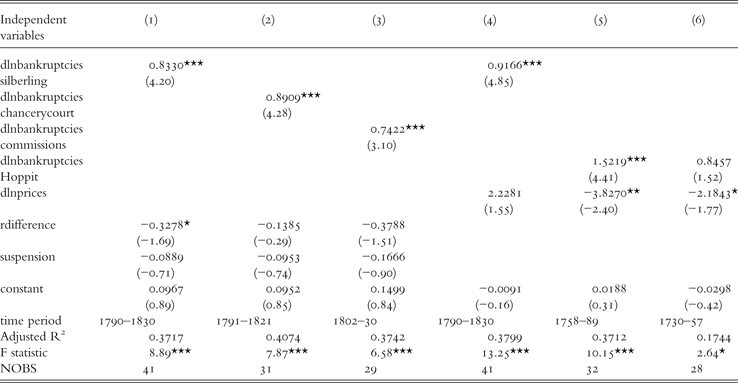
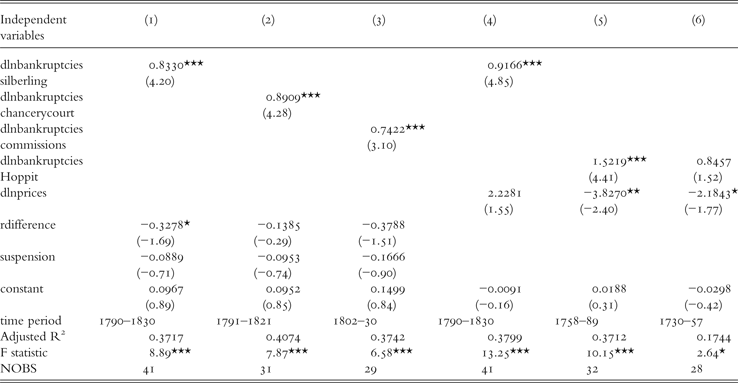
Table 1 presents the results from a similar set of regressions in which the annual change in the logarithm of real bills discounted by the Bank of England (real in the sense of nominal values adjusted for changes in the price level, not necessarily in the sense of the real bills doctrine) is regressed on annual changes in logarithm of bankruptcies. Note that the line of causation is a bit ambiguous here. At times, notably 1795, restrictive policies of the Bank probably led to an increase in bankruptcies. More generally, however, if the Bank stood ready to discount acceptable paper presented to it, one might take Bank discounting as a response to economic distress evidenced by the volume of bankruptcies.Footnote 24 Column 1 shows the estimation results for our period of interest, 1790 to 1830, using Silberling's measure of bankruptcies based on declarations in the London Gazette. The variable rdifference, the difference between the Bank rate and the open market discount rate, captures the relative price of Bank discounting services. Suspension is a dummy variable which equals one for the period of suspension by the Bank. First note that the magnitude of the coefficient of the change in log bankruptcies is greater than zero and statistically significantly different from zero. The volume of Bank discounting did respond positively to increases in bankruptcies, albeit inelastically.Footnote 25 The estimated rdifference coefficient shows that an increase in the spread between the Bank and open market discount rate rather depressed Bank discounting. However, the estimated suspension coefficient is small and not significantly different from zero. Bank discounting did not seem to have been more responsive to financial distress even in years when the Bank did not necessarily have to worry about paying out gold.
Bank of England rediscounting regressions
Note: t statistics in parentheses; *** significant at 1% level; ** significant at 5% level; * significant at 10% level.
Sources: bills discounted – Silberling (Reference Silberling1923, p. 256), Lovell (Reference Lovell1957, p. 9); bankruptcies – Silberling (Reference Silberling1923, p. 251), Hoppit (Reference Hoppit1987, pp. 182–96), Marriner (Reference Marriner1980, p. 353); prices – Silberling (Reference Silberling1923, p. 253), Mitchell and Deane (Reference Mitchell and Deane1962), Schumpeter (Reference Schumpeter1938); interest rates – Homer and Sylla (Reference Homer and Sylla1996, p. 208).
As noted earlier, measurement of bankruptcies is rather complicated and elusive (see Marriner Reference Marriner1980 for a detailed discussion). Not all creditors' petitions to have their debtors declared bankrupt were realized. Not all debtors were declared bankrupt by the commissioners; others may have been able to make a settlement before the declaration. Thus, the number of dockets struck is a larger figure than that of those technically bankrupt but possibly a more accurate count of those ‘teetering on the brink of disaster’ (Marriner Reference Marriner1980, p. 356). Results in the next two columns of Table 1 therefore are based on alternative ‘official’ statistics. Column 2 uses figures from the Court of Chancery, which stop in 1821, thus covering the first three-quarters of our period of interest. Column 3 is based on the number of commissions issued including many that may not have been opened. Both series are larger in magnitude than that from the London Gazette in column 1, but they seem to make little difference to the estimated responsiveness of Bank discounting. Excluding the ‘great’ 1825 panic does not change the tenor of the results.
To make some comparison with earlier periods for which the open market discount rate is not available, I first try in column 4 the annual percentage change in the price level rather than interest rate differences as an independent variable over the same 1790–1830 period. Note that the point estimate of the coefficient of the change in log bankruptcies variable is comparable to that in column 1, even a bit larger in magnitude. The estimates for the eighteenth century then in columns 5 and 6 are based on Hoppit's bankruptcy figures and use annual price level changes as a right-hand side variable.Footnote 26 Lovell (Reference Lovell1957) argued that there was a basic change in the role of the Bank around mid-century and focused on the period after 1757. I therefore choose the same break point – column 5 is based on a 1758–89 sample, while column 6 is based on 1730–57. The estimated coefficient for the change in log bankruptcies is statistically significantly different from zero for 1758–89 and almost double in magnitude that for the period 1790–1830. The point estimate lies above the 95 per cent confidence interval for 1790–1830, so it would appear interestingly that Bank discounting was much more responsive to changes in bankruptcies in the second half of the eighteenth century when the pound was convertible than in our later period when for the most part it was not.Footnote 27 Finally, Lovell's argument that Bank discounting was not responsive in the first half of the century is supported by the results in column 6 (covering the period 1730–57). While the point estimate of the change in log bankruptcies variable is similar in magnitude to that for the period 1790–1830, it is not statistically significantly different from zero.
The responsiveness of bills discounted to changes in bankruptcies over the late eighteenth and early nineteenth century was statistically significantly positive, but a bit inelastic (although the null hypothesis of point estimates of one for this period may not be rejected even at well above the 10 per cent level). Although the Bank's policy was more passive than active, it was in fact responsible for increasing the stock of high-powered money in times of financial crises.Footnote 28 Rather than stabilization, the Bank might well have been solely or primarily motivated by private profit, but it did supply liquidity when needed.Footnote 29 Many writers, such as Neal (Reference Neal1998, p. 69), have been critical of Bank policy, arguing that ‘it might be expected to have played an earlier, more constructive role’. But however imperfect it may have been, the Bank seems to have been acting as a de facto lender of last resort.
IV
In spite of the similarities in structure, the performances of the early nineteenth-century English banking system and the late nineteenth-century American one were rather different. The English system was more liquid than the American one. Bills on London could readily be turned into cash in normal times by country banks through rediscounting by bill brokers or London agents. In the United States, where the principal bank assets were advances or single-name promissory notes, there was no such established market. City banks might rediscount some paper of their country correspondents to smooth them over seasonal stringencies, but such operations were quite limited (James Reference James1978, pp. 54–9, 149–64). Paul Warburg, most notably, in his report to the National Monetary Commission contrasted the promissory notes usually employed in the United States with the (albeit more well-developed by then) bill or discount system. In the latter, ‘through the addition of the banker's signature the question of the maker's credit is eliminated and the note, instead of being a mere evidence of an advance is transformed into a standard investment . . . which commands the broadest possible market’ (1910, p. 7). In times of financial pressure London banks could in turn rediscount with the Bank of England (for an interesting discussion see Warburg Reference Warburg1910). Indeed, evidence on survival rates through 1830 (James Reference James, Hanes and Wolcott2012) shows that City banks, the group generally associated with country correspondents, did not have significantly higher failure rates overall than did West End banks with their more genteel clientele, even in major panics.
The Bank of England, then, was the ultimate source of liquidity. Even though it eschewed the formal lender of last resort role, it still acted as a quasi-central bank through rediscounting. In contrast, New York banks before the Federal Reserve had no source of liquidity to which to turn. Instead, in panics they tried to minimize internal drains through the issue of clearing-house loan certificates, apparently an imperfect substitute. There is some difference of opinion about what an optimal lender of last resort should do, i.e. whether potentially insolvent banks should be accommodated or not. However, there seems to be consensus on the general at minimum features – lending freely but at penalty rates, making clear early on in the crisis the Bank's willingness to do so, accommodating illiquid but solvent banks (at least) with marketable collateral (Bordo Reference Bordo1990; O'Brien Reference O'Brien2003). The Bank of England before 1826 was clearly not an optimal lender of last resort. Its role (stretched a bit late in the 1825 crisis) was generally that of a passive rediscounter of carefully specified types of bills, and indeed it may have been instrumental in bringing about some of the crises to begin with. Nevertheless, while this willy-nilly de facto lender of last resort function may well have left something to be desired, it seemed to have been enough (though at times just barely) to prevent a system collapse.