INTRODUCTION
The family Echinorhinidae comprises a group of squaliform sharks that are distinguished within the order by presenting the origin of the first dorsal fin behind the pelvic fins origin (Compagno & Niem, Reference Compagno, Niem, Carpenter and Niem1998). This taxonomic group includes a single genus with two species: Echinorhinus brucus (Bonnaterre, Reference Bonnaterre1788) and E. cookei (Pietschmann, 1928). According to Froese & Pauly (Reference Froese and Pauly2012), E. brucus is a widely spread species, distributed in the western Atlantic: Virginia and Massachusetts (USA) and Argentina; in the eastern Atlantic: from the North Sea to the Mediterranean, Morocco until Cape of Good Hope, South Africa; in the western Indian Ocean: India, Mozambique, South Africa; in the western Pacific: Japan, southern Australia, New Zealand; with records from Oman and Kiribati possibly uncertain, and it seems to be absent from the eastern Pacific Ocean. For E. cookei, the quoted authors indicate that its area of distribution is the western Pacific: Japan, Taiwan, Palau, Australia and New Zealand; to the eastern Pacific: Hawaii, USA, Gulf of California, and from Costa Rica to Peru and Chile. Until now there has been no published observation about the presence of the Echinorhinus genus in the Caribbean Sea. These sharks are mainly captured between 100 and 200 m deep, and can reach depths of 650 m and possibly until 1500 m (Ebert, Reference Ebert2003; Paul, Reference Paul2003; Kabasakal et al., Reference Kabasakal, İdil Öz, Karhan, Çaylarbaşi and Tural2005; Castro, Reference Castro2011; Long et al., Reference Long, McCosker, Blum and Klapfer2011).
MATERIALS AND METHODS
Material examined
One female of E. brucus, with 252 cm total length and 76 kg whole weight. The animal was captured in July 2012 by sport fishing with rod and reel by Luis Alcalá and Vicente Reboll, on-board of the vessel ‘Fidanzata’, approximately between 10°50′ and 11°N and between 64°50′ and 65°W, on a submarine platform located at an average depth of 200 m between Margarita and La Tortuga islands, southern Caribbean Sea. The bait used was an entire squid, Loligo sp., of about 20 cm length. The estimated depth of capture was 200 m. Sections of the tissue, skin and dermal denticles were preserved in absolute ethanol and deposited in the Laboratorio de Ecología de Peces Marinos, Departamento de Biología, Universidad de Oriente, Cumaná, Estado Sucre, Venezuela, under the code TNEC-MT.
Molecular identification
Shark identification based on molecular characteristics was performed by the characterization and analysis of DNA sequences of the mitochondrial gene cytochrome oxidase subunit 1 (COX1) used in the ‘Barcoding of Life’ initiative (Ratnasingham & Hebert, Reference Ratnasingham and Hebert2007). DNA extractions were done by using the DNEasy Tissue kit from Promega and following the manufacturer's instructions. Isolated DNA fragment was obtained using the mitochondrial LCO1490 HCO2198 primers (Folmer et al., Reference Folmer, Black, Hoeh, Lutz and Vrijenhoek1994), in a total volume of 12.5 uL, including GoTaq Green Buffer 1X (Promega); 2.5 mM Mg2Cl, 10 mM of each deoxyribonucleoside triphosphate (dNTPs); 1.5 units GoTaq enzyme (Promega) and 20 ng of isolated DNA. The thermal conditions of the PCR reaction were as follows: 3 min at 94°C; 35 cycles of 40 sec at 94°C, 40 sec at 50°C and 1 min at 72°C; and 7 min at 72°C and 5 min at 4°C. The sequencing reaction was performed using the BigDye Terminator Sequencing Kit v3.1 (Applied Biosystems, Inc.). The sequencing products were separated and detected on an ABI PRISM 377-XL. The partial sequence of the COX1 gene has been deposited in the GenBank/EMBL/DDBJ (data access code KJ864923).
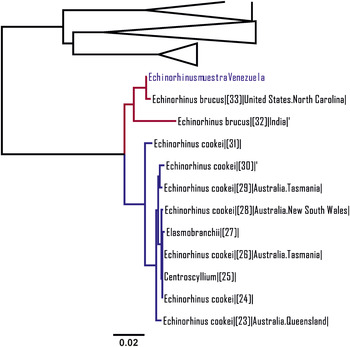
The taxonomic position was inferred by comparing the query sequence with the GenBank data and BOLD initiative, through the respective applications: BLAST (http://blast.ncbi.nlm.nih.gov/Blast.cgi); and BOLD-Systems (http://www.boldsystems.org/views/idrequest.php). The generated BOLD-ID identification tree shows high coincidence of studied shark with one sample of E. brucus from North Carolina, USA (Figure 3).
RESULTS AND DISCUSSION
SYSTEMATICS
Echinorhinus brucus (Bonnaterre, Reference Bonnaterre1788) (Figures 1 and 2)
Initially described as Squalus brucus by Bonnaterre (Reference Bonnaterre1788), named for the Greek word bruchios or brux meaning ‘of the deep sea’. The type specimen is lost. In 1816, Henri de Blainville created the Echinorhinus genus where this species is included.
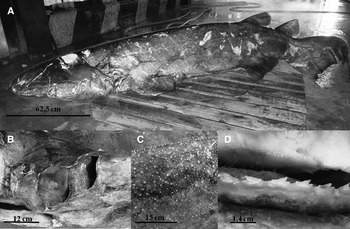
Specimen of Echinorhinus brucus captured in Venezuelan waters: (A) overall appearance; (B) detail of gill slits; (C) detail of the skin; (D) denture.

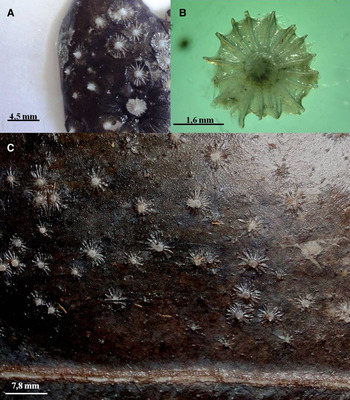
Details of specimen skin and denticles of Echinorhinus brucus.

Identification based on the generation of a phylogenetic tree under standard methodology BOLD ID; includes only the clade with specimens of Echinorhinus. The sample (Echinorhinus sp. of Venezuela, in blue) is grouped in a clade with the other sequences of E. brucus, presenting a similarity of 99.68% compared to the most similar haplotype.

DESCRIPTION
Short description of the specimen
Trunk stout and cylindrical; without abdominal ridges (Figure 1); broadly covered (but not densely) by free angular denticles usually not united in plates with multiple cusps, with stellate bases, less than 5 mm in diameter (Figure 2). Head moderately depressed; five gill slits, the last one larger than the rest; spiracles very small, located behind the eyes; nostrils widely separated from each other; short snout; mouth broadly arched, with short labial furrow; teeth alike in form and number in both jaws (approximately 21 in each case), compressed, in form of plates, with three big cusps and up to three cusplets. Dorsal fins very close to the caudal fin; the origin of the first dorsal located behind the origin of the large pelvic fins. Size of dorsal fins very similar between them and equal or smaller in length to the pelvic fins. Anal fin absent. Caudal fin asymmetrical, with the lower lobe poorly developed; without notch close to the distal extreme.
Morphometric data
Total length 252.0 cm; prenarial length 13.5 cm; preoral length 19.0 cm; eye diameter 4.3 cm; mouth width 30.0 cm; trunk height 39.0 cm; internarial space 12.3 cm; nostril width 3.9 cm; 1st gill slit height (gsh) 12.3 cm; 2nd gsh 11.6 cm; 3rd gsh 11.6 cm; 4th gsh 12.2 cm; 5th gsh 15.5 cm; 1st dorsal height 11.0 cm; 1st dorsal base 15.0 cm; 1st dorsal inner margin 6.1 cm; 2nd dorsal height 13.5 cm; 2nd dorsal base 12.4 cm; 2nd dorsal inner margin 6.0 cm; dorsal caudal margin 62.7 cm; lower caudal margin 27.1 cm; pectoral base 17.0 cm; pectoral anterior margin 24.8 cm; pectoral posterior margin 12.4 cm; pectoral inner margin 13.3 cm; pre-first dorsal length 152.2 cm; pre-second dorsal lentgh 179.7 cm; precaudal length 182.7 cm; prepectoral length 66.8 cm; prepelvic length 134.6 cm; interdorsal space 14.1 cm; dorsal-caudal space 6.0 cm; pelvic-caudal space 19.5 cm; pectoral-pelvic space 80.5 cm; prebranchial length 44.5 cm; preorbital length 18.1 cm; orbital-first gill slit space 26.5 cm; orbital-third gill slit space 33.0 cm; upper labial furrow length 2.5 cm; lower labial furrow length 1.7 cm; pelvic base 31.2 cm; pelvic anterior margin length 23.1 cm; pelvic posterior margin length 9.4 cm.
The main character that distinguishes the two species of Echinorhinus, is that E. brucus presents spine-like dermal denticles relatively big (larger than 15 mm in diameter), spread on the body, not stellate and on occasions fused within plates with multiple cusps; while in E. cookei, these denticles are numerous, densely distributed along the entire body, relatively small (generally not larger than 4–5 mm in diameter), stellate and not fused within plates with multiple cusps (Garrick, Reference Garrick1960; Compagno, Reference Compagno1984; Compagno & Niem, Reference Compagno, Niem, Carpenter and Niem1998; Compagno et al., Reference Compagno, Dando and Fowler2005; Sáez et al., Reference Sáez, Pequeño and Lamilla2010). According to this criterion, the specimen analysed has intermediate characters that make morphological identification confusing and even initially led us to think of the possibility that it was E. cookei, particularly the small size of the spines, its edge that gives the stellate character and the fact of not being fused into multiple cusps except for a few cases.
The scarcity of COX1 homologous sequences in public databases is manifest. In GenBank (accessed: 5 May 2014) there are 2 records for E. cookei (DQ521002: Hawaii, USA and EU398777: Queensland, Australia), and a single record for E. brucus (HM467790: India). The distances between pairs of sequences (p) are similar, with an average value of 0.039 to the sequence of this work, and about 0.037 E. cookei regarding E. brucus from India. In contrast, comparison of the sequence obtained from the specimen captured in Venezuela with those deposited in BOLD, shows high homology (99.68%), compared to a record identified as E. brucus from the State of North Carolina (USA). Although the location of the specimen studied in the BOLD identification tree is conclusive for taxonomic determination in E. brucus, low values of inter-specific divergence, shortage of records, and inconsistencies regarding diagnostic morphological characters, suggest the need for a revision of the genus that takes into account different sources of taxonomic evidence and different molecular markers. The niche of these species (Compagno et al., Reference Compagno, Dando and Fowler2005; Dawson & Starr, Reference Dawson and Starr2009) hinders the achievement of identifying individuals, resulting in a scarcity of DNA sequences and information with systematic utility.
Reports of the presence of E. cookei closer to the one in Venezuela have been made in Chile (Flores & Rojas, Reference Flores and Rojas1979; Parin et al., Reference Parin, Golovan, Pakhorubov, Sazonov, Shcherbachev and Parin1980; Ruiz & Fernández, Reference Ruiz and Fernández1984; Meléndez & Meneses, Reference Meléndez and Meneses1989; Brito, Reference Brito2004). There are also observations in the Pacific zone of El Salvador (Rojas et al., Reference Rojas, Fuentes and Hernández2006). The records of E. brucus closer to the Caribbean Sea have taken place in the Gulf of Mexico and in southern Brazil (Froese & Pauly, Reference Froese and Pauly2012) hence the current report represents the first observation of an individual of the genus Echinorhinus in waters of the Caribbean Sea. The difficulty of capture, due to its habitat in deeper waters (Compagno et al., Reference Compagno, Dando and Fowler2005) and its relative low abundance, something that has led to this taxon being considered as ‘Data Deficient’ in the list of endangered species generated by the IUCN (Paul, Reference Paul2003), suggests the need for appropriate data on abundance and/or distribution to make a correct assessment of risk for this taxon. In consequence, this observation is an event of importance in reducing the lack of information about E. brucus.
ACKNOWLEDGEMENTS
We are especially grateful to R. Pebé for communicating the capture of the specimen and the fishermen who allowed us to conduct the analysis of the shark. We thank Y. Parejo, L. Torcat and A. Arroyo for their help in obtaining biological data and the Nichomar Fish Trading Company for storing it. We thank MSc Joseph Alió for their critical reading of the manuscript. This research received no specific grant from any funding agency, commercial or not-for-profit sectors.