Introduction
Herbicide drift can happen either by the movement of spray droplets or solid particles at the time of application or through volatilization after application (Carlsen et al. Reference Carlsen, Spliid and Svensmark2006; Lewis et al. Reference Lewis, Hoyle, Fisher, Yelverton and Richardson2011; Marple et al. Reference Marple, Al-Khatib, Shoup, Peterson and Claassen2007; Patton et al. Reference Patton, Ruhl, Creswell, Wan, Scott, Becovitz and Weisenberger2013; Strachan et al. Reference Strachan, Ferry and Cooper2013). Drift has the tendency to damage neighboring sensitive plants and reduce efficacy of the applied herbicide on the target area (Nordby and Skuterud Reference Nordby and Skuterud1974). Dicamba drift at 5.6 g ae ha−1 (0.04X) was shown to cause 18% reduction in potato (Solanum tuberosum L. ‘Norland’.) yield and created phenoxy-type symptoms at a rate of 1.0 g ae ha−1 (0.007X) (Wall Reference Wall1994). Broccoli (Brassica oleracea L. var, botrytis L.) yield decreased by 50% when 2,4-D was applied at 16.8 g ae ha−1 (0.03X), with the highest injury of 19% observed at 28 d after treatment (DAT) (Mohseni-Moghadam and Doohan Reference Mohseni-Moghadam and Doohan2015). Slight injury (<11%) was observed by applying dicamba at 11.2 g ae ha−1 (0.02X), and it did not affect the overall yield compared with nontreated plants (Mohseni-Moghadam and Doohan Reference Mohseni-Moghadam and Doohan2015). The same rates (1/50, 1/100, 1/150, 1/200, and 1/400 of the recommended field rate of 2,4-D [840 g ae ha−1] and dicamba [560 g ae ha−1]) were applied on bell peppers (Capsicum annuum L.), and a 50% yield reduction was recorded with dicamba, while 2,4-D application did not decrease yield in comparison to nontreated plants (Mohseni-Moghadam and Doohan Reference Mohseni-Moghadam and Doohan2015).
Tomato is highly sensitive to some herbicides, particularly auxins, and drift of these herbicides onto tomato can lead to economic losses to farmers (Lovelace et al. Reference Lovelace, Hoagland, Talbert and Scherder2009; Romanowski Reference Romanowski1980; Schmoll et al. Reference Schmoll, Harrison, Regnier and Bennett2000). Off-target movement of auxin herbicides can cause economic losses by affecting yield production directly or by impacting the growth stages (vegetative and reproductive) (Christoffoleti et al. Reference Christoffoleti, Alves de Figueiredo, Pereira Peres, Nissen and Gaines2015; Hemphill and Montgomery Reference Hemphill and Montgomery1981; Kruger et al. Reference Kruger, Johnson, Doohan and Weller2012; Lovelace et al. Reference Lovelace, Talbert, Scherder and Hoagland2007; Pazmiño et al. Reference Pazmiño, Rodríguez-Serrano, Romero-Puertas, ArchillaRuiz, Del Río and Sandalio2011; Romero-Puertas et al. Reference Romero-Puertas, McCarthy, Gómez, Sandalio, Corpas, del Río and Palma2004). Lovelace et al. (Reference Lovelace, Talbert, Scherder and Hoagland2007) conducted a 2-yr experiment to detect the influence of quinclorac drift on tomato plant, particularly fruit yield. The study reported that a maximum injury of 20% occurred when plants were treated with either one, two, or three quinclorac applications, at 0.42 g ai ha−1, in both 1999 and 2000. Additionally, a reduction in plant fresh-weight accumulation was observed when quinclorac rate was increased from 0.42 to 4.2 g ai ha−1 (Lovelace et al. Reference Lovelace, Talbert, Scherder and Hoagland2007). Lovelace et al. (Reference Lovelace, Hoagland, Talbert and Scherder2009) reported an increase in quinclorac residue in tomato tissue due to an increase in rate and number of quinclorac applications. Moreover, application of dicamba and 2,4-D caused injury in tomato, although the recorded yield loss from dicamba was greater than loss from 2,4-D application (Jordan and Romanowski Reference Jordan and Romanowski1974).
The effects of sublethal amounts of 2,4-D on yield and quality of several crops revealed that tomato and root crops were sensitive to 2,4-D, with exposure to herbicide causing distorted tomato fruit shape and elongated roots in radish (Raphanus sativus L.)) (Hemphill and Montgomery Reference Hemphill and Montgomery1981). A simulated drift study of 2,4-D on tomato showed a higher loss in fruit number when drift occurred in the early bloom stage rather than at the fruit set stage (Fagliari et al. Reference Fagliari, Oliveira and Constantin2005), while negative effects of glyphosate and dicamba on marketable yield of tomato were highest when drift occurred during the flowering stage (Kruger et al. Reference Kruger, Johnson, Doohan and Weller2012).
Auxin herbicides produce different effects on sensitive crops (Christoffoleti et al. Reference Christoffoleti, Alves de Figueiredo, Pereira Peres, Nissen and Gaines2015; Pazmiño et al. Reference Pazmiño, Rodríguez-Serrano, Romero-Puertas, ArchillaRuiz, Del Río and Sandalio2011; Romero-Puertas et al. Reference Romero-Puertas, McCarthy, Gómez, Sandalio, Corpas, del Río and Palma2004). These herbicides can have different biological activity based on plant species, physiological stage, and tissue sensitivity (Cobb Reference Cobb and Cobb1992; Grossmann Reference Grossmann, Cobb and Kirkwood2000; Zheng and Hall Reference Zheng and Hall2001). Visual injuries associated with auxin herbicides include epinasty, stem curvature, senescence, and inhibition of shoot and root growth (Grossmann et al. Reference Grossmann, Kwiatkowski and Tresch2001). Some symptoms, such as destruction of cell membranes, vascular system damage, cell death, and plant deterioration, are commonly associated with yield reductions (Cobb Reference Cobb and Cobb1992; Grossmann Reference Grossmann, Cobb and Kirkwood2000; Pazmiño et al. Reference Pazmiño, Romero-Puertas and Sandalio2012). Pazmiño et al. (201l) reported that after auxin herbicides were applied to young leaves of pea (Pisum sativum L.) plants, accumulation of reactive oxygen species (ROS) occurred, which ultimately induced epinasty. On the other hand, in adult leaves, the overproduction of ROS triggers senescence. ROS production in response to 2,4-D activates xanthine oxidase and acyl-CoA oxidase, and peroxisomes have been identified as one of the primary sites where these oxidases are produced (Mittler et al. Reference Mittler, Vanderauwera, Suzuki, Miller, Tognetti, Vandepoele, Gollery, Shulaev and Van Breusegem2011; Pazmiño et al. Reference Pazmiño, Romero-Puertas and Sandalio2012, Reference Pazmiño, Rodríguez-Serrano, Sanz, Romero-Puertas and Sandalio2014; Rodríguez-Serrano et al. Reference Rodríguez-Serrano, Romero-Puertas, Sparkes, Hawes, del Río and Sandalio2009; Romero-Puertas et al. Reference Romero-Puertas, Palma, Gómez, del Río and Sandalio2002; Sandalio et al. Reference Sandalio, Rodríguez-Serrano, Gupta, Archilla, RomeroPuertas, del Río, Amad and Prassad2012, Reference Sandalio, Rodríguez-Serrano, Romero-Puertas, del Río and del Río2013; Suzuki et al. Reference Suzuki, Koussevitzky, Mittler and Miller2011).
Based on the studies cited, it is evident that auxin herbicides cause severe damage to tomato, even at simulated drift rates. Thus, breeding tomato varieties that are more tolerant to drift rates of auxin herbicides could be beneficial to tomato producers by protecting tomato fields against unintentional application of these herbicides. Development of auxin herbicide–tolerant tomato will help protect tomato fields against unintentional drift of auxin herbicides and preserve the yield and quality of the crop. The primary propose of this study was to identify herbicide-tolerant tomato phenotypes among a wide collection of tomato germplasm consisting of modern and vintage cultivars, wild species, stress-tolerant lines, and introgression lines.
Materials and Methods
Greenhouse Assays
Three wild tomato accessions (TOM198, TOM199, and TOM300) were selected from an initial preliminary greenhouse bioassay screening using 110 wild tomato accessions (unpublished data).
Two experiments (1 and 2) were conducted at the R. R. Foil Plant Science Research Center, Mississippi State, MS, in 2018. Three wild accessions: TOM199, TOM198, and TOM300 were obtained from the Tomato Genetic Resource Center, University of California at Davis, CA; while two cultivars: ‘Better Boy’ and ‘Money Maker’ were obtained from a commercial seed company (Burpee Seed Co., Warminster, PA). In both experiments, tomato seeds of all wild accessions and cultivars were planted in 72-cell trays (size of each tray: 50.8 by 25.4 cm) filled with potting mix (SunGro® Horticulture Sunshine Mix no. 2 Basic, Quebec, Canada), on March 1, 2018. After seedling emergence, plants were irrigated once a day to field capacity and fertilized twice a week with 20:20:20 formulated (45 g m−2) fertilizer (Scotts Miracle-Gro® Company, Marysville, OH) until the end of the experiment. The average temperature of the greenhouse during the course of the experiments was 23 to 25 C/18 to 19 C (day/night), photoperiod was 11.5 to 13.5 h d−1, and light quantity on top of the tomato canopy was 1,190 µmols s−1 m−2. No artificial light source was used in the greenhouse; sunlight was the only source of light. Treatments were arranged in a completely randomized design with a factorial arrangement and replicated four times. There were 20 plots (each plot represented 10 cells in a 72-cell tray) per replication, with 10 plants per plot for Experiments 1 and 2. Factors included three herbicides (2,4-D, dicamba, and quinclorac) and nontreated (without herbicide) and five tomato varieties (three wild accessions: TOM199, TOM198, and TOM300; two tomato cultivars: Money Maker and Better Boy). The 2,4-D, dicamba and quinclorac were applied at simulated drift rates of 11.2 g ae ha−1 (0.01X) (Fagliari et al. Reference Fagliari, Oliveira and Constantin2005), 2.8 g ae ha−1 (0.01X) (Kruger et al. Reference Kruger, Johnson, Doohan and Weller2012), and 39.2 g ae ha−1 (0.01X) (Lovelace et al. Reference Lovelace, Talbert, Scherder and Hoagland2007), respectively. Herbicides were obtained commercially as follows: 2,4-D dimethylamine salt (Weedar 64, Nufarm Inc, Alsip, IL), quinclorac (Facet®, BASF Corp., Florham Park, NJ), and dicamba (Clarity, BASF Corp., Florham Park, NJ). Nontreated plants were included as nontreated treatments. In Experiment 1, herbicide treatments were applied at 4 weeks after planting (WAP) (15-cm height) using a single-tip spray chamber fitted with a TP8002VS flat spray tip (TeeJet Technologies, Wheaton, IL). The spray boom was calibrated to deliver 186 L ha−1 at 275.79 kPa while maintaining a constant speed of 4.8 km h−1. In Experiment 2, tomato plants were transplanted to large pots (trade size: no. 2; top diameter: 22.86 cm; height: 21.59 cm) at 7 WAP, and herbicide was applied at 8 WAP (30 cm height) in a similar manner to Experiment 1. Experiment 2 was conducted to observe differences, if any, in response to auxin herbicides among the wild accessions and cultivars when herbicide was applied at a later vegetative stage (8 WAP). Tomato plants in both experiments were rated weekly for visual injury (using a scale of 0% to 100%: 0% to 10%, slight to no injury; 10% to 30%, moderate injury; 30% to 50%, signs of epinasty and leaf twisting; 50% to 70%, severe injury; 70% to 95%, severe injury and no growth; and 95% to 100%, plant death), and plant height (length in centimeters of the longest branch from the base of the plant). All aboveground plant parts were harvested at the soil surface (at the 28 DAT), oven-dried at 50 C for 72 h, and then weighed.
Field Experiments
Field experiments were conducted in two locations, R. R. Foil Plant Science Research Center (North Farm) in Starkville, MS (33.47°N/88.78°W), and Truck Crops Branch Experiment Station (Crystal Springs) in Crystal Springs, MS (31.94°N/90.37°W), during the 2018 growing season. The soil at Crystal Springs is Providence silt loam (fine–silty, mixed, active, thermic, Oxyaquic Fragiudalfs) with a pH of 5.7 and 0.96% organic matter, while at North Farm the soil is Leeper silty clay loam (fine, smectitic, nonacid, thermic Vertic Epiaquept) with a pH of 7.9 and 1.90% organic matter. Land preparation practices including plowing, disking, ridging, and covering planting rows with black plastic mulch were conducted at both locations. Experiments were arranged in a randomized complete block design with a factorial (two factors) arrangement consisting of three replications. Factors included three herbicides (2,4-D, dicamba, and quinclorac) and five tomato varieties (three wild accessions: TOM199, TOM198, and TOM300; two cultivars: Better Boy and Money Maker). Nontreated plots were included as nontreated treatments. Each block consisted of 20 plots, and each plot measured 2 by 2 m and contained 7 plants. For the field experiment at both locations, tomato seeds were planted on April 15, 2018, in 72-cell trays as described earlier. Seedlings were transplanted when tomato plants were 5-wk old. Plants were watered by a drip-irrigation system three times a week with a water-dropper interval of 20 cm. At 2 WAP, herbicides were applied (drift rates as described for the greenhouse assay). Visual injury of all plants within a plot was recorded weekly, and dry weight of 4 plants was measured at the end of the 4th week, as described for the greenhouse assay. Tomato total yield of the other 3 plants in each plot was measured after fruit ripening.
Statistical Analysis
PROC GLM in SAS v. 9.2 (SAS Institute, Cary, NC) was used to analyze results. Data were subjected to ANOVA, and means were compared with the use of Duncan’s test at the 5% level of probability.
Results and Discussion
Visible Injury
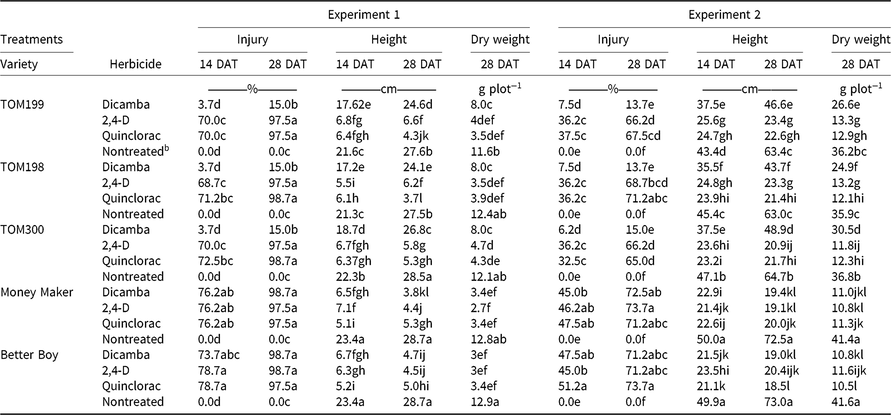
In greenhouse Experiment 1, all accessions treated with dicamba showed only 4% mean injury at 14 DAT, while injury levels of Money Maker and Better Boy were 76% and 74%, respectively (Table 1). Damage from 2,4-D and quinclorac in all accessions was higher compared with damage from dicamba (Table 1). At the end of the 4th week (28 DAT) of dicamba application, injury increased to 15% and 99% for the accessions and cultivars, respectively (Table 1). All 2,4-D- and quinclorac-treated plants were significantly different compared with their respective nontreated plots at the 4th week (Table 1). The level of injury in wild accessions exposed to dicamba increased by 28 DAT; however, this injury was less than injury for 2,4-D- and quinclorac-treated plants (Table 1).
Interaction of tomato varieties and herbicide types on plant height and visual injury in greenhouse Experiments 1 and 2.a

a Means within columns followed by the different letter are significantly different at P ≤ 0.05 using Duncan’s test.
b Nontreated: without herbicide.
c Abbreviation: DAT, days after treatment.
In greenhouse Experiment 2, the levels of dicamba injury in accessions TOM199, TOM198, TOM300, Money Maker, and Better Boy were 8%, 8%, 6%, 45%, and 48%, respectively, at 14 DAT (Table 1). All three accessions were tolerant to dicamba in comparison to both cultivars at 14 DAT (Table 1). The injury levels of TOM199, TOM198, TOM300, Money Maker, and Better Boy were 14%, 14%, 15%, 73%, and 71%, respectively, at 28 DAT (Table 1). As in greenhouse Experiment 1, all three wild accessions, TOM199, TOM198, and TOM300, were visibly tolerant to dicamba in comparison to both commercial cultivars, Money Maker and Better Boy (Table 1). All 2,4-D- and quinclorac-treated accessions and cultivars showed a higher level of injury than dicamba-treated accessions (Table 1).
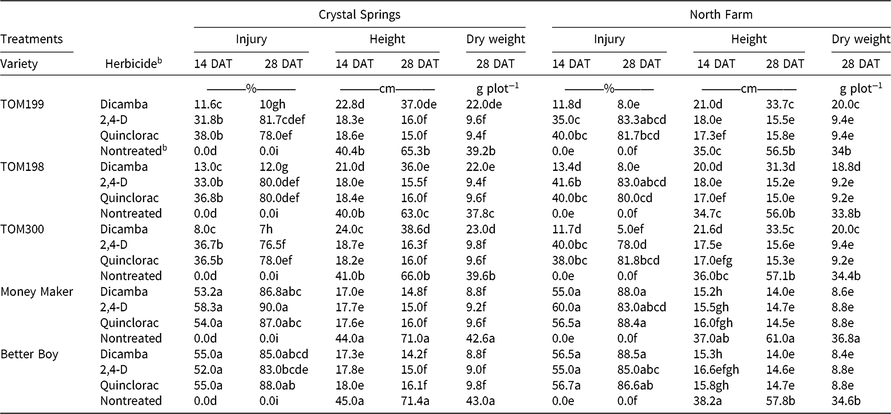
Across the two field locations, all dicamba-treated accessions showed lower injury than 2,4-D- and quinclorac-treated accessions at 14 and 28 DAT (Table 2). TOM300 showed the lowest level of injury among all accessions after application of dicamba in both field locations (Table 2). The levels of visual injury at 28 DAT of accessions TOM199, TOM198, and TOM300 were 10%, 12%, and 7%, respectively, at the Crystal Springs location (Table 2). The two cultivars, on the other hand, showed 85% to 87% injury at 28 DAT with dicamba (Table 2). An overall lower injury from dicamba treatments was observed at the North Farm than at the Crystal Springs location. At 28 DAT, injury levels from dicamba were 8%, 8%, 5%, 83%, and 89% for TOM199, TOM198, TOM300, Money Maker, and Better Boy, respectively, at North Farm (Table 2). In both experiments, all dicamba-treated accessions recovered from dicamba injury between the 2nd and 4th weeks after application (Table 2). Meanwhile, Money Maker and Better Boy showed lower levels of tolerance to dicamba than TOM199, TOM198, and TOM300.
Interaction of tomato varieties and herbicide types on plant height and visual injury at R.R. Foil Plant Science Research Center (North Farm) in Starkville, MS, and Truck Crops Branch Experiment Station (Crystal Springs) in Crystal Springs, MS.a

a Means within columns followed by the different letter are significantly different at P ≤ 0.05 using Duncan’s test.
b Nontreated: without herbicide.
c Abbreviation: DAT, days after treatment.
Studies reveal that the effects of dicamba on tomato leaves have high negative impacts on both vegetative stages of tomato (Schmoll et al. Reference Schmoll, Harrison, Regnier and Bennett2000). The level of injury caused by dicamba may be exacerbated by increased rates (Schmoll et al. Reference Schmoll, Harrison, Regnier and Bennett2000). The most sensitive vegetative growth parameter in tomato in response to dicamba application was leaf area, which was decreased 31% and 76% at 30 d after application of dicamba at concentrations of 2.2 and 22 µg L−1, respectively (Schmoll et al. Reference Schmoll, Harrison, Regnier and Bennett2000). Also, 6% and 73% reductions in fruit fresh weight per plant were observed when dicamba was applied at 1 and 10 µg L−1, respectively (Schmoll et al. Reference Schmoll, Harrison, Regnier and Bennett2000). There is a direct correlation between increasing visual injury and decreasing tomato yield (Colquhoun et al. Reference Colquhoun, Heider and Rittmeyer2014; Fagliari et al. Reference Fagliari, Oliveira and Constantin2005; Schmoll et al. Reference Schmoll, Harrison, Regnier and Bennett2000). In the case of snap bean (Phaseolus vulgaris L.), the most evident injury was in the form of delayed or deformed flowers (Colquhoun et al. Reference Colquhoun, Heider and Rittmeyer2014). Also, sublethal rates of dicamba can decrease pollinator activity, which in turn decreases fecundity (Bohnenblust et al. Reference Bohnenblust, Vaudo, Egan, Mortensen and Tooker2016). In other words, herbicide injury leads to decreased pollination, which in turn results in yield reduction (Awmack and Leather, Reference Awmack and Leather2002; Bohnenblust et al. Reference Bohnenblust, Vaudo, Egan, Mortensen and Tooker2016; Roulston and Cane, Reference Roulston and Cane2002).
It is remarkable that some dicamba-tolerant broadleaf crops can sustain floral resources despite the negative effect of the herbicide (Boutin et al. Reference Boutin, Strandberg, Carpenter, Mathiassen and Thomas2014; Egan et al. Reference Egan, Bohnenblust, Goslee, Tooker and Mortensen2014). Our results showed that all three accessions and both cultivars were unable to recover after application of 2,4-D and quinclorac at the end of the 4th week (Tables 1 and 2). Chlorosis and epinastic symptoms were observed at 14 d after 2,4-D and quinclorac applications. This indicates the plants’ inability to continue natural growth after injury from 2,4-D and quinclorac applications. Based on the greenhouse and field experiments, accessions TOM199, TOM198, and TOM300 were confirmed tolerant to the simulated drift rates of dicamba (Tables 1 and 2).
Plant Height
Plant heights for dicamba-treated accessions were greater than for accessions treated with 2,4-D and quinclorac in greenhouse Experiment 1 (Table 1). At 14 DAT, the heights of the TOM199, TOM198, and TOM300 accessions treated with dicamba were 18, 17, and 19 cm, respectively (Table 1). The heights of TOM199 and TOM198 after dicamba treatment were similar, but shorter than accession TOM300 (Table 1). Heights of both cultivars, Money Maker and Better Boy, were affected by all three herbicides (Table 1). Both Money Maker and Better Boy were only 7-cm tall at 14 DAT with dicamba (Table 1). Height reductions of accessions TOM199, TOM198, and TOM300 caused by 2,4-D, in comparison to their respective nontreated plots, were 76%, 77%, and 80%, respectively, at 28 DAT (Table 1). With quinclorac, reductions were 85%, 87%, and 81% for accessions TOM199, TOM198, and TOM300, respectively (Table 1).
Quinclorac and 2,4-D treatments caused a decrease in plant height from 14 to 28 DAT for all accessions and cultivars in greenhouse Experiment 2; however, with dicamba treatments, only the cultivars followed a similar trend. With respect to the three accessions, an increase in plant height was observed after treatment with dicamba, thus suggesting the tolerance potential of these accessions to dicamba (Table 1). Recorded plant heights for accessions TOM199, TOM198, and TOM300 were 38, 35, and 38 cm, respectively, at 14 DAT. The heights of accessions TOM199 and TOM300 were similar, but different from accession TOM198 (Table 1). The greatest (49 cm) and lowest (44 cm) heights were recorded for accessions TOM300 and TOM198, respectively, at 28 DAT (Table 1). Height reductions for dicamba-treated accessions TOM199, TOM198, and TOM300 were 26%, 31%, and 24%, respectively, when compared with their respective nontreated plots (Table 1). Plant height of dicamba-treated cultivars decreased over time (Table 1). At 14 DAT, Money Maker and Better Boy were 22- to 23-cm tall, while at 28 DAT, they were 19-cm tall (Table 1). Results from both field locations showed an increase in plant height only in all the nontreated treatments (accessions and cultivars) and dicamba-treated accessions (Table 2). This suggests that all three dicamba-treated accessions were able to resume their normal growth, as indicated by their increased height after dicamba application. In Crystal Springs, the plant heights of TOM199, TOM198, and TOM300 were 37, 36, and 39 cm, respectively, at 28 DAT; however, in North Farm, TOM198 was shorter (7%) compared with the other two accessions (Table 2). In both locations, accession TOM198 was the shortest among the three accessions (Table 2). At 28 DAT, accessions TOM199, TOM198, and TOM300 showed height reductions of 43%, 43%, and 41%, respectively, in Crystal Springs, and reductions of 41%, 44%, and 41%, respectively, in North Farm (Table 2). Money Maker and Better Boy were about 14-cm tall, at 28 DAT in both locations (Table 2).
Based on greenhouse and field experiments, all dicamba-treated accessions demonstrated less height reduction than the 2,4-D and quinclorac-treated accessions (Tables 1, 2). One study showed that 2,4-D application can decrease plant height of two soybean cultivars (‘Wiliams 79’ and ‘Dunfield’) more than their nontreated equivalents (Canady et al. Reference Canady, Helsel and Wyllie1986). A 10% plant height reduction in soybean after application of imazaquin, chlorimuron, or metribuzin plus chlorimuron has also been reported (Griffin and Habetz Reference Griffin and Habetz1989). Decreased height in susceptible tomato plants after auxin herbicide application may be due to two reasons. First, after application of auxin herbicides, chlorosis and necrosis symptoms are usually observed within a few days (Andersen et al. Reference Andersen, Clay, Wrage and Matthees2004; Grossman Reference Grossmann1996, Reference Grossmann2010). Under these stressed conditions, a plant is unable to photosynthesize, and is thus prevented from continuing its vegetative growth stage. Second, epinastic symptoms are observed after application of auxin herbicides (Coupland and Jackson Reference Coupland and Jackson1991; Grossmann Reference Grossmann1998, Reference Grossmann2010), and this bending and twisting of the stems leads to reduction in plant height, as seen in susceptible plants.
Dry Weight
Tomato dry weight was examined at 28 DAT in all greenhouse and field experiments (Tables 1 and 2). Based on the dry weight results of greenhouse Experiments 1 and 2, all 2,4-D and quinclorac-treated accessions and both cultivars showed different dry weights compared with their respective nontreated plots at 28 DAT (Table 1). In greenhouse Experiment 1, the highest dry weight was observed with dicamba-treated accessions (Table 1). Dry weight reductions for TOM199, TOM198, TOM300, Money Maker, and Better Boy were 32%, 32%, 35%, 73%, and 77%, respectively, in comparison with their respective nontreated plots (Table 1). In greenhouse Experiment 2, dicamba-treated accessions TOM199, TOM198, TOM300, Money Maker, and Better Boy showed dry weight reductions of 27%, 31%, 17%, 73%, and 74%, respectively (Table 1). In both greenhouse experiments, the observed dry weight reduction of accessions treated with dicamba was lower than with 2,4-D and quinclorac (Table 1). These results suggest the three accessions had good tolerance to the simulated drift rates of dicamba (Table 1).
As in the greenhouse experiments wild accessions treated with dicamba in both field locations showed less dry weight reduction than accessions treated with 2,4-D and quinclorac (Table 2). In contrast, the dry weights of Money Maker and Better Boy were low (less than 10 g plot−1) across all three herbicide treatments (Table 2). The dry weight reductions compared with nontreated plots were 43%, 43%, 41%, 80%, and 80% for dicamba-treated TOM199, TOM198, TOM300, Money Maker, and Better Boy, respectively, in Crystal Springs (Table 2). In North Farm, dry weight reductions for dicamba-treated wild accessions TOM199, TOM198, and TOM300 were 41%, 44%, and 41%, respectively; while for the cultivars Money Maker and Better Boy, they were 77% and 76%, respectively (Table 2). Among the wild accessions, TOM300 produced the highest dry weight (23 g plot−1) in Crystal Springs (Table 2). Dry weight of dicamba-treated accessions TOM199 and TOM198 were the same (22 g plot−1) (Table 2). In North Farm, accessions TOM300 and TOM199 had the same dry weight (20 g plot−1) after treatment with dicamba, but were different from accession TOM198 (18.8 g plot−1) (Table 2). Based on their dry weights, all three tomato accessions displayed substantial tolerance to dicamba (Table 2).
Tomato Yield
Plants of both cultivars, Money Maker and Better Boy, did not produce any fruits when treated with dicamba due to severe injury from the herbicide, so yield data were not available for comparison with the yield data for wild accessions. Accession TOM300 showed the highest yield in both field locations: 0.4 and 0.3 kg m−2 in Crystal Springs and North Farm, respectively (Figure 1). Observed yields for accessions TOM199 and TOM198 were 0.28 and 0.3 kg m−2, respectively, in Crystal Springs, and 0.2 and 0.2 kg m−2, respectively, in North Farm (Figure 1). Fruit yield in general was lower in North Farm than in Crystal Springs. This difference in fruit yield may be due to differences in soil type and extractable nutrients in soil between the North Farm and Crystal Springs locations (Li et al. Reference Li, Su, Li, Wen, Bi and Cox2018). The soil at Crystal Springs is primarily used for growing vegetables such as tomato, pepper, and squash (Cucurbita moschata Duchesne) and is of the silt loam type, whereas in North Farm, which is primarily used for growing row crops such as soybean [Glycine max (L.) Merr.], corn (Zea mays L.), and cotton (Gossypium hirsutum L.), the soil is silty clay loam. Additionally, the soil pH of Crystal Springs (pH 5.7) is more suitable for growing tomato than the soil pH in North Farm (pH 7.9). All accessions treated with 2,4-D and quinclorac and both cultivars treated with all three herbicides did not produce any fruit, as all plants were dead after 28 to 35 DAT (unpublished data).
Interaction of herbicide treatments and accessions on tomato yield in field experiments. Means within columns followed by different letters are significantly different at P ≤ 0.05 using Duncan’s test.

Hemphill and Montgomery (Reference Hemphill and Montgomery1981) showed that sublethal doses (simulated drift doses) of 2,4-D can impact yield, yield components, and growth of some crops, such as tomato, broccoli, and bell pepper. They reported that tomato is sensitive to as little as 2.1 g ha−1 of 2,4-D, which can potentially change fruit shape. The effects of varying rates of 2,4-D were studied on broccoli and bell pepper in 2010 and 2011 (Mohseni-Moghadam and Doohan Reference Mohseni-Moghadam and Doohan2015). Their results indicated that the behavior of broccoli and pepper in response to 2,4-D were not the same (Mohseni-Moghadam and Doohan Reference Mohseni-Moghadam and Doohan2015). At the 1/50 rate, 2,4-D reduced broccoli yield by 50%, but at the drift rate, it did not injure broccoli (Mohseni-Moghadam and Doohan Reference Mohseni-Moghadam and Doohan2015). On the other hand, simulated drift treatments of 2,4-D did not reduce bell pepper yield but affected the timing of fruit maturity (Mohseni-Moghadam and Doohan Reference Mohseni-Moghadam and Doohan2015). The authors concluded that these crops were sensitive to very low doses of 2,4-D (Mohseni-Moghadam and Doohan Reference Mohseni-Moghadam and Doohan2015). Sublethal doses of 2,4-D were tested on tomato plants at different growth stages in the field (Fagliari et al. Reference Fagliari, Oliveira and Constantin2005), and application of rates between 0.42 and 13.44 g ai ha−1 at the beginning of the flowering stage caused a linear decrease in crop yield, indicating that even a low rate (drift rate) of 2,4-D can affect the number of fruits per plant.
Tomato fruit yields of ‘Heinz 1350’ and ‘Heinz 1439’ were reduced and not affected when plants were treated with dicamba at rates of 0.2 and 0.1 kg ha−1, respectively (Jordan and Romanowski Reference Jordan and Romanowski1974). Both cultivars were not affected by 2,4-D application at rates equivalent to those of dicamba at the same maturity stage (Jordan and Romanowski Reference Jordan and Romanowski1974). Dicamba, however, affected total and marketable yields of potato by 40% and 74%, respectively, when sprayed at a rate of 22.2 g ai ha−1 (Wall Reference Wall1994). The percentage of the reduction in potato yield was 18% after dicamba was applied at the 56 g ha−1 rate when potatoes were at 15% flowering stage (Haderlie Reference Haderlie1987). The observed yield reduction in tomato after application of dicamba may be related to an imbalance between source and sink and can be related to the systemic nature of auxin herbicides (Fagliari et al. Reference Fagliari, Oliveira and Constantin2005). Younger vegetative and reproductive parts of tomato plants require high amounts of assimilates and are effective in moving large amounts of auxin herbicides to those parts and meristemic tissues (Fagliari et al. Reference Fagliari, Oliveira and Constantin2005; Kadir et al. Reference Kadir, Al-Khatib and Peterson2003). The ultimate result of the transfer of auxin herbicides to young reproductive areas is flower or fruit drop (Kadir et al. Reference Kadir, Al-Khatib and Peterson2003). Cyanide accumulation is another result of auxin herbicides present in vegetative and reproductive parts of crops (Grossman Reference Grossmann1998). It is notable that environmental conditions like relative humidity, temperature, and light intensity may affect uptake of (auxin) herbicides (Grossman, Reference Grossmann1998). However, after absorption, auxin herbicides may translocate across all areas in a plant and disrupt regulation of fundamental growth and developmental processes (Davies Reference Davies and Davies1995). It is also important to note that auxin herbicides are biphasic, so their activities and behavior in plants varies based on concentration (Morgan Reference Morgan and Audus1976). For instance, the yield of pepper was increased after 2,4-D application at a rate of 2.1 g ha−1 (Hemphill and Montgomery Reference Hemphill and Montgomery1981). That is why, in cases of low auxin herbicide concentration, growth by cell elongation and division is usually promoted (Grossman Reference Grossmann1998), and consequently, branching and flowering will increase, followed by an increase in fruit number (Hemphill and Montgomery Reference Hemphill and Montgomery1981). But with high auxin concentration (based on crop type or different crop species), visual injury symptoms such as epinasty occur (Grossman Reference Grossmann1998). Visual injury may be described in terms of chlorosis and necrosis accompanied by destruction of the vascular system (Devine et al. Reference Devine, Duke, Fedtke and Fedtke1993; Morgan Reference Morgan and Audus1976; Sterling and Hall Reference Sterling, Hall, Roe, Burton and Kuhr1997). Auxin herbicides may also affect RNA synthesis and, consequently, protein synthesis and cell wall plasticity (Devine et al. Reference Devine, Duke, Fedtke and Fedtke1993; Sterling and Hall Reference Sterling, Hall, Roe, Burton and Kuhr1997). These herbicides can induce synthase activity of 1-aminocyclopropane-1-carboxylic acid and increase the level of ethylene formation (Abeles et al. Reference Abeles, Morgan and Saltveit1992). In summary, after the level of ethylene increases in susceptible plants, the amount of abscisic acid will be enhanced and can trigger the process of aging in plants (Grossman Reference Grossmann1998).
In this study we screened three wild tomato accessions and two cultivars for tolerance to dicamba, 2,4-D, and quinclorac in two greenhouse and two field experiments. Although the time of application was slightly different between the two greenhouse experiments, the results were similar. Additionally, the field results were similar to the greenhouse results, and they complemented each other. Finally, based on our results, all dicamba-treated wild accessions recovered over time and were able to produce tomato fruits in both field locations, although their production was lower than in their respective nontreated plots. On the other hand, all accessions and cultivars treated with 2,4-D and quinclorac were unable to produce any fruit. Findings from this study therefore suggest that all three tomato accessions are tolerant at different levels to dicamba at the simulated drift rates. A follow-up study looking at the response of plants to dicamba exposure at different growth stages in the tolerant accessions and under different climatic conditions may help us better understand the phenotypic and environmental parameters associated with dicamba tolerance in these accessions.
Author ORCIDs
Te-Ming Tseng, 0000-0002-8102-8149
Acknowledgments
Funding for this project was provided by the Specialty Crop Block Grant sponsored by the Mississippi Department of Agriculture and Commerce/U.S. Department of Agriculture–Agriculture Marketing Service, and the study presented here is based upon work that is supported by the National Institute of Food and Agriculture, U.S. Department of Agriculture, Hatch project under accession number 230060. The authors would also like to thank Gourav Sharma, Swati Shrestha, Edicarlos Castro, and Ziming Yue for their assistance throughout the research. No conflicts of interest have been declared.