INTRODUCTION
The Parthenopidae MacLeay, Reference MacLeay and Smith1838, is a tropical and subtropical family of crabs, and includes more than 140 extant species and nearly 40 fossil genera (De Grave et al., Reference De Grave, Pentcheff, Ahyong, Chan, Crandall, Dworschak, Felder, Feldmann, Fransen, Goulding, Lemaitre, Low, Martin, Ng, Schweitzer, Tan, Tshudy and Wetzer2009). One of the most characteristic genera is Cryptopodia H. Milne-Edwards, Reference Milne-Edwards1834, which currently contains 13 species (Ng et al., Reference Ng, Guinot and Davie2008). Chiong & Ng (Reference Chiong and Ng1998) revised the genus, restricting the genus to 12 species from the Indo-West Pacific, with Tan & Ng (Reference Tan and Ng2003) later transferring Heterocrypta transitans Ortmann, Reference Ortmann1893, to Cryptopodia as well. The most distinctive character of this genus is the expanded margins of the carapace which almost or completely conceals the four pairs of ambulatory legs when they are folded.
There are few studies on the crustacean fauna of the Gulf of Oman especially on the Iranian side (Stephensen, Reference Stephensen1946; Yazdani et al., Reference Yazdani, Taheri, Sanjani and Seyfabadi2008; Fatemi et al., Reference Fatemi, Vosoghi, Valinasab, Savari and Ghotbeddin2011). Most studies have covered the brachyuran fauna of the Persian Gulf on the Iranian side (Stephensen, Reference Stephensen1946; Bahmani, Reference Bahmani1997; Naderloo & Sari, Reference Naderloo and Sari2007) and the Arabian side (Alcock, Reference Alcock1895, Reference Alcock1896, Reference Alcock1898, Reference Alcock1899a, Reference Alcockb, Reference Alcock1900; Stephensen, Reference Stephensen1946; Titgen, Reference Titgen1982; Apel & Spiridonov, Reference Apel and Spiridonov1998; Apel, Reference Apel2001).
MATERIALS AND METHODS
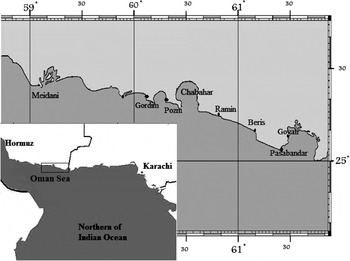
During 2009, specimens were collected from eight stations in the subtidal zones along the Iranian coast of the Oman Sea from Govatr to Meidani in the Sistan and Baluchistan province (Figure 1). The specimens were collected by a fisheries vessel with a trawl net and were preserved in 70% ethanol and sent to the laboratory for identification.
Map of the sampling areas along the Iranian coasts of the Gulf of Oman.

Measurements provided (in millimetres) are of the carapace length and breadth, respectively. Material examined is deposited in the Zoological University of Tehran Collection (ZUTC) and the Zoological Reference Collection (ZRC) of the Raffles Museum, National University of Singapore.
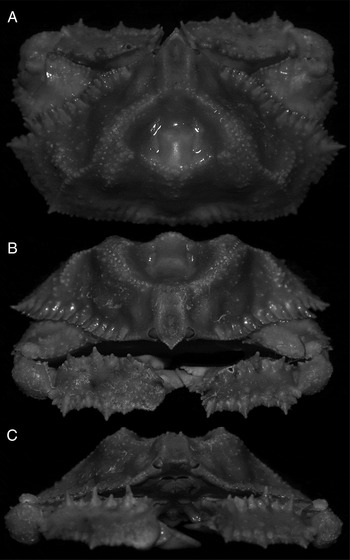
Cryptopodia echinosa Chiong & Ng, Reference Chiong and Ng1998. Female (32 by 54 mm): (A) dorsal view; (B, C) frontal view.

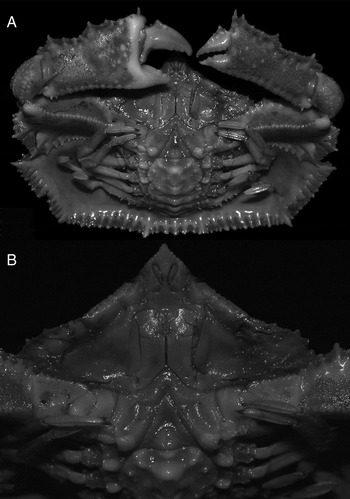
Cryptopodia echinosa Chiong & Ng, Reference Chiong and Ng1998. Female (32 by 54 mm): (A) ventral view; (B) third maxillipeds.

MATERIAL EXAMINED
One female, 27 by 49 mm; 25°08′–25°10′N 60°27′–60°59′E, 50–62 m, Chabahar Bay, Oman Sea, 15 August 2009; 1 female, 32 by 54 mm, 25°15′–25°20′N 59°10′–60°20′E, 40–46 m, Meidani, Oman Sea, 13 September 2009.
COMPARATIVE MATERIAL EXAMINED
Cryptopodia echinosa Chiong & Ng, Reference Chiong and Ng1994: holotype male (51.6 by 31.8 mm) (ZRC 1970.1.7.3), Madras, India, coll. R. Serène. Cryptopodia angulata H. Milne-Edwards & Lucas, Reference Milne-Edwards and Lucas1841: 1 male (49.4 by 28.6 mm) (ZRC 1987.450), Chittagong, Bangladesh, coll. B. Nurul-Huda, 1981–1982; 1 male (15.6 by 9.6 mm) (ZRC 1970.1.7.4), Djalandhi, Indonesia, coll. R. Serène.
DIAGNOSIS
Carapace broader than long, pentagonal; lateral margins deeply denticulated especially along anterolateral margins, with sharp teeth along anterolateral, a posterolateral angle and posterolateral margin with a posterior angle. Posterior carapace margin with two spines. Dorsal surface granulated; ventral surfaces smooth; dorsal surface of carapace with two triangular depressions, first behind front, second at centre of carapace. Front triangular, broader than long. Orbits and eyes very small. Inner and outer surfaces of chelipeds with granules and teeth; palm is not elongate; merus with wing-like expansion distally. Ambulatory legs slender, concealed by large lateral expansions of carapace. Female abdomen relatively narrow; all somites movable. First male gonopods S-shaped, with spines on distal part that decrease in size from tip.
REMARKS
The taxonomy of this species has been discussed at length by Chiong & Ng (Reference Chiong and Ng1998). They commented that while Cryptopodia echinosa superficially resembled C. angulata H. Milne-Edwards & Lucas, Reference Milne-Edwards and Lucas1841, it differed markedly in that the carapace is more triangular in shape (more pentagonal in C. angulata), branchial, gastric and cardiac regions of the carapace are prominently more inflated; the median gastric depression is relatively deeper, the dorsal surface of the carapace is distinctively more granulated, the postrostral region is proportionately deeper, and the gonopods are different in shape.
The same differences are valid between C. echinosa and the junior synonym of C. angulata, Cryptopodia angulata var. cippifer Alcock, Reference Alcock1895, described from Pakistan (see Chiong & Ng, Reference Chiong and Ng1994).
Cryptopodia angulata has been reported from Thailand, Bangladesh, Indonesia (Chiong & Ng, Reference Chiong and Ng1994) while C. echinosa is only known from the Indian Ocean (Chiong & Ng, Reference Chiong and Ng1994). Stephensen's (Reference Stephensen1946: 110) very brief record of Cryptopodia angulata var. cippifer from the Persian Gulf will need to be checked; it may prove to be merely a misidentification of C. echinosa.
DISTRIBUTION
Persian Gulf, Bombay, Malabar coast, Madras, Oman Sea (Chiong & Ng, Reference Chiong and Ng1994; present record).