Introduction
The past decade has witnessed a progressive erosion of gender and sexual rights globally, in what scholars have widely termed gender backlash (Faludi Reference Faludi1991; Köttig et al. Reference Köttig, Bitzan and Pető2017; Verloo Reference Verloo2018; Roggeband and Krizsán Reference Roggeband and Krizsán2020). Underpinned by a patriarchal reaction to advances in gender and sexual rights (Cabezas Fernández and Vega Solís Reference Cabezas Fernández and Solís2022; Butler Reference Butler2024) and by a political project aimed at reinforcing normative, heteronormative models of society grounded in gender hierarchies (Walby Reference Walby2015; Paternotte Reference Paternotte2023), gender backlash has become central to processes of democratic backsliding (Grillo et al. Reference Grillo, Luo, Nalepa and Prato2024; Riedl et al. Reference Riedl, McCoy, Roberts and Somer2024; Vida Reference Vida2022). Through attacks on feminist and LGBTQ+ movements and the dismantling of equality institutions, gender has simultaneously emerged as a primary target of backsliding, as well as a key identity marker structuring political competition between progressive and conservative forces (Norris and Inglehart Reference Norris and Inglehart2019; Graff and Korolczuk Reference Graff and Korolczuk2022).
A growing body of literature documents how these dynamics are advanced through anti-gender mobilizations. Operating in tandem with populist radical right actors, these forces actively politicize gender as a wedge issue and successfully push it to the center of conservative political platforms and discourses (Holvikivi et al. Reference Holvikivi, Holzberg and Ojeda2024; Lavizzari Reference Lavizzari, Barone, Rosenkranz, Smrdelj and Kuhar2025).Footnote 1 At the same time, scholarship has begun to map feminist responses to these threats,Footnote 2 including protest, advocacy, strategic litigation, and institutional engagement (Barone et al. Reference Barone, Rosenkranz, Markelj and Smrdelj2025; Chiva Reference Chiva2023; Kantola and Lombardo Reference Kantola and Lombardo2024; Smrdelj and Kuhar Reference Smrdelj and Kuhar2025). Such responses are typically framed as being primarily defensive, aimed at preserving existing rights and institutions. While defensive strategies are undoubtedly crucial, this framing risks neglecting the transformative and generative dimension that may be embedded within them (Chatzidakis et al. Reference Chatzidakis, Hakim, Littler, Rottenberg and Segal2020). Moreover, concepts such as resilience, resistance, and response remain theoretically underspecified in the literature, applied in only fragmented and inconsistent ways.
This article addresses these gaps by introducing the concept of democratic embodiment as a framework for capturing the relational, situated, and transformative nature of feminist resistance under backlash. We approach democracy not as a fixed normative ideal or as a self-evident positive horizon, but as a historically conditioned and inherently contested social formation, shaped by relations of power and constituted through regimes of gender, race, class, and sexuality (Walby Reference Walby1990; Butler and Scott Reference Butler and Scott1992; Pateman Reference Pateman1989; Federici Reference Federici2004; Roggeband et al. Reference Roggeband, Rawłuszko, Meier, Fernández, Lombardo and Caravantes2025). From this perspective, feminist mobilizations do not simply defend or realize democracy, but actively co-produce its meanings, practices, and boundaries.
We conceptualize democratic embodiment as a constitutive mode of political agency through which feminist actors defend, enact, and expand democracy by grounding political action in embodied vulnerability, affective relationality, and practices of care. This concept shifts the analytical focus to the mode of agency through which both endurance and transformation become possible, foregrounding marginalized bodies and communities as active sites of democratic life. In our conceptualization, the centrality of embodiment challenges dominant understandings of democracy as a solely institutional or procedural construct, capturing how democratic life is promoted through practices where vulnerability becomes a core component of resistance.
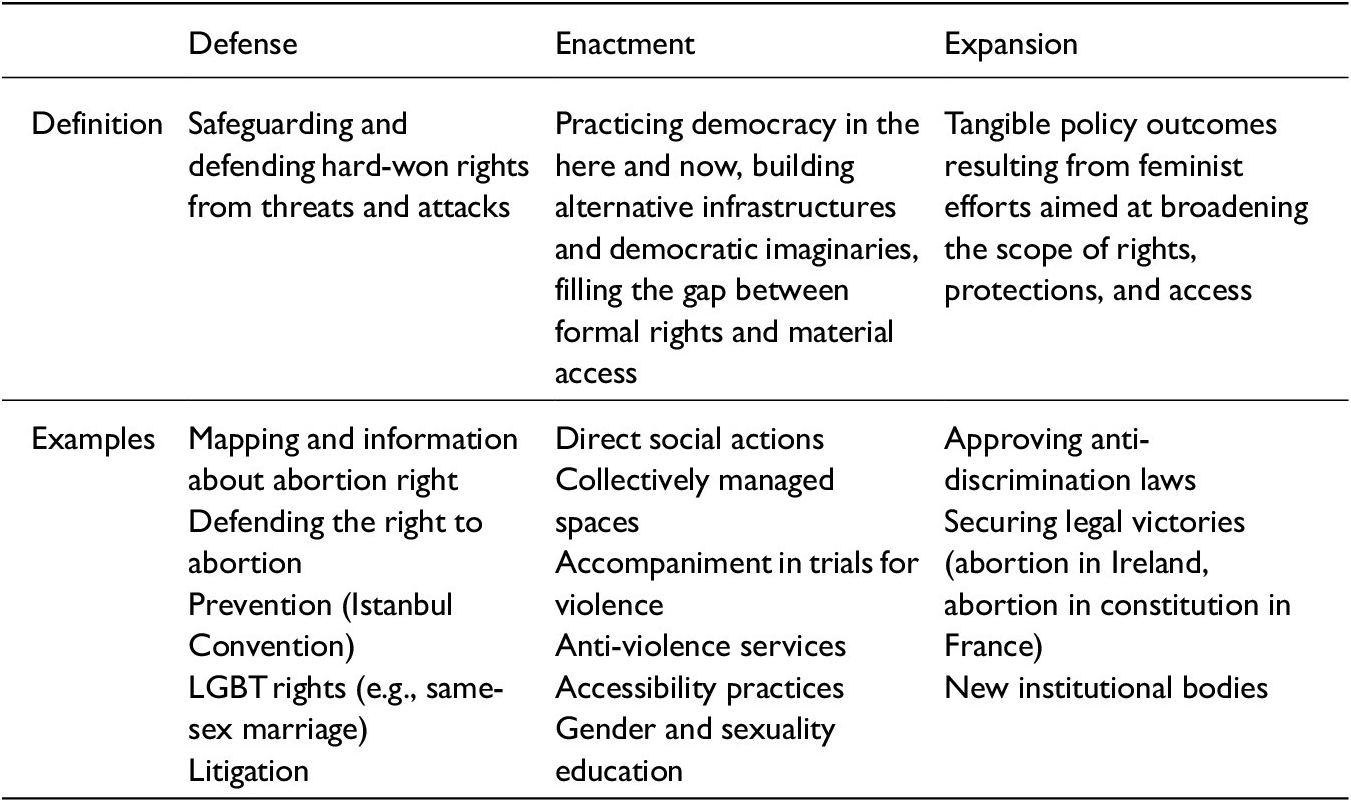
In what follows, we first map existing scholarship on gender backlash and feminist responses, before engaging with the frameworks of democratic resilience and democratic innovation and identifying their limitations. We then introduce democratic embodiment and unpack it into three analytical dimensions: defense (protection of existing rights), enactment (creation of alternatives and new imaginaries), and expansion (concrete policy change) (See Table 1). We illustrate these dynamics in cases of feminist activism in Poland, Spain, Ireland, and Italy. We conclude by reflecting on the concept’s theoretical implications and its generalizability beyond European liberal democracies.
Dimensions of democratic embodiment

Table 1. Long description
The table consists of four columns and three rows. The header row contains three categories: Defense, Enactment, and Expansion.
Row 1: Definition
* Defense: Safeguarding and defending hard-won rights from threats and attacks.
* Enactment: Practicing democracy in the here and now, building alternative infrastructures and democratic imaginaries, filling the gap between formal rights and material access.
* Expansion: Tangible policy outcomes resulting from feminist efforts aimed at broadening the scope of rights, protections, and access.
Row 2: Examples
* Defense: Mapping and information about abortion rights; Defending the right to abortion; Prevention (Istanbul Convention); L G B T rights (e.g., same-sex marriage); Litigation.
* Enactment: Direct social actions; Collectively managed spaces; Accompaniment in trials for violence; Anti-violence services; Accessibility practices; Gender and sexuality education.
* Expansion: Approving anti-discrimination laws; Securing legal victories (abortion in Ireland, abortion in constitution in France); New institutional bodies.
Democratic Backsliding and Gendered Resistance
Scholars have extensively documented how, over the past few decades, the world has experienced a process of democratic backsliding. This phenomenon is characterized by the gradual erosion of democratic norms, institutions, and civil liberties. It manifests in various forms across different political contexts, ranging from the weakening of checks and balances to the curtailment of press freedom and the rise of authoritarian tendencies within formally democratic regimes (Grillo et al. Reference Grillo, Luo, Nalepa and Prato2024; Lombardo et al. Reference Lombardo, Kantola and Rubio-Marín2021; Riedl et al. Reference Riedl, McCoy, Roberts and Somer2024; Vida Reference Vida2022).
As feminist scholars have underlined, studies of democratic backsliding have been widely blind with regard to the role of gender (Chiva Reference Chiva2023; Krizsan and Roggeband Reference Krizsán and Roggeband2018). While research has suggested several factors contributing to backsliding, such as political polarization, the rise of radical right populism, economic anxieties and globalization, and heightened identity-based conflicts (Tomini et al. Reference Tomini, Gibril and Bochev2023), it often fails to recognize gender as a key cleavage (Sass and Kuhnle Reference Sass and Kuhnle2023) and as a target of backsliding tendencies. According to Roggeband and Krizsán (Reference Roggeband and Krizsán2020), the gendered character of democratic backsliding can be seen in governments’ attempts to limit the activities of feminist organizations. This includes pulling out resources, downgrading gender equality policies in the agenda, and even sponsoring counter-movements to close civic society space for feminist and gender equality advocacy. Partially filling this research gap, studies have thus shown how gender plays a central role in democratic backsliding, linking the latter to processes of backlash on gender politics (Faludi Reference Faludi1991; Kuhar and Paternotte Reference Kuhar and Paternotte2017; Paternotte and Kuhar Reference Paternotte and Kuhar2018).
Within the framework of democratic backsliding, the concept of gender backlash has gained significant traction in recent years in analyzing organized resistance to gender equality and sexual rights. Initially popularized in the early 1990s by Susan Faludi, the term was first used to describe media and cultural reactions to the perceived successes of second-wave feminism in the United States. While initially limited to a cultural critique, the concept has since evolved into a more complex analytical tool used to make sense of political, institutional, and ideological reactions to feminist and LGBTQ+ advancements globally (Paternotte and Kuhar Reference Paternotte and Kuhar2018; Graff and Korolczuk Reference Graff and Korolczuk2022; Verloo Reference Verloo2018).
In particular, scholars have argued that the backlash should not be interpreted solely as a reaction to past gains, but as a political project aimed at restoring traditional gender orders (Paternotte Reference Paternotte2023). Walby (Reference Walby2015) has referred to this as a “restorative backlash.” Nevertheless, the use of the term is not without limitations. Critics have pointed out the notion of backlash may imply a linear view of history towards progress, in which resistance is understood as a temporary setback on the path toward equality. Further, the term is often employed in a descriptive rather than analytical manner, missing the opportunity to distinguish between different forms of opposition (Paternotte Reference Paternotte2023).
Against this backdrop, academic inquiry has increasingly turned to examining responses to these threats, exploring how democratic systems endure under such challenges. One key line of research has focused on the concept of democratic resilience, which explores how democratic institutions and practices endure and maintain stability despite polarization, conflicts, and shocks (Lieberman et al. Reference Lieberman, Mettler and Roberts2021; Lührmann Reference Lührmann2021; Merkel and Lührmann Reference Merkel and Lührmann2021). Among different sources of democratic resilience, research emphasizes the presence of institutional safeguards such as independent courts and strong local governance structures (Riedl et al. Reference Riedl, McCoy, Roberts and Somer2024), the role of political opposition and cross-ideological coalitions (Tomini et al. Reference Tomini, Gibril and Bochev2023; Chiva Reference Chiva2023), and an active civil society—the latter being particularly important when traditional institutional channels are blocked (Merkel and Lührmann Reference Merkel and Lührmann2021). Strategies of democratic resilience may thus include both institutional and extra-institutional approaches which carry different risks (Gamboa Reference Gamboa2022). Strategies like protest and grassroots mobilization, while acknowledged, have received far less attention in the literature on democratic backsliding and resistance. As a result, there is still limited knowledge on the role of non-institutional actors, such as movements, in how they participate and react to backsliding and polarization processes.
Within existing research, a significant effort has been made to develop an analysis that genders democratic resilience, exploring “critical actors’ efforts to represent marginalized groups—such as women’s groups, LGBTQ+ organizations, and feminist actors—in the face of threats to existing gender equality rights” (Chiva Reference Chiva2023, 396). These studies have shown that feminist strategies may change as the context shifts (Krizsan and Roggeband Reference Krizsán and Roggeband2018; Krizsán and Roggeband Reference Krizsán and Roggeband2021; Bonu Rosenkranz and della Porta Reference Bonu Rosenkranz and Della Porta2025) and that movement-state relationships change when political opportunities are closed (Cullen Reference Cullen2021; Kantola and Lombardo Reference Kantola and Lombardo2024; Peroni Reference Peroni2024). For example, in countries where feminist movements had previously enjoyed largely symbiotic relationships with the state, assumptions of institutional support needed to be reconfigured (Krizsán and Roggeband Reference Krizsán and Roggeband2021). Even in contexts marked by the closure of civic space, feminist organizations may continue to engage in selective forms of institutional advocacy, e.g., litigation through national courts or appeals to international mechanisms (Chiva Reference Chiva2023; Kioupkiolis Reference Kioupkiolis, Smrdelj and Kuhar2025; Peroni Reference Peroni2024). At the same time, more disruptive and confrontational strategies, including protests, tend to emerge in contexts where institutional avenues are blocked, reflecting a shift toward more radical modes of action (Lavizzari et al. Reference Lavizzari, Barone, Rosenkranz, Smrdelj and Kuhar2025; Çağatay et al. Reference Çağatay, Göker, Hünler and Polatdemir2024; Graff and Korolczuk Reference Graff and Korolczuk2022; Kurylo Reference Kurylo2022).
Alongside these institutional or high-profile mobilizations, less visible forms of resistance have also emerged within community spaces, activist networks, and grassroots organizations. Feminist and LGBTQ+ actors sometimes deliberately avoid direct confrontation with anti-gender forces, choosing instead to operate within hostile or ambiguous environments through camouflage tactics, including disengagement from overtly contentious action (Beyer Gregersen, Meret, and Rolandsen Agustín Reference Beyer Gregersen, Meret, Agustín, Smrdelj and Kuhar2025; Campillo et al. Reference Campillo, Romanos, Sádaba, Fernández-Vázquez, Smrdelj and Kuhar2025; Cohen, Forbis, and Misri Reference Cohen, Forbis and Misri2018; Smrdelj Reference Smrdelj, Smrdelj and Kuhar2025; Yüce and Çatalbaş Reference Yüce and Çatalbaş2023). This may involve, for instance, not openly identifying as feminist when conducting workshops or educational activities in conservative settings, thereby allowing the subtle diffusion of progressive ideas without triggering backlash (Gregis Estivalet and Dvoskin Reference Gregis Estivalet and Dvoskin2022; Pruvot Reference Pruvot, Smrdelj and Kuhar2025). Another strategy is to form broad alliances across sectors, including with trade unions, cultural actors, and democratic institutions (Alnıaçık and Altan Olcay Reference Alnıaçık, Altan—Olcay, Smrdelj and Kuhar2025; Lombardo and Caravantes Reference Lombardo and Caravantes2024; Rédai Reference Rédai2024; Smrdelj Reference Smrdelj, Smrdelj and Kuhar2025). These coalitions are frequently built outside public visibility and rely on grassroots trust, shared resources, and common goals, targeting the “gray zone”—that is, actors who are undecided or potentially swayable (Muszel Reference Muszel, Smrdelj and Kuhar2025).
Resistance also happens through peer-to-peer support networks, such as assistance in navigating reproductive healthcare systems and informal monitoring of discriminatory institutions (Çağatay et al. Reference Çağatay, Göker, Hünler and Polatdemir2024; Luna Reference Luna2020; Zavella Reference Zavella2020). This kind of mutual aid fosters solidarity and resilience outside formal structures or public demonstrations (Muszel Reference Muszel, Smrdelj and Kuhar2025). Grassroots groups often use digital tools not only for protest but also to build memory (e.g., femicide archives), foster emotional solidarity, and organize support in safe, decentralized ways (Kioupkiolis Reference Kioupkiolis, Smrdelj and Kuhar2025; Pruvot Reference Pruvot, Smrdelj and Kuhar2025; Yüce and Çatalbaş Reference Yüce and Çatalbaş2023). These online practices are often less visible than street protests, but they are equally strategic and effective. Through storytelling, the reappropriation of narratives, and the circulation of positive emotional discourses, marginalized actors reclaim space in public debate (Alnıaçık and Altan-Olcay Reference Alnıaçık, Altan—Olcay, Smrdelj and Kuhar2025; Carbin et al. Reference Carbin, Carlsson and Nilsson2024; Kioupkiolis Reference Kioupkiolis, Smrdelj and Kuhar2025). These tactics may not directly confront anti-gender actors, but they contribute to reshaping the emotional and symbolic terrain in which these debates unfold (Korolczuk Reference Korolczuk2020). Finally, scholars have built upon critiques of the backlash to argue that feminist and LGBTQ+ mobilizations should be understood as proactive rather than merely reactive responses—forms of what Smrdelj and Kuhar (Reference Smrdelj and Kuhar2025) conceptualize as “productive resistance.”
Theoretical Gaps and Crossroads: Resilience, Innovation, Embodiment
The concepts of democratic resilience and democratic innovation have traditionally been applied to distinct dimensions of democratic politics. Democratic resilience has been developed as a framework for analyzing how democratic institutions withstand threats and crises (Lieberman et al. Reference Lieberman, Mettler and Roberts2021; Merkel and Lührmann Reference Merkel and Lührmann2021; Riedl et al. Reference Riedl, McCoy, Roberts and Somer2024), whereas democratic innovation is primarily used to examine the expansion and deepening of democratic participation (della Porta Reference della Porta2020; Smith Reference Smith2009). We argue, however, that neither concept fully captures the dynamics of feminist resistance in the contemporary context of democratic backsliding.
In its original formulation within ecological debates, the term resilience referred to the persistence and maintenance of a given structure despite shocks—that is, the ability of a system to withstand internal and external disturbances (Holling Reference Holling1973). While the concept has since proliferated across the social sciences, it has also attracted significant criticism. By emphasizing adaptation to crises and shock absorption, for example, resilience has been described as having an “intuitive ideological fit with a neoliberal philosophy of complex adaptive systems” (Walker and Cooper Reference Walker and Cooper2011, 144). Likewise, the concept of democratic resilience tends to privilege survival in the face of threats, shocks, and disruptions (Hendriks et al., Reference Hendriks, Ercan and Boswell2020; Lieberman et al. Reference Lieberman, Mettler and Roberts2021; Riedl et al. Reference Riedl, McCoy, Roberts and Somer2024).
This focus on maintenance and endurance, however, risks overlooking the transformative character of resistance, including the ways in which actions aimed at countering attacks may simultaneously enact social change. We suggest that a defining feature of contemporary feminist politics under backlash lies in a form of agency that simultaneously sustains existing democratic spaces while enacting alternative ones. We propose the concept of democratic embodiment to capture this dual orientation, whereby the embodied infrastructures through which survival and prefiguration are co-produced (Lin et al. Reference Lin, Pykett, Flanagan and Chávez2016).
The concept of democratic innovation, while capturing the transformative potential of collective action, has often assumed that institutional spaces are central to efforts to broaden citizen participation. Democratic innovations have been defined as “institutions that have been specifically designed to increase and deepen citizen participation in the political decision-making process” (Smith Reference Smith2009, 2). Subsequent scholarship has bridged democratic theory with the study of social movements, examining the role movements play in fostering deliberative democracy and expanding spaces for participation by enacting democracy from below (della Porta Reference della Porta2020). Scholars such as della Porta and Felicetti (Felicetti and della Porta Reference Felicetti and della Porta2018; della Porta and Felicetti Reference della Porta and Felicetti2022) argue that democratic experiments are often strengthened by mobilization and civic participation, and that successful innovations do not necessarily require institutional collaboration.
Social movements generate counter-expertise, alternative knowledge, and new repertoires of democratic action. This suggests that democratic innovation is not limited to formal participatory mechanisms but also encompasses contestation and the articulation of new political imaginaries (Flesher Fominaya Reference Flesher Fominaya2022). Traditionally, however, democratic innovation has been studied primarily in contexts where political opportunities are relatively open, allowing movements to interact with institutions and contribute to the expansion of democratic participation. Classic examples include citizens’ assemblies, grassroots referendums, and participatory budgeting (Caravantes and Lombardo Reference Caravantes and Lombardo2024).
This focus risks overlooking the fact that many feminist struggles unfold in contexts where such institutional openings are absent or actively shrinking due to backlash. Feminist movements exemplify a different form of democratic innovation, one that operates through sustained mobilization, the articulation of new political subjectivities, and the creation of autonomous spaces for democratic engagement. As Cornwall and Goetz (Reference Cornwall and Goetz2005) argue, a deeper reconfiguration of democracy itself is required in order to enhance the democratic potential of women’s participation. From this perspective, feminist democratic innovations should be understood not only as inclusionary mechanisms but as transformative practices that challenge hegemonic definitions of democracy and citizenship.
At this point, it is important to clarify that resilience and innovation operate at a different analytical register than the concept we propose. Democratic resilience and democratic innovation primarily classify trajectories, strategies, or institutional outcomes of political processes. Democratic embodiment, by contrast, does not designate a type of outcome or institutional arrangement. Rather, it theorizes the constitutive mode of political agency through which practices of endurance, resistance, and transformation are enacted. Our intervention therefore does not seek to replace resilience or innovation as categories, but to shift the analytical focus from what democracy achieves to how democratic agency is materially, affectively, and relationally constituted under conditions of vulnerability.
Towards a Concept of Democratic Embodiment
As Machin argues, “theories and models of democracy can be challenged and improved by greater attentiveness to the embodiment of its political agents” (2022, 13). Understanding feminist activism in times of democratic backsliding therefore requires a reconceptualization of political agency. This effort aims to capture the transformative character of initiatives that may appear defensive or reactive yet take place in contexts of democratic erosion. Through the concept of democratic embodiment, we show how feminist movements under conditions of backlash defend, enact, and expand democracy through practices grounded in bodies, emotions, and care as constitutive conditions of political action.
We understand democracy as a set of activities “which involve the engagement of the demos in contemplating, contesting, and changing the established rules of society” (Machin Reference Machin2022, 21). Feminist scholars have long argued that mainstream democratic theory has been built on exclusionary premises, relying on a universal subject that is in practice male, white, and privileged (Eschle Reference Eschle2019; Nash Reference Nash, Randall and Routledge1998; Pateman Reference Pateman1989; Young Reference Young2002). Democracy itself has thus been contested as a historically male-centered system, in which policymaking, power distribution, and institutional arrangements have been shaped through the exclusion of women and LGBTQ+ subjects (Young Reference Young1989). As McAfee and Snyder note, “feminist theorists have been some of the most perceptive critics of underlying sexist notions in modern political philosophy, from the public–private split, to the ‘man’ of reason, to the totalizing focus on agreement that can make differences and plurality ‘disappear’” (Reference McAfee and Snyder2007, vii–viii).
Feminist critiques of democracy challenge not only who participates in democratic life, but also how democracy is conceptualized, how power is distributed, and what counts as political. Feminist theorists have shown that democratic citizenship has historically been defined through a male-centered lens. This includes the subordination of women to the will and authority of men through the sexual contract (Pateman Reference Pateman1989), the fiction of a neutral public sphere (Fraser Reference Fraser1990), and the abstract, disembodied subject of liberal democracy (Cavarero Reference Cavarero1995, Reference Cavarero2021). Feminist theory also contests the boundary between the public and private spheres, attributing political significance to issues traditionally dismissed as private and exposing how democratic spaces exclude those who do not conform to dominant norms (Young Reference Young2005). In doing so, feminist scholars make visible the embodied and affective dimensions of political participation (Butler Reference Butler2015).
Moreover, traditional democratic theory often assumes a linear trajectory of progress. Feminists challenge this assumption by showing how democracy is continuously undone and remade through struggle and contestation (Grosz Reference Grosz1999), as well as by rejecting associations between democracy and rationality, stability, and predictable progress (Ahmed Reference Ahmed2013). This critique resonates with feminist contestations of the concept of backlash, which likewise presupposes a linear understanding of progress and frames political responses primarily as efforts to restore a forward-oriented democratic trajectory (Paternotte Reference Paternotte2023). Taken together, feminist critiques of democracy—from analyses of its exclusionary foundations to proposals for more relational and inclusive models—point to the need to rethink democracy not only in institutional or discursive terms but as an embodied and affective practice.
Our theory of democratic embodiment builds on Butler’s (Reference Butler, Halsema, Kwastek and Van Den Oever2021) conceptualization of vulnerability to provide an analytic of contemporary feminist struggles. In Butler’s work, vulnerability is not simply a state of exposure to harm or injury, nor is it reducible to passivity or victimhood. Rather, it is understood as an ontological condition of social life—a constitutive feature of what it means to be human. As Butler writes, vulnerability is “a feature of the relation that binds us to one another and to the larger structures and institutions upon which we depend for the continuation of life” (Reference Butler, Halsema, Kwastek and Van Den Oever2021, 46).
In this regard, vulnerability challenges the liberal-democratic ideal of the autonomous, self-sufficient individual—a figure long critiqued by feminist theorists for masking the dependencies and exclusions upon which it rests. Rather than seeking to overcome or conceal vulnerability, Butler argues that new forms of solidarity, resistance, and political imagination may emerge from it. Interdependence and vulnerability can thus constitute “the basis for global political community, in contrast to sovereign independence and desired invulnerability” (Zaharijević Reference Zaharijević2023, 178). Vulnerability, then, is not only what renders subjects exposed to harm but also what binds them together and opens possibilities for collective action (Bracke, Reference Bracke, Butler, Gambetti and Sabsay2016).
Importantly, Butler reconceptualizes vulnerability not only as a condition of existence but also as a constitutive dimension of resistance. This move broadens the scope of political action to include not only organized protest but also the everyday, embodied acts through which marginalized subjects assert their presence and persist. As she notes, “under certain conditions, continuing to exist, to move, and to breathe is a form of resistance” (Butler Reference Butler, Butler, Gambetti and Sabsay2016, 26). Moreover, vulnerability—when understood as “a deliberate exposure to power”—can become an intentional political strategy, mobilizing affect and relationality in public space (Butler Reference Butler, Butler, Gambetti and Sabsay2016, 22). Such exposure is “both perilous and enabling,” placing vulnerability at the core of “new forms of embodied political interventions and modes of alliance characterized by interdependency and public action” (Butler et al. Reference Butler, Gambetti and Sabsay2016, 1, 7).
Building on these reflections, our conceptualization of democratic embodiment aims to theorize practices that simultaneously operate at the intersection of the politics of survival and prefigurative politics, between endurance and transformation, and are fundamentally grounded in conditions of vulnerability. By recognizing vulnerability not as a condition to be overcome, but as a generative force within political struggle, we can better understand how movements navigate tensions between immediate needs and long-term visions for change. Democratic embodiment builds in dialogue with, but remains analytically distinct from, related feminist frameworks such as prefigurative politics, care democracy, and embodied democracy.
Prefigurative politics emphasizes the enactment of desired futures in the present, while democratic embodiment theorizes the mode of agency through which both survival and prefiguration are co-constituted under conditions of democratic erosion. Similarly, care politics foregrounds relationality and interdependence as normative foundations of democracy. Democratic embodiment incorporates these insights but situates care within a broader analytic of vulnerability, affect, and embodied resistance. Finally, whereas theories of embodied democracy (Machin Reference Machin2022) emphasize the corporeal dimension of political agency, democratic embodiment specifies how embodied vulnerability becomes a constitutive condition of democratic practice in contexts of backsliding. Rather than replacing these approaches, democratic embodiment integrates and rearticulates them within a framework that foregrounds the embodied conditions through which democracy is sustained, contested, and transformed from below.
Furthermore, the concept of democratic embodiment draws attention to the continuity of feminist struggles, rather than framing them solely as reactions to external attacks (Taylor Reference Taylor1989; Whittier Reference Whittier1995). While these practices are reshaped in response to contemporary threats, they remain rooted in long-standing strategies and repertoires. This continuity endows feminist mobilization with sustained networking capacities, mobilizing power, and the ability to generate meaningful and transformative outcomes over time (Rupp and Taylor Reference Rupp and Taylor1987). In this sense, the concept challenges assumptions of democracy as a linear and progressive process periodically interrupted by regressions or backlash, as well as the corresponding understandings of resilience and innovation. By foregrounding the infrastructures of meaning, emotion, and relational practices that cut across the history of feminist movements, democratic embodiment highlights the long-term processes through which feminist interventions reshape the boundaries and meanings of democracy, beyond reactive responses to backlash.
More specifically, democracy is embodied in the sense that it is enacted through the body. It is not merely an abstract ideal or a set of institutional procedures, but something practiced, lived, and experienced in and through corporeal presence (Coole Reference Coole2005). As Melucci argues:
[I]n women’s, youth, and homosexual movements […] the body, in its different significations, becomes the cultural locus of resistance and desire; it stands opposed to rationalization and authorizes delirium. At the same time, however, the body is an object upon which the concerted integrative and manipulative efforts of systems of domination are focused. (Melucci Reference Melucci1980, 221)
The body is thus the primary site where vulnerability is experienced, but also where agency is exercised. As Machin notes, “by standing attentively or turning away, by moving or staying, by eating or starving, by dancing or wailing, embodied humans can challenge stereotypes, inspire protests, rupture conventions, and provoke change” (2022, 15). In feminist mobilizations, democracy takes shape through gestures, movements, silences, acts of care, and forms of collective presence. It is through bodies that democratic relations are cultivated, power is negotiated, and spaces of autonomy and solidarity are created (Ahmed Reference Ahmed2013; Federici Reference Federici2004, Reference Federici2018).
The concept of democratic embodiment draws attention to political strategies that exceed purely rational or linguistic modes of action (Coole Reference Coole2005). Feminist movements have long mobilized emotions as central resources of political engagement, challenging the dichotomy between reason and emotion that has historically underpinned liberal-democratic thought (Åhäll Reference Åhäll2018; Bracke Reference Bracke2012; Hercus Reference Hercus1999; Hirschman Reference Hirschman1977; Ruault Reference Ruault2021; Bonu Rosenkranz Reference Bonu Rosenkranz2025). These practices underscore how political life is not articulated solely through discourse or deliberation, but also through affective intensities, bodily presence, and shared vulnerability (Taylor Reference Taylor, Ferree and Martin1995; Tronto Reference Tronto2015). To speak of democratic embodiment, then, is to recognize that democratic life unfolds not only through laws or deliberative procedures, but through the material, affective, and relational dimensions of everyday experience.
A paradigmatic example is ACT UP, whose activist repertoire explicitly drew on grief, anger, and love to make visible the embodied consequences of state inaction during the AIDS crisis (Gould, Reference Gould2009, Reference Gould, Staiger, Cevtkovich and Reynolds2010). Their actions—such as die-ins, kiss-ins, and public mourning rituals—rendered the suffering of marginalized bodies impossible to ignore, mobilizing affect as a force of disruption and political reorientation. These tactics exemplify a broader feminist insight. Democracy is not only argued but felt. It is not only spoken, but lived through gestures, atmospheres, and corporeal encounters that generate new forms of collective subjectivity and political meaning.
Another key dimension embedded in the concept of democratic embodiment concerns practices of care. Alongside the centrality of bodies and emotions, care shapes feminist politics as both a method and a horizon of collective action. This perspective is grounded in an understanding of interdependence as a fundamental condition of social life—one that should be recognized and embedded across all levels of democratic practice, from intimate interactions to institutional and structural arrangements. Rather than being framed as a “feminine” task or a burden historically placed on women, care emerges here as a political practice of connection, responsibility, and prefiguration. As Joan Tronto (Reference Tronto2013) argues in her theorization of care democracy, democracy should be reimagined as a space in which care is not peripheral, but central.
Care ethics entails recognizing the needs and vulnerabilities of others, as well as shaping relationships through commitment and responsibility, thereby increasing the possibility of well-being while simultaneously opening space for social justice and social transformation (hooks Reference hooks2000). Thus, practices of radical care (Lorde Reference Lorde1984) become strategies for sustaining oneself while simultaneously intervening politically in the world, undoing mechanisms of isolation, individualism, and marginalization. Within feminist movements, the choice to cultivate interdependent relationships is grounded in the recognition of one’s own needs alongside the needs of others. This mutual acknowledgment enables political communities to flourish through practices of care understood not as efficiency-driven service provision, but as attentiveness, respect, and presence. Such practices are not oriented toward becoming more productive or more contentious, but toward sustaining participation over time, building trust, and making space for those whose political engagement is often constrained by structural inequalities, including care responsibilities.
Unpacking the Concept of Democratic Embodiment
The concept of democratic embodiment can be analytically unpacked into three interrelated dimensions: defense, enactment, and expansion (see Table). Each dimension captures a distinct, though not mutually exclusive, mode through which feminist movements engage with democratic practices, particularly in contexts of democratic erosion. These dimensions should not be understood as sequential or isolated; rather, they frequently overlap and interact. A single political intervention may simultaneously involve the defense of existing rights, the enactment of alternative democratic practices, and the expansion of rights and access through institutional change.
What unites these dimensions is not merely a shared prefigurative orientation, but a common mode of embodied agency that centers vulnerability, affect, and care as constitutive of democratic practice. Feminist movements do not merely respond to democratic deficits, but actively embody the values, relationships, and institutional imaginaries they seek to realize. This innovative and embodied character is central to our conceptualization of democratic embodiment and applies across all practices identified as forms of defense, enactment, and expansion. It is important to note that among the practices discussed here, some are newly developed in response to organizing under conditions of backlash, while others are long-standing forms of action that feminist movements have adopted over time. While not all these practices are new, we nevertheless understand them as innovative insofar as they contribute to reshaping the boundaries and meanings of democracy by placing bodies, emotions, and care at the center of political life.
From this perspective, our conceptualization of democratic embodiment has two aims. First, we seek to provide an analytical framework that challenges prevailing understandings of feminist initiatives under backlash as merely defensive or resilience-oriented responses, echoing the notion of productive resistance (Smrdelj and Kuhar Reference Smrdelj and Kuhar2025). Second, we seek to capture the specificity of feminist engagements with democracy in ways that foreground their innovative and transformative potential beyond the immediate context of backlash.
We consider all the practices we examine as innovative to the extent that they place material, embodied, and affective aspects at the center of democratic action. Thus, initiatives that unfold within institutional spaces or aim to influence policy, and thus correspond closely with relatively traditional movement–institution dynamics, can be innovative if they foreground the embodied and affective dimensions of politics in ways that reshape democratic practice and its boundaries. We understand these initiatives as innovative not because of the specific policy outcomes they achieve, in other words, but because the modes of action they employ center bodies, emotions, and care, regardless of whether they are ultimately “successful” in conventional terms.
Defense
The first dimension of democratic embodiment refers to practices aimed at defending existing rights and democratic arrangements. Defense encompasses efforts to protect hard-won rights, legal achievements, and institutional safeguards from erosion, rollback, or attack by far-right and anti-gender actors. It involves both resisting threats to previous gains and sustaining existing achievements in the face of democratic backsliding. We argue that even when feminist activists engage in the defense of existing rights, they can enact a form of politics grounded in bodies, care, and emotions that foregrounds an innovative and alternative vision of democracy.
Three core features characterize this dimension. First, defensive actions are deeply affective, channeling fear, rage, and grief into solidarity and collective empowerment. Second, they are generative, producing new alliances, repertoires, and shared visions even when primarily oriented toward maintaining threatened rights. Third, they are prefigurative, enacting democratic values through relational, embodied, and often intersectional practices, thereby transforming protests into spaces of care, visibility, and democratic experimentation. These modes of action are aimed at protecting existing rights from threat, but in the process of defense, they activate forms of collective action, care practices, and affective networking.
These dynamics can be seen in the Polish mobilizations in defense of abortion rights in 2016 and again in 2020–2021 (Piotrowski and Muszel Reference Piotrowski and Muszel2022). In response to the proposed “Stop Abortion Act,” which would have introduced a near-total ban on abortion, the Women’s Strike emerged as a mass mobilization involving unprecedented numbers of women. Although triggered by an immediate threat and oriented toward defending an already fragile legal framework, the “black protests” constituted what Korolczuk describes as “a revolutionary moment when fear and anger were transformed into feelings of solidarity and empowerment—a moment of personal and collective transformation” (Reference Korolczuk2016, 92). As Graff (Reference Graff, Dietze and Roth2020, 231–232) observes, these mobilizations formed part of a broader struggle against right-wing populism, giving rise to “a popular uprising, a struggle for democracy, and against the violence of right-wing populism,” while simultaneously introducing “a new collective in the public sphere.” The Poland mobilizations articulated claims that extended well beyond access to abortion, including demands for full reproductive rights, comprehensive sex education, improved economic conditions for women, and an understanding of human rights as universal—particularly for marginalized and vulnerable groups (Bielska-Brodziak et al. Reference Bielska-Brodziak, Drapalska-Grochowicz, Peroni and Rapetti2020, 54S).
Acts of defense can thus reshape political discourse and civic participation, particularly when contested rights are closely tied to the body. In such contexts, the body becomes a central site of conflict—simultaneously under threat and a source of agency, self-recognition, and connection with others through mobilization. Putting bodies in the streets, reclaiming bodily autonomy, and politicizing issues traditionally relegated to the private sphere, such as abortion, enable the articulation of broader democratic struggles. Democratic embodiment also takes place through everyday practices, such as economic forms of resistance to crisis, including feminist popular soup kitchens, the sharing of food and resources, and welfare practices organized from below (Phillips and Willat Reference Phillips and Willatt2020). Rather than merely defending existing rights, the bodily and affective dimensions of these practices expand the horizon of democratic politics, transforming individual grievances into collective democratic claims whose demands often extend well beyond the immediate issue at stake.
The expansion of democratic principles can also occur through other strategies, such as strategic litigation and legal mobilization. This is evident in cases where anti-choice proposals were blocked in Mexico and Brazil, where “the achievements of feminist activism go beyond policy approvals, encompassing a blocking function understood as the capacity to obstruct conservative opposition attacks” (Zaremberg and de Almeida Reference Zaremberg and de Almeida2021, 600). Feminist institutional responses to anti-gender politics can thus perform a preventive function while simultaneously broadening democratic spaces through coalition building, framing processes, and everyday pragmatic engagement (Caravantes, Elizondo, and Lombardo Reference Caravantes, Elizondo and Lombardo2024).
Acts of defense often become platforms for the expansion of feminist claims and the formation of new networks of feminist activism. In the Polish case, mobilization around abortion rights contributed to the creation of infrastructures of care and solidarity that remain relevant even after the Constitutional Court’s 2020 ruling, which resulted in a near-total abortion ban. These protests exemplify democratic embodiment because, even while defending minimal access to a threatened right, they opened space for broader innovation within the movement—expanding demands and linking reproductive rights to wider struggles for social justice and democracy. Moreover, these modes of action introduced tactical innovation into feminist repertoires. The feminist strike, for instance, mobilized to defend abortion rights, progressive labor market policies, and protections for care work. In so doing, it reappropriated the political symbolism of labor struggles, transforming it into a tool for articulating gendered demands, creatively disrupting everyday life, and rendering gendered bodies visible as political agents.
Activists use bodies, banners, performances, and speeches to reclaim public space, giving visibility to marginalized identities and articulating alternative visions of kinship, care, and citizenship, as illustrated by the protest against the World Congress of Families held in Verona in March 2019 (Cossutta and Habed Reference Cossutta and Habed2021). Although this mobilization emerged as a defensive response, it nonetheless enacted political innovation by transforming the conservative city of Verona—long a stronghold of Catholic traditionalism and far-right politics—into a stage for feminist dissent, queer visibility, and intersectional solidarity (Cossutta and Habed Reference Cossutta and Habed2021). While the feminist mobilization against the congress was initially triggered by the need to counter the presence of far-right ideologues and anti-gender discourse in a highly symbolic and politically significant site, the response far exceeded a merely reactive stance (Cossutta and Habed Reference Cossutta and Habed2021; Pavan Reference Pavan2020). More than 20,000 people joined the demonstrations, with activists arriving from across Europe, creating a moment of political convergence among feminist, LGBTQ+, anti-racist, and secular organizations.
These mobilizations exemplify the capacity of feminist movements to forge intersectional alliances, linking reproductive justice to LGBTQ+ rights, migrant justice, and struggles against economic precarity. In this sense, the Verona mobilization functioned as a laboratory of feminist democratic innovation, embodying alternative futures through practices of solidarity and spatial reappropriation. Non Una Di Meno , the driving force behind the protest, explicitly framed the mobilization as transfeminist, integrating struggles for reproductive rights, queer liberation, anti-racism, and anti-capitalism within a shared political vision (Cossutta Reference Cossutta2021).
In conclusion, the defense of democracy as enacted by feminist movements is far from passive or purely reactive. It is a deeply embodied, affectively charged, and care-infused practice that transforms vulnerability into resistance. By centering the body as both a site of political conflict and political agency, mobilizing emotions as drivers of collective empowerment, and constructing infrastructures of care that sustain participation over time, feminist movements reshape democratic life even while defending threatened rights. The cases discussed demonstrate that defensive struggles are affective, channeling grief and rage into solidarity, as well as generative, producing new alliances, discourses, and repertoires of democratic action.
Enactment
A second dimension embedded in the concept of democratic embodiment is the enactment of democracy. Enactment refers to the immediate, embodied practices through which feminist movements address urgent needs in the present while simultaneously prefiguring alternative futures. These practices take the form of grassroots, autonomous, and non-institutional modes of organization that respond to needs not addressed by existing laws or policies, or only formally protected by them. Rather than waiting for institutional reform, enactment creates spaces of resistance and survival within everyday life. In this sense, enactment exemplifies the interplay of bodies, emotions, and care in feminist politics.
For example, in countries where access to abortion is restricted, such as Poland, feminist activists and networks have developed alternative infrastructures to secure reproductive autonomy. These include disseminating information about medical abortion, providing peer support, and facilitating access to abortion pills (Majewska Reference Majewska2024; Szczygielska Reference Szczygielska, Krizsán and Roggeband2019). In Italy, where abortion is formally legal under Law 194/1978 but frequently rendered inaccessible due to the widespread use of conscientious objection by healthcare providers, feminist groups have adopted similar strategies. Activists accompany individuals through bureaucratic and medical procedures, offering translation, logistical assistance, and emotional solidarity. These networks constitute grassroots efforts to address institutional abandonment and to affirm autonomy as a lived democratic practice grounded in vulnerability and interdependence (Facincani Reference Facincani2023).
Feminist enactments in the field of abortion do not merely fill institutional gaps; rather, they constitute prefigurative alternatives that promote self-determination, informed decision-making, nonjudgmental attitudes, and the destigmatization of abortion narratives. By providing direct care and support, these movements challenge dominant institutional frameworks and offer prefigurative alternatives to state-run models grounded in community care and solidarity. In abortion activism, bodies, emotions, and care form the very ground on which solidarity is built and political agency is enacted. The body is central not only because reproductive rights concern bodily autonomy but also because activists deploy their own embodied presence—accompanying others to clinics, sharing abortion pills, or holding space during medical abortions—to affirm autonomy in practice. These initiatives are also profoundly shaped by affective ties: listening, comforting, and remaining with fear, uncertainty, or pain transform emotional connection into a political resource.
A parallel field of feminist enactment concerns responses to gender-based violence. Across diverse contexts, feminist movements have not only struggled for public recognition of violence against women and LGBTQ+ people as systemic and political problems (Htun and Weldon Reference Htun and Weldon2012). They have also built autonomous infrastructures to address them. Shelters and anti-violence centers emerged from feminist organizing in the 1970s, often in direct opposition to state inaction, the depoliticization of gender-based violence, carceral responses, and paternalistic welfare services (Kelly Reference Kelly2013; Schechter Reference Schechter1982; Sharifi, Hadizadeh Talasaz, and Larki Reference Sharifi, Talasaz and Larki2024). These spaces sought to provide not only physical safety but also autonomy, peer support, and collective empowerment. In these forms of collective action, feminist movements have developed practices of healing and repair grounded in embodied signs of care, respectful listening, and mutual recognition—practices through which empowerment can emerge from conditions of deep vulnerability.
Vulnerability thus becomes not a limit, but a foundation upon which women can rebuild self-confidence, recognize and challenge dynamics of dependency and control, and form relationships of trust in which new meanings of care and belonging are cultivated. These practices go beyond offering immediate survival strategies or access to resources to escape violence; they constitute deeply political acts that speak directly to the functioning of democracy itself. Gender-based violence can be understood as a force that undermines fundamental democratic capacities, including the ability to express ideas, participate in public life, and make autonomous decisions. Practices that confront and transform violence should therefore be understood as enactments of democracy—forms of democratic embodiment that generate democratic space in everyday life and reclaim access to participation for those who are otherwise silenced or excluded. This legacy continues today, particularly as the rights of survivors face renewed threats under conditions of neoliberal austerity, democratic backsliding, and the rise of anti-gender politics. In many countries, feminist anti-violence infrastructures are increasingly under attack—not only through defunding and co-optation but also through the growing delegitimization of the very concept of gender-based violence (Pichel-Vázquez and Enguix Grau Reference Pichel-Vázquez and Grau2021; Roggeband and Krizsán Reference Roggeband and Krizsán2024).
Another key site of feminist democratic enactment concerns accessibility practices shaped by disability rights and neurodivergent activism (Esteves and Pieri Reference Esteves and Pieri2023; Pieri Reference Pieri2019, Reference Pieri2024). Rather than treating inclusion as a formal requirement or a bureaucratic checkbox, many feminist collectives have developed shared, embodied protocols to make assemblies, protests, and marches accessible to a wide range of participants. These practices are grounded in a politics of interdependence and collective responsibility (Murillo Lafuente Reference Murillo Lafuente2023). Here, questions of the body are inseparable from questions of vulnerability: only by attending to diverse embodied needs can access to protest, assembly, and democratic participation be meaningfully realized.
For example, queer and feminist groups often circulate detailed flyers describing march routes in advance, indicating the presence of steps, curbs, or other potential obstacles for wheelchair users. Others provide information about quiet zones, encourage the use of earplugs, or suggest alternatives to clapping—such as waving or snapping—to accommodate neurodivergent participants. Some feminist spaces also organize moments of collective preparation to ensure that accessibility is not individualized or delegated but discussed and implemented collectively. These efforts reflect a shift away from “accommodating” disability toward rethinking collective action as something that must be co-created in dialogue with diverse embodied experiences. As disability justice activists have long argued, access is not merely a logistical concern, but a political commitment to recognizing the value of all bodies and minds (Piepzna-Samarasinha Reference Piepzna-Samarasinha2018). In this context, vulnerability emerges as a site of resistance in which, despite apparently unfavorable conditions, participants develop forms of protest, resistance, and democratic engagement that transform vulnerability into a capacity for action (Butler-Rees and Power Reference Butler—Rees and Power2025).
Care practices constitute another central dimension through which feminist movements enact democracy in everyday life. Beyond theoretical critiques of the gendered division of care work, many feminist collectives have developed concrete practices that allow care and political engagement to coexist rather than compete. These include the creation of collectively managed childcare spaces during assemblies and protests, the sharing of caregiving responsibilities among participants, and the collective adjustment of political rhythms to accommodate those with care obligations. In this way, care is not simply delegated or externalized but becomes a shared infrastructure that enables political participation. This collective management of care reflects an embodied rethinking of democratic engagement—not as an activity reserved for those free from constraints, but as a practice that must be made possible for all, regardless of age, dependency, or care responsibilities.
Because enacting democracy involves creating democratic practices in the here and now, gender and sexuality education initiatives developed by feminist actors in schools offer a particularly salient example (Arnot and Dillabough Reference Arnot and Dillabough1999; Weiler Reference Weiler2010). This is especially significant in contexts where such education is under sustained attack by anti-gender movements and far-right governments, or where comprehensive policies are lacking altogether, as in Italy (Selmi and Tamanini Reference Selmi and Tamanini2012; Venegas Reference Venegas2022). These initiatives often emerge from feminist movements that engage directly with schools, educators, and communities to introduce content and practices grounded in anti-discrimination, consent, and respectful communication. By fostering critical reflection on gender roles, challenging rape culture, and addressing normalized dynamics of abuse, feminist approaches to education seek to dismantle entrenched gender hierarchies. At the same time, they create spaces in which children and young people can explore their identities, develop self-awareness, and make informed choices free from fear, stigma, and stereotypes. In doing so, these practices not only resist dominant cultural narratives but also actively prefigure alternative models of democratic life grounded in equality, care, and mutual respect.
Feminist enactments of democracy are grounded in affective practices of staying with one another. From cooking together to emotional check-ins, from physical proximity to the creation of shared rituals, these movements cultivate spaces in which bodies encounter one another with openness, vulnerability, and trust. In this sense, doing politics is not only about speaking or deciding but also about touching, feeling, and caring. These forms of embodied relationality are central to prefiguring a democratic politics rooted not in abstraction, but in lived connection and interdependence.
Expansion
Expansion refers to tangible policy outcomes resulting from feminist efforts aimed at broadening the scope of rights, protections, and access through policy change, institutional reform, and legal innovation. While enactment practices may substantively expand democratic imaginaries and participation, within our framework expansion refers specifically to the institutionalization of such transformations through formal policy change or legal reform. In fact, although most literature on feminist movements in the backlash has so far focused on reactive feminist politics, during the last decade feminist movements have obtained significant gains in different countries.
The literature on feminist responses to democratic backsliding underestimates the political outcomes that these movements have been able to pursue, despite threats and attacks. These types of political outcomes relate to the continuity of feminist politics across crises and different political opportunity structures, on the one hand, and the capacity to infiltrate the available spots in the institutional infrastructure to promote policy changes, on the other hand. While expansion refers to tangible institutional and policy outcomes, the innovative character of feminist mobilizations lies in the democratic practices through which such outcomes are pursued—practices that may redefine democratic meanings and relations regardless of whether they ultimately translate into formal reforms.
A striking example of this dynamic can be found in initiatives that aimed at obtaining policy change, such as the campaign to repeal the Eighth Amendment in Ireland in 2018 which legalized abortion after decades of restrictive laws. One of the key strategies that made the movement so powerful was its focus on personal stories of women who had experienced abortion, who had traveled abroad for the procedure, or who had been affected by restrictive laws (Crozier-De Rosa and Barclay Reference Crozier-De Rosa and Barclay2024; Cullen and Korolczuk Reference Cullen and Korolczuk2019; Fletcher Reference Fletcher2018; McCaffrey Reference McCaffrey2023). These personal testimonies were powerful tools that embodied the consequences of the ban, shifting the conversation toward an emotional debate.
Women shared their experiences in public forums, media campaigns, and social media platforms, helping to break the silence and stigma around abortion. The act of sharing stories created a space of solidarity, where individuals could empathize with others. Through personal stories, the movement created a shared understanding that bodily autonomy, reproductive choice, and dignity are fundamental. As Fletcher argues, the “repeal cannot be reduced to the vote itself, rather it made political subjects of those who have been ‘maimed and humiliated’” (Enright 2018 in Fletcher, Reference Fletcher2018). The exposure of voices and personal experiences during the campaign represented a way to politicize vulnerability and materialize a new political subject. France offers another compelling case: the right to abortion became part of the national constitution in 2023, showing how feminist pressure can shape even a symbolic constitutional reform (Meyer and Romainville Reference Meyer and Romainville2024; Tongue Reference Tongue2024).
Feminist storytelling is a crucial strategy for generating emotional resonance and fostering embodied connection. It does not merely frame issues in political terms but enables them to be felt in one’s own body, as experiences that affect bodies and minds before they are articulated as political problems. This strategy plays a significant role in the expanding dimension of feminist politics, as it enhances the mobilizing power of movements, broadens the diffusion of issues, and amplifies their perceived urgency and legitimacy at the policy level. A clear example of expansion through democratic embodiment is the recent legal reform on sexual consent in Spain, known as the Ley de Garantía Integral de la Libertad Sexual (2022), popularly referred to as the “Only Yes Means Yes” law.
While this reform followed a trajectory that culminated in institutional change, its innovative character lies not in the policy outcome alone, but in the democratic practices through which feminist mobilization redefined the meaning of consent, sexuality, and sexual violence in the public sphere. In the wake of the La Manada case, feminist movements foregrounded embodied experience, personal testimony, and collective affect to challenge dominant legal and cultural interpretations of rape, shifting the focus from proof of resistance to the presence of consent (Faraldo-Cabana Reference Faraldo-Cabana2021). In this wave of mobilization, which later led to the approval of the consent-based law, several aspects of democratic embodiment can be found: the storytelling creating emotional resonance, the infrastructure of care, and the bodily dimension that supports mobilization.
Through demonstrations, storytelling, and affective slogans such as “Sister, I believe you” and “Only yes is yes,” feminist actors transformed individual experiences of vulnerability into collective democratic claims, reshaping how sexual autonomy and bodily integrity were understood as matters of democratic concern. These practices enacted a form of democratic innovation by redefining the terms through which citizenship, credibility, and harm are articulated, independently of—and prior to—their translation into law. In this sense, the Spanish case illustrates how feminist movements innovate democratically by reworking the meanings and practices of democracy itself, even when mobilization eventually feeds into institutional reform (Campillo et al. Reference Campillo, Romanos, Sádaba, Fernández-Vázquez, Smrdelj and Kuhar2025; Corradi and Donato Reference Corradi and Donato2024).
In addition to this symbolic shift, the law introduced comprehensive measures including prevention, education, and support for survivors, thus expanding not only rights but also institutional responsibilities. What makes this case particularly significant is that it unfolded in a broader European and global context marked by democratic backsliding and gender backlash. While anti-gender actors were gaining ground across many countries, Spanish feminist movements not only resisted these dynamics but also managed to secure a progressive legal transformation (Caravantes, Elizondo, and Lombardo Reference Caravantes, Elizondo and Lombardo2024; Kantola and Lombardo Reference Kantola and Lombardo2024). This represents a clear instance of democratic expansion, whereby feminist actors influenced state institutions to broaden the terrain of rights and protections in ways that had previously been excluded or minimized.
These examples illustrate how feminist movements have expanded the meaning and scope of democracy through legal, cultural, and institutional transformation. The expanding dimension of democratic embodiment emphasizes how embodied experiences, emotional resonance, and infrastructures of care serve as powerful tools for mobilization and institutional influence. Even in adverse political contexts, feminist movements have succeeded in transforming personal vulnerability into political strength, reframing marginalized experiences as collective democratic claims. In this sense, expansion is not only a political outcome but it is also a form of prefiguration, wherein feminist movements anticipate (feminist) democratic futures.
Conclusions
This article has introduced democratic embodiment as a framework for understanding feminist mobilizations in contexts of gender backlash and democratic backsliding. Feminist actions in this context tend to be framed as primarily defensive, aiming at preserving existing rights from threats and attacks. In line with recent scholarship (Smrdelj and Kuhar Reference Smrdelj and Kuhar2025), we believe that a defensive understanding of feminist responses to the backlash fails to capture the essentially transformative and generative dimension of activism. To make sense of the specific transformations that feminist movements operate in the democratic field under conditions of backsliding, we build on the idea that feminist actors do not simply defend or realize existing democratic norms and ideals, but they actively shape new meanings and practices of democracy, challenging traditional boundaries between resilience and transformation (Lombardo Reference Caravantes, Elizondo and Lombardo2024).
Building on feminist theoretical reflections on vulnerability, affect, and care, and engaging critically with existing frameworks of democratic resilience and democratic innovation, we have argued that feminist actors do not merely defend existing democratic norms but actively co-produce new democratic practices. By unpacking democratic embodiment into three analytical dimensions—defense, enactment, and expansion—and illustrating these through feminist activism across European contexts, we have shown that the transformative character of feminist politics lies not in measurable institutional outcomes alone, but in the modes of action that redefine the very boundaries of democratic life.
The implications of this conceptual move extend well beyond the cases discussed here. First, centering bodies, emotions, and care as constitutive of democratic practice challenges dominant understandings of democracy grounded in abstract rationality, formal institutions, and disembodied deliberation. This has consequences for democratic theory more broadly: it opens space for accounts of political agency rooted in shared vulnerability and interdependence, rather than in the figure of the autonomous, sovereign subject. Second, by highlighting the historical continuity of feminist democratic practices, democratic embodiment resists linear and teleological narratives of democratic progress or decline, revealing instead how resistance and reinvention emerge precisely in moments that dominant discourses frame as regression.
Third, and crucially, democratic embodiment is not confined to European feminist politics or to liberal-democratic settings. Its analytical purchase extends to other marginalized actors—racialized communities, LGBTQ+ and queer movements, undocumented activists, and disability justice movements—whose political agency similarly operates through embodied, relational, and affective registers. The framework is particularly well suited to feminist mobilizations in the Global South, decolonial, and indigenous contexts, where democracy is enacted through practices that exceed or contest liberal-institutional forms. Notably, its emphasis on vulnerability and embodied agency resonates strongly with frameworks emerging from community-based territorial feminisms in Latin America, such as the notion of body-territory, opening space for productive comparative and transnational dialogue. We therefore offer democratic embodiment not as a European concept exported elsewhere, but as an analytical lens intended to travel—and to be refined—across diverse historical trajectories and political settings of feminist struggle.