INTRODUCTION
Coral reefs provide critical fishery resources to millions of people, primarily in developing countries (Donner & Portere Reference Donner and Portere2007). Yet overfishing is severely eroding key ecological goods and services that coral reefs provide (Jackson et al. Reference Jackson, Kirby, Berger, Bjorndal, Botsford, Bourque, Bradbury, Cooke, Erlandson, Estes, Hughes, Kidwell, Lange, Lenihan, Pandolfi, Peterson, Steneck, Tegner and Warner2001; Newton et al. Reference Newton, Cote, Pilling, Jennings and Dulvy2007). Balancing human needs for protein with the long-term sustainability of reef ecosystems has become a critical challenge.
Some of the key tools fisheries managers have employed to balance these often-competing needs have been establishing marine protected areas (MPAs) and the prohibition or management of specific fishing gears. Properly complied with, MPAs can help to buffer the impacts of overfishing, but, in developing countries, MPAs are often too small to sustain the broader seascape (Graham et al. Reference Graham, McClanahan, MacNeil, Wilson, Polunin, Jennings, Chabanet, Clark, Spalding, Letourneur, Bigot, Galzin, Ohman, Garpe, Edwards and Sheppard2008). Thus, other management measures such as gear restrictions are also required outside of protected areas to help sustain reef ecosystems (McClanahan et al. Reference McClanahan, Hicks and Darling2008a; Cinner et al. Reference Cinner, McClanahan, Daw, Graham, Maina, Wilson and Hughes2009a). Certain fishing gears have a higher propensity to physically break corals, capture a high proportion of juvenile fish (Mangi & Roberts Reference Mangi and Roberts2006; Mangi et al. Reference Mangi, Roberts and Rodwell2007) and target species that have feeding characteristics that help promote the resilience of coral reefs (Cinner et al. Reference Cinner, McClanahan, Graham, Pratchett, Wilson and Raina2009b), and are thus good candidates for bans (McClanahan & Mangi Reference McClanahan and Mangi2004). Destructive gears used on coral reef ecosystems can include seine nets (beach seine and ring nets; McClanahan & Mangi Reference McClanahan and Mangi2001; Jiddawi & Ohman Reference Jiddawi and Ohman2002), explosives (Pet-Soede et al. Reference Pet-Soede, Cesar and Pet1999) and poison (Jones & Steven Reference Jones and Steven1997).
In East Africa, seine nets are one of the most widely used destructive gears. In Kenya, their use has been illegal since 2001, but is often tolerated (McClanahan et al. Reference McClanahan, Maina and Davies2005; Signa et al. Reference Signa, Tuda and Samoilys2008). Some communities have effectively excluded their use, using traditional institutions or co-management approaches (McClanahan et al. Reference McClanahan, Glasel, Rubens and Kiambo1997; McClanahan Reference McClanahan, Hicks and Darling2008a; Hicks et al. Reference Hicks, McClanahan, Cinner and Mills2009). In Tanzania, beach seine nets are also illegal (Jiddawi & Ohman Reference Jiddawi and Ohman2002; N. Jiddawi, personal communication 2009). Beach seine nets are typically manned by 10–25 fishers, who pull the net across a shallow bottom. Beach seine nets can be highly damaging to the substrate and their catch can consist of up to 70% juvenile fishes (Mangi & Roberts Reference Mangi and Roberts2006). Studies have shown that catch rates per area of reef and per fisher are higher in areas where beach seines are excluded (McClanahan et al. Reference McClanahan, Glasel, Rubens and Kiambo1997; McClanahan & Mangi Reference McClanahan and Mangi2001). Ring nets (also called mini-purse seine nets) are also common in Tanzania. They are manned by a similar size crew, but can be used in deeper waters because they have a ‘draw string’ which closes the bottom of the net. Although legally they are only supposed to be used in deep water to target sardines (N. Jiddawi, personal communication 2009), they are frequently used on or around coral reefs (J Cinner, personal observation 2006).
There are frequent attempts to persuade East African fishers who use destructive gears to change their behaviour, either by stopping fishing entirely, or by switching to alternative fishing gears (Signa et al. Reference Signa, Tuda and Samoilys2008). In some instances, gears are simply prohibited, but low levels of formal enforcement capacity and a lack of alternatives often leads to low levels of compliance with these regulations (Evans Reference Evans2009). In other cases, gear-exchange programmes or alternative livelihoods are developed (Verheij et al. Reference Verheij, Makoloweka and Kalombo2004). As with many alternative livelihood programmes, assumptions about the social conditions and motivations of the fishers are frequently made, which can result in spectacularly unsuccessful programmes (Allison & Ellis Reference Allison and Ellis2001; Pollnac et al. Reference Pollnac, Pomeroy and Harkes2001; Sievanen et al. Reference Sievanen, Crawford, Pollnac and Lowe2005; Pollnac & Poggie Reference Pollnac and Poggie2006).
Successfully reducing destructive gear use will depend, at least in part, on a better understanding of these fishers and the socioeconomic drivers behind their practices. A number of studies have suggested that poverty coupled with decreasing yields associated with environmental degradation may create conditions that force fishers to use destructive fishing gear (see for example Pauly Reference Pauly1990; Guard & Masaiganah Reference Guard and Masaiganah1997; Toby & Torell Reference Tobey and Torell2006), although few studies have attempted to make this link empirically (Cassels et al. Reference Cassels, Curran and Kramer2005; Silva Reference Silva2006). The concept of poverty is multi-dimensional, and can incorporate aspects of income or expenditures, access to infrastructure, education, the diversity of livelihood portfolios and social capital (Narayan Reference Narayan1997).
To help better understand the socioeconomic context in which destructive seine net fishers in East Africa operate, this paper examines socioeconomic characteristics of beach seine users operating adjacent to three East African MPAs. In particular, this paper tests the hypothesis that fishers using beach seine nets are marginalized. To test this, I (1) examined differences in thirteen socioeconomic characteristics between fishers using destructive gears and those that do not, and (2) used these socioeconomic characteristics to predict whether fishers use seine nets or not.
METHODS
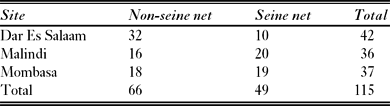
I surveyed 115 fishers in three study areas in Kenya and Tanzania (Table 1). In Kenya, I selected study sites adjacent to the Mombasa and Malindi MPAs. Mombasa study sites included the communities of Bamburi and Utange, as well as Bamburi Beach landing site and Marina landing site. Malindi study sites included the communities of Shela and Mijikenda. In Tanzania, sites included the Kunduchi and Uninio communities adjacent to the Dar Es Salaam MPA. Communities were selected as part of a larger project examining coral reef social-ecological systems in the Western Indian Ocean (McClanahan et al. Reference McClanahan, Cinner, Maina, Graham, Daw, Stead, Wamukota, Brown, Ateweberhan, Venus and Polunin2008b; Cinner et al. Reference Cinner, McClanahan, Daw, Graham, Maina, Wilson and Hughes2009a). In both countries, several other communities were also studied, but to minimize possible confounding effects of urbanization and protection, sites were omitted if (1) they were rural, or (2) there were no MPAs in the vicinity. Previous research has shown that there are significant differences in the socioeconomic characteristics between fishers in rural and urban environments and also near and far from protected areas in Kenya (Cinner et al. Reference Cinner, McClanahan and Wamukota2010). Thus, only peri-urban sites adjacent to protected areas were included in this study. The non-random selection of communities limits what inferences can be made on non-study areas.
The number of fishers interviewed by site.

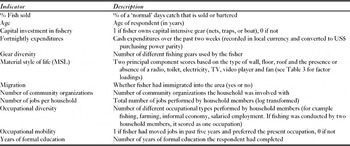
Households within a village were systematically sampled, where a sampling fraction of every ith household (for example 2nd, 3rd, 4th) was determined by dividing the total village population by the sample size. A household was defined as people living together and sharing meals. The number of fishers surveyed per community ranged from 37–42 (Table 1). Respondents were asked about education, participation in community groups, age, fortnightly expenditures, per cent of fish bartered or sold, migration status, their capital investment in the fishery, gear use, their involvement in other occupations and indicators concerning their material style of life (MSL) (Table 2). The number of jobs per household was log transformed to reduce the effect of outlying values and reflect the greater importance of each additional occupation if households had fewer occupations.
Socioeconomic indicators.

Low densities of fishers were living in the communities associated with the Mombasa MPA, making the probability of encountering fishers during household surveys very low. Thus, it was necessary to supplement these household surveys with surveys of fishers from the landing sites. Landing site chairmen provided lists of all fishers at the site and fishers were randomly selected from the list. I crosschecked these lists with fisheries department information to validate the total number of fishers at each location.
Data analysis
I developed a MSL scale based on the presence or absence of nine household possessions, such as electricity, fan, video player, TV, a toilet, radio and the type of material the house was constructed from (Table 2). The interrelationship between these items can be used to construct a MSL scale (Pollnac et al. Reference Pollnac, Pomeroy and Harkes2001). The items were factor analysed using the principal component method. I used a scree test to determine the total number of factors to be included and removed items with low factor loadings, which resulted in the removal of one item: a gas or electric stove. I calculated a score for each of the MSL components for each household based on the presence or absence of items in their household. Each item contributes to the component score based on a proportional transformation of its loading (Table 3). Items with high positive loading have a stronger contribution than those with low or negative values.
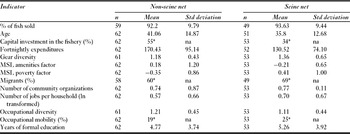
Socioeconomic characteristics of fishers. * = not mean value, na = not applicable.

I tested for differences in socioeconomic conditions between fishers using destructive gears and those that did not use destructive gears using independent samples (T-test for ordinal variables, a Mann-Whitney U test for ordinal variables and a chi-squared test for the binary indicators). I used a backward stepwise binary logistic regression model to predict whether or not fishers used beach seine nets based on the independent socioeconomic variables. This was done manually by sequentially removing the least significant variables until only significant (α = 0.05) variables remained in the model. For the logistic regression analysis, I examined all independent variables for correlations and collinearity. While several independent variables displayed statistically significant bivariate correlations using the Spearman's rank test, correlation coefficients were low (<0.4), and none of the variables displayed high variance inflation factors (all < 1.6), so no variables were removed from the analysis because of collinearity. Two variables (migration and the percentage of fish bartered or sold) were missing a substantial number of cases (8 and 6, respectively) and consequently I removed these before running the regression analyses.
RESULTS
Principal component analysis of the MSL items resulted in two factors explaining 62.4% of the variance. Items with high positive loadings on factor 1 include dirt walls, thatch roof, dirt floors and no toilet, while a radio had a high negative loading (Table 3). These items are largely associated with poor housing. Owing to the positive loading of items associated with a poorer household, a high score on this factor actually equates with a low MSL, thus, I call this a ‘poverty factor’. This factor ranged between −1.24 and 1.68, with a mean of 0 and standard deviation of 1. Items with high positive loadings on factor 2 include video players, fans, TV and electricity. I call this an ‘amenities factor.’ This factor ranged between −0.76 and 3.41, also with a mean of 0 and standard deviation of 1.
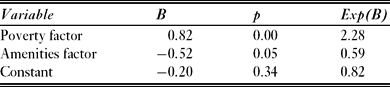
There were significant differences in age (t = 2.0, df = 111, p = 0.05), fortnightly expenditures (t = 2.5, df = 111, p = 0.13), poverty factor (t = −4.3, df = 113, p < 0.001), amenities factor (t = 2.2, df = 97, p = 0.03) and capital investment in the fishery (χ2 = 5.0, df = 1, p = 0.025) between fishers using destructive gears and those not using these gears (Table 3). The final logistic regression model included just two independent socioeconomic variables: the poverty factor and the amenities factor (Table 4). The model correctly predicted 69% of the cases and had a Nagelkerke R2 of 0.232. The Hosmer and Lemeshow chi-squared goodness of fit was not significant (χ2 = 3.5, df = 8, p = 0.90) and the Omnibus test of model coefficients was significant (χ2 = 22.0, df = 2, p < 0.001), indicating that the model adequately fits the data. There was a positive association between the poverty factor and destructive net use, a negative association between the amenities factor and destructive net use.
Socioeconomic factors predicting destructive gear use based on a backward stepwise binary logistic regression model. The exponent of B is interpreted as the odds ratio. Thus, for every unit increase in the poverty factor, respondents are more than twice as likely to use destructive gear.

DISCUSSION
Poverty is often believed to be a driving force in the exploitation of marine resources in tropical developing countries, although relationships are complicated and not well understood (Bene Reference Bene2003; Silva Reference Silva2006; Cinner et al. Reference Cinner, McClanahan, Daw, Graham, Maina, Wilson and Hughes2009a). Consistent with another empirical study from the region (Silva Reference Silva2006), I found that fishers who used destructive gears were poorer. In particular, destructive gear users were more likely to have a lower MSL, as indicated by higher poverty factor scores and lower amenity factor scores. The likelihood of fishers using destructive gears could be correctly classified almost 70% of the time based on just these two multivariate indices of well-being. Destructive fishers also had significantly lower fortnightly expenditures, were significantly younger and were less likely to own capital in the fishery, but these variables were not significant in the regression model.
The finding that destructive gear users tend to be poorer is broadly consistent with the concept of a poverty trap (Barrett et al. Reference Barrett, Marenya, Mcpeak, Minten, Murithi, Oluoch-Kosura, Place, Randrianarisoa, Rasambainarivo and Wangila2006; Enfors & Gordon Reference Enfors and Gordon2008). Poverty traps are situations in which the poor are unable to mobilize the resources required to overcome low-income situations, and thus they engage in behaviour that may reinforce their own poverty (Dasgupta Reference Dasgupta1997; Barrett et al. Reference Barrett, Marenya, Mcpeak, Minten, Murithi, Oluoch-Kosura, Place, Randrianarisoa, Rasambainarivo and Wangila2006; Cinner et al. Reference Cinner, McClanahan, Daw, Graham, Maina, Wilson and Hughes2009a). Other research suggests that poorer fishers are drawn into beach seine crews because of the low capital investment and skills required (Obura Reference Obura2001; Signa et al. Reference Signa, Tuda and Samoilys2008), but in the Kenyan artisanal fishery, profitability is lowest for crew members without capital invested (Mangi et al. Reference Mangi, Roberts and Rodwell2007). Use of beach seine nets can severely degrade the condition of the resource, resulting in lower overall fishery yields (McClanahan & Mangi Reference McClanahan and Mangi2001), and ultimately creating a feedback cycle that reinforces both poverty and environmental destruction (Bunce et al. Reference Bunce, Mee, Rodwell and Gibb2009). In a related study, Cinner et al. (Reference Cinner, Daw and McClanahan2009c) found that poorer fishers in Kenya were also less likely to exit a declining fishery.
Although most studies empirically investigating aspects of poverty and destructive gear use have found a relationship (for example see Cassels et al. Reference Cassels, Curran and Kramer2005; Silva Reference Silva2006), the inconsistencies between the studies suggest that relationships between destructive gear use and specific socioeconomic conditions are complicated and may be dependent on context. For example, in Indonesia, a lower level of education (which was not significant in this study) was related to use of destructive gears, but income levels were not (Cassels et al. Reference Cassels, Curran and Kramer2005). Other contextual socioeconomic aspects not covered in this study, such as local histories, tenure arrangements and social organization (such as caste systems) may also play an important role in determining the types of gears used (Cinner & Aswani Reference Cinner and Aswani2007; Coulthard, Reference Coulthard2008; Evans Reference Evans2009).
Attempts to manage seine net use need to consider the role of fisheries in the wider economy. Pauly (Reference Pauly1990) noted that fisheries can be perceived as a ‘dump for excess labor’. This can be particularly relevant in places such as coastal Kenya, where there are few formal economic sector jobs (Cinner et al. Reference Cinner, McClanahan, Abunge, Wamukota, Hoorweg and Muthiga2009d) and there are low costs involved in beach seine fisheries. Seine net fishers are frequently characterized as young day labourers, with few skills and little or no capital invested in the fishery (Mangi et al. Reference Mangi, Roberts and Rodwell2007). Consistent with other studies, I found that seine net users were less likely to have capital invested in the fishery (Obura Reference Obura2001; Silva Reference Silva2006) and were also significantly younger, although these variables were not significant predictors of whether fishers used destructive gear in the logistic regression model. It is likely that the seine net fishery at these sites provides an important livelihood income for poor young labourers (Mangi et al. Reference Mangi, Roberts and Rodwell2007; Signa et al. Reference Signa, Tuda and Samoilys2008). Development programmes, such as alternative income or gear exchange programmes designed to reduce seine net use, will need to better understand the socioeconomic context in which these fishers operate, including fishers’ reasons for engaging in the fishery and the non-economic satisfactions gained from fishing (Pollnac et al. Reference Pollnac, Pomeroy and Harkes2001; Sievanen et al. Reference Sievanen, Crawford, Pollnac and Lowe2005; Pollnac & Poggie Reference Pollnac and Poggie2006).
CONCLUSIONS
Managers aiming to reduce destructive gear use should consider how socioeconomic conditions may be driving involvement with the gear. Reducing destructive gear use may involve breaking poverty traps, which is generally beyond the scope of fisheries management agencies, particularly in tropical developing countries. Partnerships between fisheries departments, donors and civil society may be critical for effective fisheries management. These partnerships should include strengthening the emerging community-based management system (in Kenya, called beach management units), poverty alleviation strategies and the development of gear exchanges and/or micro-financing to allow fishers access to legal fishing gears (Signa et al. Reference Signa, Tuda and Samoilys2008).
ACKNOWLEDGEMENTS
This work was funded by the Western Indian Ocean Marine Science Association. I thank T. McClanahan, J.B. Raina and N. Jiddawi for helpful comments. This research was partially conducted while working for the Wildlife Conservation Society. Several of the indicators were compiled during a social-ecological systems working group in 2007. The University of Dar Es Salaam, the Institute of Marine Science and the Kenya Wildlife Service provided institutional support. I thank A. Wamukota, J. Kabamba, S. Hamed and R. Mdendemi for field assistance, and N. Jiddawi and H. Kalombo for assistance and logistics.