Significantly improved treatment for patients with severe beta-thalassaemia disease results in a longer life expectancy. Despite a current advance in chelating therapy, cardiovascular complications are observed in most children and adolescents with beta-thalassaemia major, mainly characterised by myocardial dysfunction associated with iron overload, which leads progressively to cardiac failure and finally death.Reference Borgna-Pignatti, Rugolotto and De Stefano1–Reference Kremastinos, Flevari, Spyropoulou, Vrettou, Tsiapras and Stavropoulos-Giokas3 In addition to cardiac disease, a higher incidence of vascular complication is consistently reported. Vascular dysfunction, with the loss of arterial compliance, has been described for these patients.Reference Aessopos, Farmakis and Loukopoulos4–Reference Tsomi, Karagiorga-Lagana, Fragodimitri, Karabatsos and Katsiki6
In particular, increased arterial stiffness, endothelial dysfunction, and accelerated vascular ageing are experienced by adult patients with beta-thalassaemia major.Reference Cheung, Chan and Ha5, Reference Cheung, Chow, Chan and Ha7, Reference Hahalis, Kremastinos and Terzis8 The interaction between iron overload, high oxidative stress, haemostatic disturbance, endothelial activation, pro-inflammatory state, and the thalassaemia itself may contribute to a pro-atherogenic environment.Reference Aggeli, Antoniades and Cosma9–Reference Kyriakou, Alexandrakis and Kyriakou12 The mechanism of early subclinical atherosclerosis occurrence in children with beta-thalassaemia major is not clear and it has to be defined exactly for the prevention of long term cardiovascular complications.
Common carotid artery intima-media thickness is a non-invasive predictor of early arterial wall alteration, which identifies and quantitates early structural vascular abnormalities, and is currently considered as a marker of premature atherosclerosis.Reference Simon, Gariepy and Chironi13–Reference Lorenz, Markus and Bots15
The aim of this study is to investigate the common carotid artery intima-media thickness in children with beta-thalassaemia major and its relation to ferritin levels, as well as the duration of beta-thalassaemia major.
Patients and methods
Study population
The study population included 33 thalassaemic children – including 22 boys and 11 girls, with a median age of 8 years (range: 4–15). The inclusion criteria were diagnosis of beta thalassaemia major; normal liver and renal function; and absence of coincidental disease, which can cause atherosclerosis, such as hypertension, diabetes mellitus, hyperlipidaemia, and other endocrinopathies. All thalassaemic children received regular blood transfusion every 3–4 weeks and all children received iron chelation therapy. In all, 30 healthy children – including 12 girls and 18 boys, with median age of 8 years (range: 4–15) – matched for age and sex were studied as the control group. All patients were asked to fill in a questionnaire that included demographic data, disease duration, and chelation history – type, dose, frequency, and age of onset. The transfusion history, including the information about the first transfusion age of the patient, type and the frequency of transfusions – with the calculation of mean pre-transfusional haemoglobin and transfusion index of packed red blood cell per body weight per year – family history of anemia and past history of splenectomy was collected. Written informed consent was obtained from the older children and from both parents of all children after the nature of the study was fully explained.
Measurements of common carotid artery intima-media thickness
The patients were studied under standardised conditions in a quiet room at a comfortable temperature, and all fasted before testing. Upon arrival at the investigation unit, the patients were equipped with measurement devices and then rested supine for approximately 15–20 minutes until satisfactory baseline vital conditions had been achieved, and then carotid artery values were measured. All measurements were recorded by the same trained paediatric cardiology practitioner. High-resolution B-mode ultrasonography of the right common carotid artery was performed using a Siemens Acusson (Siemens, Mountain view, California, United States of America) ×300PE colour Doppler echocardiography with a linear S8 transducer. All participants were examined in the supine position with their heads turned slightly to the left. Two-dimensional images of the posterior (far) wall of the carotid artery were displayed longitudinally from just 20 millimetres below the carotid bulb as two bright white lines separated by a hypoechogenic space. The distance between the leading edges of the first bright line and the second bright line indicates the intima-media thickness. The intima-media thickness was measured during end diastole. The mean intima-media thickness was calculated as the average of three consecutive measurements of maximum far-wall thickness obtained from the common carotid artery.Reference Pignoli, Tremoli and Poli16
Statistical analyses
Data are presented as median. The differences in variables between the patient group and the control group were compared using analysis of variance. The Pearson correlation test was used for investigating a correlation between common carotid artery intima-media thickness and ferritin levels. A p-value less than 0.05 was considered statistically significant. All statistical analyses were performed using the Statistical Package for the Social Sciences, version 11 (SPSS Inc., Chicago, Illinois, United States of America).
Results
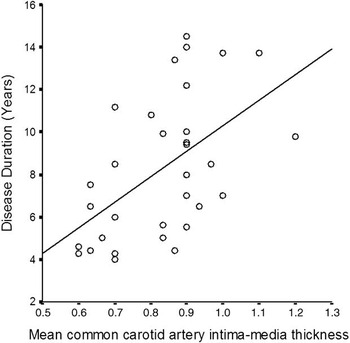
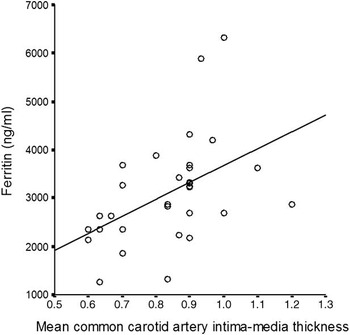
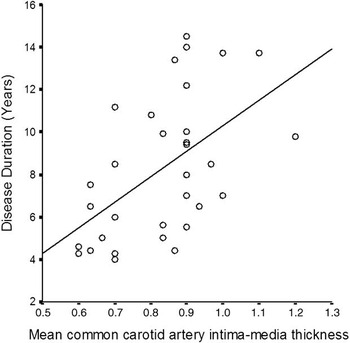
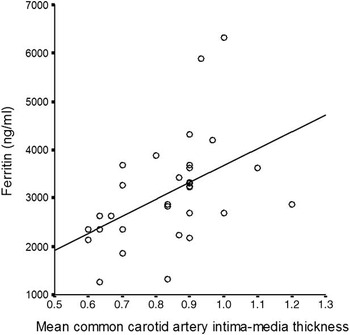
In the studied beta-thalassaemia major patients, the age at diagnosis ranged from 0.25 to 2 years, with a median of 0.6 months. Their disease duration ranged from 4 to 13.75 years, with a median of 6.5 years. The median age at first transfusion was 0.6 months, with a range from 0.1 to 2 years. The patients’ median haemoglobin level was significantly lower than controls – that is, 8.10 versus 12, with a p-value less than 0.001. The median serum ferritin was 2860 nanograms per millilitre, ranging from 1163 to 6320 nanograms per millilitre, and the median transfusion index was 95 millilitres per kilogram per year, ranging from 60 to 170 millilitres per kilogram per year. The patients’ median common carotid artery intima-media thickness was significantly higher than that of the controls – that is, 0.87 versus 0.74, with a p-value less than 0.005. The median common carotid artery intima-media thickness value was positively correlated with disease duration (r = 0.535), with a p-value less than 0.01 (Fig 1). The median common carotid artery intima-media thickness value was also correlated with serum ferritin level (r = 0.501), with a p-value less than 0.01 (Fig 2).
There is a linear relation between common carotid artery intima-media thickness and disease duration (r = 0.535, p < 0.01).
The mean common carotid artery intima-media thickness is correlated with serum ferritin level (r = 0.501, p < 0.01).
Discussion
Cardiovascular complications in patients with beta-thalassaemia major is due to myocardial dysfunction caused by iron overload, which leads progressively to cardiac failure and finally to death.Reference Borgna-Pignatti, Rugolotto and De Stefano1–Reference Kremastinos, Flevari, Spyropoulou, Vrettou, Tsiapras and Stavropoulos-Giokas3 With the increased life span of beta-thalassaemia major patients, in addition to cardiac disease, a higher incidence of vascular complication is consistently reported in these patients.Reference Kremastinos, Flevari, Spyropoulou, Vrettou, Tsiapras and Stavropoulos-Giokas3
Common carotid artery intima-media thickness was accepted as a marker for subclinical atherosclerosis in children in many different diseases.Reference Civilibal, Oflaz and Caliskan17–Reference Atabek, Kurtoglu and Pirgon19 The important finding of our study is that children with beta-thalassaemia major had increased common carotid artery intima-media thickness. To our knowledge, this is the third study demonstrating increased common carotid artery intima-media thickness in children with beta-thalassaemia major. Tantawy et alReference Tantawy, Adly, El Maaty and Amin20 showed that serum triglycerides, total cholesterol, apoprotein A, and common carotid artery intima-media thickness were significantly elevated, whereas high-density lipoproteins were significantly lowered in thalassaemic and diabetic patients compared with controls. They also found that common carotid artery intima-media thickness was positively correlated with age, haemoglobin F, ferritin, and cholesterol levels in thalassaemic patients. They concluded that atherogenic lipid profiles in young thalassaemic patients with increased common carotid artery intima-media thickness highlight their importance as prognostic factors for vascular risk stratification. Patients with hyperlipidaemia were excluded from our study population as we think that common carotid artery intima-media thickness is not correlated with hyperlipidaemia, and therefore increased common carotid artery intima-media thickness may be related to the endothelial dysfunction.
Limsuwan et alReference Limsuwan, Tubtom, Pakakasama and Chaunsumrit21 analysed common carotid artery intima-media thickness and the carotid stiffness index in beta-thalassaemia major patients who were treated conventionally or with bone marrow transplantation. They found that common carotid artery intima-media thickness and arterial stiffness were increased in conventionally treated children with beta-thalassaemia major, suggesting an early atherosclerotic change in these children. They also suggested that children with beta-thalassaemia major who underwent bone marrow transplantation had an increased common carotid artery intima-media thickness but normal arterial stiffness. They did not correlate the common carotid artery intima-media thickness results with the lipid profile. Our results are similar to this study.
From the traditional parameters, ferritin levels analysed as single measurements or as mean measurements had been regarded as reasonable indicators of iron load and prognosis in patients with beta-thalassaemia major.Reference Olivieri22, Reference Telfer, Prestcott, Holden, Walker, Hoffbrand and Wonke23 Even in a recent Italian study, deaths in beta-thalassaemia major were related to higher ferritin levels at the time of death.Reference Borgna-Pignatti, Cappellini and De Stefano24
Using serum ferritin as a measure of body iron stores, a positive correlation between serum ferritin concentration and the risk of myocardial infarction or carotid atherosclerosis has been reported in a number of population studies,Reference Salonen, Nyyssonen, Korpela, Tuomilehto, Seppanen and Salonen25–Reference Wolff, Volzke and Ludemann28 but there is a little information in children with beta-thalassaemia major.
Syrovatka et alReference Syrovatka, Kraml and Hulikova29 showed that ferritin and ratio of transferrin receptors and ferritin were correlated as indicative factors on atherosclerotic progression that was evidenced by intima media thickness in healthy subjects. In the same study, ratio of transferrin receptors to ferritin was correlated independently with fibrinogen. It has been demonstrated that fibrinogen plays a pivotal role both in the initial phase and in the advanced stages of atherosclerosis. It has been found in atherosclerotic lesions that the expression of transferrin receptor 1, an essential protein involved in iron uptake, is significantly associated with ferritin accumulation and macrophage infiltration, which contribute to both development and destabilisation (rupture) of human carotid atheroma, thus suggesting the relevant role of intralesional iron metabolism in atherogenesis.
In our study, we found that carotid intima-media thickness was positively correlated with ferritin levels, which reflected the body iron load. Previous investigators suggested a pro-atherothombotic role of iron overload as a cause for severe beta-thalassaemia major. The potential mechanism includes enhanced platelet activation, low-density lipoprotein oxidation, macrophage activity stimulation, and increased nitric oxide destruction in the context of oxidative stres and haemolysis.Reference Balla, Jacob, Eaton, Belcher and Vercellotti30–Reference Schechter and Gladwin34 Patients with severe beta-thalassaemia major exhibit a pattern of altered immune response to antigenic stimulation related to transfusions and infectious agents, cytokine levels of stored allogenic blood, iron overload, and stroma cells of hyperplastic bone marrow.Reference Bellocq, Israel-Biet and Cadranel35–Reference Lombardi, Matera and Minervini37 The interplay between the iron overload, high oxidative stress, endothelial activation, proinflammatory state, and thalassaemic cells may contribute to the pathogenesis of atherosclerosis in these patients.
The measurement of carotid intima-media thickness was recorded with an 8-megahertz transducer. However, if it was recorded with a higher-frequency transducer, the diagnostic acuity would be better. This is the limitation of our study.
As the occurrence of early vascular changes were demonstrated in children with beta-thalassaemia major in the study, it is very important to measure common carotid artery intima-media thickness of these patients for detecting the unfavorable vascular changes at very early stages of the disease.
Acknowledgement
We thank the staff of Echocardiography laboratory in Gaziantep Children Hospital for their assistance.