Introduction
Childbirth is a potent trigger for the onset of psychiatric disorders in women. In particular, postpartum depression (PPD) is one of the most common complications of childbirth with potentially damaging and harmful outcomes for mother and child (Flynn et al. Reference Flynn, Davis, Marcus, Cunningham and Blow2004; Marmorstein et al. Reference Marmorstein, Malone and Iacono2004; O'Hara & McCabe, Reference O'Hara and McCabe2013; Wisner et al. Reference Wisner, Sit, McShea, Rizzo, Zoretich, Hughes, Eng, Luther, Wisniewski, Costantino, Confer, Moses-Kolko, Famy and Hanusa2013). The prevalence of PPD is 11–15% (Gavin et al. Reference Gavin, Gaynes, Lohr, Meltzer-Brody, Gartlehner and Swinson2005; Gaynes et al. Reference Gaynes, Gavin, Meltzer-Brody, Lohr, Swinson, Gartlehner, Brody and Miller2005; Howard et al. Reference Howard, Molyneaux, Dennis, Rochat, Stein and Milgrom2014) and PPD-related suicide accounts for about 20% of postpartum deaths, making PPD a leading cause of maternal mortality (Lindahl et al. Reference Lindahl, Pearson and Colpe2005; Palladino et al. Reference Palladino, Singh, Campbell, Flynn and Gold2011). In contrast, postpartum psychosis (PP) is rare, occurring in 1 per 1000 births, but is a severe form of postpartum psychiatric illness that can result in suicide and infanticide (Sit et al. Reference Sit, Rothschild and Wisner2006; Blackmore et al. Reference Blackmore, Rubinow, O'Connor, Liu, Tang, Craddock and Jones2013). The risk of PP is significantly increased in women with bipolar disorder and may be the first presentation of lifetime bipolar illness (Sit et al. Reference Sit, Rothschild and Wisner2006; Smith et al. Reference Smith, Smith, Shen, Engel, Bowman, McGrath, Bisits, McElduff, Giles and Smith2009; Munk-Olsen et al. Reference Munk-Olsen, Laursen, Meltzer-Brody, Mortensen and Jones2011a ; Bergink et al. Reference Bergink, Bouvy, Vervoort, Koorengevel, Steegers and Kushner2012; Blackmore et al. Reference Blackmore, Rubinow, O'Connor, Liu, Tang, Craddock and Jones2013).
There has been an increasing focus on the diverse range of psychiatric illness following childbirth, and recent work has highlighted that the postpartum period is associated with increased risk for multiple psychiatric disorders (Howard et al. Reference Howard, Molyneaux, Dennis, Rochat, Stein and Milgrom2014; Jones et al. Reference Jones, Chandra, Dazzan and Howard2014). Moreover, the relationship between a complicated birth experience and the development of postpartum psychiatric disorders including postpartum acute stress reactions (symptoms lasting less than 1 month following the traumatic event) or post-traumatic stress disorder (PTSD) is an area of growing interest (Garthus-Niegel et al. Reference Garthus-Niegel, Ayers, von Soest, Torgersen and Eberhard-Gran2014).
While many risk factors for postpartum psychiatric illness are known, a previous history of perinatal psychiatric illness or prior episodes of non-perinatal mood disorders appear to confer the greatest risks (O'Hara & Swain, Reference O'Hara and Swain1996; Munk-Olsen et al. Reference Munk-Olsen, Laursen, Meltzer-Brody, Mortensen and Jones2011a ; Di Florio et al. Reference Di Florio, Forty, Gordon-Smith, Heron, Jones, Craddock and Jones2013; Meltzer-Brody et al. Reference Meltzer-Brody, Boschloo, Jones, Sullivan and Penninx2013). Marital conflict, perceived lack of partner support and stressful life events have also been associated with increased risk of postpartum mood disorders (O'Hara & McCabe, Reference O'Hara and McCabe2013). A careful review of the literature indicates that medical complications occurring during pregnancy and/or childbirth have been inconsistently linked to postpartum psychiatric disorders (Blom et al. Reference Blom, Jansen, Verhulst, Hofman, Raat, Jaddoe, Coolman, Steegers and Tiemeier2010). These include complications of pregnancy such as pre-eclampsia (Steegers et al. Reference Steegers, von Dadelszen, Duvekot and Pijnenborg2010; Robillard et al. Reference Robillard, Dekker, Chaouat, Hulsey and Saftlas2011; Di Florio et al. Reference Di Florio, Jones, Forty, Gordon-Smith, Blackmore, Heron, Craddock and Jones2014; Munk-Olsen et al. Reference Munk-Olsen, Jones and Laursen2014), hyperemesis gravidarum (HG; severe nausea and vomiting) (Poursharif et al. Reference Poursharif, Korst, Fejzo, MacGibbon, Romero and Goodwin2008; Buyukkayaci Duman et al. Reference Buyukkayaci Duman, Ozcan and Bostanci2015), gestational diabetes (Nicklas et al. Reference Nicklas, Miller, Zera, Davis, Levkoff and Seely2013; Barakat et al. Reference Barakat, Martinez, Thomas and Handley2014; Ferrara et al. Reference Ferrara, Hedderson, Albright, Brown, Ehrlich, Caan, Sternfeld, Gordon, Schmittdiel, Gunderson, Mevi, Tsai, Ching, Crites and Quesenberry2014; Meltzer-Brody & Stuebe, Reference Meltzer-Brody and Stuebe2014) and gestational hypertension (Bijlenga et al. Reference Bijlenga, Koopmans, Birnie, Mol, van der Post, Bloemenkamp, Scheepers, Willekes, Kwee, Heres, Van Beek, Van Meir, Van Huizen, Van Pampus and Bonsel2011; Rigó et al. Reference Rigó, Kecskeméti, Molvarec, Lefkovics, Szita and Baji2015), as well as obstetrical complications including postpartum hemorrhage (Sentilhes et al. Reference Sentilhes, Gromez, Clavier, Resch, Descamps and Marpeau2011; Thompson et al. Reference Thompson, Roberts and Ellwood2011), Cesarean section (C-section) (Hannah et al. Reference Hannah, Whyte, Hannah, Hewson, Amankwah, Cheng, Gafni, Guselle, Helewa, Hodnett, Hutton, Kung, McKay, Ross, Saigal and Willan2004; Sword et al. Reference Sword, Landy, Thabane, Watt, Krueger, Farine and Foster2011; Houston et al. Reference Houston, Kaimal, Nakagawa, Gregorich, Yee and Kuppermann2015) and preterm birth (Grigoriadis et al. Reference Grigoriadis, VonderPorten, Mamisashvili, Tomlinson, Dennis, Koren, Steiner, Mousmanis, Cheung, Radford, Martinovic and Ross2013; Barroso et al. Reference Barroso, Hartley, Bagner and Pettit2015; Helle et al. Reference Helle, Barkmann, Bartz-Seel, Diehl, Ehrhardt, Hendel, Nestoriuc, Schulte-Markwort, von der Wense and Bindt2015). These pregnancy and obstetrical complications occur relatively commonly: The prevalence of pre-eclampsia is 5–8% of all pregnancies (Leffert, Reference Leffert2015), preterm birth is about 10% (Delnord et al. Reference Delnord, Blondel and Zeitlin2015; Horgan, Reference Horgan2015) and gestational diabetes is up to 9% (DeSisto et al. Reference DeSisto, Kim and Sharma2014). Medical complications during pregnancy and/or at delivery may be distinguishing features for onset and degree of severity for postpartum psychiatric disorders [Postpartum Depression: Action Towards Causes and Treatment (PACT) Consortium, 2015]. In particular, the experience of a traumatic complication of childbirth (as defined by the perception of the mother who experienced it), may have a powerful role on the postpartum experience of acute stress or PTSD (Ayers et al. Reference Ayers, Rados and Balouch2015; Shlomi Polachek et al. Reference Shlomi Polachek, Dulitzky, Margolis-Dorfman and Simchen2016).
Further understanding of the associations between obstetrical and pregnancy complications and postpartum psychiatric disorders is important for the development of targeted approaches for screening and treatment. In the present study, we aimed to conduct a large epidemiological study of a general population to identify commonly occurring pregnancy and obstetrical complications that predict a range of psychiatric disorders in the postpartum period in primiparous women with new-onset postpartum psychiatric illness. We wanted to explore if the individual pregnancy and obstetrical complications influenced disease risks differently depending on which type of postpartum psychiatric disorder we studied. We also considered demographic and socio-economic factors that may influence disease risks by using the Danish population registers as data sources.
Method
Study design and study population
We conducted a population-based, cohort study to identify predictors for different types of postpartum psychiatric disorders. To define our study population, we identified all women born in Denmark on 1 January 1955 or later, who gave birth to a singleton, live-born child between 1 January 1995 and 30 June 2012. The Danish registers form the basis of a longitudinal study of nearly all health care contacts since 1968 and include 4.5 million women plus data on their partners, family members and offspring (Pedersen, Reference Pedersen2011). These registers ‘transform the entire country of Denmark into a large cohort’ (Frank, Reference Frank2000) and allow the unique opportunity to conduct a population cohort study of obstetrical and pregnancy complications and postpartum psychiatric disorders. Moreover, the Danish registers have been used for numerous prior publications in psychiatric epidemiology (Mortensen et al. Reference Mortensen, Pedersen, Westergaard, Wohlfahrt, Ewald, Mors, Andersen and Melbye1999; Li et al. Reference Li, Laursen, Precht, Olsen and Mortensen2005; Munk-Olsen et al. Reference Munk-Olsen, Laursen, Pedersen, Mors and Mortensen2006, Reference Munk-Olsen, Laursen, Meltzer-Brody, Mortensen and Jones2011a , Reference Munk-Olsen, Laursen, Pedersen, Lidegaard and Mortensen b ; Webb et al. Reference Webb, Abel, Pickles, Appleby, King-Hele and Mortensen2006; Khashan et al. Reference Khashan, Abel, McNamee, Pedersen, Webb, Baker, Kenny and Mortensen2008; McGrath et al. Reference McGrath, Eyles, Pedersen, Anderson, Ko, Burne, Norgaard-Pedersen, Hougaard and Mortensen2010; Bay et al. Reference Bay, Mortensen, Hvidtjorn and Kesmodel2013; Benros et al. Reference Benros, Waltoft, Nordentoft, Ostergaard, Eaton, Krogh and Mortensen2013) and have demonstrated strong diagnostic validity confirmed by clinical data (Bock et al. Reference Bock, Bukh, Vinberg, Gether and Kessing2009; Uggerby et al. Reference Uggerby, Ostergaard, Roge, Correll and Nielsen2013; Svensson et al. Reference Svensson, Lash, Resick, Hansen and Gradus2015).
We restricted to first-time live births and each woman was followed within the cohort from date of delivery until first-time psychiatric episode 0–12 months after birth, migration, death, 1 year after birth or 1 January 2013 (whichever came first). The decision to restrict to first-time live births was three-fold: (1) primiparity has been reported as a risk factor for postpartum psychiatric illness; (2) we did not want a previous birth experience to confound the results; and (3) we did not want a fetal or newborn death to confound the results due to the experience of normal grief and bereavement (Li et al. Reference Li, Laursen, Precht, Olsen and Mortensen2005). Overall, we identified 974 374 women with a childbirth in the period 1995–2012, of whom 435 034 had a first-time birth of a live-born single infant. We excluded women who died or migrated before the study start, and restricted the cohort to 392 458 women without previous history of psychiatric disorders.
Data resources and study variables
Information from multiple Danish nationwide registers was linked to conduct the present study. Registers were combined by linking relevant information based on personal identification numbers assigned to each person at birth. The identification of women for our cohort was made through the Danish Civil Registration System (CRS) that includes information on date of birth, parents/family membership, and daily updated information on migration and vital status (Pedersen, Reference Pedersen2011).
We used the CRS to identify women who experienced childbirth. The outcome of interest in the study was any type of psychiatric episodes 0–12 months postpartum. Data regarding psychiatric episodes were derived from The Danish Psychiatric Central Register (Mors et al. Reference Mors, Perto and Mortensen2011) and The National Patient Register (Lynge et al. Reference Lynge, Sandegaard and Rebolj2011), which hold information on all contacts to psychiatric and medical treatment facilities in Denmark. Specifically, we identified all first-time records of both in-patient and out-patient psychiatric diagnoses during the first year after childbirth (defined as date of initial contact) beginning in 1995. Out-patient psychiatric diagnoses came from specialist clinics and not from primary care settings; thus, this cohort is comprised of women who were referred to psychiatric care. The diagnostic classification system used was the International Classification of Diseases, tenth version (ICD-10) that began use in 1994. We used data on all diagnoses of mental and behavioral disorders (ICD-10 F-chapter) excluding organic disorders, substance abuse and mental retardation (ICD-10: F00–F19 and F70–F79). A postpartum psychiatric disorder was defined as any of these diagnoses within 365 days after childbirth, divided into subgroups 0–90, 91–180, 181–270, and 271–365 days postpartum. Among all women diagnosed with any psychiatric disorder we identified subgroups of postpartum episodes: PPD (F32–F33 excluding F32.3), PP (F20, F23, F25, F28–F31 and F32.3) and acute stress reactions during the postpartum period (F43). Psychiatric disorders were restricted to include only incident episodes of mental and behavioral disorders and not chronic disorders. Note, this meant that any psychiatric episode identified for the present study was first ever contact for the individual women.
Based on the literature of commonly occurring pregnancy and obstetrical complications, we identified a group of potential predictors through The Medical Birth Register, The National Patient Register, and socio-economic status covered by Statistics Denmark. Pregnancy-related factors were considered on date of delivery or prior to delivery and included the following (ICD-10 codes shown in parentheses): pre-eclampsia (O14), eclampsia (O15), gestational diabetes (O24), gestational hypertension (O13), postpartum hemorrhage (O72), emergency C-section (O82, O84.2), HG (O21), fetal stress/complications during labor and delivery (O68), and preterm labor and delivery (O60 and gestational age < 37 weeks). Similarly, we obtained information on reproductive history prior to childbirth for each cohort member including information on previous history of stillbirth or induced abortion (O02.1, O03–O06). Socio-economic factors included paternal/maternal annual income, civil status at date of childbirth and educational level recorded at 1 October in the year of childbirth. Family and partner history of mental and behavioral disorders was similarly identified as a potential risk factor defined as all mental and behavioral disorders (F-chapter ICD-10 and equivalent ICD-8 codes).
Statistical analyses
For the present study we conducted Poisson regression (survival analysis) and calculated incidence rate ratios (IRRs). We conducted survival analyses using Poisson regressions, with the logarithm of person-years as an offset variable. This method is equivalent to Cox regression under the assumption of piecewise constant incident rates (Anderson, Reference Anderson1993).
We calculated the IRRs of any psychiatric contact in quarters (1/4 of a year) for the first year postpartum, while the incidence rate 9–12 months after the birth was defined as the reference category. In the mutually adjusted analyses, we adjusted for variables measured at baseline. We then examined specific risks by type of grouped postpartum episodes: PPD, PP and acute stress reactions as defined above, as well as risks associated with all psychiatric disorders during the postpartum period jointly. When looking at psychoses we calculated the confidence intervals (CIs) by using Wald's interval, because of limited number of cases and complete separation of variables, which leads to non-convergence of the profile likelihood CI.
Results
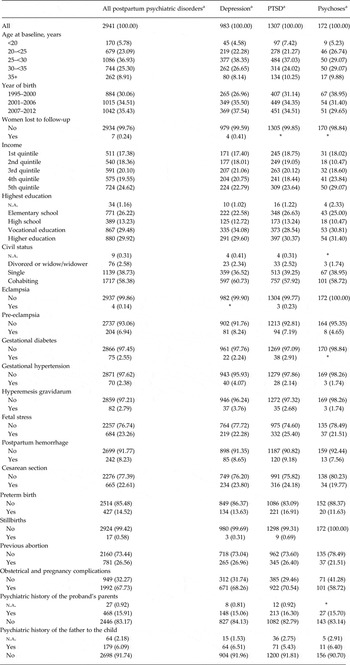
A total of 392 458 women born after 1955 who had given birth to a child between 1995 and 2012 were identified (see Table 1). Of these women, 2941 had a record of any type of psychiatric disorder within the first year after childbirth (first child, single births only). This prevalence of 0.8% is consistent with previously reported register-based incidence estimates of postpartum psychiatric illness (Munk-Olsen et al. Reference Munk-Olsen, Laursen, Pedersen, Mors and Mortensen2006). It is also, as expected, consistently lower than incidences reported when women are screened with a self-report instrument like the Edinburgh Postnatal Depression Scale (Cox et al. Reference Cox, Holden and Sagovsky1987) or another clinical interview.
Characteristics of women giving birth

Data are given as number of participants (percentage).
PTSD, Post-traumatic stress disorder; n.a., not available.
a Within 1 year from birth.
* Indicates a number equal or less than three. The Danish registers are not allowed to publish this number in detail because it includes personal identifiable information.
Predictors for all types of postpartum disorders
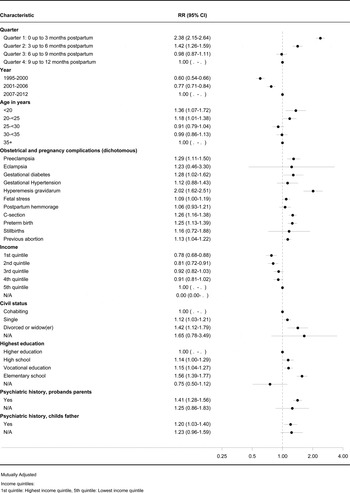
The predictors for any type of postpartum psychiatric disorders are presented in Fig. 1. The onset of any type of psychiatric illness was greatest immediately after childbirth and the risk was highest 0–3 months postpartum (quarter 1) (IRR 2.38, 95% CI 2.15–2.64) compared with the reference category 9–12 months postpartum. Of the demographic variables, the greatest risks were in the youngest mothers (age < 20 years) (IRR 1.36, 95% CI 1.07–1.72), and in single and divorced/widowed mothers (IRR 1.12, 95% CI 1.03–1.21; and IRR 1.42, 95% CI 1.12–1.79) compared with the reference categories. In contrast, mothers with the highest income had the lowest risk of all postpartum psychiatric episodes (IRR 0.78, 95% CI 0.68–0.88).
Forest plot showing the predictors for all postpartum psychiatric disorders (without substance abuse). RR, Incidence rate ratio; CI, confidence interval; C-section, Cesarean section; N/A, not available.

Pregnancy/obstetrical complications and their association with postpartum psychiatric disorders are described in Fig. 1. A range of complications was associated with increased incidence of any type of postpartum psychiatric disorder, including, among others, pre-eclampsia (IRR 1.29, 95% CI 1.11–1.50), gestational diabetes (IRR 1.28, 95% CI 1.02–1.62), HG (IRR 2.02, 95% CI 1.62–2.51) and C-section (IRR 1.26, 95% CI 1.16–1.38).
Predictors for PPD
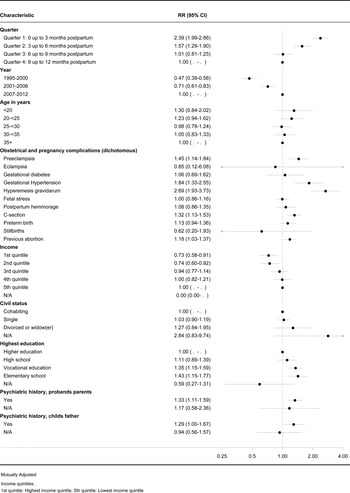
Predictors specifically for PPD are reported in Fig. 2. Age, education, civil/marital status, income, and education for incident cases of PPD had similar results compared with all types of postpartum psychiatric illness. The youngest mothers, mothers with short education, and low income had the greatest risk of experiencing PPD.
Forest plot showing the predictors for depression. RR, Incidence rate ratio; CI, confidence interval; C-section, Cesarean section; N/A, not available.

When examining pregnancy and obstetrical complications in women with PPD, the following predictors were identified as conferring increased risk in women with PPD: HG (IRR 2.69, 95% CI 1.93–3.73), gestational hypertension (IRR 1.84, 95% CI 1.33–2.55), pre-eclampsia (IRR 1.45, 95% CI 1.14–1.84) and C-section (IRR 1.32, 95% CI 1.13–1.53) were higher as compared with women in the reference categories who did not experience these specific complications.
Predictors for postpartum acute stress reactions
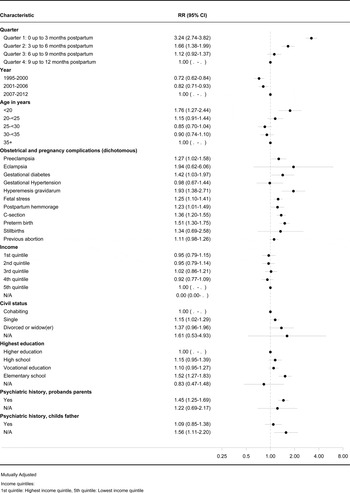
Predictors occurring in pregnancy or during delivery that increased rates of an acute stress reaction in the postpartum period are reported in Fig. 3. Young mothers (IRR 1.76, 95% CI 1.27–2.44), single mothers (IRR 1.15, 95% CI 1.02–1.29) and mothers completing elementary school only (IRR 1.52, 95% CI 1.27–1.83) had increased risks of acute postpartum stress.
Forest plot showing the predictors for acute stress reactions. RR, Incidence rate ratio; CI, confidence interval; C-section, Cesarean section; N/A, not available.

When examining pregnancy and obstetrical complications in women with postpartum acute stress reactions, the following predictors were associated with an increased rate: HG (IRR 1.93, 95% CI 1.38–2.71), preterm birth (IRR 1.51, 95% CI 1.30–1.75), gestational diabetes (IRR 1.42, 95% CI 1.03–1.97), C-section (IRR 1.36, 95% CI 1.20–1.55), fetal stress (IRR 1.25, 95% CI 1.10–1.41) and postpartum hemorrhage (IRR 1.23, 95% CI 1.01–1.49) were all higher compared with women in the reference categories who did not experience these specific complications.
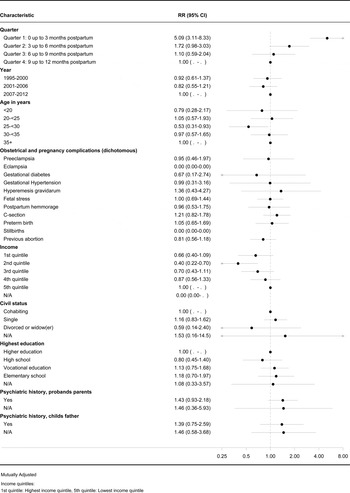
Predictors for postpartum psychoses
The onset of PP was five times higher in the first 3 months postpartum (IRR 5.09, 95% CI 3.11–8.33, Fig. 4), compared with risks 9–12 months postpartum. Further examination of specific predictors revealed no associations between socio-economic or obstetrical/pregnancy-related complications and risk of PP.
Forest plot showing the predictors for psychoses. RR, Incidence rate ratio; CI, confidence interval; C-section, Cesarean section; N/A, not available.

Discussion
We examined multiple types of common medical complications occurring during pregnancy and delivery and we also examined the type of first-episode postpartum psychiatric disorder occurring in first-time mothers within the first 3 months postpartum. Our results demonstrate that the type of medical complication and the timing of onset can serve as a particular trigger for the specific type of postpartum psychiatric illness. We further sought to parse apart the distinction between type of postpartum mood disorder (PPD v. PP) and postpartum acute stress.
Demographic and socio-economic factors
Low income and short education were associated with increased incidence of PPD and acute stress reaction. Both family history and poverty have been previously associated with increased risk for depression and anxiety (Stein et al. Reference Stein, Pearson, Goodman, Rapa, Rahman, McCallum, Howard and Pariante2014). In several countries across the world, access to health care is not uniform. Consequently, women with low socio-economic status may be particularly vulnerable when pregnant and after childbirth. The present study is from Denmark where all Danish citizens have access to free, universal health care. Despite this, we observed that for all included subgroups of postpartum psychiatric disorders, low income and less education significantly influenced the risk of developing postpartum psychiatric illness (Figs 1–3). This suggests that limited access to health care does not solely explain the increased risk of the range of postpartum psychiatric episodes. It also suggests that pregnant women in lower socio-economic groups are particularly vulnerable in this peripartum period and require careful monitoring and treatment. Another group of vulnerable women are those with partners or family members with records of treated psychiatric illness, as our results suggest that this increased risk of all postpartum psychiatric disorders (Fig. 1). Possible explanations for this could include assortative mating as well as a genetic diathesis.
Obstetric and pregnancy complications: predictors for PPD and postpartum stress disorder
The experience of HG was associated with a 2.7 increased risk for PPD (IRR 2.69, 95% CI 1.93–3.73) and close to 2 times increased risk of an acute stress reaction (IRR 1.75, 95% CI 1.26–2.41). In contrast to the other conditions examined, HG is typically diagnosed during the first trimester and if successfully treated usually decreases or resolves during the second trimester. This finding suggests that the experience of persistent and unremitting HG requiring medical intervention is particularly stressful and traumatic to women who experience it. The extent to which the observed association between HG and PPD and acute stress may be explained by psychological stress experienced by women who suffer from HG, or alternatively, is due to underlying biological contributions of the disorder, was not possible to determine in the current study design, but would be interesting to pursue in future work.
Delivery by C-section was also associated with an increased rate of PPD and acute stress reaction postpartum. This association replicates previous work that demonstrated an increased risk of PPD in women who had C-sections (Blom et al. Reference Blom, Jansen, Verhulst, Hofman, Raat, Jaddoe, Coolman, Steegers and Tiemeier2010; Weisman et al. Reference Weisman, Granat, Gilboa-Schechtman, Singer, Gordon, Azulay, Kuint and Feldman2010). However, the finding that C-section is associated with acute stress implies that the mother's perception of the C-section may be most important (i.e. planned v. emergency) and this finding replicates prior reports documenting that the unplanned or unexpected nature of a C-section is a precipitating factor for PPD compared with having a planned C-section (Blom et al. Reference Blom, Jansen, Verhulst, Hofman, Raat, Jaddoe, Coolman, Steegers and Tiemeier2010; Houston et al. Reference Houston, Kaimal, Nakagawa, Gregorich, Yee and Kuppermann2015). Moreover, this may explain the negative findings from earlier work demonstrating no association between planned C-section v. a planned vaginal birth for a singleton term breech fetus (Hannah et al. Reference Hannah, Whyte, Hannah, Hewson, Amankwah, Cheng, Gafni, Guselle, Helewa, Hodnett, Hutton, Kung, McKay, Ross, Saigal and Willan2004).
In comparison, in the present study, preterm birth in itself was not associated with PPD but was associated with an increased rate of acute stress reaction. This is an interesting finding and may help differentiate the difference between PPD v. postpartum acute stress. Our findings support the most recent literature showing an increased risk for acute stress reaction due to the traumatic nature of the preterm birth and/or having an infant in a neonatal intensive care unit (Shaw et al. Reference Shaw, Deblois, Ikuta, Ginzburg, Fleisher and Koopman2006; Vanderbilt et al. Reference Vanderbilt, Bushley, Young and Frank2009; Silverstein et al. Reference Silverstein, Feinberg, Young and Sauder2010). However, our results are in contrast to other studies that demonstrated an association between preterm birth and increased risk for PPD (Meyer et al. Reference Meyer, Coll, Lester, Boukydis, McDonough and Oh1994; Miles et al. Reference Miles, Holditch-Davis, Burchinal and Nelson1999, Reference Miles, Holditch-Davis, Schwartz and Scher2007; Davis et al. Reference Davis, Edwards, Mohay and Wollin2003; Carter et al. Reference Carter, Mulder, Bartram and Darlow2005; Poehlmann et al. Reference Poehlmann, Schwichtenberg, Bolt and Dilworth-Bart2009; Silverstein et al. Reference Silverstein, Feinberg, Young and Sauder2010).
We found that pre-eclampsia was associated with both PPD and onset of an acute stress reaction. The current literature on pre-eclampsia is inconsistent with some studies reporting an association between postpartum psychiatric episodes and pre-eclampsia (Kurki et al. Reference Kurki, Hiilesmaa, Raitasalo, Mattila and Ylikorkala2000; Qiu et al. Reference Qiu, Williams, Calderon-Margalit, Cripe and Sorensen2009) and others reporting no association (Vollebregt et al. Reference Vollebregt, van der Wal, Wolf, Vrijkotte, Boer and Bonsel2008; Henrichs et al. Reference Henrichs, Schenk, Roza, van den Berg, Schmidt, Steegers, Hofman, Jaddoe, Verhulst and Tiemeier2010). In addition, a common confounder in previous work is the difficulty in disentangling the underlying disease process from the neonatal outcome (i.e. admission to neonatal intensive care unit) (Hoedjes et al. Reference Hoedjes, Berks, Vogel, Franx, Bangma, Darlington, Visser, Duvekot, Habbema, Steegers and Raat2011).
Finally, both gestational hypertension and gestational diabetes were associated with increased rates of postpartum psychiatric disorders. Specifically, gestational hypertension was associated with increased rates of PPD and gestational diabetes for postpartum acute stress. Given the scant literature to date on these associations (Barakat et al. Reference Barakat, Martinez, Thomas and Handley2014; Rigó et al. Reference Rigó, Kecskeméti, Molvarec, Lefkovics, Szita and Baji2015), the underlying biological basis that could explain these findings is unknown. However, we can hypothesize that the observed association between gestational diabetes and postpartum acute stress could be secondary to the emotional difficulty associated with managing diabetes during the pregnancy and co-occurring complications.
Differences in predictors – clues to biological etiology?
An interesting finding in the present study is that pregnancy or obstetrical complications increase risk of PPD and postpartum acute stress, while in contrast risk of PP was not associated with any pregnancy or obstetrical complications (Figs 1–3). It is important to highlight that the findings observed in this study were in a cohort of women without a prior psychiatric history. We intentionally restricted our analyses to include only those with first episode of psychiatric illness in the postpartum period. This was done to most accurately examine the contributions from pregnancy and obstetrical complications without the overlay of prior psychiatric history. Consequently, the cohort included in the analyses reflects a subgroup of the population of all women that may experience postpartum psychiatric episodes.
Further, our finding that PP was not associated with any pregnancy or obstetrical complication should be interpreted in light that these differences can be due to limited statistical power for studying predictors for PP. PP is rare (Munk-Olsen et al. Reference Munk-Olsen, Laursen, Pedersen, Mors and Mortensen2006), and in the present study we could identify only 170 cases of PP. There is conflicting literature on this issue, with some studies not finding an association between PP and pregnancy or birth complications (McNeil, Reference McNeil1988; Kumar et al. Reference Kumar, Marks, Platz and Yoshida1995; Videbech & Gouliaev, Reference Videbech and Gouliaev1995) and a small number of others that did report an association (Paffenbarger, Reference Paffenbarger1982; Blackmore et al. Reference Blackmore, Jones, Doshi, Haque, Holder, Brockington and Craddock2006). If, however, our findings in this present study are replicated, this could suggest that different etiologies lie behind the different types of postpartum psychiatric disorders. If this is the case, we hypothesize that pregnancy and obstetrical complications may serve as important psychosocial stressors or contributors to women who are biologically vulnerable to develop PPD or a traumatic stress reaction, whereas onset of PP is more plausibly caused by a different underlying biological mechanism. This would have significance regarding the relative contribution of genetic or other underlying biological mechanisms as a trigger for the onset of PP v. PPD. Future studies disentangling these possible etiological differences could advance targeted identification of women at risk for PPD, or other types of postpartum psychiatric disorders.
Potential clinical implications
The results from this study suggest that medical and obstetrical complications confer increased risk for the development of both severe PPD and anxiety including acute stress reactions in primiparous women without prior psychiatric histories. Our cohort consists of women who had been referred for psychiatric care in either the out-patient or in-patient setting. Thus, this group is probably more symptomatic than those who may have been seen and treated by primary care providers. Consequently, there are some potential clinical implications to consider. First, women who experience pregnancy complications should ideally be provided with increased support and careful monitoring about the nature of their birth experience and if they are experiencing any psychiatric symptoms. However, in practice, we realize this is challenging but it is something that clinicians should be aware of. In particular, women who experience HG may be at high risk given that this condition occurs relatively early in pregnancy and our results indicate that this condition is associated with significant distress. Historically, hyperemesis has been pathologized in a manner that was either not supportive to women or even demeaning (Chandra et al. Reference Chandra, Magee and Koren2002). Second, women's perception of the complication may be an important factor for onset of postpartum mood or anxiety disorders. For example, health care providers must be able to appreciate that a patient may have a very different perception of a ‘traumatic birth’ compared with the provider, and it is the responsibility of the clinician to meet the patient where they are and help them move forward. For example, the woman that requires an emergency C-section may perceive that her life and that of her baby are in danger and perceive this as a trauma, while the obstetrical provider may not find the event particularly traumatic. Third, obstetrical providers are encouraged to develop a systematic way of monitoring patients with pregnancy and obstetrical complications given the association with increased risk of postpartum psychiatric illness to provide a range of appropriate treatments as needed. Most importantly, a collaborative doctor–patient relationship should include a discussion of mental health concerns in addition to medical issues.
Methodological considerations
The present study must be considered in the light of its strengths and limitations. A major strength of the study is that it is built on data from population registers, which limits bias based on selected study participants, since all primiparous women with a singleton delivery in the Danish registers have been included in the study population. Other strengths of the study include long follow-up periods and information on both subjects and their family members, and the ability to study a sensitive topic (i.e. mental health) while not having to rely on individuals’ willingness to disclose this information. Limitations include inadequate information regarding symptom onset and symptom severity, as all information regarding psychiatric disorders stemmed from specific ICD-10 diagnostic codes. There are clear differences in ICD-10 criteria for each of the psychiatric disorders that we included in the analyses. For example, the acute stress reaction group is characterized by those individuals that experienced transient symptoms without any other apparent mental disorder in response to exceptional physical and mental stress. Furthermore, data only pertain to women without previous psychiatric histories who sought care and were treated in secondary health care facilities, possibly limiting generalizability to women with, for example, mild/untreated PPD. In particular, this means that far fewer women are captured than when women are screened for postpartum psychiatric illness in a clinical setting and is reflected by the lower incidence rates observed in register-based studies. The current study also included only women giving birth to their first-born children with no previous records of treated mental health problems, as primiparity is a well-known risk factor for postpartum episodes. Finally, we cannot rule out residual confounding, as unmeasured patient characteristics potentially could influence our results. For example, there is a high prevalence of abortion in women who suffer with HG (Mazzotta et al. Reference Mazzotta, Stewart, Koren and Magee2001; Poursharif et al. Reference Poursharif, Korst, MacGibbon, Fejzo, Romero and Goodwin2007); however, our analyses only included live births.
Our results indicate that the type of pregnancy or obstetrical complication can increase the risk of PPD and acute stress reactions postpartum, whereas this was not observed in PP. If replicated, this finding suggests differences in the biological underpinning of the disorders, which is important to disentangle in future studies.
Our results also demonstrate that low socio-economic status and being a single mother increase the risk of postpartum psychiatric disorders. This is a notable finding in a cohort of women with free universal health care, and may indicate an effect of socio-economic status that cannot be ascribed to limited access to health care.
Overall, the present study demonstrates that specific demographic characteristics and medical complications are associated with psychiatric episodes following childbirth. Further understanding of this association is important for the development of targeted approaches for screening and treatment. However, the next step is to integrate our current findings with biological and genetic markers to further understand the contributions and interaction of psychological stressors and underlying biology on the development of postpartum psychiatric illness.
Acknowledgements
This study was funded by the National Institutes of Mental Health (1R01MH104468) to S.M.-B., principal investigator, and co-investigators (T.M.-O., W.C.M., P.S. and M.L.M.). S.M.-B. receives research grant support from Sage Therapeutics and Janssen.
Declaration of Interest
None.