1. Introduction
Biogas converts animal and human dung into a clean and environmentally friendly energy source and has long been recognized as a technology with the potential for vast environmental, economic and health benefits. By displacing the solid fuels commonly used for cooking in developing countries such as wood, charcoal and coal, it alleviates pressures on the local environment and by reducing the emission of methane, a potent greenhouse gas, it helps mitigate global warming. The biogas slurry can be used as fertilizer and substantial time use saving can result from reduced fuelwood collection and shorter cooking times, economic benefits which accrue especially to women, the prime victims of dirty fuel use (Köhlin et al., Reference Köhlin, Sills, Pattanayak and Wilfong2011). Women and children also stand to benefit disproportionately from the reduction in indoor air pollution (IAP) and by capturing and containing animal waste, biogas systems substantially improve the sanitary environment and people's health.Footnote 1
Biogas, in other words, would appear to be an ideal technology for sustainable development. Yet the uptake of biogas has nowhere been commensurate with its potential.Footnote 2 And, which is more troubling, biogas has often been abandoned shortly after its adoption. For example, China began mass adoption in 1975, constructing 1.6 million digesters annually within the first years under the slogan ‘biogas for every household’. However, due to low quality, half of them were no longer in use by 1980. Similarly, in India, hasty implementation in the early 1990s led to poor design and widespread abandonment. Widespread suspension has also been the fate of biogas digesters in Sri Lanka, with only one-third of digesters functioning properly shortly after installment, and in Kenya, where only 25 per cent of those initially installed were still functional a couple of years later (Ho, Reference Ho2005).
Despite these setbacks, there is now renewed worldwide interest in biogas, including in China (Chen et al., Reference Chen, Yang, Sweeney, Feng and Huod2010a). China's rapid growth is fuelling rapid growth in energy demand across all sectors. The rise in urban and manufacturing energy demand has attracted most attention. However, rural energy use is also on the rise, resulting in a rapid expansion in the use of coal and fuelwood, with their associated environmental challenges for air quality and forest conservation (Zheng et al., undated).
To manage this situation and build a ‘new socialist countryside’ which is also free of the environmental and health concerns posed by untreated animal waste, the Chinese government has been actively pursuing a range of renewable energy options over the past years, including support for smallholder biogas expansion. According to sources cited by Chen et al. (Reference Chen, Yang, Sweeney, Feng and Huod2010a), biogas provided less than 1 per cent of total rural energy in 2003, but government plans called for rapid scaling up, with 6 million new digesters to be installed annually. These efforts received an additional impetus with the adoption of the 12th Five-Year Plan (2011–2015), which strives to green China's growth process and lower its carbon intensity, also in the rural sector.
Yet despite the massive scale and speed at which China's biogas program is being rolled out, little is known about the actual benefits to users on the ground. Is the current approach to fostering adoption, which puts a larger emphasis on improved technologies and support systems, paying off,Footnote 3 and do biogas adopters sustain its use? Reports of fairly widespread suspension of biogas by households after initial adoption are, for example, emerging once again (Chen et al., Reference Chen, Yang, Sweeney and Feng2010b). At the same time, there are also indications that post-adoption suspension of biogas may not be due to defunct technologies or support systems, as was often the case in the past, but rather because of rising rural wages and urban migration (Zhang et al., Reference Zhang, Yang and Wang2011). If true, the implications of China's current experience for promoting biogas in other low- and middle-income settings are vastly different. Better empirically grounded insights into the benefits of biogas use as well as the factors affecting the adoption and suspension of biogas utilization are needed. This will help gauge the potential of smallholder biogas for greening growth and improving household welfare and health, in China and beyond.
To shed light on these issues, this paper analyzes a comprehensive survey of 2,700 households from 225 purposively sampled villages conducted under a World Bank co-funded Eco-farming Project aimed at providing household biogas systems to 400,000–500,000 rural smallholder households in five provinces of rural China. In its analytical approach, the study uses ‘thick’ descriptive analysis based on multivariate analysis of cross-sectional data. This is consistent with most of the renewable energy literature, although the sample used here is much larger and documents the experience from a large nationally implemented program.
As a result, it is the broad experience from the field that is reflected and location-specific factors such as absolute and relative energy prices, market accessibility, program placement in biogas adoption and use can be better controlled for, compared with smaller samples from case studies used in most evaluation experiments and household energy studies. Also, using a purposively designed questionnaire, the paper analyzes the use of biogas in conjunction with the broader rural household energy mix. This enables a comprehensive and comparative analysis of rural household energy use, including the identification of fuel switching patterns and its correlates, as well as the identification of entry points for better targeting of biogas programs to increase adoption and, following adoption, the continuance of its use.
The findings from the baseline survey suggest that biogas is delivering on its potential. User satisfaction is high; there is evidence of fuel switching, especially away from fuelwood and crop residues, and lower fuelwood collection time, benefiting women in particular; farmers report they are able to save on fertilizers and insecticides by using biogas residues. The quality of equipment and support structures appears adequate: breakdowns are few and quickly fixed, and most interruptions of biogas use after initial uptake appear to be temporary and related to, for example, families migrating or temporarily stocking too few animals.
The paper proceeds by describing the sampling and data collection, followed by a broad description of fuel use patterns in the sampled households (section 2). Preliminary indications of the welfare impacts of biogas are presented in section 3, while section 4 identifies the key factors associated with biogas uptake, use and interruption. Section 5 concludes.
2. Household fuel use patterns in rural China
Following the adoption of its 11th Five-year Plan in 2006, the Government of China (GoC) rekindled its national biogas program, which the World Bank joined in 2009 through a five-year US$440 million Eco-farming project, of which US$120 million were provided by a World Bank loan. The project expanded biogas provision to an additional 400,000–500,000 rural smallholder households, but especially sought to test an enhanced project design that complemented the subsidized provision of biogas digesters to smallholders with the simultaneous construction of an improved kitchen, by connecting the toilet to the digester, and providing technical assistance for productive use of the biogas slurry as fertilizer. This enhanced project runs alongside the national biogas project, which only provides subsidized biogas digesters. It operates in 64 counties of five southeastern provinces, namely Anhui, Chongqing, Guangxi, Hunan and Hubei. These areas are characterized by small family sizes and widespread outmigration of working-age adults, with the remaining population aging rapidly. They also struggle with varying degrees of deforestation and other environmental problems (World Bank, 2008).
The operation of a smallholder biogas digester (which in China is usually a 10–12 m3 cement container buried underground next to the pigsty) requires the dung from at least three pigs as feedstock for the anaerobic digestion that produces the gas, in addition to other animal and human dung. Smallholder biogas is thus best suited for farms with penned as opposed to grazing animals, such that the dung can be channeled automatically into the digester. Having a sufficient number of animals and space near the house to construct the biogas digester is usually a prerequisite to qualify for a digester construction subsidy.
Many Chinese smallholders fulfill this requirement, as small-scale pig raising has long been a tradition in Chinese mixed farming systems, partly linked to the annual traditional pig roast for the Lunar New Year Festival celebrated in January or February. However, because of its costs (US$285 on average for this sample, see below) and the need for a minimum number of animals to supply sufficient feedstock, biogas is unsuitable for the poorest smallholders (clean stoves and other technologies may be better suited for this group). At the same time, looking forward, the pork sector is undergoing a rapid reorganization into large-scale production entities (Christiaensen, Reference Christiaensen2012). How this will affect the sustainability of current smallholder biogas systems is unclear.Footnote 4
To monitor and evaluate the progress of the Eco-farming project, the project conducted a baseline survey of 2,700 households during the second half of 2009 in collaboration with local governments, China Agricultural University and the World Bank. This is the first phase in a larger effort to more accurately evaluate the impact of the project.Footnote 5 In total, 225 villages were selected, spread equally across three counties in each of the five provinces in which the project is active. Counties were stratified by physical and economic characteristics.Footnote 6 Within each county, two townships were selected purposively, and within each township, two project and three non-project villages.Footnote 7 Non-project villages were slightly oversampled (135 non-project vs. 90 project villages) to ensure a sufficient number of pure control villages that had neither the World Bank-supported nor the national biogas program.
In both project and control villages, the survey randomly sampled households meeting the criteria to qualify for biogas subsidies. To also permit within-project village impact analysis in the future, households were slightly oversampled in project villages – 15 households in the project villages vs. 10 per non-project village. The survey instruments comprised a household questionnaire covering all aspects of fuel and energy consumption, experiences with biogas, and a range of socioeconomic conditions as well as a village questionnaire covering infrastructure and socioeconomic development.
The baseline data described above forms the information base for this paper. At the commencement of the Eco-farming project in early 2009, a number of households already owned a biogas digester. In particular, the sample contains 610 households (23 per cent) with biogas installed, of which approximately 147 were provided as part of the Eco-farming project. The remainder received it with support from various government agencies or constructed it themselves. The study exploits this feature of the data to situate the current use of biogas within the overall energy mix in this part of rural China and shed light on the welfare effects of biogas use, emerging adoption patterns and durability of this new wave of biogas systems. While the results from these data are obviously not statistically representative for China or any of the provinces as such, they provide nonetheless a good starting point for descriptive inferences about biogas in rural China.
Reviewing the availability of different fuels across the sample, all except two villages were electrified. Villagers also report that fuelwood is mostly quite easily available, although around one-fifth find it becoming hard to access, and fuelwood markets are emerging. LPG is used in around 65 per cent of sample villages, and coal in 59 per cent. The lower incidence of coal use, widely used for heating, reflects the nature of the sample, which straddles both the colder north and the hotter south of China. In the latter, there is less need for coal for heating in winter. Also, the price of coal fluctuates quite widely across sample villages.
Fuels in rural areas are mainly used for heating, cooking, boiling water and preparing animal feed. In the sample, households spend about 6.5 hours per day using energy in winter, more so in the colder northern provinces, while in summer, energy is used daily for around 3.8 hours. Although less conventional, the different fuels are aggregated by the number of hours per day in which they are used for each of these four purposes, separately for summer and winter. This method of aggregation enables basic comparisons across fuels in field settings where fuelwood dominates and logistics do not permit household-specific measurement of the size and calorific content of fuelwood bundles.
Across provinces and income levels, polluting solid fuels (coal, charcoal, fuelwood, crop residues) dominate energy consumption (table 1). Although better-off households are more likely to use clean gaseous or electric fuels (LPG, biogas and electricity), solid fuels nevertheless still represent around 70 per cent of energy use even for the richest (fourth) quartile. They represent 80 per cent of fuel use for those in the first (poorest) quartile. Overall, these statistics are consistent with other literature on energy use in rural China.Footnote 8 The high level of biomass and solid fuel use across income groups in rural China suggests a muted income gradient for clean energy use in rural China (Jiang and O'Neill, Reference Jiang and O'Neill2004).
Solid fuel use continues to dominate rural energy use, even among the richer quartiles

Furthermore, while there is a tendency for coal to play a relatively greater role in the fuel mix for better-off households, at 33 per cent of the time of fuel use, fuelwood remains the most used fuel even for the richest quartile, despite the fact that fuelwood displays the largest income gradient (a 21 percentage point decline in going from the poorest to the richest quartile). These results confirm that income growth alone will not be sufficient to displace dirty solid fuels, closely mirroring findings in other studies of household energy switching in developing countries in general (Heltberg et al., Reference Heltberg, Arndt and Sekhar2000; Heltberg, Reference Heltberg2004, Reference Heltberg2005; Cooke et al., Reference Cooke-St. Clair, Köhlin and Hyde2008) and China in particular (Jiang and O'Neill, Reference Jiang and O'Neill2004). The dominance of solid fuels, even among households who should be able to afford alternatives, motivates our interest in energy technology interventions such as biogas that might help speed up the transition to cleaner and more sustainable energy use.
Interestingly, while the use of biogas is slightly larger for the 2nd and 3rd quarter households, it is lowest in relative terms among the wealthiest. This is possibly linked with the move out of small animal husbandry as households get richer. Fuel use patterns also differ by location, both because of the temperature, as highlighted in the context of biogas, but also because of differences in the ease of buying coal and collecting fuelwood. In Hubei Province, fuelwood and coal account for 52 and 32 per cent, respectively, of total energy use in winter, while in Hunan, they account for 35 and 42 per cent, respectively. In Anhui, Chongqing and Guangxi, fuelwood and crop residues are the two most common fuels. Yet biogas and other clean energy also accounted for a considerable share. In Guangxi and Hubei Provinces, biogas comprises 23 and 13 per cent, respectively, of summer energy use, while electricity accounted for more than 10 per cent in Anhui, Chongqing and Guangxi.
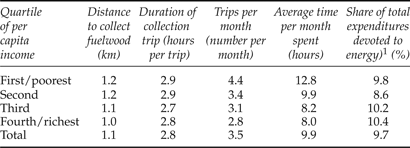
Sample households spend, on average, 10 per cent of their expenditures on energy in the form of coal, electricity and LPG, with little difference across income categories (9.8 per cent for the poorest/first and 10.4 per cent for the richest/fourth quartile, see table 2).Footnote 9 In addition, many households, and women in particular, spend a considerable amount of time collecting biomass fuels. For example, households in the first income quartile report spending 13 hours per month collecting fuelwood, at an average distance of 1.2 km from the house.
Households spend on average around 10 hours collecting fuelwood, and more for poor households
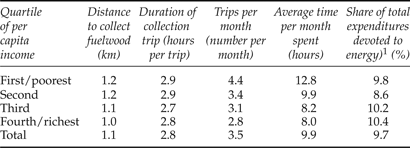
Notes: Based on 1,899 households reporting non-zero fuelwood collection time. Energy expenditures refer to cash spending on coal, electricity and LPG.
So, what is the prospect for greater uptake of biogas and what is its potential for achieving environmental, economic and health benefits? These are the questions pursued in the remainder of the paper.
3. Descriptive analysis suggests substantial benefits from biogas use
Cross-sectional data do not allow us to control adequately for the fact that biogas adoption is non-random and that adopters may differ in systematic and unobserved ways from non-adopters. Nor do such data permit protection against the fact that the areas where biogas services are offered may systematically differ from those where it is not offered, which may in itself affect biogas adoption – the so-called ‘program placement effects’, in econometric jargon. Fully cognizant of these limitations, the results below are not presented as proof of environmental, economic or health effects as such, but rather as indications that the popularity of biogas reported in the survey, in conversations with users during our field visits, and in personal conversations with other researchers studying biogas, may well be grounded in benefits felt on the ground.Footnote 10
Where possible, the robustness of the preliminary findings based on a bivariate breakdown is further explored using multivariate analysis. In particular, a series of observed household characteristics and village-level fixed effects is included to help protect against potential estimation bias from household heterogeneity and program placement, respectively. The former only provides partial protection, as it does not control for unobserved heterogeneity. The latter, on the other hand, helps overcome potential estimation bias from program placement effects, which might follow from non-random selection of villages into the (subsidized) biogas service program. As many renewable energy studies have had to rely on relatively small, purposively selected samples from a limited number of villages, they could often not properly control for placement effects or the village characteristics more broadly. The study here further adds value through its relatively larger and more diverse sample.
3.1. Environmental benefits
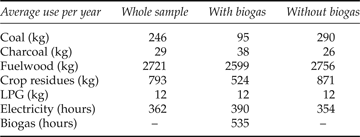
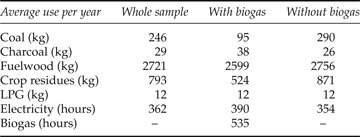
Bivariate comparison of energy use among biogas adopters and non-adopters suggests an important degree of fuel switching, with reported annual coal consumption almost 200 kg/per year lower among biogas-adopting households than among non-adopting households (95 kg/year vs. 290 kg/year) (table 3). Adopters also tend to use less fuelwood and crop residues (respectively 157 kg and 347 kg/year less on average). These numbers are suggestive of substantial displacement of dirty fuels among biogas adopters. However, attributing causality to biogas adoption is complicated. Biogas users may, for example, also be richer and thus more likely to use other clean fuels even in the absence of biogas.
Average use of coal, fuelwood and crop residue is lower among biogas users
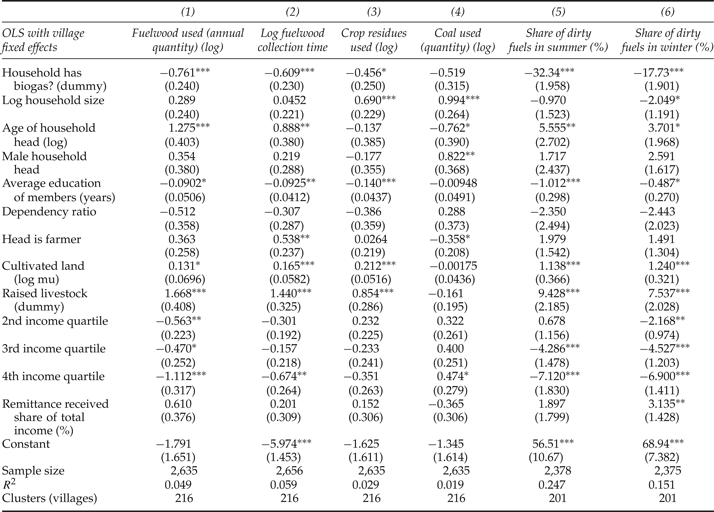
To get a better, though still imperfect, sense of how the adoption of biogas affects the demand for fuelwood, crop residues and coal, the demand for each of these fuels was estimated in a multivariate setting. Key household characteristics such as the demographic and educational characteristics of the household, its possession of land, the main occupation of the household head and its reliance on remittance income are controlled for. The demand equations were further augmented with village-level fixed effects to control for unobserved village-level factors.Footnote 11 Consumption of different fuels is expressed as quantities used annually (of fuelwood, crop residues and coal), as total weekly fuelwood collection time, and as the share of dirty fuels in total energy use (expressed in time spent cooking with each fuel). The equations are estimated using ordinary least squares (OLS) with village fixed effects and corrected for clustering at the village level. The results are reported in appendix table A1.
The regressions suggest a statistically significant displacement by biogas of dirty fuels: fuelwood (both quantity (column 1) and reported time spent collecting (column 2)), crop residues (column 3), and the share of all dirty fuels in the fuel mix (columns 5 and 6). While the effect of biogas on coal use is also negative (column 4), at a t-value of 1.64 (=0.519/0.315) the coefficient on biogas is imprecisely estimated. Note that this finding of fuel displacement by biogas is not as obvious as it might seem. Greater total energy consumption combined with energy ‘stacking’ (simultaneous use of multiple fuels) was also a potential outcome.
The results also identify several demographic and wealth variables that influence the fuel mix: for example, the more educated and the more wealthy households consume less dirty fuel overall, even though households in the richest quartile also consume more coal, as suggested by the bivariate analysis earlier on. Households with more land and those who own livestockFootnote 12 tend to use more fuelwood and crop residues and have a higher share of dirty fuels in their energy mix. These results are unsurprising and broadly consistent with the literature.
3.2. Economic benefits
When it comes to economic and welfare benefits such as time savings and reduced agricultural input costs, adopters nearly unanimously (98 per cent) said biogas saved them time in cooking, mostly women's time: women in households with biogas saved on average 1.2 hours per day in cooking time (median one hour). There were also some time savings for men and children, so the total household time saving for all biogas users was 1.7 hours per day. This is because gas is faster and easier to cook with compared to biomass alternatives.
Adopters also nearly unanimously (99 per cent of biogas users) reported time savings from having to collect less of other fuels. Women in households with biogas reported time savings of 24 days per year on average, men saved 10, and children saved four. Not only are these time savings quite sizeable, and welfare enhancing in their own right, but they are also suggestive of biogas inducing fuel switching away from biomass. One-quarter reported that their time savings were used for more leisure, while the remainder used it for household chores and income-generating activities.
Biogas residues can be used as organic inputs on the farm: 77 per cent of households with biogas used residues as fertilizer in the year prior to the survey, and almost all of those had been able to cut back on other fertilizers. Further, 79 per cent had been able to reduce their use of insecticides as a result of applying biogas residues, and nearly all of them (96 per cent) felt this had improved the quality of their crop.
3.3. Benefits to health
An increasing number of epidemiological studies are linking exposure to IAP from cooking with solid biomass fuels to various health outcomes such as acute lower respiratory infection, chronic obstructive pulmonary disease and lung cancer from coal smoke, and emerging evidence suggests that IAP also increases the risk of other child and adult health problems, including low birth weight, perinatal mortality, asthma, ear infections, tuberculosis and others.Footnote 13
The high risks, combined with the large population of solid fuel users, makes IAP a major global public health issue. In 2000, IAP, mostly from stoves burning solid fuels, was responsible for more than 1.5 million deaths and 2.7 per cent of the global burden of disease, according to the World Health Organization (2007). A meta-analysis of China implicated IAP from solid fuel use in China as responsible for approximately 420,000 premature deaths annually, more than the approximately 300,000 attributed to urban outdoor air pollution in the country (Zhang and Smith, Reference Zhang and Smith2007). Although robust documentation of health effects is not the purpose of the research reported here, the data are suggestive of some adverse impacts of solid fuels on respiratory health, especially among cooks.
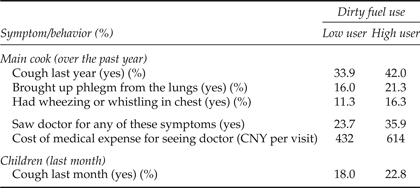
Splitting the sample at the median of dirty fuel use (by time), we find that among the 50 per cent of the households that use dirty fuels the most, 42 per cent reported coughing over the past year compared to 34 per cent among the lower users of dirty fuel in cooking (table 4, numbers refer to the main cook in the household). Bringing up phlegm from the lungs, another indicator of possible respiratory illness, is also slightly more prevalent among higher than lower users of solid fuels (21 compared to 16 per cent) and the same is found for wheezing or whistling in the chest (16 against 11 per cent). Consistently, higher users of solid fuels are more likely to have seen a doctor for one or several of these respiratory symptoms and report higher than average medical expenses for this purpose. Similarly, children below the age of 14 were also more likely to have shown symptoms of cough in the previous month (23 per cent in high dirty fuel using households compared with 18 per cent in low dirty fuel households). These results also appear to carry over to biogas per se, with only 20 per cent of children in households having biogas reporting having coughed last month compared with 24 per cent of children in households without biogas. While these findings are indicative, they need to be confirmed by more solid investigation such as with panel data (or randomized experiments) to control for factors affecting both health outcomes and energy choice to be fully affirmative.
Among adults age 14 and above mainly responsible for cooking, high users of dirty fuels are more likely to report respiratory ill health and related adult health-seeking behavior
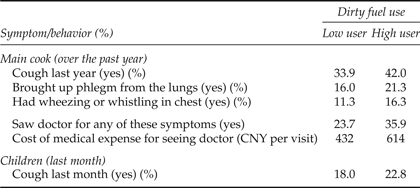
Note: Dirty energy refers to use of coal, charcoal, fuelwood and crop residues in cooking. The table splits the sample into ‘low’ and ‘high’ users, whose use of dirty fuels is below or above the median of dirty fuel use aggregated by time, respectively.
4. Biogas uptake and use
Given the supportive indications that biogas use has benefits for the environment, women's time use, economic welfare (and health), the paper now turns to the factors influencing the uptake, use and suspension of biogas. In the sample, 610 households (22.6 per cent) have installed a biogas digester (as mentioned, biogas users were deliberately oversampled). A large majority (83 per cent) of biogas users in the sample installed it during the last five years and 39 per cent installed it during 2008–2009. Ninety-three per cent of biogas users are satisfied or very satisfied with their system. Only 3 per cent are not satisfied. Taken together with the results reported above, this is grounds for optimism regarding the ability of biogas to deliver on a range of its expected benefits.
4.1. Biogas uptake
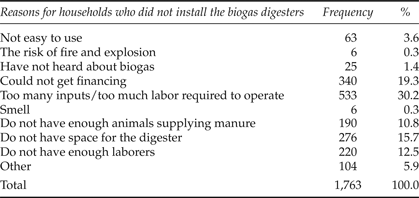
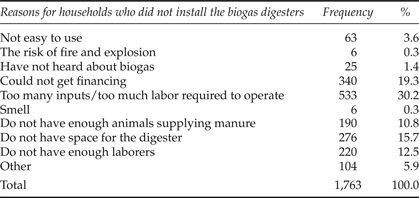
After subsidies, installation of biogas costs households on average CNY1,300 for materials and CNY530 in hired labor, equivalent to US$285 or two months of average household consumption. In addition, households reported spending on average 19 days of their own time on installation and repairs. This underscores the fact that biogas is not suitable for all farm households, in particular not those with limited financial and labor resources. Our survey probed respondents about their reasons for not installing biogas. They often centered on lack of labor, inputs (42.7 per cent) and animals (10.8 per cent) required to operate the biogas digester, as well as on lack of financing to cover the installation costs (19.3 per cent) (table 5). About 16 per cent also mentioned lack of space in the farmyard compound.
Non-adopters frequently mention lack of financing and labor inputs as reason
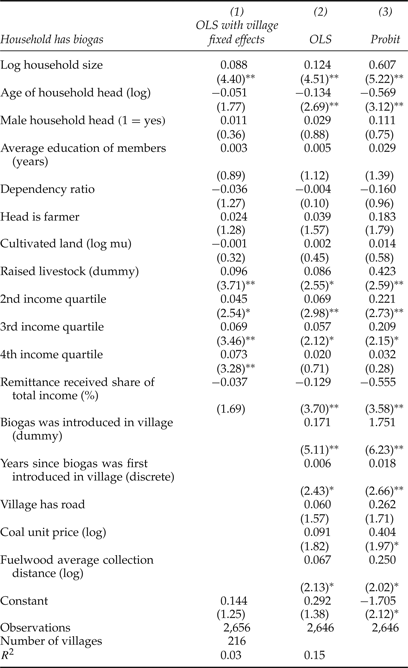
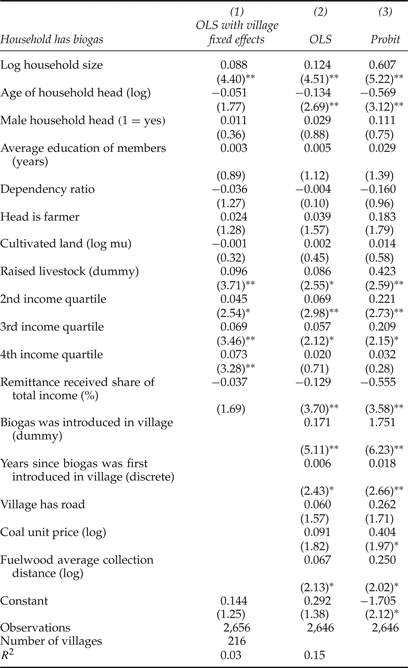
Multivariate regression analysis is used to assess some of the factors that influence the biogas uptake decision (see appendix table A2). The dependent variable is a dummy that takes on the value of one if the household has installed biogas, and zero otherwise. Given the dichotomous nature of the dependent variable and the incidental parameter problem which occurs when including village fixed effects in a probit regression (Hsiao, Reference Hsiao1986; Lancaster, Reference Lancaster2000), the adoption equation is first estimated (column 1) using the linear probability model (OLS) with village-level fixed effects. Controlling for village-level fixed effects helps protect the estimated effects of the household-level variables against all (observed and unobserved) factors that operate at the village level in affecting household demand for biogas and which may also be related to these household variables. Omitting the village-level fixed effects may lead to biased estimates of the effects of the household-level variables. Here, these include household size and dependency ratio (indicators of labor availability), education and occupation of the household head, and income and asset-related variables (such as livestock). The latter is only included as a dummy (and not the number of animals). This mitigates the risk of reverse causality, as it is unlikely that households will start raising livestock in order to produce biogas – there are substantial fixed costs involved, both in raising livestock and installing the biogas equipment, and biogas is only a side product. If biogas makes livestock holding more profitable, livestock holders could, however, increase their numbers, inducing endogeneity.
Furthermore, to get some sense of the effects of different supply and demand side variables, many of which operate at the village level, such as the availability of a biogas program, the prices of different fuels and the opportunity cost of labor, the village fixed effects were replaced by a number of village-level variables such as: the availability of a biogas program in the village and the year it was first introduced in the village, access to road infrastructure, the market price of coal and the distance to sites of fuelwood collection, averaged over all households in the village. The latter variable is the best available indicator of relative fuelwood scarcity, and thus fuelwood price, given that no market prices for fuelwood are observed.Footnote 14 This enables an assessment of the effect of these variables directly, but no longer controls for unobserved village-level effects. Finally, even though technically not correct, the coefficients in the linear probability model (LPM) yields are easy to interpret and LPM yields quite similar results in practice as the non-linear (probit) model (which also requires assumptions about the underlying data generating process). It has been defended as a valid practical alternative as such (Angrist and Pischke, Reference Angrist and Pischke2008: 103–107). For robustness, the probit estimates are included in column 3.
Results indicate that households raising animals are more likely to have biogas as compared with those who do not raise animals, as are those with larger families and with younger heads. This is consistent with the reported labor and animal shortages as key reasons for non-adoption. The dependency ratio does not have significant impact. The probability of adoption increases with income, while it decreases with the share of that income stemming from remittances, highlighting the importance of continuous labor availability at home. Concerning the village characteristics, biogas adoption appears to respond positively to: the prices of coal and the average fuelwood collection time, suggesting a substitution effect; village road infrastructure; and the number of years since biogas was first introduced in the village, suggesting gradual diffusion.
4.2. Use of biogas
Almost all households (93 per cent) with biogas used it for cooking. For nearly all of them, the quantity of gas generated was sufficient or nearly sufficient to cover their needs during the summer. But during the winter, it was only sufficient for half of them (the colder temperatures during China's two to three winter months reduce the digestion speed). Only 60 per cent of biogas adopters had received technical training in how to make best use of the biogas residues. Most of that training was delivered by government officials and most of the farmers who had received the training were fully or partly satisfied. However, only 64 per cent of trainees were aware that biogas residues could also be used to soak the seeds before they are planted, suggesting some scope for further optimization of biogas utilization.
4.3. Suspension and interruption
Biogas, like other similar energy technologies, can be susceptible to problems with technical reliability and consumer acceptance. In 2007, of the 26.5 million biogas digesters installed in China's rural areas, only 60 per cent were operating normally, with some sort of problem affecting the remainder. The majority of this appears to stem from technical problems and poor follow-up services and to occur during the first year after installation (Chen et al., Reference Chen, Yang, Sweeney and Feng2010b).
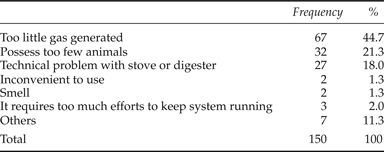
The findings here shed additional light and indicate a far more positive picture than these national statistics. Although 36 per cent of households that ever adopted biogas reported some interruption in use (mostly during the first year), this was often a temporary interruption rather than a permanent suspension. Rather than flaws in the equipment, survey responses make it clear that interruption often stems from temporarily stocking too few animals, sometimes in combination with cold winter temperatures that slow down digestion (table 6). Two-thirds of the households reporting biogas interruption cite issues with insufficient quantity of gas and too few animals to supply the dung needed to keep the system operating.
Supply interruptions are mostly caused by lack of animal waste, the feedstock for the digesters
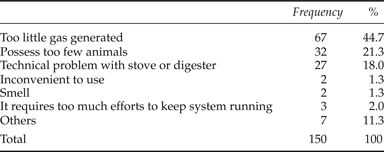
These two reasons (insufficient gas and too few animals) amount to the same, as the key reason for insufficient gas production is shortage of animals, in particular pigs, which supply the feedstock for the digester. Animal ownership fluctuates over the year, as it is customary to sell or slaughter pigs in winter in time for the Lunar New Year celebration and to restock a few months later. Among households reporting biogas interruption, one-quarter did not raise any animals and the remainder reported double as many days without pigs (110 vs. 55 days/year) compared with those who did not report interruption.
In the sample, 11 per cent of biogas users have experienced some technical problem with their system for a host of reasons. However, almost all of them were able to get their system repaired, mostly quite easily and at low cost (89 per cent spent less than CNY100 on the repair, which was usually done by government-employed technicians). Delays until repairs may also account for some of the observed interruptions. In addition, there are more interruptions among households who did not receive technical information and training on biogas use and maintenance (some 14 per cent of adopters reported not having received information, which is problematic given the relative technical complexity of the system).
These findings suggest a need for careful targeting of biogas to households with a sufficiently large and stable pig holding and a role for training and information dissemination to potential adopters. They also suggest that the post-installation services work satisfactorily in the sampled areas. It is speculated that technical standards of the digesters and of post-installation services may have improved over time, accounting for better results now as compared to the past. The importance of good post-installation services for success was regularly emphasized by the policy makers during our visit.
5. Conclusions
Clean and safe rural energy is an important component of green growth and sustainable development, with biogas being a clean and renewable energy technology that appears to hold substantial promise. Biogas converts waste to useful energy, reduces greenhouse gas emissions, helps phase out solid fuels, improves IAP and respiratory health, and saves time on fuel collection. Many of its benefits are felt disproportionately by women. Worldwide, biogas uptake is nowhere near potential, making scaling up of biogas seem an easy win for sustainable development strategies.
Using purposively collected data with a sample size of 2,700 households from 225 villages in five provinces, this study provides a preliminary assessment of China's experience in scaling up smallholder biogas, thereby learning from what is by far the world's most ambitious push to take smallholder biogas to scale, and one with long antecedents. The paper finds grounds for optimism. Rural biogas in the sampled areas of China appears to deliver on most of its purported benefits. Farmers know, accept and like biogas. There are clear indications of benefits on the ground, in the form of: time savings from reduced fuelwood collection and easier cooking that disproportionately benefit women; indications of productive use of biogas by-products; signs of partial displacement of fuelwood and crop residues in response to biogas adoption, with mixed indications regarding displacement of coal; and weak suggestions of benefits to respiratory health. Moreover, problems with interruption of biogas, whether due to technical or human factors, were relatively minor, and temporary, with most equipment breakdown getting repaired with modest delay and expense. This is reassuring, given the uneven implementation record of many household energy interventions in the past.Footnote 15
In other words, the findings indicate that current approaches to rolling out biogas are far more promising than past efforts associated with large-scale abandonment. While the data do not permit explicit comparison to past programs, key differences in affordability, targeting, technical services and forest scarcity in some localities appear important. The biogas program studied here is relatively affordable: not only are the digesters subsidized, but income in rural China has increased considerably, thanks in part to remittances. It is also targeted at those who can best make use of it, namely farmers with at least three pigs, rather than spread widely. Further, the survey responses suggest that China has addressed some of the technical and managerial problems that plagued earlier biogas programs. Finally, it is possible that growing scarcity of fuelwood and forest resources in some localities may give added impetus to biogas adoption.
Moving forward, it will be important to re-assess the findings in light of panel data using impact evaluation methodologies. In this, health impacts should be given particular attention. While it seems clear that biogas can promote the reduction (but not the elimination) of polluting fuels with highly adverse consequences for respiratory health, the health impacts of biogas proved difficult to identify directly with the data at hand. Better data on health and IAP will be required. The findings further suggest that biogas is not suitable for all farmers. The requirements for successful biogas adoption and operation include: reliable post installation services; a sufficient number of penned animals; appropriate temperatures and preferably mild winters; and adequate resources to afford and to finance the upfront investment. Many smallholder farmers meet these criteria, but not the very poorest. Other energy and policy solutions will be needed for rural households who do not meet these requirements.
Appendix: Regressions
Correlates of fuel use

Correlates of biogas adoption