Introduction
Water scarcity raises a soaring concern in the Mediterranean region, as higher temperatures and more frequent drought events are projected to occur due to climate change. Furthermore, changes in the hydrological cycle, including decreases and increases in winter and autumn precipitation amounts, respectively, are also anticipated in most areas (Giannakopoulos et al., Reference Giannakopoulos, Kostopoulou, Varotsos, Tziotziou and Plitharas2011).
Alfalfa (Medicago sativa L.) is the main perennial forage legume in the Mediterranean basin, owing to its suitability to low-input conditions, its positive effects on soil fertility, as well as the high protein concentration and nutritive value of its forage (Campiglia et al., Reference Campiglia, Caporali, Barberi, Mancinelli, Olesen, Eltun, Goodlimg, Jensen and Köpke1999; Huyghe, Reference Huyghe2003). In addition, alfalfa's ability to extract water, through its deep rooting system, offers better exploitation of water table in late spring and makes it a rather more drought-tolerant crop in comparison with other perennial legumes. Also, its capacity to cease vegetative growth during summer contributes to a faster resumption of growth when the rains come in early autumn (Sheaffer et al., Reference Sheaffer, Tanner, Kirkham, Hanson, Barnes and Hill1988; Humphries and Auricht, Reference Humphries and Auricht2001; Volaire, Reference Volaire2008; Annicchiarico et al., Reference Annicchiarico, Pecetti, Abdelguerf, Bouizgaren, Carroni, Hayek, M'Hammadi Bouzina and Mezni2011; Norton et al., Reference Norton, Li, Xu, Price, Tyndall and Hayes2021).
Alfalfa cultivars and breeding materials are commonly compared in different environments for selection and/or recommendation purposes. Due to the differences in genotype adaptability to various environments, genotype × environment interactions (GEI) frequently occur, perplexing cultivar recommendation and affecting genetic improvement (Annicchiarico, Reference Annicchiarico1992). The highest yielding alfalfa cultivars may not be stable across environments (Hakl et al., Reference Hakl, Mofidian, Kozova, Fuksa and Jaromír2019), while the higher drought stress intensity is accompanied by greater trait variability among genotypes and increased GEI (Moghaddam et al., Reference Moghaddam, Raza, Vollmann, Reza Ardakani, Wanek, Gollner and Friedel2015). The exploitation of specific adaptation has been proposed as an ecological means to raise selection gains relative to breeding for wide adaptation since fitting cultivars to a specific environment can contribute to more sustainable agriculture instead of altering the environment via costly inputs (Ceccarelli, Reference Ceccarelli, Cooper and Hammer1996). However, selection for wide adaptation is more desirable because it simplifies the selection, production and marketing of varieties across a wide range of environments. Nevertheless, evaluation of alfalfa cultivars in Italy indicated that selection for wide adaptation was of lower efficiency, relative to specific selection because GEI were mostly dependent on drought stress conditions during summer and the soil type of each location (Annicchiarico and Piano, Reference Annicchiarico and Piano2005; Annicchiarico et al., Reference Annicchiarico, Bottazzi, Ruozzi, Russi and Pecetti2020). Yet, significant genetic variability in water use efficiency has been recorded in alfalfa germplasm (Johnson and Tieszen, Reference Johnson and Tieszen1994), and the efficiency of crop improvement for variable stress environments can be enhanced by identifying morpho-physiological and developmental traits associated with higher water use efficiency (Van Oosterom et al., Reference Van Oosterom, Whitaker, Weltzien, Cooper and Hammer1996; Anower et al., Reference Anower, Boe, Auger, Mott, Peel, Xu, Kanchupati and Wu2017).
Alfalfa is the most widely grown forage crop in Greece, occupying 119 000 ha with a mean annual hay yield of 7.0 t/ha in rainfed environments (Hellenic Statistical Authority, 2019). Currently produced/marketed native cultivars were selected from introduced populations or local ecotypes through mass selection breeding schemes, during the late 1970s and 1980s (Kontsiotou, Reference Kontsiotou2005; Vlachostergios and Baxevanos, Reference Vlachostergios and Baxevanos2015). In general, Greek cultivars are characterized by an erect growth habit as the plants are tall with thick or moderately thick, hollow stems. During winter, they are semi-dormant and show good winter survival and resistance to diseases such as downy mildew (Peronospora trifoliorum de Bary), rusts (Uromyces striatus Schröter), pseudopeziza [Pseudopeziza medicaginis, (Lib.) Sacc.], bacterial wilt of lucerne [Corynebacterium insidiosum (McCulloch 1925) Jensen 1934 (Approved Lists 1980)] and alfalfa mosaic virus (Lucerne mosaic virus) (Kontsiotou, Reference Kontsiotou2005).
Although forage yield potential and persistence of local cultivars are deemed acceptable, there is growing interest to enhance resilience and stability of alfalfa under rainfed or limited-irrigation conditions, since irrigation contributes the most to the annual cost of the crop. Resilience is defined as the ability of a forage system to maintain high yield under adverse environmental conditions, stability describes the minimal variability of yields, while productivity is estimated as the average yield across normal years (Picasso et al., Reference Picasso, Casler and Undersander2019). Moreover, taking into account that climate change is predicted to increase both autumn temperature and precipitation (Giannakopoulos et al., Reference Giannakopoulos, Kostopoulou, Varotsos, Tziotziou and Plitharas2011), selecting alfalfa cultivars that are more winter active could increase the forage yield potential. In addition, due to changes in European Common Agricultural Policy (2014–2020), which includes provisions for extra monetary subsidies for the cultivation of protein crops (Anonymous, 2018), the alfalfa cropping area has expanded in Greece, at the expense, however, of grazing/pasture area.
In Mediterranean countries, increasing livestock numbers, a lowering of water tables and the increased demand for urban water use drive a soaring interest in the cultivation of alfalfa under rainfed conditions or with no irrigation during summer and in rotation with cereal crops (Kontsiotou, Reference Kontsiotou2005; Annicchiarico et al., Reference Annicchiarico, Pecetti, Abdelguerf, Bouizgaren, Carroni, Hayek, M'Hammadi Bouzina and Mezni2011; Achir et al., Reference Achir, Annicchiarico, Pecetti, Khelifi, M'Hammedi-Bouzina, Abdelguerfi, Meriem Laouar and Annicchiarico2020). For these reasons, new cultivars have been introduced from abroad and new local ones are tested. However, there is a lack of information on cultivar resilience, productivity and stability under rainfed conditions.
The objectives of this study were to: (i) monitor the performance of 20 alfalfa cultivars, of diverse origin, in terms of their forage yield and nutritive value under rainfed Mediterranean conditions, and (ii) identify adaptive genotypes and responses contributing to high productivity and resilience for use in future breeding programs.
Materials and methods
Site and experiment set up
A field experiment was established in 2013 and lasted up to 2017 in the Institute of Industrial and Fodder Crops (39°36′N, 22°25′E, 77 m a.s.l.), Larissa, Greece. The experimental site was left fallow in the previous season, and seedbed preparation included mouldboard plough, disc harrow and cultivator. The soil was a clay loam (CL) Vertisol with pH 7.86 (1 : 1 in H2O), organic matter content 176 g/kg, N-NO3 15 mg/kg, P-Olsen 13 mg/kg, CH3COONH4-extracted K 152.0 mg/kg and CaCO3 120 g/kg (0–30 cm depth).
The experiment was arranged as a randomized complete block design in triplicate with 20 alfalfa cultivars. Each plot consisted of six, 7 m long rows at 0.25 m spacing (10.5 m2), separated by a 1 m buffer zone. The blocks were separated by a 2.5 m buffer zone. Seeding was conducted by hand in April 2013 at a seeding rate of 15 kg/ha. Basal fertilization of 32 kg N/ha (as 26-0-0) and 70 kg P2O5/ha (as 0-20-0) was applied before seeding and incorporated into the soil. In the following growing seasons, 90 kg P2O5/ha were applied in late autumn. Alfalfa seeds were not inoculated with rhizobia, but satisfactory root nodulation was verified by visual examination. The plots were kept free of weeds by hand-weeding when necessary.
During the 2013 growing season, the trial was irrigated five times after seeding, using a centre pivot and supplying ca. 30 mm/irrigation, to ensure good stand establishment. No further irrigation was applied afterwards. Additionally, two commercial cultivars (‘Yliki’ and ‘Blue Ace’), representing different fall dormancy (FD) groups (‘Yliki’, FD = 6 and ‘Blue Ace’, FD = 9), were established in an irrigated field next to the experimental site. Each cultivar was sown in three plots of the same dimensions (10.5 m2) with the experimental plots. The irrigated checks were established to indicate the yield potential under optimal water inputs. Irrigation doses were applied according to local practices: once before first and fifth harvests, and twice before second, third and fourth harvests. Thus, the irrigated checks received ca. 240 mm of water over eight applications.
The climate of the region is semi-arid in the cool version (Köppen: BSk), but it is close to a hot summer Mediterranean climate and is classified as Csa (temperate climate with a hot-dry summer) by the Köppen–Geiger system (Peel et al., Reference Peel, Finlayson and McMahon2007). The annual precipitation is ca. 427 mm (30-year average). Precipitation and temperature variables for the five seasons of the study are presented in Table 1. The wettest growing season was 2014 (493 mm), whereas 2015 was the driest (418 mm). Average precipitation during the rainfed 4-year cycle (2014–17) was 451 mm, whereas during the growing season (April–October), it was 232 mm, with the exception of the driest 2015, when precipitation was recorded at 159 mm. The hottest summer (June–August) was in 2017, and the coolest in 2014. The irrigated checks were supplied, on average, with 478 mm (50.2% more than the rainfed field).
Precipitation (Prec., mm) and temperature (T, °C) variables in the 5 years of evaluation at the experimental site

Genetic material
Twenty entries of M. sativa L. were used in the experiment. Specifically, nine entries were from Greece, including eight cultivars and the ecotype ‘Serron’, originating from the Serres region in Central Macedonia, Greece. All nine entries were classified as semi-dormant, with the exception of ‘Cheronia’, which was a winter-active. Four cultivars were from Australia, with ‘Icon’ being reported as semi-dormant, and the others (‘Blue Ace’, ‘Almasa’, ‘Evergreen’) being winter-active. Last, three Italian, semi-dormant cultivars (‘Prosementi’, ‘Claudia’, ‘Gea’) and four cultivars from the USA (winter-active ‘Maxima’ and ‘59N59’ and the semi-dormant ‘Ultima’ and ‘57Q53’) were also tested.
Yield and agronomic measurements
The plots were mechanically harvested at the beginning of flowering [BBCH 60, (Enriquez-Hidalgo et al., Reference Enriquez-Hidalgo, Cruz, Teixeira and Steinfort2019)], by cutting the plants at 5 cm above soil level. At each harvest, fresh weights were measured and a subsample of ca. 1 kg was randomly selected from each plot and dried to constant weight at 65°C.
No data were recorded during the establishment growing season (2013). During the next four growing seasons (2014–17), the plots were harvested five times per season (H1 to H5) and harvest occasions were grouped as follows: H1: mid-spring (7–16 May), H2: late-spring (15–20 June), H3: summer (25–29 July), H4: late summer (6–11 September), H5: autumn (20–23 October). The dry weight of each plot was used to calculate the dry matter yield (DMH1–5) in t/ha in each harvest. The sum of the five harvests per season represented the annual DM (DMA) of each cultivar. The sum of the DMA was the total DM (DMT) over the four growing seasons (2014–17). The ratio of DMH1–5 to DMA (R H1–5, g/kg) was calculated to assess the seasonal distribution of DM.
Just before the first harvest, on ten randomly selected main stems (one per crown) in each plot, the following agronomic traits were determined:
• Plant height (PH): as the distance (cm) from the soil surface to the uppermost point of the stem.
• Number of nodes (NN): as the total number of main stem nodes.
• Node distance (ND): as the ratio of PH to NN (cm).
• Natural plant height (NPH): it was measured, ca. 25 days after the fifth harvest, using a score on a 1 to n scale with each increment of 5 cm.
The NPH was used as an indicator of autumn growth to assess cultivar winter activity and approximate FD (Teuber et al., Reference Teuber, Taggard, Gibbs, McCaslin, Peterson and Barnes1998), as the more fall-dormant cultivars would be very decumbent, while the least fall dormant cultivars would be upright and tall. For all the traits, the 10 measurements per plot were averaged and the mean was the value of each plot.
Measurements on the initial plant density (IPD) and final plant density (FPD) were performed by counting plants in 1.0 m row length in third and fourth rows of each plot in the same spot at the first and last counts. The IPD count was performed in the 2014 growing season, while the FPD count was conducted after the last harvest in 2017. The plant survival (Survival) was determined according to Ventroni et al. (Reference Ventroni, Volenec and Cangiano2010) as:

Quality assessments
Quality traits were assessed from samples taken during the second harvest of the four growing seasons (2014–17). Dried sub-samples were ground to pass a 1-mm screen and their total N concentration (g/kg) was determined using the Kjeldahl method, while crude protein concentration (CP) was calculated as the product N × 6.25 (AOAC, 2000). Neutral detergent fibre (NDF) and acid detergent fibre (ADF) were determined according to Van Soest et al. (Reference Van Soest, Robertson and Lewis1991), using an ANKOM 220 Fiber Analyzer (ANKOM Technology Corporation, NY, USA) and relative feeding value (RFV) was calculated according to Jeranyama and Garcia (Reference Jeranyama and Garcia2004) as:

Statistical analysis
A two-way analysis of variance (ANOVA), referred to the cultivar × year (C×Y) model, using the mixed procedure, considered cultivars and years as fixed factors and blocks as a random factor, was performed (Annicchiarico, Reference Annicchiarico2002). The means were compared using the least significant difference (LSD) test at α = 0.05.
Cultivar resilience was calculated according to Picasso et al. (Reference Picasso, Casler and Undersander2019). The third growing season (2015) was considered as a crisis year because the yield was reduced (by 41%) in comparison to productive years across the entire trial. Cultivar productivity was calculated from the mean DMA of the normal years (2014, 2016 and 2017), while cultivar resilience was estimated as the ratio of the DMA in the crisis year (2015) to the productivity of the normal years. Therefore, the higher the yield of a cultivar in the crisis year, the higher the resilience of the cultivar.
Pearson phenotypic correlation coefficients (r) between agronomic traits, yield and quality were calculated to identify the most prominent correlations. To avoid spurious self-correlations (Kenney, Reference Kenney1982), coefficients were not estimated for interconnected traits e.g. FPD and Survival. The analyses were performed using the statistical software IBM SPSS package v. 23 (IBM Corp., New York, USA).
Genotype plus genotype × environment (GGE) biplot analysis was used for analysing C×Y interactions and ranking cultivars for yield and stability. The advantage of the GGE biplot model is the removal of the noise caused by the environment main effect and generates biplots based on G+GE, which are relevant to cultivar evaluation (Yan and Kang, Reference Yan and Kang2003; Baxevanos et al., Reference Baxevanos, Goulas, Tzortzios and Mavromatis2007). The GGE biplot analysis was performed using the software package GGE Biplots in R version 1.0-8 (Frutos et al., Reference Frutos, Galindo and Leiva2014).
Results
Dry matter (DM) yield
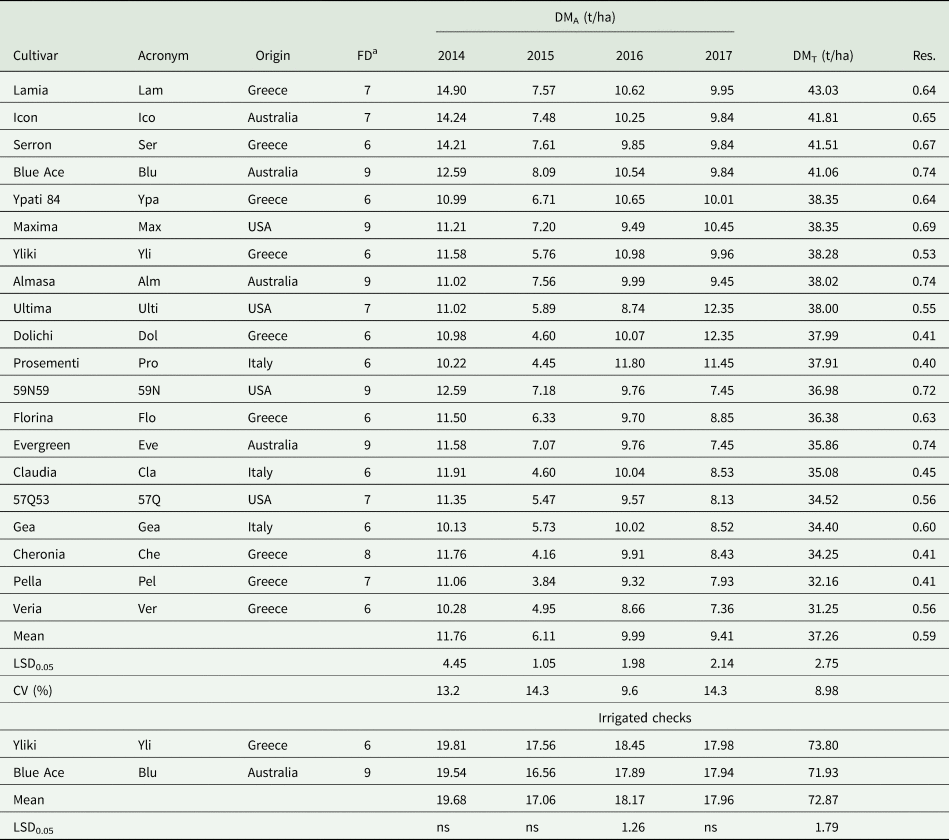
Year (Y), cultivar (C) and the C×Y interaction had significant effects on DMA (Table 2). The most productive year was 2014 (mean DMA, 11.76 t/ha), whereas the least productive was 2015 (6.11 t/ha). Under rainfed conditions, cvs. ‘Blue Ace’ and ‘Yliki’ produced less DMT in comparison to the respective irrigated checks, by 42.9% and 48.1%, respectively. Under irrigation, cv. ‘Yliki’ was significantly superior in DMT to ‘Blue Ace’, whereas under rainfed conditions, the opposite was evident (Table 3).
Statistical probabilities of F-criterion of the 20 cultivars tested for four years (2014–2017) after the year of establishment (2013)

D.F., degrees of freedom; DMA, annual dry matter yield; CP, crude protein concentration; NDF, neutral detergent fibre; ADF, acid detergent fibre; RFV, relative feeding value; PH, plant height; NN, number of nodes; ND, node distance; NPH, natural plant height.
* and **: significance at P < 0.05 and 0.01. respectively.
Comparisons for annual and total dry matter yield (DMA, DMT) and resilience (Res., it was estimated as the ratio of DMA in the crisis year of 2015 to the DM of the normal years) of the 20 alfalfa cultivars tested over four years (2014–2017)

ns, not significant.
a FD, fall dormancy degrees correspond to: 6 and 7 semi-dormant and 8 and 9 winter-active.
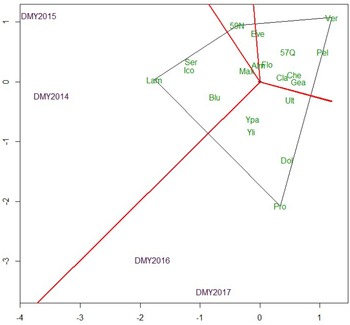
The GGE biplot for the four years, with the ‘which-won-where’ pattern, indicated crossover interactions with two groupings. Specifically, cv. ‘Lamia’ was the best performing cultivar in 2014 and 2015, followed by ‘Serron’, ‘Icon’, ‘Blue Ace’ and ‘Maxima’, whereas in 2016 and 2017, cv. ‘Prosementi’ yielded higher, followed by ‘Dolichi’, ‘Yliki’, ‘Ypati 84’ and ‘Ultima’ (Fig. 1).
GGE biplot with the ‘which-won-where’ pattern based on four-year annual dry matter yield (DMA) data and the winning cultivars. Cultivar acronyms are given abbreviated by the first three letters (Table 3). The vertex genotype for each group is the one that gave the highest DMA for the years that fall within that sector. PC1 = 41.27. PC2 = 30.95. Sum = 72.22.

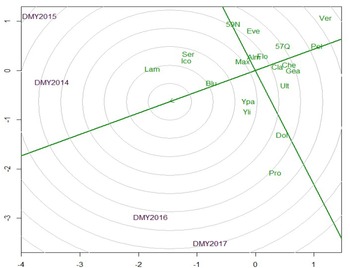
The four top-yielding cultivars in DMT were ‘Lamia’ (43.03 t/ha), ‘Icon’ (41.81 t/ha), ‘Serron’ (41.51 t/ha) and ‘Blue Ace’ (41.06 t/ha), which did not differ significantly (Table 3). GGE biplot analysis for comparing cultivars with the ‘ideal’ for DMA and stability showed that the most desirable cultivars were, in descending order, ‘Blue Ace’, ‘Lamia’ > ‘Icon’, ‘Serron’ > ‘Maxima’, ‘Yliki’, ‘Ypati 84’, whereas ‘Blue Ace’ was the most stable; zero projection in the horizontal mean–environment axis (Fig. 2). In 2015, the lowest yielding season, the five most resilient cultivars were ‘Blue Ace’, ‘Maxima’, ‘Almasa’, ‘59N59’ and ‘Evergreen’ (Res. = 0.69–0.74), followed by ‘Lamia’, ‘Icon’ and ‘Serron’ (Res. = 0.64–0.67) (Table 3).
GGE biplot for comparing alfalfa cultivars with the ‘ideal’ for annual dry matter yield (DMA) and stability. Cultivar acronyms are given abbreviated by the first three letters (Table 3). The centre of the concentric circles represents the position of an ‘ideal’ genotype, otherworldly, a genotype with both high mean DMA and high stability. PC1 = 41.27. PC2 = 30.95. Sum = 72.22.

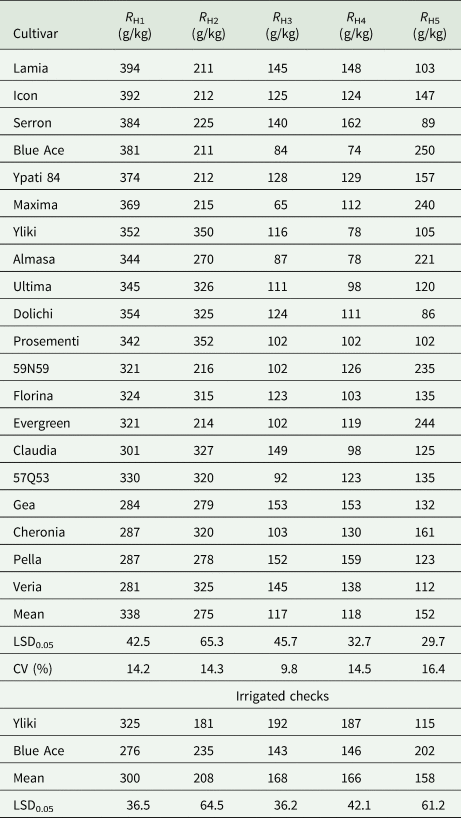
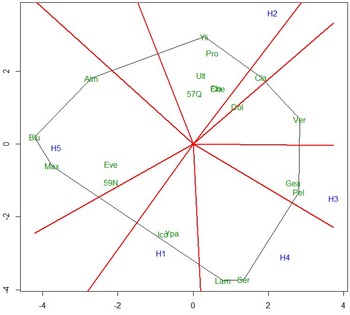
There were significant differences among the cultivars for the seasonal yield distribution as expressed by R H (Table 4). Most of the cultivars showed high R H1 values; the mean was 338 g/kg, much higher than the respective values in summer (R H3, R H4) and autumn (R H5). It is noteworthy that the higher-yielding cultivars, namely ‘Lamia’, ‘Icon’, ‘Serron’ and ‘Blue Ace’, had higher R H1 compared to lower-yielding ones. Regarding R H5, the highest was recorded in winter-active cultivars (‘Blue Ace’, ‘Maxima’, ‘Almasa’, ‘59N59’ and ‘Evergreen’). The introduced, winter-active cv. ‘Blue Ace’ and the semi-dormant ‘Icon’ achieved higher R H5 (by 160.4 and 52.0%, respectively) compared to older, high-yielding, semi-dormant cultivars (‘Lamia’ and ‘Serron’). Moreover, high-yielding, semi-dormant cvs. ‘Lamia’, ‘Icon’ and ‘Serron’ had significantly higher R H3 and R H4 values (by 77.9%) in comparison to winter-active ‘Blue Ace’. However, cvs. ‘Lamia’ and ‘Serron’ showed higher R H3 and R H4, by 88.3 and 19.4%, compared to ‘Blue Ace’ and ‘Icon’, respectively.
Comparison of harvest ratios (R H, g/kg) of the five harvest occasions for the 20 alfalfa genotypes tested for four years (2014–2017)

The cultivars are listed in descending order from the highest yielding to the lowest yielding
Regarding the comparison for R H between rainfed v. irrigated checks (Table 4), under rainfed conditions, R H1 and R H5, on average, were higher (by 11.8% and 12.3%, respectively), but R H3 and R H4 were lower (by 47.3%). Under rainfed conditions, cv. ‘Blue Ace’ had higher R H5 compared to ‘Yliki’, whereas ‘Yliki’ had higher R H1 under irrigation. The GGE biplot analysis for R H across the four years, with the ‘which-won-where’ pattern, grouped the winter-active, high-yielding cultivars (‘Blue Ace’, ‘Maxima’, ‘Almasa’, ‘59N59’ and ‘Evergreen’) in R H5 (Fig. 3).
GGE biplot with the ‘which-won-where’ pattern based on four-year harvest ratios (R H) of the five harvest occasions (H1 to H5). Cultivar acronyms are given abbreviated by the first three letters (Table 3). The vertex genotype for each group is the one that gave the highest R H for the cultivars that fall within that sector. PC1 = 46.39. PC2 = 29.37. Sum = 75.76.

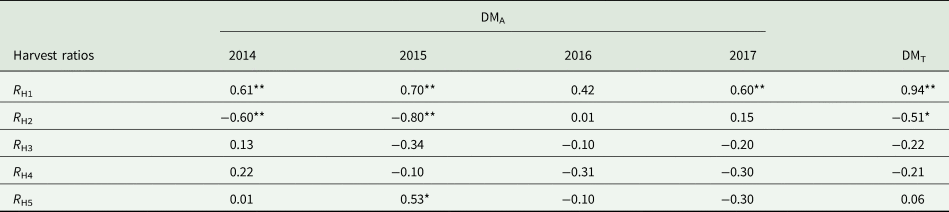
There were positive correlations between R H and DMA or DMT (Table 5). R H1 was moderately associated with DMA in 2014 (r = 0.61, P < 0.01), 2015 (r = 0.70, P < 0.01) and 2017 (r = 0.60, P < 0.01), while over the years, it was strongly correlated with DMT (r = 0.94, P < 0.01). R H5 was moderately associated with DMA in 2015, the lowest yielding season (r = 0.53, P < 0.05).
Correlation coefficients of the five harvest ratios (R H) to annual and total dry matter yield (DMA and DMT, respectively)

Correlation coefficients (n = 20) superscripted with * or ** were significant at P < 0.05 or 0.01, respectively.
Quality traits
There were significant differences between cultivars for CP, NDF, ADF and RFV, whereas C×Y interaction was not significant (Table 2). The over-year mean comparisons indicated small differences among cultivars for CP. Among the top-yielding cultivars, ‘Icon’ and ‘Blue Ace’ had higher CP by 33.6 g/kg compared to ‘Lamia’ and ‘Serron’ (Table 6).
Over-year mean comparisons of CP, NDF, ADF and RFV for the 20 alfalfa genotypes tested

ns, not significant.
The cultivars are listed in descending order from the highest yielding to the lowest yielding.
The variation among the cultivars for ADF and NDF was small. Cultivar ‘Cheronia’ had significantly lower ADF, while cvs. ‘Ultima’ and ‘Cheronia’ had the lower NDF values. The four top-yielding cultivars showed no significant differences for RFV (Table 6).
Irrigated checks produced slightly lower CP and RFV (by 2.8 and 19.5 g/kg, respectively) and higher ADF and NDF (by 11.7 and 24.2 g/kg, respectively).
Agronomic traits
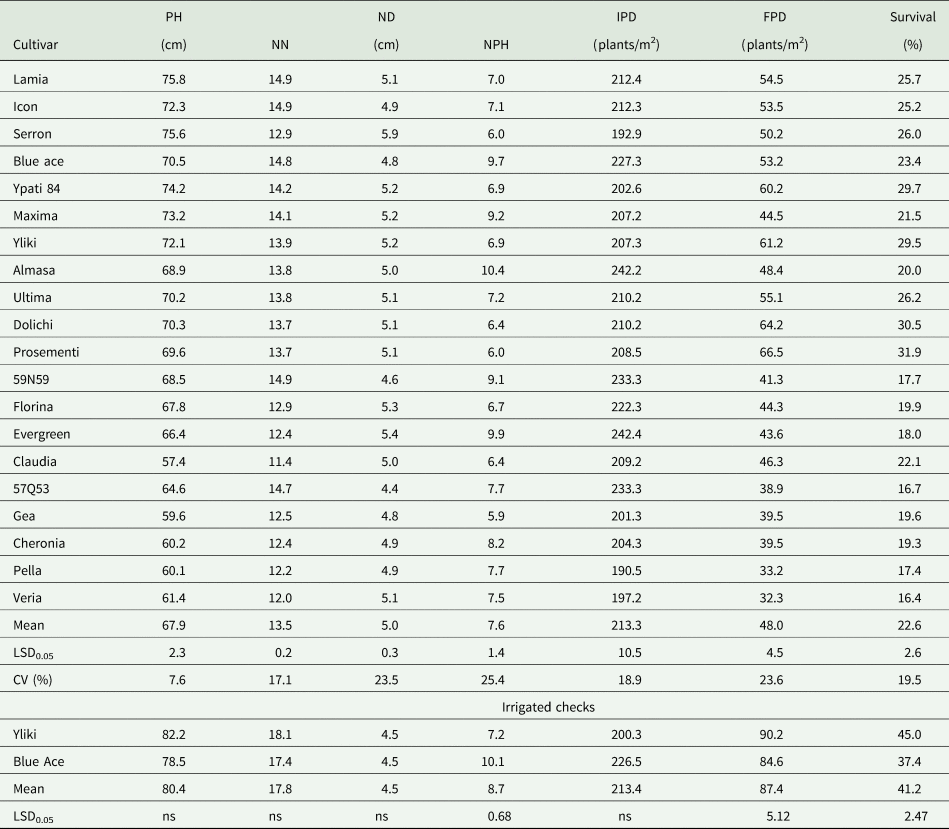
Significant differences were found between cultivars regarding plant height (PH), number of nodes (NN), node distance (ND) and natural plant height (NPH), whereas the interaction C×Y was significant for PH and NPH (Table 2). Cultivars ‘Lamia’, ‘Serron’ and ‘Ypati 84’ were significantly taller, with a trend of the high-yielding cultivars to be taller (>70 cm, Table 7). In this line, the top-yielding cultivars showed higher NN (>14), excluding ‘Serron’, which had 12.9 nodes. As expected, a negative pattern was evident for ND.
Over-year mean comparisons of PH, NN, ND, NPH, IPD, FPD and plant survival

ns, not significant.
The cultivars are listed in descending order from the highest yielding to the lowest yielding.
With respect to NPH, which was measured ca. 25 days after the last harvest, winter-active cultivars ‘Blue Ace’, ‘Maxima’, ‘Almasa’, ‘59N59’ and ‘Evergreen’ had high NPH (>9), which was highly correlated with FD (r = 0.94, P < 0.01, data not shown) (Table 3).
Regarding plant survival, cvs. ‘Prosementi’, ‘Dolichi’, ‘Yliki’ and ‘Ypati 84’ had the higher number of remaining plants (29.5–31.9%), corresponding to 60.2 and 66.5 plants/m2 (Table 7). These cultivars were the best-performing during the last two growing seasons (2016 and 2017), as the GGE biplot analysis indicated (Fig. 1). Finally, the irrigated checks were taller, with higher NN and less ND, having a higher number of plants at the end of the last growing season.
As Table 8 shows, positive correlations were found between DMT and PH (r = 0.86, P < 0.01), NN (r = 0.68, P < 0.01), FPD (r = 0.68, P < 0.01) or plant survival (r = 0.65, P < 0.01). Additionally, cultivar resilience was positively correlated with PH (r = 0.46, P < 0.05) and NPH (r = 0.57, P < 0.01), while node distance was negatively correlated with CP (r = −0.71, P < 0.01, data not shown).
Correlation coefficients for PH, NN, ND, NPH, IPD, FPD, plant survival (Survival), cultivar resilience (Res.) and total dry matter yield (DMT) for the four growing seasons

Correlation coefficients (n = 20) superscripted with * or ** were significant at P < 0.05 or 0.01, respectively.
a Not estimated to avoid spurious self-correlation.
Discussion
Rainfed cropping allowed for good persistence over the 4-year rainfed cycle with mean annual precipitation of 451 mm (232 mm from April to October). However, DMT was reduced by 42.9–48.1% with 50.2% less water than the irrigated checks. This was in accordance with Annicchiarico et al. (Reference Annicchiarico, Pecetti, Abdelguerf, Bouizgaren, Carroni, Hayek, M'Hammadi Bouzina and Mezni2011), who reported that yield was reduced 42%, with 61% less water across west Mediterranean environments and the marginal precipitation to sustain yield was defined at just above 100 mm during spring–summer. Furthermore, yield reductions, from 41.6% to 48.5%, were recorded under rainfed conditions in Algeria (Achir et al., Reference Achir, Annicchiarico, Pecetti, Khelifi, M'Hammedi-Bouzina, Abdelguerfi, Meriem Laouar and Annicchiarico2020) and in field trials in Morocco, when irrigation was withheld for nine weeks during summer (Bouizgaren et al., Reference Bouizgaren, Farissi, Ghoulam, Kallida, Faghire, Barakat and Najib Al Feddy2013). There was a strong relation between DMA and seasonal precipitation. Thus, the DMA in the drier season (2015) was reduced by 40.9% compared to the other seasons, in agreement with previous reports (Metochis, Reference Metochis1980; Pecetti et al., Reference Pecetti, Carroni, Annicchiarico, Manunza, Longu and Congiu2008; Annicchiarico et al., Reference Annicchiarico, Pecetti, Abdelguerf, Bouizgaren, Carroni, Hayek, M'Hammadi Bouzina and Mezni2011).
GGE biplot analysis revealed different winners for different growing seasons, with cv. ‘Lamia’ to be the high-yielder in 2014 and 2015 and cv. ‘Prosementi’ in 2016 and 2017. The cross-over interaction might be ascribed to cultivar adaptation responses to water or temperature variability, as well as to differences related to stand persistence or to complex interactions that could not be interpreted with the available data (Annicchiarico et al., Reference Annicchiarico, Barrett, Brummer, Julier and Marshal2015). Since the wet and cool 2014 growing season grouped with the dry 2015 growing season (Fig. 1), it could be assumed that the interactions were not related to the variability in water supply in different years.
Plant persistence is a trait highly valued by breeders because it improves stand longevity (Beuselinck et al., Reference Beuselinck, Bouton, Lamp, Marches, McCaslin, Nelson, Rhodes, Sheaffer and Volenec1994). Persistent genotypes are characterized by the long-term stable or increasing net balance between production and plant loss, whereas those with declining balance are poorly persistent (Nie and Norton, Reference Nie and Norton2009). Overall, DMA reduced as the stands were getting older, but some cultivars were more persistent (i.e., higher plant survival and FPD) and produced similar or even higher yields with stand ageing. For example, the biplot analysis found that the Italian cv. ‘Prosementi’, along with ‘Dolichi’, ‘Yliki’, ‘Ypati 84’ and ‘Ultima’ were the highest yielding in the last growing seasons (2016–17). The differentiation between cultivars in persistence is also explained by the moderate correlation found between plant survival and DMT, whereas the correlation with DMA in 2017, the last year, was stronger (r = 0.83, P < 0.01), in agreement with Bouizgaren et al. (Reference Bouizgaren, Farissi, Ghoulam, Kallida, Faghire, Barakat and Najib Al Feddy2013).
There was also a cross-over interaction between rainfed and irrigated conditions for the two check cultivars (‘Blue Ace’ and ‘Yliki’), indicating the variable response of those cultivars under various water regimes; cv. ‘Blue Ace’ was superior under rainfed conditions, whereas cv. ‘Yliki’ was more productive under irrigated conditions. Performance of alfalfa cultivars in optimum environments was found to be largely unrelated with performance under stressful conditions, especially under severe stress, supporting the selection of varieties specifically adapted to irrigated or severely drought-prone environments (Ceccarelli, Reference Ceccarelli1989; Annicchiarico et al., Reference Annicchiarico, Pecetti, Abdelguerf, Bouizgaren, Carroni, Hayek, M'Hammadi Bouzina and Mezni2011, Reference Annicchiarico, Pecetti and Tava2013; Moghaddam et al., Reference Moghaddam, Raza, Vollmann, Reza Ardakani, Wanek, Gollner and Friedel2015). Cultivar ‘Yliki’ was selected out of cv. ‘Ypati 84’ for high yielding under irrigated conditions, and this was probably the reason for the lower yielding under drought conditions (Kontsiotou, Reference Kontsiotou2005).
Two local cultivars (‘Lamia’ and ‘Serron’) along with the newly imported cvs. ‘Icon’ and ‘Blue Ace’ were the top-performers in DMT, with ‘Blue Ace’ being the most stable. Cultivar ‘Lamia’ is a selection out of ‘Ypati 84’ (Kontsiotou, Reference Kontsiotou2005), whereas ‘Serron’ is a local ecotype, which has been historically cultivated and adapted by farmers. Specific adaptation to severe drought conditions has also been reported in Italian landraces, which had been cultivated in environments with low annual rainfall of ca. 500–600 mm (Annicchiarico et al., Reference Annicchiarico, Pecetti, Abdelguerf, Bouizgaren, Carroni, Hayek, M'Hammadi Bouzina and Mezni2011).
Cultivar resilience is defined as the ability of a forage system to withstand a climatic crisis while maintaining high forage yield, whereas stability describes the minimal variability of yields in the productive years (Picasso et al., Reference Picasso, Casler and Undersander2019). The limitations of the present study were that stability across locations could not be assessed since it was a one-site study, while resilience evaluation was conducted in one year. Thus, based on our four-season, one-site study, the top-yielding cultivars were stable, whereas in other studies the high-yielding alfalfa cultivars were not stable across different locations (Moghaddam et al., Reference Moghaddam, Raza, Vollmann, Reza Ardakani, Wanek, Gollner and Friedel2015; Hakl et al., Reference Hakl, Mofidian, Kozova, Fuksa and Jaromír2019). For the evaluation of resilience, due to low precipitation, 2015 growing season was considered as a crisis year with 40.9% lower DMA compared to wetter seasons. Among the most resilient cultivars in the crisis year were the winter-active ones, a finding which is in accordance with Bouizgaren et al. (Reference Bouizgaren, Farissi, Ghoulam, Kallida, Faghire, Barakat and Najib Al Feddy2013), who concluded that cultivars with high autumn activity had higher DMA after a dry summer. This was ascribed to the ability of the winter-active cultivars to recover faster and hence, take advantage of the first autumn rains. Climate change prediction models are anticipating increases in the number of dry days, by at least 20 days, decreases in winter precipitation by approximately 15%, accompanied by increases in autumn precipitation and minimum temperatures, in Greece for the period 2021–50 (Giannakopoulos et al., Reference Giannakopoulos, Kostopoulou, Varotsos, Tziotziou and Plitharas2011). This might be an opportunity for breeders to take advantage of the more favourable growth conditions in autumn by selecting winter-active genotypes.
Previous studies have indicated that the spring harvest ratio (R H1) is the highest contributor (>30–40%) to the DMA (Bolger and Matches, Reference Bolger and Matches1990; Hoy et al., Reference Hoy, Moore, George and Brummer2002; Zhang et al., Reference Zhang, Kang, Guo, Zhao, Xu, Yan and Yang2014). In the present study, R H1 and R H5 (the autumn harvest ratio) were higher compared to the respective ratios under irrigation (by 11.8% and 12.3%, respectively), whereas the summer harvests (R H3, R H4) were reduced by 47.3%. This might be an adaptive response of the cultivars in using the available resources across the season and an indication that the study of seasonal yield distribution could be effective in the identification of the most adaptive genotypes. Ceccarelli (Reference Ceccarelli1989) concluded that high yields under stressful conditions are associated with morphological and physiological characteristics that are different from those associated with high yielding under optimal conditions. Across our 20 cultivars, R H1 was highly correlated with DMT (r = 0.94, P < 0.01), which is in agreement with the suggestion that spring yield can be a criterion for the selection of high-yielding genotypes (Bolger and Matches, Reference Bolger and Matches1990; Hoy et al., Reference Hoy, Moore, George and Brummer2002; Zhang et al., Reference Zhang, Kang, Guo, Zhao, Xu, Yan and Yang2014). On the other hand, although the winter-active cultivars (‘Blue Ace’, ‘Maxima’, ‘Almasa’, ‘59N59’ and ‘Evergreen’) had high R H5, which was associated with high DMA in the crisis year, can be concluded that high R H5, might be used as a criterion for the selection of genotypes that are responsive to extreme drought.
Volenec et al. (Reference Volenec, Cunningham, Haagenson, Berg, Joern and Wiersma2002), comparing the yield distribution between five harvests for old v. newly released cultivars, argued that the modern cultivars were not improved over the old ones regarding R H1, while higher R H5 was attributed to the elimination of FD. Similarly, in the present study under rainfed conditions, high-yielding, newly introduced cvs. ‘Blue Ace’ and ‘Icon’ achieved equal R H1, but had much higher R H5 (by 160.4% and 52.0%, respectively) in comparison to older, high-yielding cultivars (‘Lamia’ and ‘Serron’), indicating that they were more effective in using environmental resources during autumn.
Recent data indicated that newly released cultivars were more responsive in stressful environments (Picasso et al., Reference Picasso, Casler and Undersander2019). However, in our study, the old, local cultivar ‘Lamia’ and the ecotype ‘Serron’ were equally high-yielding compared to cvs. ‘Blue Ace’ and ‘Icon’. This was attributed to the fact that ‘Lamia’ and ‘Serron’ were more effective in using environmental resources during summer, having R H3 and R H4 higher by 88.3% and 19.4% compared to cvs. ‘Blue Ace’ and ‘Icon’, respectively. According to Annicchiarico et al. (Reference Annicchiarico, Pecetti, Abdelguerf, Bouizgaren, Carroni, Hayek, M'Hammadi Bouzina and Mezni2011), gains from breeding were realized only when modern cultivars were tested in the target region, where they were selected, explaining the poor performance of many introduced cultivars that were cultivated outside the target environment. Additionally, alfalfa cultivar evaluation studies in Italy showed that specific selection provided an estimated advantage of 12.9% relative to the best-performing, widely adapted cultivars, because GEI were mostly dependent on drought stress conditions during summer and the soil type of each location (Annicchiarico and Piano, Reference Annicchiarico and Piano2005; Annicchiarico et al., Reference Annicchiarico, Bottazzi, Ruozzi, Russi and Pecetti2020). This stresses the need for the implementation of local breeding programmes and the adaptation of breeding objectives and selection criteria for selecting responsive genotypes to rainfed or drought-prone environments.
In order to be used as a cost-effective, indirect selection index for evaluating yield potential and quality, one trait should be heritable and easy to measure (Annicchiarico et al., Reference Annicchiarico, Scotti, Carelli and Pecetti2010). Our data showed that tall plants (PH > 70 cm), with more nodes (NN > 14), were more productive. Plant height ca. 25 days after the last harvest in autumn (NPH) was used to approximate FD index (Teuber et al., Reference Teuber, Taggard, Gibbs, McCaslin, Peterson and Barnes1998) and the values were highly related to the FD values reported by the breeders (r = 0.94, P < 0.01).
With respect to forage nutritive value, CP (185.0–228.8 g/kg), ADF (256.2–308.9 g/kg), NDF (315.4–366.5 g/kg) and RFV (>1666.1 g/kg) were indicative of high-quality alfalfa hay (Undersander, Reference Undersander2003). Appreciable genetic differences for these traits have been reported to be inconsistent and the selection progress for improved forage quality is limited (Annicchiarico et al., Reference Annicchiarico, Barrett, Brummer, Julier and Marshal2015; Pecetti et al., Reference Pecetti, Annicchiarico, Scotti, Paolini, Nanni and Palmonari2016). In accordance, we found small differences between cultivars for ADF, NDF and RFV, whereas the most noteworthy was that among the four top-yielding cultivars, ‘Blue Ace’ and ‘Icon’ had higher CP compared to local genotypes ‘Lamia’ and ‘Serron’. Additionally, the rainfed trials produced slightly higher CP, whereas their ADF and NDF were lower in comparison to their irrigated checks. Reduced growth caused by water deficit can result in the reduction of fibre concentration and increase of alfalfa digestibility (Halim et al., Reference Halim, Buxton, Hattendorf and Carlson1990; Pecetti et al., Reference Pecetti, Annicchiarico, Scotti, Paolini, Nanni and Palmonari2016), but the effect of drought on CP has been reported to be inconsistent (Carter and Sheaffer, Reference Carter and Sheaffer1983; Halim et al., Reference Halim, Buxton, Hattendorf and Carlson1990; Petit et al., Reference Petit, Pesant, Barnett, Mason and Dionne1992; Pecetti et al., Reference Pecetti, Annicchiarico, Scotti, Paolini, Nanni and Palmonari2016).
Breeding for enhanced nutritive value has frequently focused on morphological traits that ensure a high leaf-to-stem ratio or stems with shorter nodes, but various findings have been reported (Rotili et al., Reference Rotili, Gnocchi, Scotti and Kertikova2001; Pecetti et al., Reference Pecetti, Annicchiarico, Scotti, Paolini, Nanni and Palmonari2016). In this study, ND was negatively correlated with CP, indicating that the cultivars with short nodes had higher CP.
Conclusions
Rainfed cropping allowed good stand persistence over the one-site, four-year study, but the yield was reduced by 42.9–48.1% compared to optimum conditions. Two local genotypes (‘Lamia’ and ‘Serron’), along with the two newly imported Australian cultivars (‘Icon’ and ‘Blue Ace’), were the top performers in yield and stability. The spring harvest ratio (R H1) was more indicative of cultivar productivity in normal years, whereas the autumn harvest ratio (R H5) was more representative of cultivar productivity under extreme drought stress. The study of seasonal yield distribution demonstrated two contrasting, but equally effective, strategies for high resilience under rainfed conditions with winter-active cultivars being the most resilient in the driest year, potentially due to their ability to exploit autumn rains, whereas locally adapted genotypes were more persistent and productive in summer. These results highlight the need for developing more adaptive cultivars in terms of higher autumn and summer yields and improved plant survival, in order to safeguard alfalfa production under rainfed conditions in the face of anticipated climatic changes.
Acknowledgements
We thank the staff of the Hellenic Agricultural Organization-‘Demeter’, Institute of Industrial and Fodder Crops, Larissa, Greece for the help during the course of experimentation. The authors also acknowledge the excellent reviewers whose willingness and comments to improve the manuscript is greatly appreciated.
Financial support
This research received no specific grant from any funding agency, commercial or not-for-profit sectors.
Conflict of interest
None.