INTRODUCTION
Early voting behavior research documented the potent role of voter religious affiliation in determining vote choice (Lazarsfeld, Berelson, and Gaudet Reference Lazarsfeld, Berelson and Gaudet1944). Related research suggests that candidate religious affiliation or appeal can increase the favorability of a candidate's evaluation. In this article, we separate a candidate's personal religious commitment (hereafter, personal religiosity) from his religious political appeal (hereafter, political religiosity). We examine how these two different features of religiosity affect voters’ evaluations of a candidate.
We situate this study in a comparative context by examining a predominantly Muslim democracy (Indonesia) and predominantly Christian democracy (the United States). We also consider how a voter characteristic, namely religious fundamentalism, moderates the effects of a candidate's personal and political religiosities. Since both countries are democratic yet have different religious affiliations, the comparison allows a direct test of whether Muslims are less capable of separating religion and politics than their Christian counterparts (e.g., Huntington Reference Huntington1996).
Analysis of online survey experiments from both countries yields five main findings. First, a candidate's personal religiosity increases the favorability of candidate evaluation in both countries, especially with regard to the candidate's moral integrity. Second, participants from both countries negatively evaluate candidates who endorse a blending between religious and state affairs (hereafter, pro-blending). Third, we find no difference in regard to Indonesians' and Americans' evaluations of candidates who endorse religion-state separation (hereafter, pro-separation). Both groups of participants fail to evaluate a pro-separation candidate more positively than the control candidate. Fourth, high fundamentalist participants are more favorable toward the pro-blending candidate and low fundamentalist participants are more supportive toward the pro-separation candidate. These moderating effects of religious fundamentalism are stronger among Indonesian than American participants. Fifth, these findings emerge even when focusing on religious majority participants (Muslim Indonesians and Christian Americans), and regardless of whether American unbelievers are included or excluded from the analysis.
PERSONAL RELIGIOSITY: CANDIDATE RELIGIOUS COMMITMENT
A considerable body of research points to the social benefits of being religious. Religious individuals are evaluated and perceived more positively than non-religious individuals (e.g., Galen et al. Reference Galen, Smith, Knapp and Wyngarden2011; Randolph-Seng and Nielsen Reference Randolph-Seng and Nielsen2007; Saroglou et al. Reference Saroglou, Pichon, Trompette, Verschueren and Dernelle2005). A 2007 survey by Pew Global Attitudes Project found that 57% of Americans and 98% Indonesians believed that one must believe in God to be moral.
There is evidence that the generally held relationship between religiosity and positive evaluation transfers to the political realm. Pew Forum (2012, 12) finds that between 2000 and 2012 about 70% registered voters in the United States wanted a religious president. Another survey (Gallup Reference Poll2007) finds that 53% respondents said they would not vote for an atheist, which is higher than the 43% who indicated they would not vote for a homosexual candidate.
In some cases, however, a candidate's religious affiliation may reduce a candidate's popularity. Within the United States, for example, voters may be reluctant to endorse Mormons or Muslims (Campbell, Green, and Monson Reference Campbell, Green and Monson2012). In Indonesia, the same phenomena might be evident if a candidate is from a “deviant” Islamic group (e.g., Ahmadiya; Crouch Reference Crouch2009) or is Christian (Mujiburrahman Reference Mujiburrahman2006).
Although the effect of personal religiosity on social evaluations is widely documented, scholars disagree on whether the effect is general or particularized. Some argue that the effect depends on various factors. In the context of political evaluation, the effect of a candidate's personal religiosity may depend on voters’ partisanship (Sheets, Domke, and Greenwald Reference Sheets, Domke and Greenwald2011), whether voters themselves are religious (Albertson Reference Albertson2011), or whether the candidate's religious affiliation has certain partisan connotations (Campbell, Green, and Layman Reference Campbell, Green and Layman2011). Religious voters may regard religious politicians from the same faith as in-group members (Ysseldyk, Matheson, and Anisman Reference Ysseldyk, Matheson and Anisman2010) and due to in-group favoritism form a more favorable impression of the candidates. Also, in the United States, Republicans or conservatives may favor religious candidates more than Democrats or liberals do (Campbell Reference Campbell2007; Layman Reference Layman2001).
On the other hand, one can argue for a generalized halo effect. A candidate's religious commitment might activate a prototype of a “religious person” that leads to positive inferences regarding the candidate's character (e.g., “moral,” “high integrity;” Kinder Reference Kinder, Lau and Sears1986; Miller, Wattenberg, and Malanchuk Reference Miller, Wattenberg and Malanchuk1986). This effect might emerge even among voters who do not share the same faith as the politician and among non-religious voters.
POLITICAL RELIGIOSITY: THE RELIGION-STATE RELATIONSHIP
Importantly, personal religious commitment can be distinguished from the tendency to mix religion with political affairs. One can be personally religious or even publicly affirm his religiosity and at the same time be opposed to mixing religion and politics (Beard et al. Reference Beard, Ekelund, Ford, Gaskins and Tollison2013). This is especially true within democracies, which generally favor the separation of religion and state (Brathwaite and Bramsen Reference Brathwaite and Bramsen2011; Fox Reference Fox2006). In countries with strong democratic norms, a politician who mixes religion and politics may be viewed as discriminating and evaluated as undemocratic (e.g., Calfano and Djupe Reference Calfano, Djupe and Djupe2015). In a democracy, acceptance of democratic values arguably constitutes a prerequisite of a good citizenry. Thus, a candidate who appears undemocratic should attract little support from voters. This does not imply, however, that politicians never appeal to the religious. The thrust is mainly that, as democratic norms and separation of religion and state become more internalized, politicians have to be more careful in their appeal so as to avoid alienating voters at large.
Indeed, within a democracy, we argue that a candidate's personal and political religiosity will elicit a paradoxical pattern of effects. Namely, whereas religious commitment should elicit favorable attitudes due to the morality signal it sends, the tendency to mix religion with political affairs should elicit unfavorable attitudes toward a political candidate. We label this the “Paradoxical Religiosity Hypothesis.” According to this view, personal religiosity increases voter endorsements whereas political religiosity decreases voter endorsements of a political candidate.
How should one conceptualize the tendency to mix versus separate religion and politics? Fox and colleagues (Fox Reference Fox2006; Fox and Sandler Reference Fox and Sandler2005) argue that secularism can be conceptualized as possessing multiple components. These include a structural separation between state and religious institutions, an absence of state restrictions or preferences regarding religious affiliation, an absence of discrimination against minority religions, and a tendency to avoid the adoption of religious laws into national laws. This conceptualization provides the basis for the political religiosity manipulation employed in the present research.
THE PARADOXICAL RELIGIOSITY HYPOTHESIS
The present study conceptualizes personal and political religiosity as separate constructs that have different consequences and can be experimentally manipulated. To manipulate personal religiosity of a candidate, participants are presented with a hypothetical candidate who claims to be religious, or alternatively, expresses no religious commitment (control). We do not include a condition in which a candidate explicitly expresses an agnostic personal orientation, simply because we believe no reasonable candidate in Indonesia or the United States would publicly express this orientation. To manipulate political religiosity, the candidate endorses religion-state separation, religion-state blending, or expresses nothing regarding political religiosity (control).
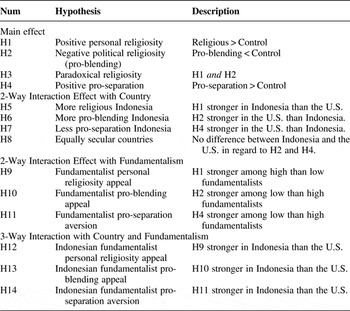
Table 1 presents hypotheses tested in this article. According to the Paradoxical Religiosity Hypothesis (H3), personal religiosity will elicit favorable impressions of a political candidate (H1), whereas political religiosity (i.e., pro-blending) will elicit unfavorable impressions of a political candidate (H2). Additional hypotheses consider the possibility that each of these effects will be moderated by country (Indonesia versus the United States) or level of religious fundamentalism.
List of hypotheses

CROSS-COUNTRY DIFFERENCES
The present article examines cross-country differences regarding the influence of religion in the political world. Samples were collected from Indonesia and the United States. While the United States is an industrialized democracy containing predominantly Christian voters, Indonesia is pre-dominantly Muslim and has been a democracy only since 1998. Eighty-seven percent of Indonesia's 240 million population are Muslims, and 10% are Christians. Thus, Indonesia is the world's largest Muslim-majority country. Interestingly, however, Indonesia is not officially an Islamic country and in the post-1998 free elections Islamic parties have generally performed worse than non-Islamic parties. Nonetheless, some argue that Indonesia is not truly secular, mainly because all parties (Islamic and non-Islamic alike) employ religious rhetoric (Tanuwidjaja Reference Tanuwidjaja2010) and religious freedom for minority groups seems to be worrisomely disappearing (Human Rights Watch 2013)
A cultural approach would suggest that the effect of personal religiosity may differ in these two samples. Specifically, because Indonesia is relatively high in personal religiosity (Pew Global 2008), the positive effect of personal religiosity may be amplified in Indonesia relative to the United States Relative to the control candidate, Indonesians may evaluate the personally religious candidate more positively than Americans do (H5).
It is less clear, however, whether cultural differences will be observed when examining political religiosity. Both countries possess a democratic political system, and some would argue that Indonesia, like the United States, is a secular democracy (Barton Reference Barton2010; Mujani and |Liddle Reference Mujani and Liddle2007; Reference Mujani and Liddle2009). Accordingly, one might anticipate that the negative political religiosity effect (and consequently, the paradoxical religiosity effect) will be obtained in both countries (H8).
However, it is also possible that the political religiosity effect will be attenuated in the Indonesian sample. The United States is a long-standing democracy whereas Indonesia adopted a democratic system more recently. Endorsement of religion-state separation may be more evident in mature democracies than young democracies (Brathwaite and Bramsen Reference Brathwaite and Bramsen2011). More controversially, some have suggested that religion-state separation is less compatible with Muslim than Christian religious tradition (Huntington Reference Huntington1996).
Although it is difficult to disentangle these two explanations, many have argued that religion is an important factor in Indonesian politics (Crouch Reference Crouch2012; Tanuwidjaja Reference Tanuwidjaja2010). Moreover, 72% of Indonesian Muslims favor making sharia the official law (Pew Forum 2013, 15). Thus, either due to the youthful age of democracy or religious tradition, the negative effect of pro-blending (and positive effect of pro-separation) may be reduced or reversed in Indonesia (H6 and H7). If this is true, the effect of personal and political religiosity may not be paradoxical after all in Indonesia.
RELIGIOUS FUNDAMENTALISM
The effects of personal and political religiosity may also be moderated by voter religious fundamentalism. Fundamentalism is positively associated with religious commitment (Savage and Liht Reference Savage and Liht2008; Ysseldyk et al. Reference Ysseldyk, Matheson and Anisman2010), and voters prefer candidates who are similar to themselves (Ottati Reference Ottati, Tesser and Schwarz2001). Thus, voter fundamentalism may moderate the effect of personal religiosity by magnifying the appeal of the personally religious candidate (H9).
Other considerations, however, suggest that voter fundamentalism may fail to moderate the personal religiosity effect. Personal religiosity can be high among non-fundamentalists, and although correlated, personal religiosity and religious fundamentalism are distinct constructs with distinct political outcomes (Ellison and Musick Reference Ellison and Musick1993; McFarland Reference McFarland1989). Accordingly, the appeal of a personally religious candidate (who is not necessarily fundamentalist) may be no greater among fundamentalist than non-fundamentalist voters.
Voter religious fundamentalism may be more likely to moderate the effect of the candidate's political religiosity. This is because religious fundamentalism advocates adherence to fundamental religious values in all aspects of life, implying that political decisions should be guided by religious principles (Monroe and Kreidie Reference Monroe and Kreidie1997). As such, fundamentalism should reduce or reverse the predicted effect of political religiosity. That is, the tendency to oppose pro-blending and favor pro-separation should be reduced or reversed among fundamentalists (H10 and H11, respectively).
Research suggests that fundamentalist opposition to separating religion and politics may be especially pronounced in non-western (Kinnvall Reference Kinnvall2004) and Muslim societies (Imhoff and Recker Reference Imhoff and Recker2012; Monroe and Kreidie Reference Monroe and Kreidie1997). Thus, the moderating role of religious fundamentalism may be more evident in Indonesia than in the United States. Although fundamentalism may magnify positive endorsement of a personally religious or a pro-blending candidate in Indonesia, this may not be the case in the U.S (H12, H13, and H14).
METHODS
Participants
Indonesian data collection was performed online between January 2012 and January 2013. The survey was presented in Indonesian language. Links to the survey were distributed to Indonesian mailing-lists, social media, and online discussion forums. For data collection of the United States, we employed Amazon's Mechanical Turk to sample participants residing in the United States The United States data was collected in April of 2013 (participants were paid $0.40).
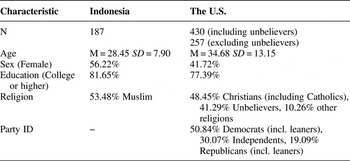
Table 2 presents the characteristics of our samples. Of special importance is a portion of American participants who said they did not follow any religion.Footnote 1 Our main analysis excluded these “unbelievers” based on two rationales. First, because unbelievers were non-existent in the Indonesian sample, including American unbelievers means the effect of country would be confounded with the effect of unbeliever status. Second, by implication, a person who does not believe in religion cannot be a religious fundamentalist. Including American unbelievers would confound the effect of fundamentalism with the effect of unbeliever status. Thus, we initially present the main analysis with unbelievers excluded. Afterward, we present supplementary analyses that include unbelievers as robustness check. The results do not change our conclusions.
Characteristics of the samples

Design
We presented all materials to the participants in their native language (i.e., in Indonesian for Indonesian participants and in English for American participants). Dependent variables were the likelihood of voting for the candidate, attitude toward the candidate, and perceived competence and integrity of the candidate. The moderating variables were participant religious fundamentalism and a dummy variable representing the participant's country (Indonesia as reference category). Participant political involvement, agreement with the candidate (on non-religious filler issues), age, education level, and religious affiliation (member of minority versus majority religion) served as control variables.
Independent variables were the experimental manipulations of personal religiosity (no-information, religious) and political religiosity (no-position, pro-blending, and pro-separation). In both experiments, we presented the candidate as running for gubernatorial office. We did not mention the candidate's religion, but assume that participants would infer that it was the majority religion (Islam in Indonesia, Christianity in the United States).Footnote 2 This assumption is justified by pervasive evidence regarding the availability heuristic (e.g., Kahneman and Tversky Reference Kahneman and Tversky1974). Because political elites are generally drawn from the majority, the availability heuristic suggests that with no information of an elite's attribute, voters would assume that the elite comes from the majority.
Dependent Variables
Dependent variables were assessed on a 10-point scale. These included the participant's attitude toward the candidate (“strong dislike” to “strong liking”), perception of the candidate's competence (“very incompetent” to “very competent”), perception of the candidate's integrity (“very low integrity” to “very high integrity”), and their likelihood of voting for the candidate (“very unlikely” to “very likely”).
Independent Variables
Participants were randomly assigned to six experimental conditions (2 personal religiosity × 3 political religiosity). The stimulus material contained a summary of a question-and-answer session between the candidate and potential voters. This description included the candidate's positions on four (non-religious) filler issues that remained constant across conditions (taxation, social welfare, crime and education).
For the personal religiosity manipulation, the candidate answered a question, “Do you mind to tell us how you define and live your faith? Are you a religious person?” In the personally religious candidate condition, the candidate answered the question with “I believe in God. I pray regularly. If I do something good, it's because I believe that's what God and the scripture ask us to do. Whatever I do, I try to bring my action into line with my faith in God. Religion is for me very important.” In the no-information (control) condition, the question and answer were deleted.
The political religiosity manipulation was inspired by Fox's (Reference Fox2006) conceptualization of secularism. The candidate answered three questions: (1) “Some people teach their own versions of religious doctrines, which in some cases are very different from mainstream religious teachings that we have in this country. Some teachings even blaspheme our faiths. Do you think that the government should do something about it?” (2) “What do you think about accommodating religious laws (for Indonesia) or religious teachings (for the United States) into formal laws or public policies, especially when it comes to moral issues? Would you do such thing?” (3) “What is your thought on how the government should treat various religious groups? Must they be treated equally regardless of their numbers or what?”
In the pro-blending condition, the candidate's responses indicated the candidate favored regulating blasphemy, favored the legislation of religious values into national laws, and preferred the majority religion to minority religions.Footnote 3 In the pro-separation condition, the candidate's responses conveyed the opposite of these sentiments. In the no position (control) condition, these questions and answers were deleted (see Online Supplement).
Moderating Variables
To test the moderating effect of culture, we include a dummy variable representing country. We assign value of 0 to Indonesian participants and 1 to American participants. Participant religious fundamentalism was assessed using Altemeyer and Hunsberger's (Reference Altemeyer, Hunsberger, Paloutzian and Park2005) 12-item Religious Fundamentalism measure. Participants indicated their agreement with each item on a scale ranging from 1 (“strongly disagree”) to 7 (“strongly agree”). Sample items include “God has given humanity a complete, unfailing guide to happiness and salvation, which must be totally followed;” and “To lead the best, most meaningful life, one must belong to the one, fundamentally true religion” (alpha = 0.87 for Indonesian and alpha = 0.95 for American sample).
Control Variables
Control variables include participant religious affiliation, issue agreement, political involvement, age, and education level. Religious affiliation was coded as whether a participant is a religious minority in her country (i.e., value of 1 for non-Muslim Indonesian and non-Christian American participants and 0 otherwise). Issue agreement was assessed by asking participants to rate their agreement with the four filler issue positions. Responses ranged from 1 (“strongly disagree”) to 7 (“strongly agree”). An issue agreement score was calculated by averaging the participant's responses to the four items.
Political involvement was assessed by administering three items that ranged from 1 to 10. These were “How much knowledge related to the political process and political world do you know about?” (“very little knowledge” to “a lot of knowledge”), “How interested are you in the political process and political world?” (“very little interest” to “very interested”), and “How much time do you spend attending to political news in television, radio, newspapers, and other kinds of mass media?” (“very little time” to “a lot of time”). These items were averaged to produce a summary political involvement score (alpha = 0.88 for both Indonesian and American samples).
RESULTS
The categorical variables were dummy-coded. For personal religiosity, the control candidate was coded as 0 whereas the religious candidate was coded as 1. For political religiosity, two dummy variables were created. “Pro-blending” was coded as 1 for participants in the pro-blending condition, and 0 otherwise. “Pro-separation” was coded as 1 for participants in the pro-separation condition, and 0 otherwise. The no-position condition served as the baseline condition. All continuous variables (political involvement, religious fundamentalism and issue agreement) were standardized (M = 0, SD = 1).
To test the hypotheses, each dependent measure was predicted using multistep regression with interaction terms (Aiken and West Reference Aiken and West1991). Control variables, main effect independent variables (personal religiosity, pro-blending, pro-separation), and the moderators (country dummy and voter fundamentalism) were entered at Step 1. Interactions between religiosity treatments and country dummy and between religiosity treatments and participant fundamentalism were entered at Step 2. Lastly, at Step 3, we added the three-way interactions between experimental treatments, country dummy, and participant fundamentalism.
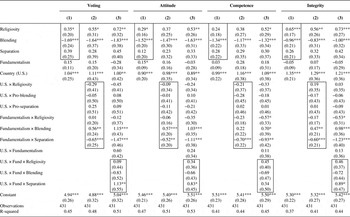
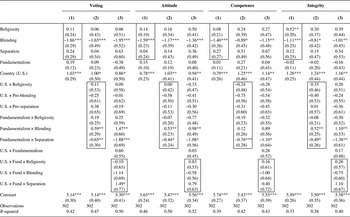
It is worth noting that the use of dummy coding means that the coefficients for some variables reflect conditional simple effects at Steps 2 and 3. For example, the effect of personal religiosity treatment at Step 2 in Table 3 estimates the simple effect of personal religiosity treatment within the political religiosity control condition for religious majority participants (religion dummy equals to zero) in Indonesia (country dummy equals to zero). For this reason, main effects pooled across conditions are reported at Step 1, two-way interactions at Steps 2 and three-way interactions at Step 3. To ease the reader, we boxed each step's coefficients of interest. As previously noted, we first report our core analysis that excludes religious unbelievers, followed by three robustness checks.
Multistep regression predicting voter endorsement of candidate (religious sample, excluding unbelievers)

***p < 0.01, **p < 0.05, *p < 0.10. Standard errors in parentheses. Controls of religious affiliation, education, age, political involvement, and issue agreement are always included.
Main Effects (Step 1)
Columns 1 of Table 3 reveal that personal religiosity significantly increased participant endorsement of the candidate on three of the four dependent variables (voting, attitude, and integrity). It did not significantly increase perceptions of competence. In accordance with the paradoxical religiosity hypothesis, the pro-blending treatment reduced endorsement of the candidate on all four dependent measures. Interestingly, however, the pro-separation orientation failed to increase endorsements of the candidate.
Moderating Roles of Country and Fundamentalism (Step 2)
At Step 2, we tested whether the strengths of the treatment effects differed between Indonesian and American participants and between participants with high and low fundamentalism. We find no evidence for the moderating effect of country. No significant interactions emerged between country dummy and our experimental treatments.
In regard to fundamentalism, we find no interaction between fundamentalism and personal religiosity, which means that high and low fundamentalists did not differ in their evaluations of personally religious candidate. The moderating role of fundamentalism was more evident when considering the effect of political religiosity. For all dependent measures, the interaction between fundamentalism and pro-blending was significant (except for perceived competence), as was the interaction between fundamentalism and pro-separation.
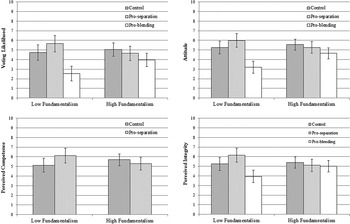
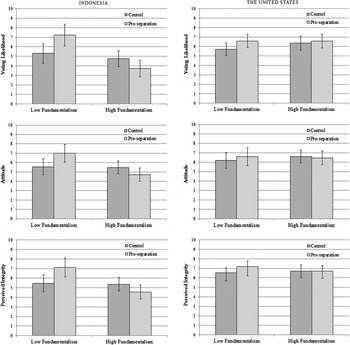
Figure 1 presents the political religiosity effects for low fundamentalist (one standard deviation below mean) and high fundamentalist participants (one standard deviation above mean) separately, along with their 95% confidence intervals. Relative to the control condition, among non-fundamentalists, pro-separation orientation increased endorsement of the candidate on all dependent measures and pro-blending decreased endorsement of the candidate on all four ratings. Thus, the political religiosity effect was robust among non-fundamentalists.
Political Religiosity Effects among Low and High Fundamentalists (Religious Sample)

A different pattern emerged for participants high in fundamentalism. Among these participants, pro-separation failed to increase voter endorsements and the evaluation of pro-blending candidates became more positive. Indeed, in terms of perceived integrity, high fundamentalist participants evaluated the pro-blending candidate as positively as control and pro-separation candidates. From our paradoxical religiosity framework, these patterns of interaction suggest that the paradoxical religiosity effect is stronger among low fundamentalist than high fundamentalist participants.
Country Moderation of Fundamentalism Effects (Step 3)
Given how fundamentalism moderated our treatment effects (Step 2), a natural follow-up question would be whether this moderating effect differed across countries. That is, we were interested in the three-way interactions between country dummy, fundamentalism, and treatment effects. We tested these interactions in Step 3 of the regressions. We find evidence that country differences influence how strong fundamentalism moderates the effects of our pro-separation treatment on voting likelihood, attitude toward the candidate, and perceived candidate integrity.
Figure 2 presents the interactions. Indonesian low fundamentalists evaluated the pro-separation candidate more positively than the control candidate when reporting voting likelihood, attitude, and integrity ratings; and American low fundamentalists evaluated the pro-separation candidate more positively than control candidate when reporting voting likelihood ratings. Interestingly, we find evidence of reversal effects among Indonesian participants high in fundamentalism. High fundamentalist Indonesians rated pro-separation candidate less positively than the control candidate. Notably, however, this reversal does not emerge in the American sample. High fundamentalist Americans did not rate the pro-separation candidate less positively than the control candidate. Therefore, the figure suggests that the moderating effect of fundamentalism was stronger in Indonesia than in the United States Fundamentalism was a more relevant a construct among Indonesian than American participants.
Three-way Interactions between Country, Fundamentalism, and Experimental Treatments (Religious Sample)

Robustness Checks
The results presented in the preceding section reveal similarities when comparing the Indonesian and American sample. Given how different Indonesia and the United States are in terms of history of democracy, culture of secularism, and religious composition, the next question is, “How robust are these results?”
In this section, we present three robustness checks. The first aims to compare Muslim Indonesians and Christian Americans after excluding non-Muslim Indonesians and non-Christian Americans from the analysis. If this approach continues to reveal similarities when comparing the Indonesian and American sample, it is difficult to argue that these similarities were driven by Indonesian and American religious minorities.
The second check is specific to the American sample. Whereas party identification is weak in Indonesia (about 80% said they did not feel close with a party, Lembaga Survei Indonesia 2011), party ID is a potent factor in American politics (Campbell et al. Reference Campbell, Converse, Miller and Stokes1960). Thus, it is possible that the previously described effects are moderated by party identification in the American sample. We address this concern by including PID as additional predictor (1 = strong Democrat to 7 = strong Republican). We are specifically interested in testing whether the personal religiosity and pro-blending effects hold up after controlling for party ID, whether party ID moderates the treatment effects in the expected directions (i.e., Republicans should be more favorable toward religious and pro-blending candidates than Democrats are), and whether party ID moderates the interactions between participant fundamentalism and experimental treatments.
The third check reincorporates the previously excluded participants: the American unbelievers. This, of course, enables religious identification (believer versus unbeliever) to be confounded with culture (Indonesia versus the United States). If inclusion of the American unbelievers produces different effects than those obtained in the initial regression analyses, it would suggest that the Indonesian and American samples are similar when focusing on “believers,” and that differences between these two countries are primarily due to American unbelievers.
Muslim Indonesians and Christian Americans
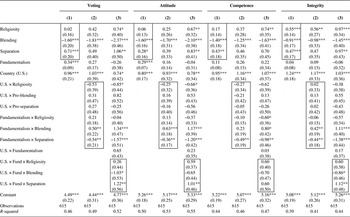
To explicitly address the question of whether Muslims are less likely than Christians to separate religion from politics, we compare Muslim Indonesians and Christian Americans.Footnote 4 Table 4 presents the regression results. Two differences from our original results are evident. First, the positive effect of personal religiosity is now limited to perceived integrity. Second, the three-way interaction between country dummy, fundamentalism, and pro-separation treatment is now limited only to voting likelihood.
Robustness check: Multistep regression predicting endorsement of candidate (religious majority sample, excluding unbelievers and religious minority participants)

***p < 0.01, **p < 0.05, *p < 0.10. Standard errors in parentheses. Controls of education, age, political involvement, and issue agreement are always included.
Despite the differences, three important features of the original results hold up. First, the pro-blending treatment consistently resulted in lower ratings across the four dependent measures. Second, fundamentalism continues to moderate the effects of political religiosity treatments in the expected directions. More importantly, we find no evidence that Muslim Indonesians and Christian Americans differed in their responses to the experimental treatments. The results therefore point to similarities in these two samples.
Americans' Party Identification
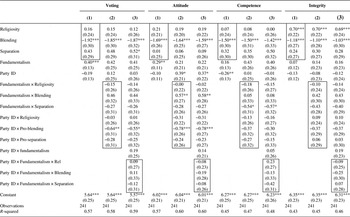
Table 5 presents regression results for the American religious sample, including party identification as an additional predictor. The main effects (Step 1) continue to provide support for our effects of interest (positive effect of personal religiosity on integrity and negative effects of pro-blending). The relative absence of interactions between fundamentalism and our treatments is not a concern because our original analysis already suggests that interactions between fundamentalism and our treatments are less prevalent in the American than Indonesian sample.
Robustness check: Party identification in the U.S. religious sample (excluding unbelievers)

***p < 0.01, ** p < 0.05, *p < 0.10. Standard errors in parentheses. Controls of religious affiliation, education, age, political involvement, and issue agreement are always included.
More relevant to our present concerns are potential interactions between party identification and the experimental treatments. Since the Republican Party is known as the party of the faithful, Republicans should be more favorable toward the pro-blending candidate than Democrats. We find no evidence for this interaction. The interactions that did emerge are actually in the wrong direction and as such contradict the notion that the paradoxical religiosity effect is limited to liberal Democrats in the United States sample.
Including the Unbelievers
Our last check includes American unbelievers in the analysis (there were no Indonesian “unbelievers”). Table 6 presents the regression results. Three similarities with our original results are noteworthy. First, personal religiosity treatment continues to positively influence perceived integrity. Second, the negative effect of pro-blending holds up across all four dependent measures. Third, the patterns of two-way interactions between fundamentalism and political religiosity treatments and three-way interactions between country, fundamentalism, and political religiosity treatments all resemble the interactions in our original analysis. Table 6 also reveals a new finding involving a positive main effect of pro-separation on all four dependent variables. These main effects suggest that an explicitly pro-separation position works its charm primarily among unbelievers.
Robustness check: multistep regression predicting endorsement of candidate (full sample, no exclusions)

***p < 0.01, **p < 0.05, *p < 0.10. Standard errors in parentheses. Controls of education, age, political involvement, and issue agreement are always include
General Discussion
The present research conceptualizes personal religiosity and political religiosity as distinct candidate characteristics and tests them in a comparative context, examining a Muslim-majority sample in Indonesia and a Christian-majority sample in the United States. In accordance with the paradoxical religiosity hypothesis, personal religious commitment tended to increase endorsements, especially on perceived moral integrity, whereas political religiosity decreased endorsements of a political candidate.
The effect of personal religiosity on integrity ratings was robust and generalized, suggesting that personal religiosity activates a shared prototype of a morally virtuous person (Saroglou, Yzerbyt, and Kaschten Reference Saroglou, Yzerbyt and Kaschten2011). Interestingly, in both countries, personal religiosity did not significantly increase competence ratings. This suggests moral virtuosity does not necessarily imply task-oriented competence. This finding highlights the distinction between integrity and competence (Kinder Reference Kinder, Lau and Sears1986; Miller, Wattenberg, and Malanchuk Reference Miller, Wattenberg and Malanchuk1986), and suggests that the personal religiosity effect is primarily localized to personality-related dimensions that are distinct from competence.
In accordance with the paradoxical religiosity hypothesis, the pro-blending orientation reduced candidate endorsements in both countries. In addition to offering support for the paradoxical religiosity thesis, this finding also suggests that Indonesians are not less secular than Americans. Both Indonesians and Americans find a candidate who explicitly endorses a blending of religion and politics to be unacceptable. This contradicts the assumption that Muslims are incapable of separating religion and politics (Huntington Reference Huntington1996).
This effect was robust, occurring for all four measures of candidate endorsement. Even among high fundamentalists, the pro-blending candidate was evaluated more negatively than the control candidate (Figure 1). This may be, in part, because the pro-blending condition potentially involved governmental monitoring of religious speech, a practice that erodes the fundamental right to freedom of speech. Perhaps a more palatable pro-blending frame (e.g., governmental restriction of blasphemy that promotes ethnic discrimination) would have increased the favorability of the pro-blending condition. On the other hand, rejection of the pro-blending candidate may simply reflect a core feature of democratic culture. Since both Indonesia and the United States are democracies, perhaps a simple pro-blending position is not appealing enough. Perhaps in democracies, democratic culture and norms compel even fundamentalists to look for a reason — a proper frame — to justify their support for mixing politics with religion. This is especially true if mixing politics with religion is perceived to promote discrimination against minorities (see also the Online Supplement). The same may not be true of fundamentalists from non-democratic regimes, where such norms may be weak or non-existent. Future research can further investigate this possibility.
Because we found no evidence of major differences with regard to the paradoxical religiosity hypothesis, we are left with a message that emphasizes similarities. Our Indonesian participants responded to personal and political religious cues in the same way as our American participants. Importantly, this similarity emerged even when comparing Muslim Indonesian participants to Christian American participants. This finding may surprise scholars who are sympathetic to Huntington's clash of civilization thesis, but will not surprise scholars of Muslim democracies who already suggest that Muslims, too, can separate the sacred and the secular (e.g., Mujani and |Liddle Reference Mujani and Liddle2007; Reference Mujani and Liddle2009).
Although our paradoxical religiosity effect did not differ when comparing Indonesia to the United States, the moderating role of religious fundamentalism did differ when comparing these two countries. That is, religious fundamentalism moderated the effect of pro-blending and pro-separation in Indonesia, but not in the United States Future studies might want to explore this finding further, for example by examining how people across cultures or religious traditions are different or similar in their conceptualizations of religious piety and how that may influence the extent of which fundamentalism affects their political behavior.
CONCLUSIONS AND VALIDITY
To our knowledge, ours is the first experimental study to document that Muslim Indonesians are just as secular as their Christian American counterparts. When considering these findings, two aspects of the current study should be highlighted. First, it should be noted that the present experiments did not use nationally representative samples of the Indonesian and American voting populations. Notably, the Indonesian sample is better educated than Indonesians in general. This aspect of the sample actually may be beneficial. Specifically, it enabled us to control for education when comparing the two countries, and thereby increased the internal validity of the experiment.
Other sample characteristics might have actually increased the likelihood of observing a relatively high level of secularism in the United States. The American sample, drawn from Amazon's MTurk, is probably more liberal than the United States population in general (Berinsky, Huber, and Lenz Reference Berinsky, Huber and Lenz2012, see also Table 2). This should lead the American sample to be more opposed to religion-state blending than the general United States population. Thus, the present findings suggest that educated Indonesians and educated Americans are equally secular, even when comparing the Indonesians to a United States sample that is potentially biased in the direction of secularism. Nevertheless, future research should endeavor to test the presently investigated hypotheses using representative national samples.
A second concern relates to the ecological validity of the political religiosity treatment. Namely, some might argue that the political religiosity condition is beyond the purview of American politics. Although this concern is worth addressing in future research, there are reasons to believe this was not the major drive behind our findings. First, as previously noted, a manipulation check confirmed that the political religiosity treatment produced a meaningful image of the candidate. Second, if our political religiosity treatment is completely untenable in American politics, one should observe strong support for the pro-separation candidate among American respondents or a significant interaction between country dummy and the treatment. Neither of these effects emerged. Third, many prominent American politicians have explicitly indicated that they believe the United States is a Christian nation with a Constitution rooted in Christian principles. Fourth, blasphemy laws remain on the books in some states within the United States (e.g., Michigan, Oklahoma, Pennsylvania; Freedman Reference Freedman2009). Fifth, in examining government monitoring and surveillance of minority religious groups in the United States, Richardson and Robbins (Reference Richardson, Robbins and Davis2010) suggest that government involvement in religion is becoming less uncommon. Indeed, political scholars have argued that the United States possesses only a “partial separation of church and state” (Richardson and Robbins Reference Richardson, Robbins and Davis2010, 70; Wald and Calhoun-Brown Reference Wald and Calhoun-Brown2014). Thus, the political religiosity condition appears to provide a viable description of a political candidate who might run for office within the Unites States. We agree, however, that future research will benefit from devising experimental treatments that are more comparable across countries. In fact, such an endeavor could be a fruitful research agenda by itself due to variations across countries on how religion is politicized.
Supplementary materials and methods
To view supplementary material for this article, please visit http://dx.doi.org/10.1017/S175504831500053X.