The diagnosis of Kawasaki disease is based on the presence of prolonged fever, 5 days or more, plus more than four of the five clinical criteria. Even in the diagnosis of incomplete – only two or three clinical features are diagnosed – Kawasaki disease, fever prolonged for 5 days or more is still the criteria that must be fulfilled.Reference Newburger, Takahashi and Gerber1 However, is there really any case of Kawasaki disease with fever less than 5 days? Here, we report a boy of incomplete Kawasaki disease complicated by bilateral giant coronary aneurysms who presented with only 3 days of fever.
Case report
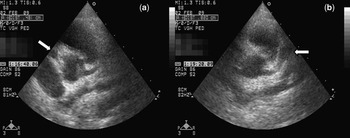
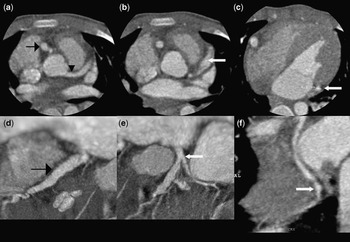
A 5-year and 4-month-old boy was admitted to a regional hospital due to intermittent abdominal pain and fever beginning from the admission day. The laboratory data revealed 27,540 white cells per cubic millimetre of blood, 12.7 milligrams of haemoglobin per decilitre of blood, 512,000 platelets per cubic millimetre of blood, and 5.93 milligrams of C-reactive protein per decilitre of blood. He also had rhinorrhea and cough with sputum, so he was initially treated for viral illness. Two principal symptoms including non-exudative bilateral bulbar conjunctivitis and fissured lips with strawberry tongue were noted 2 days after admission. Then incomplete Kawasaki disease was suspected. As a result, echocardiography was performed and revealed normal coronary artery size. However, the fever subsided after the day 3 of admission. Kawasaki disease was excluded according to the diagnostic guideline. Although the intermittent abdominal pain and the ill-looking appearance persisted, he was discharged on the day 9 of the illness. After 3 days, this boy was referred to our outpatient clinic of paediatric cardiology where echocardiography showed bilateral giant coronary aneurysms (Fig 1), which were also shown by the multidetector-row computed tomography (Fig 2). The C-reactive protein was 2.1 milligrams per decilitre. After administration of 2 grams per kilogram of intravenous immunoglobulin, the abdominal pain resolved markedly. No sign of angina or ST-T change in electrocardiography was noted during the whole hospital course. The boy was then discharged with aspirin and warfarin therapy. Peeling of fingers was found during the outpatient visit on the day 22 of the illness.
Echocardiography of parasternal short-axis plane on the day 12 of the illness showing (a) significantly dilated right coronary artery (white arrow), 4.8 millimetres in diameter; (b) a giant aneurysm over left anterior descending coronary artery (white arrow), 8.2 millimetres in diameter.

Multidetector-row computed tomography revealing (a) a 4-millimetre right coronary artery aneurysm (black arrow) and dilated left coronary artery (arrowhead); (b) left anterior descending artery aneurysm, 8 millimetres in diameter (white arrow); (c) left circumflex artery aneurysm, 4.5 millimetres in diameter (white arrow); (d) dilated right coronary artery (black arrow); (e) dilated left main coronary artery and its branches (white arrow); and (f) left circumflex artery aneurysm (white arrow).

Discussion
Kawasaki disease is an acute self-limited systemic vasculitis.Reference Newburger, Takahashi and Gerber1, Reference Burns and Glode2 It is now the leading cause of acquired cardiac disease in children of most industrialised countries.Reference Holman, Curns and Belay3–Reference Yanagawa, Nakamura and Yashiro5 It may induce coronary artery abnormalities ranging from transient ectasia, small aneurysms, to giant aneurysms.Reference Senzaki6 Prompt diagnosis and timely administration of intravenous immunoglobulin are crucial to prevent coronary complications.Reference Newburger, Takahashi and Gerber1, Reference Burns and Glode2, Reference Belay, Maddox and Holman7 However, the incidence of incomplete Kawasaki disease is increasing in recent years.Reference Sonobe, Kiyosawa and Tsuchiya8, Reference Witt, Minich and Bohnsack9 Thus, physicians often face difficulties in decision making. The American Academy of Pediatrics and American Heart Association have endorsed an algorithm to evaluate patients with suspected incomplete Kawasaki disease.Reference Newburger, Takahashi and Gerber1 It is now widely accepted as a standard for making diagnosis of Kawasaki disease. But the cardinal feature of diagnosing incomplete Kawasaki disease is still the prolonged fever for more than 5 days. Should we consider Kawasaki diseases if the patient presents with less than 5 days of fever? Or, more specifically, does fever subsiding mean stopping of coronary artery vasculitis? In the lack of specific diagnostic test or pathognomonic clinical features, these questions are very difficult to be answered.
In this case, the diagnosis of Kawasaki disease would not be made according to the American Heart Association and American Academy of Pediatrics guideline because the fever lasted for only 3 days. The coronary aneurysm would be missed and the patient would be at high risk of coronary events. If this condition happened, the life of the patient could be jeopardised. This case reminds us that Kawasaki disease with coronary complications could happen in less than 5 days of fever. Diagnostic criteria of fever duration might need reconsideration.