INTRODUCTION
Depression has a community prevalence of about 10% (Singleton et al. Reference Singleton, Bumpstead, O'Brien, Lee and Meltzer2001; Layard, Reference Layard2006) and is expected to become the second highest cause of disease burden worldwide by 2020 (Murray & Lopez, Reference Murray and Lopez1997). The annual cost of depression in England alone was estimated at £9 billion in 2000, of which 90% was attributed to around 110 million lost working days (Thomas & Morris, Reference Thomas and Morris2003). This figure has been estimated at £17 billion per annum for the UK as a whole, equivalent to 1·5% of the gross domestic product (GDP) (Layard, Reference Layard2006). The prevalence of depression in developed countries has not fallen in recent decades, despite effective treatments, evidence-based guidelines (NICE, 2004) and public education campaigns (Brugha, Reference Brugha1995; Kendrick, Reference Kendrick2000; Department of Health, 2001).
The unmet need for treatment becomes even more alarming when considering only cases of severe disorder (Demyttenaere et al. Reference Demyttenaere, Bruffaerts, Posada-Villa, Gasquet, Kovess, Lepine, Angermeyer, Bernert, de Girolamo, Morosini, Polidori, Kikkawa, Kawakami, Ono, Takeshima, Uda, Karam, Fayyad, Karam, Mneimneh, Medina-Mora, Borges, Lara, de Graaf, Ormel, Gureje, Shen, Huang, Zhang, Alonso, Haro, Vilagut, Bromet, Gluzman, Webb, Kessler, Merikangas, Anthony, Von Korff, Wang, Brugha, Aguilar-Gaxiola, Lee, Heeringa, Pennell, Zaslavsky, Ustun and Chatterji2004). Only a minority of those suffering from clinically significant episodes of disorder receive and adhere to treatments in keeping with evidence-based guidelines (Scott, Reference Scott2006). Population-based surveys in the UK, the USA and Canada found that around one-half of those with a recent or current depressive episode of at least moderate severity had sought medical care for this (Bebbington et al. Reference Bebbington, Brugha, Meltzer, Jenkins, Ceresa, Farrell and Lewis2000), with up to 62% reporting medical consultation for this problem at some time in the preceding year (Singleton et al. Reference Singleton, Bumpstead, O'Brien, Lee and Meltzer2001; Brugha et al. Reference Brugha, Bebbington, Singleton, Melzer, Jenkins, Lewis, Farrell, Bhugra, Lee and Meltzer2004; Wang et al. Reference Wang, Lane, Olfson, Pincus, Wells and Kessler2005). Previous studies report that 30–40% of those in the community who are depressed receive medical treatment (medication or psychological treatments) (Lin & Parikh, Reference Lin and Parikh1999; Singleton et al. Reference Singleton, Bumpstead, O'Brien, Lee and Meltzer2001). This figure fell to less than 25% when only treatments of ‘minimal’ adequacy or better were included in the US National Comorbidity Study replication (NCS-R) (Young et al. Reference Young, Klap, Sherbourne and Wells2001). The latter study also found that only 15% of those with major depressive disorder seen in general medical settings (including primary care) in the past year received treatment meeting these criteria. Recent findings indicate increases in rates of medical help seeking and antidepressant prescribing (from around 5% to 16%) during the 1990s, but not in the use of psychological therapies. Nor was there any significant reduction in the prevalence of depression over the same period (Brugha et al. Reference Brugha, Bebbington, Singleton, Melzer, Jenkins, Lewis, Farrell, Bhugra, Lee and Meltzer2004). The quadrupling of antidepressant prescribing in this period includes a 12-fold rise in the rate of prescriptions among those free from psychiatric symptoms at the time of interview.
The reasons for these high levels of undertreatment remain unclear, and are likely to be complex. Undertreatment includes failing to seek help, declining care and dropping out of care (Edlund et al. Reference Edlund, Wang, Berglund, Katz, Lin and Kessler2002; Anderson et al. Reference Anderson, Robins, Greeno, Cahalane, Copeland and Andrews2006). Many years of attempting to improve physicians' performance, including the development and dissemination of guidelines (Kendrick, Reference Kendrick2000; Thompson et al. Reference Thompson, Kinmonth, Stevens, Peveler, Stevens, Ostler, Pickering, Baker, Henson, Preece, Cooper and Campbell2000; NICE, 2004), have produced only modest results. More recently, interest has turned to the effects of patients' attitudes to depression and preferences for treatment (Nutting et al. Reference Nutting, Rost, Dickinson, Werner, Dickinson, Smith and Gallovic2002; Jorm et al. Reference Jorm, Griffiths, Christensen, Parslow and Rogers2004; Kessing et al. Reference Kessing, Hansen, Demyttenaere and Bech2005; Lin et al. Reference Lin, Campbell, Chaney, Liu, Heagerty, Felker and Hedrick2005; Pyne et al. Reference Pyne, Rost, Farahati, Tripathi, Smith, Williams, Fortney and Coyne2005). Intriguingly, while two recent trials have shown that the efficacy and cost-effectiveness of treatments for depression are greatly enhanced by individuals' preferences for the treatments offered (Rost et al. Reference Rost, Nutting, Smith, Werner and Duan2001; Lin et al. Reference Lin, Campbell, Chaney, Liu, Heagerty, Felker and Hedrick2005; Pyne et al. Reference Pyne, Rost, Farahati, Tripathi, Smith, Williams, Fortney and Coyne2005), a systematic review of studies with patient preference designs has found no such effect (King et al. Reference King, Nazareth, Lampe, Bower, Chandler, Morou, Sibbald and Lai2005). However, this literature is characterized by variability in the nature of attitudes and beliefs studied, and the manner in which these are elicited. Most studies have been concerned primarily with adherence to antidepressant treatment (Kessing et al. Reference Kessing, Hansen, Demyttenaere and Bech2005), and few have explored attitudes about depression as well as treatment preferences. It has been common to concentrate on receptiveness to treatment in general (Cooper-Patrick et al. Reference Cooper-Patrick, Powe, Jenckes, Gonzales, Levine and Ford1997; Dwight-Johnson et al. Reference Dwight-Johnson, Sherbourne, Liao and Wells2000), or to psychological or pharmacological treatments (Kessing et al. Reference Kessing, Hansen, Demyttenaere and Bech2005) more specifically, usually as dichotomous outcomes (Rost et al. Reference Rost, Nutting, Smith, Werner and Duan2001; Pyne et al. Reference Pyne, Rost, Farahati, Tripathi, Smith, Williams, Fortney and Coyne2005).
To understand the determinants of undertreatment of depression in primary care, we recruited a large sample of individuals with a recent history of ICD-10 moderate or severe depressive episodes. The aim of the present paper was to validate and describe the responses to a questionnaire about attitudes to depression and its treatment. We hypothesized that (1) those who viewed depression as treatable would be more likely to have received and adhered to evidence-based treatment for their recent depressive episode; (2) those who were positive about the merits of antidepressant medication were more likely to have received and adhered to evidence-based pharmacotherapy; and (3) individuals who perceived depression as shameful and stigmatizing were the least likely (a) to have disclosed a recent episode to family or friends, or (b) to have received and adhered to evidence-based treatment.
METHOD
Design and setting
A cross-sectional survey was undertaken in general practices in England and Wales belonging to the UK General Practice Research Framework (GPRF). The GPRF comprises over 1200 general practices throughout the UK involved in epidemiological, primary care and health services research. Thirty-six general practices took part in this study. These were recruited from all regions on the basis of location, socio-economic deprivation (Jarman score for practice, banded as high, medium or low) and practice size (single-handed, 2–3 principals and ⩾4 principals). We initially proposed to recruit 50 practices and issued a call for expressions of interest within the GPRF. Approximately 60 practices replied, from which 52 were invited to take part and 46 sent a research nurse to one of three training days. Of the 36 practices that contributed to data collection, 13 were located in Trent, Eastern and West Midlands regions, nine in the North, Yorkshire and the North West, seven in the South West, six in London and the South East, and one in Wales. Although the South West and West Midlands were over-represented (56% v. 22% of all GPRF practices), and the South East under-represented (14% v. 28% of GPRF practices), study practices approximated the distribution of GPRF practices in terms of area type (e.g. 31% in cities or industrial areas versus 31% for all GPRF practices). Average list sizes were slightly higher for study practices (9911 v. 7399 for all GPRF practices), while deprivation scores tended to be lower (e.g. average Jarman 91 score 5·7 v. 7·9 for all GPRF practices).
Participants
Consecutive attendees aged 18–75 at participating general practices with an appointment to see a doctor, nurse or other professional at the practice about themselves were approached in the waiting room. Exclusion criteria included learning difficulties, cognitive impairment that would prevent completion of the study assessments, and inability to communicate in English.
Measures
Ascertainment of ICD-10 depressive episodes in the preceding 12 months
Individuals who had experienced an ICD-10 depressive episode (index episode) in the 12 months prior to interview were identified using a two-stage procedure. Research nurses from participating practices were trained to administer the study assessments.
Attendees were asked to complete a brief, 10-item waiting room screening questionnaire containing items taken from the depression section of the 12-month version of the Composite International Diagnostic Interview (CIDI; WHO, 1997). This brief pencil-and-paper questionnaire, which took no more than 5 minutes to complete, was developed for this study. Terminology was the same as that used in the CIDI, with questions that enquired about ‘periods when you have felt sad, empty or depressed in the past 12 months’. Replicating the structure of the CIDI, two stem questions asked respectively whether in the past 12 months the respondent recalled 2 weeks or longer ‘when nearly every day you have felt sad, empty, or depressed for most of the day’ and ‘when you lost interest in most things like work, hobbies and other things you usually enjoyed’. Those who answered ‘Yes’ to either question were asked to complete a further eight items concerning ‘the time (or times) in the past 12 months when you felt sad, empty, or depressed or when you lost interest in most things nearly every day for 2 weeks or longer’. These items (each with Yes/No format) used CIDI depression items covering fatigue, appetite, weight loss, insomnia, concentration, and feelings of worthlessness, inferiority and guilt.
A pilot study compared responses to this questionnaire (in a general practice waiting room) against the 12-month version of the CIDI depression section administered by telephone approximately 1 week later. Although too small for definitive statistical analysis, the results suggested that an optimum balance between sensitivity and specificity was likely to be achieved using a cut-off of ⩾5 (out of 10), including at least one positive response to the first two (stem) questions. This cut-point was also chosen to maximize the positive predictive value in order to minimize costly ‘false positive’ second-stage interviews. Those scoring at or above this level were invited by telephone (or letter) to participate in a face-to-face interview with a research nurse.
The occurrence of one or more depressive episodes was established at face-to-face interview with a researcher using the depression section from the 12-month version of the CIDI (WHO, 1997). Severity was rated at the time that most symptoms were present concurrently and diagnosis was established using the research version of ICD-10 (WHO, 1993).
Treatments for depression interview
Sources and types of help sought, general practitioner (GP) consultations, and receipt of and adherence to medication and psychological treatments were assessed using a structured interview designed for this study. This was administered during the second-stage interview to all individuals found to have experienced an ICD-10 depressive episode in the preceding 12 months. Questions concerned the identity, dose and duration of adherence to all treatments received in respect of the index episode of depression.
This interview was administered directly after the depression section of the 12-month CIDI. As many individuals with depression do not endorse this term, the latter begins by eliciting core symptoms of depression (low mood, loss of interest and/or fatigue) and then referring to the specific ‘problems’ endorsed rather using than the word ‘depression’ when asking about other symptoms. The period about which treatment questions were asked was anchored during the CIDI interview by identifying the month in the preceding year when the respondent had the ‘largest number of problems [symptoms] at the same time’. Using CIDI terminology (‘problems’ such as ‘feeling sad, empty or depressed, etc.’ rather than ‘symptoms’ or ‘depression’), participants were asked to identify the month and the year when this depressive episode began and ended.
Participants were reminded about the ‘problems’ they had described in the preceding year in response to the CIDI questions and the month when these were at their worst. They were then asked if they had spoken with their GP about these problems, and about the timing of the first consultation in respect of this episode.
All possible treatments were first enumerated, starting with medication. Participants were asked if their GP or any other doctor had prescribed any medicines since the time when they had first consulted their doctor about the index episode of depression identified during the CIDI interview. Using a show card containing the names of all antidepressants listed in the British National Formulary (BNF), participants were asked to identify up to three drugs that they had been prescribed. For each drug mentioned, questions covered dose, duration of adherence, and how often, on average, they had remembered to take this medicine. Further questions asked if they were still taking this drug, and if not, why not and whether discontinuation had been discussed with a doctor.
Participants were asked about psychological and other treatments. They were reminded of the month when they reported that the index episode had begun, and were asked if they had been referred to (whether by someone else or by self-referral) a counsellor within the practice, a counsellor outside of the practice, psychiatrist, psychologist, psychotherapist or psychoanalyst, or other mental health professional. Taking each in turn (where endorsed), participants were asked how many sessions they had attended, whether they were still attending and the reasons (where appropriate) for termination.
Finally, this interview asked about disclosure of depression. Participants were asked ‘Since [month when the index episode began], have you told any of your family or friends that you [were feeling sad, empty or depressed/had lost interest in most things/lacked energy]?’
Criteria for evidence-based treatments
Treatments were divided into pharmacological and psychological, and criteria for appropriateness were derived from current evidence-based guidelines. We followed previous studies in operationalizing dose, duration and adherence, and setting thresholds that were consistent with minimally adequate treatment (Wang et al. Reference Wang, Lane, Olfson, Pincus, Wells and Kessler2005). Pharmacological treatment was said to have met evidence-based standards when a participant reported having taken (i) a therapeutic dose of an antidepressant, (ii) for at least 4 weeks, (iii) at a minimum frequency of ⩾4 days per week on average. Therapeutic doses of antidepressant were based on the BNF. This was taken as ⩾75 mg/day of dothiepin or amitryptiline, ⩾20 mg/day of fluoxetine or paroxetine, ⩾75 mg/day of venlafaxine and >50 mg/day of sertraline. Psychological treatment was considered to have met evidence-based standards when a participant reported referral to a counsellor, psychologist or psychotherapist, and either (i) they attended ⩾3 sessions, or (ii) the treatment had been completed, or (iii) they were still attending.
Attitudes to depression and its treatment (ADepT questionnaire)
Participants completed a new 19-item self-report questionnaire concerning attitudes to depression (13 items) and its treatment (six items). Several items were based on those found in existing measures at the time that our study began (Botega et al. Reference Botega, Mann, Blizard and Wilkinson1992; Priest et al. Reference Priest, Vize, Roberts, Roberts and Tylee1996). Items were selected to address common misconceptions about depression (‘You must be careful not to upset someone who has been depressed, or they will get ill again’), and the sense of stigma and shame that often accompany this condition (‘If other people knew I had been depressed, they would think less of me’) as well as views about treatment (‘Counselling is an effective way of treating depression’). All items were rated using a five-point scale with responses ranging from ‘strongly agree’ (5) to ‘strongly disagree’ (1). Positive and negative phrasing was used to prevent response set bias, and we included two items that asked about possible advantages of depression (e.g. ‘People with depression are more creative and imaginative than others’). Questionnaire items are shown in Table 2.
Socio-economic status
This was assessed using questions about employment status, housing tenure, car access, education and financial strain. The latter was assessed using a question commonly used in social surveys, the response to which is highly predictive of current and future rates of psychiatric morbidity (Weich & Lewis, Reference Weich and Lewis1998).
Analysis
Cronbach's α was calculated to assess the internal reliability of the ADepT questionnaire. We used principal factor analysis to investigate and describe the underlying factor structure of the questionnaire. The number of factors was determined by examination of a scree plot and the size of the eigenvalues (Cattell, Reference Cattell1966). After factor extraction, an orthogonal (varimax) rotation was made to achieve a simpler factor structure. When analysing factor loadings, we chose 0·4 as a cut-off for size of loading to be interpreted. The greater the factor loading, the more the item is a pure measure of the factor. Principal factor analysis was repeated after stratifying by severity of depressive episode, to see whether this affected underlying item response patterns.
Regression-based factor scores were derived from the rotated components, and were normalized to have a mean of 0 and standard deviation of 1. All analyses were undertaken using Stata 8 (StataCorp, 2004). To reflect the clustered nature of the sample, analyses were undertaken using survey commands that adjust standard errors and χ2 statistics for clustering (autocorrelation) within clinics. Differences in mean factor scores between those who did and did not receive evidence-based treatments, and those who did and did not disclose their depression to family or friends, were estimated using linear (least squares) regression.
RESULTS
Excluding those who were ineligible, 7718 individuals were asked to take part in screening and 7271 (94·2%) completed the waiting room questionnaire. Of those who completed the questionnaire, 2211 (30·4%) scored above the inclusion threshold for interview. A total of 975 individuals (44·1% of those with positive screen results) took part in the second stage interview. No statistically significant difference was found in screening score between those who took part in the interview and those who declined or were not available [mean difference −0·04, 95% confidence interval (CI) −0·18 to 0·11, p=0·61].
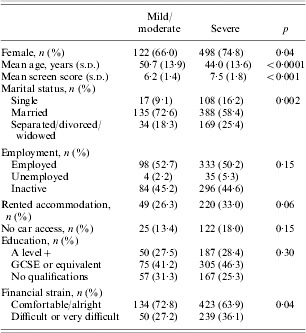
At interview, 866 individuals (88·8% of those interviewed) were found to have experienced an ICD-10 depressive episode in the preceding 12 months, of whom 812 (94·2%) endorsed all three ‘core’ depressive symptoms. Twelve individuals (1·4%) had experienced a mild depressive episode, 175 (20·3%) a moderate episode, and 679 (78·4%) a severe depressive episode. Of those with a confirmed depressive episode, 786 (90·8%) completed the ADepT questionnaire in full, and analyses were based on this group. The characteristics of the study sample are shown in Table 1.
Characteristics of the study participants with an ICD-10 depressive episode in the 12 months prior to interview (n=865Footnote a), comparing mild and moderate versus severe depressive episodes

s.d., Standard deviation.
a Totals do not always add up to 866 because of missing data.
In total, 330 individuals with ICD-10 depressive episodes (38·1% of the sample) reported receipt of and adherence to evidence-based treatment. Two hundred and sixty-seven (30·8% of the sample) met minimum criteria for evidence-based antidepressant treatment. Only 99 individuals (11·5% of the sample) met minimum criteria for evidence-based psychological treatment.
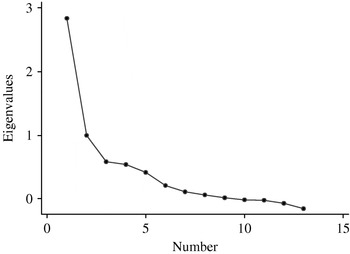
Cronbach's α was 0·73 for the full scale. Principal factor analysis resulted in nine factors with eigenvalues greater than 0. Inspection of the scree plot (Fig. 1) was consistent with a three-factor solution, although three-, four- and five-factor models were all considered before the former was judged the most parsimonious. Interpretation was not made any clearer, even after rotation, by the inclusion of more than three factors.
Scree plot derived from principal factor analysis of the Attitudes to Depression and its Treatment (AdepT) questionnaire.

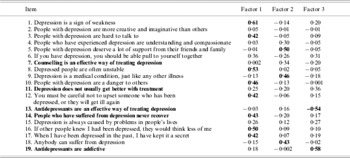
Factor loadings after rotation are shown in Table 2. Eight items had high positive loadings on the first factor, and reflected concerns about the emotional instability of people with depression, the shamefulness of the condition and the poor prognosis. We entitled this factor ‘depression as permanent, disabling and stigmatizing’. Three items were highly and positively loaded on the second factor. These items encompass a more sympathetic and understanding attitude to depression, which is seen as a medical condition that can affect anyone. We have called this ‘depression is a medical condition that responds to support’. Two items had high loadings (one of which had a negative sign) on the third factor. These items were concerned with antidepressants. The positive loaded item was ‘antidepressants are addictive’, while the negatively loaded item was ‘antidepressants are an effective way of treating depression’. We have therefore called this factor ‘antidepressants are addictive and ineffective’.
Results of principal factor analysis of responses to the AdepT questionnaire, showing item loadings on three retained factors after varimax rotation. Items concerning treatment are shown in bold

AdepT, Attitudes to depression and its treatment.
These results were largely unchanged when the sample was stratified by severity of depressive episode as in Table 1. The results for the severe depression group were almost identical to those in the sample as a whole. The results were slightly different in the mild and moderate depressive episode group. Although the same three-factor solution pertained, factor loadings were subtly different. On factor 1, item 6 ‘If you have depression, you should be able pull to yourself together’ (factor loading 0·41) replaced item 17 ‘When I have been depressed in the past, I have kept it a secret’ (0·48). On factor 2, loadings on items 9 ‘Depression is a medical condition, just like any other illness’ and 18 ‘Anybody can suffer from depression’ were reduced very slightly, to just below 0·40. Loadings on factor 3 were unchanged.
Tests of study hypotheses
Those who reported receiving and adhering to evidence-based antidepressant medication for the index episode had significantly lower scores on factor 1 (depression as permanent, disabling and stigmatizing) and factor 3 (antidepressants are addictive and ineffective) and higher scores on factor 2 (depression is a medical condition that responds to support) (Table 3). A similar pattern was seen for receipt and adherence to psychological treatments, although this did not reach statistical significance for factor 1. Those who reported disclosure (telling family and/or friends about their depressive episode) had significantly higher scores on factor 2 and lower scores on factors 1 and 3.
Unadjusted mean difference in ADepT factor scores between those who received and adhered to evidence-based treatments and those who did not, and between those who disclosed their depressive episode to family and/or friends and those who did not

AdepT, Attitudes to depression and its treatment; s.e., standard error.
Discussion
One of the most notable findings from this research was the subtle range of attitudes about depression and its outcome that we elicited. This view was supported by the modest internal reliability of the 19-item ADepT questionnaire, and by the results of factor analysis. We identified three factors within the responses to this instrument. The first factor had high loadings from items reflecting a view of depression as a permanent, disabling and stigmatizing mental breakdown from which there was little prospect of recovery. The second factor reflected a more sympathetic view of depression as a medical condition that could affect anyone and from which recovery was possible with support and help. Finally, a third, bipolar, factor concerned antidepressant medication, with high scores indicating a view of these as ineffective and addictive. Further analysis revealed little variation with depression severity, although among those with mild and moderate depression there was some evidence of less concern with concealment and a more normalizing attitude to recovery.
Despite the relative clarity of interpretation, we cannot be certain of the direction of these associations; such attitudes may determine concordance with treatments, or experiences of treatment and support may lead to these attitudes to depression. These findings do, however, stand in contrast to many previous reports, which have tended to concentrate almost exclusively on dichotomous views about the acceptability or otherwise of treatment (Pyne et al. Reference Pyne, Rost, Farahati, Tripathi, Smith, Williams, Fortney and Coyne2005).
Strengths and weaknesses of the study
The present findings are based on a very large sample of individuals with ICD-10 depressive episodes in the 12 months preceding interview, the majority of which were of at least moderate severity. These individuals were recruited from among consecutive primary care attendees, and depressive episodes were confirmed using a validated, standardized clinical interview. The 36 participating practices were recruited from across England and Wales. This is one of the largest, most diverse and best validated samples of this type ever recruited in the UK. By recruiting individuals with a depressive episode at any time in the preceding 12 months, our sample was likely to be more representative of all those with depression than cross-sectional samples of those with current depression, in terms of attitudes to this condition and its treatment (Singleton et al. Reference Singleton, Bumpstead, O'Brien, Lee and Meltzer2001). Cross-sectional samples are likely to include substantial numbers of those with chronic depression as well as those with episodes of recent onset. Thus, a prevalence sample will include many who are treatment resistant (or treatment reluctant), as well as those who have not yet had the opportunity to experience treatment.
One weakness of this study was the high rate of attrition between screening and interview. Although non-participation may limit the generalizability of study findings, it does not usually affect their validity (Hennekens & Buring, Reference Hennekens and Buring1987). Although less than half of those who were eligible for the second-stage interview agreed to take part, screening questionnaire scores did not differ significantly between those who were and were not interviewed. Nevertheless, we cannot exclude the possibility that those who were interviewed differed in other ways, including their willingness to receive and adhere to treatment. Although scores on the ADepT questionnaire might not be wholly representative of those with a history of moderate or severe depression, it is unlikely that non-participation at interview would have resulted in biased estimates of association between attitudinal measures and either treatment receipt/adherence or disclosure. For this to have occurred, non-participation would have to have been associated with both attitudes to depression and treatment receipt or disclosure.
A further weakness is that the ADepT questionnaire is in effect a new instrument; although based on items from other measures, we cannot be wholly certain of their reliability. We would, however, argue that the criterion validity of this questionnaire was evidenced by the patterns of association between factor scores and indices of treatment receipt/adherence, and disclosure.
Identifying and quantifying the adequacy of treatment delivery and adherence is extremely challenging, and despite the proliferation of different ways of measuring adherence, there is no agreed gold standard (Garber et al. Reference Garber, Nau, Erickson, Aikens and Lawrence2004; DiMatteo & Haskard, Reference DiMatteo and Haskard2006). We chose to rely on patient reports in both instances in the context of a comprehensive, structured face-to-face interview. We were careful to begin by eliciting evidence of a depressive episode in the preceding 12 months, and then using this to anchor the remainder of the interview, which covered the onset and duration of symptoms, and related help-seeking. We enumerated all possible pharmacological and psychological treatments, and asked about the dose, duration and circumstances of termination for each. Although this method was not formally validated, the approach was thorough and systematic. By recording both the names and doses of different medications, it is unlikely that rates of prescribing were over-reported. We would also argue that the pattern of associations with responses to the ADepT questionnaire provides evidence of the validity of our treatment receipt and adherence data. While some psychiatrists might view the treatment criteria as potentially inclusive of subtherapeutic interventions, these were entirely in keeping with previous research in community and primary care settings (Wang et al. Reference Wang, Lane, Olfson, Pincus, Wells and Kessler2005). For this reason, we described these collectively as ‘minimally adequate treatment’. The most important point is that these criteria were operationalized and applied systematically and without bias to the entire sample.
Future directions
These findings highlight the need for GPs to explore people's attitudes to depression prior to considering treatments, and indeed it might be argued that this should be part of the assessment of depression. However, it is important to stress that this study cannot distinguish between attitudes as the cause or consequence of specific treatment experiences. While it might be that particular views (such as seeing depression as a medical condition likely to respond to treatment) could enhance treatment receipt and adherence, it is also possible that the attitudes elicited were shaped by treatment experiences. There is now a need for longitudinal research to explore this further, as well as intervention studies to evaluate the mediating or modifying effects of patients' beliefs and attitudes on treatment outcomes.
Conclusions
Even after experiencing a moderate or severe depressive episode, individuals continue to have very subtle and often divergent views about this condition, its outcome, and the most appropriate forms of help. These go far beyond whether particular treatments are acceptable or not, and encompass beliefs about the nature and causes of depression itself. Such beliefs are likely to have significant implications for help seeking, consultation outcomes and adherence to treatment.
ACKNOWLEDGEMENTS
This study was funded by the Medical Research Council under the Health of the Public Initiative, grant number G9900548. We thank our colleagues at the GPRF for their contribution, particularly Louise Letley, and the many research nurses who collected the data.
DECLARATION OF INTEREST
None.