1. INTRODUCTION
The link between dislocation and spoken language is frequently made both in grammars of French and in linguistic research into this construction. Gadet (Reference Gadet1991: 110) opens her review of the treatment of dislocation in twentieth-century French grammars with the question ‘Le détachement: une structure de l'oral?’. However, despite the fact that dislocation is one of the most frequently studied constructions, there is still no certain answer to this question. There is some agreement that dislocation is more frequent in spoken French than in written French (Gadet, Reference Gadet1991: 110; Blasco-Dulbecco, Reference Blasco-Dulbecco1999: 83). What remains uncertain, however, is whether dislocation always entails a certain level of orality, even when it is used on the page. Blasco-Dulbecco (Reference Blasco-Dulbecco1999: 94) does not doubt this link to the oral code: she states that ‘à l'écrit, la dislocation a une function stylistique: journalistes ou écrivains y recourent pour donner un effet d'oralité’. Intuitively, it seems likely that dislocation will frequently have this function, but I would like to suggest that further investigation of the use of dislocated constructions is necessary before firm conclusions can be drawn. The research discussed in the current article constitutes the first step in such a program.
The purpose of this article is to propose a refinement of our understanding of the link between dislocation in French and the oral code, through the analysis of a mixed-medium corpus of contemporary French. Starting from the apparent consensus that dislocation is more frequent in the oral code, I look first at the notion of medium and propose an intermediary code – Representation of the Oral in the Graphic – that is frequently found in the journalistic prose I analyse. It is shown that using this intermediary code increases the accuracy of descriptions of the form and function of dislocated constructions according to medium. This suggests that large categories such as spoken and written French are not sufficient for the kind of fine-grained analysis required to understand the relationship between dislocation and the oral code. The second part of the investigation therefore focuses on the question of the oralising function of dislocation in contemporary French fiction. This is done by analysing variation in the form and function of dislocated constructions in voices with varying levels of orality, ranging from direct speech to narrative.
2. METHODOLOGY AND CORPUS
From among the ‘foisonnement terminologique’ (Gadet, Reference Gadet1991: 119), including dislocation, detachment and segmentation, I use the term dislocation because it refers most consistently to the same structure (Blasco-Dulbecco, Reference Blasco-Dulbecco1999: 9, 43). Dislocation is commonly defined as the detachment of an element from its canonical position in the main clause to either the left or the right, with the detached element being coreferential with a clitic pronoun in the main clause (Ayres-Bennett and Carruthers, Reference Ayres-Bennett, Carruthers and Temple2001: 257). Blasco-Dulbecco (Reference Blasco-Dulbecco1999: 9) cites examples such as (1) and (2) where the dislocated element and the coreferential clitic are highlighted.
(1) L'auteur de l'Adonis, il ne peut être qu'un esprit singulièrement attentif (Valéry)
(2) Je les compare, ces sentiments, à des étais (Gide).
Several problems with the terminology have been highlighted: Blanche-Benveniste (Reference Blanche-Benveniste and Brown2006: 477) notes that the very notion of dislocation is linked to a transformational analysis according to which dislocation results from movement. Although this analysis has now largely been abandoned, the terminology remains. Blasco-Dulbecco (Reference Blasco-Dulbecco1999: 11 n.2) also criticises the use of the labels ‘left’ and ‘right’ to refer to the position of the dislocated element, since they privilege the analysis of written over spoken language. In both cases, it is important to recognise the problems but the terminology is retained here because it is generally recognised in the field.
Linguists have also encountered what are perhaps more serious problems in defining dislocation: first the nature of the relationship between the dislocated element and the clitic pronoun, and second the relationship between dislocation and other constructions. Blasco-Dulbecco (Reference Blasco1997, Reference Blasco-Dulbecco1999) argues that the notion of coreference is too broad, and that there is not always strict coreference between the dislocated element and the clitic. This is highlighted by the absence of grammatical agreement in (3) and (4).
(3) la mairie ils ont dit d'attendre (Blasco Reference Blasco1997: 12)
(4) c'est pour ça que la Suisse on a rarement des problèmes (ibid).
These examples bring us to the second definitional problem, namely the relationship between dislocation and other related constructions because it could be argued that (3) and (4) are not cases of dislocation, but rather binary constructions. Deulofeu (Reference Deulofeu1977: 37) defines binary constructions as ‘deux éléments d'énoncé dans une relation de couple . . . la relation n'est pas marquée par des catégories grammaticales’, as in (5).
(5) ces souliers j’écrase les pieds de tout le monde (Deulofeu, Reference Deulofeu1979: 75).
In this respect, the definition of dislocation used in the current investigation is narrower than that used by Blasco-Dulbecco: although the two construction types are closely related, I distinguish between dislocation and binary constructions.
Where the definition of dislocation used here is similar to Blasco-Dulbecco's, on the other hand, is with respect to the question of subject doubling. It is standard within generative analyses to distinguish between subject doubling and dislocation. Rowlett (Reference Rowlett2007: 137) for example, contrasts the subject doubling in (6) and the dislocation in (7).
(6) Mon chat il dort tout le temps
(7) Mon chat, il dort tout le temps
However, I do not maintain this distinction in the investigation, primarily because the main diagnostics that are used to differentiate the two constructions are based on prosody.Footnote 2 It is assumed that in written French the presence of the comma reflects the different prosodic patterns, and thus it distinguishes between the two constructions. Like Blasco-Dulbecco (Reference Blasco1997; Reference Blasco-Dulbecco1999; Reference Blasco-Dulbecco2004), I base my analysis of spoken French on transcriptions compiled by the Groupe Aixois de Recherche en Syntaxe (GARS, now DÉLIC). Their methodology, outlined by Blanche-Benveniste, Rouget and Sabio (Reference Blanche-Benveniste, Rouget and Sabio2002: 9–13), means that the transcriptions contain neither punctuation such as commas, nor intonation coding. This means that both (6) and (7) are likely to be transcribed as (8).
(8) mon chat il dort tout le temps
However, it is not merely this practical consideration that motivates my conflation of subject doubling and dislocation, rather the problems posed by the graphic code. While some tokens can be distinguished by diagnostics that do not involve prosody, it would be imprudent in other cases to rely on the use of the comma to distinguish between the two constructions.Footnote 3 Other factors, such as normative pressure, influence decisions of this sort. Since written French plays an important role in this investigation, it is desirable to use the same syntactic analysis for the two media and examples such as (6) and (7) are therefore both analysed as dislocations.
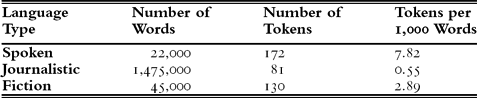
The investigation is based on a corpus involving three language types: spoken French, journalistic French and contemporary French fiction. The spoken French section of the corpus consists of two transcriptions belonging to the GARS corpus: a conversation among six speakers, recorded and transcribed in 1995, and three separate interviews carried out in 2000. The journalistic section is made up of six consecutive editions of Libération (20–26 September 2001).Footnote 4 The corpus of written French fiction consists of 45,000 words taken from three contemporary prize-winning novels: Confidence pour confidence by Paule Constant, Ingrid Caven by Jean-Jacques Schuhl and Le Complexe de Di by Dai Sije (see Appendix for bibliographical information).Footnote 5Table 1 gives a summary of the corpus.
Corpus data
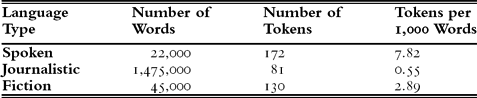
The data in Table 1 are in line with observations made elsewhere regarding the relatively high frequency of dislocation in spoken French (e.g. Gadet, Reference Gadet1991: 110; Blasco-Dulbecco, Reference Blasco-Dulbecco1999: 83).Footnote 6 The design of the corpus reflects the aim of this research: it is smaller than corpora used in other studies of dislocation such as Blasco-Dulbecco (Reference Blasco-Dulbecco1999) and Coveney (Reference Coveney2003) that are based on over 2,000 and 1,761 tokens respectively (Blasco-Dulbecco, Reference Blasco-Dulbecco1999: 83; Coveney, Reference Coveney2003: 112–13). This investigation is based on only 383 tokens because the close reading of individual tokens played an important role in the analysis. This means that it is generally not possible to provide conclusive statistical evidence because there are not enough data points. However, it is frequently possible to see systematic patterns in the data and the combination of this and close reading of individual tokens seems to be an appropriate way to investigate the stylistic function of dislocation.
Another feature of the corpus is the mixture of media and language types: this reflects the focus on the question of speech voice and is seen in other recent work in the field of speech and thought presentation such as Marnette (Reference Marnette2005). The spoken section of the corpus consists of two types of discourse that are frequently used in linguistic research: multi-speaker conversation and interview. The journalistic section comes from the newspaper, Libération, which is a national left-leaning publication in France with a readership of 172,770.Footnote 7 The choice of works to include in the literary section of the corpus was conditioned by a desire to limit both the time period and the genre: the three novels were published over a period of five years (1998–2003), and are all prize-winning fiction. Since the aim of this project is to compare the use of dislocation across spoken, journalistic and literary French, no comparison is offered on this occasion between the individual components that make up each of the three sections. It is clear, however, that the question of variation between texts within one language type would be interesting: for example, Marnette (Reference Marnette2005: 251, 280 n.38) notes that dislocation is particularly frequent in Céline's Voyage au bout de la nuit as a non-standard feature alongside the dropping of ne in negation, slang, colloquialism and the use of on for nous.
The main question addressed throughout this investigation is how dislocation is used in different media and in different speech presentation voices. Each token was therefore classified according to a range of features to allow comparison of both its form and its function. The analysis of form broadly follows the Approche pronominale that is concerned with the syntactic features of this construction. In the present investigation, the tokens were classified according to the position of the dislocated element relative to the main clause: it can be to the left (LD), (9), to the right (RD), (10), multiple elements can be dislocated (MD), (11), and there also exist what I have termed ‘repeated dislocations’ (R), (12), where the same element is dislocated twice (Rowlett Reference Rowlett2007: 174).Footnote 8
(9) moi je trouve
(10) je sais pas moi
(11) elle ça lui manque d'avoir le contact
(12) moi je parlerais pas moi
It is clear from the discussion of the definition of dislocation above that different analyses of tokens (9)–(12) would be proposed under other frameworks, but the definition of dislocation used here is broader because of the type of corpus being investigated. Using the Approche prononinale that considers pronouns, rather than lexical nouns, to be basic (Blanche-Benveniste et al., Reference Blanche-Benveniste1984: 23–59), the tokens are classed according to the type of pronoun used in the main clause. It can either have a subject function (S) as in (9), or an object function (13)–(16).
(13) le reste, elles l’ont appris en salle des profs
(14) elles on leur parle de l'anesthésie péridurale
(15) ça j’en ai fait beaucoup
(16) l'idée qu'on se réalise par nos actes [. . .], j’y crois
Examples (13)–(16) illustrate the four possible object functions in dislocated constructions in French that correspond to four different pronominal paradigms: LE, LUI, EN and Y.
The tokens are also classified according to their function and this is based on the work that has been done on dislocation in the fields of functional and pragmatic syntax, principally, Lambrecht (Reference Lambrecht1981; Reference Lambrecht1994), Barnes (Reference Barnes1985) and Ashby (Reference Ashby1988). Barnes (Reference Barnes1985) develops work by linguists such as Cinque (Reference Cinque1977), Larsson (Reference Larsson1979) and Lambrecht (Reference Lambrecht1981; Reference Lambrecht1984; Reference Lambrecht and Tomlin1987) that had highlighted the topic-comment structure of dislocated constructions. Through the analysis of a corpus of spoken French, Barnes (Reference Barnes1985) shows that this topic-comment structure is rarely the motivation for left dislocation in French, but that instead left dislocation is motivated by a variety of pragmatic functions that all stem from this structure. She maps out four pragmatic functions: contrast, topic shift, turn taking and weak motivation.Footnote 9 Ashby (Reference Ashby1988) develops this work on LD by applying similar tests to RD and establishes a list of eight possible functions. These functions are drawn from work on dislocation by a range of linguists including Chafe (Reference Chafe and Li1976), Lambrecht (Reference Lambrecht1981) and Barnes (Reference Barnes1985), and also from Ashby's own analysis of spoken French:Footnote 10
Contrast (C) – overtly contrastive
Topic Shift (TS) – introducing a new topic
Turn Taking (TT) – signals beginning of speaker's turn
Filler (F) – has no clear pragmatic motivation, and is accompanied by hesitation
Clarification (CL) – clarifies the referent
Epithet (E) – gives information about the referent
TC (TC) – signals end of speaker's turn
Weak (W) – has no apparent pragmatic/discourse motivation
To this list, I add the function ‘list interpretation’ (LI) that is based on an observation by Blasco (Reference Blasco1997: 18) who notes that left dislocation can be used in lists such as (17).
(17) La patrie, il lui en voulait de ses démêlés avec l'autorité militaire ou municipale. La religion, il l’ignorait depuis sa première communion. L'amour, il ne l’avait rencontré que vénal et criard.
In the present corpus, a similar effect is seen in the list interpretation in (18), although it occurs within the same sentence.
(18) Médicaments, calmants, analgésiques, vous les connaissez tous.
All tokens in the corpus were classified according to these nine functions.
This approach was chosen rather than alternatives, such as subsequent developments in the generative field, because it provides a detailed mapping that is specific to French and includes a broad range of discourse-pragmatic functions that can lead to dislocation. Of all the categories, filler and clarification appear to be the most problematic: Ashby (Reference Ashby1988: 221–22) notes that RDs are used as fillers in examples such as (19) where the dislocated pronoun has ‘no pragmatic motivation other than to reflect the speaker's hesitation in completing the sentence’.
(19) Euh, on débute un petit peu par, eu comment je vais vous dire, moi, euh, la charcuterie par exemple.
There is considerable overlap with the category of weakly motivated dislocations where there is no strong pragmatic or discourse function.Footnote 11 Clarification, on the other hand, is problematic because it requires intuition to determine that the dislocation in cases such as (20), cited by Ashby (Reference Ashby1988: 220), is used to avoid a potential ambiguity.
- (20)
Speaker 21: [describing a friend's new apartment]: Claire a trouvé un appartement. Justement, elle voulait, parce qu'elle travaille rue de Toulon. Elle a trouvé un appartement, une maison où a vécu Gambetta. C'est très récent, quand même. Il est bien.
Speaker 97: C'est certainement mieux que moderne parce que . . .
Speaker 21: C'est un apparemtent du dix-neuvième siècle. Il est rénové. Oh, elle n'est pas vieille, la maison.
I retain both the filler and clarification categories in the investigation, but acknowledge that the judgements made here are by nature more subjective than, for example, the classification of dislocation according to the function of the clitic pronoun.
3. AN INTERMEDIARY CODE
In this section I propose the use of an intermediary code, Representation of the Oral in the Graphic (henceforth ROG), for the analysis of dislocated constructions in French. The distinction between the oral and graphic codes has certainly been brought into question. Ayres-Bennett and Carruthers (Reference Ayres-Bennett, Carruthers and Temple2001: 4), for example, note that the dichotomy is complicated by the different registers available within the codes, ranging from a formal lecture in the oral code to an informal post-it™ note. At the same time, however, much of the recent research into dislocation in French focuses either on spoken French (e.g. Coveney, Reference Coveney2003; Blasco-Dulbecco, Reference Blasco-Dulbecco2004) or retains the written-spoken dichotomy (e.g. Blasco-Dulbecco, Reference Blasco-Dulbecco1999). The question underlying this section, therefore, is whether it is helpful in a linguistic analysis of dislocation in French to recognise that some cases of written language have their origins in speech. This idea is certainly not new in the study of French syntax in general (see for example Fleischman, Reference Fleischman1986; Carruthers, Reference Carruthers2005; and Marnette, Reference Marnette2005) but its significance for dislocation has yet to be highlighted. The case being considered here involves reported speech in the press. Out of a total of 81 tokens of dislocation that were found in six issues of Libération, 47, or 58%, are instances of reported speech. This result is significant because until now, tokens of dislocation taken from newspapers have been classified as graphic. For example, (21) from Le Provençal is included in the ‘corpus écrit’ by Blasco-Dulbecco (Reference Blasco-Dulbecco1999: 332).
(21) A la fin 90, J.J va donc quitter la télévision, avec le sentiment «d’en avoir fait des choses»
This choice is perhaps problematic in an investigation that at times offers comparison between usage in the two codes. On the other hand, it is understandable because it would also be inappropriate to classify the token as spoken French. When citing spoken language, journalists do aim to reproduce the speaker's words very closely in the interests of accuracy but it is possible that some features will change (such as instances of hesitation or repetition). I therefore suggest that such tokens should be classed as ROG reflecting their dual origins in both codes, and their two authors: the original speaker and the journalist.Footnote 12 Examples from my corpus include (22) from a lead article and (23) from a transcription of an interview.
(22) Le secrétaire régional CFDT de la Fédération chimie-énergie, lui-même salarié d'AZF à Toulouse, est tout aussi formel: “Le nitrate d'ammonium ça n'explose pas.”
(23) Comment avez-vous réagi quand vous avez entendu Sharon dire “Arafat, c’est notre Ben Laden”?
It is clear that in both tokens the dislocations are oral in origin, although they are found on the page in Libération: they are therefore both classified as ROG.
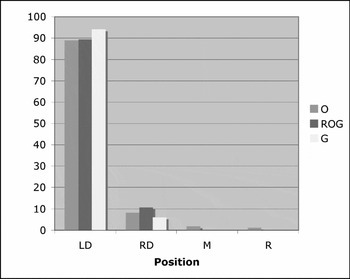
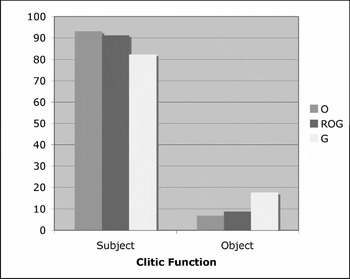
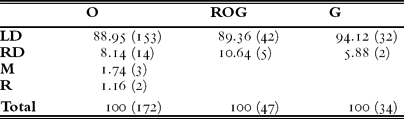
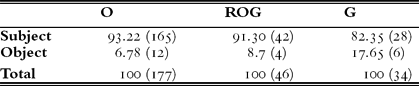
Using this tri-partite classification, I analysed the form of the 253 tokens of dislocation in spoken and journalistic French. Figure 1 shows the position of the dislocated element according to the code, and Figure 2 shows the function of the clitic according to code: the numerical data is given in tabular form in Tables 2 and 3. From the outset, it is important to note that the relatively small size of the corpus means that for some categories there are only very few tokens.
Position of the dislocated element according to code.

Clitic function according to Code.

Numerical data for Figure 113
Numerical data for Figure 2
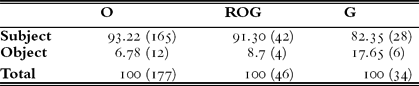
The data in Figures 1 and 2 were tested to determine where there is any correlation between the code and either the position of the dislocated element or the function of the clitic. The significance of the correlation was tested using the chi-squared test: the results are not statistically significant.Footnote 14 However, in all but one case across both figures, the result for ROG lies between the results for the oral code and the graphic code. This suggests that using ROG allows a better comparison between the codes although more data would be required to provide the statistical evidence. Blasco-Dulbecco's (Reference Blasco-Dulbecco1999) excellent study provides one of the most comprehensive and insightful analyses of dislocation in French, but I would like to suggest that refining the analysis of code in this way leads to two improvements. It leads first to the emergence of interesting results previously hidden by the two-way division of code and second, to a questioning of the assumption that dislocation is primarily an oral structure. Blasco-Dulbecco (ibid.: 94) assumes that writers use dislocation to represent orality, but she observes that ‘leurs exemples fabriqués présentent une distribution fort différente de celle de la langue parlée qu'ils cherchent à refléter’. This argument is used convincingly to show that linguists should not rely on written examples to investigate a structure such as dislocation. However, it masks the potential for this structure to serve a function other than a reflection of the oral code. In the next section, therefore, I analyse the use of dislocation in different speech voices in contemporary French fiction to explore the premise of Blasco-Dulbecco's argument, namely that dislocation is used in written French ‘pour donner un effet d'oralité’.
4. SPEECH PRESENTATION IN FICTION
The 130 tokens of dislocation from contemporary French fiction were classified according to the speech voice in which they were found using Leech and Short's (Reference Leech and Short1981) continuum:
Narrative report of action (NRA)
Narrative report of speech act (NRSA)
Indirect speech (IS)
Free indirect speech (FIS)
Direct speech (DS)
Free direct speech (FDS)
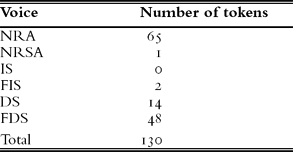
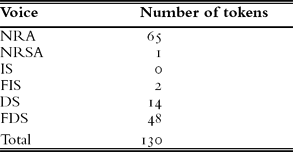
This continuum was chosen because it is organised according to a progressive loss of control on the part of the narrator, which can be seen for the purposes of this investigation to correspond to an increase in the level of orality in the individual voices.Footnote 15 The narrator has the least control in DS and FDS that we can assume often contain what Fludernik (Reference Fludernik1993: 19) calls ‘typicalized “mimetic” features’ in this case used to mark orality. Fludernik writes: ‘since language cannot reproduce language in completely authentic fashion, representation has to recreate the known features of expressive utterance and when wishing to enhance the mimetic status of the represented discourse, this mimetic effect increasingly comes to rely on the deployment of typicalized “mimetic” features and on their density and pervasiveness’. This continuum therefore allows the main hypothesis of this section to be tested: if the function of dislocation on the page is to give the effect of orality as a typicalized mimetic feature, then it is expected that most – if not all – of the tokens will be found in the most oral voices. Table 4 summarises the number of tokens of dislocation found in each voice.
Number of tokens per voice
In most cases, classifying the tokens according to voice posed few problems: according to the classification, (24) is an example of NRA and (25) an example of FDS.
(24) Du regard, Lola Dhol fit le tour de la pièce. [. . .] Pour Lola, l'hiver c’était aussi le ventre rouge du théâtre Gustav-Dhol [. . .].
(25) –Écoute, dit Gloria, si tu avais besoin de dollars et que tu en trouvais un gros tas sur le trottoir, qu'est-ce que tu ferais? –Je les prendrais, dit Babette. [. . .] –Eh bien! moi, j’ai besoin d'un livre et je le prends.
As regards the results presented in Table 4 it is immediately interesting to note that not all of the tokens are found in the most oral voices; in fact, exactly half of the tokens are found in the least oral voice, NRA. There are several possible explanations for this: it could be that it is inappropriate to associate dislocation with orality, or that some types of dislocations are more strongly linked to orality than others.Footnote 16 However, the explanation I explore here is that dislocation can perform an oral function in voices such as DS and FDS, but that it may also have a different function in the other voices. In the rest of this section, therefore, I present a comparison of the form and function of dislocation in the different voices to determine to what extent it can be said to play different roles according to the level of orality of the voice.
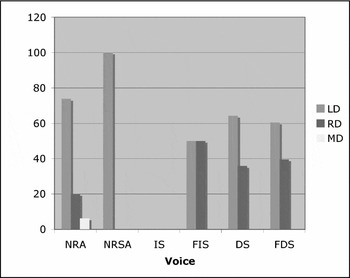
To begin with, Figure 3 shows the distribution of different types of dislocations for each voice. It is immediately obvious that, unlike the corpus of spoken French, this corpus contains no repeated dislocations. This could certainly have occurred by chance since repeated dislocations are relatively rare (see Figure 1). On the other hand, it is also possible that this kind of repetition is one of the features of the oral code that are not automatically used when representing orality on the page, either in journalistic citation or in the creation of fictional voices.
Position of the dislocated element according to voice.

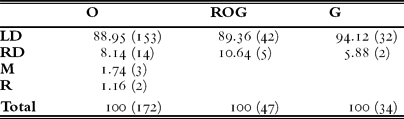
Numerical data for Figure 3

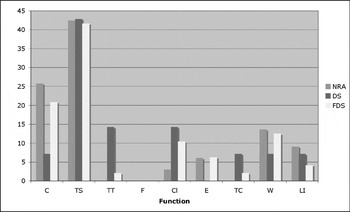
Before discussing Figure 3, it is important to point out that the results for NRSA, IS and FIS given in Table 4 are so low (at 1, 0 and 2 respectively) that it is impossible to draw any conclusions for them. Instead, the discussion throughout this section focuses on the results for NRA, DS and FDS. Although the results for Figure 3 are not statistically significant overall, there is a pattern in these three voices for the proportion of LDs to reduce as the voices become more oral, and correspondingly for the proportion of RDs to increase.Footnote 17 A similar pattern was seen across the codes in Figure 1 where the oral code has the smallest proportion of LDs. This result is interesting because it shows that the authors display usage patterns in the speech voices of the text similar to those found in the oral code itself. This suggests that there is a link between the formal features of the speech voices in written fiction and the formal features of spoken language. In this case, therefore, both types of orality correlate. Figure 3 also shows that MDs are only found within NRA, which supports the idea that the stylistic function of dislocation differs according to the voice in which it is used. In Figure 1 it was seen that MDs are only found in the spoken French part of that corpus so they are probably more typical of spoken rather than written French. This implies that that their use in only the least oral of voices in the corpus of fiction reflects the fact that dislocation has more than one stylistic function in written French.
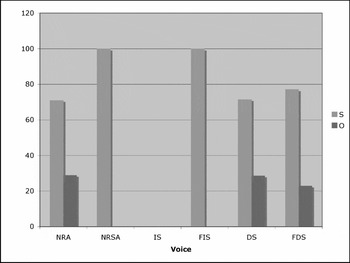
The notion that dislocation may have more than one stylistic function is supported by the results in Figure 4 showing the distribution of tokens with different syntactic functions for the clitic, according to voice.
Syntactic function of the clitic according to voice.

Numerical data for Figure 4

Once again, the findings are not statistically significant and the results for NRSA, IS and FIS are too low to allow comparison.Footnote 18 However, the results for the other three voices are interesting because they display a different pattern from Figure 3: in Figure 3 the more oral voices made less use of what is the most common overall type of dislocation, LD, and more use of the less common types, RD and MD. It was argued that this relatively lower frequency of LD in the more oral voices reflected the distribution seen across the codes in Figure 1. Here, on the other hand, the more oral voices make a relatively greater use of the most common function overall, Subject, and less use of the object functions. It is interesting to consider why this might be the case. It is certainly possible that the object function is avoided by authors because it is perceived as more complex on account of its relatively low overall frequency in French. However, such an explanation would be difficult to support with concrete evidence and a more likely reason concerns the perceptibility of the features in question. Behind both Fludernik's (Reference Fludernik1993: 19) ‘typicalised “mimetic”’ features and Blasco-Dulbecco's (Reference Blasco-Dulbecco1999: 94) assumption that dislocation is used by writers ‘pour donner un effer d'oralité’ is the idea that writers select features that are associated with the oral code to give an oral tone to their writing. This selection process clearly depends on the features being both perceptible and somehow conventionally – or typically – associated with the tone they are meant to reflect. The difference between the patterns seen in Figures 3 and 4 may therefore result from the fact that authors associate the use of dislocations other than LD with the oral code but do not use the function of the clitic pronoun as a ‘“mimetic” feature’ and thus the function that is the most common overall, namely subject, is the most frequent here. This difference between the two figures illustrates the kinds of difference to be found between the oral code and its constructed counterpart on the page.
The final set of data is presented in Figure 5 showing the discourse-pragmatic function of tokens according to voice. In this case, I have simplified the voice category to include only NRA, DS and FDS because of the small numbers of tokens for the other voices and the large number of categories for function.
Discourse-pragmatic function according to voice.

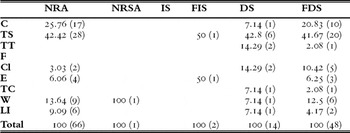
Numerical data for Figure 5

These data are not significant at the p = 5 level, but they are significant at the p = 10 level.Footnote 19 Several observations can be made about the results: it is striking that the TS function is consistent across the three voices at 42.24%, 42.86% and 41.67% for NRA, DS and FDS respectively. This confirms the frequent association of dislocation with topic shift (Ashby, Reference Ashby1988: 217; Lambrecht, Reference Lambrecht1994: 183; Blanche-Benveniste, Reference Blanche-Benveniste and Brown2006: 479). The first conclusion that can be drawn here, then, is that with its main function, the use of dislocation does not vary across the voices. However, never more than 43% of tokens have the TS function so it is also important to take into account the other functions where there is more variation.
First, it can be seen that there are no tokens with the F function in the corpus. This can be compared to Ashby (Reference Ashby1988: 217) who finds that 23 out of 172, or 13%, of RDs in his corpus of have this function. It may well be that there are no such tokens here because there are only 38 RDs in this part of the corpus. However, it is also possible that even a larger corpus of RDs would not contain any dislocations with the filler function because it is a function limited to the oral code. Ashby's (Reference Ashby1988: 222) definition suggests this is possible because it indicates that filler dislocations have no pragmatic motivation and consequently, this may be a function of dislocation that authors choose not to pick up and represent on the page. This is similar to repeated dislocations that were seen in Figure 1 to be present only in spoken French. In this way, the F function is different from Cl that is found in the corpus of French fiction and is used substantially less in NRA than in either of the two more oral voices. The opposite pattern is seen for C that is used more in the narrative voice than in the more oral voices.Footnote 20 An example of C in NRA is given in (26) and an example of Cl in DS in (27).
(26) Un acteur il faut le voir sur un écran, un écrivain il faut le lire.
(27) “Par un bel après-midi, à Munich, on était allés, Rainer et moi, dans un endroit qui venait d'ouvrir”
The token in (27) sheds some light on the frequent use of dislocation as a clarifying device in the more oral voices because it highlights one of the difficulties writers face when trying to represent orality on the page. If spoken French is characterised by a more frequent use of pronouns than written French, for similar reasons the more oral voices in fiction can also be characterised by a more frequent use of pronouns. However, the very interactivity that leads to the more frequent use of pronouns in the oral code is present only at the level of implied speakers and implied hearers in written fiction: the author is also catering for an actual reader with whom there is no interaction beyond the words on the page. I would like to suggest, therefore, that in cases such as (27), the pronoun can reflect the oral code but it is the absence of interactivity that leads to the use of the clarifying dislocation. What we see here, therefore, is a difference between true orality – the oral code – and the imitative orality of speech voices on the page; and it is this difference that explains the particular distribution of dislocations with clarifying function across the three voices.
So far, the findings of this investigation of the use of dislocation in contemporary French fiction cast doubt over the assumption that its function on the page is always oral. The strongest evidence for this is the fact that half of the dislocations are used in the least oral of the voices. It was also seen that there are differences in the way dislocation is used in the different voices at both the formal and functional levels. It is certainly true that dislocation can be used to indicate orality, as Blasco-Dulbecco (Reference Blasco-Dulbecco1999: 94) notes. Token (25), for example, is found in the most oral of voices and other ‘mimetic features’ are present such as ‘eh bien!’. It can be said with some certainty that the dislocation ‘moi je’ is used here ‘pour donner un effet d'oralité’. In cases such as (24), on the other hand, it is less certain that dislocation is being used for its orality: it is the voice of the narrator, and there are no other ‘mimetic features’ present. In fact, in the same paragraph, the narrator uses features more closely associated with the graphic code such as the simple past, subject-verb inversion and lexical items such as ‘dévêtir’ where ‘déshabiller’ might be more typical in unplanned speech. There are also rhetorical features typical of literary prose such as the following extended metaphor: ‘Au nord, l'hiver retient longtemps l'enfance, il la couve dans les cocons de neige, il la pelotonne dans de grands lits blancs et s'inscrit sur les vitres les signes étincelants de son bonheur’. In this context, it is unlikely that the dislocation is used to reflect orality.
Although it is not the aim of the current article to determine exactly what other functions dislocation might play in fiction, several possibilities have emerged. To begin with, as early as Barnes (Reference Barnes1985: 49), it was noted that dislocation can be grammatically triggered: ‘The data of this corpus strongly suggest that the use of LD with lexical subjects of être is quasi-obligatory where ce (c-) is an appropriate anaphor.’ This probably explains the dislocation in (24). Where dislocation is grammatically triggered, it is unlikely that it will also perform a strong stylistic function such as conveying orality, although the two can certainly coincide in some tokens. Similarly, the function of dislocation can also be primarily discourse-pragmatic rather than stylistic. The token in (28) is an example of the narrative voice and the main function of the dislocation is the establishment of a topic.
(28) Elles étaient près de se disputer, et puis elles tombèrent d'accord, la fautive c’était la fille et toute cette catégorie calamiteuse de jeunes femmes arrogantes qui s'installent d'emblée dans la compétition avec des femmes comme elles et ne doutent pas une seconde qu'elles remporteront la victoire.
Once again, it is possible to interpret this dislocation as not having a particularly oral function.
I have suggested that tokens can be stylistically neutral, but it might also be beneficial to offer a refinement of the term ‘oral’ and distinguish, as Leech and Short (Reference Leech and Short1981) and Marnette (Reference Marnette2005) do, between speech and thought. In this way, the function of the dislocation in token (25) can accurately be described as oral since it is the oral code that is being represented on the page. The token in (29), on the other hand, is difficult to associate with the oral code since it is found in an excerpt from a diary entitled ‘Jeudi 29 juin’ which should perhaps be considered closer to thought than to speech.
(29) Moi, je craignais que ma mémoire ne succombât devant tous les objets de rêves de ces jeunes filles
The potential for overlap between types of reported discourse is highlighted by Marnette (Reference Marnette2005: 50–63) and she proposes a continuum of discourse types from external speech, via inner speech to thoughts and, finally, attitudes. In applying this continuum to data from nineteenth and twentieth-century French literature, Marnette (ibid.: ch.3) shows that there is frequent blurring between speech and thought. The use of dislocation in the diary entry in (29) probably results from this blurring between speech and thought but it is still useful to point out that conveying orality does not necessarily imply any truly oral source for the token. It may therefore be beneficial in a future study to investigate whether there are differences in the form and function of tokens in reported speech and in reported thought in literary fiction.
Finally, token (30) suggests that dislocation can play a stylistic role that is not necessarily oral.
(30) Elle se rappelait ce conseil du Grand Shakespearien: les écrivains, il les faut morts.
Alongside the discourse-pragmatic function of TS, its stylistic function may in part be oral, but it is significant that it appears in the novel just two sentences after the dislocated construction that was given in (26). It therefore plays another stylistic role in establishing a parallelism between the two sentences that, thanks to the dislocation, become linked both by their content and by their phrase structure. This example illustrates the potential for dislocation to have a range of stylistic functions.
Before concluding, it is important to highlight an unavoidable difficulty when investigating stylistic function: there is the potential for circularity in analysing tokens from the narrative voices such as (28). So far, only two types of orality have been considered in this article: first, ROG that represents actual instances of speech on the page, and second, the range of voices from IS to FDS used by writers to represent imagined speech on the page and often involving Fludernik's ‘typicalized “mimetic features”’. At the heart of the problem is the potential for a third kind of orality where the writer has chosen to imbue the voice of the narrator with a level of orality. The circularity in analysing the stylistic function of dislocation would emerge here if the only clue to the oral ‘tone’ of the narrator's voice were the use of dislocation. However, in practice it seems unlikely that this will pose a problem because if the writer wishes the narrator's voice to be to some extent oral, it is unlikely that dislocation will be the sole feature used to convey this tone. On its own, therefore, the distribution of tokens across the different voices may not be sufficient evidence to illustrate the non-oral function of dislocation. However, this claim is supported here by both further comparison of the formal and functional features of dislocation in the different voices on the page and by qualitative analysis of individual tokens.
5. CONCLUSION
To return to Gadet's (Reference Gadet1991: 110) question: ‘Le détachement: une structure de l'oral?’, this investigation has contributed two main findings. First, it was seen that the notion of orality is itself complex and three main types of orality have been seen: the ‘primary’ orality of the oral code, the ‘representative’ orality of the oral code presented on the page in journalistic prose and the ‘constructed’ orality of the imagined oral code in speech presentation in written fiction.Footnote 21 At a theoretical level, it is appropriate to acknowledge that all three types of orality are related but that distinguishing between them is important in order to reflect the very different circumstances of their production. At the practical level, the analysis of the form and function of dislocation presented here supports the use of this model, since it allows us to link some of the differences in the form and function of the tokens of dislocation to the different types of orality in which they are found. This then leads to the second main finding of this investigation, namely that dislocation in contemporary French fiction is not necessarily restricted to the sole stylistic function of conveying ‘orality’. This may well be the most frequent – and even dominant – function, but it does not seem to be its only function. This interest in the function of dislocation could be explored further by using a larger corpus and by taking into consideration a wider range of texts and text-types. Nevertheless, it is possible at this stage to conclude that dislocation is not only ‘une structure de l'oral’.
APPENDIX
The following is a summary of the bibliographical information for the three components of the corpus.
1) The Written Press
Libération, 20 September 2001–26 September 2001.
2) Spoken French
Rigaud, N. (2000). Corpus Part 2 ‘L'amour est-il une denrée périssable ?’. In: On en revient à dire que je disais. Éléments linguistiques pour une approche intégrative pour un corpus de parole spontanée: interaction et négotiation. Unpublished DEA Thesis, Université de Provence, Aix-Marseille I.
Nikoulina, N. (1995) Transcription d'un corpus de français parlé ‘Métier’. Unpublished MA Thesis, Université de Provence, Aix-Marseille I.
3) Contemporary Fiction
Constant, P. (1998). Confidence pour Confidence. Paris: Gallimard.
Schuhl, J. – J. (2000). Ingrid Caven. Paris: Gallimard.
Sijie, D. (2003). Le Complexe de Di. Paris: Gallimard.