


1 Introduction
This paper argues that tone-association patterns are fundamentally local over autosegmental representations (ARs) in a well-defined, computational sense. This notion of locality provides for an explicit theory of tonal well-formedness that is attractive compared to previous explanations, in that it makes clear typological predictions that cover a broader range of attested patterns, but does not predict unattested patterns which involve global calculations over the entire representation. It also provides a clear path for understanding how these patterns can be learned.
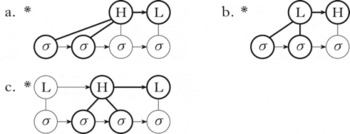
To illustrate, (1) gives examples of three logically possible tone-association patterns: (a) right-to-left association, (b) left-to-right association and (c) ‘centring’ association, in which a single H tone associates to the syllable closest to the centre of the word. The patterns in (a) and (b) are attested (as discussed in §3), but (c) is not.
-
(1)

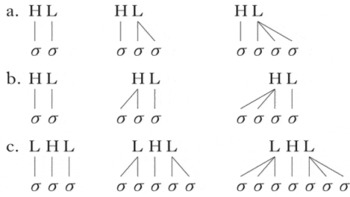
This fact can be explained by a theory of tonal phonology that states that surface association patterns are fundamentally local. The attested directional patterns result in an edge-based generalisation in the surface representation: in (1a), multiple association only occurs on the right edge, in (1b) on the left. Such generalisations can be captured by constraints on forbidden substructures, which ban ‘pieces’ of ARs. For example, (2) forbids a structure in which a non-final H spreads to more than one syllable (the notation is discussed in §5).
-
(2)
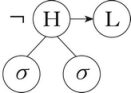
If such a structure is forbidden, the initial H in (1a) cannot spread, and so the L does instead. In (1b), in contrast, this structure would not be banned, leaving the initial H free to spread. However, constraints on forbidden substructures cannot describe the pattern in (1c) – intuitively, this is because there is no finite set of substructures we can ban in order to ensure that the number of syllables on either side of the H tone is the same. Capturing this pattern instead requires global evaluation, which can count the number of syllables on either side. Thus, a computationally local theory of tone excludes (1c) from the typology.
As Zoll (Reference Zoll2003) points out, tone-association patterns are not purely directional. §3 below reviews not only directional patterns as in (1a) and (b), but also examples of patterns highlighted in Zoll's work: quality-specific patterns, which refer to the association of specific tones, and positional patterns, which refer to a position in the word. Furthermore, as an example of long-distance tonology, §3 also considers a culminativity pattern, in which a word is restricted to a single H tone. The analyses of forbidden subgraphs in §5 then demonstrate that all of the above patterns are computationally local, leading to the conclusion that a sample of major tone-association patterns share this property. While a full survey of tone is beyond the scope of this paper, and future work may discover patterns that defy a computationally local characterisation, this analysis compares well with Zoll (Reference Zoll2003) and other foundational work on tone. As discussed in §6, this is because the current proposal explicitly makes locality a core tenet of the theory, contra previous theories.
This notion of locality focuses on the well-formedness of surface structures. This is independent of how they are derived from underlying forms. Thus any full theory of AR transformations will have to meet the output conditions provided here.
Finally, while autosegmental representations have been called into question (Cassimjee & Kisseberth Reference Cassimjee, Kisseberth, Hyman and Kisseberth1998, Leben Reference Leben, Mugane, Hutchison and Worman2006, Hyman Reference Hyman2014, Shih & Inkelas Reference Shih, Inkelas, Kingston, Moore-Cantwell, Pater and Staubs2014), there are various reasons for continuing to use them. First, their formal properties have been extensively studied (Bird & Klein Reference Bird and Klein1990, Coleman & Local Reference Coleman and Local1991, Wiebe Reference Wiebe1992, Kornai Reference Kornai1995, Eisner Reference Eisner1997a). More importantly, as will be seen throughout this paper, they straightforwardly capture the distribution of contours and ‘plateaus’ of adjacent tone-bearing units (henceforth TBUs) that agree in tone, and it is thus extremely likely that local AR constraints ‘translate’ into local constraints in alternative representational theories.
This paper is structured as follows. §2 introduces the computational notion of locality in terms of forbidden substructures. §3 then gives a brief typology of basic tone-association generalisations. §4 extends the notion of forbidden substructures to autosegmental representations, and §5 demonstrates how each of the patterns in §3 are local by analysing them with grammars of forbidden substructures. §6 contrasts this result with previous theories of tone, which do not capture the local nature of the patterns, and §7 concludes.
2 Grammars of forbidden substructures
The notion of locality central to the current proposal is based on forbidding substructures, and is drawn from work on logical characterisations of formal languages (Büchi Reference Büchi1960, Thomas Reference Thomas1982, Rogers Reference Rogers1998, Rogers et al. Reference Rogers, Heinz, Fero, Hurst, Lambert, Wibel, Morrill and Nederhof2013) and their application to well-formedness constraints in phonology (Heinz Reference Heinz2007, Reference Heinz2009, Reference Heinz2010a, Graf Reference Graf2010a, Reference Grafb, Heinz et al. Reference Heinz, Rawal and Tanner2011, Rogers et al. Reference Rogers, Heinz, Fero, Hurst, Lambert, Wibel, Morrill and Nederhof2013).Footnote 1 Grammars of forbidden substructures provide a strong theory of well-formedness (Heinz Reference Heinz2007, Reference Heinz2010a); there are proven methods for learning such grammars from positive data (García et al. Reference García, Vidal and Oncina1990, Heinz Reference Heinz2010a, Reference Heinzb, Jardine & Heinz Reference Jardine and Heinz2016). They have also been used to define local transformations (Chandlee Reference Chandlee2014). Below I illustrate forbidden substructure constraints with forbidden substrings, as they have been extensively studied. This is extended to ARs with forbidden subgraphs in §4.
A forbidden substructure grammar is a statement of the form in (3a).
-
(3)

We interpret this notation as: ‘don't contain any of r1, r2, r3, …, or rn’. That is, given some universal set of structures, this statement specifies a subset of well-formed structures that contain none of r1 through rn. For example, let our universal set of structures be all logically possible strings of H- and L-toned TBUs. The forbidden substructure grammar in (3b) specifies exactly the set of strings which do not contain HLL as a substring, i.e. a contiguous ‘piece’ of a string.
To give an example tonal pattern that can be described with such a constraint, words in Kagoshima Japanese have exactly one high-pitched syllable, either on the final or the penultimate syllable (Haraguchi Reference Haraguchi1977, Kubozono Reference Kubozono2012). Thus, LLHL and LLLH are well-formed strings in Kagoshima (e.g. [kagaríbi] ‘watch fire’ and [irogamí] ‘coloured paper’; Haraguchi Reference Haraguchi1977), but *LHLL is not. We can (partially) model this pattern with the forbidden substring grammar ¬HLL, which can be interpreted as: ‘a H-toned syllable cannot be followed by two L-toned syllables’.
Evaluating the well-formedness of a string with respect to this constraint has a straightforward cognitive interpretation (Rogers et al. Reference Rogers, Heinz, Fero, Hurst, Lambert, Wibel, Morrill and Nederhof2013): for any string of H and L TBUs, whether it is well-formed with respect to the Kagoshima Japanese pattern can be checked by scanning the string with a window of size 3 to ensure that it does not contain a HLL substring. This, then, is the local nature of constraints on forbidden substructures: well-formedness is based on contiguous structures of a specific size. This also allows for a learning model for these constraints, as a learning algorithm only needs to scan through input data in this way in order to discover the pattern (García et al. Reference García, Vidal and Oncina1990, Heinz Reference Heinz2007, Reference Heinz2010a). A detailed description of such learners over strings and their applications to phonotactics can be found in Heinz (Reference Heinz2010a). Additionally, this window can form the basis of a theory of computationally local transformations from underlying to surface form: any changes must be based on information in a window in the underlying form (Chandlee Reference Chandlee2014, Chandlee et al. Reference Chandlee, Eyraud and Heinz2014).
The remainder of this paper shows how grammars of forbidden substructures can be extended to define a local theory of autosegmental well-formedness in tone. The following section surveys examples of generalisations that have played a major role in our understanding of tone association.
3 The typology
This section gives examples of directional association, in which the tone melody appears to align to one edge of the word, positional association, in which a tone spreads up to a TBU in a particular position, and quality-sensitive association, in which there is a constraint on H-tone spreading, but not L-tone spreading. Additionally, as an example of a long-distance constraint on melodies, a culminative pattern is also reviewed. While space constraints necessitate a brief overview of patterns, these examples have motivated foundational work on derivational and optimality-theoretic approaches to tone. (Analyses in these frameworks are discussed in §6.) The goal here then is to demonstrate the local nature of these basic cases, using the analyses of forbidden substructures in §5.
3.1 Directional and positional association
Mende (Mande; Leben Reference Leben1973, Reference Leben and Fromkin1978, Dwyer Reference Dwyer1978) is a classic example of a directional association pattern, and provides one of the original arguments for treating tonal units independently of their TBUs. In Mende, tonal ‘plateaus’ of adjacent syllables with the same tone are limited to the right word edge, as are contour tones. Some examples are given in (4) (from Leben Reference Leben1973, Reference Leben and Fromkin1978). Throughout this paper, standard notation is used; [V́] transcribes a high tone (H), [V̀] a low tone (L), [V̂] a falling tone (F) and [Ṽ] a rising-falling tone (R-F).
-
(4)

In terms of ARs, plateaus are represented by the multiple association of a single tone to multiple syllables, and contours by the multiple association of multiple tones to a single syllable. In Mende, then, multiple association can only occur at the right edge of the word, as in (5).
-
(5)
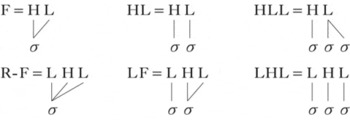
In contrast to Mende, in the Chadic language Hausa (Newman Reference Newman1986, Reference Newman2000), plateaus and contours occur at the left edge of the word, as in (6) (for exceptions to both the Mende and Hausa patterns, see note 4).
-
(6)

For example, while three-syllable HL words are pronounced HLL in Mende, they are HHL in Hausa. In autosegmental terms, this means that multiple association in Hausa is allowed at the left edge, not the right, as in (7).
-
(7)

However, association generalisations are not limited to referring to only the left or right edge. In the Northern Karanga dialect of Shona (Bantu; Odden 1986, Myers Reference Myers1987, Hewitt & Prince Reference Hewitt and Prince1989), morphologically based tone alternations on the verb result in a well-formedness generalisation which refers to both edges. The pattern is summarised in (8) with data from the Northern Karanga Shona non-assertive tense. The pattern in question holds over the domain comprising the verb root and suffixes, ignoring the morphological complex /handáka/ ‘I didn't’, which comprises a different phonological domain. Maximally, a series of three H-toned syllables is followed by an unbounded stretch of L-toned syllables and a final H-toned syllable.
-
(8)
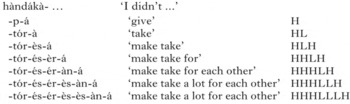
In autosegmental terms, the leftmost H associates maximally to the first three syllables, while the second H of the non-assertive tense associates only to the final syllable. Modulo the restriction that it cannot spread to the penult, the initial H spreads as close as it can to the third syllable. In this way, Northern Karanga Shona also provides an example of a positional generalisation, as it refers to a particular syllable in the word.
3.2 Quality-sensitive association
Kukuya (Bantu; Hyman Reference Hyman1987, Archangeli & Pulleyblank Reference Archangeli and Pulleyblank1994, Zoll Reference Zoll2003) shows a very similar distribution of tone patterns to Mende, with the exception that *LHH forms are not possible, while LLH forms are. The Kukuya patterns are summarised in (9) (from Zoll Reference Zoll2003: 229).
-
(9)
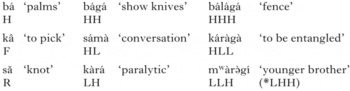
The generalisation here, as pointed out by Zoll, is that there is a quality-sensitive restriction on association: L tones may freely multiply associate, but H multiply associates just in case it is the only tone in the word. Thus [bálágá] (HHH) is licit, while *HHL is not. This generalisation is shown in the autosegmental diagrams in (10) for three-syllable H, HL and LH melody forms.
-
(10)

Note that whereas multiple association in contours only occurs on the right edge (e.g. [sǎ] in (9)), in terms of multiple association of tones, only L, not H, can freely associate. Thus, as noted above, *LHH is illicit, but LLH is allowed. Kukuya therefore provides an example of a quality-sensitive well-formedness condition that refers to specific tonal phonemes (this terminology is due to Zoll Reference Zoll2003).
3.3 A melody constraint: culminativity
Finally, constraints on the melody can operate independently of the number of TBUs. In Hirosaki Japanese (Haraguchi Reference Haraguchi1977), there is a culminativity constraint, which states that there must be exactly one H tone on the melody tier.Footnote 2 The data in (11) (from Haraguchi Reference Haraguchi1977: 76–77) exemplify this pattern. The TBU for Hirosaki Japanese is the mora, including the moraic coda nasals, which can carry tone (e.g. in [tòráǹkù]). The relevant domain comprises nouns and certain suffixes.
-
(11)

There are two major restrictions. One is that there is must be exactly one H- or F-toned mora in the word – if there is a F-toned mora, then there cannot be an H, and vice versa. Additionally, F-toned moras can only appear word-finally; e.g. LHLL is attested in [tòráǹkù] and LLLF in [kàmìnàrî], but *LFLL is not attested.
The ARs in (12) display these restrictions. If we view a F-toned mora as multiply associated to an H and L tone, then the restriction on H- and F-toned moras reduces to the statement that there must be exactly one H tone on the melody tier.
-
(12)

There is also a quality-sensitive restriction on multiple association: H cannot associate to multiple moras. The restriction of the falling contour to the right word edge can also be seen as a directional restriction that only word-final moras can associate to multiple tones.
The requirement in Hirosaki Japanese there must be exactly one H tone somewhere in the word makes the tone pattern ‘long-distance’, as it holds over the entire length of the word. It is important to remember that, in terms of the melody tier, this long-distance generalisation can be reduced to a statement about the well-formedness of the melody tier that is independent of the number of TBUs to which it associates.
4 Locality and autosegmental representations
The preceding section illustrated how tone patterns can exhibit directional, positional and quality-specific association patterns, as well as culminativity constraints. The remainder of the paper argues that these patterns are fundamentally local in the sense introduced in §2, but in order to do this we need to extend the notion of forbidden substructure to ARs. This section shows how this can be done by banning certain subgraphs in graph representations of ARs.
An AR is a kind of graph (Goldsmith Reference Goldsmith1976, Coleman & Local Reference Coleman and Local1991, Jardine & Heinz Reference Jardine and Heinz2015), where a graph is defined as a set of elements or nodes and a set of binary relations or edges over those elements. We can represent an AR as a set of labelled nodes with undirected edges representing association and directed edges representing precedence on each tier (marked in (13b) with arrows; cf. Raimy Reference Raimy2000). This paper also assumes boundary elements, labelled #, denoting the beginning and ending of each tier. An example is given in (13b) for Mende [félàmà] in (4).
-
(13)

Of course, not every graph is an AR, and this paper will assume a number of generally agreed-upon axioms for ARs. First, the elements are arranged into some number of tiers – for the purposes of this paper, two – and ordered on each tier (Goldsmith Reference Goldsmith1976). Second, ARs obey the No-Crossing Constraint, which states that the association relation respects the orders on each tier (Goldsmith Reference Goldsmith1976, Hammond Reference Hammond1988). Third, ARs are fully specified; that is, all tones are associated to some TBU, and all TBUs are associated to some tone (Goldsmith Reference Goldsmith1976). Finally, the representations here will all assume the Obligatory Contour Principle (OCP; Leben Reference Leben1973, McCarthy Reference McCarthy1986), which states that adjacent melody tier units must be distinct. Pulleyblank (Reference Pulleyblank1986) and Odden (Reference Odden1986) have argued respectively against full specification and the OCP as universals, but they will suffice for the tone patterns discussed here, and the results of this paper do not depend on whether or not these properties are universal.Footnote 3 Formal definitions of all of the above properties can be found in Goldsmith (Reference Goldsmith1976), Coleman & Local (Reference Coleman and Local1991), Kornai (Reference Kornai1995), Jardine (Reference Jardine2014) and Jardine & Heinz (Reference Jardine and Heinz2015).
A substructure of an AR is thus a subgraph, a ‘piece’ of a graph. An example subgraph of (13c) is given below in (14a), and highlighted in (14b).
-
(14)

Let us assume that subgraphs are connected, i.e. that we can travel from one node to any other node in the graph by following some path of edges (ignoring directionality of the directed edges). (Formal definitions of these concepts can be found in graph-theory texts such as West Reference West2001.)
Given that we have a universal set of ARs and a notion of AR substructures, we thus can immediately extend the notion of constraints on forbidden substructures to ARs. The tonal patterns surveyed in this paper will thus be analysed using statements of the form in (3a), i.e. ¬r1W¬r2W…W¬rn, where each rn is a subgraph. For example, the grammar in (15) has a single constraint, which bans the subgraph in (14a).
-
(15)
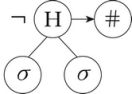
This grammar specifies the set of ARs which do not have multiple association of a final H tone. The following shows how grammars consisting solely of such constraints can capture the patterns discussed in §3.
5 Forbidden subgraph analyses of association patterns
This section shows how the well-formedness generalisations of tone-mapping patterns in Mende, Hausa, Kukuya, Northern Karanga Shona and Hirosaki Japanese discussed in §3 can all be described by grammars of forbidden structures over ARs as defined in the preceding section. This demonstrates that all of these patterns are fundamentally local in the computational sense defined in §2 and §4.
5.1 Directional and positional association
To begin with directional generalisations, recall that multiple association in Mende can only occur on the right edge of the word (cf. (5) above), while in Hausa it was restricted to the left edge of the word (cf. (7)). (16a) and (b) contrast well-formed ARs in the two patterns, using the notational conventions introduced in §4.Footnote 4
-
(16)
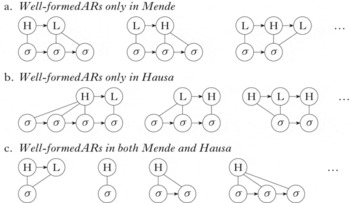
Of course, multiple association when there is a single TBU or a single tone in the melody is the same in both patterns (because it is both at the left and right edge), as in (16c).
For the analysis of (16a), we can recast the generalisation negatively as two generalisations: ‘non-final tones do not multiply associate’ and ‘non-final syllables cannot multiply associate’, where ‘non-final’ means ‘not the last unit on its tier’. The former can be achieved by the grammar in (17).
-
(17)
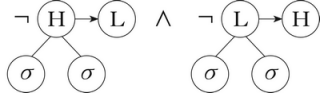
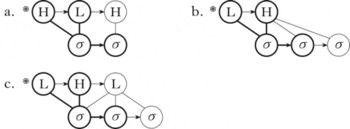
The subgraphs in the above grammar single out a non-final H and a non-final L respectively, which are associated to multiple syllables.Footnote 5 (Again, because we are adopting the OCP, a non-final H can only be followed by an L tone, and vice versa.) Note that any AR in which association occurs anywhere besides the right edge will contain one of these subgraphs, highlighted in (18). Note that (18a) and (18b) are valid ARs in Hausa.
-
(18)
Even though the structures in (17) only refer to two timing tier units, they forbid graphs like (18) with plateaus on the left edge, no matter the length of the plateau (as in (18a)). Note that all of the valid Mende ARs in (16a) and (c) are well-formed with respect to (17), because they contain neither of these subgraphs.
We also want to ban non-final contours. This can be achieved by forbidding the subgraph in (19), which picks out a multiply associated syllable followed by some other syllable.
-
(19)
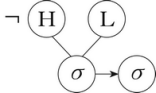
Note the lack of a directed edge between the H and L nodes in (19); this means that both falling and rising contours are matched by this subgraph, as can be seen in the examples in (20a) and (b). (19) also bans non-final LHL contours, as such a structure is a superstructure of (19). An example is given in the graph in (20c), which contains two instances of (19) (only the first is highlighted).
-
(20)
Thus, to capture the right directional generalisation in Mende, we conjoin the grammar in (17) forbidding association of non-final tones with that in (19) forbidding non-final contours, to give (21).
-
(21)
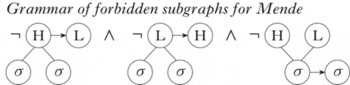
As explained above, this distinguishes the set of ARs that are well-formed with respect to Mende (such as the examples in (16a, c)) from those that are not (such as the examples in (16b)).
The Hausa pattern, then, can be captured with subgraphs targeting multiple association at the opposite edge – i.e. with a grammar forbidding non-initial spreading and non-initial contours, as in (22).
-
(22)
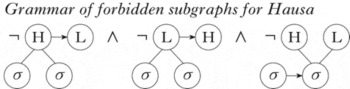
Note that each of these subgraphs is essentially the mirror image of that for the Mende grammar in (21): the first two subgraphs match non-initial spreading tones, and the final one matches a non-initial contour. As with the three directional constraints in Mende, forbidding these three subgraphs will be enough to capture the generalisation that multiple association can only occur on the left edge. Note that in both the grammars for Hausa and Mende, spreading of H and L tones are treated separately, i.e. they are referred to with separate subgraphs. This will be taken advantage of later in the analysis of the quality-sensitive association pattern in Kukuya, which will use both subgraphs from the Mende and Hausa patterns representing multiple association of H.
Consider now the analysis of Northern Karanga Shona, in which the generalisation refers to both edges. Recall from §3.1 that H-toned Karanga verbs in the non-assertive tense have a pattern in which the H tones associate to the initial and final syllables, with the initial H spreading maximally to the third syllable, as in (23).
-
(23)
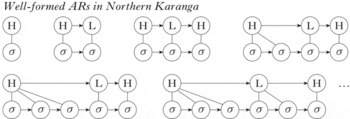
There are three possible tone melodies, H, HL and HLH, depending on the number of syllables in the word. This generalisation can be restated in negative terms as follows: there are no initial L tones, and no LHL sequences on the melody tier. These constraints on the melody are captured by the grammar in (24).
-
(24)

There are also several constraints on association. First, there are no contours. Second, a final H tone never multiply associates. Third, no H tone associates to more than three syllables. These three constraints are formulated in the forbidden subgraphs in (25).
-
(25)

Note that forbidding the second structure in (25) ensures not only that a final H only associates to one syllable (as demonstrated by (26a)), but also that bisyllabic or longer forms must include an L. Examples of this are given in (26b) and (c).
-
(26)
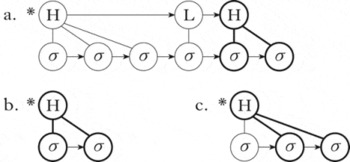
The final forbidden subgraph in (25) excludes structures in which the initial H has associated to four or more syllables, as in (27).
-
(27)
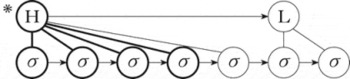
These are the only restrictions on H associations that we need to consider. The remainder of the constraints deal with the association of medial L. For associations with L, there are two important generalisations. First, L does not associate to the final syllable in words of three syllables or more. Second, an L tone associated to the second or third syllable cannot multiply associate. These two generalisations are captured by the forbidden subgraphs in (28).
-
(28)

Forbidding the first subgraph in (28) ensures that an H must associate to the final syllable in trisyllabic or longer words. (An L does not associate to the final syllable in monosyllabic words, but this is subsumed under the generalisation in (24) that there is no initial L.) The second and third subgraphs in (28) motivate the tertiary spreading of the H in forms of five syllables or more by restricting multiple association of the medial L when it is associated to the second and third syllables. This ensures that the associations to the second and third syllables are ‘filled in’ by the initial H.
Thus a combination of the melody constraints in (24) and association constraints in (25) captures the directional generalisation that Northern Karanga non-assertive verbs have H tones at the right edges, and the constraints in (28) on the association of L capture the positional generalisation that the initial H associates maximally as far as the third syllable. The Northern Karanga association pattern can thus be described with a grammar of forbidden subgraphs comprised of the conjunction of (24), (25) and (28).
5.2 Quality-sensitive association
Quality-sensitive association generalisations are local in the same way. Recall that multiple association of H in Kukuya is disallowed in the presence of an L tone, but allowed when H is the only tone on the melody tier, as illustrated in (29). We can capture this with some of the same forbidden subgraphs that were used in the analyses for Mende and Hausa.
-
(29)

In other words, H is banned from spreading when it is either non-final or non-initial. We can thus capture the Kukuya generalisation by forbidding multiple association of a non-final H, as in the Mende grammar in (21), and by banning multiple association of a non-initial H, as in the Hausa grammar in (22), giving (30).
-
(30)
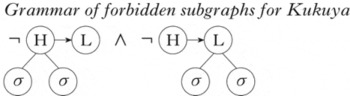
This bans any spreading of an H in the presence of L, as in (31a) but allows spreading in case H is the only tone on the melody tier, as is illustrated in (31b).
-
(31)

Crucially, the forbidden subgraphs in (30) capture the fact that H and L behave independently with respect to spreading: H cannot spread if it is non-initial or non-final, whereas L can spread in both of these situations. However, with only these constraints, L can spread freely. To prevent this spreading from creating unwanted contours such as (32b), we must also forbid the subgraph in (32a). As the order between the L and H in the subgraph is not specified, (a) prevents both falling and rising contours produced in this way.
-
(32)

Finally, like Mende, Kukuya allows contours only at the right edge. The full grammar for Kukuya is given in (33), with forbidden subgraphs representing the constraints on H, L and non-final contours.
-
(33)

Thus the quality-sensitive association generalisation in Kukuya is also local, in that it can be captured by a grammar of forbidden substructures.
5.3 Culminativity
Recall from §3.3 that in Hirosaki Japanese (Haraguchi Reference Haraguchi1977), at most one H or F can appear in a word, and F may only appear word-finally. Each word must contain either a H or F, and cannot contain both. In terms of ARs, the restrictions on H can be handled by constraints on forbidden substructures on the melody tier. Falling contours are restricted to word-final TBUs. Some examples are given in (34).
-
(34)

The melody constraints in (35) ban words with no H tone or more than one H tone.
-
(35)

The first constraint bans words without H tones, because, assuming the OCP, any AR equivalent of any string of L tones will have a single L in the melody tier. Some examples are given in (36a). Similarly, for any string with more than one H- or F- toned TBU, such as *HLLLH or *LHLF, its graph will contain the second subgraph in (35). This bans any such graph, no matter how many L-toned TBUs intervene between the two Hs on the melody tier, as illustrated in (36b).
-
(36)
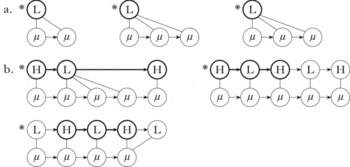
Thus the melody for the set of ARs in the Hirosaki Japanese pattern can be specified by the grammar of forbidden substructures in (35).
However, we must also restrict the associations of the melody nodes to TBUs. First, H in Hirosaki Japanese does not spread at all. ARs in which a H tone associates to multiple TBUs can be excluded by the forbidden subgraph in (37a), as exemplified in (37b).
-
(37)

Finally, only falling contours occur in Hirosaki Japanese, and only on the final TBU. These generalisations can be captured respectively by a forbidden subgraph specifying an LH sequence associated to a single TBU (i.e. a rising contour) and the forbidden subgraph specifying a non-final contour seen above for Mende and Kukuya (modulo the labelling of the TBU).
-
(38)

The ‘long-distance’ pattern of Hirosaki Japanese can thus be fully described by the conjunction of the grammar of forbidden substructures in (35) governing the obligatoriness and culminativity of H in the melody and that in (37a) and (38) governing association of tones to TBUs.
5.4 Discussion
This section has shown how directional, positional and quality-sensitive association generalisations, as well as generalisations referring to the melody independent of TBUs, are describable by grammars of forbidden substructures. This means that these patterns are fundamentally local in the computational sense defined in §2 and §4. The largest subgraph for any grammar had six nodes, required for (28) in Northern Karanga Shona. Most of the other subgraphs had four or five nodes. More importantly, it has been shown that both directional spreading and long-distance melody constraints are local in this way. As these mechanisms have been integral to our understanding of tone, we can be cautiously optimistic that this locality result will hold for tone systems beyond the sample reviewed in this paper.
It should be noted that the locality of the Hirosaki Japanese pattern, when viewed over ARs, is due to the assumption that the OCP holds. Adopting the OCP means that all adjacent L-toned TBUs are associated to the same L on the melody tier: hence the constraint against a HLH substructure in the melody to enforce the absence of two H tones in the melody, no matter how many L-toned TBUs intervene.
As mentioned in §4, the OCP has been argued against as a universal. However, if we make the OCP a language-specific constraint, it is still local, as it can be described (for H and L tones) by the grammar of forbidden substructures in (39). Thus locality is not dependent on a universal OCP.
-
(39)

This raises the issue of learnability: how could the OCP, or any forbidden substructure constraint, be learned? The answer is that grammars of forbidden substructures can be efficiently learned using an algorithm similar to those using the ‘scanning window’ described in §2 for strings. Such an algorithm would instead scan through a set of ARs for connected subgraphs of a particular size. (This is known to be efficient for graphs in general; see Ferreira Reference Ferreira2013.) It is possible to then infer the set of forbidden subgraphs from the observed subgraphs. For example, if the learner never observes an HH sequence on the melody, it can assume it is forbidden. One might claim that human learners cannot observe ARs directly – they only perceive linear strings of TBUs. Even if this is true, Jardine & Heinz (Reference Jardine and Heinz2015) have shown how to derive ARs from strings, resolving this potential problem. There are thus ways of learning autosegmental grammars from string input.
6 The non-local nature of previous approaches to tone
Adopting the forbidden substructure notion of locality as a theory of autosegmental well-formedness for tone makes specific typological predictions: a well-formedness pattern should not be attested if it cannot be described in terms of the presence or absence of forbidden substructures. As shown in the preceding section, this gives a unified explanation of the attested typology. Furthermore, as discussed in §2, the notion of forbidden substructures is restrictive, due to the computationally simple nature of evaluation, and it is also learnable.
These are all significant advantages over previous theories. For example, derivational frameworks require at least a globally evaluated directionality parameter to capture right- and left-directional patterns (one such formalisation can be found in Archangeli & Pulleyblank Reference Archangeli and Pulleyblank1994), but the typology is less clear when other patterns are considered. For the two-edged pattern in Northern Karanga Shona, Hewitt & Prince (Reference Hewitt and Prince1989) further define an ‘edge-in’ association paradigm, which is based on, but distinct from, the paradigm used by Yip (Reference Yip1988). This proliferation of language-specific association paradigms makes it unclear what the typological predictions of a derivational theory are, as there are no clear constraints on what constitutes a possible paradigm.
Furthermore, analyses in derivational frameworks often fail to capture the surface generalisations. Hyman's (Reference Hyman1987: 316) analysis of Kukuya depends on the language-specific rule in (40) to ‘fix’ a multiply associated H created through left-to-right association.
-
(40)
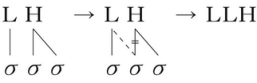
Zoll (Reference Zoll2003) rightly criticises this analysis for missing the surface generalisation that H cannot spread in the presence of an L tone. However, this insight is directly captured with the constraints on forbidden substructures in (33), which ban the multiple association of a H that is either followed or preceded by an L tone. In this way, the grammar of forbidden substructures preserves Zoll's insight that H and L can behave independently of some general directional association paradigm.
Zoll's (Reference Zoll2003) theory of Optimal Tone Mapping insightfully captures such surface generalisations through using Clash and Lapse constraints to capture quality-specific generalisations and Align constraints (McCarthy & Prince Reference McCarthy and Prince1993) to capture directional generalisations. However, Align constraints are problematic for two reasons. First, as Zoll observes, they cannot capture the positional Northern Karanga pattern. Second, the global evaluation of Align constraints predicts bizarre patterns (Eisner Reference Eisner1997b, McCarthy Reference McCarthy2003). For example, Eisner (Reference Eisner1997b) formulates a constraint belonging to the Align family which produces the ‘centring’ pattern in (1c), involving association of H to the middle of a word. As mentioned in §1, grammars of forbidden substructures exclude such patterns, because they make the strong claim that the evaluation of a structure is based only on the well-formedness of its substructures.
One potential criticism of analyses based on grammars forbidding subgraphs is that they explain patterns exclusively through surface constraints, whereas previous theories have explained the patterns through the mapping of an underlyingly unassociated melody to a fully associated one. However, this is not as drastic a departure from previous theories as it may seem. For example, Zoll's Optimal Tone Mapping analyses depend almost exclusively on the ranking orders of markedness constraints governing surface well-formedness, with the relative ranking of faithfulness constraints remaining largely fixed, and therefore playing little role in explaining language-specific variation. This highlights the fact that language-specific variation in these tone-association patterns is essentially variation in surface well-formedness. Furthermore, although the present analysis focuses on the local character of this surface variation, it does not reject this view of association patterns as mappings. Indeed, Chandlee (Reference Chandlee2014) and Chandlee et al. (Reference Chandlee, Eyraud and Heinz2014) show how surface locality based on substrings can be extended to string-to-string mappings. How this can be done for AR-to-AR mappings is an important goal for future work.
7 Conclusion
This paper has defined a notion of locality for surface association patterns over autosegmental representations, based on the notion of forbidden subgraphs. It has demonstrated that major directional, positional, quality-sensitive and culminativity-based generalisations in tone are local in this way, through forbidden subgraph analyses of patterns in Mende, Hausa, Northern Karanga Shona, Kukuya and Hirosaki Japanese. This notion of locality is not only sufficient to capture major patterns, but, as it is based on the well-formedness of substructures, is also restrictive in its typological predictions in comparison to previous theories of tone, and, as discussed in §2 and §5.4, is learnable. While the current work is by no means comprehensive, it is at least as successful as previous theories with respect to the characterisation of some basic patterns, and thus serves as a foundation for future research on the computational study of well-formedness, transformations and learning in tone.



