Introduction
Community assembly during succession may be regulated by: (1) environmental conditions and resources; (2) chance events; and (3) biotic interactions (Weiher and Keddy, Reference Weiher and Keddy1999). Through the traits of dominant species, the outcome of biotic interactions (herbivory, competition, facilitation) may, in turn, feed back on abiotic conditions and resource availability, and strongly determine the further development of the system. One model system that is currently undergoing great change is European semi-natural grassland, which carries an exceptionally high diversity of plants (e.g. Ellenberg, Reference Ellenberg1988; Korneck et al., Reference Korneck, Schnittler, Klingenstein, Ludwig, Takla, Bohn and May1998). Diversity and composition of these ecosystems evolved under the prevailing site conditions (Vandvik and Birks, Reference Vandvik and Birks2002), but also in response to continuous human activity over millennia (Ellenberg, Reference Ellenberg1988; Pärtel et al., Reference Pärtel, Zobel, Zobel and van der Maarel1996). Consequently, their characteristic species are adapted to human land use, and grassland diversity is strongly related to past and current management practices (Waldhardt and Otte, Reference Waldhardt and Otte2003; Wellstein et al., Reference Wellstein, Otte and Waldhardt2007). With agricultural abandonment and intensification, plant diversity in semi-natural grassland communities changes dramatically (Korneck et al., Reference Korneck, Schnittler, Klingenstein, Ludwig, Takla, Bohn and May1998; Luoto et al., Reference Luoto, Pykälä and Kuussaari2003; Mitchley and Xofis, Reference Mitchley and Xofis2005; Pykälä et al., Reference Pykälä, Luoto, Heikkinen and Kontula2005; Wellstein et al., Reference Wellstein, Otte and Waldhardt2007; Enyedi et al., Reference Enyedi, Ruprecht and Deák2008). The resulting decrease in species numbers is mainly due to: (1) increasing cover and biomass of a few highly productive species, which exert strong competitive effects on subordinate species; and (2) the accumulation of dead plant remains, i.e. litter, which interferes with seed germination and seedling establishment (Bosy and Reader, Reference Bosy and Reader1995; Virágh and Bartha, Reference Virágh and Bartha1996; Bakker and Berendse, Reference Bakker and Berendse1999; Kahmen et al., Reference Kahmen, Poschlod and Schreiber2002; Moog et al., Reference Moog, Poschlod, Kahmen and Schreiber2002). Litter may affect seed germination by its effects on microclimate, by acting as a mechanical barrier or through chemical effects (Facelli and Pickett, Reference Facelli and Pickett1991; Bosy and Reader, Reference Bosy and Reader1995; Jensen and Gutekunst, Reference Jensen and Gutekunst2003; Eckstein and Donath, Reference Eckstein and Donath2005). Since these effects are litter-type specific, the dominant plant species may exert a strong influence on germination and succession (Myster, Reference Myster2006; Quested and Eriksson, Reference Quested and Eriksson2006; Quested et al., Reference Quested, Eriksson, Fortunel and Garnier2007; Donath and Eckstein, Reference Donath and Eckstein2008), but also on ecosystem processes (Wardle et al., Reference Wardle, Nilsson, Gallet and Zackrisson1998).
The regeneration of plants from seeds is a process that can be broken down into several conditional components, such as reproductive fertility and seed production, seed viability, germination, seed resource-based initial seedling growth (radicle elongation, leaf expansion), autotrophic seedling growth and establishment. As such, it is a particularly vulnerable stage in the life cycle of many plant species, and the suppression of seedling recruitment can have serious consequences for population viability and species diversity (e.g. Tilman, Reference Tilman1993). In this context allelopathy, i.e. the leaching or volatilization of phytotoxins from plant tissues, is considered as one possible mechanism acting on seed germination (Baskin and Baskin, Reference Baskin and Baskin2001), but also on seedling establishment (Schlatterer and Tisdale, Reference Schlatterer and Tisdale1969; Chang-Hung and Chiu-Chung, Reference Chang-Hung and Chiu-Chung1975; Werner, Reference Werner1975; Bosy and Reader, Reference Bosy and Reader1995), and plant growth and distribution (del Moral and Cates, Reference del Moral and Cates1971; Rice, Reference Rice1972; Newman and Rovira, Reference Newman and Rovira1975). Chemicals involved are generally secondary metabolites, mainly simply structured, low molecular weight compounds, such as coumarins, terpenoids, phenolics or tannins (Rice, Reference Rice1984; Harborne, Reference Harborne1993). However, since there are close links between plant secondary compounds, palatability, litter quality and decomposition (Grime et al., Reference Grime, Cornelissen, Thompson and Hodgson1996), allelochemicals may also affect other components and functions of the ecosystem, and thus play an important role in ecosystem regulation (Wardle et al., Reference Wardle, Nilsson, Gallet and Zackrisson1998; Mazzoleni et al., Reference Mazzoleni, Bonanomi, Giannino, Rietkerk, Dekker and Zucconi2007).
Biochemical interactions differ in their strength and may differentially affect the competitive vigour of dominant and subordinate species. Hence, to understand these interactions and the potential influence of dominant species on ecosystem processes, it is necessary to identify plant species in a community with strong allelopathic effects on other species (Chang-Hung and Chiu-Chung, Reference Chang-Hung and Chiu-Chung1975; Anaya and del Amo, Reference Anaya and del Amo1978; Anderson et al., Reference Anderson, Katz and Anderson1978), but it is equally important to reveal the differential susceptibility of community constituents to these toxins (Datta and Sinha-Roy, Reference Datta and Sinha-Roy1975; Wardle et al., Reference Wardle, Nicholson and Rahman1993).
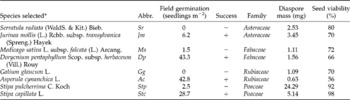
Preliminary results of a manipulative field experiment on abandoned grasslands from the Transylvanian lowlands of Romania (Ruprecht et al., in preparation) suggested that secondary compounds of the dominant grass may, among other factors, drive community assembly and succession through strong negative effects on the recruitment of a number of co-occurring plant species. These species-rich, dry, steppe-like grasslands occur on steep south-facing slopes with eroded carbonated chernozemic soils on clayish or marly substrate, and are dominated by feather-grass (Stipa) species. The main consequences of long-term abandonment of these grasslands are: (1) strong dominance by Stipa pulcherrima; (2) litter accumulation; (3) vegetation composition changes; and (4) decrease of plant species diversity (Enyedi et al., Reference Enyedi, Ruprecht and Deák2008). Under several experimental treatments, consisting of litter and/or biomass removal, establishment success of certain species was very low (see Table 1; Ruprecht et al., in preparation), although there were no indications of seed or microsite limitation, since plants flowered abundantly, and various types of potential safe sites for germination and establishment were created by the treatments. Another group of dry grassland species with abundant flowering and seed production established successfully under the same experimental conditions (see Table 1). Therefore, we investigated experimentally the possible chemical effects of the dominant species, Stipa pulcherrima, on the germination of seven co-occurring dry grassland species and on itself at two constant and two fluctuating temperature regimes. Previous studies addressing chemical effects of litter have either used one constant (e.g. Anaya and del Amo, Reference Anaya and del Amo1978; Bosy and Reader, Reference Bosy and Reader1995) or one fluctuating temperature regime (e.g. Rice, Reference Rice1972; Norby and Kozlowski, Reference Norby and Kozlowski1980), whereas our experimental set-up allowed us to address the interaction between litter leachate and temperature across a range of conditions. Our study attempts to link potential chemical effects at the population level with known transformations in ecosystem properties in a dry grassland community as a result of grazing abandonment.
Species abbreviations (Abbr.), field germination, establishment success under field conditions, family, diaspore (seed) mass, and seed viability of the eight dry grassland species selected for the germination experiments

Field germination is the sum for the 2 years of field observations (2006, 2007) of the cumulative number of seedlings counted in two dry grassland sites (Suatu, Puini), expressed as seedlings m− 2. Data on seed mass are the results of measurements of 500 (5 × 100) seeds per species. Seed viability of 50 (2 × 25) seeds per species was tested with a 1% tetrazolium chloride solution.
* Plant nomenclature follows Flora Europaea (Tutin et al., 1964–Reference Tutin, Heywood, Burges, Moore, Valentine, Walters and Webb1980).
Our main hypotheses were that: (1) Stipa leachate reduces percentage germination, delays germination, and interferes with radicle elongation, thus exerting strong negative effects on the regeneration through seeds of the eight test species; and that (2) there are species-specific differences in the response of these various components of recruitment to leachate. (3) We hypothesized that the magnitude of the effect of Stipa leachate is related to the germination success under field conditions, i.e. the negative effects are more pronounced in species with unsuccessful than in those with successful field recruitment.
Materials and methods
Species selection
Eight grassland species, which are typical constituents of dry steppe-like grasslands of the Transylvanian Lowland (Romania), were selected for laboratory seed germination experiments, based on the results of previous field experiments (Table 1). The species set consisted of four familial pairs (Asteraceae, Fabaceae, Rubiaceae, Poaceae), where one species of each pair was from the group with successful establishment and the other from the group with unsuccessful establishment under field conditions (Table 1). Family pairs were used to obtain a phylogenetically balanced data set.
Seed collection
Propagules of the eight species (called seeds from here on) were collected in bulk from autochthonous populations in dry steppe-like grasslands in the Transylvanian Lowland. Seed collection was carried out between May and August 2007, depending on the time of seed ripening, and included at least 100 different plant individuals from five sites each. Seeds were dry-stored in darkness at room temperature (c. 20°C) until the start of the experiments in autumn 2007.
Germination experiment 1
The germination experiment was performed in climate chambers (Rumed, Rubarth Apparate GmbH, Laatzen, Germany) at the Department of Landscape Ecology and Landscape Planning, Gießen University, Germany. Fifty seeds of each species were spread on a double layer of filter paper in sterile Petri dishes. A total of 40 dishes per species were prepared, randomly distributed into two groups to test for chemical effects of Stipa pulcherrima. One group was watered with a leachate prepared from leaves of S. pulcherrima, whereas the other group received distilled water (control). Leaves of S. pulcherrima were collected in the middle–late phase of the vegetation period (July and August 2007) from two grassland sites (Suatu, Puini) and dried at room temperature. The leachate was prepared by soaking 344.67 g of dry leaves in 3300 ml of distilled water for 48 h. These amounts of leaves and water (0.1044 g leaves per ml water) correspond to the average litter quantity in the field (470 g m− 2) and the quantity of rain water of an average precipitation event (4.5 l m− 2), respectively (Cluj Napoca Meteorological Station). In the leachate and the control treatments, each sample was watered with 10 ml of the leachate solution or 10 ml of distilled water, respectively, once at the start of the experiment. The osmotic potential (Osmomat 030, Gonotec GmbH Berlin, Germany) and pH (Lab 860, Schott Instruments, Mainz, Germany) of the leachate were assessed, as these characteristics may influence seed germination.
The 20 dishes of each leachate treatment group were randomly distributed to the four temperature treatments, i.e. two constant (10 and 20°C) and two diurnally fluctuating temperatures (5/15°C and 10/25°C), and incubated in climate chambers. Five Petri dishes of each species were put together into a climate chamber and sealed to reduce evaporation. The light regime simulated spring day conditions with 12 h of light and 12 h of darkness.
The experiment was comprised of the following factors: species [factor levels (k) = 8], nested within field establishment success (k = 2), temperature regime (k = 4), and leachate (k = 2). Each combination of factors was replicated five times. Germinated seeds were counted and removed once every week for 6 weeks. A seed was considered germinated when the radicle was beginning to protrude from the seed coat. At each counting occasion, the radicle length of a maximum of five randomly chosen seedlings was measured using a millimetre paper. As dependent variables we used: (1) cumulative germination, calculated as the sum of germinated seeds over 6 weeks in relation to the total number of seeds; (2) the week of maximum germination; and (3) the radicle length of seedlings. Since in our experiment fungi developed in high abundance, especially in samples watered with leachate, we visually estimated the cover of developing fungi in the dishes to the nearest 5% and determined fungal genera (or higher-order groups).
Germination experiment 2
To separate the possibly confounding effects of leachate and fungi on seed germination, we carried out an additional experiment where we tried to exclude fungi to test the effect of leachate alone. The experimental set-up was analogous to that mentioned above, with the exception that seeds were surface sterilized by application of NaOCl (3% active chlorine), and the leachate was sterile-filtered to exclude spores of fungi and bacteria. We used one diurnally fluctuating temperature regime of 5/15°C (12/12 h), which had proved to be an optimal germination temperature regime for most of the study species in the first experiment. The measures successfully prevented fungal growth in the Petri dishes containing Jurinea mollis, Medicago sativa, Dorycnium pentaphyllum, and Asperula cynanchica during the first 3 weeks of germination. Seedlings were counted and removed once every week.
Data analysis
Data on cumulative germination, radicle length, week of maximum germination and fungal abundance were analysed using a four-factorial hierarchical general linear model analysis of variance. The factor species was nested within field germination success (Table 1), and all factors were considered fixed. In a combined analysis, we used data on cumulative germination after 3 weeks for those four species that showed no fungal growth after the sterilization treatment. Here, we used a three-factorial general linear model analysis of variance with the factors species, leachate and seed surface sterilization, i.e. sterilization (no effect of fungi) versus no sterilization (seeds infected by fungi). Arcsine or square root transformation was used to improve homogeneity of variances. Tukey's HSD test was applied for a posteriori testing of multiple means (Quinn and Keough, Reference Quinn and Keough2002). All analyses were done using Statistica, version 6.0 (StatSoft Inc., Tulsa, Oklahoma, USA).
Results
Seed germination
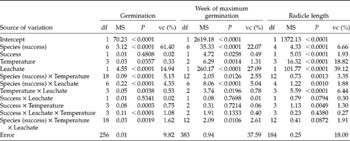
Cumulative percentage germination across temperatures varied significantly among species (Table 2, Fig. 1a) and ranged between 1.8% (S. pulcherrima) and 67.6% (S. radiata). Under these experimental conditions, there were no general significant differences between species that showed successful or unsuccessful germination in the field. However, leachate significantly and strongly reduced percentage germination (Figs 1a and 2a); among species, germination was reduced by between 33 and 94% as compared to controls. This factor explained 14.9% of the total variation (Table 2).
Effects of species identity, establishment success under field conditions, temperature and leachate on percentage germination, week of maximum seed germination, and radicle length

Data are the results of a four-way hierarchical ANOVA with species nested within establishment success. Temperature = constant temperatures: 10°C, 20°C, fluctuating temperatures: 5/15°C and 10/25°C. Data on relative germination were arcsine-transformed, and data on fungal abundance were square root-transformed before analysis. Owing to missing data, S. pulcherrima and A. cynanchica were excluded from the analysis of radicle length, and in the analysis of the week of maximum seed germination, the temperature level 20°C had to be omitted. Abbreviations: df, degrees of freedom; MS, mean sum of squares; vc (%), percentage of the total variation explained.
Percentage seed germination in Petri dishes treated with Stipa pulcherrima leaf leachate (hatched bars) and distilled water (white bars), (a) across temperature regimes after 6 weeks for all eight species and (b) pooled germination of surface sterilized and non-sterilized seeds of four species (Jm, Ms, Dp and Ac) after 3 weeks. For species abbreviations, see Table 1. Data are means ± SE (n = 20). In (a) dotted lines separate family pairs; species with successful and unsuccessful field germination are denoted by (+) and ( − ), respectively. Note logarithmic y-axis. Means sharing the same letter are not significantly different (P>0.05; Tukey's HSD). Panel (b) shows a comparison of data from the first and second experiment. In the latter, fungi were excluded through seed surface sterilization. The figure depicts the non-significant interaction between the effect of leachate and the presence of fungi (F 1,64 = 0.01, P = 0.92).

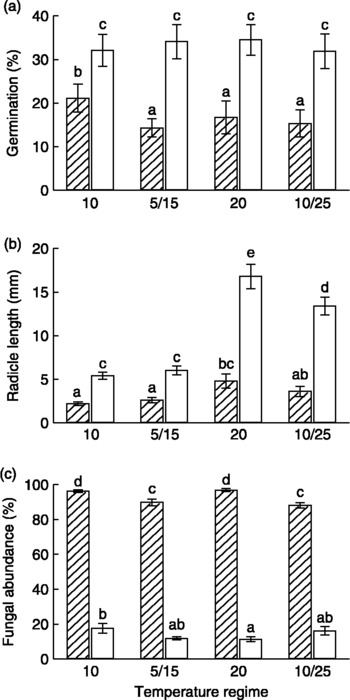
(a) Percentage germination, (b) radicle length and (c) fungal abundance in Petri dishes treated with Stipa pulcherrima leaf leachate (hatched bars) and distilled water (white bars) at different temperature regimes across species. Data are means ± SE [in (a) and (b): n = 26–30; in (c): n = 40]. Means sharing the same letter are not significantly different (P>0.05; Tukey's HSD on the temperature × leachate interaction). S. pulcherrima and A. cynanchica were excluded from the analysis of radicle length because of missing values at certain temperatures.

In both the Fabaceae and Poaceae, the unsuccessful field germinator was more strongly affected by leachate than the successful species, whereas this pattern was reversed in the Rubiaceae. For both Asteraceae species, the germination response did not differ between the successful and the unsuccessful field germinator. In comparison with the leachate effect, main temperature effects on final germination percentages were rather weak (Fig. 2a, Table 2). However, the effect of leachate was significantly lower at 10°C constant temperature than in the temperature regimes with higher daytime temperatures (Fig. 2a).
Strong leachate effects on germination were confirmed in the combined analysis of data on cumulative germination after 3 weeks from both experimental set-ups. Germination was significantly reduced (F 1,64 = 274.39, P < 0.0001) by the application of leachate (Fig. 1b). The factor leachate alone explained 49.4% of the total variation. In contrast, there was neither a significant main effect of sterilization (F 1,64 = 3.2, P>0.08) nor a leachate × sterilization interaction (F 1,64 = 0.01, P = 0.92). These results indicate that leachate, but not fungal effects, were responsible for significantly reduced cumulative germination in experiment 1.
Timing of germination
Although the week of maximum germination also differed among species (Table 2), a large part of the variation (27.1%) was accounted for by the main leachate effect alone. The application of leachate at the start of the experiment significantly delayed the germination peak of the species by about 1.5 weeks.
Radicle length
In contrast to cumulative germination, there was a strongly significant effect of temperature on radicle length (F 3,184 = 64.1, P < 0.0001; Fig. 2b), which alone explained 18.8% of the variance (Table 2). Leachate significantly reduced radicle length (F 1,184 = 399.8, P < 0.0001; explained variance: 39%). In addition, there was a significant temperature × leachate interaction (F 3,184 = 21.9, P < 0.0001), indicating that the negative effect of leachate in comparison to controls was stronger at higher (20°C and 10/25°C) than at lower temperatures (Fig. 2b). In general, leachate reduced radicle length to below 5 mm in all temperature regimes, with reduction ranging from 55% at 5/15°C to 74% at 10/25°C.
Fungal groups and abundance
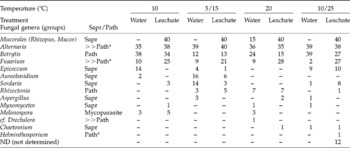
The distribution of developing fungi in the dishes suggested that these were mostly seed-borne. Application of leachate strongly increased fungal abundance (Fig. 2c; F 1,256 = 6901.5, P < 0.0001; explained variance: 88.8%). Compared with the other variables, species effects were small (F 6,256 = 23.3, P < 0.0001; explained variance: 1.8%), which implied that fungal development was not, or only weakly, species specific. Fungal growth in the leachate treatment was significantly lower under alternating (88.9 ± 1.2%, mean ± SE, n = 80) than under constant temperature regimes (96.6 ± 0.6%, F 1,144 = 43.3, P < 0.0001; Fig. 2c). The abundance of fungi (Fig. 2c), but not their frequency (Appendix 1), was higher in the leachate treatment than in controls. We classified 14 genera or higher-order groups of fungi (Appendix 1). Six of the genera are known to include pathogenic species, which may produce highly active mycotoxins.
Discussion
Leachate effects on various components of seedling recruitment
Our laboratory germination experiments showed that leaf leachate of Stipa pulcherrima, the dominant species of abandoned dry grasslands in Transylvania, exerted strong negative effects on different processes related to regeneration by seeds of all grassland species studied, and that the strength of the inhibitory effect differed between test species. This is in line with other studies, which demonstrated that leachate from living plant tissues or dead plant remains inhibited seed germination of co-occurring species (e.g. Schlatterer and Tisdale, Reference Schlatterer and Tisdale1969; Chang-Hung and Chiu-Chung, Reference Chang-Hung and Chiu-Chung1975; Werner, Reference Werner1975; Bosy and Reader, Reference Bosy and Reader1995), but that the degree of susceptibility is species specific. In addition, the leachate effect was prevalent across all constant and fluctuating temperature regimes.
In only two of the species pairs (Fabaceae and Poaceae) was germination of species with unsuccessful field recruitment significantly more affected by leachate than germination of species with successful field recruitment. The results of our analysis thus led to rejection of our third hypothesis. Our data suggest that chemical effects may only in part be responsible for recruitment failure of the study species under field conditions. Other constraints for successful field recruitment could be very specific requirements for germination (Baskin and Baskin, Reference Baskin and Baskin2001) or other factors related to the life-cycle of the species.
Timing of germination is a species-specific characteristic determining the success of species under different habitat conditions (Baskin and Baskin, Reference Baskin and Baskin1988, Reference Baskin and Baskin2001; Olff et al., Reference Olff, Pegtel, van Groenendael and Bakker1994; Hölzel and Otte, Reference Hölzel and Otte2004). As shown by monthly observations of germination in two grassland sites over 2 years (Ruprecht et al., in preparation), field germination of dry grassland species occurred mostly in wet periods during the year, with a highly synchronized germination peak in early spring (March or April). According to our experimental results, leachate application may delay seed germination by about 1.5 weeks on average; germination delay ranged from 0.9 weeks (S. radiata) to 2.2 weeks (G. glaucum). Due to steep slopes, southern orientation and shallow soils with low water-holding capacity, environmental conditions in these grasslands are especially harsh. With only a relatively narrow time window favourable for germination, seed germination shortly after precipitation events may present a crucial advantage for seedling establishment. Consequently, missing the favourable period for germination and/or slow seedling growth as a consequence of reduced radicle protrusion in the presence of leachate may be fatal for recruitment from seed and survival of species of this dry grassland system.
Besides specific allelochemical substances, the osmotic potential and pH of litter leachates represent confounding factors that may potentially also inhibit seed germination and seedling development (Wardle et al., Reference Wardle, Nicholson and Ahmed1992). In our study the osmotic potential of the leachates (sterile-filtered as well as unsterilized) was − 0.16 ± 0.01 MPa (mean ± SE, n = 3), and both had a pH value of 5.83 ± 0.01. These values certainly differ from the osmotic potential and pH of distilled water, but still lie well within the range where no significant effects on either germination or radicle growth can be expected (Baskin and Baskin, Reference Baskin and Baskin2001; Black et al., Reference Black, Bewley and Halmer2006). A preliminary high pressure liquid chromatography (HPLC) analysis of the leaf leachate indicated the presence of coumarin in the Stipa leachate. Coumarin is known to have a strong effect on seed germination through irreversible blocking of one or more key physiological events during the early phases of germination (Abenavoli et al., Reference Abenavoli, Cacco, Sorgonà, Marabottini, Paolacci, Ciaffi and Badiani2006). Additionally, coumarin may affect radicle growth of seedlings (Chon and Kim, Reference Chon and Kim2004), which has also been observed for several other allelochemicals (del Moral and Cates, Reference del Moral and Cates1971; Chou and Young, Reference Chou and Young1975; Norby and Kozlowski, Reference Norby and Kozlowski1980). This effect may also have been observed in the present study. The speed of radicle elongation may be decisive for establishment success, especially in extreme environments where a longer radicle could facilitate easier water and mineral uptake. In this context, the reduction of the radicle to below 5 mm by leachate suggests that Stipa leachate may not only influence the germination, but also the establishment of dry grassland species.
Were there direct or interactive effects of fungi on germination?
Besides direct effects on seed germination, allelochemicals may also interact with fungi present on seeds, in the litter or in the soil. These interactions may either be positive (secondary compounds promoting spore germination and the development of hyphae) or negative (toxic effects on fungi or, conversely, decomposing activity of fungi) (Rice, Reference Rice1984; Rizvi and Rizvi, Reference Rizvi and Rizvi1992). In addition, seeds may be the direct target of saprophytic and pathogenic fungi, and fungal-induced seed mortality or delayed germination may have serious implications for plant demography and community processes (Dalling et al., Reference Dalling, Swaine and Garwood1998; Blaney and Kotanen, Reference Blaney and Kotanen2001; Mitschunas et al., Reference Mitschunas, Wagner and Filser2006; Wagner and Mitschunas, Reference Wagner and Mitschunas2008).
In our experiment, the development of fungi was apparently promoted by the leachate. Residues of several plant species produce volatile compounds, which may stimulate spore germination and fungal growth (Menzies and Gilbert, Reference Menzies and Gilbert1967; Rizvi and Rizvi, Reference Rizvi and Rizvi1992). Thus, it is likely that some secondary compounds of S. pulcherrima may have a similar stimulating effect on the development of seed-borne fungi. Alternatively, coumarin, which was found in the aqueous extracts of S. pulcherrima leaves, may delay or prevent the recovery of stable membrane configuration after seed imbibition (Abenavoli et al., Reference Abenavoli, Cacco, Sorgonà, Marabottini, Paolacci, Ciaffi and Badiani2006). This transient perturbation of membrane structures may cause leakage of solutes from the seeds, which in turn may promote fungal growth.
In light of these complex interactions between plant secondary compounds and fungi, a high abundance of a diverse set of fungi, especially in leachate-treated dishes, presents a confounding factor for the interpretation of results from our first experiment. However, the fact that we obtained identical germination responses after excluding fungi through seed surface and leachate sterilization (at least for the first 3 weeks of germination) supports the view that fungi had little, if any, effects on germination in our experiment. Additionally, leachate effects on percentage germination and seedling radicle elongation were smaller under lower temperatures, which are more likely connected to the way a chemical compound is operating, whereas fungi developed equally well under low and high temperatures, and should thus lead to similar effects across temperature regimes.
Conclusions
Cessation of traditional management is a serious problem for the conservation of species-rich dry grasslands in Transylvania. Continuous grazing maintains species-rich grasslands with an open structure, dominated by Stipa lessingiana, a narrow-leaved feather grass species occurring also in semi-desert plant communities of Asia. After abandonment of grazing, soil erosion induced by grazing animals is slowed down, the number and area of bare patches decreases, and the grassland becomes dominated by Stipa pulcherrima, a broad-leaved feather grass with higher biomass production than the former species. The grassland structure is becoming denser, litter is accumulating and, as a long-term consequence, species diversity and evenness is decreasing (Enyedi et al., Reference Enyedi, Ruprecht and Deák2008).
Since the aqueous leaf extract of S. pulcherrima inhibited germination and establishment of all study species, it is not unreasonable to suggest that, besides other traits, such as their competitive ability or physical and microclimatic effects of their accumulating litter, chemical litter effects may partly govern the dynamics of dry continental Transylvanian grasslands after abandonment. S. pulcherrima itself may evade autotoxic effects through its perennial life-cycle, which enables it to maintain itself simply through clonal reproduction. Long, hairy awns of its seeds facilitate dispersal over long distances to places where feathergrass abundance and autotoxic effects are low.
However, the fact that germination success observed in the field was not consistently related to the germination responses of species to leaf leachate in our experiments indicates that other factors are equally important for recruitment success in the field. In order to identify these factors and their role for the succession of abandoned dry grasslands, further field and laboratory studies are required.
Acknowledgements
We thank Christiane Lenz-Kuhl, Joseph Scholz-vom Hofe, Márton Enyedi, Péter L. Pap, Anna Szabó, János Józsa, Mária and Béla Ruprecht for invaluable field and laboratory assistance and Rolf Düring and Uta Kraus for help with the HPLC analysis. We are very grateful to Elke Stein, Karl-Heinz Rexer and Gregor Langen for their help with the determination of fungi and to Hans-Werner Koyro for measuring the osmotic potential of the leachate. Jafargholi Imani is acknowledged for valuable help with the seed sterilization, and Jutta Ahlemeier for statistical advice. Comments of Sandra Burmeier on an earlier version of the manuscript considerably improved this paper. E.R. was supported by a scholarship from the German Academic Exchange Service (DAAD).
The frequency of fungi (genera or higher-order groups) in samples treated with distilled water or leachate under different temperature regimes

Fungal groups may be saprophytic (Sapr) or pathogenic (Path) (>>, mainly pathogenic); some groups are known to produce toxic substances (*).