

INTRODUCTION
Peats are important archives from the onset of the Holocene up to the present day. Peat bogs survive environmental changes and they can preserve events at high resolution in a continuously accumulating sediment. Stable isotopes preserved by the cellulose in the fossilized Sphagnum components can be determined, which allows for the reconstruction of temperature during the formation of sediment. In such studies, ombrotrophic peat bogs are more suitable, as they are fed by rainwater and there is no surface inflow (de Vleeschouwer et al. Reference De Vleeschouwer, Chambers and Swindles2010).
Vegetation of peat bogs is dominated by Sphagnum species and dwarf shrubs may accumulate large amount of sediments (often up to 10–11 m) which are high in organic material content (~65%), which in a few cases may reach even 95–99% (Charman Reference Charman2002).
In order to make an environmental reconstruction based on these sediments, it is important to have a reliable sampling method which provides (as far as possible) undisturbed sediment core of adequate quality and amount for the analyses, to provide an accurate and detailed chronology. For high-resolution studies, samples of sufficient quality and quantity are necessary (De Vleeschouwer et al. Reference De Vleeschouwer, Chambers and Swindles2010). Various types of sampler equipment/methods and their modifications appeared from the beginning of the 1950s. One of the most common and widely used is the Russian type corer, introduced by Belekopytov and Beresnevich in Reference Belekopytov and Beresnevich1955, which was further developed by Jowsey (Reference Jowsey1966).
The advantage is that it is very easy to use, requires no special technique and consists of lightweight pieces making them easy to carry even in a backpack. The equipment is available in several diameters (28–100 mm) and allows for the extraction of a half or one-meter-long core at once and in one piece. Disadvantages of this corer are the compaction and sediment mixing that may occur during sampling.
Peat samples are fibrous and may contain hard twigs and trunks. Drilling tools must be able to penetrate through these tougher parts without mixing the sediment. The shape and design of the cutting edge is also important. Piston corers designed for lake sediments may be modified for peat sampling, as was described by Wright (Reference Wright1993) and Cumming et al. (Reference Cumming, Glew, Smol, Davis and Norton1993).
Our aim in this study was twofold: (1) to develop a novel, more robust and reliable sampling corer for peat bogs, which allows less disturbed sampling with minimal chance of core compression or mixing, and (2) to construct a high-resolution age-depth model for the Mohos peat bog.
One of the most widespread dating methods for peat deposits is radiocarbon (14C) dating. A wide range of materials from peat could be used for this purpose. Unfortunately, there is no consensus regarding selecting and preparing material for proper 14C dating of peat. A number of different preparation techniques are applied, such as removing roots before dating bulk peat sediments (Törnqvist et al. Reference Törnqvist, De Jong, Oosterbaan and Vander Borg1992), or selecting remains of Sphagnum species (Kilian et al. Reference Kilian, van der Plicht and van Geel1995) to avoid possible reservoir effects. However, the existence of a reservoir effect in bulk peat 14C samples could not be confirmed by Blaauw et al. (Reference Blaauw, Bakker, Christen, Valerie and van der Plicht2007). Others have recommended different fractions of bulk peat (humin, humic, and fulvic acids), but from different studies it is clear that there are still many questions and efforts to understand peat formation and to select the most appropriate samples (Shore et al. Reference Shore, Bartley and Harkness1995; Nilsson et al. Reference Nilsson, Klarqvist, Bohlin and Possnert2001; Brock et al. Reference Brock, Lee, Housley and Bronk Ramsey2011). Previously, bulk peat was used for dating as earlier beta-counting measurements required grams of carbon for analysis. During bulk sediment dating, modern rootlets penetrating down to the older peat sections can cause problems due to recent contamination. Accelerator mass spectrometry (AMS) 14C techniques allow us to date plant fragments, in very small quantities (0.01–1 mg of carbon for analysis), avoiding contamination and also enabling to date a greater number of thinner peat sections. Thereby the more precise dating of short-term events and abrupt changes can be obtained.
Another critical point is the number of samples representing the core sections. It is questionable how much information we lose if we have only a few measured dates from a sediment. However, there are suggestions for the appropriate number of dates to sample per sequence for the meaningful application of the Bayesian technique (Blaauw et al. Reference Blaauw, Bakker, Christen, Valerie and van der Plicht2007). In our study, we targeted 3–4 points per millennium also taking into account places where deposition rate changes occurred. For higher-resolution dating, it is necessary to have decadal or centennial timescales for detailed studies of environmental change.
The work presented in this paper forms part of a larger research project that aims to reconstruct the temperature based on measuring the δ18O from peat cellulose from the Mohos peat bog, East Carpathians. Studies of 18O/16O oxygen isotope ratio of alpha-cellulose from peat samples indicate that variations in the isotopic composition provide estimates of climate change and palaeotemperature (Hong et al. Reference Hong, Jiang, Liu, Zhou, Beer, Li, Leng and Hong2000, Reference Hong, Wang, Jiang, Lin, Hong, Zhu, Wang, Xu, Leng and Li2001). Palaeotemperature reconstructions based on the oxygen isotopic analysis have only been conducted for a handful of studies concentrated on the Holocene period in the Carpathian region (e.g. Constantin et al. Reference Constantin, Bojar, Lauritzen and Lundberg2007; Demény et al. Reference Demény, Czuppon, Siklósy, Leél-Őssy, Lin, Shen and Gulyás2013; Magyari et al. Reference Magyari, Demény, Duczkó, Kern, Vennemann, Fórizs, Vincze, Braun, Kovács, Udvardi and Veres2013; Dragusin et al. Reference Dragusin, Staubwasser, Hoffmann, Ersek, Onac and Veres2014). As peat bogs occur in many areas in the Carpathian region, this technique has great potential in palaeotemperature studies from this area (Willis et al. Reference Willis, Braun, Sümegi and Tóth1997, Reference Willis, Sümegi, Braun and Tóth1995; Magyari et al. Reference Magyari, Sumegi, Braun, Jakab and Molnar2001; Wohlfarth et al. Reference Wohlfarth, Hannon, Feurdean, Ghergari, Onac and Possnert2001; Björkman et al. Reference Björkman, Feurdean and Wohlfarth2003).
Based on previous studies from the Mohos peat bog (Tantau et al. Reference Tantau, Reille, de Beaulieu, Farcas, Goslar and Paterne2003; Schnitchen et al. Reference Schnitchen, Charman, Magyari, Braun, Grigorszky, Tóthmérész, Molnár and Szántó2006; Longman et al. Reference Longman, Veres, Ersek, Salzmann, Hubay, Bormann, Wennrich and Schäbitz2017), we expected a more than 10-m-long well-preserved ombrotrophic peat sequence, which would be an excellent record for palaeotemperature studies.
STUDY SITE
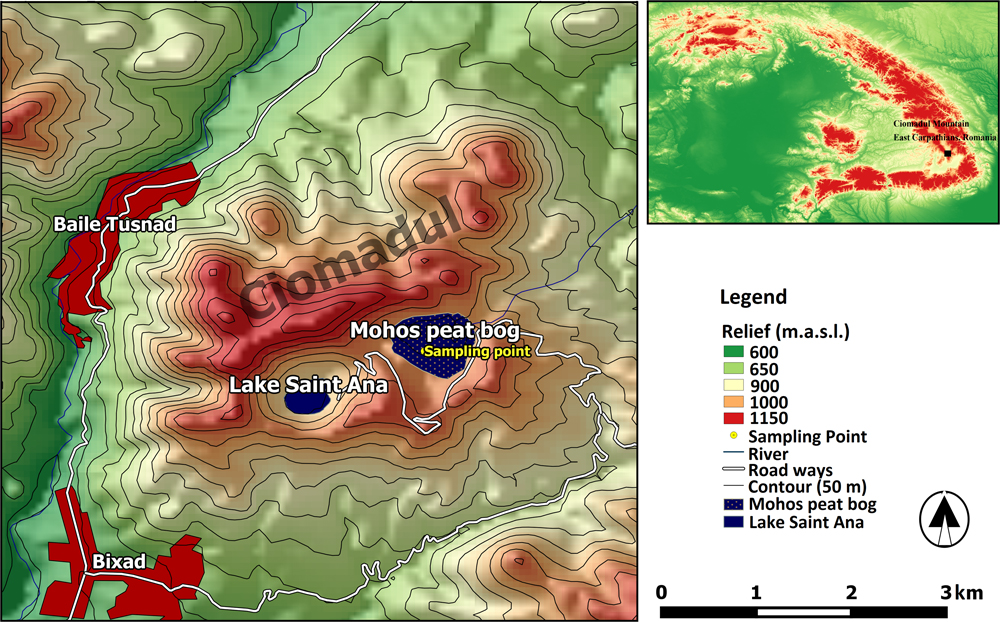
The Mohos peat bog (46°8′3.60″N, 25°54′19.43″E, 1050 m asl, 80 ha area) and Lake St. Anna (46°07′35″N, 25°53′17″E, 946 m asl) is situated in the Ciomadul Massif (South Harghita Mountains), part of a Neogene-Quaternary volcanic range in the East Carpathians, Romania (Figure 1). The Ciomadul is part of Călimani-Gurghiu-Harghita, the inner Neogene-Quaternary volcanic range of the East-Carpathian mountains. The mountain is the youngest volcano of the Carpathian-Pannonian region, based on detailed geochronological studies, the oldest rocks range from 1 Ma to 220 ka (Szakács et al. Reference Szakács, Seghedi and Pécskay1993; Pécskay et al. Reference Pécskay, Szakács, Seghedi and Karátson1992, Reference Pécskay, Lexa, Szakács, Balogh, Seghedi, Konečný, Kovács, Márton, Kaličiak, Széky-Fux, Póka, Gyarmati, Edelstein, Rosu and Žec1995) and the most recent volcanic events occurred in the past 27–50 ka (Harangi et al. Reference Harangi, Lukács, Schmitt, Dunkl, Molnár, Kiss, Seghedi, Novothny and Molnár2015; Szakács et al. Reference Szakács, Seghedi, Pécskay and Mirea2015; Karátson et al. Reference Karátson, Wulf, Veres, Magyari, Gertisser, Timar-Gabor, Novothny, Telbisz, Szalai, Anechitei-Deacu, Appelt, Bormann, Jánosi, Hubay and Schäbitz2016). Post-volcanic activity in the form of gas upwelling (mofettas and solfataras) and mineral water springs are still observable today.
Location of the studied peat section.
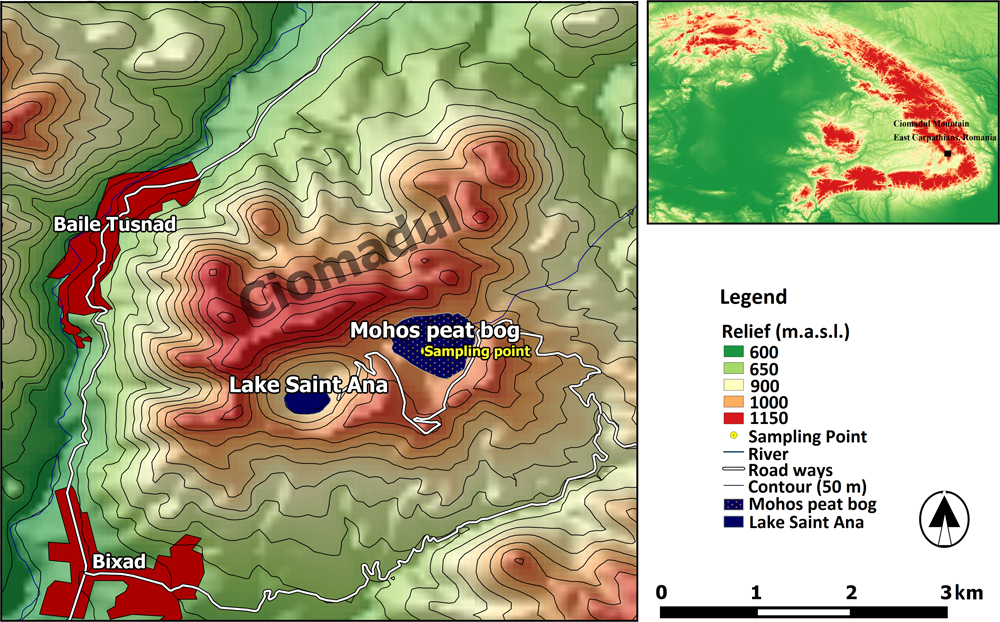
The Mohos peat bog occupies one of the twin volcanic craters and it is unique to this area as meters of continuous Sphagnum peat sediment accumulated during the Holocene period (Tantau et al. Reference Tantau, Reille, de Beaulieu, Farcas, Goslar and Paterne2003).
The bog belongs to the temperate zone and the only source of water is from precipitation (800–1000 mm per year) (Karátson et al. Reference Karátson, Telbisz, Harangi, Magyari, Dunkl, Kiss, Jánosi, Veres, Braun, Fodor, Biró, Kósik, von Eynatten and Lin2013). It has one outflow called Veres stream, which starts from the northeast segment of the peat bog. Today, the peatbog is partly covered with Pinus sylvestris, Betula pubescens, and there are species of Ericaceae with Sphagnum species (Tantau et al. Reference Tantau, Reille, de Beaulieu, Farcas, Goslar and Paterne2003).
MATERIALS AND METHODS
Coring
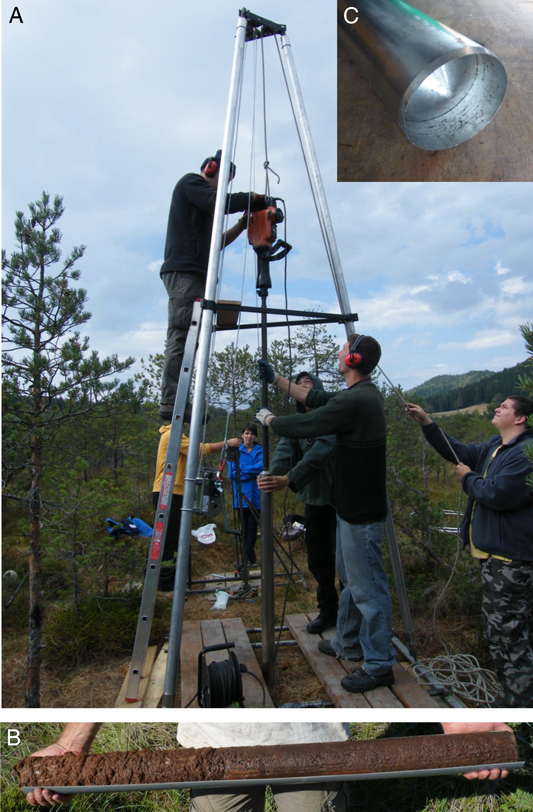
Our first coring from the Mohos peat bog was carried out in 2004 using a Russian sampler (Schnitchen et al. Reference Schnitchen, Charman, Magyari, Braun, Grigorszky, Tóthmérész, Molnár and Szántó2006). Since we received slightly disturbed samples with the Russian sampler there was no measured 14C analysis on this sediment. As our aim was also to sample the lake sediment under the 10-m peat section, a modified piston corer was used operated with a tripod in summer 2012. The coordinates of sampling location were 46°08′05.5″N, 25°54′16.8″E. The modified piston corer consisted of aluminium tubes (52 mm ID, 60 mm OD; Figure 2), a 1-m-long and 76 mm in diameter stainless steel pipe, which was used as a sampler with a piston and sharp cutting edge. The advantage of the sharp cutting edge is that it could penetrate through the roots or fibrous layers, and even tree branches. To support an easy penetration of sampler through the peat fibrous layers, a breakthrough/electric hammer was used instead of hand-operated hammer. This system provided a smooth penetration and recovery of undisturbed and uncompressed samples. High-frequency blows cut off the fibers and the sampler did not compress the peat in this process. Also, a casing was used to prevent closing up of the peat layer. Although this sampler contains more elements and is heavier than a Russian corer, it eliminates the compaction and can continue sampling even through dense material.
A) Our team during coring the Mohos peat bog; B) example of 1-m-long uncompressed peat core; C) cutting edge.
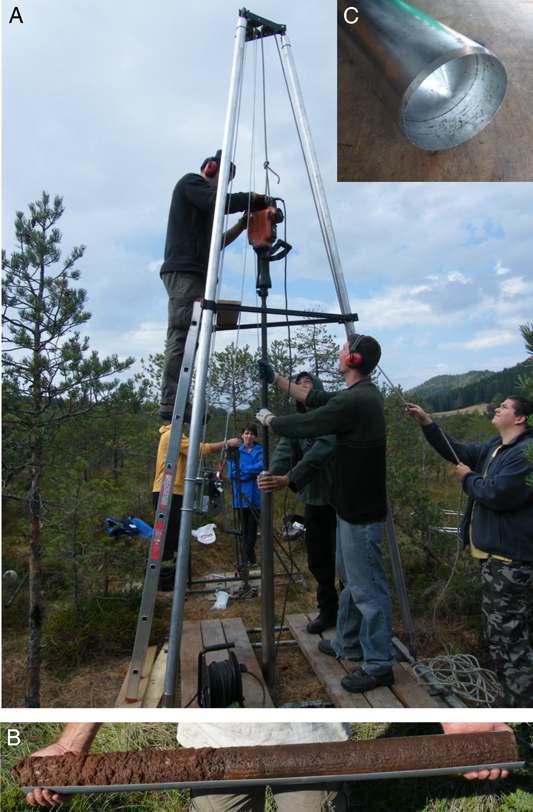
Ten 1-m-long core sections were extruded from the stainless steel pipes on-site. Sections were wrapped in plastic film, stored in PVC tubes and transferred to the laboratory, where they were kept in a cold room until subsampling. In total, the core length was 19.5 m. The sequence above 9.30 m, which is the focus of this study, shows a continuous record up to present, consisting of peat.
Lithostratigraphy
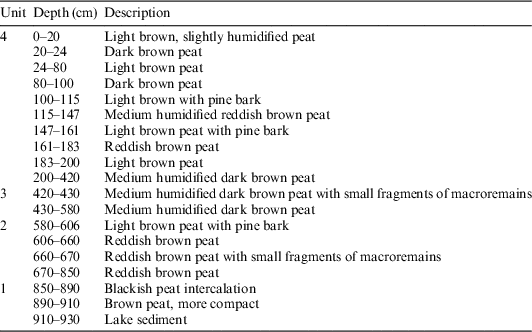
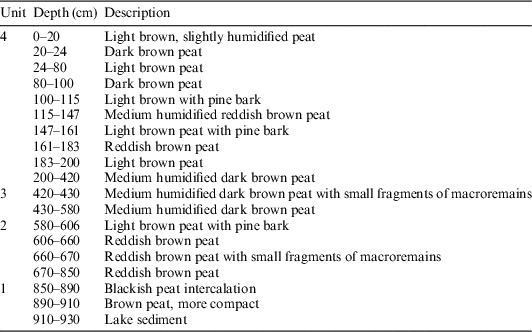
The core sequences were photographed in the field and also in the laboratory. Stratigraphic descriptions were made and the simplified stratigraphy is presented in Table 2. Four main stratigraphic units were separated. The bottom half of the deepest core contained lake sediment, while peat constituted the rest of the core.
Radiocarbon Analyses, Age-Depth Model, and Deposition Time (DT)
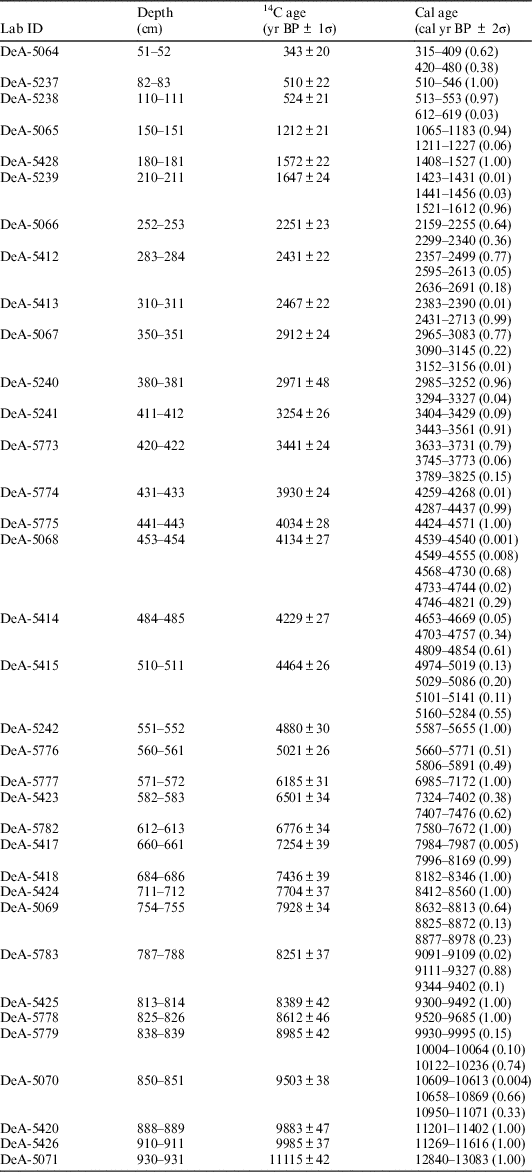
Subsamples were selected for 14C dating along the almost 10-m-long core. For 14C dating, 3–4 samples were selected from each 1-m-long core section. One sample was taken at the middle of the section and two samples were taken 10 cm from both ends of the section. Using this sampling procedure, we obtained 29 samples from 10 sections for the first time.
For 14C dating we separated Sphagnum leaves and stems to avoid age reversals caused by down penetrating rootlets. We used a cellulose extraction, instead of the commonly used acid-base-acid sequence (Molnár et al. Reference Molnár, Janovics, Major, Orsovszki, Gönczi, Veres, Leonard, Castle, Lange, Wacker, Hajdas and Jull2013a) to avoid any possible contamination by other organic peat fractions.
First, a physical preparation was performed to separate roots and larger sediment constituents. The subsamples were wet sieved (1 mm to 40 µm Retsch sieve) with doubly deionized water. The remaining material between 40–200 µm fractions was saved for dating. After sieving, the residue was examined using a light microscope in sterile Petri dishes. Visible roots were removed from the samples at this stage.
The next step was the chemical cleaning of the samples. Dry Sphagnum samples for AMS dating were prepared using the modified BABAB (base-acid-base-acid-bleaching) method (Nemec et al. Reference Nemec, Wacker, Hajdas and Gäggeler2010) with revised amounts for peat cellulose preparation. After the chemical preparation, samples were redried in freeze-dryer. Sphagnum cellulose samples were combusted in a sealed tube using MnO2 as the oxidizing agent at 550°C (Janovics et al. Reference Janovics, Túri, Futó and Molnár2017). The liberated carbon dioxide was cryogenically cleaned and converted to graphite by Fe/Zn reduction (Orsovszki and Rinyu Reference Orsovszki and Rinyu2015; Rinyu et al. Reference Rinyu, Orsovszki, Futó, Veres and Molnár2015, Reference Rinyu, Molnár, Major, Nagy, Veres, Kimák, Wacker and Synal2013). The samples were measured on the EnvironMICADAS accelerator mass spectrometry (AMS) at the Isotope Climatology and Environmental Research Centre (ICER, Atomki, Debrecen, Hungary) (Molnár et al. Reference Molnár, Janovics, Major, Orsovszki, Gönczi, Veres, Leonard, Castle, Lange, Wacker, Hajdas and Jull2013a, Reference Molnár, Rinyu, Veres, Seiler, Wacker and Synal2013b).
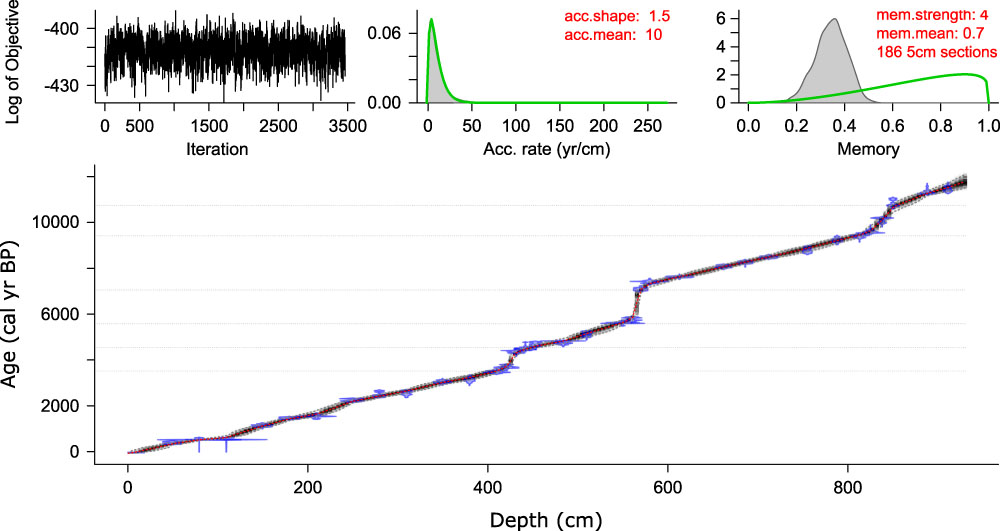
For the calibration of the measured conventional radiocarbon ages, CALIB 7.04 was used (Stuiver and Reimer Reference Stuiver and Reimer1993) and IntCal13 calibration curve (Reimer et al. Reference Reimer, Bard, Bayliss, Beck, Blackwell, Ramsey, Buck, Cheng, Edwards, Friedrich, Grootes, Guilderson, Haflidason, Hajdas, Hatté, Heaton, Hoffmann, Hogg, Hughen, Kaiser, Kromer, Manning, Niu, Reimer, Richards, Scott, Southon, Staff, Turney and van der Plicht2013). The age-depth model was obtained using BACON, a Bayesian age modeling software package (Blaauw and Christen Reference Blaauw and Christen2011). The top of the core (0 cm) was assigned to age AD 2012.
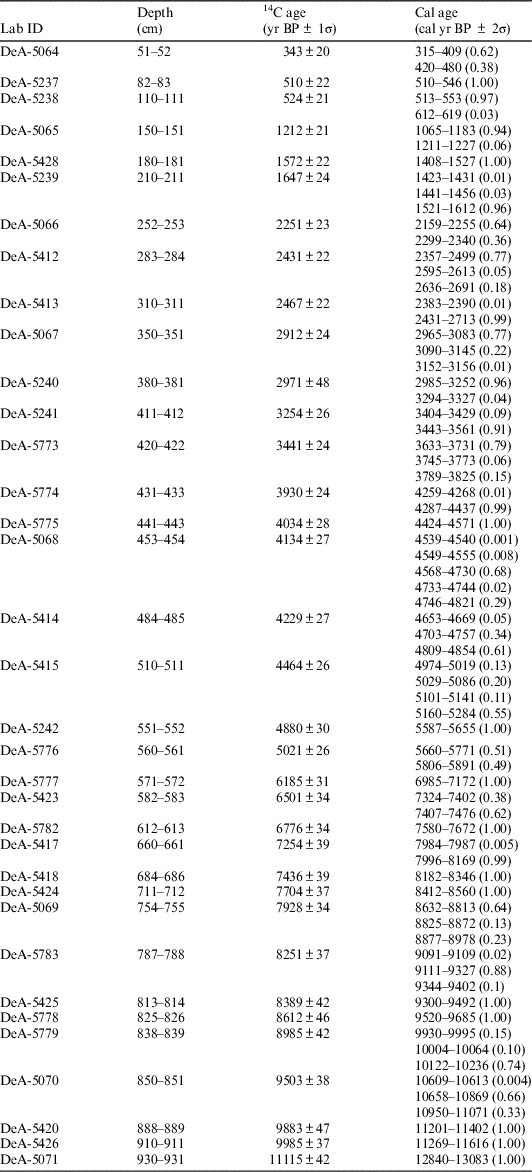
After the primary modeling, more subsamples were taken from under-represented parts of the sequence where more rapid changes have been observed. These subsamples were treated in the same way described earlier. In total 36 14C samples were measured for the age-depth model (Table 1). The deposition time (DT) was calculated by the age-depth model and expressed as yr cm–1 (Bennett Reference Bennett1994). The inverse of deposition time is accumulation rate, calculated as cm yr–1.
AMS 14C dating results with calibrated years (cal yr BP) for Mohos profile. Radiocarbon ages were calibrated with the IntCal13 calibration curve (Reimer et al. Reference Reimer, Bard, Bayliss, Beck, Blackwell, Ramsey, Buck, Cheng, Edwards, Friedrich, Grootes, Guilderson, Haflidason, Hajdas, Hatté, Heaton, Hoffmann, Hogg, Hughen, Kaiser, Kromer, Manning, Niu, Reimer, Richards, Scott, Southon, Staff, Turney and van der Plicht2013) using Calib software version 7.0.4 (Stuiver and Reimer Reference Stuiver and Reimer1993).
Sample Preparation, Ash Content, and Loss-on-Ignition
Sediment cores were sliced into 1–2 cm thick subsamples for other analyses such as loss on ignition (LOI) and chemistry. Samples were dried at 105°C in an oven for 24 hr. To remove organic and water components, powdered samples were ignited at 550°C in a muffle furnace for 4 hr. Ash content and loss-on-ignition (LOI550) values were calculated after Heiri et al. Reference Heiri, Lotter and Lemcke2001.
RESULTS AND DISCUSSION
Coring Results, Lithostratigraphy, Age-Depth Modeling Results
The total length of the recovered core was 19.5 m. The sequence above 9.30 m (11,115 ± 42 yr BP), which is the focus of this study, shows a continuous record up to present, consisting of peat with different degrees of humification. A simplified stratigraphy of the sequence (0–930 cm) is presented in Table 2.
Simplified stratigraphic description of the Mohos peat sequence.
Since our goal was to establish a robust chronology for the Mohos peat section, we chose cellulose preparation, so that all ages were determined from the same material, minimizing the potential problems that have been described elsewhere (Kilian et al. Reference Kilian, van der Plicht and van Geel1995; Shore et al. Reference Shore, Bartley and Harkness1995; Brock et al. Reference Brock, Lee, Housley and Bronk Ramsey2011). We hope to determine what time resolution can be achieved in Holocene studies.
In total 36 14C AMS measurements were obtained, which are reported in Table 1. The yield of the cellulose preparation was 30–48%. All ages were used in the BACON model, and no dates were excluded as outliers. The age-depth model of the sequence is shown in Figure 3. According to the age-depth model, the top 930 cm of the Mohos peat bog covers the range from 2012 AD to 11,770 cal yr BP. The 95% confidence intervals span between 6 yr (at 1 cm) and 954.4 yr (at 566 cm).
Age-depth model of the Mohos peat section.

Deposition Time, Loss-On-Ignition, and Ash Content Results
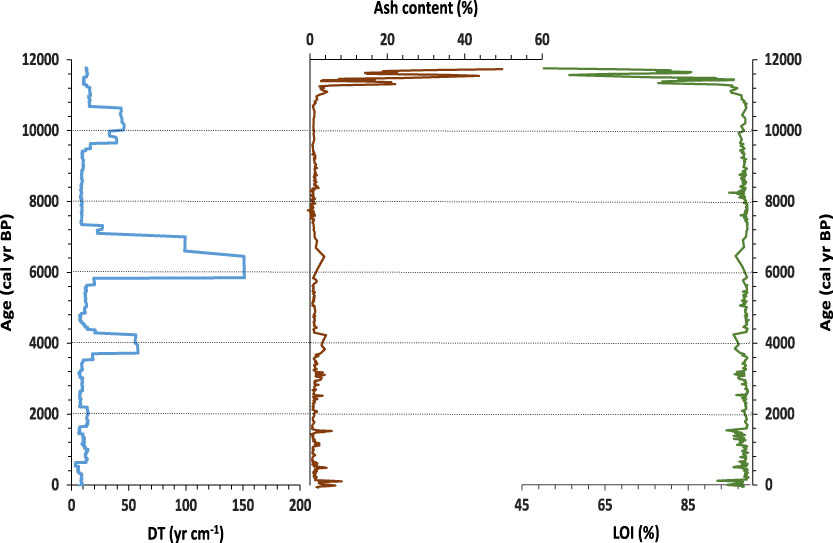
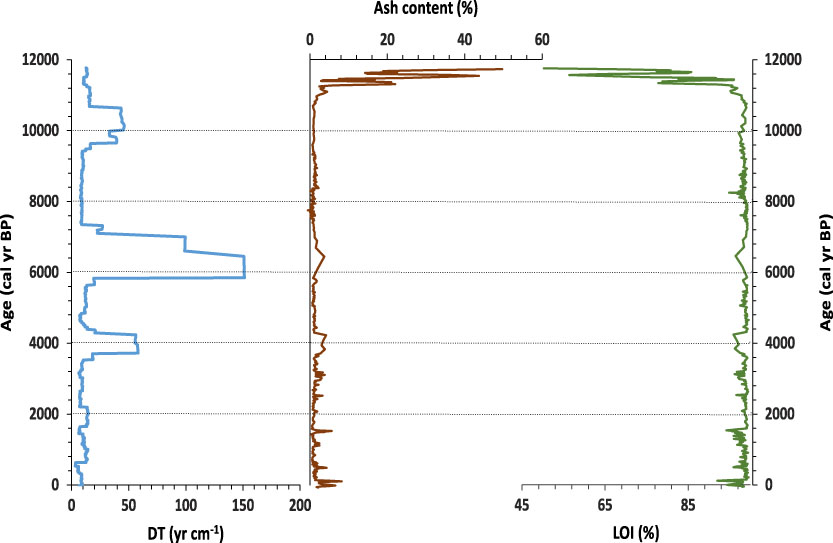
Peat accumulation rate changes were observed along the profile. The sediment deposition time (DT, yr cm–1) varied between 3 and 151 yr cm–1. We were able to separate periods of relatively stable peat bog growth and constant sediment deposition time, as well as five events of significant deposition-rate change. The first period is between 930 and 850 cm (11,770–10,680 cal yr BP) related to lower DT values (16 yr cm–1). During this Early Holocene period organic rich lake sediment is characteristic with moss leaves from the fringing mire and this can be clearly documented in several areas from Europe (Kalnina et al. Reference Kalnina, Stivrins, Kuske, Ozola, Pujate, Zeimule, Grudzinska and Ratniece2014). This development continues even up to today in the case of the Mohos.
There is another change in DT between 10,680 and 9650 cal yr BP (850–825 cm), where DT increased to about 42 yr cm–1. There is also a lithostratigraphic change at 850 cm. During the period between 9650 and 7340 cal yr BP (820–580 cm), DT was reduced to 9 yr cm–1. During this time period, St. Anna Lake in the neighboring crater showed a different trend with faster accumulation (5–38 yr cm–1), when the lowest water depths were found and the crater was occupied by Sphagnum-bog and bogpools (Magyari et al. Reference Magyari, Buczkó, Jakab, Braun, Pál, Karátson and Pap2009).
From 7340 cal yr BP (582 cm), the DT increased by a large amount from 19 to 151 yr cm–1 up to 5650 cal yr BP (550 cm). During this time period, St. Anna Lake had increasing water depth (Magyari et al. Reference Magyari, Buczkó, Jakab, Braun, Pál, Karátson and Pap2009).
After this time, DT ranged over lower values between 7 and 20 yr cm–1 until 4290 cal yr BP (430 cm). A shorter period between 4290 and 3720 cal yr BP (430-420 cm) is characterized by increased DT (55 yr cm–1), where small fragments of macrofossils were observed in the humified peat. Faster accumulation rate (5–38 yr cm–1) and increasing water depth were observed from the St. Anna Lake between 5700 and 3800 cal yr BP (Magyari et al. Reference Magyari, Buczkó, Jakab, Braun, Pál, Karátson and Pap2009). Peat deposition in the uppermost part of the sediment (above 3720 cal yr BP) was relatively constant, DT ranged between 3 and 19 yr cm–1.
There was no major change in the loss on ignition and ash content. Loss on ignition content from the Mohos peat bog values are between 80 and 99% and ash content is between 0.02 and 8%, which is typical for ombrotrophic bogs (Figure 4). Slight changes can be seen based on loss on ignition and ash content, similar to stractigraphic changes.
Deposition time (yr cm–1) vs. age (cal yr BP), ash content (%) vs. age (cal yr BP) and loss-on-ignition (LOI550) vs. age curve.
CONCLUSION
The 910-cm continuous peat profile studied from Mohos peat bog covers the range from 2012 AD to 11,440 cal yr BP. Our excellent record demonstrates that 14C dating of peat deposits is best obtained when cellulose is extracted from the plant material. The use of cellulose avoids problems with incomplete humate extractions with the usual acid-base-acid cleaning.
Fine peat accumulation rate changes (sections with lowest accumulation values) were observed along the profile. Significant changes beginning between ca. 7300–5600 cal yr BP and 4200–3700 cal yr BP with increase in DT suggest lower peat accumulation rates. In further studies we will focus on special intervals to investigate environmental changes during the Holocene. Thanks to the chronological model the past environmental record of Mohos peatbog can be compared to other records on unified calendar time scale.
ACKNOWLEDGMENTS
The research was supported by the European Union and the State of Hungary, co-financed by the European Regional Development Fund in the project of GINOP-2.3.2-15-2016-00009 “ICER.”