

INTRODUCTION
In many developed nations, the historic process of demographic transition was interrupted during the central decades of the 20th century by a period of unexpected fertility increase that has been called the baby boom. During this period, reproduction dynamics shifted with an acceleration of nuptiality coupled with more or less important increases in total fertility leading to a generalised increase in yearly totals of births. The process itself was diverse in timing and intensity, with substantial fertility increases in some societies and very modest ones in others. In all cases, however, a true trend reversal took place that brought decades of fertility decline to a halt. While this period has been widely studied, the resulting literature deals almost exclusively with the developed world (Romaniuk Reference Romaniuk1984; Byerly and Rubin Reference Byerly and Rubin1985; Chesnais Reference Chesnais1992; Owram Reference Owram1996; Macunovich Reference Macunovich2002; Emeka Reference Emeka2006; Russell Reference Russell2006; Sardon Reference Sardon2006; van Bavel and Reher Reference van Bavel and Reher2013; Requena and Salazar Reference Requena and Salazar2014; Sandström Reference Sandström2014; van Bavel Reference van Bavel2014).
In a recent paper, Jan van Bavel and Reher (Reference van Bavel and Reher2013) returned to the theme of the baby boom from a comparative perspective based on data for 24 developed nations and have identified considerable heterogeneity in the experience of the baby boom among these nations. In many countries — mostly those situated in the English-speaking, non-European world together with nations from Northern Europe — the baby boom was very important, characterised by significant and prolonged increases in fertility. In other parts of Europe, the intensity of the baby boom was much lower, especially in nations of Southern and Eastern Europe where it ranged from modest to inexistent. The increase in cohort fertility seen in many countries suggests that the baby boom was far more than a matter of tempo and period. A marriage boom also took place nearly everywhere as people married earlier and more of them married than before. In some nations, marital fertility rose as well, thus contributing significantly to the overall rise in fertility. A common characteristic of the baby boom was an important reduction of childlessness, likely associated at least in part to more widespread and younger marriage patterns. The authors point to the fact that the incidence of contraceptive miscalculations cannot be discounted as an important factor in the boom, especially considering that efficient contraception was not available before the 1960s (van Bavel and Reher Reference van Bavel and Reher2013, pp. 275-279). This notwithstanding, however, it is also possible that in the developed world people may have aimed for and obtained larger families, much as increasing marital fertility in many countries seems to suggest (van Bavel and Reher Reference van Bavel and Reher2013, pp. 279-280).
In the developing world, relatively little is known about fertility before its pronounced decline beginning in the 1960s and 1970s. Some years ago, Dyson and Murphy (Reference Dyson and Murphy1985, Reference Dyson and Murphy1986) published two seminal papers regarding fertility swings in a small set of nations in the developing world. Using very rudimentary indicators they found that there was indeed a period of high, even increasing fertility during the 1950s, precisely when the baby boom was underway in the developed world. Even though they did not take their interpretation much further, the apparent simultaneity of fertility swings in some developing nations was an important result and constitutes the point of departure for the present paper. Beyond this, however, little is known of the component parts of this trend change or even of its intensity. The persistent neglect of a truly global perspective on fertility trends during the 20th century is the result not only of the self-centered obsession of many scholars working in and on the developed world, but also because there are little data available that might afford an alternate vision of demographic trends in the developing world before mid-century or later. This may not be the case everywhere and for countries with good statistical systems and valid vital registration, it is possible to probe the earlier period with useful results, often by means of indirect estimation techniques (Pérez Brignoli Reference Pérez Brignoli2010). These notwithstanding, however, for much of the developing world reliable data are very difficult to find.
A recent publication has launched a full-fledged assault on this dearth of knowledge regarding the developing world at mid-century (Reher and Requena Reference Reher and Requena2014). In this paper, micro-census data were used to reconstruct cohort fertility trends for a set of developed and developing countries (13 in total). These census data contain estimates of the number of children ever born (CEB) by the mother’s date of birth and can be used to track cohort fertility patterns for women born after the start of the 20th century. These data cover the period just prior to the boom, during the fertility boom and the beginnings of the ensuing baby bust as well, thus offering a portrayal of fertility for women bearing their children between ∼1925 and 1975. The results of this study suggest that in the countries from the developing world included in the sample there was an upward swing in fertility for women born between about 1925 and 1945 who were having their children at about the same time as baby boom participants in the West. This fertility cycle was characterised by decreasing levels of childlessness, decreasing variability of individual fertility outcomes at a national level and an important though partially surprising role of education for fertility. Finally, the authors show that in the developing countries used in their analysis, the role of mortality looms large because the rapid improvements of survivorship tended to augment the impact of increases in fertility experienced by these boom cohorts. The authors hesitate to call the observed patterns a «baby boom», but underscore the commonality of fertility shifts in both the developed and the developing world.
The original Reher and Requena study makes use of data from eight nations from the developed world with another five taken from the developing world (Morocco, China, Turkey, Costa Rica and Mexico). Despite this small sample size, the paper has high impact results for many parts of the world. The goal of the current paper is to apply a number of the methods used in the original study to a much larger set of data from Latin America. Are the results in the original paper applicable to the entire continent? More specifically, to what extent are fertility cycles in the region similar to those holding both in the developed and the developing world included in the original study? These are unquestionably pertinent questions because in the developing world very little research has been carried out on fertility prior to the period of massive fertility decline starting in the 1960s and 1970s. Despite this, some experts on Latin American fertility transitions have already noted an increase in total period fertility rates in several countries prior to the historic fertility declineFootnote 1 .
In this study, a total of ten Latin American nations are used. Two of them (Argentina and Uruguay) are not, strictly speaking, developing nations, but the rest certainly are. After careful vetting, countries were selected for analysis based on the reliability of their census data. The detailed description of reproductive changes in the region presented here is based entirely on retrospective fertility data for cohorts of women born during the first half of the 20th century. These results offer a complementary approach to the more common use of vital statistics to reconstruct fertility cycles during this period that, at least in some countries, is possible as shown in publications by Héctor Pérez Brignoli (Reference Pérez Brignoli2010) for Costa Rica and María Eugenia Zavala de Cosío (Reference Zavala de Cosío1993). Since an important part of the mid-century fertility boom cannot be attributed exclusively to period effects, these fertility shifts, if they exist, should also appear in the type of data used here. Cohort fertility estimates, unlike other synthetic measures, have the advantage of reflecting the actual reproductive experience of real women.
DATA
Research for this paper is based on the census data contained in the Integrated Public Use Microdata Series, International (Minnesota Population Centre 2011; hereafter, IPUMS-I). To date, this massive database contains individual census returns for 258 censuses corresponding to 79 countries and containing information on 560 million persons. While population censuses are not designed specifically to measure fertility, using them for fertility studies is not only possible but also at times highly profitable. Of particular interest on this point is the possibility of using a single census to assess fertility trends in the past, across different birth cohorts (David y Sanderson Reference David and Sanderson1990). Any given census refers to a specific moment in time and all data contained therein refer to that moment when the census was undertaken. Despite this, it is also clear that the data referring to the number of children enables us to make use of a cohort perspective, as long as we use only women who have completed their fertile periodFootnote 2 . In this way, cohort fertility can estimated over time for all birth cohorts for women above that age, as long as mortality and migration do not have significant selective effects on the fertility of these cohorts. Besides technical detailed information about sample design, characteristics, variables and variance estimates for each census, IPUMS-I includes information about the comparability of the variable «children ever born». Taking into account the technical characteristics of the different censuses, the comparison among cohorts and countries is perfectly feasible. Thus, these data enable us to reconstruct certain key indicators of reproduction for women born during the first half of the 20th century in several Latin American nations.
Initially we identified countries with censuses that had the variable of CEB in IPUMS-I. In the selected countries, data quality is a source of concern, especially considering potential problems of census coverage, generally low levels of education among elderly women, the tendency of informants to misreport data increasingly with age, or the possibility that inaccurately reporting childlessness might increase with age as was found many years ago by El-Badry (Reference El-Badry1961) and subsequently by Feeney (Reference Feeney1995). If these problems are widespread, they could alter the results regarding fertility trends by birth cohort presented here, especially for the earlier cohorts born in 1910-1935.
In order to ascertain data quality, three different tests were used. (1) One was based on levels of non-response to the question about CEB. All cohorts with levels of non-response 5+ per cent were excluded from our sampleFootnote 3 . (2) Where possible, results from different censuses were compared with those derived from the World Fertility Survey (WFS) for the same cohorts. Only countries where the CEB estimates fell within the 95 per cent confidence intervals of those derived from the WFS were retained for this analysis. (3) CEB levels were compared with estimates of total period fertility rates ∼25-30 years after the birth cohort derived from the United Nations World Population Prospects Database. For evident reasons, the resulting figures were never the same because they refer to different indicatorsFootnote 4 .
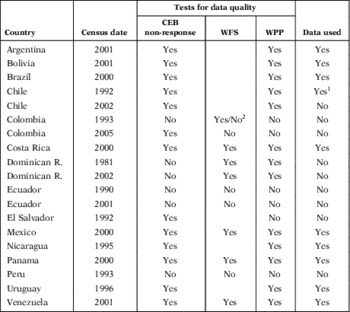
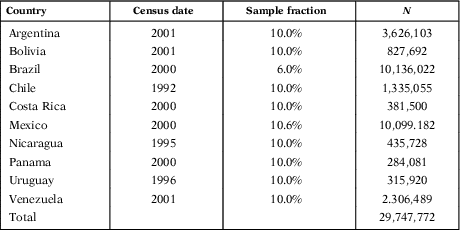
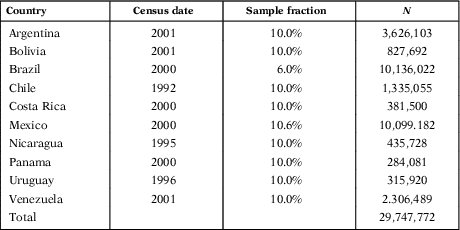
The rule of thumb used here has been to include only cohorts and countries that have passed all three tests. The exception is where WFS data are missing. In these cases, if the other two tests were passed, the country census was also included. In the case of Chile, the 1992 census was preferred because the fit on the other two tests was better than that of the 2002 census. The results of these tests are summarised in Table 1. In addition, in line with Feeney (Reference Feeney1995), we checked to see whether the trends in CEB for specific birth cohorts shown by different censuses were similar, as they were in all countries selected for analysis (Table 2).
Selected IPUMS-I samples and countries (test for data quality)

Note: CEB: children ever born; WFS: World Fertility Survey; WPP: World Population Prospects.
1 Better fit to WPP data and lower levels of no response than Chile 2002.
2 Yes for the 1931-1935 birth cohort; No for the 1926-1930 birth cohort.
Countries and samples selected for the analysis
Source: IPUMS-I.
The analysis is mainly based in two standard cohort fertility measures: total cohort fertility rates and parity progression ratios. Provided all the relevant information is available, these indicators can be estimated directly from the census variable «children ever born». For each country, the two fertility measures have been estimated for 5-year birth cohorts of women born in the first half of 20th century (in the cases of the countries with censuses taken after 2000, the analysis can be extend to women born up to the early 1960s). In all countries, women’s educational status has also been taken into consideration.
RESULTS
Cohort fertility
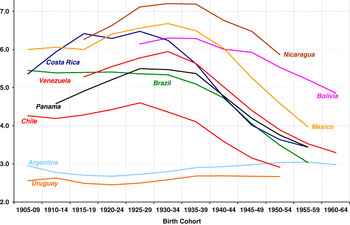
The results from the analysis of these data offer convincing proof that in the majority of Latin America the central decades of the 20th century are ones of increasing fertility. Figure 1 contains the basic estimates of CEB for birth cohorts of women born during the first half of the century in selected Latin American nations. With the exception of three nations (Brazil, Argentina and Uruguay), there was a significant increase in fertility for women born between ∼1910 and 1935. The highest levels of fertility correspond to cohorts born during the 1930s though in some cases (Chile, Costa Rica) peak levels of fertility are visible slightly earlier (1925-1929)Footnote 5 . The dissonant results here are shown by Argentina and Uruguay where fertility levels are much lower than in other nations and there is no indication whatsoever of any increases in fertility born during the period. Brazil, on the other hand, with much higher fertility, shows no increase at all. Again with exceptions, cohorts born during the 1940s initiate a precipitous decline in fertility that persists among cohorts born in the 1950s. It is the unmistakable sign of a demographic revolution (called the demographic transition) under way, though our data only enable us to catch a glimpse of the initial stages of this enormous process of change. Taken as a whole, the portrait that emerges from this figure is one of a complete fertility cycle, with low levels at the outset and low levels after 1940-1950, and high levels in between. In terms of birth cohorts, it is a cycle that lasts about 50 years. Finally, the results of this figure show very large fertility disparities prior to the demographic transition ranging from more than seven children in Nicaragua to just above four in Chile, not counting the very low levels observed in Argentina and Uruguay.
CHILDREN EVER BORN BY BIRTH COHORT, SELECTED COUNTRIES
Source: IPUMS-I.

Despite important disparities, the results from this Figure point to the existence of a common pattern in most of the continent similar in many ways to that holding in other parts of the world. This is clearest in developed nations where period indicators point to the existence of a similar pattern of change: low fertility in the 1930s, relatively high fertility starting after World War II and lasting into the 1960s or, in some cases, 1970s, followed by sharp fertility decline thereafter (van Bavel and Reher Reference van Bavel and Reher2013; Reher Reference Reher2014). In some developed countries, this pattern has also been seen with cohort indicators (van Bavel and Reher Reference van Bavel and Reher2013 and Frejka and Calot Reference Frejka and Calot2001a, Reference Frejka and Calot2001b). It mirrors the results recently published for a small set of developing nations (Reher and Requena Reference Reher and Requena2014) and dovetails nicely with those presented 30 years ago by Dyson and Murphy (Reference Dyson and Murphy1985, Reference Dyson and Murphy1986) based on rudimentary period data. These cohort data are also coherent with the period estimates of fertility presented by experts on Latin American demographic transitions (Guzmán et al. Reference Guzmán, Singh, RodrÍguez and Pantelides1996; Schkolnik Reference Schkolnik2004). If we approximate cohort with period fertility, the simultaneity of the trend changes shown here is uncanny.
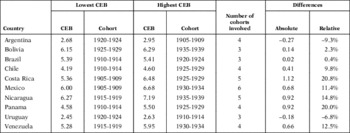
The increases in fertility during the boom varies widely, ranging from increases of more than 20 per cent in Costa Rica and Panama, followed by Nicaragua (14.8 per cent), Venezuela (12.5 per cent), Mexico (11.4 per cent) and Chile (9.8 per cent). It is impossible to estimate this correctly for Bolivia due to the very late starting date of the data set, and there is no increase at all in Brazil, Uruguay and Argentina. These levels do not differ appreciably from those holding in some developed nations such as France, Austria or Germany for the same birth cohorts (Table 3).
The fertility boom in Latin America

Note: CEB: children above born.
Source: IPUMS-I.
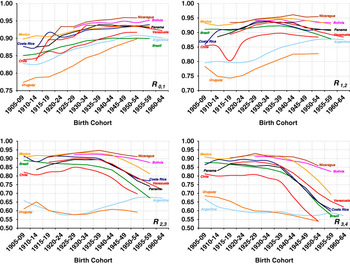
Micro census data make estimating parity progression ratios a relatively straightforward matter. These ratios are essential building blocks for understanding the fertility histories of women of different ages present on the census. The ratios show the likelihood that women of any given parity will go on to have another birthFootnote 6 . In order to simplify the presentation of results, we have generated figures for different parities (0→1, 1→2, 2→3 and 3→4) in the form of panels for Figure 2. Very little is known about the way these parity-based decisions change during the period of rising fertility even in developed countries. What is apparent is that in the developed world, there are indications of increases in these ratios for the initial parities (0→1 and 1→2) but mixed results at higher parities, with increases clearest in countries with important baby booms (Reher and Requena Reference Reher and Requena2014). Next to nothing is known of what actually happened in the developing world, with the exception of the few countries included in the Reher and Requena paper.
PARITY PROGRESSION RATIOS BY PARITY AND COHORT
Source: IPUMS-I.

Data in Figure 2 show convincingly that the declines in childlessness were widespread during the period of increasing fertility at mid-century. For the Latin American nations presented here, the increases in this indicator are quite pronounced, often by as much as 10 per cent. Judging from the results presented here together with those contained in the Reher and Requena (Reference Reher and Requena2014) paper, there appear to be indications that this may be a universal characteristic of the mid-century fertility boom. There are three possible explanations for this change. The most important one is the revolution in maternal and child health taking place in which intrauterine deaths and stillbirths were declining due to improved public health measures and, equally as important, improved health and nutritional status of mothers. It is interesting to note that in most countries included in our sample childlessness continues to decline even after the high fertility period is over, thus suggesting the ongoing importance of health and nutrition improvements. Second, in the developed world there is also a pronounced change in nuptiality as it becomes more widespread and earlier during the baby boom (van Bavel and Reher Reference van Bavel and Reher2013). This argument is also applicable, at least to a certain extent, to Latin America though less so to societies in other parts of the developing world where nuptiality tends to be almost universal and is always very early. There are indications of accelerating nuptiality during this period in Latin America, though this effect is often muted due to the particular types of families and family formation that characterise much of the continentFootnote 7 . Finally, decreasing childlessness may also reflect conscious decisions to have families for women (couples) who did not want them earlier; in this case, socio-economic circumstances facilitating the formation of new family units may have also played a role. While it is impossible to verify this last explanation with the results presented here, it should not be discounted as a possible factor.
In this sample of Latin American nations, the likelihood of having a second child increased in most countries for cohorts born in the 1920s and 1930s but then declined substantially for later cohorts as a result of incipient fertility control in these populations. At higher parities, developing nations show the pathway of the demographic transition clearly. For the earlier birth cohorts, there is little indication of reductions over time or by parity in the likelihood of having an additional child. They give every appearance of still being immersed in natural fertility regimes. During the fertility boom, however, there is widespread evidence that the likelihood of having a third or a fourth birth increased in most nations. These increases are not substantial, mostly because the starting levels are already very high, but they do exist. Only in Argentina, Uruguay and Brazil are there indications that this was not the case. In other countries, women (couples) appear to have been seeking larger completed family sizes during this period. After the 1940 birth cohort, these ratios decline, often with striking speed, as parity-specific fertility began to make inroads in the region.
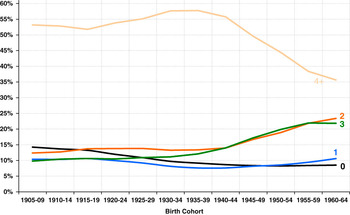
These patterns of childbearing can be seen from a slightly different perspective if women are classified by final parity and birth cohort (Figure 3). Again the decline in childlessness is apparent. Equally eloquent is the importance of large families (4+) throughout the period with evident increases taking place during the fertility boom. This trend is also visible among multiparous women during the boom in other countries and appears to be mostly unrelated to reductions in childlessness, thus suggesting that women were seeking and obtaining larger families during this 20-year fertility boom in Latin America. Once the boom past, it is also clear that Latin America was well on its way to clustering around an ideal family size of two offspring though this process was still far from complete for the birth cohorts used in this study.
DISTRIBUTION OF FINAL PARITY BY BIRTH COHORT
Source: IPUMS-I.

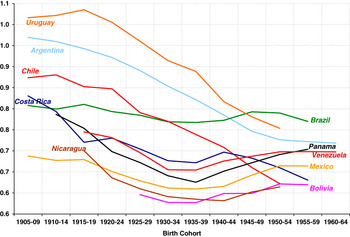
Beyond the diversity of parity progression ratios and final parities, our data also show a steady decrease in the coefficient of variation of cohort fertility during the fertility boom in all of the Latin American nations included in our sample (Figure 4)Footnote 8 . These results show that the variance of family size decreased everywhere during this period of increasing fertility, indicating, at least indirectly, that there were increasingly common goals of couples during the period. Once the boom has past, however, the common trend disappears. In countries like Uruguay, Argentina, Brazil, Chile and Costa Rica, the march towards uniformity continues unabated, while in other countries the trend towards a reduction in variance ceases though overall levels hardly increase.
COEFFICIENT OF VARIATION OF CHILDREN ABOVE BIRTH (CEB) BY BIRTH COHORT
Source: IPUMS-I.

We believe these differences are related to the progress of the demographic transition in the region. In countries when it had already begun in earnest during or before the fertility boom, coefficients of variation continue their unabated decline, while in others where it was only in its initial stage, the passing of the boom period marks a halt to the process of uniformity. It is likely that in the period immediately following the one analysed in this paper, declines continued in those countries as the process of fertility control picked up speed. In sum, this declining variance appears related to the growing concentration of final-parity distributions of those women, thus pointing to a greater uniformity in reproductive behaviour everywhere. It suggests that the fertility boom that affected women born in the 1930s was not the result of extremely high fertility in a segment of women but rather something that was the result of an increasing standardisation of reproduction. These behaviour patterns mirror those observed in the developed world closely, though final parities there are much lower (Reher and Requena Reference Reher and Requena2014).
Education and fertility
Improvements in education are considered a source of social modernisation mainly because of the way education influences behaviour, decreasing the willingness of people to accept their situation as one that is difficult or even impossible to change. We know much more about education throughout history in the developed than in the developing world, though it is unquestionable that everywhere great strides were made towards increasing the educational levels of national populations. The presence on censuses of questions about education enables us to delve into how education changed over the period and how this affected reproductive behaviour.
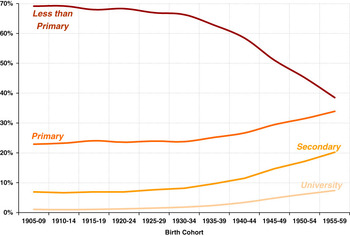
The starting point in this discussion is the spectacular increases in education taking place in Latin America over the period under study. These should be viewed together with processes of social modernisation and economic growth as an indication that a major process of social change was under way in the countries of Latin America during this period. Figure 5, which reflects this process from a continent-wide perspective, gives fitting testimony to this change. For cohorts born during the first years of the century, educational attainment was extremely low, with ∼70 per cent of adult women having less than primary education, often illiterateFootnote 9 . About one-fifth of the female population had completed primary school, about 8 per cent secondary school and almost nobody went to the university. All of this began to change with the 1930-1934 birth cohort — the leader of the fertility boom studied here — as the lowest levels of education were nearly halved over ∼20 years, primary education increased by 50 per cent and secondary and university degrees more than doubled. These cohorts correspond to women who educated between ∼1945 and 1965. While Latin America lags behind European nations and especially the United States, advances during the period were noteworthy and continue to this day.
LATIN AMERICAN ADULT WOMEN. EDUCATIONAL ATTAINMENT BY COHORT
Source: IPUMS-I.

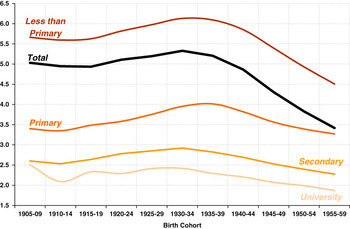
Education has a strong and expected effect on fertility. The negative correlation between education and women’s total fertility has become a sort of constant in demographic research, with numerous examples constituting solid findings in the fieldFootnote 10 . In Figure 6, where the number of CEB by educational attainment and birth cohort is shown, the effect is unmistakable. Highest levels of fertility are found among the least educated women. At higher levels of education, fertility decreases and is lowest among university educated women. Equally as important for the purposes of this paper is the fact that all educational levels appear to participate in the fertility boom studied here as well as in the early stages of the baby bust that followed, thus suggesting that these are general fertility trends affecting all levels of society. After the 1935-1939 birth cohort, total fertility on the continent tends to be closer to that of more highly educated women suggesting that structural increases in education were a key part of this period of declining fertility.
CHILDREN ABOVE BIRTH (CEB) BY EDUCATIONAL ATTAINMENT AND COHORT IN LATIN AMERICA
Source: IPUMS-I.

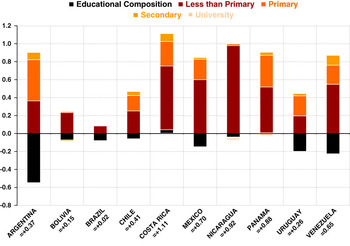
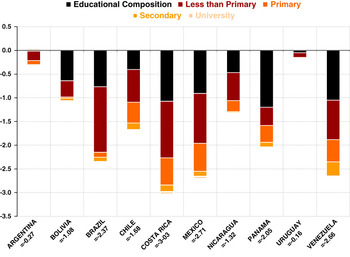
In order to refine the analysis of the relationship between education and fertility further, we have undertaken a straightforward algebraic decomposition of the data presented earlierFootnote 11 . The basic idea behind this decomposition is to differentiate changes in fertility into two components: fertility change that can be attributed to changes in the educational structure of any given society and changes that are related specifically to the reproductive behaviour of any given level of education. Two decompositions have been carried out for each country included in our sample, one corresponding to the period of fertility growth and the other to the initial period of fertility decline (Figures 7A and 7B). With the sole exception of Panama, changing educational structures tended to depress fertility during the fertility boom period in Latin America (panel A). Despite this, women of every country, independent of their educational attainment, ended up contributing to increasing fertility during this period. In other words, in Latin America the fertility boom took place despite the pressure downwards on fertility exerted by educational change. On the other hand, during the initial phase of fertility decline shown in panel B of this same figure, structural change in education as well as women of all educational strata participated in the downward trend of fertility.
A DECOMPOSITION OF THE EFFECT OF CHANGES IN EDUCATIONAL STRUCTURES AND OF FERTILITY BY EDUCATIONAL STATUS ON CHANGES IN THE NUMBER OF CHILDREN EVER BORN. COHORTS PARTICIPATING IN THE FERTILITY BOOM.
Source: IPUMS-I.

A DECOMPOSITION OF THE EFFECT OF CHANGES IN EDUCATIONAL STRUCTURES AND OF FERTILITY BY EDUCATIONAL STATUS ON CHANGES IN THE NUMBER OF CHILDREN EVER BORN. COHORTS PARTICIPATING IN THE FERTILITY BUST
Source: IPUMS-I.

Fertility and improving survivorship
Throughout this paper, our entire assessment of the fertility boom has been based on a straightforward demographic indicator like CEB. If, however, our goal is to analyse the impact of the boom on society, other indicators may be preferable. This is especially the case with countries from the developing world that continued to be affected by high levels of mortality during the early stages of life. There, the impact of increases in fertility would be multiplied if the scale of mortality changed over the period under analysis, as indeed it did. In developing countries where the demographic transition was just getting underway, the role of mortality was likely greater than it would have been in the developed world where mortality was already at relatively low levels during this period. In most of the countries included in our sample (the exception is Argentina), censuses include a question regarding the number of surviving offspring that can be used to approximate the evolution of mortality. It is important to remember that this indicator does not refer strictly speaking to mortality in infancy but rather to survival at the date of the census. This means that older women will always tend to have fewer surviving offspring than younger ones, though the differences on this count should be relatively small because in the early stages of the demographic transition most mortality and most mortality change were concentrated in the initial stages of life. This approach should yield a relatively robust though approximate indicator of the role of survivorship for the mid-century fertility boom.
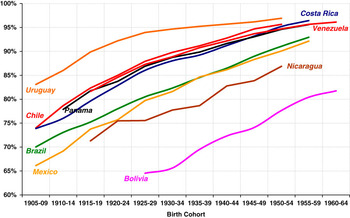
Figure 8 shows the evolution of the percentage of surviving offspring at the census date in nine different nations and provides a glance at the mortality transition in this part of the world. For cohorts born during the early years of the 20th century wide disparities exist in mortality, with some countries showing levels that can be considered typical of pre-transitional mortality regimes in the West with life expectancy at birth (e 0) between 30 and 40, others with somewhat more benign mortality regimes and one (Uruguay) with relatively low mortality throughout the entire period. More important for this paper is the fact that everywhere there was a dramatic increase in survivorship over time in the countries included in this sample that cannot be attributed solely to the different ages of women on the census. There are indications of a true revolution in health during this period. Improvements in health during the central decades of the 20th century is not surprising, though data on developing countries is often difficult to find.
SURVIVING OFFSPRING AS PERCENTAGE OF CHILDREN EVER BORN
Source: IPUMS-I.

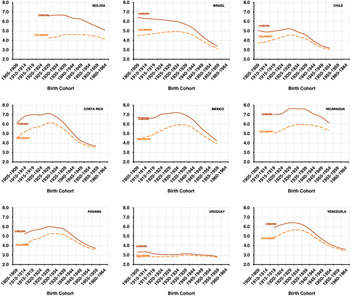
Over time the differences between the number of CEB and the number of surviving children tends to decrease. If both variables are plotted on the same graph, this process of convergence is unmistakable (Figure 9). The only outlier of the nine nations included in the figure is Uruguay mostly because mortality was already at relatively low levels at the outset of the 20th century. Implicit in this relationship is the fact that the intensity of the fertility boom would be much greater if our estimates were based on net family size rather than on the number of CEB.
CHILDREN EVER BORN (WOMEN WITH 1+ CHILDREN) AND THE NUMBER OF SURVIVING OFFSPRING BY BIRTH COHORT
Source: IPUMS-I.

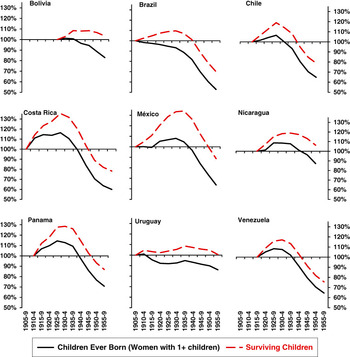
This can be seen from a different perspective in Figure 10 where the per cent increase in fertility with respect to the benchmark cohort for these cohorts is seen together with the per cent increase in net fertility for the same cohorts. See from this perspective, the relative contribution of each variable to the mid-century boom in net fertility can be seen. For comparison’s sake, the dashed line represents the increase in net fertility with respect to the benchmark cohort and the solid line the increase in CEB for the same cohort. The area beneath the solid line would be increases attributable strictly to fertility and the area between the solid and the dashed lines the part corresponding to health improvements. In most countries, increases in survivorship are even more important for net fertility than those due to fertility change itself. The net effect of both variables places the Latin American fertility/health boom on a level only slightly below that of the strongest baby booms in the developed world (the United States, for example) and well above the impact of the boom in many other developed countries (Reher and Requena Reference Reher and Requena2014)Footnote 12 . This result has important implications for the long-term economic and social consequences of the fertility boom in Latin America because it means that the actual number of offspring — the net family size — increased far beyond what is suggested solely by increases in cohort fertility. The key element behind the population explosion of the developing world was a unique combination of increasing fertility coupled with dramatic improvements in child health.
PER CENT OF CHILDREN EVER BORN (WOMEN WITH 1+ CHILDREN) AND SURVIVING OFFSPRING RELATIVE TO THE OLDER COHORT
Source: IPUMS-I.

Another important facet of the complex interaction between mortality and fertility in these countries is the potential impact for reproduction of improving survivorship among adults. In particular, the rapid decline in mortality in Latin America after 1930s brought about an increase in the number of years women spent in marital unions, that is, of time women were exposed to risk of motherhood. In the absence of effective contraception, longer marital unions can be expected to increase cohort fertility (Arriaga Reference Arriaga1970)Footnote 13 . The demographic implications of this aspect of changing survivorship could have been substantial in the developing world, although probably tended to be less important, at least for net reproduction (surviving children), than improvements in childhood survival.
DISCUSSION
This paper enables us to answer some of the research issues stated earlier but leaves many intriguing and significant issues unanswered that promise to command the attention of future research on the subject. The most important conclusion is that there was indeed a fertility boom in Latin America similar to the one seen in many developed countries and in a limited number of developing countries as well. The intensity of this increase in fertility is similar to that holding in the West. Despite some notable exceptions, most of the region participated in this fertility shift with certain common characteristics. Highest fertility levels were reached among cohorts born 1925-1940, though increases are visible earlier starting from the low levels of fertility among cohorts born 1910-1919. The boom came to a crashing end among women born in the 1940s or early 1950s.
The outliers in this pattern are often difficult to explain. Argentina and Uruguay participated in the historic fertility transition and properly belong to the set of countries considered ‘pioneers’ of the demographic transition (Reher Reference Reher2004). Their demographic system bears little resemblance to that of the rest of the region during the period under analysis. Despite this, it is noteworthy that the patterns followed by these two nations are unlike to that of most developed nations that experienced a baby boom of their own. With Brazil, where fertility remained largely unchanged before and during the boom period, there is no ready explanation. It should be remembered, however, that even in the developed world the baby boom was far from a uniform phenomenon. In some countries, there were strong increases in fertility, in others fertility increase was delayed and muted at best and in others there was no boom at all. In the developed world, the baby boom was a widespread but not a universal process. In Latin America much the same appears to be the case.
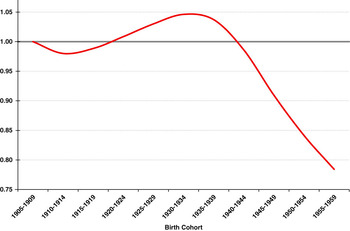
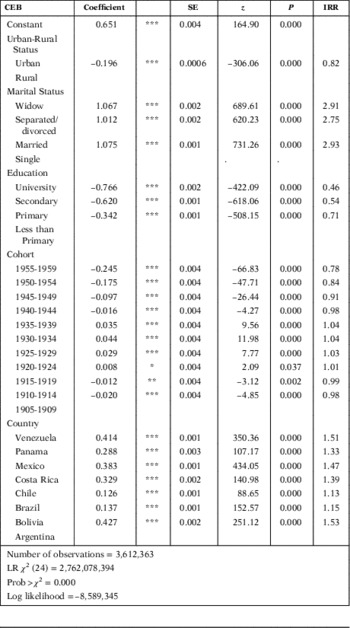
In order to present a streamlined view of this, Figure 11 shows the incidence rate ratios (IRR) by birth cohort estimated from a Poisson regression model on the variable «Children Ever Born». IRRs are adjusted by habitat, marital status, educational level, cohort and country, and offer a synthetic regional perspectiveFootnote 14 . Controlling for these independent variables, the inter-cohort change in the IRRs draws very clearly the double phase of the boom and bust fertility cycle in the selected Latin American countries. These ratios summarise in a straightforward and elegant way the pattern of change in fertility in this world region during the period, showing the boom and bust cycle clearly, with an initial trend change commencing among cohorts born during the 1910s, peaking for those born in the 1930s and initiating a long and precipitous decline for those born in the 1940s. It is a cycle that shows evident similarities to those found in the developed world during the baby boom.
FERTILITY SHIFTS IN LATIN AMERICA. ADJUSTED INCIDENCE RATE RATIOS OF CILDREN EVER BORN (CEB) BY BIRTH COHORT (FROM THE POISSON REGRESSION MODEL)
Source: IPUMS-I.

The overall shift downward in fertility can be linked to the availability of widespread and inexpensive contraception, and the differences in timing are linked to the distribution of contraceptives in different countries. In this sense, the timing in the decline of fertility in these Latin American nations, with Costa Rica and Chile leading and Nicaragua, Panama and Bolivia lagging behind, may well be an indication of the timing of the spread of contraception in different countries. Beyond the specifics of individual nations, the most noteworthy aspect of the results presented here are precisely the similarities in timing both of the fertility boom and the subsequent start of the fertility bust.
The intensity of the fertility boom in Latin America was highest in Costa Rica, followed by Panama, Nicaragua, Venezuela and Mexico in that order. It is impossible for us to estimate with a reasonable degree of accuracy the intensity of the boom in Bolivia where no realistic benchmark date is available and, as stated earlier, there was no boom in Argentina, Brazil or Uruguay. This notwithstanding, fertility in these nations increased by between 9 and 20 per cent, slightly lower than increases in some developed countries like the United States, Austria or France (20-40 per cent), higher than in others (2-5 per cent in Spain and Hungary) and more or less on a par with increases in a small sample of developing countries (Turkey, Morocco, China) (Reher and Requena Reference Reher and Requena2014).
The results presented here have added further evidence to the fact that a fundamental, even universal characteristic of this period of increasing fertility was an important decline in childlessness. In the Latin American countries shown here, this decline ranged from less than 4 per cent in Bolivia to as high as 15 per cent in countries like Uruguay. Everywhere, however, it declined. Declines in developed nations appear to have been slightly stronger while in other developing nations levels are similar to those seen in Latin America (van Bavel and Reher Reference van Bavel and Reher2013; Reher and Requena Reference Reher and Requena2014). The universal nature of these declines can be explained by improvements in maternal health and nutritional status, a truly worldwide phenomenon. Increasing nuptiality also plays a role, though this effect is only visible in countries where nuptiality tended to be delayed and muted than where it tended to be widespread and early.
At higher parities, the most visible result of this study is the proof presented of an increase in higher order births among Latin American women, visible both in distributions of final parities and in the parity progression ratios at higher parities. These increases are only modest in developing nations mostly because fertility was already at high levels before the fertility boom. In certain developed nations, this was not the case because fertility had already reached much lower levels by the 1930s. On this point, it is impossible to discount the fact that couples wanted and obtained larger families during the period. The role of imperfect contraception cannot be discounted either, though plausibly its role was less important. With the end of the fertility boom, the ideal of the 4+ children family weakened rapidly and by the end of the period under study was well on its way to disappearing as the modal family size.
During this fertility boom, there was an increasing uniformity in the reproductive behaviour of women. This same result was found years ago in the United States by Norman Ryder (Reference Ryder1986) and recently has been brought to light in a comparative paper on the fertility boom in developed and in some developing countries (Reher and Requena Reference Reher and Requena2014). This uniformity of behaviour tended to concentrate on the two-child family in the developed world and on the 4+ child family in the developing world. Even so, increasingly uniform behaviour may suggest the existence of certain common ideals regarding family size in different societies. If so, this result would help substantiate the idea that during the fertility boom people actually wanted larger families, much as they wanted much smaller ones afterwards. The results shown here for Latin America pose this same intriguing question for the region and possibly for others as well.
The 20th century was a period of enormous advances in educational attainment. This started in the developed world, especially in Northern Europe and in the English-speaking non-European world, but ended up affecting the entire world. In the Latin American countries studied here, at the outset of the century levels of adult female education were alarmingly low, well-below the lowest levels found in Europe. Yet as the century progressed, especially starting with women born in the 1930s, educational levels began a prolonged and thorough change. It was the sign of the times and increasing education continues to be considered one of the hallmarks of social modernisation forces everywhere. In this study, educational levels have been shown to have a substantial impact on reproductive behaviour with women of higher educational attainment invariably exhibiting lower fertility, and the less educated showing higher fertility, a result similar to the one found in Reher and Requena (Reference Reher and Requena2014). During the period of the fertility boom, it has been shown that while changes in the general structure of education tended to depress fertility, all social and educational groups participated in higher fertility. Yet when the fertility bust followed the boom, both structural change and all educational groups contributed to the decline. This suggests that these large fertility swings (boom, bust) responded to ideas and values shared by all social groups, irrespective of their levels of education.
At the same time, as the educational revolution underway in mid-century Latin America, enormous strides in the fight against infant and child mortality and infectious disease were being made. This process was especially strong in countries like Costa Rica, Venezuela and Chile but can be seen throughout the region. This change had powerful implications for family size because it increased the numbers of surviving children enormously. When our admittedly approximate census-based indicator of the number surviving offspring is used, it turns out that the intensity of the fertility boom nearly doubles in the region and even in countries like Brazil with no apparent fertility spurt there is a marked increase in the number of surviving offspring. Our estimate, reflecting both fertility changes and improving mortality, nearly doubles the overall intensity of this period of increased fertility plus increased survivorship, nearing the levels reached by the developed countries where the baby boom had been strongest. Mortality change also had implications for reproduction by means of improved adult survivorship leading to longer married lives for adults, facilitating reproduction in the absence of divorce and in contexts of imperfect fertility control. This second effect may have been smaller for completed family size (net reproduction) than the one influencing surviving children, though it represents a significant and often overlooked contribution of adult mortality change to fertility during the boom period that has often been neglected in the literature despite the fact that it constitutes a key part of the population explosion taking place in the developing world at this time. Managing this growth in population was no small task for these countries. Its initial consequence was breakneck population growth in the region, intense migration and increasing levels of poverty. Only now is the region beginning to emerge from this scenario, thanks largely to the enormous reduction in fertility and in family size whose beginnings are visible in the data presented here.
FURTHER THOUGHTS
This paper has presented strong evidence from a large sample of countries in Latin America that a fertility boom took place in the region during the central decades of the 20th century, concretely among women born between 1925 and 1945. Not every country in the region participated in this, but in seven out of the ten countries included here the spurt is unquestionable. Considering the heterogeneity that characterised the baby boom in the developed world, the disparities in Latin America should come as no surprise. The basic timing of the boom mirrored closely the cycle taking place in the developed world, as did many of its component parts. Despite some differences between both worlds, the overall impression is that they are different parts of a great mid-century change in fertility. At this stage, it is only possible to make this statement with a degree of confidence for the developed world and for Latin America. In the future, our goal is to include more countries from other parts of the world. In so doing, we may be able to piece together the basic outline of a world history of fertility during the central decades of the 20th century. Whether or not there is a real world pattern in fertility remains unclear. Until this sample is increased to include more countries from Asia and from Africa, speaking of world fertility patterns must remain a matter of speculation.
These strides in our understanding of past fertility patterns outside of the developed world have been made, thanks to a massive data set bringing together micro-census data for many countries and censuses corresponding to the final years of the 20th century. These data are not without problems and individual censuses were carefully vetted to ascertain their reliability and quality. In Latin America, a number of countries met the criteria outlined in this paper and in Reher and Requena (Reference Reher and Requena2014) but others have not. This is not to say that the data included here are not without problems, yet the reality they reveal is similar to that found in censuses from developed countries and coincides with other sources based on vital statistics, where available. It would have been ideal to use only vital statistics for this paper, much as van Bavel and Reher (Reference van Bavel and Reher2013) did in their paper on the baby boom, but these statistics are simply not available or are not reliable for much of the developing world. The micro census data and the IPUMS-I database have enabled us to unlock a large parcel of Latin American population history that until now was largely unknown. Lack of adequate data is no longer a reason to overlook the history of fertility during the central decades of the 20th century.
Despite the similarities, in the end we are hesitant to call the mid-century fertility boom a real baby boom. The term ‘baby boom’ was tailored to the developed world specifically and referred to the sharp rise in fertility taking place around the time of the war or afterwards. Since starting levels were relatively low, it refers to a real trend change taking place at a fairly advanced stage of the demographic transition. In the developing world, this was not the case, as the rise in fertility took place before the demographic transition when starting levels of fertility were still very high. The main distinguishing factor here is the timing of the demographic transition.
The extent to which this fertility shift was common to all, to most or to some of the developing world remains to be seen, but demographers and historical demographers can no longer overlook this possibility. Until now, explanations for this great cycle have been lacking. Identifying this fertility cycle in Latin America is a step in the right direction. Enlarging the sample of developing countries and proposing a plausible explanatory framework that will help us understand it better are major challenges for future research (Table A1).
APPENDIX
Selected Latin American countries