Introduction
The rainforests of Rondônia in the Amazon basin are lichenologically largely unknown, with so far only around a dozen mostly foliicolous lichen species have been reported, (Lücking Reference Lücking2008). However, a recent project to survey the lichens in these still mostly primary forests has begun, and the first results show that the region is among the richest sites for lichen diversity in the world. It is especially surprising that some undescribed species are locally abundant, like some of the Pyrenula species recently described from the area (Aptroot et al. Reference Aptroot, Sipman and Cáceres2013).
The vast majority of the pyrenocarpous lichen species in Rondônia grow on tree bark in closed rainforest. Fewer species do occur on other substrata, such as living leaves or the soil of termite nests (Aptroot & Cáceres Reference Aptroot and Cáceres2014). The lower tree trunks in the rainforest in Rondônia are mostly covered by crustose lichens, not bryophytes as is usual in rainforests. The reason seems to be that the trees are naturally more dispersed than in other regions in the Amazon, such as the Guyanas for example, because of the poor soils that do not sustain a more dense vegetation. As a result, sampling the lichen diversity does not depend as much on the lucky encounter of recently fallen trees (Aptroot Reference Aptroot1997) or the availability of logging sites. Many different species could be collected within a relatively short period during two collecting trips in 2012.
The high lichen biodiversity is somewhat surprising in light of the palynological record, which shows that the rainforest in Rondônia at the southern edge of the Amazonian basin is of a geologically recent date and was replaced by savannahs in drier or colder periods in the Tertiary and Quaternary, including the ice ages (Hooghiemstra & van der Hammen Reference Hooghiemstra and van der Hammen1998; Colinvaux et al. Reference Colinvaux, De Oliveira and Bush2000). The explanation may be that lichens are better dispersers than most other organisms, on which the rapid changes in vegetation may have had more effect.
The lichen flora of a rainforest is largely composed of crustose species. Macrolichens are sparse, and mostly represented by microfoliose species. Among the crustose lichens, there are four speciose and abundant groups, viz. the Arthoniales, the Ostropales (mainly Graphidaceae), the Lecanorales and the pyrenocarpous lichens (comprising several non-related groups). This paper treats the pyrenocarpous lichens (with the exception of the Trypetheliaceae), of which c. 50 species were found in Rondônia, including many that were undescribed. They will be described when the on-going phylogenetic studies of the family have resulted in a more natural generic division. We intend to prepare similar publications for some of the other large groups.
An illustrated identification key is given to all 65 species identified, even though the knowledge of the flora is still incomplete, as it will help to identify additional taxa in the future. Representative specimens are cited and illustrated. Foliicolous lichens are only listed, not keyed out, as keys to all South American species are available in Lücking (Reference Lücking2008). This is the first identification key for pyrenocarpous lichens in a South American rainforest area.
Material and Methods
Identification and descriptive work was carried out in Itabaiana, Universidade Federal de Sergipe, using a Leica EZ4 stereomicroscope and a Leica DM500 compound microscope, and also in Soest using an Olympus SZX7 stereomicroscope and an Olympus BX50 compound microscope with interference contrast, connected to a Nikon Coolpix digital camera. Sections were mounted in tap water, in which all measurements were also taken. The chemistry of all specimens was investigated by a UV-lamp, and occasionally by spot tests with 10% KOH.
All specimens cited were collected by M. E. S. Cáceres and A. Aptroot in Rondônia state, Brazil, at c. 100 m elevation, and are preserved in both ABL and ISE. Collection numbers in the 11000s refer to collections from March 2012, and numbers in the 15000s refer to collections from November 2012. Unless otherwise mentioned, the collections are from tree bark in rainforest (such details are only given in extenso for the newly described species).
Short names and locality information for the main collecting sites:
- Buriti:
-
Sítio Ecológico Buriti on Lago Cujubim NE of Porto Velho, 8°35′17″S, 63°40′40″W.
- Circuito:
-
Porto Velho, Parque Circuito, 8°43′54″S, 63°54′04″W.
- Cuniã:
-
Estação Ecológica de Cuniã, km 760 on road BR 319 NNE of Porto Velho, 8°02′44″S, 63°29′11″W.
- Nova Esperança:
-
Porto Velho, Nova Esperança, private property 7014, 8°42′55″S, 63°52′35″W.
- São Francisco:
-
Fazenda São Francisco off BR319, 30 km N of Porto Velho, 8°24′33″S, 63°58′56″W.
- Parque Natural:
-
Porto Velho, Parque Natural Municipal de Porto Velho, 8°41′10″S, 63°52′05″W.
- Porto Velho:
-
Porto Velho, historical town centre, 8°45′57″S, 63°54′31″W.
- UNIR:
-
Porto Velho, UNIR Federal University campus SW of city, 8°50′14″S, 63°56′25″W.
The New Species
Agonimia tenuiloba Aptroot & M. Cáceres sp. nov.
MycoBank No.: MB 804311
Corticolous Agonimia with thallus with minute flabellate lobes developing goniocysts, smooth grey ellipsoidal ascomata and densely muriform ascospores of 30–50(–76)×20–35 µm.
Type: Brazil, Rondônia, Estação Ecológica de Cuniã, km 760 on road BR 319 NNNW of Porto Velho, 8°02′44″S, 63°29′11″W, alt. c. 100 m, on tree bark in primary rainforest, 20 November 2012, M. Cáceres & A. Aptroot 15685 (ISE—holotype; ABL—isotype).
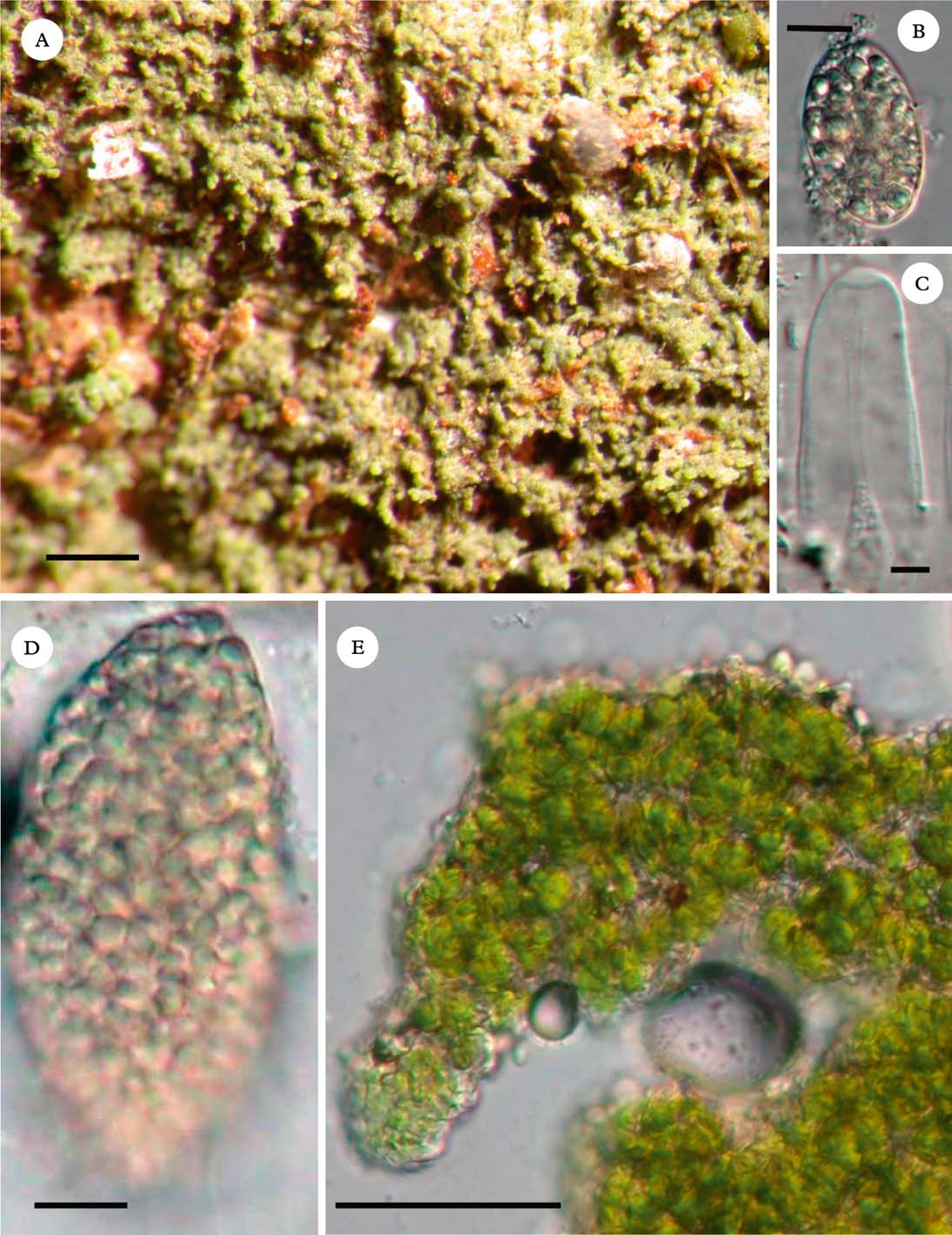
(Fig. 1)
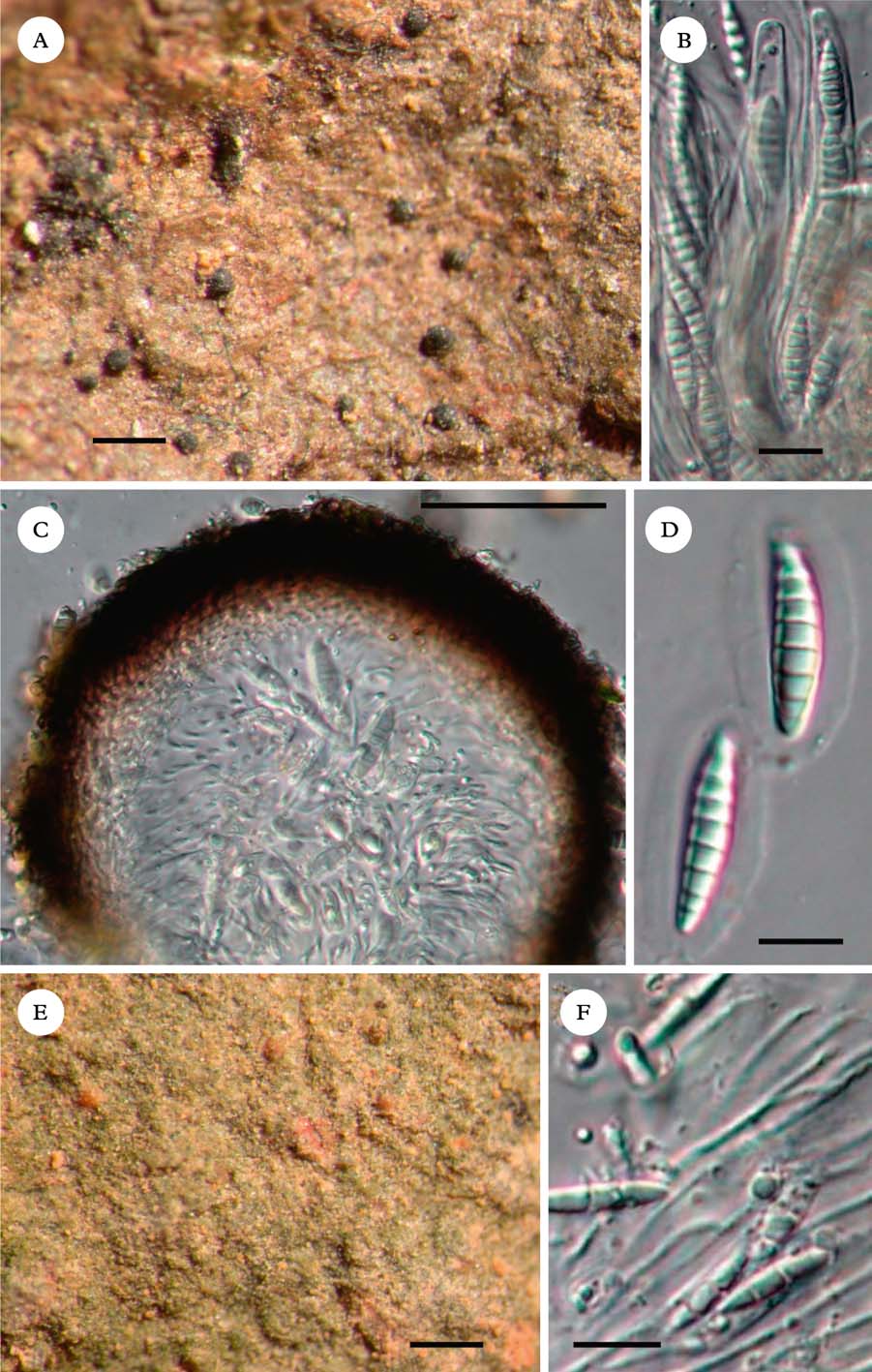
Agonimia tenuiloba (isotype). A, thallus with ascomata; B, young ascospore; C, ascus tip; D, ascospore; E, thallus lobe with papillae. Scales: A=0·5 mm; B–D=10 µm; E=50 µm. In colour online.
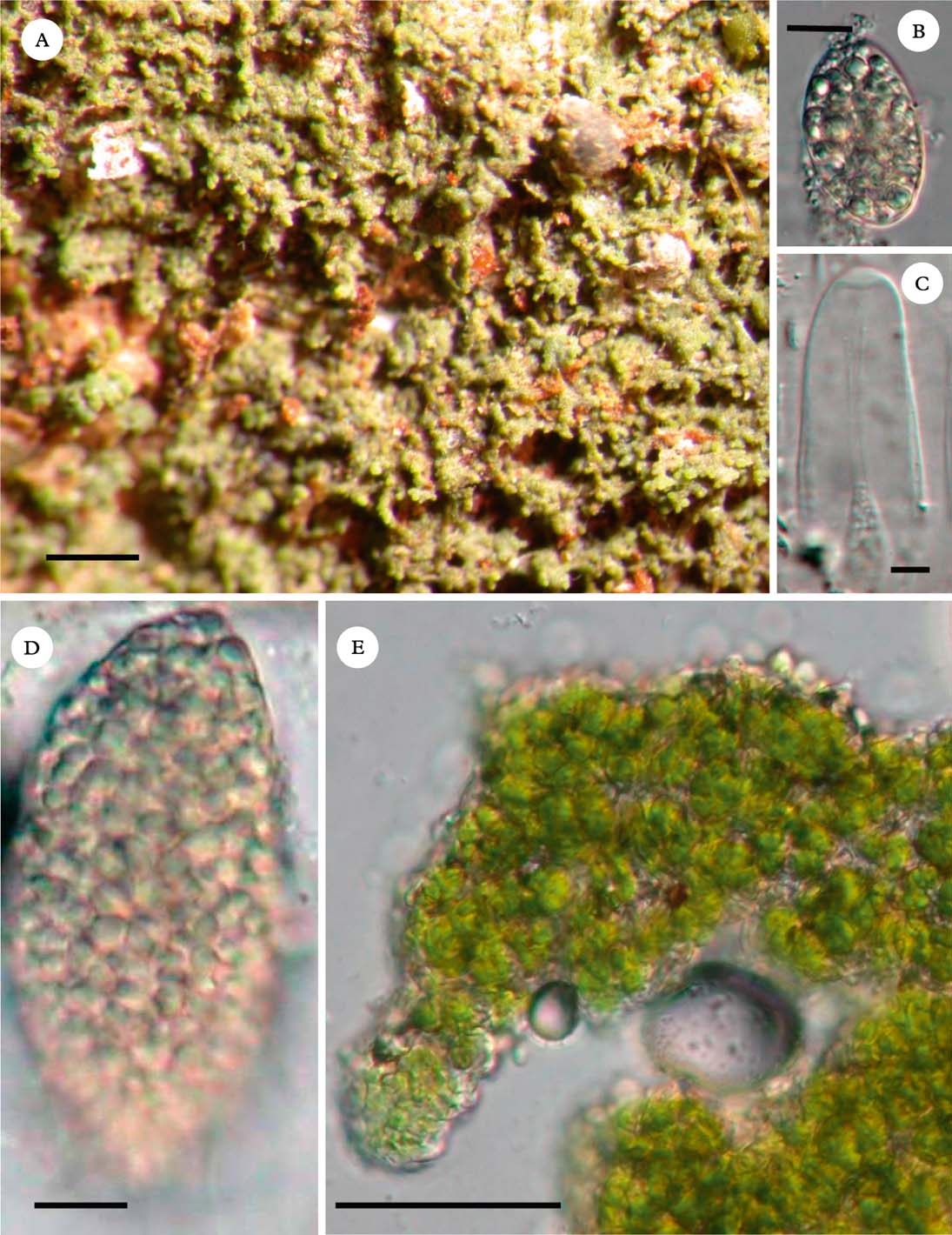
Thallus consisting of green, minute flabellate generally dissected c. 0·1 mm wide lobes with hyaline papillae, developing globose goniocysts 25–35 µm diam.
Ascomata perithecioid, simple, dispersed, ellipsoidal, superficial, grey due to a thin thalline cover, smooth, 0·3–0·4 mm wide, 0·4–0·6 mm high. Wall carbonized above, thickest at the sides, up to c. 100 µm thick. Ostioles whitish, apical. Hamathecium hyaline, not inspersed. Ascus pyriform, wall much thickened towards the tip. Ascospores 2 per ascus, hyaline, pale brown when old, ellipsoidal, densely muriform, 30–50(–76)×20–35 µm.
Pycnidia not observed.
Chemistry
No reactions with K or UV; no secondary substances detected.
Ecology and distribution
On smooth bark of trees in primary forest. Known only from Brazil.
Discussion
This species is closest to the European Agonimia flabelliformis Halda et al. (Guzow-Krzemińska et al. Reference Guzow-Krzemińska, Halda and Czarnota2012). They share the flabellate thallus squamules and the presence of goniocysts. However, the ascospores of the European species are shorter and, in particular, much narrower (23–35×11–15 µm), the ascomata are mostly globose and the carbonized wall much thinner (5–15 µm).
Anisomeridium lateriticum Aptroot & M. Cáceres sp. nov.
MycoBank No.: MB 804312
Saxicolous Anisomeridium with sessile pyriform conidiomata, brown and hyaline septate setae in the ostiole, and simple to 1-septate conidia of 8–11×2·0–2·5 µm.
Type: Brazil, Rondônia, Fazenda São Francisco off BR319, 30 km N of Porto Velho, 8°24′33″S, 63°58′56″W, alt. c. 100 m, on lateritic rock in primary rainforest, 15 March 2012, M. Cáceres & A. Aptroot 11801 (ISE—holotype; ABL—isotype).
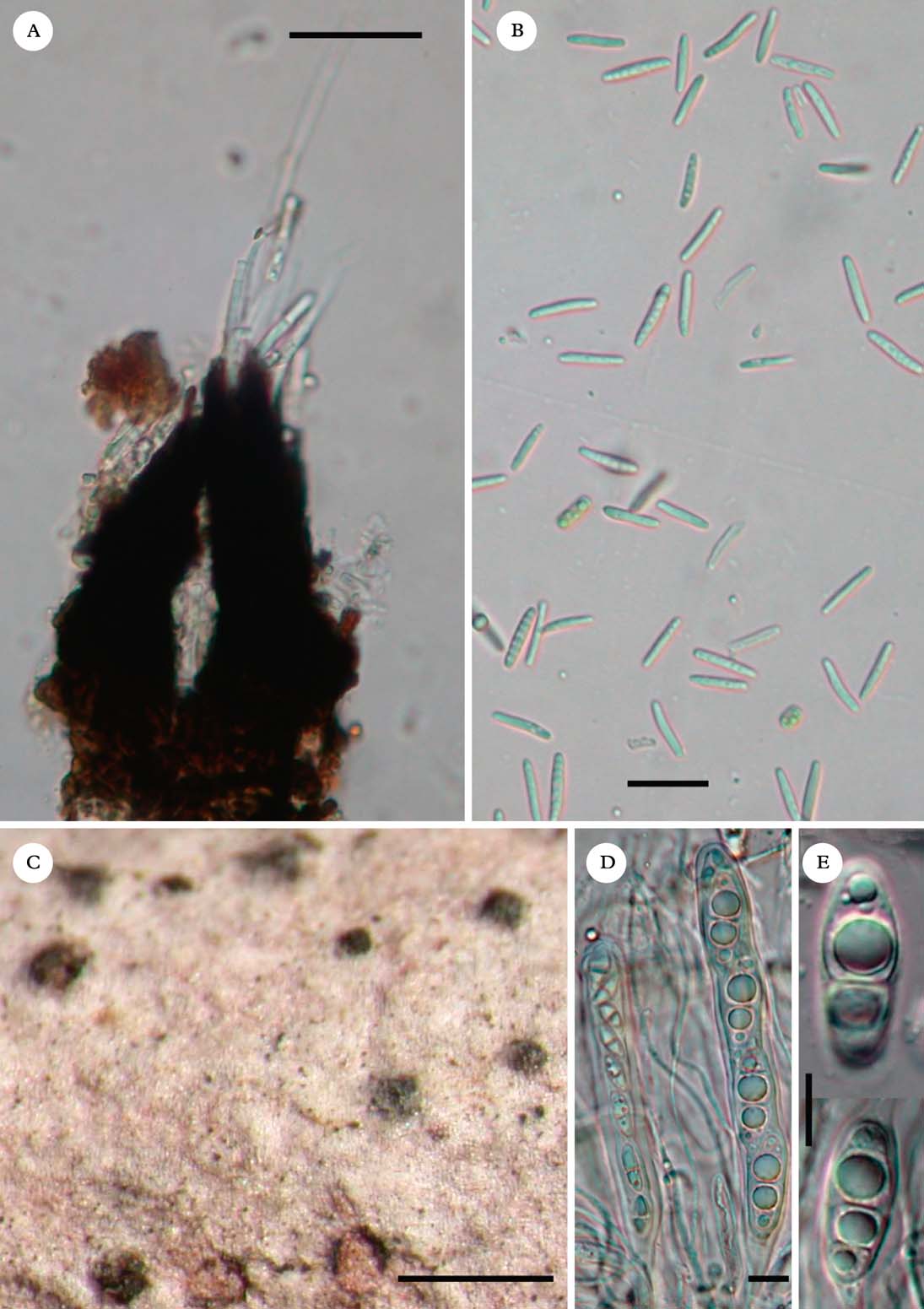
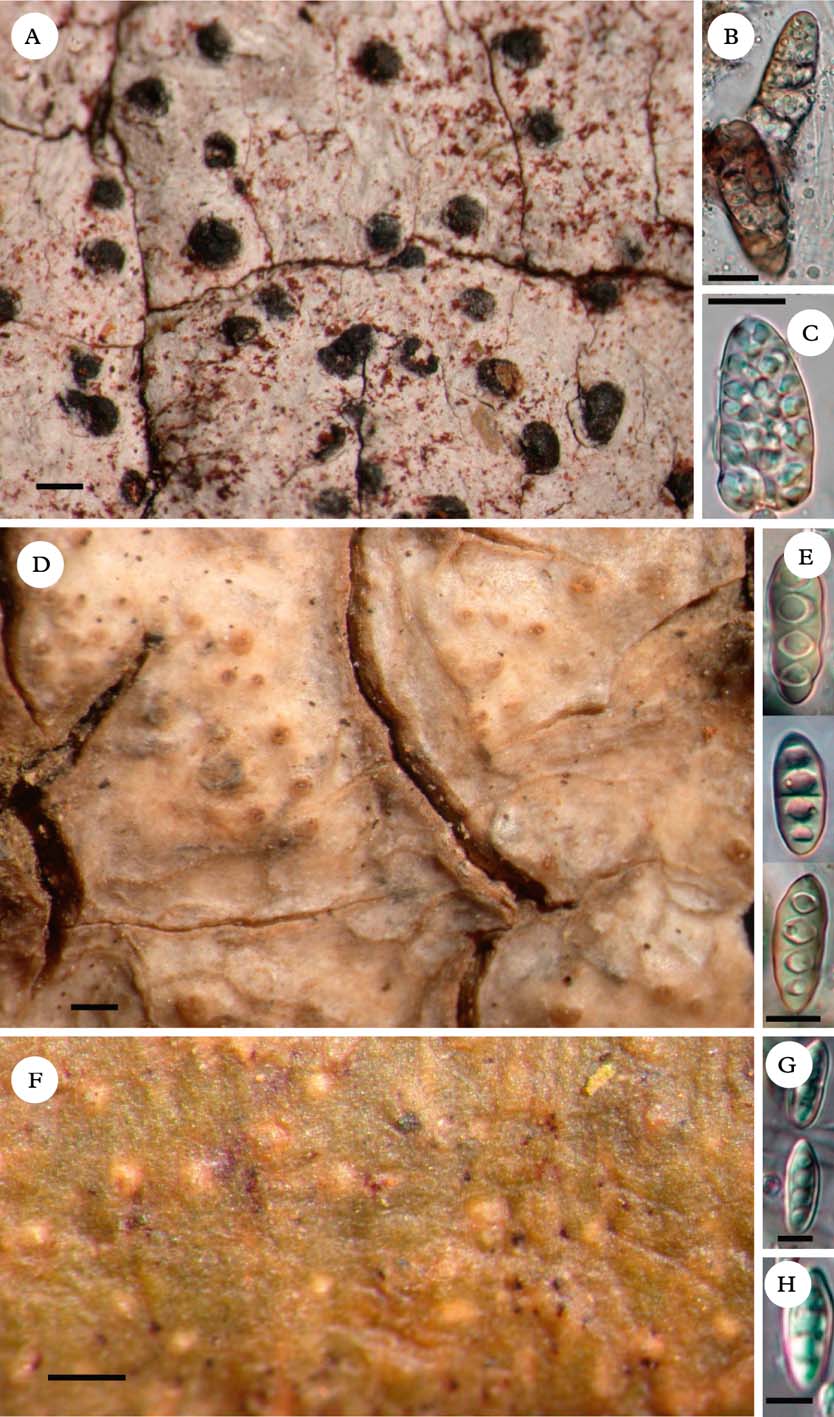
A & B, Anisomeridium lateriticum (isotype). A, conidioma with setae; B, conidia. C–E, A. triseptatum, (isotype). C, thallus with ascomata; D, hamathecium with asci; E, ascospores. Scales: A=50 µm; B, D & E=10 µm; C=0·5 mm. In colour online.
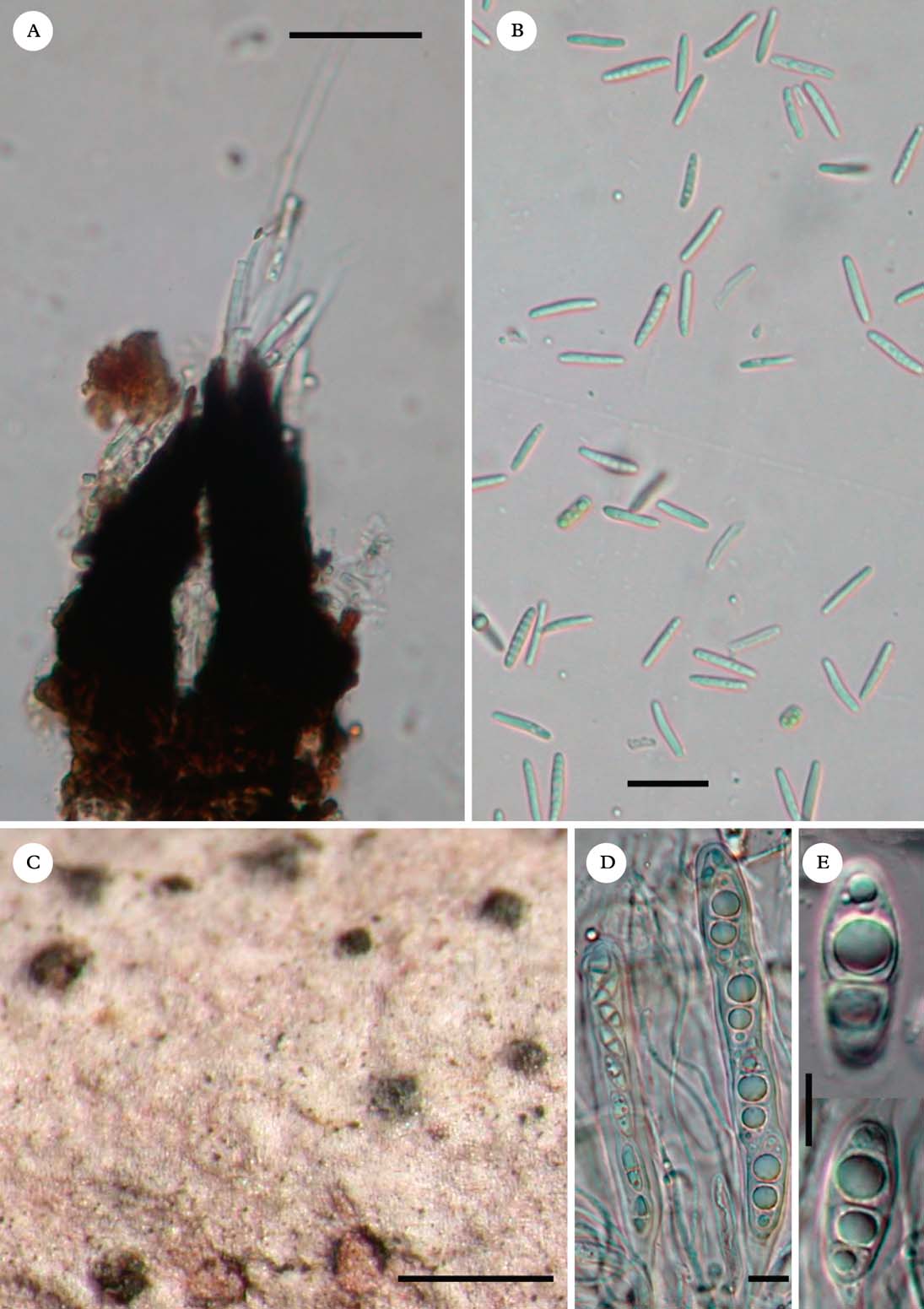
Thallus inconspicuous, brownish grey, very thin, glossy; algae trentepohlioid.
Ascomata not observed.
Pycnidia sessile, pyriform, black, c. 0·1 mm wide and c. 0·2 mm high. Ostiole with partly brown, partly hyaline septate setae of 20–100×4–6 µm. Conidia hyaline, bacillary, simple to 1-septate, 8–11×2·0–2·5 µm, often with additional pseudosepta/oil globules.
Chemistry
No reactions with K or UV; no secondary substances detected.
Ecology and distribution
On lateritic bauxite rock in primary forest. Known only from Brazil.
Discussion
Although no ascomata are known, this species can be assigned to the genus Anisomeridium because the combination of beaked pycnidia and trentepohlioid algae are known only in this genus. It is closest to A. throwerae R. C. Harris (Harris Reference Harris1995), which differs by having wider conidia (4–5 µm) and a corticolous habitat.
Anisomeridium triseptatum Aptroot & M. Cáceres sp. nov.
MycoBank No.: MB 804313
Corticolous Anisomeridium with ascomata with lateral ostioles and (1–)3-septate ascospores of 25–30×7·5–10·0 µm, often with gelatinous appendages.
Type: Brazil, Rondônia, Estação Ecológica de Cuniã, km 760 on road BR 319 NNE of Porto Velho, 8°02′44″S, 63°29′11″W, alt. c. 100 m, on tree bark (twig) in primary rainforest, 20 November 2012, M. Cáceres & A. Aptroot 15723 (ISE—holotype; ABL—isotype).
Thallus not corticate, smooth, continuous, thin, whitish grey, surrounded by a black prothallus line; algae trentepohlioid.
Ascomata perithecioid, simple, dispersed, ampulliform to triangular, emergent, 0·2–0·3 mm wide, 0·3–0·4 mm long, black. Ostioles black, lateral. Hamathecium hyaline, densely anastomosing above the asci, not inspersed. Asci cylindrico-clavate, IKI−, with 8 uniseriate ascospores. Ascospores hyaline, (1–)3-septate, clavate, often constricted at the middle septum, 25–30×7·5–10·0 µm, ends rounded, often with c. 5–7 µm wide and c. 6–9 µm long gelatinous appendages.
Pycnidia not observed.
Chemistry
No reactions with K or UV; no secondary substances detected.
Ecology and distribution
On smooth bark of twigs on trees in primary forest. Known only from Brazil.
Discussion
Only five species of Anisomeridium are known with (often only tardily) 3-septate ascospores (Harris Reference Harris1995); all other species have 1-septate ascospores. None of the species with 3-septate ascospores have lateral ostioles, a character that is very pronounced in the new species, rendering the shape of the ascomata often triangular.
Mycomicrothelia megaspora Aptroot & M. Cáceres sp. nov.
MycoBank No.: MB 804314
Mycomicrothelia with ornamented, 1-septate ascospores of (27–)29–35(–40)×8–12 µm which are often surrounded by a 6–15 µm thick gelatinous layer.
Type: Brazil, Rondônia, Estação Ecológica de Cuniã, km 760 on road BR 319 NNE of Porto Velho, 8°02′44″S, 63°29′11″W, alt. c. 100 m, on tree bark in primary rainforest, 20 November 2012, M. Cáceres & A. Aptroot 15747 (ISE—holotype; ABL—isotype).
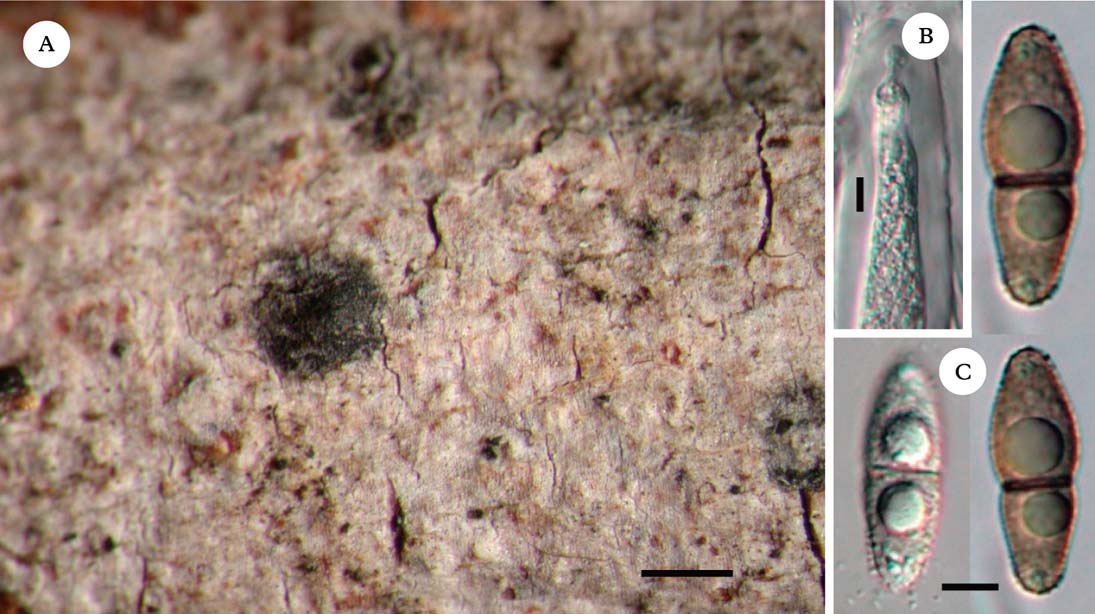
(Fig. 3)
Mycomicrothelia megaspora. A, thallus with ascomata (isotype); B, ascus tip (11950); C, ascospores (isotype). Scales: A=0·5 mm; B & C=7 µm. In colour online.
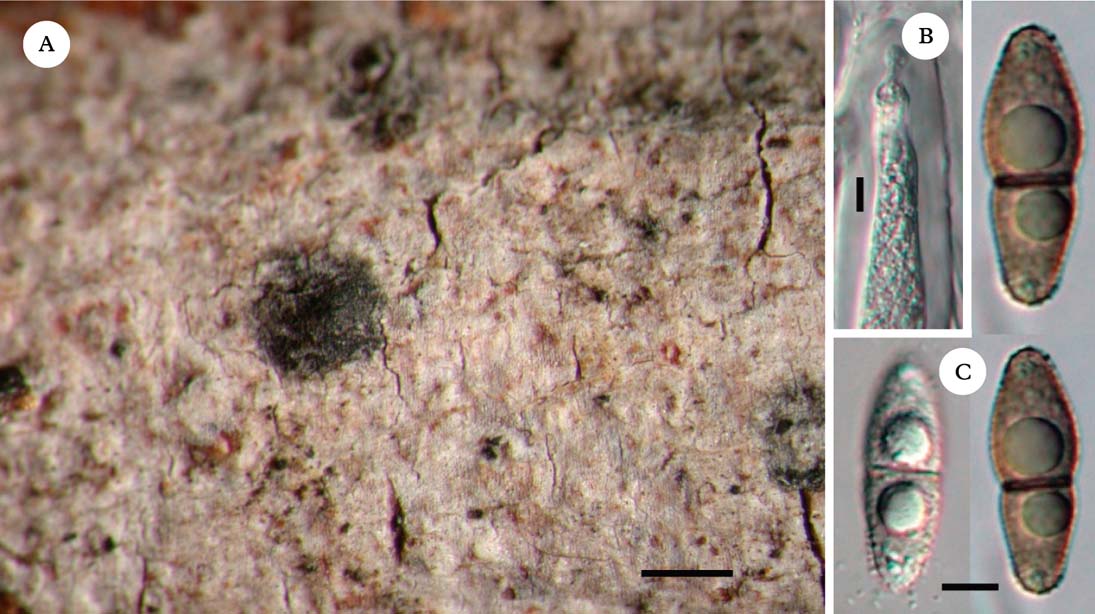
Thallus not corticate, smooth, continuous, thin, pinkish to whitish grey, surrounded by a black prothallus line; algae trentepohlioid.
Ascomata perithecioid, simple, dispersed, conical, superficial, 0·5–0·9 mm diam., black. Wall only carbonized above, extending sideways as a clypeus. Ostioles black, apical. Hamathecium hyaline, not inspersed. Asci cylindrico-clavate, with 8 irregularly biseriate ascospores. Ascospores brown, 1-septate, clavate, often constricted at the septum, (27–)29–35(–40)×8–12 µm, often surrounded by a 6–15 µm thick gelatinous layer.
Pycnidia not observed.
Chemistry
No reactions with K or UV; no secondary substances detected.
Ecology and distribution
On smooth bark of trees in primary forest, locally common. Known only from Brazil.
Discussion
This species has among the largest 1-septate ascospores in the genus. Only two species have 1-septate ascospores that are in the same size class, viz. M. macrocarpa Komposch et al. and M. xanthonica Komposch et al. (Komposch et al. Reference Komposch, Aptroot and Hafellner2002). Both differ by the inspersed hamathecium and the presence of lichexanthone. The ascospores of M. queenslandica (Müll. Arg.) Sipman & Aptroot are also very large, but are mostly 3-septate. Mycomicrothelia queenslandica was accommodated in the new genus Ornatopyrenis by Aptroot (Reference Aptroot1991), but it is now classified into Mycomicrothelia (Sipman & Aptroot Reference Sipman and Aptroot2005).
Additional specimens seen. Brazil: Rondônia: same as the type, M. Cáceres & A. Aptroot 15786; ibid., 2012, M. Cáceres & A. Aptroot 11641; Porto Velho, Parque Natural Municipal de Porto Velho, 8°41′10″S, 63°52′05″W, alt. c. 100 m, on tree bark in primary rainforest, 2012, M. Cáceres & A. Aptroot 15503; Fazenda São Francisco off BR319, 30 km N of Porto Velho, 8°24′33″S, 63°58′56″W, alt. c. 100 m, on tree bark in primary rainforest, 2012, M. Cáceres & A. Aptroot 11821, 11903, 11920, 11939, 11950, 11986, 11988 (all ISE, ABL).
Porina linearispora Aptroot & M. Cáceres sp. nov.
MycoBank No.: MB 804315
Corticolous Porina with shiny green thallus, immersed ascomata of 0·2–0·3 mm, and filiform (7–)9(–13)-septate ascospores of 75–90×1·5–2·0 µm.
Type: Brazil, Rondônia, Porto Velho, Parque Natural Municipal de Porto Velho, 8°41′10″S, 63°52′05″W, alt. c. 100 m, on tree bark in primary rainforest, 17 November 2012, M. Cáceres & A. Aptroot 15317 (ISE—holotype; ABL—isotype).
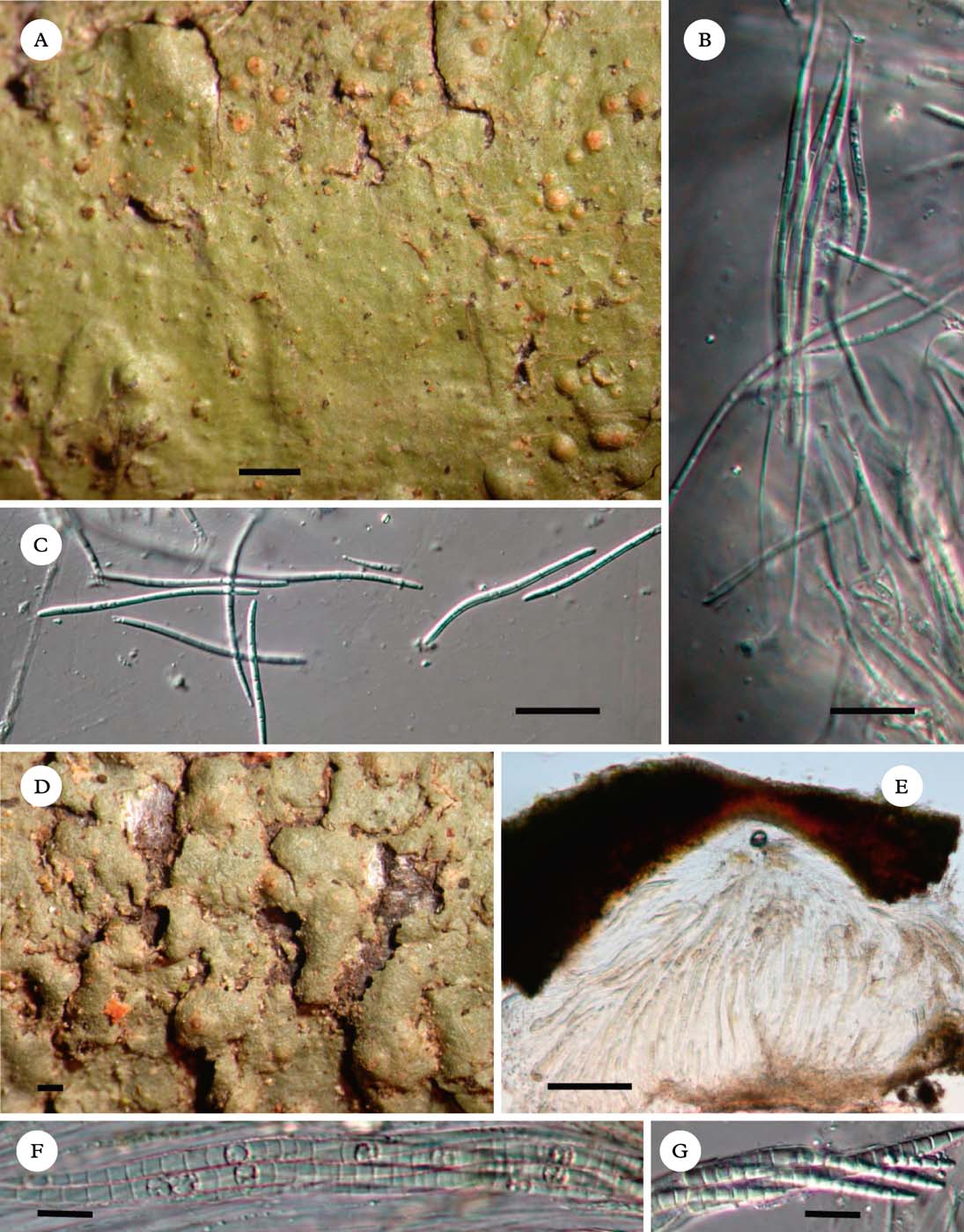
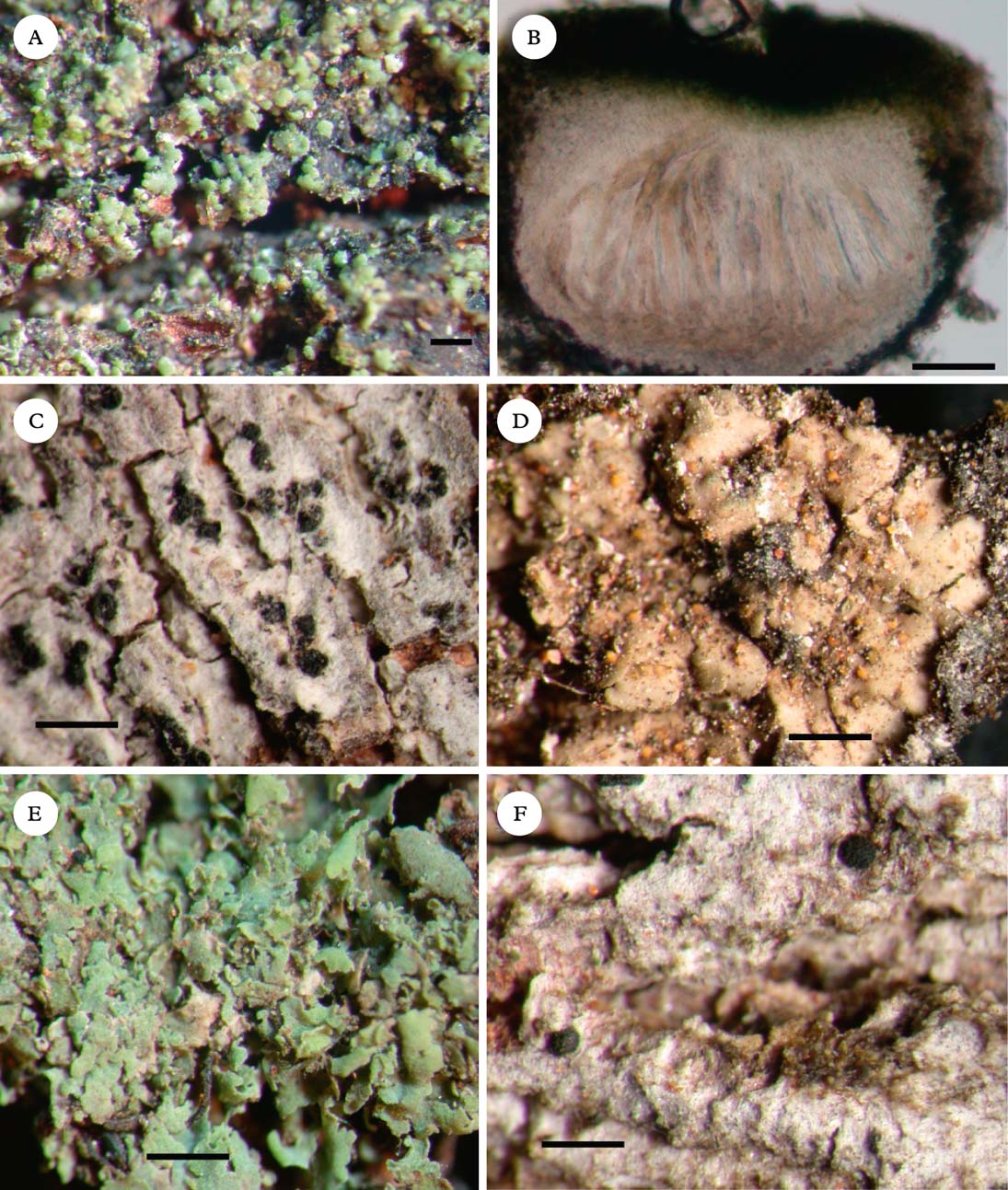
A–C, Porina linearispora (isotype). A, thallus with ascomata; B & C, ascospores. D–G, P. maxispora, (isotype). D, thallus with ascomata; E, section through ascoma; F, ascospores; G, ascospore tips. Scales: A & D=0·5 mm; B, C, F & G=10 µm; E=50 µm. In colour online.
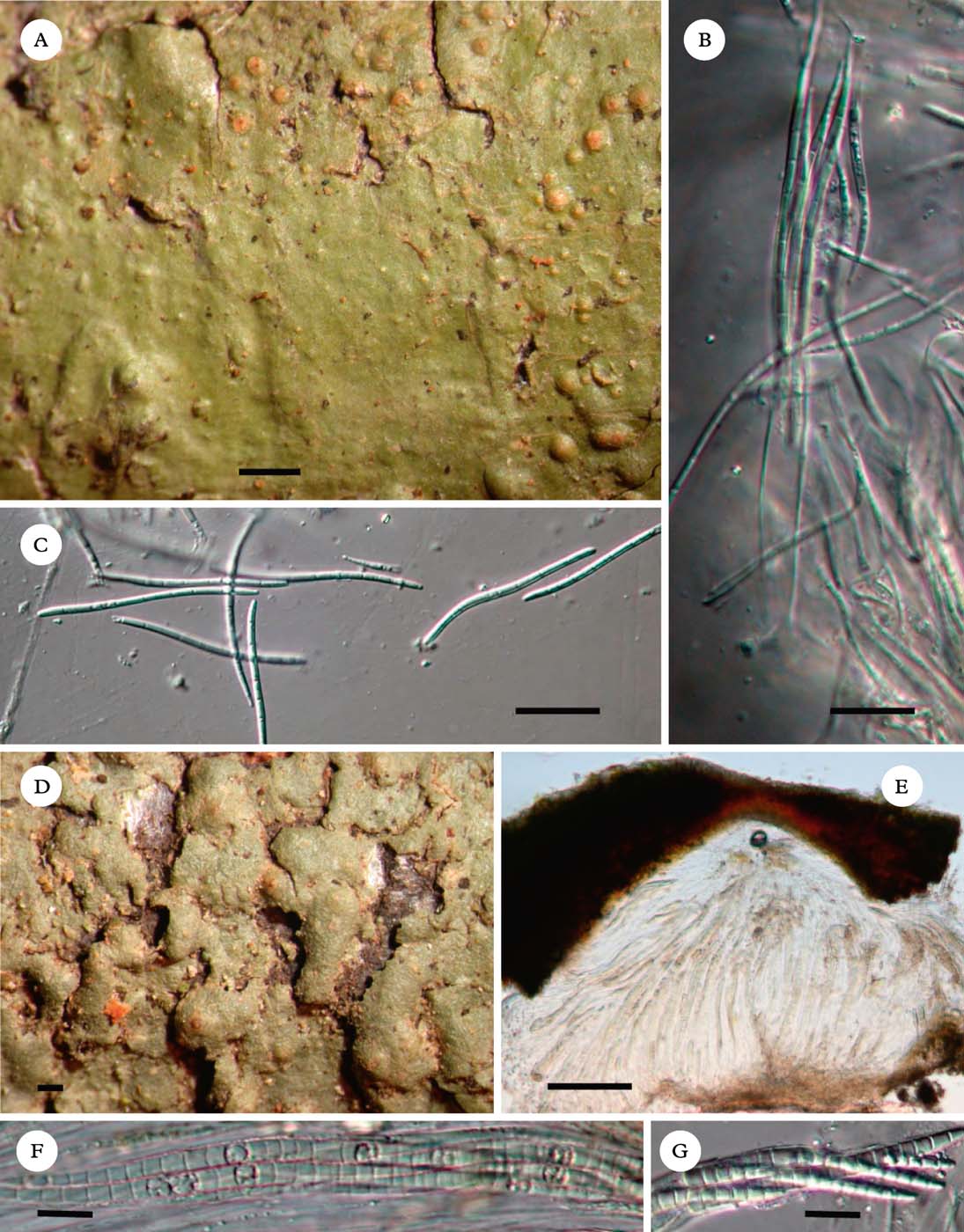
Thallus corticate, smooth, shiny, continuous, thin, green, without warts, with a continuous black hypothallus below, surrounded by a shiny white prothallus line; algae trentepohlioid.
Ascomata perithecioid, simple, dispersed, hemispherical, emergent, 0·2–0·3 mm diam., brown, fully immersed in thallus warts of 0·3–0·4 mm diam. Wall brown, KOH−. Ostioles pale brown, apical. Hamathecium not inspersed. Ascospores hyaline, (7–)9(–13)-septate, filiform, 75–90×1·5–2·0 µm, ends rounded, without surrounding gelatinous layer.
Pycnidia not observed.
Chemistry
No reactions with K or UV; no secondary substances detected.
Ecology and distribution
On smooth bark of trees in primary forest. Known only from Brazil.
Discussion
This species differs from all described species of Porina by the long, and at the same time thin, ascospores. There are several species with ascospores in the size range of 75–90 µm, but all have the ascospores at least 3 µm wide. Also, the ascomata of this species are unusually small for a species of the tetracerae-group, characterized by a glossy thallus on a black hypothallus, and ascomata that are covered by the thallus.
Porina maxispora Aptroot & M. Cáceres sp. nov.
MycoBank No.: MB 804316
Corticolous Porina with matt green thallus, immersed ascomata of 0·5–0·7 mm, and filiform (17–)23–35-septate ascospores of 95–110×4·5–5·5 µm.
Type: Brazil, Rondônia, Porto Velho, Parque Natural Municipal de Porto Velho, 8°41′10″S, 63°52′05″W, alt. c. 100 m, on tree bark in primary rainforest, 17 November 2012, M. Cáceres & A. Aptroot 15318 (ISE—holotype; ABL—isotype).
Thallus corticate, rather smooth, matt, continuous, rather thick, green, without warts, with a continuous black hypothallus below, surrounded by a shiny white prothallus line; algae trentepohlioid.
Ascomata perithecioid, simple, dispersed, hemispherical, emergent, 0·5–0·7 mm diam., brown, fully immersed in thallus warts of 0·6–0·9 mm diam. Wall brown, K−. Ostioles pale brown, apical. Hamathecium not inspersed. Ascospores hyaline, (17–)23–35-septate, filiform, 95–120(–160)×4·0–5·5 µm, ends rounded, without surrounding gelatinous layer.
Pycnidia not observed.
Chemistry
No reactions with K or UV; no secondary substances detected.
Ecology and distribution
On smooth bark of trees in primary forest. Known from Brazil, French Guiana and Guyana.
Discussion
There are several species with ascospores in the size range of 95–120 µm, but most have the ascospores at least 10 µm wide. There is one species with filiform ascospores of a similar size in the mastoidea-group, characterized by a dull thallus on a black hypothallus and ascomata that are covered by the thallus. This is P. exasperatula Vain., which has ascospores 17–21-septate, filiform, 100–110×3·5–4·5 µm, but differs from the new species because it is isidiate. This species was treated by Aptroot & Sipman (Reference Aptroot and Sipman1993) in a somewhat wider sense, also including material that is not isidiate. Most specimens cited by them as P. exasperatula from the Guianas are probably conspecific with P. maxispora.
Porina novemseptatoides Aptroot & M. Cáceres sp. nov.
MycoBank No.: MB 804317
Saxicolous Porina with very thin, glossy brown thallus, superficial ascomata of 0·1–0·2 mm, and fusiform (7–)9-septate ascospores of 21–24×4·5–5·0 µm, surrounded by a c. 5 µm thick gelatinous layer.
Type: Brazil, Rondônia, Porto Velho, Parque Natural Municipal de Porto Velho, 8°41′10″S, 63°52′05″W, alt. c. 100 m, on lateritic rock in primary rainforest, 19 November 2012, M. Cáceres & A. Aptroot 15525 (ISE—holotype; ABL—isotype).
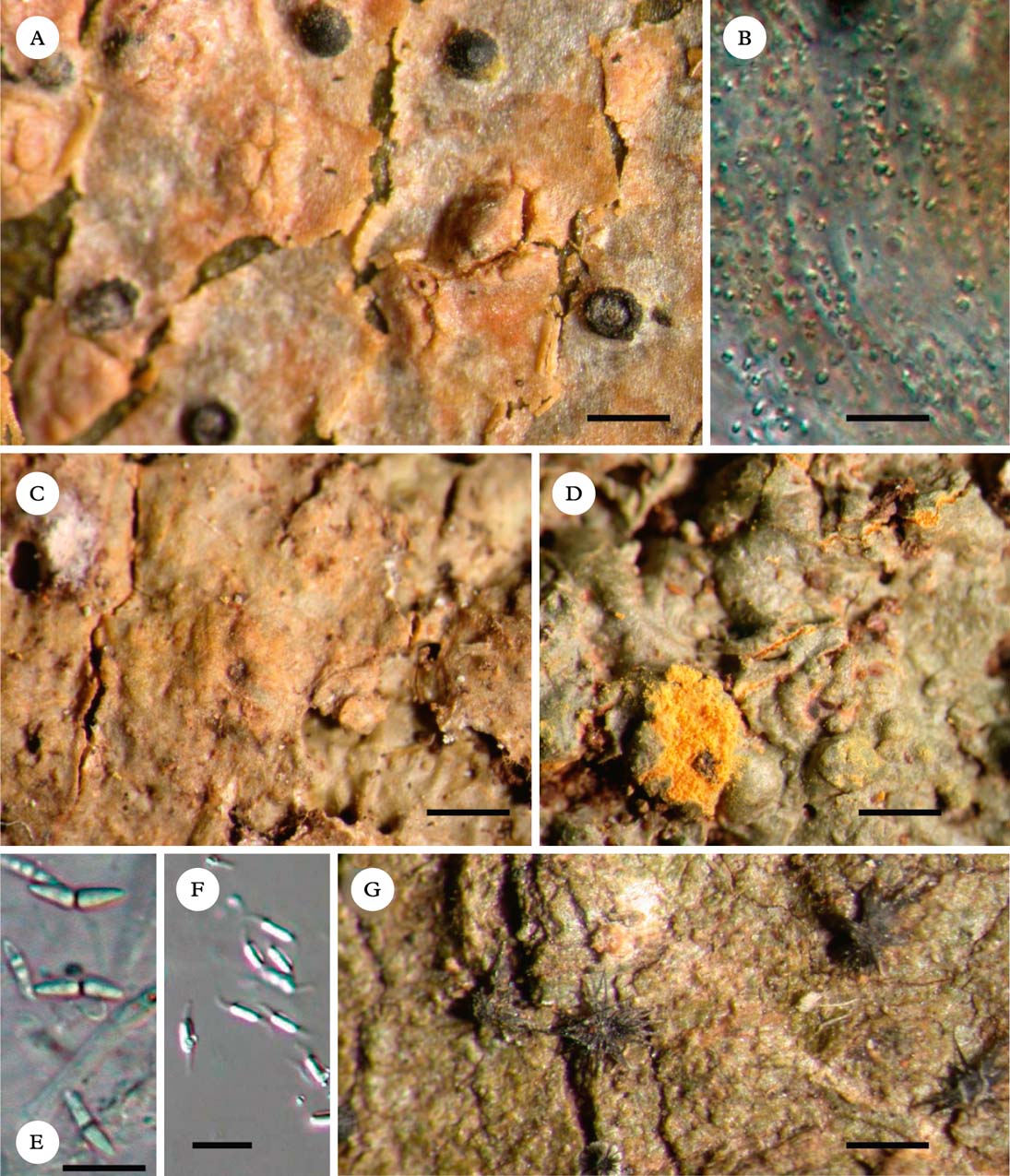
A–D, Porina novemseptatoides (isotype); A, thallus with ascomata; B, hamathecium with asci; C, section through ascoma; D, ascospores. E & F, P. termitophila, (isotype); E, thallus with ascomata; F, ascospores. Scales: A & E=0·5 mm; B, D & F=10 µm; C=50 µm. In colour online.
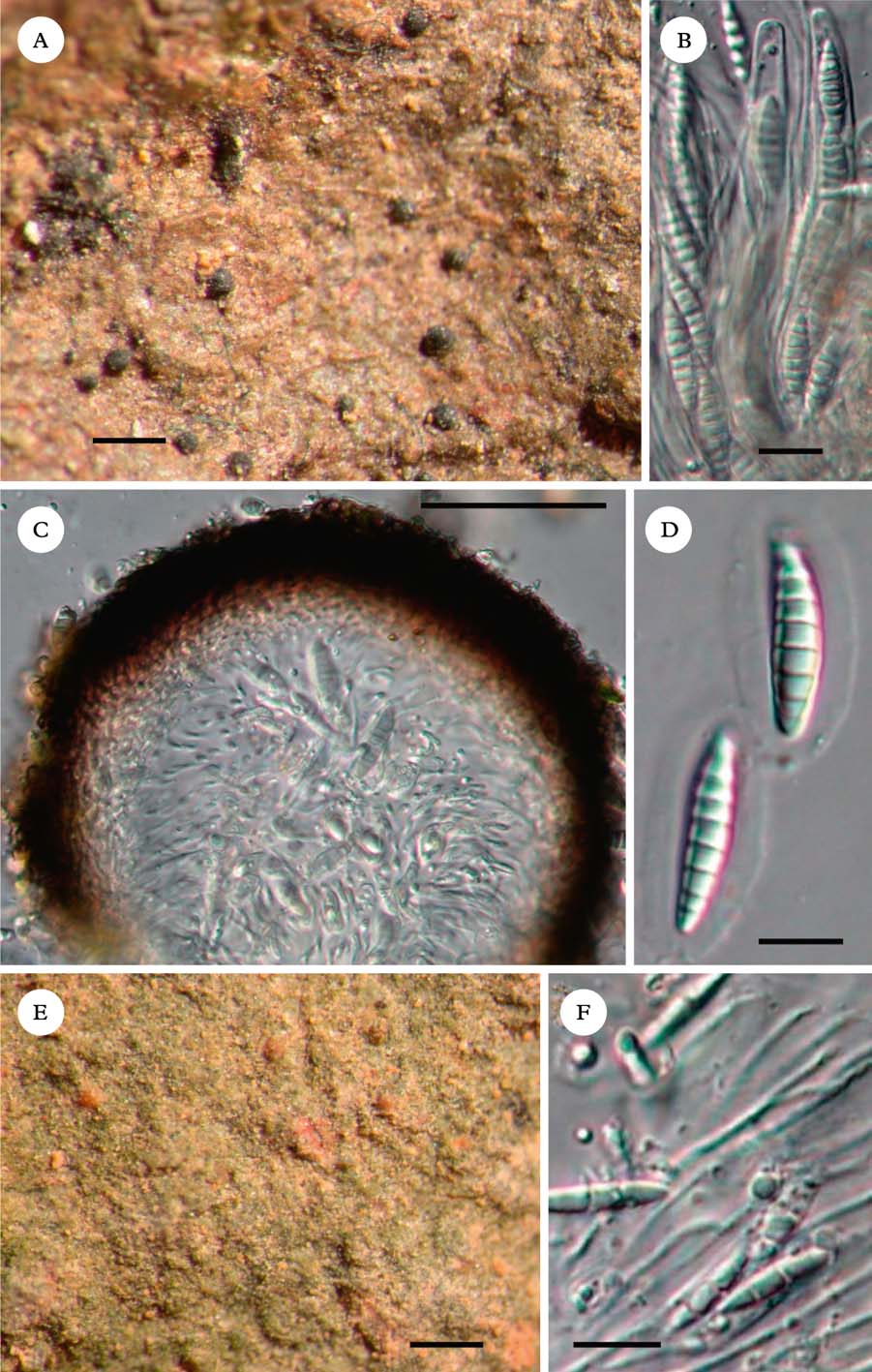
Thallus very thin, shiny, continuous, brownish, without warts, without hypothallus or prothallus; algae trentepohlioid.
Ascomata perithecioid, simple, dispersed, hemispherical, superficial, 0·1–0·2 mm diam., black, not covered by thallus. Wall carbonized all around except below the hamathecium, c. 20 µm thick, almost equally thick in most places, inner parts somewhat purplish tinged, KOH+ greyish. Ostioles black, apical. Hamathecium not inspersed. Ascospores hyaline, fusiform, (7–)9-septate, 21–24×4·5–5·0 µm, ends rounded, surrounded by a c. 5 µm thick gelatinous layer.
Pycnidia not observed.
Chemistry
No reactions with K or UV; no secondary substances detected.
Ecology and distribution
On lateritic bauxite rock in primary forest. Known only from Brazil.
Discussion
The ascoma and thallus of this species are close to P. adflata Müll. Arg. (McCarthy Reference McCarthy1993), also a Brazilian saxicolous species, but the latter differs by having only 5-septate ascospores. It has smaller ascomata and ascospores than the common and widespread P. guentheri (Flotow) Zahlbr., and the ascospores are generally 9-septate, while they are generally 7-septate in P. guentheri.
Additional specimens seen. Brazil: Rondônia: same as the type, M. Cáceres & A. Aptroot 15534 (ISE, ABL).
Porina termitophila Aptroot & M. Cáceres sp. nov.
MycoBank No.: MB 804318
Terricolous Porina with greyish green thallus, emergent ascomata of 0·15–0·20 mm, and fusiform 1–3-septate ascospores of 13–15×2·5–3·0 µm.
Type: Brazil, Rondônia, Sítio Ecológico Buriti on Lago Cujubim NE of Porto Velho, 8°35′17″S, 63°40′40″W, alt. c. 100 m, on soil of termite nests in disturbed rainforest, 18 November 2012, M. Cáceres & A. Aptroot 15458 (ISE—holotype; ABL—isotype).
Thallus thin, dull, mostly continuous, uneven but following the soil surface, greyish green, without warts, without hypothallus or prothallus; algae trentepohlioid.
Ascomata perithecioid, simple, dispersed, hemispherical, emergent, 0·15–0·20 mm diam., pale brown, not covered by thallus. Wall pale brown, K−. Ostioles black, apical. Hamathecium not inspersed. Ascospores hyaline, fusiform, 1–3-septate, 13–15×2·5–3·0 µm, ends rounded, without surrounding gelatinous layer.
Pycnidia not observed.
Chemistry
No reactions with K or UV; no secondary substances detected.
Ecology and distribution
On termite nests in disturbed forest. Known only from Brazil.
Discussion
Terricolous occurrences of species of Porina are extremely rare. This species comes closest to P. leptalea (Durieu & Mont.) A. L. Sm., a cosmopolitan species that grows on various substrata, including bark and rock. This species, however, has consistently 3-septate ascospores that are longer and wider (14·5–23·0×3·5–5·0 µm). The possibility that the new species represents young material of the latter can be ruled out, especially because of the presence of symmetrically 2-septate ascospores, which are not conceivably a young stage of 3-septate ascospores.
Pyrenula bispora Aptroot & M. Cáceres sp. nov.
MycoBank No.: MB 804319
Pyrenula with whitish thallus, dispersed ascomata, inspersed hamathecium, and 2 muriform ascospores, 55–75×19–23 µm, per ascus.
Type: Brazil, Rondônia, Estação Ecológica de Cuniã, km 760 on road BR 319 NNE of Porto Velho, 8°02′44″S, 63°29′11″W, alt. c. 100 m, on tree bark in primary rainforest, 20 November 2012, M. Cáceres & A. Aptroot 15683 (ISE—holotype; ABL—isotype).
A–C, Pyrenula bispora, (isotype); A, thallus with ascomata; B & C, ascospores. D–E, P. leptaleoides (isotype); D, thallus with ascomata; E, ascospores. F–H, P. rhomboidea. (isotype); F, thallus with ascomata; G & H, ascospores. Scales: A, D & F=0·5 mm; B & C=15 µm; E=10 µm; G & H=5 µm. In colour online.
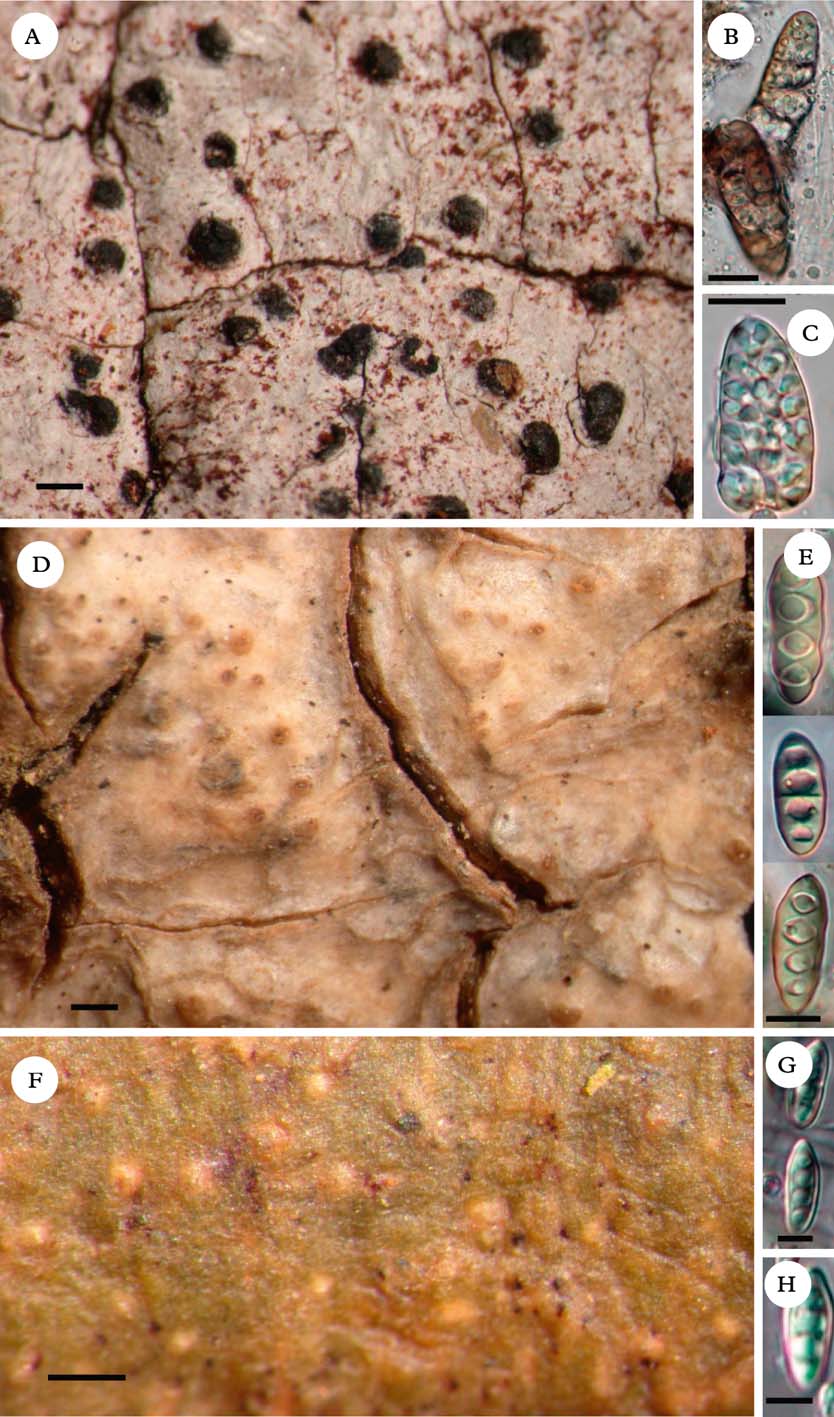
Thallus not corticate, smooth, continuous, thin, whitish, without pseudocyphellae, without prothallus line; algae trentepohlioid.
Ascomata perithecioid, simple, dispersed, hemispherical, emergent, 0·4–0·7 mm diam., black, edges with thallus covering. Wall only carbonized above, extending sideways as a clypeus, without crystals, up to c.100 µm thick. Ostioles black, apical. Hamathecium hyaline, densely inspersed with oil droplets. Asci cylindrico-clavate, with 2 ascospores. Ascospores brown, densely distoseptately muriform, fusiform, 55–75×19–23 µm.
Pycnidia not observed.
Chemistry
No reactions with K or UV; no secondary substances detected.
Ecology and distribution
On smooth bark of trees in primary forest. Known only from Brazil.
Discussion
There are six other Pyrenula species known with asci with 2 muriform ascospores, viz. P. duplicans (Nyl.) Aptroot, P. globifera (Eschw.) Aptroot, P. lyoni (Zahlbr.) Aptroot, P. neosandwicensis Aptroot, P. platystoma (Müll. Arg.) Aptroot (Aptroot et al. Reference Aptroot, Lücking, Sipman, Umaña and Chaves2008; Aptroot Reference Aptroot2012) and P. xanthoglobulifera Aptroot et al. (Menezes et al. Reference Menezes, Xavier-Leite, Aptroot and Cáceres2013). All these species have longer ascospores, of at least 80 µm and always averaging over 100 µm. The new species is the only one that has 2 ascospores in the range of 55–75 µm per ascus. It is not certain whether the whitish non-corticate thallus is truly a species character, as the surface of the type material seems somewhat damaged by external factors.
Pyrenula leptaleoides Aptroot & M. Cáceres sp. nov.
MycoBank No.: MB 804320
Pyrenula with green to pale brown thallus, ascomata that are deeply immersed in the bark, with long necks that are fused in joint ostioles visible as brown dots on the surface, and ascospores of 23–27×8–11 µm with rather angular lumina.
Type: Brazil, Rondônia, Sítio Ecológico Buriti on Lago Cujubim NE of Porto Velho, 8°35′17″S, 63°40′40″W, alt. c. 100 m, on soil of termite nests in disturbed rainforest, 18 November 2012, M. Cáceres & A. Aptroot 15352 (ISE—holotype; ABL—isotype).
Thallus corticate, smooth, continuous, thin, green to pale brown, with whitish pseudocyphellae, surrounded by a black prothallus line; algae trentepohlioid.
Ascomata perithecioid, deeply immersed in the bark, 0·4–0·6 mm diam., black (visible only in sections through the bark), with long necks that are fused with those of 3–8 neighbouring ascomata in joint ostioles which are visible as brown dots on the surface. Wall carbonized all around, and often much carbonization also present along the necks where it fuses with carbonization of neighbouring ascomata, up to c.100 µm thick. Ostioles brown, lateral and fused. Hamathecium hyaline, not inspersed. Asci cylindrico-clavate, with 8 uniseriate ascospores. Ascospores brown, 3-septate, clavate-rhomboidal, without constrictions, 23–27×8–11 µm, ends obtuse but rather pointed, middle lumina broadly diamond-shaped, end lumina triangular, separated from the wall by a thick endospore layer.
Pycnidia not observed.
Chemistry
No reactions with K or UV; no secondary substances detected.
Ecology and distribution
On smooth bark of trees in primary forest. Known only from Brazil.
Discussion
This species is close to P. cubana (Müll. Arg.) R. C. Harris (Aptroot et al. Reference Aptroot, Lücking, Sipman, Umaña and Chaves2008) but differs by the ascomata that are fully immersed when mature.
Additional specimens seen. Brazil: Rondônia: same as the type, M. Cáceres & A. Aptroot 15405, 15409 (ISE, ABL).
Pyrenula rhomboidea Aptroot & M. Cáceres sp. nov.
MycoBank No.: MB 804321
Pyrenula with olive-brown thallus, immersed single ascomata, and irregularly uniseriate clavate-rhomboidal ascospores of 11–13×3·5–4·0 µm.
Type: Brazil, Rondônia, Porto Velho, Parque Natural Municipal de Porto Velho, 8°41′10″S, 63°52′05″W, alt. c. 100 m, on tree bark in primary rainforest, 17 November 2012, M. Cáceres & A. Aptroot 15338 (ISE—holotype; ABL—isotype).
Thallus corticate, smooth, continuous, thin, olive-brown, without pseudocyphellae, not surrounded by prothallus; algae trentepohlioid.
Ascomata perithecioid, simple, fully immersed in the bark, only visible from above by the ostioles, lenticular, 0·1–0·2 mm diam., black. Wall completely carbonized, without crystals, up to c. 50 µm thick. Ostioles pale brown, apical, somewhat raised above the thallus surface. Hamathecium hyaline, not inspersed. Asci cylindrico-clavate, with 8 irregularly uniseriate ascospores. Ascospores brown, 3-septate, clavate-rhomboidal, not constricted at the septa, 11–13×3·5–4·0 µm, ends rounded, lumina rounded to diamond-shaped, separated from the wall by a thick endospore layer.
Pycnidia not observed.
Chemistry
No reactions with K or UV; no secondary substances detected.
Ecology and distribution
On smooth bark of trees in primary forest. Known only from Brazil.
Discussion
The ascospores of this species are among the smallest in the genus; it is similar to Pyrenula aspistea (Ach.) Ach., but the ascospores are more slender and consistently rhombiodal.
Key to the pyrenocarpous lichens in Rondônia
This key treats all pyrenocarpous lichens identified in Rondônia so far, except for the Trypetheliaceae, which will be treated in a separate paper. Also excluded are primarily foliicolous species.
The key mentions collecting localities (see Materials and Methods) and one collection number, except for species newly described from Rondônia in the present paper or in Aptroot et al. (Reference Aptroot, Sipman and Cáceres2013) (and M. E. S. Cáceres, A. Aptroot, M. P. Nelsen & R. Lücking, unpublished data; C. Gueidan, A. Aptroot & M. E. S. Cáceres, unpublished data), for which collection details have already been given in the respective publications. Descriptions and further details about the species can also be found in the aforementioned papers, as well as in Aptroot et al. (Reference Aptroot, Lücking, Sipman, Umaña and Chaves2008), Cáceres (Reference Cáceres2007), Cáceres et al. (Reference Cáceres, Santos, Mendonça, Mota and Aptroot2013), Harris (Reference Harris1995), Lücking (Reference Lücking2008), McCarthy (Reference McCarthy1993), McCarthy & Elix (Reference McCarthy and Elix1996), and Sipman & Aptroot (Reference Sipman and Aptroot2005).
-
1 Thallus microsquamulose to roughly granular, green ... 2
Thallus crustose, not roughly granular ... 5
-
2(1) Thallus squamulose, squamules mostly appressed, hamathecium with algae. Porto Velho (11741) ... Endocarpon pallidulum (Nyl.) Nyl. (Fig. 7D)
Thallus microsquamulose and ascending or granular, hamathecium without algae ... 3
-
3(2) Thallus granular or irregular, not microsquamulose and ascending. Nova Esperança (11517) & Parque ... Agonimia tristicula (Nyl.) Zahlbr. (Fig. 7A)
Thallus microsquamulose and ascending ... 4
-
4(3) Thallus dissected into lobes of c. 0·1 mm wide, lobes in one plane. Cuniã ... Agonimia tenuiloba Aptroot & M. Cáceres (Fig. 1)
Thallus lobes wider than 0·2 mm, often curved upwards or downwards. Porto Velho (11748) ... Flakea papillata O. Erikss. (Fig. 7E)
-
5(1) Thallus with bright yellow, soft medulla, sometimes with yellow soredia ... 6
Thallus without yellow medulla, without soredia ... 8
-
6(5) Thallus without ascomata, often with soredia ... Myeloconis sp. indet. (Fig. 8D)
Thallus with immersed ascomata ... 7
-
7(6) Ascospores >140 µm long. Cuniã (11612) ... Myeloconis guyanensis P. M. McCarthy & Elix (Fig. 8C)
Ascospores <140 µm long. Cuniã (11600), Parque & São Francisco ... Myeloconis parva P. M. McCarthy & Elix
-
8(5) Thallus with isidia ... 9
Thallus without isidia ... 12
-
9(8) Isidia minute, somewhat gnarled, ascoma wall black. Parque (15600) ... Porina isidioambigua M. Cáceres et al.
Isidia cylindrical, ascoma, if present, with brown wall ... 10
-
10(9) Ascomata absent. Collective taxon. Parque (11176) ... Porina distans Vězda & Vivant (Fig. 9B)
Ascomata present ... 11
-
11(10) Prothallus nitidous, usually dark. Buriti (15460), Circuito, Cuniã & Parque ... Porina conspersa Malme
Prothallus absent. Parque (15265) ... Porina scabrida R. C. Harris
-
12(8) Thallus only with conidiomata; ascomata absent ... 13
Thallus with ascomata ... 14
-
13(12) Ostiole with setae. São Francisco ... Anisomeridium lateriticum Aptroot & M. Cáceres (Fig. 2A & B)
Ostiole without setae. Various taxa, usually unidentifiable, except when similar fertile material is found nearby. When conidiomata in pseudo-stromatic tissue (differing in structure and colour from the thallus) ... Trypetheliaceae
-
14(12) Ascospores hyaline ... 15
Ascospores brown to grey when mature ... 40
-
15(14) Ascospores 1-septate ... 16
Ascospores more than 1-septate ... 19
-
16(15) Ascomata in groups with fused or even dissolved walls. Circuito (11461), Cuniã, Parque & São Francisco ... Mycoporum eschweileri (Müll. Arg.) R. C. Harris (Fig. 7F)
Ascomata single ... 17
-
17(16) Ascospores ovoid. Buriti (15366) & Parque ... Anisomeridium albisedum (Nyl.) R. C. Harris
Ascospores fusiform ... 18
-
18(17) Ascospores soon dissolved in two halves. This usually foliicolous species was found on bark in Cuniã (11690) ... Strigula nitidula Mont. (Fig. 8E & F)
Ascospores not fracturing. Parque (11544) ... Strigula americana R. C. Harris
-
19(15) Ascospores muriform ... 20
Ascospores only transversely septate ... 23
-
20(19) Ascoma wall brown, not carbonized. Buriti (15431) ... Porina nuculastrum (Müll. Arg.) R. C. Harris
Ascoma wall at least partly carbonized ... 21
-
21(20) Ascoma wall with a flat ring of spines on top. Parque (11404) ... Trichothelium horridulum (Müll. Arg.) R. Sant. (Fig. 8G)
Ascoma wall without spines ... 22
-
22(21) Ascoma wall only carbonized at the ostiole. São Francisco (11932), new to South America ... Aspidothelium glabrum Lücking et al. (Fig. 7B)
Ascoma wall usually fully carbonized ... Trypetheliaceae
-
23(19) Ascoma wall carbonized ... 24
Ascoma wall not carbonized, but brown to yellowish or reddish ... 30
-
24(23) Ascospores filiform, >50 µm long but under 2 µm wide. São Francisco (11898) ... Celothelium dominicanum (Vain.) Aguirre (Fig. 7C)
Ascospores (long) ellipsoid, clavate to fusiform, much wider if long ... 25
-
25(24) Hamathecium filaments at least partly anastomosing ... 26
Hamathecium filaments unbranched paraphyses ... 27
-
26(25) Hamathecium filaments only anastomosing above the asci, ascospores asymmetrical, clavate. Cuniã ... Anisomeridium triseptatum Aptroot & M. Cáceres (Fig. 2C–E)
Hamathecium filaments anastomosing throughout, ascospores symmetrical ... Trypetheliaceae
-
27(25) Ascospores 3-septate ... 28
Ascospores at least 5-septate ... 29
-
28(27) Thallus and ascomata smooth, glossy. Parque (11584a) ... Porina aenea (Wallr.) Zahlbr.
Thallus and ascomata dull. Parque (11528) ... Porina tetralocularis Aptroot & Sipman (Fig. 9F)
-
29(27) Ascospores mostly 7-septate. UNIR (11165) ... Porina guentheri (Flot.) Zahlbr.
Ascospores mostly 9-septate. Parque ... Porina novemseptatoides Aptroot & M. Cáceres (Fig. 5A–D)
-
30(23) Ascoma wall reddish to orange ... 31
Ascoma brown to yellowish ... 32
-
31(30) Ascospores 1–3-septate. Terrricolous, Buriti. ... Porina termitophila Aptroot & M. Cáceres (Fig. 5E & F)
Ascospores only 3-septate. Cuniã (11656) & Parque ... Porina leptalea (Durieau & Mont.) A. L. Sm. (Fig. 9D)
-
32(30) Ascospores filiform, >50 µm long but under 6 µm wide ... 33
Ascospores (long) ellipsoid, clavate to fusiform, wider than 6 µm if long ... 35
-
33(32) Thallus verrucose. Parque (11323) & São Francisco. ... Porina dolichophora (Nyl.) Müll. Arg. (Fig. 9C)
Thallus smooth ... 34
-
34(33) Ascospores <90 µm long, 1·5–2·0 µm wide. Parque ... Porina linearispora Aptroot & M. Cáceres (Fig. 4A–C)
Ascospores >95 µm long, 4·5–5·5 µm wide. Parque ... Porina maxispora Aptroot & M. Cáceres (Fig. 4D–G)
-
35(32) Ascospores exclusively 7-septate ... 36
Ascospores 7–13-septate ... 39
-
36(35) Ascospores on average >50 µm long. Buriti (15472), Parque & São Francisco ... Porina mastoidea (Ach.) Müll. Arg. (Fig. 9E)
Ascospores on average <45 µm long ... 37
-
37(36) Prothallus absent. Parque (11180) & UNIR ... Porina africana Müll. Arg. (Fig. 9A)
Prothallus nitidous, often black ... 38
-
38(37) Ascospores on average <30 µm long. Buriti (15371) & Parque ... Porina subinterstes (Nyl.) Müll. Arg.
Ascospores on average >40 µm long. Parque & São Francisco; already reported from Rondônia ... Porina tetracerae (Afz. in Ach.) Müll. Arg.
-
39(35) Thallus verruculose. Parque (11340) & UNIR ... Porina atlantica (Erichs.) P. M. Jørg.
Thallus smooth. Buriti (15417) ... Porina internigrans (Nyl.) Müll. Arg.
-
40(14) Ascospores 1-septate ... 41
Ascospores more than 1-septate ... 43
-
41(40) Hamathecium inspersed with oil globules. Cuniã (11631), Parque, São Francisco & UNIR ... Mycomicrothelia oleosa Aptroot (Fig. 8A & B)
Hamathecium not inspersed ... 42
-
42(41) Ascospores on average under 27 µm long. Parque (15214) ... Mycomicrothelia hemisphaerica (Müll. Arg.) D. Hawksw.
Ascospores on average over 27 µm long. Cuniã, Parque & São Francisco ... Mycomicrothelia megaspora Aptroot & M. Cáceres (Fig. 3)
-
43(40) Ascospores muriform ... 44
Ascospores only transversely septate ... 45
-
44(43) Thallus UV+ yellow, ascospores 8 per ascus, under 20 µm long. Circuito (11443) ... Pyrenula confinis (Nyl.) R. C. Harris (Fig. 10E)
Thallus UV−, ascospores 2 per ascus, over 50 µm long. Cuniã ... Pyrenula bispora Aptroot & M. Cáceres (Fig. 6A–C)
-
45(43) Ascomata mostly compound, joint with several together with fused walls, not with joint ostioles ... 46
Ascomata single or only with joint ostioles ... 53
-
46(45) Ascomata bright red. Cuniã ... Pyrenula sanguinea Aptroot et al. (Fig. 10I & J)
Ascomata black ... 47
-
47(46) Ascospores 2-septate. Parque (15117) ... Pyrenula lineatostroma Aptroot (Fig. 10F)
Ascospores 3-septate ... 48
-
48(47) Hamathecium inspersed with oil globules. Circuito ... Pyrenula paraminarum Aptroot & M. Cáceres
Hamathecium not inspersed ... 49
-
49(48) Ascospores >21 µm long. Buriti (15449), new to South America ... Pyrenula leucotrypa (Nyl.) Upreti
Ascospores <21 µm long ... 50
-
50(49) Ascospores >15 µm long ... 51
Ascospores <15 µm long ... 52
-
51(50) Ascospores with thick layer of endospore between the end lumina and the wall. Buriti, Circuito, Parque & UNIR ... Pyrenula infraleucotrypa Aptroot & M. Cáceres
Ascospores with thin layer of endospore between the end lumina and the wall. Buriti (15349), Cuniã, Nova Esperança, Parque & UNIR ... Pyrenula anomala (Ach.) Vain.
-
52(50) Ascomata only partly fused in small groups. Buriti & Parque ... Pyrenula aggregataspistea Aptroot & M. Cáceres
Ascomata all fused in large groups. Cuniã (11700), Parque & São Francisco ... Pyrenula arthoniotheca Upreti (Fig. 10A & B)
-
53(45) Ascomata with joint ostioles, immersed in the bark ... 54
Ascomata single, immersed or not ... 55
-
54(53) Ascospore lumina somewhat rounded, never diamond-shaped. Cuniã & São Francisco ... Lithothelium immersum Aptroot & M. Cáceres
Ascospore lumina diamond-shaped. Buriti ... Pyrenula leptaleoides Aptroot & M. Cáceres (Fig. 6D–E)
-
55(53) Ascomata immersed in the bark ... 56
Ascomata at least partly protruding above the thallus level ... 57
-
56(55) Ascospores <15 µm long. Parque ... Pyrenula rhomboidea Aptroot & M. Cáceres (Fig. 6F–H)
Ascospores >17 µm long. São Francisco ... Pyrenula viridipyrgilla Aptroot & M. Cáceres
-
57(55) Ascospores with the end lumina directly against the outer ascospore wall ... 58
Ascospores with the end lumina separated from the outer ascospore wall by a layer of endospore ... 60
-
58(57) Thallus some shade of red. Parque ... Pyrenula rubronitidula Aptroot & M. Cáceres
Thallus green to brown ... 59
-
59(58) Ascospores <21 µm long, ends round.Buriti (15380) ... Pyrenula nitidula (Bres.) R. C. Harris
Ascospores >21 µm long, ends pointed, horn-like. São Francisco ... Pyrenula cornutispora Aptroot & M. Cáceres
-
60(57) Hamathecium densely inspersed with oil globules ... 61
Hamathecium not inspersed ... 65
-
61(60) Ascospores uniseriate in the ascus ... 62
Ascospores irregularly biseriate in the ascus ... 64
-
62(61) Ascospores <15 µm long. Parque, São Francisco & UNIR ... Pyrenula inframamillana Aptroot & M. Cáceres
Ascospores >16 µm long ... 63
-
63(62) Ascospores 15·5–21·0 µm long. Buriti (15360), Cuniã, Parque, São Francisco & UNIR ... Pyrenula mamillana (Ach.) Trevis.
Ascospores 20–25 µm long. Buriti (15378) ... Pyrenula massariospora (Starb.) R. C. Harris
-
64(61) Ascospores with thick layer of endospore between the end lumina and the wall. Parque (11387) ... Pyrenula laetior Müll. Arg.
Ascospores with thin layer of endospore between the end lumina and the wall. Parque ... Pyrenula inspersaspistea Aptroot & M. Cáceres
-
65(60) Ascospores >21 µm long ... 66
Ascospores <21 µm long ... 67
-
66(65) Ascospores >35 µm long. Buriti (15359) ... Pyrenula subducta (Nyl.) Müll. Arg. (Fig. 10K)
Ascospores <27 µm long. Buriti (15496). New to South America, also found in Chile (specimen seen in B) ... Pyrenula micheneri R. C. Harris (Fig. 10H)
-
67(65) Ascospores <15 µm long. Cuniã (11618), Parque & UNIR ... Pyrenula aspistea (Ach.) Ach. (Fig. 10C & D)
Ascospores >15 µm long ... 68
-
68(67) Ostioles red. Cuniã ... Pyrenula rubrostigma Aptroot & M. Cáceres
Ostioles brown. Nova Esperança (11505) & Parque ... Pyrenula minor Fée (Fig. 10G)
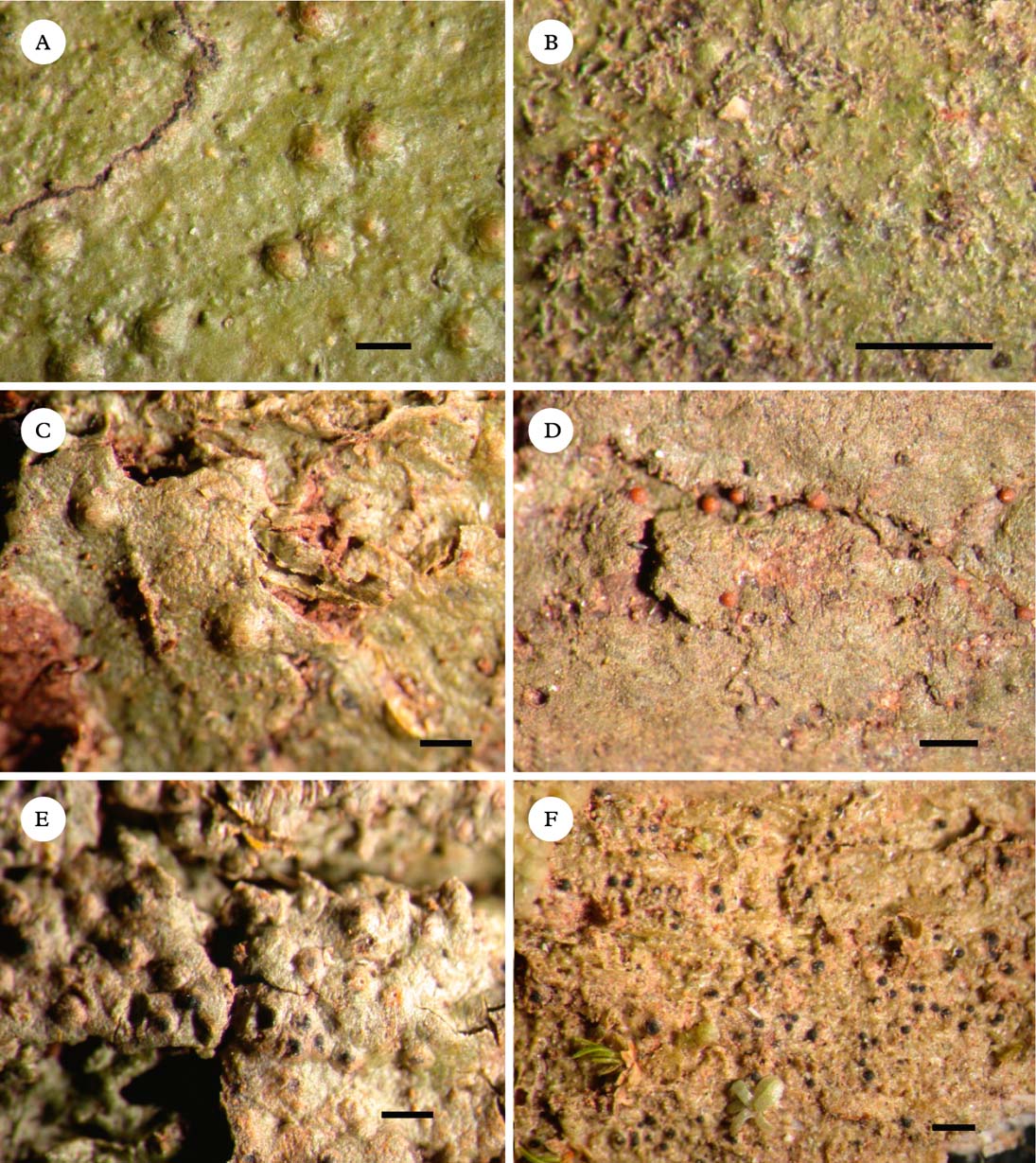
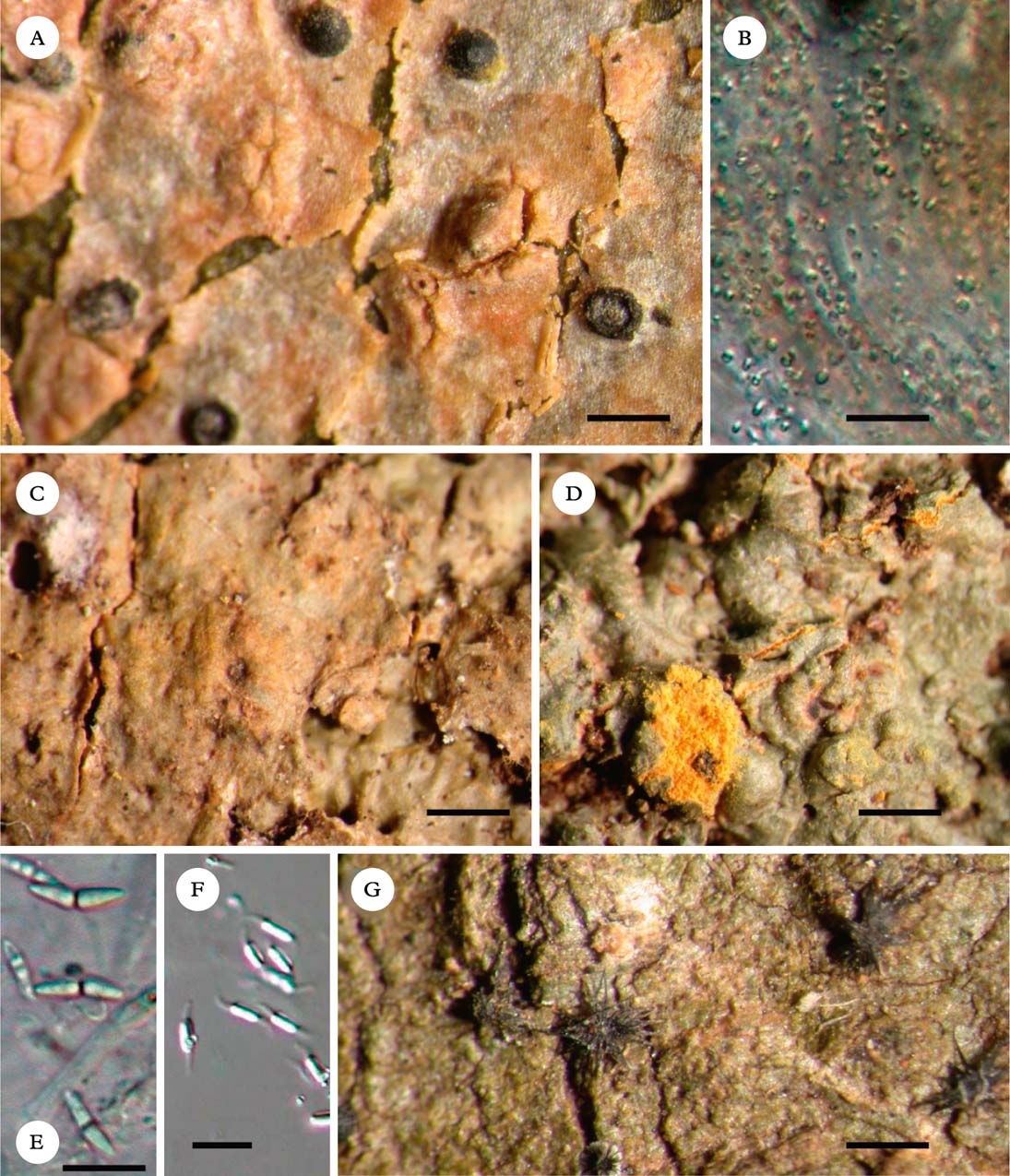
A, Agonimia tristicula (11517), thallus with ascomata, B, Aspidothelium glabrum (11932), section through ascoma; C, Celothelium dominicanum (11898), thallus with ascomata; D, Endocarpon pallidulum (11741), thallus with ascomata; E, Flakea papillata (11771), thallus; F, Mycoporum eschweileri (11908), thallus with ascomata. Scales: A, C, E & F=0·2 mm; B=50 µm; D=0·5 mm. In colour online.

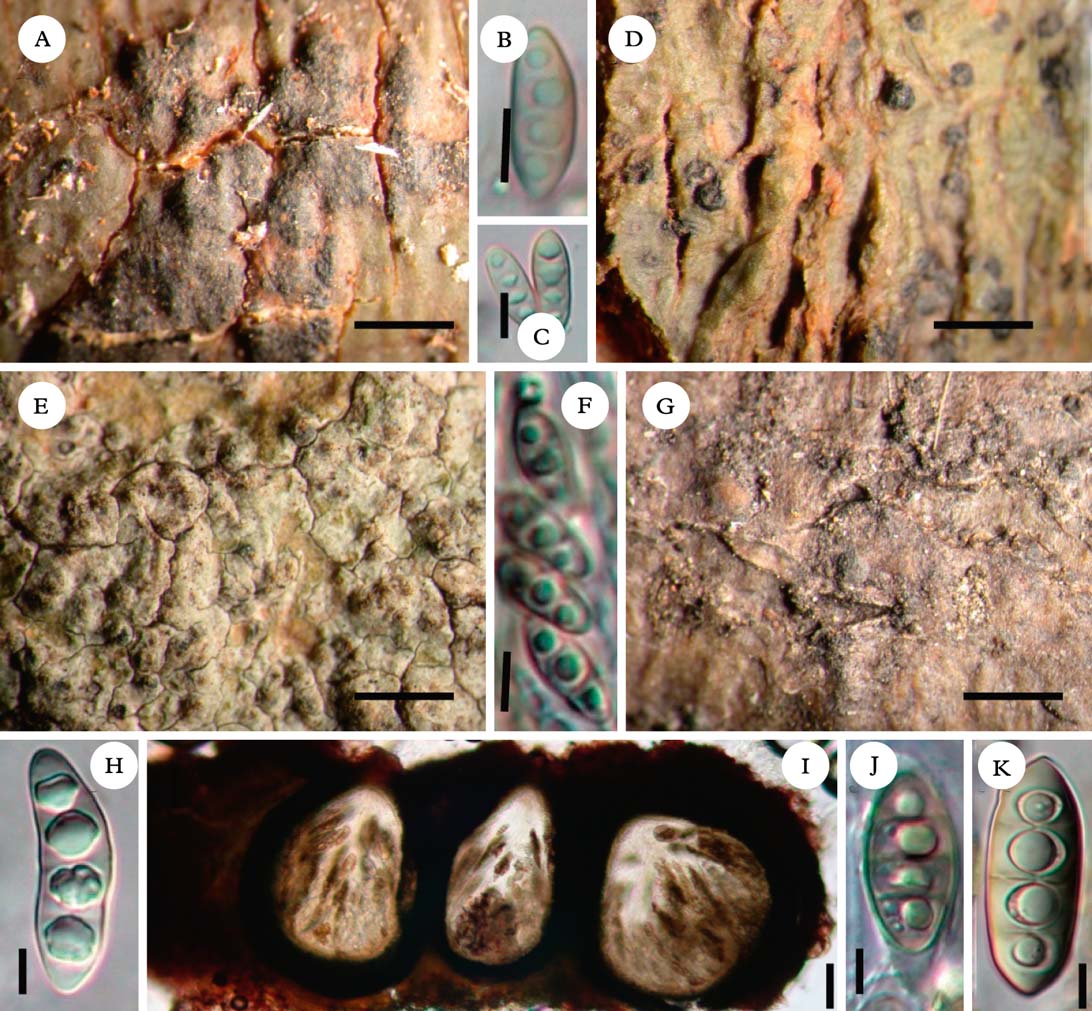
A & B, Mycomicrothelia oleosa (11967); A, thallus with ascomata; B, inspersed hamathecium. C, Myeloconis guianensis (11612), thallus with ascomata. D, Myeloconis sp. (11739), thallus with soredia. E & F, Strigula nitidula (11690); E, fracturing ascospores; F, conidia with gelatinous appendages. G, Trichothelium horridulum (11404), thallus with ascomata with spikes. Scales: A, C, D & G=0·5 mm; B, E & F=10 µm. In colour online.
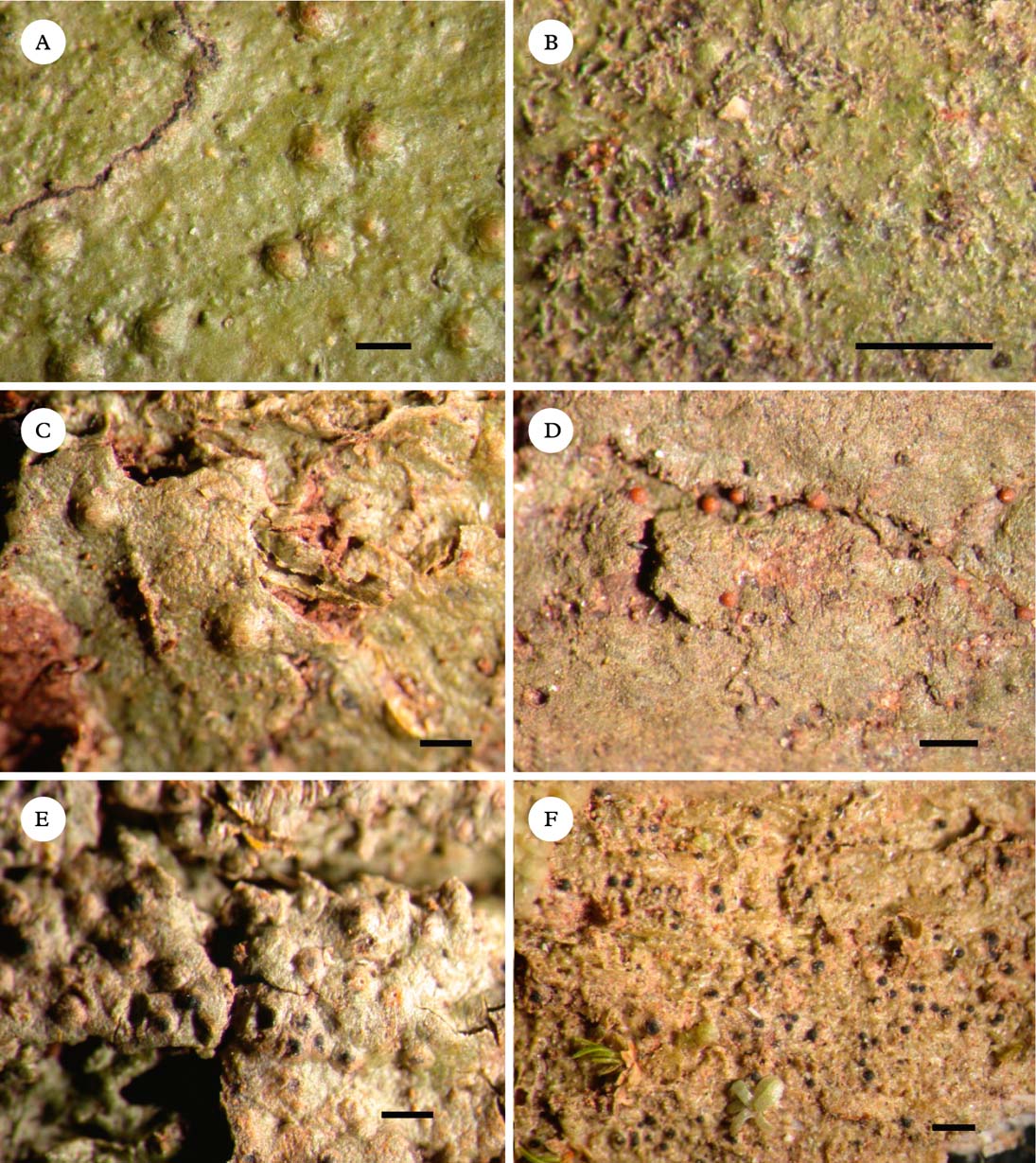
A, Porina africana (11532), thallus with ascomata. B, Porina distans (11176), thallus with ascomata. C, Porina dolichophora (11900), thallus with ascomata. D, Porina leptalea (11636), thallus with ascomata. E, Porina mastoidea (11965), thallus with ascomata. F, Porina tetralocularis (11528), thallus with ascomata. Scales: A–F=0·5 mm. In colour online.
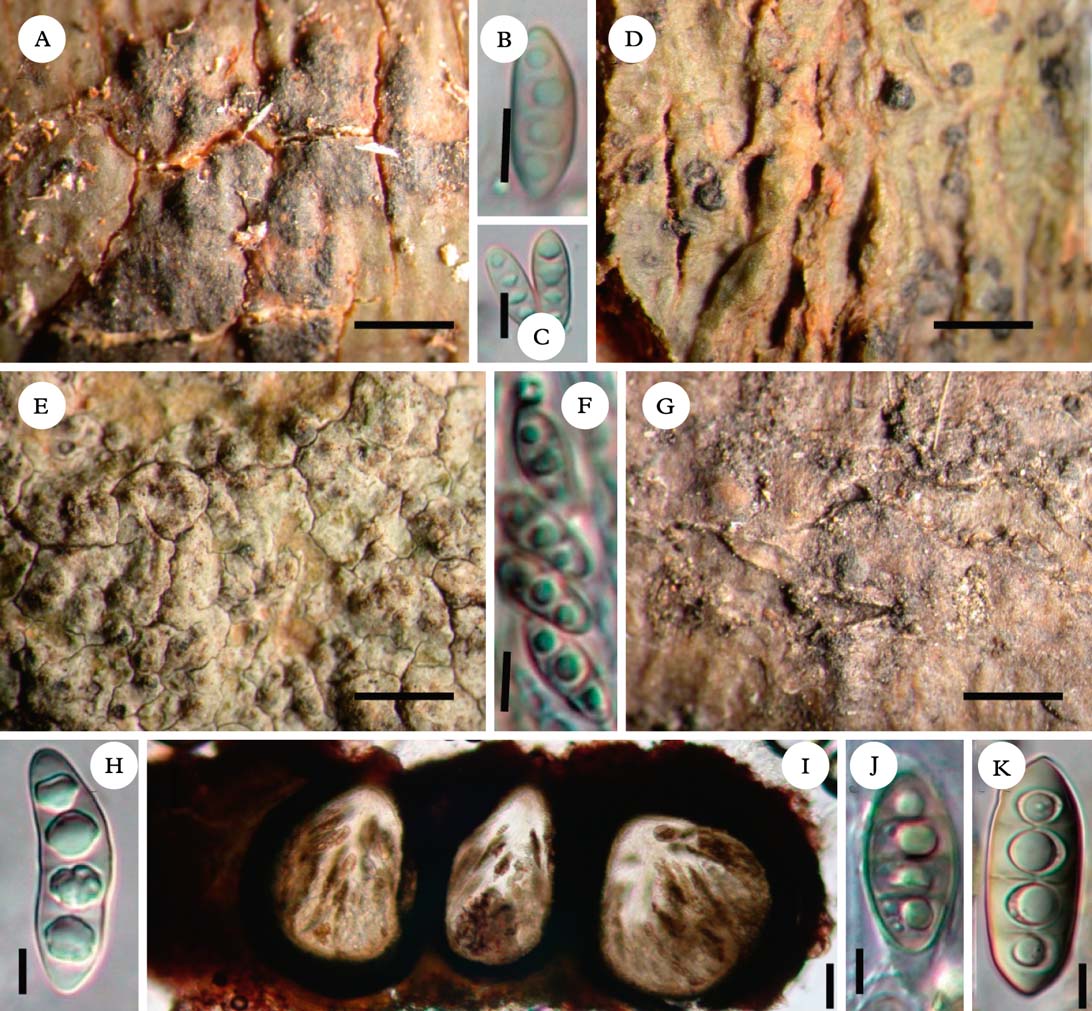
A & B, Pyrenula arthoniotheca; A, thallus with ascomata (11219); B, ascospore (11877). C & D, Pyrenula aspistea; C, ascospore (11618); D, thallus with ascomata (11263). E, Pyrenula confinis (11466), thallus with ascomata. F, Pyrenula lineatostroma (15117), ascospores. G, Pyrenula minor (11505), thallus with ascomata. H, Pyrenula micheneri (15496), ascospore. I & J Pyrenula sanguinea (15707). I, section through compound ascomata; J, ascospore with gelatinous appendages. K, Pyrenula subducta (15359), ascospore. Scales: A, D, E & G=1 mm; B, C, F, H, J & K=5 µm; I=40 µm. In colour online.
Foliicolous pyrenocarpous lichens
Foliicolous species were only collected extensively in the Parque Natural (mostly with collection number 11187 or 11419, with letters as extensions for the split-offs). The following species were identified in this material. For details about morphology and nomenclature, see Lücking (Reference Lücking2008). Some of the species were also collected at Sítio Ecológico Buriti, Cuniã and/or São Francisco. In Buriti, many foliicolous species were also found on the smooth surface of old painted planking of a bridge. Anisomeridium foliicola R. Sant. & Tibell, A. musaesporoides Etayo & Lücking, Aspidothelium geminiparum (Malem) R. Sant., A. trichothelioides Sérus. & Vězda, Caprettia amazonensis Bat. & H. Maia, Lyromma confusum Lücking & Sérus., L. ornatum Lücking, Kalb & Sérus., Microtheliopsis uleana Müll. Arg., Phylloblastia amazonica Kalb & Vězda, Porina africana Müll. Arg., P. alba (R. Sant.) Lücking*, P. epiphylla (Fée) Fée, P. fusca Lücking, P. guianensis Lücking & Vězda, P. imitatrix Müll. Arg., P. kamerunensis, P. karnatakensis Makhija et al., P. leptospermoides Müll. Arg., P. lucida R. Sant., P. mastoidea (Ach.) Müll. Arg.!, P. pilifera Neuwirth, P. pseudapplanata Lücking & M. Cáceres, P. rubentior (Stirt.) Müll. Arg.*, P. rubrosphaera R. Sant.*, P. subinterstes (Nyl.) Müll. Arg.!, Strigula janeirensis (Müll. Arg.) Lücking, S. macrocarpa Vain., S. melanobapha (Kremp.) R. Sant., S. nemathora Mont., S. phyllogena (Müll. Arg.) R. C. Harris, S. platypoda (Müll. Arg.) R. C. Harris, S. smaragdula Fr., S. subelegans Vain., Trichothelium argenteum Lücking & Ferraro, T. bipindense F. Schill.*, T. epiphyllum Müll. Arg., T. minutum (Lücking) Lücking, T. pallescens (Müll. Arg.) F. Schill., T. sipmanii Lücking var. sipmanii* and T. ulei (P. Henn.) Höhnel. These include some of the few lichen species that were previously reported from Rondônia, marked with (*) (Lücking 2008). Species that were also found corticolous are marked with (!).
The CNPq (Conselho Nacional de Desenvolvimento Científico e Tecnológico) is thanked for a research grant to MESC (Processo 501633/2009-0). The costs of the collecting expeditions to MESC were financed by CNPq (CNPq-Simbiota Processo 563342/2010-2). Elton Bill Souza and Allyne Christina Gomes Silva are thanked for logistical support and for organizing the collecting trips. We are grateful to Leo Spier for performing thin-layer chromatography.