


Introduction
The arrival of Europeans had a major impact on the health of Indigenous peoples worldwide. In Australia, colonisation and racism have led to the marginalisation of Indigenous Australians and resulted in significant inequalities in comparison to the dominant non-Indigenous group (MacKean et al., Reference Mackean, Fisher, Friel and Baum2019). The combination of introduced diseases and poor environmental, political and socio-economic factors led to the current health disadvantage faced by Indigenous Australians (Phillips, Reference Phillips2004). The Australian Government acknowledges the gap between Indigenous Australians and other Australians in life expectancy, child mortality, educational achievement and employment (Australia Co., 2009). Closing the Gap Refresh acknowledges that while there have been some improvements over the last couple of decades, improving health and socio-economic statistics in Indigenous Australians remains a challenge. Closing the Gap Refresh seeks to address shortfalls by revising the original strategies to include a whole of government agenda working in partnership with Aboriginal and Torres Strait Islander people (Rigby et al., Reference Rigby, Duffy, Manners, Latham, Lyons, Crawford and Eldridge2011; DPMC, 2019).
Previous studies have shown that socio-economic determinants as well as limited accessibility/acceptability of health services influence the health of Indigenous populations (Dade Smith, Reference Dade Smith2007). Of main concern is the under-use of existing health services and/or compliance with interventions (Gruen et al., Reference Gruen, Bailie, d'Abbs, O'Rourke, O'Brien and Verma2001). These practices are attributable in part to historical mistrust of authority by Indigenous people (Turale and Miller, Reference Turale and Miller2006) and to the lack of culturally appropriate healthcare practices (Dade Smith, Reference Dade Smith2007; Taylor and Guerin, Reference Taylor and Guerin2010). Without sufficient knowledge about the client's cultural background, healthcare workers may use their own cultural beliefs as a reference for the assessment and delivery of services, and thus may misunderstand a client's appropriate cultural response (Valencia, Reference Valencia1992; Kreuter et al., Reference Kreuter, Lukwago, Bucholtz, Clark and Sanders-Thompson2003). This type of bias constitutes an issue for any cultural minority group in a healthcare or health education setting. Healthcare practitioners frequently reported feeling poorly prepared to deal with cultural minority groups (Gerrish and Papadopoulos, Reference Gerrish and Papadopoulos1999; Johnstone and Kanitsaki, Reference Johnstone and Kanitsaki2007) which can impact on the efficacy of work with these groups (Gerrish and Papadopoulos, Reference Gerrish and Papadopoulos1999; Hughes and Hood, Reference Hughes and Hood2007; Lipson and Desantis, Reference Lipson and Desantis2007; Williamson and Harrison, Reference Williamson and Harrison2010; Brown et al., Reference Brown, Middleton, Fereday and Pincombe2016). A wide range of terms have been employed in discussions of around training to work appropriately with cultural minorities including cultural competence, cultural relevance and cultural safety (Beagan, Reference Beagan2015).
Students must have a clear understanding of culture and the meaning associated with this concept (Jungersen, Reference Jungersen1992). Culture refers to shared ideas, values and beliefs within a particular group (Hammell, Reference Hammell2009). Although culture is often reduced to a narrow focus on ethnicity, it is also informed by gender and class (Beagan, Reference Beagan2015). Teaching students ‘cultural competency’ has been put forward as a way of achieving this cultural understanding (Pope-Davis et al., Reference Pope-Davis, Prieto, Whitaker and Pope-Davis1993). According to Fitzgerald et al. (Reference Fitzgerald, Mullavey-O'Byrne and Clemson1997), a culturally competent therapist has an awareness of and sensitivity to the meaning of culture and related issues. Even though cultural safety is similar to cultural competency; in that they both focus on knowledge development and self-reflection, ‘cultural competence’ does not place emphasis on a socio-political analysis.
Cultural safety values the cultural knowledge and experience of the Indigenous client and recognises the impact of colonisation and the resulting manifestations of power inequalities and racism (Mackean et al., Reference Mackean, Fisher, Friel and Baum2019). This socio-political and historical understanding is necessary to help students understand the issues faced by Indigenous groups, particularly the negative impact of racism (both individual and institutional) on health status, and the inherent power imbalance between a health provider and their client which can lead to treatment that does not respect the cultural needs of the client (Gerlach, Reference Gerlach2012; Beagan, Reference Beagan2015). The development of culturally safe attitudes in health professionals is crucial to safe and effective practice (Ramsden, Reference Ramsden1992). Thus, the focus of this research was on the teaching of cultural safety.
According to Durey (Reference Durey2010, pp. S87–S92), ‘racism is a fundamental social determinant of health’. Thus, cultural safety is more than just the accumulation of knowledge and skill about other cultures and sensitivity to others; it requires an attitudinal shift towards anti-racism (Ramsden, Reference Ramsden1992). Anti-racism requires people to be able to work with those who have less power in society in order to elucidate and contest assumptions and inequalities (Australian Human Rights Commission, 2019). The journey to become culturally safe requires growth and maturity through ongoing personal reflection around assumptions about Indigenous people and their position of power in the healthcare relationship (Forwell et al., Reference Forwell, Whiteford and Dyck2001). Through learning about their own culture, health care students can gain an understanding of their own position of power and also understand that cultural identity is meaningful and unique for all people (Mackean et al., Reference Mackean, Fisher, Friel and Baum2019). A culturally safe therapeutic relationship can help address the power imbalance between a non-Indigenous health professional and Indigenous client (Gray and McPherson, Reference Gray and McPherson2005). Furthermore, cultural safety also has a broader utility, in that the development of open-mindedness and understanding of power relationships that come with the focus on Indigenous groups serve to enable the health professional to work safely with all other groups that are culturally different to themselves (Gray and McPherson, Reference Gray and McPherson2005). Although this paper will prioritise the focus on cultural safety, it draws upon other relevant literature including that dealing with cultural competence.
A 2005 study undertaken on new graduate occupational therapists across New Zealand and Australia revealed that graduates did not feel competent about the aspects of culture in relation to a person's wellbeing (Gray and McPherson, Reference Gray and McPherson2005). This lack of confidence may reduce the quality of services that are appropriate and meaningful to clients and decrease the likelihood of the clients to be motivated to accomplish treatment goals (Dillard et al., Reference Dillard, Andonian, Flores, Lai, MacRae and Shakir1992; Pope-Davis et al., Reference Pope-Davis, Prieto, Whitaker and Pope-Davis1993; Gray and McPherson, Reference Gray and McPherson2005). The training of health practitioners who can provide culturally safe health delivery has implications for health education and training (Forwell et al., Reference Forwell, Whiteford and Dyck2001; Stedman and Thomas, Reference Stedman and Thomas2001; Gray and McPherson, Reference Gray and McPherson2005; Rasmussen et al., Reference Rasmussen, Lloyd and Wielandt2005; Nash et al., Reference Nash, Meiklejohn and Sacre2006; Nelson et al., Reference Nelson, Gray, Jensen, Thomas, McIntosh, Oke and Paluch2011; Carey, Reference Carey2015). In order to develop culturally safe professionals, there must be a culturally safe education (Bennett and Salonen, Reference Bennett and Salonen2007; Sanner and McAllister, Reference Sanner and McAllister2010).
Liaw et al. (Reference Liaw, Hasan, Wade, Canalese, Kelaher, Lau and Harris2015) highlight that the knowledge of Indigenous history among the medical profession needs improvement. Yet it has been commonly reported that students do not understand the need to focus on Indigenous issues, which highlights the need for the socio-political focus and education about the special place of Indigenous people within their own country of origin (Gray and McPherson, Reference Gray and McPherson2005; Nash et al., Reference Nash, Meiklejohn and Sacre2006). Although the actual wording may differ across disciplines, the teaching of cultural safety concepts and/or the development of cultural competence has been mandated by most health care professional bodies in Australia. For universities, this responsibility is governed through the programme accreditation processes. The Australian Health Practitioner Regulation Agency regulates health practitioners and associated university programmes in partnership with National Boards (who produce the competency standards) to ensure that required curriculum standards are met, including training for culturally safe practice (AHPRA, 2019).
Becoming a culturally safe practitioner begins through an appropriate curriculum which introduces the political and historical context which has led to the health status of Indigenous Australians (Nash et al., Reference Nash, Meiklejohn and Sacre2006). There are two approaches mooted with regards to the presentation of Indigenous content and cultural safety in a curriculum. Firstly, the ‘integration’ or ‘embedding’ of Indigenous Australian themes throughout (Phillips, Reference Phillips2004; Nash et al., Reference Nash, Meiklejohn and Sacre2006), versus a stand-alone block or workshop, which incorporates all themes at one time (Forwell et al., Reference Forwell, Whiteford and Dyck2001).
It has been highlighted that the most effective means of providing cultural safety education is through ‘embedding’ into existing curricula, as this serves to continually reinforce cultural knowledge (Forwell et al., Reference Forwell, Whiteford and Dyck2001; Nash et al., Reference Nash, Meiklejohn and Sacre2006). However, ‘workshop’ style block courses may be beneficial in ensuring that relevant knowledge does not become ‘lost within an overcrowded’ curriculum (Forwell et al., Reference Forwell, Whiteford and Dyck2001, pp. 90–103). All studies found that students who took part in cultural safety curricula, whether embedded or block, increased self-rated competence skills (Nash et al., Reference Nash, Meiklejohn and Sacre2006; Forwell et al., Reference Forwell, Whiteford and Dyck2001; Pope-Davis et al., Reference Pope-Davis, Prieto, Whitaker and Pope-Davis1993; Rasmussen et al., Reference Rasmussen, Lloyd and Wielandt2005; Trentham et al., Reference Trentham, Cockburn, Cameron and Iwama2007).
Although cultural inclusions into the curriculum are now widespread, Gallagher and Polanin (Reference Gallagher and Polanin2015) reviewed 25 studies of educational cultural competence interventions and concluded that these interventions varied in their effectiveness. Some studies show that students demonstrate enhanced cultural awareness, an appreciation of difference and similarities across cultures, and increased personal and professional growth (Bittle et al., Reference Bittle, Duggleby and Ellison2002; Neander and Markle, Reference Neander and Markle2005; Kruske et al., Reference Kruske, Kildea and Barclay2006; Hamner et al., Reference Hamner, Wilder and Byrd2007; Hunt and Swiggum, Reference Hunt and Swiggum2007; Casey and Murphy, Reference Casey and Murphy2008; Hutnik and Gregory, Reference Hutnik and Gregory2008). Other studies have demonstrated that training was successful in improving learners' cultural awareness, sensitivity, knowledge and self-rated cultural competence skills (Dogra, Reference Dogra2001; Forwell et al., Reference Forwell, Whiteford and Dyck2001; Beach et al., Reference Beach, Price, Gary, Robinson, Gozu, Palacio, Smarth, Jenckes, Feuerstein, Bass, Powe and Cooper2005; Carter et al., Reference Carter, Lewis, Sbrocco, Tanenbaum, Oswald, Sykora, Williams and Hill2006; Nash et al., Reference Nash, Meiklejohn and Sacre2006; Trentham et al., Reference Trentham, Cockburn, Cameron and Iwama2007). However, many studies undertaken have been qualitative in method and there is no broad quantitative evidence that supports cultural safety training as a strategy for improving cultural competence in allied health students. This current study utilised a mixed methodology but reports on the quantitative aspect only.
Curriculum development
The National Aboriginal and Torres Strait Islander Health Workforce Strategic Framework 2016–2023 identifies the inclusion of ‘training to build a culturally safe and responsive workforce’ as a priority to help close the gap of Indigenous disadvantage (ATSIHWWG, 2016, p. 2). A landmark document in the movement towards the changes to health policy, including the inclusion of specific aspects of Indigenous Australian content was the 1989 National Aboriginal Health Strategy (National Aboriginal Health Strategy Working Party, 1989). The principles incorporated in this document are still relevant today (National Aboriginal Health and Torres Strait Islander Health Council, 2003). Recommendations for course design within this document included the inclusion of content about Indigenous Australian culture, history and current issues; involvement of Indigenous Australian people in the delivery of such content; and the engagement of academic staff in Indigenous Australian orientation and cross-cultural awareness programmes (National Aboriginal Health Strategy Working Party, 1989).
Evolving from discussions between academic occupational therapy staff and academic Indigenous Australian staff at a regional Australian university (including the authors of this paper), a workshop format was developed to fit into the 1st and 4th year curriculum for various allied health disciplines. A workshop approach was chosen as it did not require changing an entire curriculum. The 1st year workshop ran for one full day and the 4th year workshop one full day.
Durey (Reference Durey2010) highlighted that in order to provide effective cultural safety education for undergraduate students, there must be consultation and partnerships between academics, health services and Indigenous Australian communities. Both Indigenous Australian academics, Elders and community members, and non-Indigenous academics collaborated on the development and delivery of these workshops. Workshops utilised a variety of teaching methods that enabled students to engage with, and experience, Indigenous Australian content and reflect on their own perceptions of working with Indigenous Australian people (e.g. self-reflection activities, Indigenous Australian History, conversations with Elders, education on culturally safe communication).
In some cases, the workshops were one of the few times the mainly non-Indigenous students had interacted with Indigenous Australian people. The learning that comes from such an ‘immersion’ experience cannot be gained from a contrived classroom situation. All teaching staff members undertook a pre-workshop training session, in which they were provided more detailed information about key messages and ways of responding to difficult situations. For example, teaching staff members were taught ways to de-escalate situations when students become upset or angry. Post-workshop debrief sessions were held for teaching staff, to allow for the ‘venting’ of concerns.
Although the 1st and 4th year workshops had similar activities, the focus was different. For 1st year students, the focus was for them to begin to think critically about issues and to explore their own values, e.g. ‘Privilege Walk Activity’, which allows students to explore and discuss the aspects of privilege they enjoy and compare that to others (University of Houston, 2019). For 4th years, the culturally safe communication and professional practice learning component was foremost and was an important contribution to the exploration of ethical issues related to practice. In this 4th year workshop, culturally safe practice is discussed in relation to the ethical principles of justice, autonomy, and maleficence and non-maleficence. Students examined previous experiences of working with Indigenous Australian clients within health services and reviewed the responsibilities of professionals to ensure culturally safe practice.
The 4th year workshops also entailed professional ‘interviewing’ experiences with Indigenous Australian Elders and other community members. After the interviews, the students received feedback from the interviewees about their style and were provided with pointers to enhance communication. This component was designed as an immersion technique. Although limited in time and undertaken in an ‘artificial setting’, this process provided a ‘safe space’ for students to interact with an Indigenous Australian person. Caffrey et al. (Reference Caffrey, Neander, Markle and Stewart2005) found moderate to large gains (positively correlated with the time immersed in experience) in student self-perceived knowledge and comfort after an immersion experience.
Workshops were run and evaluated in order to provide information on the efficacy of this curriculum component and the best methods of teaching it. This information could then be utilised in the extension or embedding of cultural safety through the curriculum. The literature review of studies that have evaluated cultural safety curriculum indicated that a mixed-methods research approach was best to appropriately assess the impact of cross-cultural content (Betancourt, Reference Betancourt, Green, Carrillo and Ananeh-Firepong2003). Only minor changes (based on staff and student feedback) were made to the workshops over the 5-year period, making it viable to combine the evaluation results. The aim of this project was to explore the self-perceived knowledge and attitudinal changes of allied health students who attended the cultural safety education workshops at different stages of their education. It was postulated that attending the workshop would increase self-rated cultural safety knowledge and attitudes.
Methods
This project employed a quantitative before-and-after design. Surveys (pre and post) were devised to determine the level of attitudinal change experienced by the various student cohorts through attending the two 1-day workshops (beginning of 1st year and end of 4th year). Qualitative data were also gained via provision on the survey for open-ended responses and a reflective activity. This paper only reports on the quantitative evaluation method and results. This research was approved by the Human Research Ethics Committee of the investigated regional university prior to participant recruitment (approval number #H2743). Informed consent was obtained from all participants at the beginning of each workshop.
Participants
The target group consisted of all allied health students at a regional Australian University over the years 2007–2011 who had participated in the cultural safety workshops in either their 1st year at university or 4th year at university. Workshops were undertaken as part of the normal curriculum offering. Those students attending 1st year workshops represented several different disciplines including occupational therapy, physiotherapy, speech pathology and diploma of health. The response rate was 347 from 382 1st year students over the 5 years (90.8%). Only occupational therapy students attended the 4th year workshops. The response rate was 159 from 198 4th year occupational therapy students over the 5 years (80.3%).
Data collection
The pre- and post-evaluation method used in this study was informed by other studies, which utilised similar methods such as attitudinal self-report surveys to evaluate cultural competency. In these studies, surveys were generally specifically designed for the programmes offered (Cheung, Shah and Muncer, Reference Cheung, Shah and Muncer2002; Neander and Markle, Reference Neander and Markle2005; Carter et al., Reference Carter, Lewis, Sbrocco, Tanenbaum, Oswald, Sykora, Williams and Hill2006; Hutnik and Gregory, Reference Hutnik and Gregory2008; Chapman et al., Reference Chapman, Martin and Smith2014). As was undertaken by Cheung et al. (Reference Cheung, Shah and Muncer2002), the evaluation focused on the specific goals of each workshop, rather than using more generic attitudinal change instruments or previously utilised surveys.
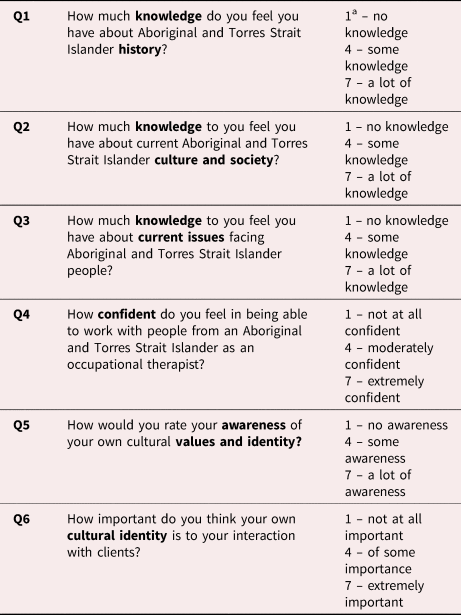
Participants were asked to complete a pre-survey at the start of the workshop. These were collected by staff prior to the students continuing with the day's activities. The identical post-workshop surveys (and the reflective diary sheets for 1st years' only) were then provided and the students asked to keep this with them to be collected at the end of the day. Answers between the two instruments were compared. Likert scales (from 1 to 7) were used to assess the participants' self-perceived knowledge and attitudinal changes directly in relation to specific workshop content (see Table 1).
Survey questions compared pre and post

a Likert scale 1–7 included in the survey.
The pre-survey was also used to gather participant demographic information such as age group; where they spent most of their childhood; if they were of Aboriginal or Torres Strait Islander background; and if they had previously lived or worked with people from an Aboriginal and Torres Strait Islander background. Inclusion of this information helped to identify any potential bias in the survey results.
Data analysis
To reduce the chances of obtaining false-positive results (type I errors), since multiple pairwise tests were performed on a single set of data, the Bonferroni correction was used (Bonferroni, Reference Bonferroni1936). Because six outcome measures were tested against one hypothesised predictor in first and fourth years, a Bonferroni-adjusted significance level of 0.0042 was calculated to account for the increased possibility of type-I error. Accordingly, the authors used the Bonferroni correction to adjust the p value for each hypothesis to 0.0042 to neutralise this risk. In this study, the participants served as their own control. The Statistical Package for Social Sciences (SPSS), Version 13 was used for data analyses. Normally distributed data were expressed as mean ± standard deviation.
Results
Participant characteristics
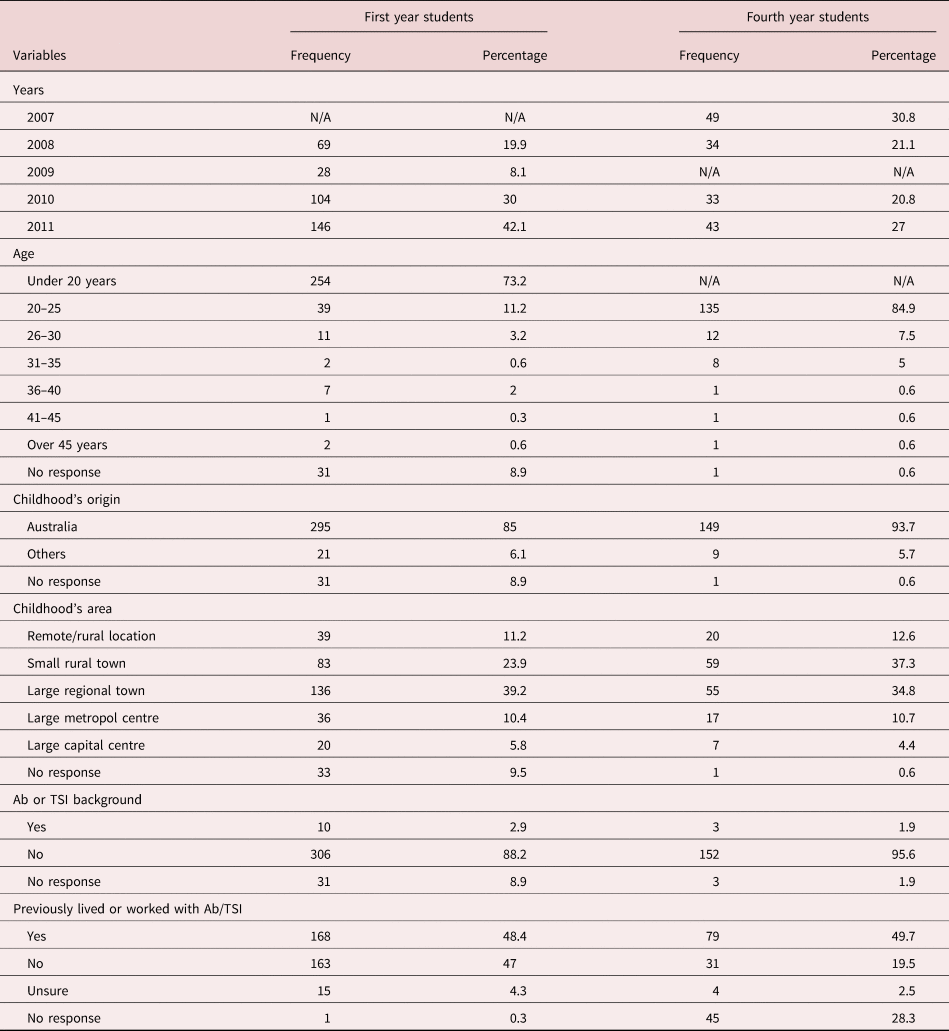
Table 2 shows that most 1st year participants (73.2%) were under 20 years old, whereas most 4th year participants (84.9%) were between 20 and 25 years old. Most of the participants grew up in Australia (85% 1st year participants and 93.7% 4th year participants) in a small or large regional town (23.9% and 39.2% 1st year participants and 37.3% and 34.8% 4th year participants, respectively). Only a small number of participants were of Indigenous Australian background (2.9% 1st year participants and 1.9% 4th year participants). Almost 50% of the 1st year and 4th year participants had previously lived or worked with people from an Indigenous Australian background. It was expected that many of the 4th year students would have experience working with people from an Indigenous Australian background during fieldwork; however, the high percentage of 1st year students who had experience working with Indigenous people was unexpected. Results indicated that some 1st year students considered going to school with Indigenous Australian people were synonymous with working with them.
Characteristics of the student participating in this study

Metropol, metropolitan; Ab, Aboriginal; TSI, Torres Strait Islander Background.
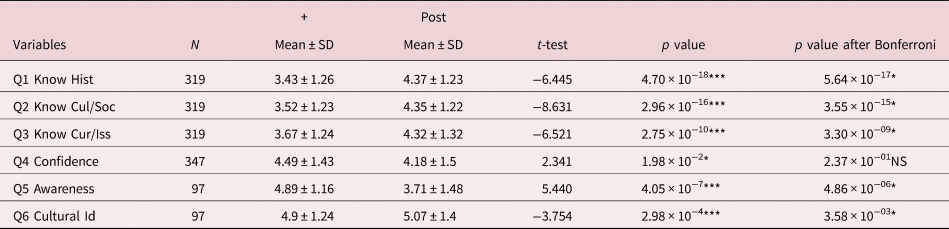
Table 3 shows that attending the workshop increased some of the targeted variables in 1st year students. After attending the workshop, 1st year students perceived they had more knowledge about Indigenous Australian history (t(318) = −6.445, p < 0.0042); culture and society (t(318) = −8.631, p < 0.0042); and current issues (t(318) = −6.521, p < 0.0042). The results also showed that participants perceived their own cultural identity in relation to successful interactions with clients as something more important after (5.07) than before (4.9) the workshop (t(96) = −3.754, p < 0.0042). However, results showed that 1st year students rated their awareness of their own cultural values and identity lower after (3.71) than before (4.89) the workshop (t(96) = 5.440, p < 0.0042). After the Bonferroni correction, statistical analyses did not show a significant difference in confidence scores in being able to work with people from an Indigenous Australian background (t(346) = −2.341, NS). Controlling for age, geographical background and having previously worked or lived with Indigenous Australian people, results showed that none of these variables impacted on the significance of the previous findings.
T-test conducted of comparison between pre- and post-workshop scores on variables (attitudinal change experienced) for 1st year students

Know Hist, student perceptions about their knowledge about Indigenous Australian history; Know Cul/Soc, student perceptions about their knowledge about Indigenous Australian culture and society; Know Cur/Iss, student perceptions about their knowledge about current issues facing Indigenous Australian; Confidence, student feelings of confidence to work with Indigenous Australians; Awareness, student awareness of their own cultural values and identity; Cultural Id, student rating of importance of their own cultural identity in relation to interactions with clients.
After Bonferroni correction *means p < 0.0042.
***high significance
**medium significance
*low significance
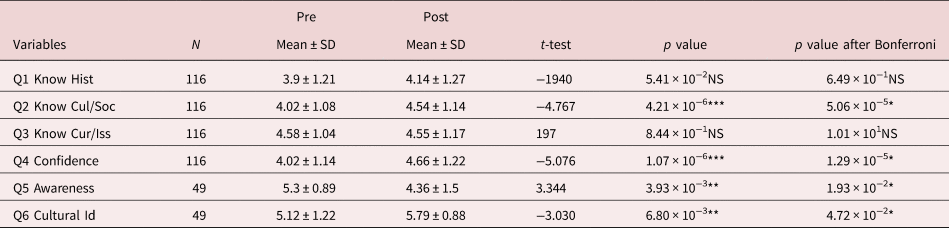
Table 4 shows that the workshop increased some of the targeted variables in 4th year students. Results showed that scores on knowledge about Indigenous Australian culture and society were higher after (4.52) than before (3.97) the workshop (t(158) = −4.767, p < 0.0042). However, the results showed that attending the workshop did not increase either knowledge about Indigenous Australian history (t(158) = −1.940, NS), nor knowledge about current Indigenous Australian current issues (t(158) = 0.197, NS). Statistical analyses revealed that the confidence scores in being able to work with people from an Indigenous Australian background were higher after (4.52) than before (4) the workshop (t(158) = −5.076, p < 0.0042). Results showed that 4th year students perceived their own cultural identity in relation to successful interactions with clients as being more important after (5.79) than before (5.12) the workshop (t(48) = −3.030, p < 0.0042). However, statistical analyses showed that participants rated their awareness of their own cultural values and identity lower after (4.36) than before (5.3) the workshop (t(48) = 3.344, p < 0.0042). Controlling for age, geographical background and having previously worked or lived with Indigenous Australians, results showed that these variables did not impact on the significance of the previous findings.
T-test conducted of comparison between pre- and post-workshop scores on variables (attitudinal change experienced) for 4th year students

Know Hist, student perceptions about their knowledge about Indigenous Australian history; Know Cul/Soc, student perceptions about their knowledge about Indigenous Australian culture and society; Know Cur/Iss, student perceptions about their knowledge about current issues facing Indigenous Australian; Confidence, student feelings of confidence to work with Indigenous Australians; Awareness, student awareness of their own cultural values and identity; Cultural Id, student rating of importance of their own cultural identity in relation to interactions with clients.
After Bonferroni correction *means p < 0.0042.
***high significance
**medium significance
*low significance
Discussion
The aim of this project was to explore the self-perceived knowledge and attitudinal changes of 1st and 4th year allied health students who attended a cultural safety education workshop. The workshops were well attended and resulted in self-perceived changes over the majority of targeted knowledge and attitudinal items. However, importantly, the findings showed that the significance and direction of those changes were different depending on the item and year cohort. For 1st year students, there was an increase in perceived knowledge about Indigenous Australian history, culture and society, and current issues. These results are important as cultural knowledge is one of four levels of development necessary for achieving cultural competence (Papadopoulos, Reference Papadopoulos2006).
Findings from this study also showed that 1st year students had a significant increase in perceptions of the importance of their own cultural identity in interactions with clients. However, results showed that the workshop significantly decreased these students' awareness of their own cultural values and identity, indicating perhaps that, through this education, students discovered their own level of ‘cultural blindness’ (where they were unaware of their cultural difference previous to the workshops) (Steed, Reference Steed2010). In line with this negative change in awareness of their own values and identity, there was also no increase in their confidence in being able to work with Indigenous Australian people.
Regardless, these negative findings could be construed as a positive outcome. For example, a self-evaluation by primary physicians after attending cultural competence course on diabetes care found an increased appreciation of their own lack of knowledge and a lowering of confidence in cultural abilities (Kutob et al., Reference Kutob, Bormanis, Crago, Harris, Senf and Shisslak2013). Isaacson (Reference Isaacson2014) found a similar downward shift in perceived cultural competency after senior nursing students experienced cultural immersion in a Native American reservation. These results subsequently raise the question whether cultural safety training needs to acknowledge the importance of the development of what is termed as cultural humility as a step in the process (Minkler and Wallerstein, Reference Minkler and Wallerstein2012). To have cultural humility, you must have openness to the meaning of diversity, be egoless and self-aware (Foronda et al., Reference Foronda, Baptiste, Reinholdt and Ousman2016). Cultural humility and cultural safety have a considerable overlap in terms of self-reflexivity, although cultural safety has more focus on seeking to empower the client in the healthcare relationship (Shepherd, Reference Shepherd2019). So perhaps, the overlap in these concepts was reflected in the findings of this current research. For example, 1st year students showed themselves to be more open and self-aware by perceiving that they had more to learn about themselves (own cultural identity and values) before they felt they were confident to practice with Indigenous Australian clients.
For the 4th year students, the pattern of results differed. The workshop only had an effect on perceived knowledge about Indigenous Australian culture and society. This finding suggests that this cohort may have already integrated some knowledge of Indigenous Australian history and current issues. For some of this 4th year cohort, they had previously completed the 1st year workshop, 3 years earlier, so may have retained some of this knowledge. Consistent with the 1st years, findings showed that 4th year students were more aware after they attended the workshop of the importance of their own cultural identity in interactions with people from different cultural backgrounds. Converse to this increased awareness about the importance of their identity in practice, 4th year students (as with 1st years) also experienced a decrease in awareness of their own cultural values and identity (likely for the same reasons as discussed previously). However, unlike 1st year students, 4th year students still felt more confident in working with Indigenous Australian people after attending the workshop. This result suggests that the immersion strategy used for the 4th year cohort was more effective in increasing student's feelings of confidence. In addition, it is likely that 4th year students generally felt more prepared to work as health professionals due to being further through their programmes than 1st years. Confidence does not necessarily equate to safety though, hence the importance of the development of cultural humility also shown in the 4th year cohort (Foronda et al., Reference Foronda, Baptiste, Reinholdt and Ousman2016).
Taking into consideration that these workshops indicate an improved cultural humility, findings suggest that, while cultural safety programmes can lead to these short-term improvements (Durey, Reference Durey2010), one-off workshops may not be sufficient for promoting ongoing knowledge and attitudinal changes required for culturally safe practice. Indeed, a recent study by Bullen and Roberts (Reference Bullen and Roberts2018) found that an entire 1st year learning unit dedicated to Indigenous Australian cultures and health only brought about small but measurable changes in students' attitudes and preparation towards working with Indigenous Australians. According to Gibbs (Reference Gibbs1984), it is difficult for a person to fully understand the value system of another culture unless he/she is brought up in, or has lived in, that culture for a long period of time. Placements which require living and working in cultural minority settings have proven effective in developing culturally safe practice, when racism and the value of cultural mentors are addressed (Gair et al., Reference Gair, Savage and Zuchowski2014). The findings of this current study suggest that to develop fully as culturally safe practitioners, students need more time immersed in another culture different than their own.
The findings have several implications for planning when and how often these educational experiences are staged within a curriculum. Gray and McPherson (Reference Gray and McPherson2005) suggest that developing culturally safe practice should begin with culturally appropriate knowledge at an undergraduate level. The findings of this current study imply that the 1st year workshop extended their knowledge of other cultures and encouraged the critical examination of their own cultural values and identity and the development of cultural humility. Therefore, an intervention, even as brief as a single day-long workshop, can be effective to achieve this starting point in the journey towards becoming culturally safe. Results indicated that the 4th year students only perceived an increase in knowledge around Indigenous Australian culture and society. Much of the ‘culture and society’ content was directly related to professional practice. Therefore, it is recommended that a focus on culturally safe practice, rather than more general knowledge in the latter years of undergraduate study, may reduce the risk of students being poorly prepared to deal with cultural minority groups.
Limitations
Several limitations in the current study should be noted. Despite using an anonymous questionnaire, there is a growing concern that self-report measures lead to socially desirable answers (Larson and Bradshaw, Reference Larson and Bradshaw2017). As such, an improvement in confidence on subjective responses may not indicate that students are truly able to apply what they have learned. Perversely, a decrease in confidence can indicate an increase in knowledge. As learners grasp how little they know about the culture, and the effect of cultural differences in clinical encounters, they have been shown to report lack of knowledge, understanding and skills in this arena (Kutob et al., Reference Kutob, Bormanis, Crago, Harris, Senf and Shisslak2013; Isaacson, Reference Isaacson2014). Validity was improved through the standardising of methods over the 5 years of the study with the principal investigator (first author) introducing the research component to students and overseeing the research aspect consistently over the years of the study. Incomplete datasets on the pre–post measures of attitudinal change also limited the statistical power of these findings. As this study used a student sample from one regional university in Australia, and a survey which was specific to the specific curriculum content of this setting, the generalisability of the findings is limited. This study comprised of one group for the pre- and post-test, with no control group, therefore the effects of potential confounding factors could not be analysed.
Nevertheless, a significant change in student perceptions was found, suggesting that these types of workshops were effective in achieving self-perceived attitudinal change in many areas. Finally, it is unknown to what effect the participants' own cultural background had on their cultural knowledge and attitudes. For example, individual participant characteristics may make them more vulnerable to socially desirable answers (Larson and Bradshaw, Reference Larson and Bradshaw2017). In addition, Meydanlioglu et al. (Reference Meydanlioglu, Arikan and Gozum2015) found that students who speak and understand another language had higher levels of cultural awareness than those who did not. Therefore, it would be important to consider the background of students when designing cultural safety programmes.
Conclusion
This study explored the self-perceived knowledge and attitudinal changes of allied health students who attended a cultural safety education workshop. Cultural safety education and competence are mandated by the majority of health professional accrediting bodies, therefore is an obligation for most Universities to meet. A key aspect of cultural safety is the development of the socio-political and historical knowledge necessary to understand the negative impact of racism on health status, and to understand the inherent power imbalance between a health provider and their client which, when not considered, can lead to inappropriate treatment. Thus, cultural safety education is an essential component in helping improve the health of Indigenous Australians. This current study showed significant self-perceived improvements in socio-political knowledge items (Indigenous Australian culture and society) and the attitudinal item of understanding the importance of your own cultural identity in interactions with clients across all cohorts and year groups.
Whilst the other results are varied in terms of achieving positive change across all of the taught knowledge and attitude items, they provide some evidence around the value of this type of curriculum intervention. An important finding was around the students becoming self-aware about their need to understand more about their own values and cultural identity, combined with the acknowledgement that their own identity was important in their interactions with clients. This form of ‘cultural humility’ is an important step to becoming a culturally safe practitioner. Thus, these cultural safety workshops were successful, even as a beginning point for students to develop further. These types of curricula interventions would be enhanced through embedding and scaffolding throughout the curricula. Findings also indicate that different content aspects should be scaffolded across the curriculum at times when the students are best prepared to learn them. For example, history, culture and current issues should be presented in the first instance, with more culturally safe clinical practice-related content presented in the later years of the curriculum.
While evidence exists that such programmes are effective in producing the desired educational outcomes, there is less evidence that investigates if these outcomes translate into better clinical practice (Carter et al., Reference Carter, Lewis, Sbrocco, Tanenbaum, Oswald, Sykora, Williams and Hill2006). Further longitudinal research, which follows up graduates in practice, would be valuable. While this research was undertaken with allied health students, recommendations are pertinent to the development of cultural safety in other health professions. Any country with Indigenous and/or minority groups could adapt this type of curriculum intervention to their own culture and history to prepare future health practitioners to meet clients' cultural needs.
Marion Gray is a Professor in the Discipline of Occupational Therapy at the University of the Sunshine Coast. She completed her OT qualifications, Research Masters (bioethics) and PhD (Public Health) at the University of Otago, NZ. Marion undertook Postdoctoral training in environmental epidemiology at the Armed Forces Institute of Pathology in Washington DC, focusing on the link between trace elements and prostate disease. Her current research interests lie in allied health education and practice, Indigenous health, inclusive sport, rural and remote health with a Pacific focus, and aged care and chronic disease management.
Yvonne Thomas is the Academic Lead for Allied Health Professions at the University of Worcester. She utilises mainly qualitative research methods to explore the lived experience and meanings of those whose occupations are limited by physical, cognitive, social, environmental or cultural factors. As a researcher, she is interested in how people's experience of wellbeing is influenced by their activities and social environment. In practice, this has led her to studies related to people who live in rural and remote settings, people who are culturally diverse and marginalised, and the diverse experience of students and health professionals in providing services that meet these needs.
Marianne Bonassi is a Staff Development officer and Allied Health Clinical Educator at Townsville Hospital and Health Service. Her undergraduate degree was in Occupational Therapy at JCU and she holds a Masters of Mental Health, Psychoanalysis and Psychotherapy from The University of Queensland. Marianne has expertise in mental health and psychotherapy, supervision and cognitive behavioural therapy. Her key research interests lie in social enterprises, first year experience in tertiary education, student retention and the mental health of rural and remote youths.
Jacinta Elston is an Aboriginal woman from Townsville in North Queensland and currently holds the position of inaugural Pro Vice-Chancellor (Indigenous) at Monash University. For nearly three decades, she has worked in higher education, primarily on Aboriginal and Torres Strait Islander health. Her research interests are centred on health systems, health workforce and Aboriginal and Torres Strait Islander health.
Geraldine Tapia's research is in the field of cognitive psychopathology. Within this approach, she is particularly interested in the cognitive and emotional factors associated with the appearance and maintenance of post-traumatic stress disorder (PTSD). More recently, Geraldine has developed an interest in the links between trauma and addiction, two disorders sharing a large comorbid terrain. Her current research projects target defined goals in two different populations. The first among students is to prevent the emergence of risky behaviour via the identification of precipitating factors. The second in a dependent population (addicts) is to develop new integrative therapeutic protocols to treat addiction.