Across the United States, 42,249 opioid-related deaths occurred in 2016 — more than 100 per day.1 Over the last decade, states have taken diverse approaches to confronting this crisis, leading to a range of policy models. While key stakeholders have outlined best practices and recommendations for states,Reference Murphy2 less attention has been paid to cataloguing and evaluating the policies currently in place.
This paper focuses on the most common state policy responses, dividing them into six broad categories. Within each category we highlight the rationale behind the group of policies within it, discuss the details and support for individual policies, and explore the research base behind them. The objective is to better understand the most prevalent state responses to the opioid crisis.
Methods
The response categories were developed through a broad survey of the literature and reports on state policy approaches. These resources included the “Road Map” published by the National Governors Association,3 reports on state policy trends,Reference Blackman4 and summaries of steps taken by individual states.Reference Penm5 After generating a comprehensive list of policies, we investigated each one to determine its use across states. Our findings include the following:
All 50 states operate prescription drug monitoring programs
All 50 states cover buprenorphine treatment under their Medicaid programs, but only 34 cover methadone
All 50 states passed naloxone access laws
41 states have syringe exchange programs
40 states passed “Good Samaritan” immunity laws
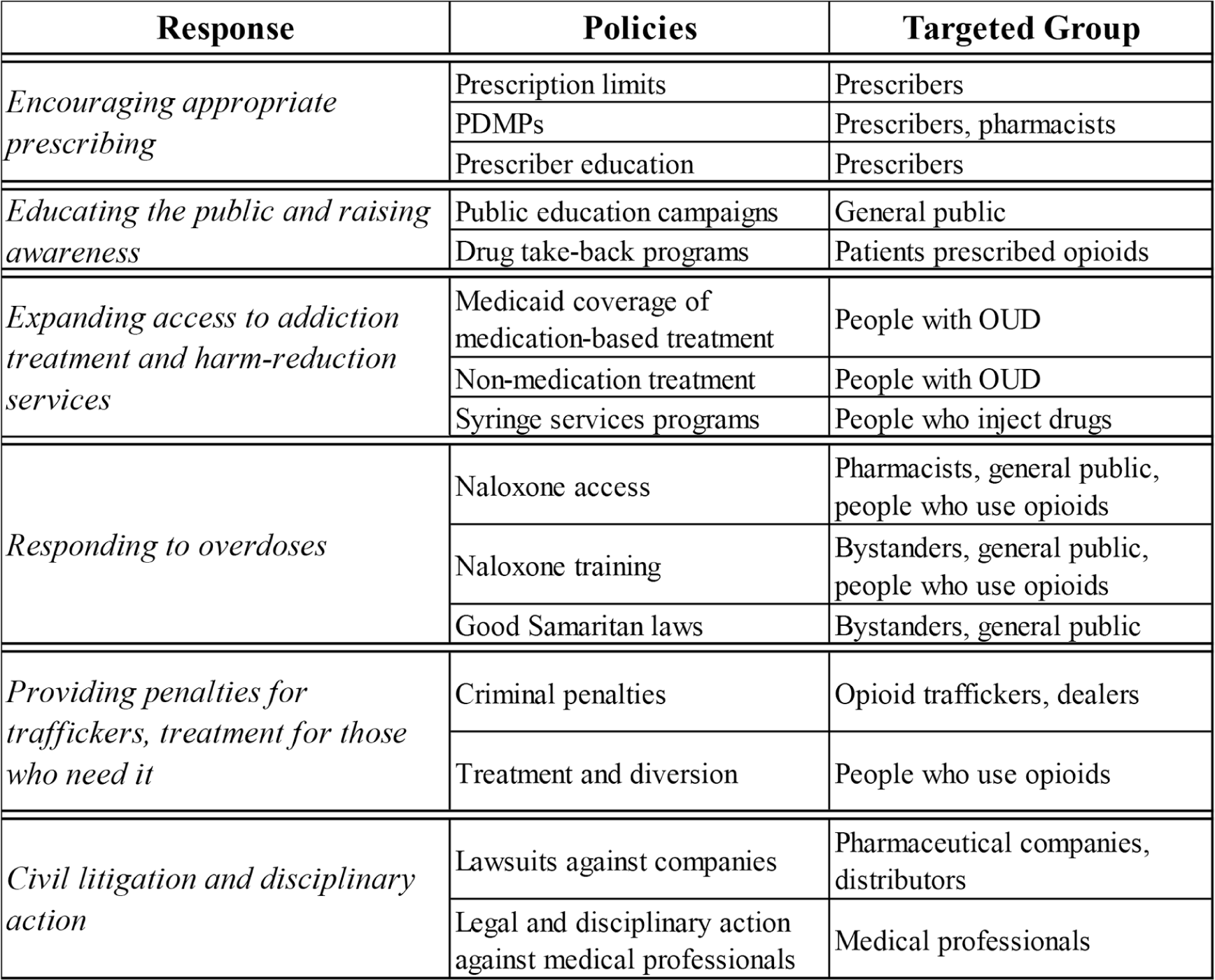
In some instances, statewide adoption information was already collected and easily accessible (for example, Brandeis University maintains a website tracking state implementation of prescription drug monitoring programs6). In others, additional state-by-state research was required to determine a policy's prevalence. This process generated the 15 policies below (See Figure 1), which are organized into categories based on the element of the opioid epidemic that they target.
Figure 1

While many of these policies are new state initiatives, in some cases states have enhanced or revisited existing laws and programs. For example, syringe services programs first appeared in the 1980s but are receiving increased attention as heroin use rises. Both types of policies are included below, in an effort to fully capture the range of policy levers — old and new — that states are using to address the opioid epidemic.
Figure 1, below, shows the six response categories. The responses consist of two or three specific policies, each of which is targeted at a particular group.
State Responses
Response One: Encouraging appropriate prescribing
rationale
The policies below target a driving force of the opioid epidemic in many states: the widespread availability of prescription opioids. These responses are grounded in the idea that prescription opioids are often prescribed more frequently than is warranted by the evidence regarding their efficacy and without adequate attention to the accompanying individual and public health risks. States are working to ensure that opioids are prescribed only when necessary and appropriate, and in amounts that minimize risk. These policies seek to prevent non-medical use of prescription opioids and to reduce the number of patients who develop opioid use disorder (OUD) and/or progress to illicit opioids such as heroin and fentanyl.
policies
Common prescribing policies include (1) limiting the number of pills per prescription, (2) establishing prescription drug monitoring programs, and (3) requiring that prescribers take continuing medical education courses in pain management.
prescription limits
Half the states have limited the number of opioid pills that can be written in an initial prescription.Reference Vestal7 This movement follows publicized examples of large, unnecessary prescriptions (such as a 30-day supply of pills after wisdom teeth removal) and evidence of significant variation among prescribers.Reference Hill8 Because excess supply creates the potential for diversion and continued use of opioids increases the possibility of physical dependence and OUD, policymakers posit that limitations will reduce this risk as well as the overall volume of prescriptions. These policies target first-time prescriptions, not patients receiving long-term opioids for pain.
Massachusetts became the first state to legislate a prescription limit in early 2016. The state set a seven-day policy for new prescriptions, which has become the most common benchmark nationwide, though some states set limits as low as three days while others go up to 14 days. A number of legislatures directed state government entities, such as boards or commissions, to develop an appropriate limit rather than setting the limit in statute. The pharmacy chain CVS recently adopted a seven-day limit for new opioid prescriptions across all of its pharmacies, which will complement the state initiatives.Reference Scutti and Kounang9
Because these policies were enacted quite recently, their effectiveness has not yet been thoroughly examined. Additionally, the variation across states will make evaluations and comparisons difficult. However, this approach appears to be based on research demonstrating a link between additional days of opioid treatment and long-term use (defined as continued use of opioids one year later). One study found that the likelihood of long-term use rises to nearly 30% after only a month of treatment.Reference Shah10 The Centers for Disease Control and Prevention (CDC) advocates for limits on initial prescription duration of fewer than seven days.11
States have faced some resistance from physicians' groups in implementing these policies. Leaders of organizations including the American Medical Association and the Maryland Society of Addiction Medicine have voiced opposition. They argue that prescription limits undermine patient care because they are too rigid and interfere with doctors' ability to create appropriate, individualized treatment plans.Reference Vestal12
prescription drug monitoring programs
Prescription drug monitoring programs (PDMPs) are state databases that track prescription information for individual patients. They allow physicians and pharmacists to quickly access a patient's history of controlled substance prescriptions before prescribing opioids. PDMPs seek to reduce the likelihood that patients are receiving multiple prescriptions from multiple providers. They offer both physicians and pharmacists more complete information about the risk of aberrant drug-seeking behavior by the patient (or “doctor shopping”) or aberrant prescribing practices by doctors.
All 50 states have created PDMPs.13 Missouri was the last state to join this group in late 2017, following an executive order from the state's governor.Reference Suntrup and Liss14 PDMPs are commonly administered by the state board of pharmacy or department of health, but some states have delegated this authority to law enforcement or a consumer protection agency.15 Funding arrangements vary as well. Sources include general state funds, state and federal grants, and a variety of fees (on professional licensing, health insurers, and controlled substance registration, among others).Reference Finklea16
Evaluations of PDMPs show mixed results. One study reported that implementing a PDMP was associated with a decrease in opioid prescribing of more than 30%, and some states have seen reductions in overdose deaths and multiple physician prescribers following the creation of a PDMP.Reference Bao17 However, a recent review found that such results are not consistent across states and studies.Reference Finley18 This may be due to variations in state law and utilization. Only 23 states mandate that prescribers and dispensers enroll with the PDMP.19 Even fewer—13 states—require both prescribers and dispensers to check the PDMP before writing or filling a prescription. Eighteen states have no requirement to check the PDMP for either group.20 (This is significant because the PDMP is rarely integrated into the electronic medical record, and thus requires extra time and effort to access.) These implementation decisions make a difference: policies that require registration or use of PDMPs are associated with a 10% decrease in opioid prescribing compared to states which have PDMPs but lack such mandates.Reference Wen21
prescriber education
States are working to ensure that medical providers have current and sufficient education about the appropriate use of opioids. Studies demonstrate that many physicians do not feel fully prepared to treat chronic pain and that opioids are regularly prescribed in cases for which they will have limited effectiveness.Reference Davis and Carr22
State medical boards require physicians to complete a number of hours of continuing medical education (CME) courses to maintain their licenses, and 23 states have requirements specific to pain management (though many such requirements pre-date the current opioid epidemic).23 These policies vary considerably in the hours required and the physician groups covered, but generally fall into one of two categories. The first includes broadly applicable, low-level requirements: for example, in Connecticut all physicians must have one hour of instruction in pain management and proper prescribing every six years. The second category features narrower, heightened requirements: in Mississippi, pain clinic practitioners must complete 15 CME hours annually.24 Overall, the existing requirements are far from comprehensive or universally enforced. Only five states require that all physicians receive CME on pain management. Eight more apply such requirements to those licensed to prescribe or dispense controlled substances (schedule I-V medications). This leaves a significant number of states with minimal or no required pain management education.
While skepticism exists about the value of CME, analysts generally conclude that it has some positive effects. A large systematic review of studies (not specific to opioid prescribing) found low-quality evidence that CME can improve knowledge and skills and can often influence practice behavior. As with other types of education, variation in the method of instruction and number of sessions is important, and states may wish to consider these factors as they update CME requirements.Reference Marinopoulos25 Few studies have focused specifically on the efficacy of CME for opioid prescribing.Reference Alford26
Education-focused policies seek to better inform the public about the potential harms of opioid use as well as safe management of prescribed opioids. States believe that as consumer sophistication increases, residents will be more cautious when they are prescribed opioids and will be more hesitant to experiment with opioids from illegitimate sources. These educational programs can also diminish stigma and foster community support for individuals with OUD.
Response Two: Educating the public and raising awareness
rationale
Education-focused policies seek to better inform the public about the potential harms of opioid use as well as safe management of prescribed opioids. States believe that as consumer sophistication increases, residents will be more cautious when they are prescribed opioids and will be more hesitant to experiment with opioids from illegitimate sources.Reference Barry27 These educational programs can also diminish stigma and foster community support for individuals with OUD.Reference Livingston28
policies
Two of the most common approaches are (1) conducting broad public education campaigns, and (2) publicizing local prescription drug take-back programs.
public education campaigns
State-sponsored public education campaigns take a variety of forms, including community events, web-sites, and public service announcements on TV or online. The message varies as well. For instance, Montana's program features stories of individuals who have been affected by opioids, while Alabama's campaign emphasizes the serious risk of harm and death posed by non-medical use of opioids.29
At least 37 states have a public education campaign specific to the opioid epidemic, and more are developing such programs.30 Many will use a share of their funding from the 21st Century Cures Act (which will distribute a total of $1 billion across all states) to develop or expand prevention campaigns.31
The evidence regarding the effectiveness of anti-drug education initiatives is mixed, at best. Studies indicate that many prevention campaigns do not have a significant impact.Reference Allara32 However, there are exceptions. Following disappointing results from the national “My Anti-Drug” campaign, which focused on the harms of drug use, its successor — “Above the Influence” — painted drug use as interfering with the independence and activities of teenagers, the target demographic. Subsequent analysis found that exposure to this campaign predicted lower rates of marijuana use.Reference Slater33 As states develop their own prevention materials, they may benefit from consulting the substantial literature on designing effective campaigns.
A handful of states — including Massachusetts, Indiana, and Connecticut — operate separate programs specifically designed to reduce stigma around substance use disorders (SUD).34 For example, the Massachusetts campaign includes a website and series of television ads which share individual stories of opioid addiction. Research suggests that such interventions may reduce social stigma and self-stigma (feelings of shame and stigma held by individuals with SUD).Reference Livingston35
prescription drug take-back programs
A substantial portion of opioid prescriptions go unused, often because the patient was provided with an excessive supply. This creates a risk of improper use by family members or friends, or by the original patient at a later date. Take-back programs provide secure, convenient drop-boxes that allow easy disposal of extra pills.
The Drug Enforcement Administration organizes a National Take Back Day twice per year.36 Although this program may be useful in focusing public attention, many local police departments and pharmacies also operate drop-boxes that are accessible daily. States are playing a role in publicizing this resource. Because states are focused on sharing information about take-back programs, rather than operating the programs themselves, these efforts pair naturally with education and awareness campaigns.
At least forty states have created listings or interactive maps of collection box locations.37 Some states, such as Arkansas, have gone further, developing dedicated websites with additional resources and information.38 Others, including Ohio, pay for secure drop-boxes, easing the financial burden on local police departments.39
Evaluations of take-back programs indicate that while they succeed in collecting prescription opioids, they take in only a small fraction of the existing supply. One study in five Kentucky counties found that take-back programs gathered over 21,000 drug doses, an amount equal to only 0.3% of all drugs prescribed that year.Reference Egan40 This evidence suggests that even with increased publicity and awareness, take-back programs are unlikely to significantly reduce the prescription opioid supply.
Response Three: Expanding access to addiction treatment and harm-reduction services
rationale
States have focused a great deal of resources and attention on serving individuals with OUD who require treatment and other forms of support. This group has a broad range of needs: some people are ready to enter treatment but have difficulty accessing or affording it, while others may not be interested in treatment but would benefit from a range of harm-reduction services.
policies
State policies address both of these populations. States have focused on (1) providing coverage for medication-based treatments through Medicaid, (2) funding non-medication treatment programs, and (3) facilitating syringe services programs (SSPs).
medicaid coverage of medication-based treatment
Medication-based treatments are a proven, effective treatment for OUD.Reference Connery41 Medicaid plays an important role in providing access to such treatment: the program covers 30% of the 2.2 million Americans with OUD due to prescription opioids.Reference Young and Zur42 Of the three types of medication — methadone, buprenorphine, and naltrexone — methadone and buprenorphine have the strongest evidence of efficacy.Reference Bart43 Prior to the Affordable Care Act, federal law did not require state Medicaid programs to provide substance abuse coverage. Under the Act, states that expanded Medicaid must now offer a substance abuse benefit but are not obligated to cover all three FDA approved medication options.Reference Boozang44 As of 2016, all state Medicaid programs covered buprenorphine and all but two covered naltrexone.Reference Grogan45 Methadone lags behind, with only 34 states providing coverage — a situation likely caused by regulation and historical stigma around the treatment.Reference Vestal46
Despite the availability of other types of medication-based treatments, the absence of methadone weakens treatment outcomes for several reasons. First, given the high demand for treatment and the limited supply, patients may not have accessible alternatives beyond methadone. A recent study found that offering Medicaid reimbursement for metha-done significantly increases the portion of enrollees receiving treatment, suggesting that without metha-done coverage many patients do not find other treatment options.Reference Saloner47 Second, National Practice Guidelines issued by the American Society of Addiction Medicine emphasize the importance of a choice among treatment options because each provides different benefits. For example, methadone (which for the first three months requires supervised daily doses at a specified location) may be most appropriate for patients in need of regular supervision or who present a risk of diversion. Finally, for some patients who do not respond to buprenorphine treatment, methadone can be an effective alternative.Reference Kampman and Jarvis48
non-medication treatment
The vast majority (88%) of all opioid treatment programs (medication-based and non-medication) are privately operated. The remaining 12% are run by local, state, federal, or tribal governments. States are responsible for just two percent. But while governments only have operational control of a small number of treatment programs, they provide funding to more than half of the thousands of facilities nationwide. Of these facilities, a significant portion do not use medication but rather promote non-medication treatment models.49
Evidence suggests that treatment with medication is superior to other treatment approaches. One study of individuals who use heroin compared methadone treatment with a variety of non-medication options and concluded that patients receiving methadone were more likely to stay in treatment and less likely to use heroin.Reference Mattick50 Another study found that buprenorphine patients are similarly more likely to remain in treatment than those who only receive counseling, therapy, and other forms of non-medication support.Reference Kakko51
syringe services programs
The transition among some people from intranasal prescription opioid and heroin use to injection routes highlights additional public health concerns and has brought syringe services programs, which arose in response to heroin use in the 1980s, back into policy debates. A recent outbreak of HIV and Hepatitis C among people who were injecting a prescription opioid in rural Indiana illustrated the risks posed by sharing or re-using syringes and drew the attention of policymakers nationwide.Reference Janowicz52 Syringe services programs (SSPs) can limit the spread of infection by providing clean syringes. The most effective programs offer a variety of supplemental services as well, including rapid HIV testing, overdose education and naloxone, an on-site nurse, and referrals to treatment, counseling, and housing assistance programs.Reference Bluthenthal53
SSPs currently exist in 41 states, though many are operated by private organizations rather than a state or local government.54 The legal landscape is complex. Only 18 states explicitly authorize SSPs, and several of these require local government approval before a program can be established. Other states implicitly permit SSPs through, for instance, exceptions in their drug paraphernalia laws which apply to syringes or specifically to programs, like SSPs, that aim to prevent disease transmission.Reference Burris55 Indiana, one of the few states which had directly banned SSPs, reversed course in 2015 after its HIV outbreak and now permits cities and counties to authorize syringe programs.Reference Harper56
The funding and operation of SSPs vary by state, and often by program within states as well. Some programs are operated by city or county health departments while others are privately run.57 In 2015, Congress provided states with another funding option by reversing a ban on using federal funds for SSPs.58
Numerous studies demonstrate that SSPs dramatically decrease the risk of disease transmission. They are a cost-effective government investment, as they help to reduce the need for expensive Hepatitis C and HIV treatments.59 Despite this evidence, SSPs have faced a backlash from some voters and politicians. Following Indiana's legalization of syringe programs in 2015, eight counties authorized them. But local officials in two of those counties voted to end their programs two years later, citing moral opposition.Reference Hedger60
Response Four: Responding to overdoses
rationale
Opioid overdoses are the most urgent moments for intervention. Most overdose deaths occur within three hours of the individual ingesting or injecting the drug.61 Many states are increasing access to medication designed to reverse the overdose, encouraging bystanders to get involved, and taking other measures to decrease the risk of future overdoses.
policies
States have taken a number of steps to improve overdose response, with most geared around naloxone, a medication designed to rapidly reverse opioid overdoses.62 These policies include: (1) increasing naloxone access, (2) providing training in naloxone administration, and (3) Good Samaritan laws that grant legal immunity to 911 callers.
naloxone access
Before states began to take action, it was illegal to possess naloxone or administer it without a prescription.63 On April 3, 2001, New Mexico became the first state to allow licensed health care professionals to “prescribe, dispense, distribute or administer an opioid antagonist” without being subject to civil or criminal liability.64
As of July 2017, every state has a naloxone access law. Some of them protect naloxone providers: 37 states offer criminal immunity for prescribing, dispensing, or distributing naloxone to a layperson, while 41 grant civil immunity. Thirty-five states grant immunity from professional sanctions.65 These laws protect the public as well. Thirty-eight states provide criminal immunity to laypersons administering naloxone and 46 provide civil immunity.66
Pharmacists in all states except Nebraska can dispense naloxone without a prescription.67 Walgreens and CVS have attempted to offer it over the counter (Walgreens in 46 states, CVS in 43), though there are doubts as to whether either has effectively implemented its policy.Reference Skwarecki68 A study in New Mexico tracked naloxone purchases through Medicaid claims and reported an increase of 900% in the first half of 2016 compared to 2014, following the implementation of a standing order policy.Reference Morton69
A 2017 study found that naloxone access laws were generally effective and were “associated with a 9 to 11 percent reduction in opioid-related deaths.” 70 Another study observed that while such laws are a positive step, the cost of naloxone has prevented more widespread access.Reference Davis and Carr71
naloxone training
Largely due to the immunity laws, naloxone training and the provision of naloxone kits have greatly expanded. One study published in 2015, comparing its results to a survey conducted in 2010, found a 183% increase in the number of organizations providing training and kits, a 243% increase in the number of local sites providing naloxone, a 160% increase in the number of overdose reversals, and a 94% increase in states with at least one organization providing naloxone.Reference Wheeler72
good samaritan laws
Responding to an overdose requires quick action, yet often witnesses do not call emergency services for fear of arrest. One report surveyed people who use opioid, finding that 33% of those choosing not to call cited “fear of police” as their primary reason.Reference Davidson73 In 2007, New Mexico became the first state to pass a Good Samaritan law.74 Since then, 39 additional states have followed suit.75 A 2011 review of Washington's Good Samaritan law found that 88% of people who use opioids surveyed “indicated that now that they were aware of the law they would be more likely to call 911 during future overdoses.”Reference Banta-Green76 However, 62% of police said that the laws did not change their behavior, as they would not have made an arrest for possession anyway, with only 14% reporting that they would be less likely to make such an arrest.77 A study of Good Samaritan laws found they were associated with a small decrease in opioid-related deaths, but the result was not statistically significant.78
Response Five: Providing penalties for traffickers and treatment for those who need it
rationale
States are combatting the opioid epidemic through the criminal justice system as well. Policymakers in many states believe that government should deter sales of illegal opioids through harsh punishments, while individuals who use opioids should not face criminal charges and, when possible, should be directed to treatment services rather than to prisons.
policies
States policies following this rationale include (1) increased penalties and aggressive enforcement for trafficking and conspiracy to commit trafficking, and (2) reduced penalties and diversion programs for minor possession and use offenses.
criminal penalties
Since 2011, 16 states have passed punitive anti-drug laws.Reference Lopez79 Eleven of the 16 enacted tougher penalties related to opioids, three enacted a drug-induced homicide law, and two enacted both measures.80 Importantly, these laws are all intended to target drug trafficking, as opposed to drug use (though occasionally they can sweep in those who might help someone take his own drugs).
A few illustrative examples:
Maryland's SB 539, passed in 2017, responds to the increased presence of fentanyl in the illegal drug market by permitting increased prison sentences for trafficking fentanyl-laced heroin by 10 years;81
Louisiana's SB 87, passed in 2014, doubled the minimum prison sentence for trafficking heroin from five years to ten;82
Indiana's HB 1235,83 passed in 2016, reversed previous criminal justice reforms and reinstated ten-year mandatory minimum sentences for trafficking methamphetamines or heroin in cases where the individual had previously been convicted of a similar trafficking offense;84
Kansas, HB 2044, passed in 2013 established two new crimes: (1) “distribution of a controlled substance causing great bodily harm” and (2) “distribution of a controlled substance causing death.”85 In total, 20 states have enacted such “drug-induced homicide laws.”86
criticism of criminal penalties
This approach has met a great deal of criticism from the public health and medical community. First, opponents argue that these laws are used simply to prosecute the last person to touch the drug, rather than the “kingpins” responsible for wide-spread distribution of illicit opioids. In New Jersey, which established strict-liability for drug-induced death, punishable by ten to twenty years in prison, the statute was mostly “used to prosecute minors with no record or evidence of prior drug dealing, family members who engaged in drug use ‘recreationally,’ and ‘small time users’ whom the legislature expressly stated should be rehabilitated, not incapacitated.”Reference Knight87 Additionally, these strict-liability drug-induced death statutes arguably counteract, if not directly contradict, Good Samaritan laws, by discouraging individuals from making emergency calls.88
Second, critics argue that while demonstrating leniency with individuals who use drugs and prosecuting traffickers sounds good, the line between the two groups can blur. A Department of Justice report found that 70% of individuals convicted of trafficking in state courts had used drugs in the previous month themselves, and 42% had used drugs at the time of the trafficking offense.Reference Mumola and Karberg89
Third, critics contend that some of these laws actually counteract positive steps in state criminal justice reform. For instance, Louisiana passed a reform bill in 2017 that lowered the prison sentence for heroin trafficking from 10 to 5 years. But because this reform came after a 2014 law that increased minimum prison sentences for heroin trafficking from 5 to 10 years, the two laws essentially cancelled each other out.90
Finally, there is a question as to the degree of economic impact. A comprehensive study reviewing the literature reflected that, “Simply put, the market responds to the demand for drugs by replacing drug sellers sent to prison with either new recruits or by the increased drug selling of dealers already in the market. As a result, the incapacitation effect found for some other offenses is largely nullified in the case of drug dealing.”Reference Pryzbylski91 Another study concluded that “there is little evidence that raising the risk of arrest, incarceration or seizure at different levels of the distribution system will raise prices at the targeted level, let alone retail prices.” Reference Pollack and Reuter92 Proponents of aggressive enforcement, however, may respond that studies cannot fully take account of the alternative — that absent prosecution of mid-level dealers, drug sales and abuse would be even more rampant than they already are.
As this article was going to press, the litigation took a major turn when more than 200 federal cases were consolidated, pursuant to the special procedural rules set out in 28 U.S.C. §1407, into a single multi-district litigation in federal court in Ohio. The judge in the case, Dan Polster, has made clear that he intends to reach a global settlement as quickly as possible. To that end, Judge Polster has asked even those parties whose cases have not yet been filed, including the attorneys general, or which have not been consolidated before him (for example, cases filed in state court) to appear and participate in settlement negotiations.
treatment and diversion for individuals who use drugs
States have generally relaxed drug laws that impact individuals who are not involved with trafficking. Over the past five years, nine states reduced their penalties for possession of a controlled substance, and eight states changed mandatory minimum laws to provide greater leniency.93
These laws also allow more individuals to access diversion programs and drug courts rather than proceeding through the traditional criminal justice system. Such programs exist for drug-related offenses in 39 states, and although many predate the current opioid epidemic, they have been employed more heavily in recent years.Reference Widgery94
Successful pretrial diversion avoids a criminal conviction entirely. A diversion program puts the criminal charge on “hold” while the defendant completes a specified treatment program. Unfortunately, a diversion program that requires complete abstinence (i.e., no “urines with illicit opioids”) fails to recognize the often chronic and relapsing nature of addictive disorders. Drug courts are often more intense and comprehensive, including regular monitoring by the court as well as education- or job-related programs.95 These courts, which arose in the 1980s and 1990s, were originally designed to “impose mandated, abstinence-based treatment on people arrested for drug possession, with close judicial oversight.”Reference Davies96 Today there are more than 3,100 drug courts in the United States, some of which provide access to medication-based treatment rather than requiring no use of medications as the only route to success.97 Drug courts remain controversial and have received divergent reviews.Reference Mitchell98
Response Six: Civil litigation and disciplinary action
rationale
Beyond targeting drug traffickers, states are also focusing litigation and disciplinary efforts on licit sources of opioids—including manufacturers, distributors, retailers (pharmacies) and prescribers.Reference Gluck, Hall and Curfman99 States believe that these companies and individuals must be held accountable for their role in facilitating non-medical use of opioids and addiction.
policies
States and localities have adopted two types of approaches: (1) filing lawsuits against pharmaceutical companies, distributors and retailers, and (2) legal and disciplinary action against medical professionals.
lawsuits against companies
In May 2007, Purdue Pharma paid a $600 million criminal settlement for misbranding its drug OxyContin following an investigation by the U.S. Attorney's Office for the Western District of Virginia.Reference Meier100 Three of its executives pled guilty to criminal charges.101 Eight years later, in 2015, Mississippi became the first state to sue a pharmaceutical company for its contribution to the opioid crisis.Reference Quinn102 Subsequently, more than 200 lawsuits have been filed by states, cities, and counties. Causes of action include public nuisance, negligence, unjust enrichment; and violations of state consumer protection, racketeering, and Medicaid fraud statutes. In addition to these suits, 41 state attorneys general are participating in a joint investigation of manufacturers and distributors.Reference Noguchi103
As this article was going to press, the litigation took a major turn when more than 200 federal cases were consolidated, pursuant to the special procedural rules set out in 28 U.S.C. §1407, into a single multi-district litigation in federal court in Ohio. The judge in the case, Dan Polster, has made clear that he intends to reach a global settlement as quickly as possible. To that end, Judge Polster has asked even those parties whose cases have not yet been filed, including the attorneys general, or which have not been consolidated before him (for example, cases filed in state court) to appear and participate in settlement negotiations.Reference Raymond104
legal and disciplinary action against medical professionals
Lawsuits and disciplinary actions aimed at individual medical professionals have increased in recent years. Suits against individual doctors include claims ranging from medical malpractice to operating illegal pill mills.Reference Krans105 For example, in January 2010, one doctor received a $9 million fine after he was “found negligent for prescribing a combination of Vicodin, Xanax, and Soma, which caused an overdose death.”Reference Yang106 State medial licensing boards have also been active in investigating and disciplining physicians.107 Some worry that these lawsuits will result in reduced access to prescription opioids for patients who benefit from them as doctors become more concerned about investigations and professional sanctions.Reference Keilman108
In November 2017, the scope of the state lawsuits further expanded when local officials in the West Virginia towns of Huntington, Charleston, Kenova, and Ceredo initiated a class-action suit against a non-profit organization known as the Joint Commission, which “inspects hospital performance and sets practice standards” for hospital physicians. The Joint Commission is quite powerful, as it defines standards for Medicare and Medicaid reimbursement, and accredits hospitals. In 2001, in an effort to address the undertreatment of pain, the Joint Commission promulgated a standard that led to questions about pain being asked in every patient encounter — which came to be known by some as the promotion of pain as a “fifth vital sign.”Reference Blau109 The lawsuit alleges that the Commission is “responsible for … spread[ing] ‘misinformation’ about the risks of opioid addiction dating back to the early 2000s” and incentivizing overprescribing by physicians.
Outcomes
Purdue Pharma, which produces OxyContin, announced in early 2018 that it will no longer market opioids to physicians. Purdue also plans to reduce its sales staff.110 While this change may be a result of state litigation (as well as negative publicity), it is too early in the life-cycle of these lawsuits to draw definitive conclusions as to their overall efficacy. State lawsuits are explored in detail elsewhere in this volume.111
Discussion
This paper has presented the six primary approaches states have taken to combat the opioid epidemic. This section further explores state responses from the perspectives of evaluation, experimentation, and funding.
Evaluation
A number of the initiatives discussed above are backed by solid evidence. These policies — such as expanding treatment access and supporting SSPs — are known to produce positive results. For other state actions — including public education campaigns and harsh trafficking laws — the evidence is more mixed. The prevalence of both types of policies suggests that state responses are not solely driven by proof of efficacy. Indeed, a recent report found that while many states are moving toward evidence-based policymaking models broadly, they do not yet use this approach in a rigorous, comprehensive way.Reference Dube112
Experimentation
States are coalescing around a number of common policy options, as discussed above, but they are also engaged in the process of experimentation. As “laboratories of democracy,” states have long explored creative and novel solutions to governing challenges. That pattern continues here; for instance, some states are now providing medication-based treatment in prisonsReference Gourlay113 while others are aggressively enforcing mental health parity laws (which prohibit insurance plans from offering mental health or substance abuse services on less favorable terms than other types of medical care).114 Separately, several states (including Illinois,115 Rhode Island,Reference Montanaro116 West Virginia,117 and Connecticut118) created comprehensive opioid plans which identify overarching goals and define processes for achieving them. For example, Rhode Island's plan was developed by an Opioid Task Force and includes a goal of reducing overdose deaths by 33% over three years as well as a set of key metrics to measure progress.Reference Montanaro119 Ongoing evaluation of these varied state initiatives will determine whether they merit broader adoption.
This is a complex and dynamic area of state policymaking, and one that will benefit from further study. In particular, additional research on the costs and benefits of state programs as well as the impact of comprehensive state plans will complement the findings presented here.
Funding
Congress provided states with some financial assistance through the 21st Century Cures Act, which distributes $1 billion over two years in response to specific grant applications from the states.120 West Virginia directed its grant funds toward SSPs, prison treatment efforts, and a medication treatment program which specializes in treating pregnant women.Reference Beck121 Massachusetts is investing in medication-based treatment and community overdose prevention programs, as well as new treatment and recovery programs targeting at-risk populations.Reference Pittman122
At the state level, direct spending comparisons are difficult to make due to variation in policy approaches, program structure, and funding sources — as well as lack of available information.Reference Hitchcock123 However, financial concerns likely play a large role in opioid policy decisions. Although most states have recovered from the depths of the 2008 financial crash, budget challenges persist; more than half the states faced budget shortfalls in 2017.Reference Povich124 In this context, it is unsurprising that many of the widespread policies discussed above are low-cost options. A number of them involve only legislation and a minimal amount of implementation or regulation: examples include prescription limits, Good Samaritan laws, syringe service program laws (assuming the state doesn't fund the actual syringe programs), and increasing maximum prison sentences on the books (which may not lead to increases in actual sentences).
Litigation is a policy response clearly targeted at raising funds to address the crisis. Most cases are being funded by private counsel, handling claims on contingency, so states and localities have taken on little risk in the hope of reaping settlement funds from deep-pocketed companies.125
Other initiatives have higher costs. PDMPs require an average of $1 million to launch and another $500,000 annually to operate.Reference Finklea126 Public education campaigns are often in the same range. Ohio's campaign, supported by a CDC grant, carried a $1 million price tag.Reference Orozco127
Many types of criminal enforcement require more significant investment. Criminal enforcement costs rise as more prosecutions are undertaken and as prison populations increase; even with the promising drug court and diversion efforts detailed above, prisons across the country are facing overcrowding challenges.Reference Sofield128 Because a year of incarceration is quite expensive — roughly $24,000, though many estimates are higher — opioid-related arrests constitute a large financial commitment by the state.129
The cost of medication-based treatment has received significant attention, in part because the treatment is in high demand. A 2015 study reported that nearly all states “had opioid abuse or dependence rates higher than their buprenorphine treatment capacity.”Reference Jones130 While medication-based treatment carries substantial costs, evidence suggests that it is a wise investment for two reasons. First, it meets the standard cost-effectiveness benchmark for U.S. healthcare services (indicating that the health benefits justify the expense).Reference Murphy131 Second, patients who receive these treatments have lower overall health-care costs than those treated without medication.Reference Baser132 These findings help to explain the consistent focus on medication-based treatment across states despite its upfront cost.
Conclusion
This is a complex and dynamic area of state policy-making, and one that will benefit from further study. In particular, additional research on the costs and benefits of state programs as well as the impact of comprehensive state plans will complement the findings presented here.