Introduction
This article explores the intersection between the care regime and migration by examining the gendered migration pattern and the development of the care labour market in South Korea. The feminisation of labour migration has been widely discussed in the context of the re-organisation of the welfare/care regime. Most notably, as the terms ‘international division of reproductive labour’ and ‘care chain’ indicate, the migration of domestic workers, nannies, caregivers and nurses from the Global South to the Global North has been researched extensively (Yeoh et al., Reference Yeoh, Huang and Gonzalez1999; Parreñas, Reference Parreñas2000; Yeates, Reference Yeates2009). However, the conceptual questions related to the nexus of migration, gender and care have been framed with primacy given to South–North migration (Kofman and Raghuram, Reference Kofman and Raghuram2009). As Kofman and Raghuram (Reference Kofman and Raghuram2009) noted, the migration of women is altering the landscape of care around the world; yet, the degree of commodification and institutionalisation of care services as well as their relationship to social policy may vary across countries and regions. In this regard, the process of forming a paid care labour market and how migrant care workers play a role in this process deserves attention. This article explores the process of developing a care labour market and institutionalising social policy for care provision and migration policy with the case of Korean Chinese care workers in South Korea.
Discussion on the provision of care depends on how one defines the care services market and paid care labour, and on how care labour is organised and rewarded institutionally. Razavi (Reference Razavi2007: 6) further defined care work as:Footnote 1
involv[ing] direct care of persons; it can be paid or unpaid. Those with intense care needs include young children, the frail elderly and people with various illnesses and disabilities, but able-bodied adults also require and receive care. Paid carers include nannies, childminders, nurses and care workers in homes for the elderly and other institutional settings; they can work in a variety of institutions (public, market, not-for-profit).
Domestic work is not explicitly mentioned in Razavi's (Reference Razavi2007) definition of paid care work, although Razavi acknowledged that domestic workers also undertake some forms of care work. In the context of East Asia, domestic workers serve various care needs, including childcare and elder care; hence, the domestic worker is indispensable in the discussion of care work.Footnote 2
The governance of care provision has been discussed largely in terms of the care regime, which emphasises the major institutions of care provision, that is, the state, the market, the family and the community (Ochiai, Reference Ochiai2009). Care regimes can be defined as ‘the institutional and spatial arrangements (locations) for the provision and allocation of care’ (Kofman and Raghuram, Reference Kofman and Raghuram2009: 6). The notion of the care regime largely relies on analysis of the gendered dimension of the welfare regime, with a focus on care (Daly and Lewis, Reference Daly and Lewis2000; Daly, Reference Daly2012; Salis, Reference Salis2013). As Jenson (Reference Jenson1997) noted, care is a key component of the welfare regime, and how care provision is organised differently across a region or how this organisation of care provision has changed are important questions to explore. In particular, the changing organisation of care provision cannot be divorced from the decline of the welfare state or from neoliberal restructuring (Misra et al., Reference Misra, Woodring and Merz2006). Acknowledging the care regime in East Asia as a familialistic regime, Ochiai (Reference Ochiai2009) showed the variations of this institutional arrangement of care in East and Southeast Asia. Peng (Reference Peng2009: 2) described the Korean care regime as a ‘familialistic male breadwinner welfare regime’, which refers to ‘the state's extensive reliance on the family for individual welfare and personal care – leading to women's uncommodified labour’, and noted that the role of the state and the market has increased since the 1990s in response to political economic changes.
The discussion on the intersection between the care regime and the migration regime in the literature varies, although it is largely focused on the Global North. Williams (Reference Williams2010: 389), noting how the care regime and migration regime intersect with each other, wrote: ‘[M]any US based studies explain the demand for domestic and care workers as a consequence of the lack of public care policies, whereas in Europe it is the nature of the recent development of care regimes that constitutes an important influence in demand.’ Van Hooren (Reference van Hooren2012) argued that the differences in care regimes contributed to the different types of migrant care workFootnote 3 and that the labour migration policies for care workers had only a limited impact, ‘as many migrants employed in the social care sector rely on residence permits unrelated to employment’ (143). In a similar vein, Pastore (Reference Pastore2010) acknowledged the importance of the labour force participation of non-economic migrants in Europe and called for a labour migration governance system, which went beyond the conventional labour migration policy. These insights on the differences in care regimes and the labour force participation of non-economic migrants in the care labour market provide clues for contextualising the discussion of the intersection between the care and migration regimes in South Korea.
In South Korea, where the migration regime and the public care system are emerging, the role of migrant care workers in this process deserves scrutiny. However, unlike the general trend of the feminisation of labour migration, the labour migration pattern in Korea is male-dominated. It is worth exploring how the gendered patterns of migration in South Korea are linked to concerns about the provision of care. In this article, I attempt to explore the following: (1) how the market for paid care labour was formed, and (2) the potential role of migrants, both marriage migrants and labour migrants, in this process. In doing so, I analyse policy papers, immigration statistics and results of the Foreign Employment Survey in 2013 (Statistics Korea, 2013), and I complement this material with the narratives of Korean Chinese care workers collected from in-depth interviews. Interviews were conducted at two hospitals in the Seoul Metropolitan Area in 2012 and 2015.Footnote 4 Interviewees include eight Korean Chinese care workers who provide twenty-four-hour care services in these hospitals, two administrative persons in each hospital, and three managers of recruitment agencies for Korean Chinese.
Gendered migration patterns in East Asia in the discourse of the feminisation of migration
This article sheds light on the specific context of East Asian countries within the discussion on the feminisation of migration and the changing welfare regime; hence, it helps highlight the heterogeneity of migration and the care regimes (Kofman and Raghuram, Reference Kofman and Raghuram2012). Given that the feminisation of labour migration is linked to analysis of shifting care provision, the increase in migration in East Asia over recent decades prompts the question of how this trend is related to the changes in the care regime. Although East Asian countries, including Japan, Korea, Singapore and Taiwan, face similar socio-demographic challenges, that is, an ageing population and a care deficit, which have accumulated throughout the process of rapid economic development, each government adopted different strategies for providing care services.
Ochiai (Reference Ochiai2009) showed that East Asian countries are similar in that family plays an important role in providing care but that the roles of the state, the market and the community vary across countries, as does the role of migrant workers within the care labour market. The provision of care has largely depended on the family, yet rapid demographic changes, including the decrease in fertility and family size, population ageing, the increase in women's labour force participation during the industrialisation process and economic changes, including the decline in the family wage and the male-breadwinner system during the 1990s, all created conditions for the state to play a larger role in care provision. An increase in the dependency ratio and in care provision for children and the elderly became a key issue around the 2000s in this context.Footnote 5
Reviewing migration policies, Song (Reference Song2015) suggested that Japan, Korea and Taiwan have responded to the recent care concerns in different ways. Whereas the Taiwanese government ‘opened the care service market to foreign workers’, the Korean government only ‘opened it to co-ethnic workers’, and Japan accepted foreign workers only marginally (Song, Reference Song2015). The current picture of care labour migration cannot be separated from female employment patterns, social care provision and labour policies for care (Song, Reference Song2015). Putting this into a historical context, East Asian countries that underwent rapid industrialisation experienced labour shortages at different points. In response, they implemented a variety of policies to utilise women's labour, in particular that of married women, and the migrant workers appeared despite relatively strict regulations. Singapore relaxed its regulations on labour migration as early as 1968, but others were rather slow to institutionalise it (Jones and Findlay, Reference Jones and Findlay1998; Martin, Reference Martin and Mason2001). Taiwan officially accepted foreign domestic helpers and caregivers in 1992 by implementing the Employment Service Act (Migration News, 2007). Japan and Korea did not accept unskilled migrant labour but ‘tacitly permit[ted] foreign students, industrial trainees and illegal entrants to take unskilled employment’ (Jones and Findlay, Reference Jones and Findlay1998: 94). Although these policies were implemented in response to changes in the labour market and to labour shortages, more policies were implemented as these societies faced demographic challenges such as low fertility and an ageing population around the 2000s. For example, Japan began accepting caregivers and nurses by signing economic partnership agreements with the Philippines (2006), Indonesia (2007), Vietnam (2009) and India (2011) (Ministry of Health, Labour and Welfare, in Ford and Kawashima, Reference Ford and Kawashima2013), although the number of migrants into Japan under these agreements is nominal.
Providing a comprehensive comparative picture of care labour migration requires navigating multiple migration categories due to the differences in migration policies between these countries. For example, Taiwan and Singapore have a specific visa category for domestic helpers. The data on labour migration in Korea are more comprehensive after 2004, when the Work Permit System was implemented.Footnote 6 Korea allowed only Korean Chinese to work in the service sector, including domestic and care services during the 2000s. The data on foreign caregivers and nurses in Japan are available only for the period since the partnership agreements. However, this does not necessarily mean that there were no foreign migrant care workers in Korea and Japan prior to the data collection. Hence, it is important to examine the migration patterns and the employment of migrants, as visa status does not always reflect participation in the labour market. In the following section, I examine the gendered migration pattern in South Korea and the employment of migrants. In doing so, I focus on both labour migration and family-related migration of Korean Chinese and explain the link between migration and the labour market.
The changing care regime and the care labour market in South Korea
The development of the care services market is an important shift in the Korean care regime in addition to the greater role of the state (Peng, Reference Peng2009). On the one hand, there was a pressing demand for care services due to demographic changes; on the other hand, there was a need to find growth engines and create job opportunities in the post-industrial context. Lee (2008, cited in Peng, Reference Peng2009: 20) noted that ‘the successive governments since 1998 have been reframing social welfare expansion policies not only as family-friendly social policies, but as family-friendly economic policies, in essence, selling social services as potential ‘growth engines’ for the new economy’.Footnote 7
The long-term-care insurance (LTCI) system was introduced in 2008 to provide long-term-care services for people sixty-five years old and older who have care needs. Its aim included ‘promoting senior citizens’ health and life stabilisation as well as increasing the quality of people's lives by mitigating the burden of care on family members’ (NHIS, 2014). As a part of the LTCI, the new qualification system for care workers (yoyangbohosa) was introduced to supply qualified care workers. According to the annual survey of LTCI in 2013 (NHIS, 2014), the number of long-term-care workers (yoyangbohosa) increased from 172,889 in 2009 to 252,663 in 2013.
The results of the Local Employment Survey from 2008 to 2011 show that employment in the care labour market increased from 567,000 to 761,000 (Hwang et al., Reference Hwang, Yoon, Yoon, Rostgaard, Letablier, Bothfeld, Oschmiansky, Fagan, Norman and Rubery2012). Hwang et al. assessed the care labour market by examining four occupational categories – social-welfare-related professional work, kindergarten teaching, medical-welfare-related service and domestic work and childcare – using Local Employment Survey data.Footnote 8 While employment in social-welfare- and medical-welfare-related work has increased, employment in domestic work and childcare has decreased and the former is due to the expansion of public care services, in particular the LTCI system (Hwang et al., Reference Hwang, Yoon, Yoon, Rostgaard, Letablier, Bothfeld, Oschmiansky, Fagan, Norman and Rubery2012).
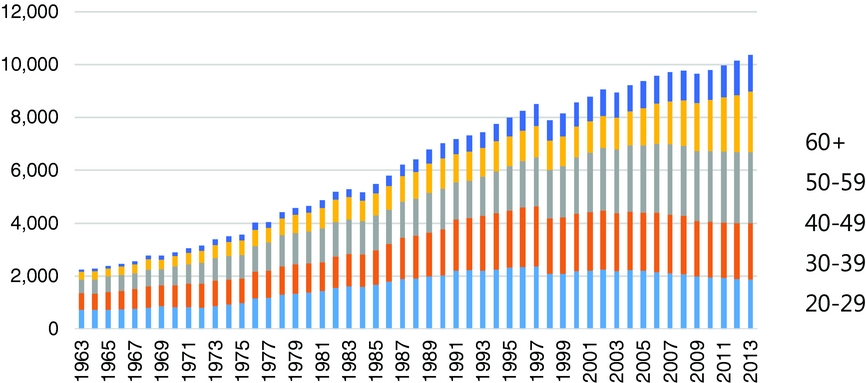
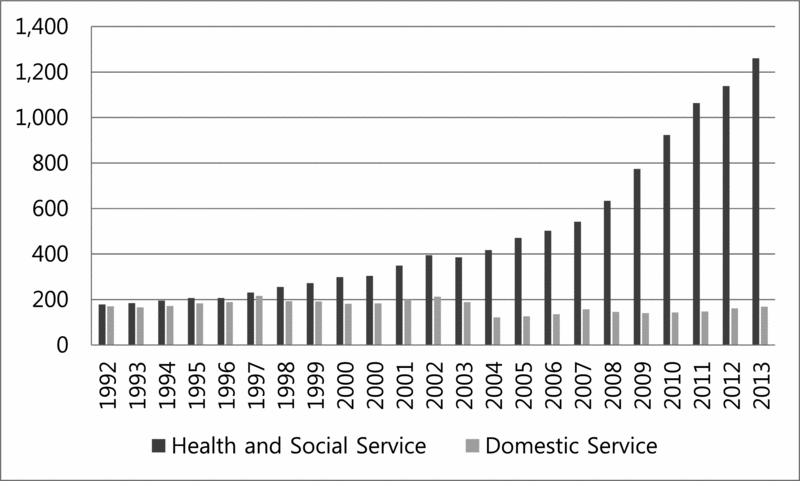
The recent discussion on the Korean care labour market tends to be associated with the introduction of LTCI; however, the formation of the migrant care labour market needs to be understood in the historical context of the changes in women's labour force participation. Data on women's labour force participation from the earlier period help put this into perspective (Figures 1 and 2). In particular, it is worth exploring women's engagement in domestic work in the context of the changes in women's labour force participation, as domestic workers have served various care needs, including childcare and elder care, in the context of East Asia. During the 1960s and 1970s in Korea, live-in domestic helpers, called ‘Sikmo’ or ‘kajeongbu’, worked for middle-class households (Kang, Reference Kang2009). They were often single female migrants from rural areas. ‘Domestic helper’ was one of the biggest occupational categories for women workers during the early period of industrialisation.Footnote 9 Beginning in the late 1970s, part-time domestic helpers, called ‘Pachulbu’, became more common, and more middle-aged women engaged in this work as young women moved to other service sectors (Kang, Reference Kang2009). Standardisation of wages and employment relationships for domestic work occurred during this period. Women's labour force participation from the 1980s through the mid-1990s is characterised by the increase in married women's participation, and coincides with the labour shortage during that period and the shift in the discourse on married women's labour force participation. However, the share of the domestic service sector as a proportion of women's employment decreased, while women's labour force participation steadily increased (Kang, Reference Kang2007). The share of paid domestic labour in women's labour force participation was below 1 per cent from 1995.Footnote 10 In the mid-1990s, women's labour force participation became a norm, and work–family balance became an important discourse (Kang, Reference Kang2007). The gap between the increase in women's labour force participation and the low share of paid domestic labour in the labour market indicates the lack of care labour. An influx of foreign domestic workers was observed during this period. The paid domestic labour market is characterised by the division between foreign live-in domestic workers and Korean part-time domestic workers during the mid-1990s (Kang, Reference Kang2009). This period is important, as it provides clues to the origins of migrant care workers. Migrant care workers existed even before the migration and care regimes were institutionalised. Korean Chinese migrants are important in this context because they occupied this space before the institutionalisation began and helped shape the care labour market in Korea in a variety of ways.
Female labour force participation by age, 1963 to 2014 (in 1,000s of persons)

Female employment, by industry sector (in 1,000s of persons)

The next phase is the institutionalisation of the care labour market from the late 2000s with the introduction of various policies including LTCI. Um and Lightman (Reference Um and Lightman2011) suggested that the introduction of LTCI led to the division of the care labour force: yoyangbohosa, certified long-term-care workers under the LTCI system and ganbyeongin, care workers in a less-regulated market. Yoyangbohosa are required to participate in an education programme in order to earn a certificate. Their working hours and wages are set by the government, and they are eligible for social insurance. They are likely to be Korean nationals, whereas ganbyeonginare are composed of both Koreans and Korean Chinese (Um and Lightman, Reference Um and Lightman2011).
Korean Chinese migrants at the intersection of the care and migration regimes
Gendered migration and employment patterns in South Korea
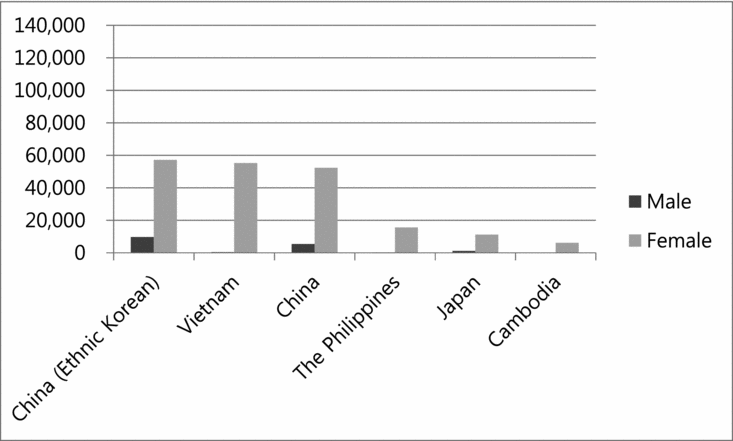
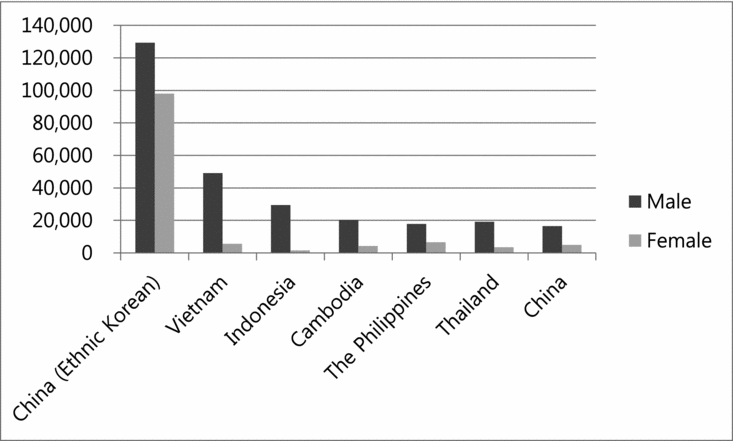
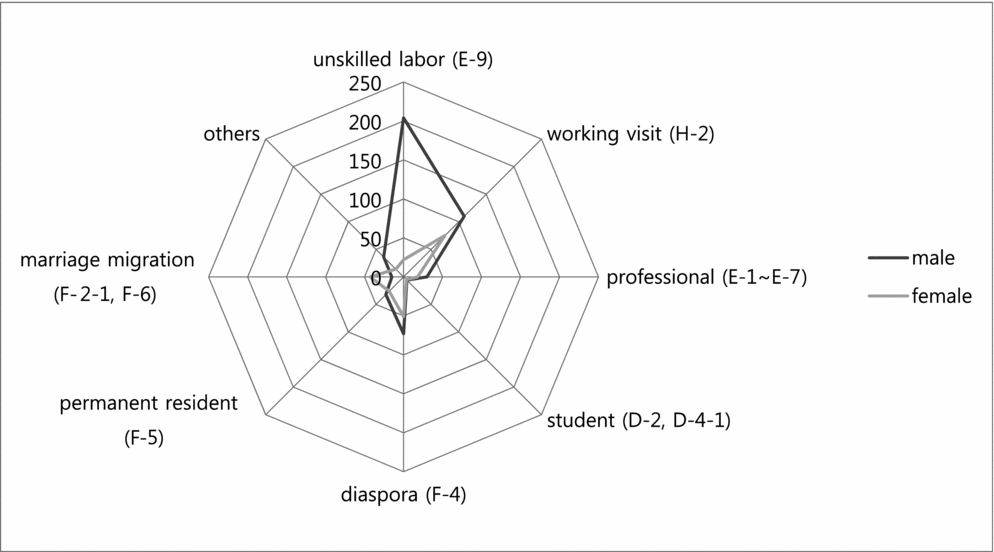
As of 1 January 2014, there were 520,906 (372,671 male, 148,235 female) migrant workers and 147,591 (20,887 male, 126,704 female) marriage migrants in KoreaFootnote 11 (Ministry of the Interior, n.d.). As Figures 3 and 4 show, labour migration is highly male-dominated and marriage migration is highly feminised. The distinction between labour migrants and marriage migrants is based on visa status. However, results of the 2013 Foreign Employment Survey show that many types of migrants engage in economic activity. According to the survey results, there are 1,126,000 foreign residents in South Korea, of whom 760,000 are employed (Statistics Korea, 2013). The number of employed female migrants is 255,000, or 33.6 per cent of all employed migrants (Statistics Korea, 2013). It is worth noting that the labour force participation of women migrants is higher than the number of labour-related visa holders, which indicates that marriage migrants and migrants with diaspora visas play an important role in the employment of female migrants in South Korea.Footnote 12 To a certain extent, this confirms that migrant care workers in the care labour market are not necessarily labour migrants, as van Hooren (Reference van Hooren2012) acknowledged in a study of Europe.
Marriage migration to Korea

Labour migration to Korea

As Figure 5 shows, the major visa statuses of employed female migrants include working visit (H-2; 29.4 per cent), diaspora (F-4; 20 per cent), marriage migration (F-2-1, F-6; 16.9 per cent), permanent residency (F-5; 10.1 per cent), unskilled labour (E-9; 8.6 per cent), skilled labour (from E-1 to E-7; 7 per cent), and others (8.8 per cent). Major sectors include retail, restaurant and hotel (35 per cent); manufacturing (30.6 per cent); and personal or public service (29 per cent). Occupations include manual work (38.5 per cent), service and sales (23.3 per cent) and machinery (17.62 per cent) (Statistics Korea, 2013). Of employed female migrants, 47.4 per cent are in the 40–59 age group, and 72.2 per cent earn between 1 million and 2 million WonFootnote 13 (approximately 670 and 1,340 GBP; Statistics Korea, 2013).
Migrant labour by visa status.

Korean Chinese represent a significant portion of all three major visa categories of employed foreign residents (working visit, marriage migration and diaspora). They represent 43.5 per cent of all employed foreign residents and 54.5 per cent of employed female foreign residents according to the results of the 2013 Foreign Employment Survey (Statistics Korea, 2013).Footnote 14 Their dominance in the migrant labour force is attributed to their special status within the migration regime. The term Korean Chinese refers to Koreans who moved to Northeast China during the Japanese occupation in the early 1900s but who were unable to return to Korea after the formation of North and South Korea.Footnote 15 Until 1988, they were regarded as family members of Koreans, who were separated by political upheavals, and they were able to visit Korea using temporary travel certificates. In 1988, the Korean government opened the door to the Korean diaspora to visit North and South Korea, and the number of visitors increased from 1,660 in 1988 to 36,147 in 1991 (Korean Immigration Statistics, n.d.) After diplomatic relations between Korea and China were established in 1992, the Korean government gradually lowered the age threshold for family reunions, and the number of visitors for the purposes of reunion increased.Footnote 16 It was also during this period that marriage for rural bachelors became a national concern and that marriage between rural Korean men and Korean Chinese women began. The number of marriages increased from 9,719 in 2001 to 36,632 in 2007 and decreased to 17,158 in 2015 (Korea Immigration Service, n.d.a). Korean Chinese is the biggest group among the marriage migrants and the mean age of Korean Chinese marriage migrants are much higher than for other marriage migrants.
With regard to labour migration policy, the Korean government implemented an industrial and technical training programme, the so-called Industrial Trainee System, to address serious labour shortages in the manufacturing and service industries in 1993. The official labour migration policy for importing unskilled labour, the Employment Permit System based on the Act on Foreign Workers’ Employment, was only implemented in 2003. However, there were already specific policies for the labour force participation of Korean Chinese. In 2002, the Employment Management System enabled Korean Chinese who held a family reunion visa (F-1-4) to work in the service sector (Korea Immigration Service n.d.b). Given that Korean Chinese had already come to Korea through various channels, these policies were designed not to initiate care labour migration but to manage the current trend (Lee, Reference Lee2004). In a way, the contributions of the Korean Chinese to care labour were recognised officially only in 2002. In 2007, the Working Visit System for Korean Chinese was implemented by amending the Act on Foreign Workers’ Employment. Currently these policies are converged under the Special Employment Permit System.
As results of the 2013 Foreign Employment Survey show, marriage and diaspora migrants are active in the labour market. Yet, it is hard to trace the development of the migrant care labour market, because employment practices were rather informal, and it was only after 2002 that Korean Chinese were officially allowed to work in this sector, and the Foreign Employment Survey was first conducted in 2012. Immigration statistics published data using the category ‘Korean Chinese’ beginning in 1991. A number of news articles mentioned Korean Chinese domestic workers and nannies in relation to the labour shortage, undocumented migrants, economic recession and changes in migration policy from 1991 to 2015Footnote 17. The collection of statistical data, newspaper articles and interviews with Korean Chinese care workers provides a glimpse into how Korean Chinese women occupy or constitute the care labour market.
Although qualitative studies indicate that Korean Chinese female migrants engaged in many different forms of service labour, including catering services, domestic labour and care labour (Lee, Reference Lee2004; Shin, Reference Shin2009; Woo and Lee, Reference Woo and Lee2013), comprehensive statistical data on the employment of Korean Chinese during this period are not available. Interviews with Korean Chinese care workers about their lives provide insights into how they engaged in the labour market in Korea.
Interviewee G (sixty-four years old) came to Korea in 1997 through a commercially arranged marriage. She confessed that the marriage was arranged for the purpose of coming to Korea; it was a so-called fake marriage. She took various jobs as an undocumented worker, including working in a restaurant and an inn. When the new labour migration policy was introduced in the early 2000s, there was an exemption period. She returned to China and came back with legal status. Since then, she has worked as a domestic worker in an individual household and recently moved to a hospital as a care worker (ganbyeongin). She said, ‘This is the last place to come. I am too old to work any other places . . . I still want to work as a domestic worker if possible.’
Interviewee E (sixty-four years old) came to Korea in 2004 to take care of her ill sister, who had married a Korean man in 1996. After her sister recovered from her illness, Interviewee E began working in a factory, and later she worked as a care worker (ganbyeongin) in an individual household as well as at a long-term care hospital and a rehabilitation hospital.
Interviewee D (fifty-four years old) came to Korea to visit family in 2009. She noted, ‘It is not easy to work with my visa [F-4].Footnote 18 Working at the hospital as a care worker or working at the restaurant are the available options . . . I am anxious when I am working [as an undocumented worker]. Also, at my age, it is hard to find any other jobs. In my hometown, though, it is even harder to find one.’
The stories of interviewees offer important insights into the migration of Korean Chinese women and their participation in the labour market. All three cases came to Korea without an official labour migration visa. Interviewee G said that she came to Korea through a marriage visa in 1997, as she had no relatives in Korea. Interviewees E and D indicated that they came to Korea through family visits. They came to Korea after 2002, when the Employment Management System was introduced. However, it is not clear whether the change in migration policy affected their migration decision. Interviewee D's comments suggest that she was not aware that she was allowed to work.
The interviewees’ career trajectories were not diverse, and they recognised that they had few employment options outside the service sector. Their socio-demographic characteristics, as middle-aged women with little education or with unrecognised qualifications, are contributing factors. This tendency resonates with the labour force participation of middle-aged Korean women to a certain extent. Korean Chinese women migrants are older than women migrants of other nationalities because of the institutional legacy that allowed family reunions for people who had reached a certain age. It helped to form a Korean Chinese labour force with particular demographic characteristics in Korea. Their participation in the labour market cannot be separated from the general patterns of women's employment in South Korea. For instance, 90.3 per cent of these Korean care workers are between forty and sixty years old (Kim, Reference Kim and Shin2008).
The recent introduction of various care-related policies has helped establish the care labour market. In particular, the LTCI system has contributed to the specialisation of the care labour market in South Korea by introducing specific occupations with job descriptions and qualifications (yoyangbohosa). This system is intended primarily for the use of the Korean women's labour force, although it does not exclude foreigners. Yet it is difficult to obtain qualifications if one lacks linguistic and cultural knowledge. Whether the LTCI system reduces the demand for Korean Chinese workers remains an important question. However, although it is still too early to make an assessment, it seems that the care labour market for Korean Chinese workers is segmented from the market for carers for the LTCI system. Um and Lightman (Reference Um and Lightman2011) noted that Korean Chinese migrant workers make up 43 per cent of the workforce in the seven long-term-care hospitals they surveyed. Interviewee E said, ‘There are also Korean carers but it is mostly Korean Chinese especially for those who provide 24-hour care . . . the manager of the association encouraged me to get a certificate to be a long-term carer but I am not sure. Being eligible for social insurance is attractive, but I will eventually leave this country. I don't see why I have to go through the hassles.’ Although the LTCI system and the certification system for caregivers may be institutional barriers for Korean Chinese women in this sector, they do not necessarily keep Korean Chinese women from care work. A hospital administrator noted, ‘There used to be more Korean care workers but they have all moved to the LTCI these days.’ This comment suggests that the LTCI does not keep Korean Chinese care workers out of the care labour market, instead it has stratified the market. Even though the elderly care system is established, the number of patients who are eligible for this system is limited, and there is a greater need for patient care services.
Conclusion
In this article, I examined the gendered migration patterns in South Korea and their relationship to Korea's changing care regime and migration policy. The findings in terms of patterns and policies of migration are as follows. While the trend in labour migration is highly male-dominated whereas marriage migration is highly female-dominated at the aggregate level, Korean Chinese occupy a special status within the migration regime. Their numbers are greatest in both labour migration and marriage migration, regardless of gender. Their migration is rooted in the historical context of the division of the Korean peninsula, industrialisation and labour shortages and the recent care labour deficit. Although migration policy cannot be divorced from recent concerns about labour shortages, it does not necessarily reflect this context directly, and labour migration policy was often implemented after migrants arrived and began working. For example, many Korean Chinese came to Korea for the purpose of family visits or marriage during the time that South Korea was experiencing labour shortages.
The other important area of concern for further analysis of the gendered migration patterns in South Korea is the changes in the care regime and the development of the care labour market. Korea underwent changes in its care regime beginning in the late 1990s. As Peng (Reference Peng2009) noted, these changes accompanied the development of the care services market. Although specialisation of the care labour market was accelerated during the 2000s through various policies, this does not necessarily mean that paid care labour did not already exist. The paid care labour market has grown rapidly since the late 2000s with the introduction of LTCI; however, the need for care services emerged a decade ago with the changes in the labour market caused by the labour shortage and the increase in women's labour force participation. Yet, the care deficit was not explicitly discussed in public policy during the 1990s. Korean Chinese played a role in meeting the needs of the Korean labour market, including the care services sector, whereas the Korean government did not implement labour migration policy actively. Korean Chinese women who came to Korea through various channels have worked as domestic workers, nannies and caregivers, and their numbers increased dramatically with the introduction of the working visit visa in 2007. The introduction of LTCI in 2008 brought specialisation of the care labour market. It was geared towards increasing the employment of Korean women. However, it does not seem to have displaced Korean Chinese care workers in the market.
The interviews with Korean Chinese migrants reflect that many Korean Chinese women came to Korea with a visa other than for labour migration (e.g., family visit or marriage) and worked as carers even before and after the policy was implemented in 2002 and 2007. Also, what interviewees see as available to them in the labour market depends on their age and gender. In most cases, these are jobs in the service sector, in particular care services. Although the number of interviewees is small and it is hard to generalise the findings, they generally resonate with statistical data (Statistics Korea, 2013) and reveal the detailed personal history of migration and employment, which the current statistical data cannot show.
Examining the gendered migration patterns in Korea and contextualising them within the changing migration and care regime provided an opportunity to expand the discussion on the intersection between the migration and care regime. Korean Chinese women played a role in providing paid care services in the process of expanding women's labour force participation in Korea, but it is worth acknowledging that for some of the women, migration was arranged not as labour migration but as marriage migration or family visits. The non-labour migrants' engagement in the paid care labour market may illuminate the complexity of the gender division of labour on a global scale. While it indicates the international division of reproductive labour, it also reflects the gender division of labour and ambiguous position of women.
Acknowledgments
This work was supported by the Seed Program for Korean Studies through the Ministry of Education of the Republic of Korea and the Korean Studies Promotion Service of the Academy of Korean Studies [AKS-2015-INC-2230004]; the Yonsei University Future-leading Research Initiative for 2014 [2014-22-0179].