


Introduction
Metacognitive theory as developed by Wells (Reference Wells1995, Reference Wells2009) has proven to be a promising transdiagnostic approach to understanding psychopathology, in particular disorders of anxiety and depression. Central to this model is the proposition that psychological problems arise from maladaptive responses to negative thoughts, beliefs and emotions. These response patterns, labelled the cognitive attentional syndrome (CAS), consist of extended processing and persistent thinking patterns such as worry and threat monitoring and coping attempts such as thought control and reassurance seeking (Wells, Reference Wells2009). The model proposes that the CAS arises because of certain beliefs about thinking (i.e. metacognitive beliefs). For example, holding the positive metacognitive belief that worry is helpful encourages engagement in more worry. Also, holding the negative metacognitive belief that worry is uncontrollable or harmful leads to the use of counterproductive coping strategies or a failure to attempt control. The CAS thereby maintains negative emotions and strengthens negative beliefs (Wells, Reference Wells2009). The metacognitive model of psychological disorder provides a comprehensive theoretical framework for understanding mental disorders, and several of its components have received extensive empirical support for adults (for reviews, see Wells, Reference Wells2009, Reference Wells2013). Metacognitive therapy, the accompanying treatment, was developed to directly modify the behaviours and processing styles that constitute the CAS and to change its underlying maladaptive metacognitive beliefs (Wells, Reference Wells2009). Meta-analytic results have demonstrated that metacognitive therapy is effective for a range of psychological problems, with effects being best documented for anxiety disorders and depression (Normann and Morina, Reference Normann and Morina2018).
In recent years, researchers have also extended this model to childhood anxiety. Developmental research indicates that even young children are capable of endorsing and reporting metacognitive beliefs and knowledge (for reviews, see Ellis and Hudson, Reference Ellis and Hudson2010; White and Hudson, Reference White and Hudson2016). With respect to both metacognitions and coping strategies, research suggests that there is a transition in children’s understanding of cognitive activity at ages 6–7 years. They gain knowledge that cognitive activities occur and that these can be both strategic and automatic (Pillow, Reference Pillow2008). In support for this notion, a series of studies have shown that introspective reflection, awareness of, and reporting on mental events is seen in 7- to 8-year-olds, but not in 5-year-olds (Flavell et al., Reference Flavell, Green, Flavell, Harris and Astington1995), and Wilson and Hughes (Reference Wilson and Hughes2011) found that children as young as 6 years old were able to report spontaneously on worry beliefs. In support for the metacognitive model, a meta-analysis reported a strong association between metacognitions and anxiety symptoms in children and adolescents aged 7–17 years across eight studies including 2613 participants, r = .48, 95% CI [.41, .55] (Lønfeldt et al., Reference Lønfeldt, Silverman and Esbjørn2017). Consistent with metacognitive theory, the strongest correlations were found between negative beliefs about worry and anxiety, while the weakest associations were found between positive beliefs (which are also present in non-clinical populations) and anxiety (Lønfeldt et al., Reference Lønfeldt, Silverman and Esbjørn2017). Additionally, a comparison of clinically anxious youth versus control groups of typically developing youth indicated higher levels of maladaptive metacognitions in the clinical population (r = .36, 95% CI [.02, .52]; Lønfeldt et al., Reference Lønfeldt, Silverman and Esbjørn2017). Less is known in this area about types of child psychopathology other than anxiety; however, metacognitions in adolescent populations have also been found to be strongly associated with symptoms of depression (Cartwright-Hatton et al., Reference Cartwright-Hatton, Mather, Illingworth, Brocki, Harrington and Wells2004; Ellis and Hudson, Reference Ellis and Hudson2011). With regard to metacognitive therapy for children, indications are emerging that the treatment is effective for children with generalized anxiety disorder (Esbjørn et al., Reference Esbjørn, Normann and Reinholdt-Dunne2015; Esbjørn et al., Reference Esbjørn, Normann, Christiansen and Reinholdt-Dunne2018), obsessive-compulsive disorder (Simons et al., Reference Simons, Schneider and Herpertz-Dahlmann2006), and post-traumatic stress disorder (Simons and Kursawe, Reference Simons and Kursawe2019).
In order to continue to advance our knowledge about the metacognitive model and therapy for children, we need continued adaptations and evaluation of clinical measures that relate to the metacognitive model. Previous research has focused on the development of an appropriate measure of metacognition for children (Bacow et al., Reference Bacow, Pincus, Ehrenreich and Brody2009; Esbjørn et al., Reference Esbjørn, Reinholdt-Dunne, Caspersen, Christensen and Chorpita2013a,b; White and Hudson, Reference White and Hudson2016), based on adaptations of the Metacognitons Questionnaire for adults and adolescents (Cartwright-Hatton et al., Reference Cartwright-Hatton, Mather, Illingworth, Brocki, Harrington and Wells2004), with the most recent version showing sound psychometric properties for children aged 7–12 years (White and Hudson, Reference White and Hudson2016). While these measures assess domains of metacognitive beliefs relevant to the metacognitive model, they do not assess other important aspects of the CAS, namely the metacognitive strategies (e.g. using distraction) and the maladaptive thinking styles (e.g. worry) individuals employ in response to their negative thoughts and emotions. Additionally, these measures examine domains on a trait level and are not designed to measure state level CAS activity, which is often of relevance to clinicians. As such we are currently lacking a measure of CAS activity in children.
For use with adults, Wells (Reference Wells2009) has created a self-report measure of CAS activity, titled the Cognitive Attentional Syndrome-1 (CAS-1). The measure is transdiagnostic, contains 16 items, and simultaneously assesses metacognitive beliefs and metacognitive strategies used in attempts to cope with negative thoughts and feelings. In addition to questions regarding positive and negative metacognitive beliefs, respondents are asked to rate how much they have sought reassurance, tried not to think about things, and sought to control their emotions, to name a few. As the CAS-1 was originally designed to monitor treatment progress during weekly sessions of therapy (Wells, Reference Wells2009), it assesses CAS activity in the past week. As pointed out by Nordahl and Wells (Reference Nordahl and Wells2019), this offers a state-level examination of the components of the CAS. This differs from other instruments that assess aspects of the CAS on a trait level, such as the Metacognitions Questionnaire (Cartwright-Hatton and Wells, Reference Cartwright-Hatton and Wells1997; Cartwright-Hatton et al., Reference Cartwright-Hatton, Mather, Illingworth, Brocki, Harrington and Wells2004) or measures of thinking styles such as the Penn State Worry Questionnaire (Meyer et al., Reference Meyer, Miller, Metzger and Borkovec1990). Studies have demonstrated the clinical utility of the CAS-1, as they have established that the measure can be used to monitor treatment progress and is sensitive to changes during treatment (Capobianco et al., Reference Capobianco, Reeves, Morrison and Wells2018; Hoffart et al., Reference Hoffart, Johnson, Nordahl and Wells2018; Hutton et al., Reference Hutton, Morrison, Wardle and Wells2013; Nordahl and Wells, Reference Nordahl and Wells2018). The measure has undergone psychometric evaluation in adult non-clinical and clinical samples. In non-clinical samples, the CAS-1 has demonstrated good internal consistency, stability and convergent, predictive, incremental and discriminative validity (Fergus et al., Reference Fergus, Bardeen and Orcutt2012; Kowalski and Dragan, Reference Kowalski and Dragan2019; Nordahl and Wells, Reference Nordahl and Wells2019). With regard to the factor structure of the instrument, one study found that a two-factor model was the best solution (i.e. strategies and beliefs; Kowalski and Dragan, Reference Kowalski and Dragan2019), while another study found support for a three-factor solution (i.e. strategies, positive beliefs, negative beliefs; Nordahl and Wells, Reference Nordahl and Wells2019). The study using a clinical sample included participants with anxiety disorders or depression as their primary complaint (Fergus et al., Reference Fergus, Valentiner, McGrath, Gier-Lonsway and Jencius2013). Here the researchers found that the CAS-1 shared significant positive associations with symptom measures of worry (generalized anxiety), mood (depression), social anxiety, obsessive-compulsive disorder and panic, which supports the theoretical notion that the CAS spans across psychological disorders (Wells, Reference Wells2009). The strongest relationships were found for depression and generalized anxiety symptoms. Evidence of incremental validity was also present, as the CAS-1 shared unique correlations with symptom measures after controlling for another transdiagnostic construct, namely psychological inflexibility (Fergus et al., Reference Fergus, Valentiner, McGrath, Gier-Lonsway and Jencius2013).
An adaptation of the CAS-1 measure for children will allow for a brief and easily administered self-report measure of the proposed maintaining mechanisms of child psychopathology according to the metacognitive model. Such a measure will have utility for both clinical and research purposes, as it benefits from being a time-efficient measure of the key components of the metacognitive model. The aim of the present study was therefore to adapt the adult version of the CAS-1 for use with children aged 7–13 years and conduct an initial evaluation of its feasibility as an easily administered therapeutic assessment tool in a sample of clinically anxious children. We wished to examine the following aspects of the CAS-1 for children (CAS-1C):
-
(1) To explore the associations between CAS activity and symptoms of anxiety disorders (generalized anxiety, obsessive-compulsive, panic, separation anxiety and social anxiety), depression and worry. Based on theory suggesting that higher levels of CAS activity are indicative of higher levels of symptomatology and psychological distress, we hypothesized that the CAS-1C would display strong correlations with measures of anxiety, depression and worry symptoms. With regard to metacognitions, we also hypothesized that a strong correlation would be found, as the CAS-1C intends to partly measure the same constructs as the measures of metacognition. With regard to disorder-specific symptomatology, based on adult findings (Fergus et al., Reference Fergus, Valentiner, McGrath, Gier-Lonsway and Jencius2013), we expected strongest associations with generalized anxiety and depression symptoms.
-
(2) To assess whether CAS-1C had the ability to explain additional variance in symptoms of anxiety over and above a measure of metacognitions. We expected that the CAS-1C would be able to explain some additional variance in symptomatology, as it intends to measure a construct that is broader than metacognitions. In order to further validate the measure as a clinical assessment tool, we also wished to explore the ability of the CAS-1C to explain variance in symptomatology compared with a measure of metacognitions.
-
(3) Lastly, we wished to examine whether the measure was sensitive to treatment change. Because the CAS-1C was originally developed to monitor progress in treatment, we expected that the measure would be sensitive to treatment change (i.e. that scores in CAS-1C would decrease from pre-treatment to post-treatment) and that the CAS-1C would explain significant variance in change scores of anxiety and worry.
Method
Participants
A clinical population was chosen for the purpose of this study, because the CAS-1 was developed as a clinical assessment and monitoring tool. Participants were 127 (47.2% female) clinically anxious children, all referred by their parents for treatment in a university clinic specializing in childhood anxiety disorders. Children were included in the study if they had an anxiety disorder as their primary diagnosis, were between 7 and 13 years of age, had at least one native Danish parent, and had an IQ screening score according to WISC-IV (Wechsler, Reference Wechsler2010) that was above the cut-off for intellectual disability (IQ < 70; American Psychiatric Association, 2013). The distribution of primary diagnoses according to a composite parent–child score on the Anxiety Disorders Interview Schedule-IV (Silverman and Albano, Reference Silverman and Albano1996) was as follows: 82 (64.6%) children had generalized anxiety disorder, 26 (20.5%) had separation anxiety disorder, nine (7.1%) had specific phobia, nine (7.1%) had social anxiety disorder, and one (0.8%) had agoraphobia as their primary disorder. The reason for the high prevalence of generalized anxiety disorder was that the university clinic was running a trial for children with this disorder at the time of recruitment. Co-morbidity rates in this sample were high; 105 (82.7%) participants had more than one diagnosis. The most common co-morbid disorders were anxiety disorders as well as oppositional defiant disorder (n = 14), dysthymia (n = 10) and attention deficit hyperactivity disorder (n = 8). The mean age of the sample was 9.96 years (SD = 1.82) years. The majority of the children were from Denmark (94%), while one child was adopted from Bolivia and mixed ancestry was reported for seven children (China, France, Israel, Pakistan, Poland, Russia, Sweden). Sociodemographic information from mothers (n = 126) and father (n = 115) was collected. The mean age of mothers and fathers was 41.60 (SD = 4.47) and 43.80 years (SD = 5.36), respectively. With regard to parental education, the majority of mothers (81%) and fathers (62.6%) had a graduate or a bachelor’s degree.
Measures
The Cognitive Attentional Syndrome-1 for Children (CAS-1C) was adapted from the original measure for adults (Wells, Reference Wells2009). Questions on the CAS-1C are based on the metacognitive theoretical model of psychopathology. The measure includes items evaluating levels of worry and rumination during the past week, the extent to which the child engages in maladaptive coping strategies to regulate negative thoughts or other inner events (e.g. avoidance or reassurance seeking), and positive and negative maladaptive metacognitive beliefs that the child holds. The adult version of the measure was first translated from English to Danish, then adapted for use with children, and finally back translated and approved by Adrian Wells. To ensure adherence to the original adult measure and validity of its theoretical foundation, the adaptation process was conducted in collaboration with Adrian Wells. Adaptations included removal of the item regarding the use of alcohol and drugs and the addition of an item regarding eating candy or food in order to try to feel better. Both these items concern the use of external stimulants that trigger immediate pleasure or reward. Additionally, one item from the original version (‘controlled my symptoms’) was removed, due to the overlap with another item (‘tried to control my emotions’), as we assumed that it would be difficult for children to distinguish between the two items. The response scales were also revised. The adult measure contains ratings from 0 (none of the time) to 8 (all of the time) for the first eight items and from 0 (I do not believe this at all) to 100 (I’m completely convinced this is true) for the last eight items. These response scales were deemed too complicated for our target age group. In order to facilitate the child’s interpretation (Wildt and Mazis, Reference Wildt and Mazis1978), and because fully labelled response categories have been associated with higher reliability (Weng, Reference Weng2004), we constructed the following two 5-point Likert scales. For the first seven items, we used none of the time (0), some of the time (1), half of the time (2), most of the time (3) and all of the time (4). For the last eight items regarding metacognitive beliefs, we used not true (0), a bit true (1), neither true nor false (2), very true, (3) and totally true (4). The CAS-1C consists of 15 items, and the total score ranges between 0 and 60, with higher scores indicating higher levels of CAS activity. We simplified the language for use with children. Readability using the LIX index (Björnsson, Reference Björnsson1968), a readability index suitable for Danish and other Nordic languages, indicated a score of 27, which means that the measure was ‘an easy text for experienced readers’ and just above the level for ‘an easy text for all readers, for example child literature’. The LIX index is computed based on the formula W/P + (L×100)/W, where W = number of words in the text, P = number of punctuations in the text, and L = number of long words containing more than six letters. Thus, smaller children may need help reading the questionnaire. Cronbach’s alpha for the total scale was acceptable (α = .75). The measure is available from the corresponding author upon request.
The Metacognitions Questionnaire for Children (MCQ-C30; Esbjørn et al., Reference Esbjørn, Reinholdt-Dunne, Caspersen, Christensen and Chorpita2013a,b) is a 30-item questionnaire that assesses maladaptive metacognitive beliefs and processes across five subscales. These include positive beliefs about worry, negative beliefs about the uncontrollability and danger of worry, cognitive confidence, need for control, and cognitive self-consciousness. Beliefs are rated on a 4-point Likert scale ranging from 1 (not at all) to 4 (completely). The Danish version of the scale has displayed acceptable reliability and validity (Esbjørn et al., Reference Esbjørn, Reinholdt-Dunne, Caspersen, Christensen and Chorpita2013a,b). Internal consistency for the total scale in the current sample was good (α = .87).
The Revised Child Anxiety and Depression Scale – Child version (RCADS-C; Chorpita et al., Reference Chorpita, Yim, Moffitt, Umemoto and Francis2000) measures children’s symptoms of social phobia, obsessive-compulsive disorder, panic disorder, generalized anxiety disorder and major depressive disorder as outlined by the DSM-IV. The anxiety scales can be summed for a total anxiety score. The scale has 47 items and is scored on a 4-point Likert scale ranging from 0 (never) to 3 (always). Higher scores indicate greater levels of anxiety and depressive symptoms. The Danish version of the scale has been validated and shows satisfactory psychometric properties (Esbjørn et al., Reference Esbjørn, Sømhovd, Turnstedt and Reinholdt-Dunne2012). Internal consistency in the current sample was good for the total anxiety scale (α = .91) and ranged from acceptable to good for the subscales (depression α = .81, social phobia α = .85, panic α = .83, separation anxiety α = .71, generalized anxiety α = .81, obsessive-compulsive α = .66).
The Penn State Worry Questionnaire – Child version (PSWQ-C; (Chorpita et al., Reference Chorpita, Tracey, Brown, Collica and Barlow1997) consists of 14 items measuring worry in children on a 4-point Likert scale ranging from 0 (never true) to 3 (always true). Eleven of the items are non-reversed so that high scores indicate high levels of worry, and three items are reversed, making low scores associated with high levels of worry. The total score is calculated by summing all items after accounting for the reverse coded items. The Danish version of the scale has been validated and shown satisfactory psychometric properties (Esbjørn et al., Reference Esbjørn, Reinholdt-Dunne, Caspersen, Christensen and Chorpita2013a). Internal consistency in the current sample was good (α = .89).
Procedure
Prior to commencing the study, ethical approval was sought and obtained by the Institutional Review Board at the Department of Psychology, University of Copenhagen (approval number 2012-2), and it complies with the national ethical standards for children enrolled in psychological research projects. For all participating families, we obtained written informed consent from parents and informed assent from children. Parents referred their child for treatment in the university clinic. Following a standard screening, parents and children participated in a formal assessment battery. For the purpose of this study, data were collected both prior to commencing treatment (at intake), and within one week after treatment was terminated (at post-test). The intake questionnaire measures were collected online prior to the assessment in the clinic, with the instruction to let the child answer the questions with minimal help from parents. At the clinic the semi-structured diagnostic interview, the Anxiety Disorders Interview Schedule-IV (Silverman and Albano, Reference Silverman and Albano1996), was used to determine whether the child had a primary diagnosis of anxiety. An IQ screening, using the subtests Matrix Reasoning and Vocabulary of the WISC-IV (Wechsler, Reference Wechsler2010), was conducted in order to ensure that the children had the abilities to take part in standard cognitive therapy. The selected subtests were the most highly correlated with the full-scale IQ (Wechsler, Reference Wechsler2010). The assessment of diagnoses and IQ was administered either by clinicians with a minimum of a master’s degree in psychology or by trained psychology students. After the assessment, the children were treated with various types of cognitive therapy (cognitive behavioural therapy or metacognitive therapy) in different modalities (individual family-based, group or guided self-help). Therapists consisted partly of psychologists who had recently begun their practical training and partly of experienced therapists who were specialists in child cognitive therapy. After treatment completion, post-test data on the various questionnaires for examining treatment sensitivity were collected online. We included different types of treatments in this analysis, as the CAS is considered a transdiagnostic concept, and thus relief of psychological problems, regardless of treatment type, is assumed to be linked with CAS reduction.
Results
Age and gender differences
There was no significant difference in the scores for CAS-1C for girls (mean = 18.67, SD = 8.36) and boys (mean = 16.48, SD = 7.84), t 125 = –1.53, p = 0.13, although at face value girls tended to report slightly higher scores, which was consistent with the fact that they reported higher levels of anxiety than boys, t 125 = –2.7, p = .008. With regard to age differences, a non-significant regression equation was found for age on CAS-1C, F 1,125 = 48.87, p = 0.392. Based on these findings, we conducted all following analyses including both boys and girls in all age groups.
Statistical assumptions
In order to establish assumptions of normality of the measures, we first visually investigated the shape of the distribution, then examined a P-P plot (probability-probability plot) for each measure. At face value, all four questionnaires (CAS-1C, MCQ-C30, PSWQ-C and RCADS-C) showed a close to normal distribution. Lastly, we inspected skewness and kurtosis levels, and converted the scores into z-scores (CAS-1C: skewness z = 1.20; kurtosis z = –1.14; MCQ-C: skewness z = 2.75; kurtosis z = 3.68; PSWQ-C: skewness z = –.86; kurtosis z = –1.47; RCADS-C: skewness z = 1.52; kurtosis z = –.33) to ensure that these scores were below the recommended value of 1.96 (Field, Reference Field2013). Given these findings, we assumed that the CAS-1C, the PSWQ-C and the RCADS-C were normally distributed. However, as the MCQ-C30 did not meet criteria for normal distribution at the p < .05 level, analyses including this measure employed non-parametric tests.
Intercorrelations between CAS, anxiety and depression symptoms, and metacognitions
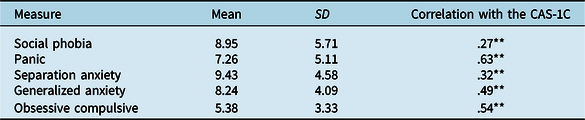
Table 1 presents the means, standard deviations and correlations among the studied variables. As we hypothesized, the CAS-1C was significantly and strongly correlated with measures of overall anxiety, depression, worry and metacognition. We also examined relations between the CAS-1C and specific anxiety symptoms according to the RCADS, which are displayed in Table 2. The CAS-1C showed strong associations with panic, obsessive-compulsive and generalized anxiety symptoms, and moderate associations with social anxiety and separation anxiety symptoms.
Descriptive statistics and intercorrelations between study variables

‡Non-parametric correlation. SD, standard deviation; CAS-1C, Cognitive Attentional Syndrome-1 for Children; RCADS, Revised Child Anxiety and Depression Scale – Child version; PSWQ-C, Penn State Worry Questionnaire – Child version; MCQ-C30, Metacognitions Questionnaire for Children. ** p < 0.01.
Descriptive statistics for the RCADS anxiety symptoms subscales and their correlations with the CAS-1C

SD, standard deviation; CAS-1C, Cognitive Attentional Syndrome-1 for Children; RCADS, Revised Child Anxiety and Depression Scale – Child version. **p < 0.01.
CAS-1 as a clinical assessment tool
We were interested in determining whether the CAS-1C explained additional variance in anxiety scores over and above the MCQ-C30. Therefore, a two-step linear regression analysis was run with RCADS-C total anxiety as the outcome variable and MCQ-C30 and CAS-1C as the predictor variables entered in Blocks 1 and 2, respectively. The MCQ-C30 accounted for 36.6% of the variance in Step 1, and the CAS-1C accounted for an additional 6.4% of the variance in Step 2. Both steps in the model were significant: MCQ-C30, F 1,125 = 72.25, p < .001; CAS, F 2,124 = 46.85, p < .001. Due to the prominent role of worry in the metacognitive model, we conducted the same analysis with worry (as measured by the PSWQ-C) as the outcome variable. Here, the MCQ-C30 accounted for 36.9% of the variance in Step 1, and the CAS-1C accounted for an additional 5.4% in Step 2. Again, both steps in the model were significant: MCQ-C30, F 1,125 = 72.99, p < .001; CAS-1C, F 2,124 = 45.44, p < .001. With regard to the degree of multicollinearity, our tolerance values were .57 in both analyses, which is acceptable according to Menard (Reference Menard2002), who recommends that tolerance values should be above .2.
Given that it is not ideal to use a lengthy instrument such as the MCQ-C30 in treatment sessions, we wanted to test the hypothesis that CAS-1C has potential as a quick assessment of metacognitive beliefs and strategies. To do so, we assessed how much of the variance in symptoms was explained by the longer assessment tool, the MCQ-C30, compared with the shorter CAS-1C, by employing four sets of linear regression analyses. Findings showed that with regard to anxiety symptoms, the MCQ-C30 was able to explain 36% of the variance in RCADS-C and the CAS-1C was able to explain 35%. Similarly, the MCQ-C30 explained 36% and the CAS-1C explained 32% of the variance for worry symptoms. This suggests that the CAS-1C had similar relevance to symptomatology as the more lengthy measure of metacognitions.
Sensitivity to change
In order to examine the sensitivity of CAS-1C to treatment change, we used a subsample of 104 children that had completed either MCT or CBT in a university clinic setting. The remaining 23 families had either declined to receive the offered treatment after the intake assessment (n = 8), had dropped out during the active treatment phase (n = 5), or had missing data points at post-test (n = 10). A significant reduction in CAS activity from pre-treatment (mean = 17.62, SD = 7.92) to post-treatment (mean = 11.24, SD = 7.04) was found, t 103 = 8.25, p < .001. With regard to the magnitude of effect, we calculated Cohen’s d, which indicated a large effect size, d = 0.81.
Furthermore, we conducted regression analyses to examine whether the changes in CAS-1C were associated with changes in anxious symptomatology as measured by the RCADS-C total anxiety and PSWQ-C, when controlling for the effects of age and gender. We used change scores from pre- to post-treatment in RCADS-C total anxiety and PSWQ-C, respectively, as the outcome variables and the pre- to post-treatment change score in CAS-1C as the predictor variable. Table 3 contains the results of the regression analyses. Both regression analyses were significant: RCADS-C total anxiety: F 1,102 = 26.86, p < .001; PSWQ-C: F 1,102 = 23.07, p < .001. CAS-1C was a significant predictor of changes in anxiety and worry during treatment, explaining 21 and 17% of the variance in anxiety and worry change scores, respectively. This further indicates that this measure is sensitive to treatment change.
Regression analyses for changes in CAS-IC as a predictor of changes in anxiety and worry symptoms

Δ, change in score from pre- to post-treatment; CAS-1C, Cognitive Attentional Syndrome-1 for Children; RCADS, Revised Child Anxiety and Depression Scale – Child version; PSWQ-C, Penn State Worry Questionnaire – Child version. ***p < 0.001.
Discussion
In this study, we modified the content, language and reading level, as well as the response scales, of an adult measure of the cognitive attentional syndrome in order to adapt it for use with children aged 7–13 years. Consistent with our first hypothesis, we found strong positive associations between the new measure, CAS-1C, and symptom measures of anxiety, worry and depression. This suggests that the proposed deleterious effects of the CAS also apply to children. Although all measured symptoms of anxiety disorders and depression had significant positive associations with the CAS, there were marked differences between the disorders in the strength of the association. Whereas the associations with the CAS were strong for depression, panic, obsessive-compulsive and generalized anxiety symptoms, they were only moderate for social phobia and separation anxiety. While this finding may be due to the composition of our sample (i.e. few suffered from social anxiety disorder), it may also indicate that there are important differences in the CAS between different disorders in childhood. Such differences are in line with the metacognitive theory, which states that although the underlying model is transdiagnostic, there are individual manifestations of the CAS in various disorders (Wells, Reference Wells2009). For example, judgements of cognitive confidence in one’s own memory have been found to be particularly important for adult social phobia (Nordahl and Wells, Reference Nordahl and Wells2017) and are not included in this brief measure of the CAS. Our results are comparable to adult findings that the measure is of particular relevance to depression and generalized anxiety symptoms (Fergus et al., Reference Fergus, Valentiner, McGrath, Gier-Lonsway and Jencius2013). From a clinical perspective, clinicians should be cautious when interpreting the CAS-1C in children who suffer primarily from separation anxiety and social phobia, and they should supplement this information with disorder-specific information that captures socially anxious children’s metacognitions and safety behaviours as well as the tendency of children with separation anxiety to seek proximity to their parents. In our study, we were unable to disentangle CAS differences between disorders further, as our clinical sample had a high rate of co-morbidity. Nevertheless, such a sample resembles the complexity in the composition of the samples in everyday clinical practice settings, where the CAS-1C is likely to be used.
In line with our hypothesis, we found a strong relationship between the CAS-1C and MCQ-C30. This was expected, as both instruments aim to measure maladaptive metacognitions. Also in accordance with our hypothesis, after accounting for metacognitions, the CAS-1C was able to explain an additional 6.4 and 5.4% of variance in the children’s anxiety and worry symptoms. This may be due to the CAS-1C having an additional specific focus on thinking styles and strategies that are not captured by the MCQ-C30. However, although the additional explained variance was significant, it was rather small. Next, although the CAS-1C is a shorter and broader measure than the MCQ-C30, it showed equal ability to predict anxiety symptoms and worry. This accentuates the clinical utility of the assessment tool, as longer time-consuming questionnaires may pose a challenge for clinicians due to constant time constraints. While the strength of the MCQ-C30 is to provide detailed information on specific metacognitive domains, the CAS-1C may be used when there is a need for a time-efficient measure of metacognitive beliefs and metacognitive strategies.
Third, as expected, the measure was able to detect treatment change. Following treatment, children had lower scores on the CAS-1C than they did at the intake assessment. The magnitude of this effect was large (d = 0.81), yet caution should be taken with regard to this interpretation, as this was a completer analysis and we did not control for the effect of time. Although not a focus of the present study, initial analyses suggest that reductions in CAS activity are seen in both metacognitive therapy (d = 1.07; n = 21) and in cognitive behavioural therapies (d = 0.76; n = 83). Future studies with randomized designs and larger sample sizes per treatment group are needed to investigate potential differences in effect in more depth. Further supporting the sensitivity of the measure to treatment change, the CAS-1C was a significant predictor of change in anxiety and worry symptoms during treatment. These results suggest that the measure can be used to track progress in metacognitive components during psychotherapeutic treatment of anxious children. Of note, we did not control for co-morbidity or treatment type in these analyses. It may be that lower degrees of change in CAS activity are seen in children with higher rates of comorbidity or suffering from disorders other than anxiety, such as oppositional defiant disorder or attention deficit hyperactivity disorder.
The present study has limitations that must be acknowledged. The studied sample included only children with an anxiety disorder as their primary problem. Therefore, our results do not generalize to a broader group of children with psychopathology, which the metacognitive theory claims to represent. No inter-rater reliability analysis was performed on the diagnoses, and therefore caution needs to be taken with regard to their precision. Also, in future, further validation of the questionnaire’s factor structure may prove beneficial, as it may be that the CAS-1C can be meaningfully divided into subconstructs, as has been seen with the adult measure (Kowalski and Dragan, Reference Kowalski and Dragan2019; Nordahl and Wells, Reference Nordahl and Wells2019). Due to our relatively limited sample size, we were not able to perform such analyses. Furthermore, our analysis of the measure’s treatment sensitivity could be improved to not only demonstrate sensitivity from pre-treatment to post-treatment, but also between therapy sessions by measuring mid-treatment effects. Information about the measure’s test–retest reliability would be helpful in order to establish more certainty about the treatment sensitivity. We were also unable to compare the change in CAS by type of treatment and diagnosis. Finally, although the content of some items was changed to better represent the CAS in children, there may be CAS behaviours that are specific to this age group that are not part of the original adult scale. Future qualitative work would be beneficial for elucidating such behaviours.
In conclusion, the present study demonstrated support for the use of a measure of the CAS for clinically anxious children. The CAS-1C has the benefit of being a brief, easily administered tool that provides information on the core components of relevance to the maintenance of psychopathology according to the metacognitive model. We believe that such a measure is of interest to both clinicians and researchers who wish to assess and monitor children’s thinking styles, strategies, and positive and negative metacognitive beliefs.
Acknowledgements
None.
Financial support
This research received no specific grant from any funding agency in the public, commercial, or not-for-profit sectors.
Conflicts of interest
The authors have declared that they have no competing or potential conflicts of interest.





Comments
No Comments have been published for this article.