Advertisements for various methods to solve the navigational problem of longitude appeared in several London newspapers soon after the creation of the Board of Longitude and the announcement of the maximum £20,000 reward in the summer of 1714. While there have been many studies addressing numerous aspects of the quest to determine longitude accurately, these advertisements have not received close scrutiny. This article examines the first year of longitude advertisements, from approximately July 1714 to July 1715. It is true that none of the schemes promoted during this twelve-month period were successful in methodology, receiving the reward, or even appearing before the Board itself, but efficacy is not my main concern. A study of specific notices for a specific period allows insight into the importance of the reading public for the potential success of the schemes and the degree to which longitude was turned into a commodity. Moreover, these ads utilized London's public sphere, itself upheld in part through newspaper publication. Longitude advertisers were only too happy to use this marketplace of ideas for their own purposes. As such, longitude ads reflect larger phenomena in Enlightenment-era London and my focus is set on what these ads can reveal about the nexus of commercialization, natural philosophy, and the importance of advertisement itself for historians of eighteenth-century science. “Every literary form,” Simon Schaffer explains, “is linked with local complexes of technical and social practice” (Schaffer Reference Schaffer and Lenoir1998, 221).Footnote 1 Revealing the “complexes” of longitude ads is the goal of this current study.
Notices of proposed longitude solutions and discussion of such solutions were found in several London newspapers: British Mercury, Daily Courant, Evening Post, Examiner, Post Boy, Post Man, Weekly Journal with Fresh Advice Foreign and Domestick, and the Weekly Packet. These newspapers were mostly the single-sheet variety, news on the front and two columns of advertisements on the reverse. On the importance of this type of newspaper, Gary Stuart De Krey writes that it “quickly became an integral part of London's political culture and a critical agent in providing the London electorate with information about politics” (De Krey Reference Krey and Stuart1985, 215; see also Rogers Reference Rogers1989, 13; Holmes Reference Holmes1987, 32). Longitude schemes took advantage of this readymade promotional platform that had been created to carry politics out of doors, and fashion the public sphere itself, even though political agendas played little role in the advertisements. Authors, instrument makers, public lecturers, and opportunists set their plans to solve the problem of longitude in published books or with displays of accurate timepieces. Getting potential supporters to open those books or inquire about those instruments, however, required that their interests be piqued through widely available advertisements. In this way advertisers were speaking to consumers, engaging in a silent conversation of persuasion. It is a conversation that historians miss by considering only objects (books or instruments) when writing histories of longitude.Footnote 2
The academic study of advertisements is quite young. In 1982, Neil McKendrick published one of the first dedicated studies of ads and urged others to follow his lead by engaging with these untapped resources, which “illustrate the extent of the commercializing process” in eighteenth-century England. Recently, Maxine Berg lamented that McKendrick's plea found a mostly deaf audience and that “Few have celebrated the virtues of advertising.” Fewer historians of science have considered ads to be part of their purview even though the growth of public science in the eighteenth century brought with it the commercialization, and hence marketing, of formerly esoteric natural philosophy.Footnote 3 In focusing on longitude ads, I have adopted the advice offered by McKendrick, who suggested that “by concentrating on an individual advertising campaign one can demonstrate in more convincing detail its characteristic quality.” Moreover, as Patricia Fara revealed in her study of magnetism, the examination of a single natural philosophical concept, longitude in this present example, for a defined period of time “enables grander historical themes, such as the emergence of the public sphere, the creation of a consumer society . . . to be fleshed out and refined” (McKendrick Reference McKendrick, McKendrick, Brewer and Plumb1982, 191, 192; Berg Reference Berg2005, 270; Fara Reference Fara1996, 6).Footnote 4
By being advertised on the back page of newspapers, longitude became another commodity marketed to the public. Early eighteenth-century newspaper advertisements, longitude examples included, were in text only and relied on descriptive persuasion, although some ads did utilize simple graphics such as pointing fingers, stars, or large bold-face type. Broadly speaking advertised consumable goods tended not to be essential items but rather items that made the lives of those who could afford them pleasant, comfortable, and more interesting. Longitude was similarly consumed, not by an individual consumer only but more importantly by the Board of Longitude. The ability to determine longitude would certainly have the same impact on sea travel by making it more pleasant, comfortable, and a great deal less challenging for sailors trying to determine their location in open water. This is not to suggest that the ability to determine longitude was considered a luxury. Certainly it was seen as a necessity. What is more, with respect to the role played by commodities in society, aside from personal accumulation, Adam Arvidsson, following the work of Ernest Dichter, has theorized that “people tend to use consumer goods as tools for the construction of social relations, of sense of self or of a context for life in general. Goods have use-values that go beyond their established functionality” (Arvidsson Reference Arvidsson, Brewer and Trentmann2006, 79).Footnote 5 Purchasing books describing how specific stellar observations might determine longitude or witnessing the demonstration of a particular clock that promised precise timekeeping, provided consumers more than interesting publications and grist for future conversation. A successful method for determining longitude would bring stability to the nations' sea faring enterprises, commercial and military. This was consumption for the good of the nation, buying with a greater purpose.
To accomplish my goal of explicating the meaning of longitude ads within the natural philosophical and commercial climates of the day, I have divided this article into three sections. Section one, Context, will consider briefly the three newspapers containing the bulk of the longitude ads, before outlining the problem of longitude itself and the formation of the Board of Longitude. Section two, Content, will present the ads themselves with commentary meant to reveal how promoters used their ads to both speak to potential consumers and seek public validation. Finally, section three, Meaning, will offer some interpretation of the longitude advertising campaign and what it can teach us about natural philosophy, commercial culture, and the public sphere in London.
Context
While there were several newspapers offering longitude advertisements and discussion of the problem, the Post Boy, Post Man, and Daily Courant contained the most ads of this type between 1714 and 1715.Footnote 6 The Post Man and Post Boy were two of London's most important single-sheet newspapers and appeared in late 1695 following the lapse of Licensing Act. The Post Boy débuted on 16 May 1695 and was followed by the Post Man on 22 October of that same year.Footnote 7 Both papers were thrice-weeklies printed on Tuesday, Thursday, and Saturday. The Daily Courant, printed every day except Sunday, premiered on 11 March 1702 with a mission to “give news daily and impartially.” Mostly its articles came from foreign newspapers (Walker Reference Walker1974, 701–702). How many people read these three newspapers? The Post Man was the most circulated paper in London during this time; while Geoffrey Holmes has identified the Post Boy as one of “the most widely read” newspapers. In 1704, for example, this meant subscription numbers for each issue of over 3,800—as many as 4,000 on Saturday—for the Post Man and 3,000 for the Post Boy. In contrast the Daily Courant managed 800 subscribers a day for its six issues per week. Thus, from a commercial standpoint, the Post Man and Post Boy were important venues. By 1712 nearly 25,000 copies of single-sheet newspapers of all types were sold every week in London. Factoring in coffeehouses and other types of multiple readers of issues such as families, individual issues of each paper were perhaps read by as many as 50,000 persons (Sommeville Reference Sommeville1996, 123; Walker Reference Walker1973, 116, 130; Sutherland Reference Sutherland1935, 111, 124; Porter Reference Porter2000, 77; Van Horn Melton Reference Van Horn Melton2001, 29; Holmes Reference Holmes1987, 30–31). Longitude ads reached a very sizable audience.Footnote 8
When the advertised commodity could potentially provide Britain with an unsurpassed navigational advantage over its rivals, the stakes were high indeed. By the early eighteenth century one half of the two-pronged problem of maritime navigation had been solved, that of latitude (location north or south). Its calculation relied on determining the angle of the North Star: higher meant one was further north and a lower angle meant one was nearer the equator. Once past the equator (the unchanging midpoint), navigators relied on other stellar points of reference such as the Southern Cross. During daylight hours one could also rely on the altitude and angle of the noon sun. But the other half, accurate determination of longitude (location east or west) remained a quandary that seemed for many, including Isaac Newton, to be unsolvable. That it remained unsolved was painfully reinforced in 1707 when a maritime disaster took the lives of over 2,000 of Her Majesty's Royal Navy after the convoy commanded by Rear Admiral Sir Cloudesley Shovell mistook its position and ran aground near the Scilly Islands (Fara Reference Fara1996, 66–67). Reckoning longitude, which on paper was a deceptively simple matter, rested on knowing what time it was at a recognized longitude such as Greenwich (although part of the problem was that any longitude could serve as a reference point) and taking into account that the Earth rotated 15° every hour. By comparing the local time aboard ship (midday is easiest) with the time at the same moment at Greenwich, a captain could know how far west he had sailed because every four minutes (or one degree) difference translated to approximately sixty miles, slightly more at the equator and less nearer the poles. The problem was that no reliable method for keeping time on a ship during a prolonged journey existed because most contemporary clocks relied on pendulum motion, which did not work particularly well onboard a ship in the choppy waters of the Atlantic. Similarly, existing spring-driven clocks did not possess enough accuracy to be useful in navigation. As one hopeful put it, “if Time can be kept exactly at Sea, the Business is done” (Billingsley Reference Billingsley1714, 10).
Another method of determining time relied upon astronomical observation. Certain celestial events, such as the orbital periods of Jupiter's four largest moons, were known to occur at specific times. By observing these from onboard ship, and consulting tables of astronomy, the time could be found and the process would continue as outlined above (Johnson Reference Johnson1989, 66). Galileo had devoted much time in his final years to perfecting this approach. However, as with pendulum clocks the pitching deck of a ship did not make a very satisfactory observational platform despite attempts at producing telescope supports with gyroscopic levels.Footnote 9 The lunar distance method, which involved the angular distance of the moon compared to a known reference star in addition to measuring the altitude of the moon and the reference star, was also thought to be promising but again accurate observation at sea proved elusive. Also limiting the practicality of the lunar distance method was the difficulty in compiling an accurate chart of the moon's motion. It remained an issue until the mid-1750s when the German astronomer Tobias Mayer produced a new table of the moon's orbit for which he received a posthumous reward from the Board of Longitude (Kuhn Reference Kuhn1984, 42). Pursuit of these heavenly tactics, which did work well with land-based longitude queries, had been one of the chief reasons for founding the Greenwich observatory in 1675 and the establishment of John Flamsteed as the first Astronomer Royal charged with the task of obtaining hyper-accurate data.
If necessity is the mother of invention, then financial reward is certainly its midwife. In July 1713 William Whiston and Humphrey Ditton began suggesting that the government sponsor a prize for solving the problem. Whiston, having recently been cast out of his Lucasian Professorship at Cambridge for promoting Arianism, was establishing himself as a popular London public lecturer of Newtonian natural philosophy and always on the lookout for money-making possibilities. Ditton offered mathematical lectures at the Marine Coffeehouse (Jacob and Stewart Reference Jacob and Stewart2004, 70, 78; Snobelen and Stewart Reference Snobelen, Stewart, Knox and Noakes2003, 148–167). By the following year, their gentle prodding had grown to a push that, in combination with the efforts of others who had joined the cause, was large enough to see the creation of “An Act for providing a publick Reward for such Person or Persons as shall discover the Longitude at Sea” on 3 July 1714. The announcement was noted by both the Examiner and the British Mercury on 5 and 7 July respectively. The former commented that Whiston was no longer pursuing longitude (a claim that was false) but had found a new pastime in hassling the English Church in support of Arianism (a claim that was true). For a newspaper that was the brainchild of Jonathan Swift's High-Church Tory mind (Black Reference Black2001, 26), the characterization of Whiston is understandable. The British Mercury, a paper that was a product of the Sun Fire Insurance Company (ibid., 65), included the Act among a list of legislation to which Queen Anne had given royal assent in the House of Lords. High stakes demand a high reward and the Board of Longitude, the body selected to oversee and evaluate potential solutions, was authorized to present £10,000 for accuracy within one degree or sixty miles and twice as much (£20,000) should anyone reckon longitude within one-half of a degree or thirty miles. Particularly promising projects might also be granted seed money. There can be little wonder that so many people offered solutions (Stewart Reference Stewart1992, 186, 189).
Illustrious though the Board may have been – Bishops of Hereford and Bristol, First Commissioners of the Admiralty, Navy, and Trade, Admirals of the Red, White, and Blue Squadrons in addition to the President of the Royal Society, the Astronomer Royal, the Savilian, Lucasian, and Pulmian Professors, among others, all joined by several high profile MPs – it convened very sporadically and no records of its meeting prior to 1737 are extant (Johnson Reference Johnson1989, 65). To appear before the Board meant submitting an application that the members deemed worthy of consideration. By all accounts, however, not much seemed to impress the members who quickly dismissed much that was brought to their attention. Given the additional costly condition that a successful plan had to be tested on a Royal Navy ship during a voyage to the West Indies or any such port chosen by the Board, only those schemes judged to have sufficient merit would proceed past the stern eye of the Board (Sobel Reference Sobel1996, 55). With a somewhat invisible judge, would-be solvers of the problem had to present their cases and sell their wares in the public sphere if they were going to derive any profit from their plans. However, advertisers also hoped to catch the attention of Board members, to whom many books outlining solutions were dedicated, through such a public promotional campaign.Footnote 10
Seeking public involvement and validation for natural philosophical endeavors, which is what schemes of longitude were, was something of a novelty although it was not entirely without precedent. In a 4 February 1697 Post Man advertisement Bernard Connor, MD, requested that audience members for his anatomy lectures think of experiments and procedures they would like to see and communicate the same in advance of the lecture. Nonetheless, as has been aptly demonstrated by several scholars, the production of facts of nature and natural philosophy itself was a closely guarded process that aimed to exclude all but the initiated. Jan Golinski, for example, has commented that early modern natural philosophy, of the type practiced in the mid-to-late seventeenth century by Robert Boyle to name only one, was presented, not shared, decreed, rather than debated. The public was a passive recipient of ready-packaged knowledge (Golinski Reference Golinski1992b, 2–3; Shapin Reference Shapin1988). This is not to say that readers of natural philosophy did not take what they had learned and apply it to problems of their own choosing, but that the making of natural knowledge itself was not done in a public manner.
Longitude was different and so too was the culture in which it was presented. In his influential Structural Transformation of the Public Sphere, Jürgen Habermas asked the question: when did open and critical discussion of issues relating to the public good first emerge? He suggested in response that the creation of public avenues of debate chiefly in print media, for topics formerly done in private behind closed doors, led to the creation of the public sphere. For Habermas the phenomenon of the public sphere was intimately tied to the dissolving of household economies replaced by markets as the means of exchange and accumulation of goods and services. This occurred, he argued, first in England in the late seventeenth and early eighteenth centuries. Recently, Peter Lake and Steve Pincus have dated the initial emergence of the English public sphere to the era of the Civil Wars, ca. 1642–1649. Each side Royalist and Parliamentarian sought to “secure military and ideological victory” among the English population through a variety of printed publications. “These were,” Lake and Pincus continue, “wars of words as well as of guns” designed to shape public opinion. The result was a market for current events and an explosion in the volume of printed material, which England would never abandon. Closely associated with the great availability of print was the changing demography of the country. By 1700, and the firm establishment of the public sphere, more and more of the nation's population lived in towns or cities and used the market as the vehicle of commerce (Lake and Pincus Reference Lake and Pincus2006, 279, 280, 282). Within the public sphere ideas became commodities and certainly had done so by the time period of this study. Natural philosophy too found a niche in London's pubic sphere becoming public science, as scholars have aptly shown (Stewart Reference Stewart1992; Golinski Reference Golinski1992b). “It was the evolution of the public sphere,” Thomas Broman writes, “that gave the new natural philosophy its wide spread cultural authority in the eighteenth century” (Broman Reference Broman1998, 124).
Longitude, although part of the public science phenomena, was unique. In part it is the difference between demonstration and experiment with the former repeatedly displaying knowledge already known to be true and the latter attempting the creation of something novel with the outcome not entirely certain. Public lectures and popular books about natural philosophy offered eighteenth-century witnesses and readers, among other topics, demonstrations of Newton's laws of motion that were acknowledged to be true. Conversely, solutions to longitude were not as certain to be true. Consider the following two advertisements. The first appeared in the Post Man on 18 March 1710 announcing the publication of a book:
Physico-Mechanical Experiments on Various Subjects, containing an Account of several surprising Phaenomena, Touching Light and Electricity, Producible on the Attrition of Bodies . . . To which are added, the Explanations of all the Machins (the figures of which are done from Cropper, Curiously Engrav'd and other Apparatus us'd in making the Experiments[)]. Sold by J. Knapton, H. Clements. R. Smith Booksellers. And in Wine Office Court Fleet-Street by the Author, F. Hauksbee, F.R.S. . . . Pr. bound 6s.
The second appeared 29 January 1717 announcing a series of lectures:
A Course of Mechanical and Experiment Philosophy, under the following Heads, viz. Mechanicks, Opticks, Hydrostaticks and Pneumaticks, to be perform'd by Fr. Hauksbee, and the Explanatory Lectures read by W. Whiston, M.A. Catalogues of the Experiments may be had Gratis at Mr. Whiston's House the lower end of Crossstreet, Hatton Garden, and at Mr. Hauksbee in Crane Court near Fetter Lane, Fleetstreet, where the Course is to be perform'd. Subscriptions are taken in at either of the above mentioned Places. This course is to begin on Monday the 4th of February, 6 in the Evening.
Neither of the ads, which are entirely typical, asked for public judgment or participation in the construction of the natural philosophy to be demonstrated. As I hope to show, purveyors of longitude were conducting public experimental trials of their schemes. Tied to these displays of longitude was another public encounter with natural philosophy occurring almost simultaneously. In early 1715 the solar eclipse coming in April had Londoners inundated with offers of lectures, observational devices, and instruments. This event helped condition the longitude audience for some of the hopefuls. While the rooms of the Royal Society and the laboratories of its fellows remained out of reach for most of London's population, the problem of longitude provided an opportunity to participate in the production of natural philosophy for the city at large. Validation and credibility were sought among the audiences of London's newspaper reading public. Advertisers hoped that the public sphere would become both the crucible of judgement for longitude and the eager consumer for anything related to the pursuit of its solution.
Content
Longitude ads began appearing in the Post Man even before the creation of the prize. In 1710 a second edition of Thomas Streete's Astronomia Carolina; or a New Theory of the Coelestial Motions promised readers a new appendix that would use the material presented in the book “to find the Longitude at Sea.” Streete, who had died in 1689, was reputed to be a first-rank astronomer well into the eighteenth century. This current version of the book was edited by Edmund Halley, whose scheme of longitude, based on observations of the appulses (near appearance of one stellar body to another) of a star close to the moon, is found in the text, although none of this is mentioned in the ad. What is more, the title page of the book does not contain the same promise of a longitude solution as found in the newspaper ad. The book offered “Lunar and Planetary Observations with a Proposal for their use in Navigation” (PM 23 February 1710; Street Reference Street1710; Cook Reference Cook1998, 395–398). It would seem that the lure of longitude was here used as a literary device to pique interest in the publication. This indicates that even prior to the announcement of the prize longitude carried a certain rhetorical attraction for readers who were sufficiently aware of the nation's navigational woes for a potential solution to the problem to translate into sales. Halley's failure to find success with his method in 1710 is ironic because as Savilian Professor of Geometry at Oxford he was appointed to the Board of Longitude in 1714 and would judge schemes with which he was in competition. The announcement of the prize must have given Halley and his publisher renewed hope for sales and consideration of the plan because a new version of both the book and the advertisement appeared in the Weekly Journal on 4 June 1715 in which Halley's name figured prominently in the ad copy.
A similar use of longitude is also found in a Post Man ad placed within weeks of the prize announcement. In the first week of September 1714 Benjamin Habakkuk Jackson's anonymously advertised work of astronomy included such topics as “Threefold Motion of the Earth: The Rectification of the Kallendaer; the Flowing and Ebbing of the Sea, the Nature of the Magnet; the Variation of the Compass; the cause of the Sea Currents and Trade Winds; the various Motions of the all the Celestial Orbs; the finding out the true Place of the Moon.” All of this, the ad promised, was merely a preface to the real purpose of the book which was “Discovery of the Longitude” with a method never “before thought of.” Specifically, Jackson offered his work to the esteemed judgment of the public and “to the Honourable the Learned and Ingenious Gentlemen of the Royal Society.” Jackson seems to have used both the book and the ad as a means to attaining an introduction to the Royal Society with the hopes of joining their ranks. Using public acclamation was a new way to gain entrance into the Society and reveals the importance of the public sphere, whereas previous would-be Fellows, as Andrea Rusnock has argued, sent private letters to the society with the goal of finding admittance. As newspaper readers would help validate longitude schemes, they might also help confer Royal Society membership. The use of the term “longitude” in the ad and in the book, where the section in question is slightly less than five lines offering only a suggestion that the inclination of the earth might aid in astronomical observations lending themselves to determining longitude, is best viewed as a hook to snare readers who held an interest in such matters. Jackson found no takers for his plan, and did not become a Royal Society Fellow. He did have some success a few years later in 1722 when he patented his “swimming engine,” a life jacket that obtained buoyancy with iron cylinders. He drew interest in the device the same way that he had hoped to do with his longitude scheme: through public viewing and demonstration (PM 7 September 1714; Jackson Reference Jackson1714, 12; Rusnock Reference Rusnock1999; MacLeod Reference MacLeod1988, 86–87).
Henry Wilson also had success after his longitude plan came up empty. In late July (the 19th, 21st, and 23rd) 1715 Wilson who styled himself a “Philomath,” offered readers of the Evening Post, London's first nightly newspaper (Black Reference Black2001, 28), and the Post Man his plan, which was contained in Navigation new Modell'd. The scheme relied upon trigonometry and mathematics to compute longitude using heavenly bodies. At over 500 pages, Wilson's book was easily one of the longest published that first year of longitude advertisements. Along with examples of correct observational method and measuring technique to determine one's longitude, Wilson used the book to promote his skill in teaching logarithms, tangents, and other aspects of trigonometry as might be useful for artillery commanders ranging their cannon (Wilson Reference Wilson1715). While the book did not bring Wilson success in 1715, its usefulness for navigation outlived its author. Although he died in 1741 a new edition of Wilson's book appeared as part of a collection of navigational treatises under the title, A compleat system of navigation, published in Dublin in 1750 (Atkinson Reference Atkinson1750).
For July and September 1714 the Daily Courant was the chosen venue for longitude advertisements. Those placed by William Hobbs nicely exemplify the complex nature of the longitude ad campaign.Footnote 11 On 20 July Hobbs offered readers a complete account, in a brief fourteen pages, of his “New, Universal, valuable, and infallible Horologe,” a timepiece that was impervious to “Motion arising from Cold and Heat, or difference of Climates, or from foulness or cleaness or the Movements.” For an instrument that would hopefully spend long days at sea, this was an important claim. Hobbs sought more than public approval and validation of his device. Lack of financial wherewithal had prevented actual manufacturing. Knowing that his invention would be successful, Hobbs urged, “any one Person, whether Merchant or private Gentleman, Mathematician or watchmaker, [who] is willing to engage in this so Noble an Enterprize, he will be readily received as a Partner, on such conditions as may be reasonably concerted therein.” In this example, the ad sought acceptance and backing. For all intents and purposes what Hobbs had published was a research proposal that hoped to secure a patron among the readers of the newspaper. Later that year, on 8 November, Hobbs offered to show the finished timepiece at various London coffeehouses so that its accuracy could be witnessed firsthand. Public approval and sales were crucial, because Hobbs' attempt to appeal directly to the Board through a letter sent to Flamsteed had met with no success (DC 20 July, 8 November 1714; Hobbs Reference Hobbs1716; Stewart Reference Stewart1992, 194).
Also seeking public acclamation was William Hall whose own plan involved observation of the sun to determine longitude much in the same way that one might find latitude. A succinct fifteen-page pamphlet, dedicated to the Board of Longitude, outlined Hall's idea. The earth, he began, was an immovable sphere with equal surface area in all directions, which the sun circled daily. This meant that both latitude and longitude were equal distances. From these erroneous assertions, Hall concluded, one could use the same method to find each: the angle of the sun. What is important about the ad, other than the apparent long-lasting belief in the Ptolemaic model of the solar system, is the promise that Hall's plan would be rendered in “a Plain and Familiar Way for the Publick Good” and “recommended to publick Consideration.” Moreover, Hall encouraged public evaluation of the plan. In this most important natural philosophical endeavor, private rooms and closed experimental spaces were giving way to public judgment. For Hall this manner of promotion held more importance than navigation. “The whole World,” he explained, “is the Looking-Glass of GOD's Power and is Subject enough for all Men's Admiration in the Universe” (DC 7 September 1714; Hall Reference Hall1714, 6–7, 10). To determine longitude was to know God.
The issues of the Post Man from the middle of September offered readers a longitude scheme by Isaac Hawkins. Hawkins, who is mistakenly called “Hawkings” in the ads, promoted “An Essay for the Discovery of Longitude at Sea by several new Methods fully and particularly laid before the Publick.” Companion ads were also placed in the Daily Courant on 13 and 17 September 1714. Though in the ad Hawkins solicited public approval, the book itself was dedicated to the “Commissioners appointed by Act of Parliament for the Discovery of the Longitude at Sea,” whom he named individually in the dedication (PM 14, 18 September 1714; Hawkins Reference Hawkins1714, preface). Certainly, he expected some Board members to be reading the Post Man. But he also sought public validation of the plan, which would consist of sailors' measuring when high and low tides occurred at their location and then compare this data against the tables found in Hawkins' book. Accurate measurement proved extremely difficult and the plan met with little success. A similar tactic of gaining notoriety before the Board is evident in the early October 1714 ad for John Coster's A Practical Method for finding the Longitude at Sea, by a Marmeter, or Instrument for measuring the exact Run of the Ship. Coster, from a family of copper smelters in Bristol and also an engineer who made contributions to copper mining, hoped to parade his instrument before the “Honourable Commissioners for finding the Longitude at Sea” by first coming to their attention through the Post Man (PM 9–12 October 1714; Stewart Reference Stewart1992, 295–6).
Solutions that relied on the accuracy of instruments were common among the longitude ads. For example, Samuel Watson, known seller of timepieces and planetariums, joined the race for the longitude prize in late October 1714 in a Post Man ad. His entry, not surprisingly, was a clock that promised to adjust itself automatically to the local time after only a single observation on the part of the user. As would Hobbs in November that same year, Watson offered to show the device to whomever asked and hoped to gain enough notice to entice “the Honourable Commissioners appointed by Act of Parliament” to request a viewing “when they shall think fit” (PM 23–26 October 1714; Clifton and L'E. Turner Reference Clifton and Turner1995, 291). Public solicitation of a public viewing added a new dimension to natural philosophical validation and confirmation of facts. Watson certainly had the expertise needed to produce a clock with the precision that he claimed in the ad. Prior to this latest horological endeavor, Watson was highly regarded for his craft, which the diarist John Evelyn described as “the best of that Profession.” Among Watson's customers was Charles II who, in 1682, had paid the princely sum of £215 for a clock which “showes the rising and setting of the Sun and Moon, and many other motions” (Evelyn Reference Evelyn and Beer1995, 111–112; Akerman Reference Akerman1851, 66). Watson had also been involved in an earlier use of timepieces in the service of science, specifically medical science. The physician Sir John Floyer, who authored The Physician's Pulse Watch in 2 vols. (1707–10), had turned to Watson to produce an instrument that allowed for extremely accurate time measure (it included a second hand) of a patient's pulse. Despite enormous past success, Watson failed to build a clock that satisfied the requirements of the prize, which demanded accuracy to within three seconds per day.
On 11 November 1714 Jeremy Thacker promoted another type of clock. In The Longitudes examin'd, Thacker claimed to have produced a timepiece that was contained within a vacuum, sealed inside a vessel, that kept the workings secure against the elements. He had also devised winding rods that ensured the clock continued to move while it was being wound. Thacker alerted potential readers of his book, rather immodestly, that this “Machine of my Own, which I am (almost) sure will do for the Longitude,” would indeed “procure me the £20,000.” Having coined the term “chronometer” to refer to his invention, Thacker was entirely mocking of rival schemes, which he referred to as being championed by “Longitudinarians.” A snipe at Whiston whose own Latitudinarianism leading to Arianism had sealed his fate at Cambridge. In the book Thacker described how “poor Mr. W—–n” who had “been so often handled as a Longitudinarian and a Latitudinarian” had become so entranced by his flashy ideas that the idiocy of his scheme was not apparent. However, the best accuracy that Thacker could achieve with his chronometer was a loss of six seconds per day, nearly double what was needed. Although it failed to produce results that merited the prize, Thacker's attempt has been called “the best of the lot reviewed by the members of the Board of Longitude during the first year” (PM 11 November 1714; Thacker Reference Thacker1714, 2; Sobel Reference Sobel1996, 59).
Thacker's claim to sole proprietorship of his described clock was contested by a rival. The 5 April 1715 issue of the Post Boy contained the ideas of John Ward who, described as being an instructor in mathematics, “Humbly propos'd for the Use of the Publick” what he called “A Practical Method to discover the Longitude at Sea, by a new contriv'd Automaton; freed from all the various Effect of Air, in different climates, &c. and liable to disorder, by the irregular Motion of a ship; the whole method render'd plain and easy to be understood by every Mariner.” Like other hopefuls Ward appealed directly to the reading public rather than the Board members, although the book was dedicated to them. Also, Ward claimed his unnamed instrument, a kind of chronometer impervious to shipboard conditions, was simple enough to be operated by all sailors and not just specialists. Ward's belief that his device might be used by all onboard a ship is reflective of his desire for an educated population. He had been very sceptical of aids to calculation, such as slide rules when the devices were first introduced to England. By relying upon a slide rule, which in Ward's opinion was “so much applauded, and but too much practiced,” an entire generation might lose the ability to do mathematics. The ad was repeated two days later on 7 April. What is interesting about Ward's scheme, and not mentioned in the ad, is that Ward accused Thacker of intellectual theft and that Thacker's plan was in reality Ward's repackaged (PB 5 April 1715; Ward Reference Ward1714, preface; Cajori Reference Cajori1909, 30). Thacker would retaliate in the pages of his own book by questioning the worthiness of Ward's vessel for keeping saltwater out of the clockworks.
Newspapers which carried hardly any longitude advertisements were nonetheless a source of information regarding the progress of potential solutions to the problem. One such paper used a news item to advance a scheme advertised on its back page. On 4 December 1714 the Weekly Packet alerted readers that in Hamburg “a certain person had found out a Method to discover the Longitude and has printed a book there on that subject.” However, the editor of the newspaper, which contained mostly advertisements and some commercial news (Black Reference Black2001, 65), believed that the unnamed and nondescript plan was very dubious and certainly no match for the strategy of “erecting Light-Houses, describ'd in a book publish'd by Way of Advertisement in this Day's Packet.” Dutiful readers who turned to the back page found the said ad which offered “An Essay Towards a New Method to show the Longitude at Sea; especially near the dangerous shores. Being a more practicable scheme than any yet Produced.” The anonymous eighteen-page pamphlet was, like its competitors, dedicated to the Board members. Its plan, which was very similar to that offered by Whiston and Ditton, relied on powerful beams of light emanating from lighthouses and reflecting off clouds (no discussion appeared about how this might work on clear nights) and the light being flashed on and off to correspond with the time at the lighthouse just as bells might ring out the hours. Sailors would see the light and set their clocks accordingly. Despite the impassioned endorsement from the Weekly Packet, the plan did not prove illuminating to the problem.
Beginning in January 1715 the Weekly Journal with Fresh Advice Foreign and Domestick carried three news items, which certainly would have sunk the hearts of English longitude-hopefuls, if the content proved to be true. On 8 January the paper related that one Monsieur Dailles of Guienne had “discovered the Longitude by land and sea” and that his scheme had impressed to such an extent that it was currently under examination by “three Members of the Academy of Sciences” in Paris. Again on 22 January the paper noted that the “Scheme invented by Monsieur d'Ailles, to find out the Longitude at Sea and Land, appears on Private Examination, practicable, which is likely to procure him great Advantage from those Nations to whom the Discovery will be Useful.” The news on 5 February relating the findings of the examination of Dailles' plan was no doubt welcomed in English natural philosophical circles. Upon closer consideration of the still nondescript scheme, “the Persons appointed to inspect into it, did not find his project practicable at Sea, tho' the Theory appears demonstrative in all respects.” The Academy of Sciences decided to suspend further investigation. Post Man readers already knew that the plan was likely a nonstarter because that paper had reported on 6 January of Dailles' “pretended” longitude solution. The same issue carried an advertisement for Whiston's answer to longitude, which we will examine shortly.
French usurping of longitude from English inventors seemed a possibility as the Daily Courant reported on 4 July 1715 that the Academy of Science had received a bequest from a deceased member which would establish an annuity of 5,000 Livres per year to reward anyone who discovered longitude. However, the paper reported further that the Academy and the man's heirs were fighting over the money and the additional stipulation that determining accurate longitude was not sufficient. Any successful claimant also had to describe “the Mechanick cause of the Motions of the Heavens.” The heirs claimed that until both problems (longitude and an account of all stellar motion) were solved, they owed the Academy nothing. English hopefuls had little to worry about.
Longitude ads were placed in the Post Boy with a similar frequency to the Post Man and Daily Courant, beginning in early 1715, as we saw with John Ward. On 20 January both the physician John Clarke and mathematics instructor John French each advertised their respective methods for finding longitude. Clarke's ad first appeared anonymously with his name being included only the following week. He promised a way for “Measuring Equal Time with the utmost Exactness; without the Necessity of being confin'd to Clocks, Watches, or any other Horological Movements; in order to discover the Longitude at Sea” (PB 20 January 1715). The timepiece in question seems to have relied upon the movement of a fluid, something like sand in an hourglass.
Alternatively, John French offered for sale, out of his home, an account of an unnamed solution that he declared had been in use for twenty-five years. French had a long association with longitude. He claimed to have solved the problem in 1709 at tremendous personal cost. Larry Stewart has suggested that in 1706 Prince George (Anne's consort) likely conducted unsuccessful trials of French's apparatus, which was little more than a fire placed under a compass to supposedly make it align with longitudes. By 1715 it would seem that French was seeking public endorsement for his plan. That in 1716 French would appeal directly to the Prince of Wales, suggests that he did not receive the grassroots support that he sought. The Prince would reject French's request and comment that the Board was competent to judge the merits of any project without royal involvement (PB 20 January 1715; Fara Reference Fara1996, 215; Stewart Reference Stewart1992, 200–201).
Answers found in improved astronomical observation were presented in an ad that ran in the Post Boy on 24 May. Identified only as a “Gentleman who hath used the Sea,” the author of An Essay of the Longitude promised to show “how with help of certain Tables of fixed stars, and common Plumb-Line, the Longitude at Sea may be found every Night in the Year (the sky being Clear) by an easy Observation, in any part of the World.” Rather than solicit readers from the general public as others had done, although the ad encouraged them to buy the book, the author directed his work specifically to “the Rt. Hon. The Lords, and others, Commissioners by a late Act of Parliament for the Discover of the Longitude at Sea” (PB 24 May 1715). By adopting this strategy of presentation for both his book and ideas, the unnamed author anticipated that some members of the Board would be reading the Post Boy.
In July 1715 Samuel Newton offered Post Man readers a solution based on measuring the position of specific stars with respect to the moon (the lunar distance method) in addition to utilizing the phases of Jupiter's four largest satellites. Without the geometry and mathematics Newton offered, he claimed that such observations in pursuit of accurate longitude would be very difficult (PM 7 July, 21 July, 23 July 1715). Samuel is an interesting character whose promotion of his method has a revealing background. In 1695 he had become Master of Christ's Hospital Mathematical School on the recommendation of Isaac Newton (no relation) over the explicit objection of John Flamsteed, who also taught at the school. That same year Samuel had published An Idea of Geography and Navigation, which helped secure his cause by demonstrating his abilities in mathematics. Isaac Newton's endorsement of Samuel was likely enhanced by Flamsteed's dislike of the man. At this time Flamsteed and Isaac Newton were locked in conflict over Flamsteed's refusal to hand over astronomical data to Isaac. While the chief role of Christ's Hospital was to produce qualified sailors, Samuel's relationship with the Royal Navy was not always smooth. A reprimanding letter from Samuel Pepys telling the Master to mind his place reveals that Samuel Newton believed boys were taken to sea at too young an age. Although Pepys no longer carried the title Secretary of the Navy, as he had under James II, he had been involved in founding Christ's Hospital and took an active role in ensuring that the institution lived up to its purpose. Likely, Flamsteed was not the only one pleased in 1709 when Samuel was “turned out for insufficiency” from his duties as Master (Iliffe Reference Iliffe and Willmoth1997, 136, 138, 143). With the English mathematical community, and the newspaper reading public, watching, Samuel hoped to rebuild his tarnished reputation in 1715 with an ad in the Post Man for his new book The Art of Navigation. However, a close examination of his 1695 book and that of 1715 reveals identical content; only a slight variation in titles differentiates the two works. If the book had brought him success in 1695, it would seem that Samuel hoped for the same outcome in 1715 and thus to get the last laugh on Flamsteed, who, as noted above, was given the task of determining longitude as part of his duties as Astronomer Royal and of judging potential solutions.Footnote 12
Whiston and Ditton's plan was by far the most public and most visible of any of the potential schemes advertised in the newspapers. They suggested that shooting star-burst flashes from explosive shells fired as high as 10,000 feet in the air, at specific hours, from cannons on ships anchored along known routes would permit other ships at sea to determine their longitude by either timing the difference between sighting the light and its sound or by measuring the angle of the light. All this was explained in a book, which was heavily advertised in the Daily Courant during July 1714. It was first promised “Next Week,” “This Week,” “On Thursday next,” “Tomorrow,” and finally “Just Publish'd, a New Method for Discovery of the Longitude both by sea and Land” (DC 8, 9, 10, 12, 13, 14, 15, 16, 17, 19 July 1714).
Being leaders in the hunt for longitude and among the main influences behind the creation of the prize itself set Whiston and Ditton as the yardstick against which rivals promoted their own efforts.Footnote 13 Thacker's ads of 14 November 1714 nicely exemplified this as we saw above. Another example of this is the ad placed by Case Billingsley who, within a week of the publication of Whiston's and Ditton's book, promised Daily Courant readers “The Longitude at Sea not to be found by firing Guns, nor by the most curious Spring-Clocks or watches, but the only true Method for discovering that valuable Secret by the Sun, Moon, or Stars, and an exact time Keeper, not yet described by any other person.” Billingsley was a projector (in the worst sense of the term), promoter of the public use of natural philosophy, and in the words of A. J. G. Cummings and Larry Stewart, a “shadowy figure lurking on the fringes of the South Sea Bubble.” His life is characterized by a constant search for the “big-score.” Beginning as a clerk in the Chatham dockyards in the 1690s before becoming a purser to the Northumberland, Billingsley was on the make. Finding no success with his longitude solution, a clock enclosed in a glass container, he remained true to his naval background and tried his hand at maritime insurance in 1717 before turning, like so many others, to the South Sea Company to make his fortune (DC 26 July 1714; Cummings and Stewart Reference Cummings, Stewart and Moran1991, 239–242).
Ridicule of their scheme like that found in Billingsley's and Thacker's ads did not deter Whiston and Ditton. Proper testing of their theory required some practice runs and reports from observers. With this in mind, an ad in late October 1714 alerted readers of the Post Man that
Mr. Whiston hereby informs the Publick, That in order to shew the Progress already made in Mr. Ditton's and his new Method for discovering the Longitude, there will be every Saturday Night that is tollerably clear, a Ball of Fire thrown up from Black Heath about a Mile high, and that the time will be exactly at 8 a Clock by Mr. Graham's Regulator, at Mr. Tompion's former Shop, near Water Lane, Fleeetstreet. And he desires the Curious within 50 or 60 Miles of London, to make and communicate their Observations as to its Azymuth, Altitude and the time it is visible every where, and to avoid, as far as they can, looking thro the thick Air of London. (PM 26 October 1714; Whiston Reference Whiston1714, 18–78)
This ad was carried neither in the Post Boy nor in the Daily Courant.
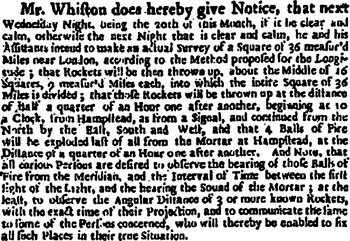
Another Post Man ad placed on 20 July 1715 saw Whiston (Ditton had died on 15 October 1714) asking for even more exacting information (see fig. 1). This time, however, Whiston placed a companion ad in the Daily Courant with the intent of increasing the number of potential witnesses for his public experiments. As in October of the previous year, providing the sky was clear, “Balls of Fire” would appear at regular intervals and Whiston stated that
curious Persons are desired to observe the bearing of those Balls of Fire from the Meridian, and the Interval of Time between the first sight of the Light, and the hearing of the Sound of the Mortar; at least, to take the Angular Distance of 3 or more known Rockets, tho' it be without regard to the Meridian, and to communicate the same to some of the Persons concern'd, who will thereby be enabled to fix all such Places in their true Situations. (PM 14 July 1715; DC 15 July 1715)
Whiston placed tremendous faith in the competency of those who read his ads. Clearly, he believed that readers of the Post Man and Daily Courant possessed the necessary skills to accomplish the tasks he required of them. Two years later, in 1717, an ad presented even more complicated instructions: observers were asked “how plainly, and how many Seconds the Balls are seen; and if they well can, at what utmost Altitude, and in what Angle from the Meridian they are seen: And in what Places within 20 or 30 miles, how many seconds the sound is heard after the first Sight of the Light also” (PM 14 May 1717; DC 13 May 1717). Although he made a lot of noise, Whiston was unsuccessful in this plan and would eventually abandon it.
An example of William Whiston's longitude advertisements containing instructions for both observation and reporting. It appeared in the Post Man on 14 July 1715, and in the Daily Courant on 15 July 1715.

Whiston knew from personal experience that London possessed an audience for his longitude experiments that was eager and capable. He had helped school them. In the same way that one sighted a telescope or focused a microscope before use, Whiston's actions prior to attempting to solve the problem of longitude had the result of turning the bodies of some Post Man and Daily Courant readers into virtual scientific instruments capable of validating and confirming the effectiveness of his very public solution to England's navigational inadequacy.Footnote 14 In early 1715 (before Whiston's second ad requesting observers for his light show over the London sky) Daily Courant, Post Boy, and Post Man readers had also cast their eyes towards the night sky with the hope of viewing the coming eclipse on 22 April 1715 (Walters Reference Walters1999, 4–5). Always ready to seize an opportunity, Whiston placed ads in the Post Man and Daily Courant in late February 1715 offering for sale several items to enhance the viewing experience of those who planned to observe the eclipse. The ad told readers that “Mr. Whiston having finished his Copernicus, or universal Astronomical Instrument for the easy Calculation and Exhibition of Eclipses, and of all the Celestial Motions. This is to give notice, that it is now to be seen and subscribed for at his House in Crosstreet, Hatton Garden” (PM 22 February 1715; DC 23 February 1715). Along with the Copernicus, a device designed by Whiston himself and produced by instrument maker John Senex, he offered a globe and guidebook. Prices ranged from four Guineas for all the items down to one-and-a-half Guineas for the Copernicus alone. The Copernicus was an instrument with which the owner might model the stellar motions as an aid to observing the eclipse. Whiston described his invention as consisting of “ten intermediate concentrical Annuli, or broad circular Rings, fitted to revolve one within another; but so, as to be capable of being fix'd, by small pins, in any situation whatsoever.” The advertised globe was meant to be placed in the innermost circle (Whiston Reference Whiston1715, 1–2).Footnote 15 Whiston urged all interested parties to act immediately lest they delay too long and miss the superior viewing opportunity that he presented.
As the date of the eclipse drew near, Whiston's ads for his March series of public lectures in natural philosophy held at Button's Coffeehouse were altered to accommodate the upcoming event. The lectures now included “that part of Astronomy which is necessary to the understanding of Eclipses” (PM 15 March 1715; DC 18 March 1715). Pricing of the lecture, readers would be pleased to know, remained the same. April, the month of the eclipse, saw a flurry of ads in the Post Man. For a single shilling Whiston sold an Account of the Great Eclipse. The book was more than a simple “account” it also promised to direct all those who bought it exactly how to best observe the eclipse (PM 9 April 1715). Even those who did not attend his lectures could benefit from Whiston's expertise. With three days left before the eclipse, Whiston invited Post Man readers to watch the eclipse with him. Because he sold tickets to this event, we may surmise that he would be offering commentary during the eclipse. From a single ad placed on 7 April we know that Whiston used his lectures on the eclipse to help further his longitude scheme and that encouraging observation of the eclipse meant encouraging observation of his method to determine longitude. Whiston advised readers that during the eclipse he planned to “have one of his Balls of Fire thrown up from Hampstead Heath, just at the Middle of the Eclipse, for a Signal to all the remote Observers, and a Specimen how far that Light may be seen at a time of so great an Observation” (PM 7 April 1715). Following the eclipse there was still a market to be tapped and Whiston hoped to capitalize on the enthusiasm for astronomy that the event had generated by offering recollections and instructions for viewing future eclipses (PM 19 April 1715; DC 19 April 1715).Footnote 16 The coincidental timing of the April 1715 solar eclipse benefited not only Whiston's cause by hopefully nurturing in London's reading population an interest in and the ability to measure night time celestial phenomena, which might also be useful for determining the angle of his explosive shells, but also other longitude promoters including John Ward and Samuel Newton, who were advertising near this same time.
While we may easily tie Whiston's eclipse campaign to his longitude advertisements, the connection to longitude in general is also evident. Readers of others newspapers that would contain longitude ads were also casting their eyes skyward to view the eclipse. In March and early April 1715 Whiston's name was among those mentioned by John Senex, FRS, instrument maker, engraver, and publisher, in ads for two new prints, which had the eclipse as their subject. Senex placed the ads in the Post Boy, Daily Courant, and the London Gazette. Listed first was “Mr. Professor Halley's Description of the Shadow of the Moon over England in the total eclipse of the Sun on the 22d Day of the Next month.” Second was “Mr. Whiston's Calculation of the same Ecclipse from Mr. Flamstted's tables, as corrected to Sir Isaac Newton's Theory of the Moon in the Astronomical Lectures, with its Construction for London, Rome, and Stockholm.” Both prints were priced at six pence and could be purchased at Senex's shop at the Globe in Salisbury Court (PB 10, 17, 24 March 1715; DC 17 March 1715; Clifton and L'E. Turner Reference Clifton and Turner1995, 248; Johns Reference Johns1998, 615). A similar optical instrument fashioned from paper was advertised in the Post Boy on 16 April by John Sturt, an engraver, who like many of his profession made most of his living as a book illustrator. However, unlike others in the trade, for items of natural philosophy directed at the public, such as the optical instrument maker John Yarwell who had 1000s of pounds at the time of death, Sturt often had to beg for payment from customers telling them that “I have urgent occasion for money” (British Library Add. MS 46968 ff. 157–162v; British Library Stowe MS 748 f. 1). The market was not equal for those who sought their fortune. With little more than a week remaining before the eclipse, Sturt offered for sale “The Eclipseometer, an Instrument shewing the Course of the Eclipse of the Sun, every instant of its Duration, being a plain and easy Method, whereby those not acquainted with Astronomy, will at first be inform'd of the Nature of the Eclipse” (PB 16 April 1715). The device was a single sheet that allowed the path of the moon to be followed along a schematic diagram with a gradated scale that was to be used in conjunction with a clock. As Alice N. Walters has put it, the Eclipseometer and other similar devices “encourage[d] and facilitate[d] the active participation of their purchasers in the observation of an eclipse” (Walters Reference Walters1999, 9). Similar participation was required of those who bought longitude accounts.
These tools offered for sale by Sturt and Senex are reflective of a larger change taking place at the highest levels of natural philosophical discourse and suggests that transformations in such rhetorical strategies were making their way into public presentation. During the formative years of the Royal Society and of its journal The Philosophical Transactions, communicating natural philosophy was achieved through descriptive articles that sought to present facts of nature and explanations of them. Narrative took precedent. In the eighteenth century, as recent commentary has explained, “the social and personal fade into the background as the author concentrates on describing and explaining the natural world by means of measurement, calculations, and empirical observation.” Similarly Mary Poovey has shown that parallel to this literary development numbers were considered prestigious in contemporary natural philosophy (Gross, Harmon, and Reidy Reference Gross, Harmon and Reidy2002, 66; Vickery Reference Vickery2000; Poovey Reference Poovey1998, 141–143). Tools sold to the public with which to view the eclipse that allowed Londoners to track it with mathematical precision and time it with a clock is evidence that public and private natural philosophy were beginning to merge. The same skills would be required by a public requested to judge longitude solutions where familiarity with timepieces and rudimentary astronomical observations were assumed to be common traits of London's newspaper reading public.
Meaning
Part of the purpose of this article has been to expose advertisements for items of a natural philosophical sort as a valuable historical resource. We have seen that ads for longitude may be considered as both texts of marketing persuasion and as pieces of scientific rhetoric. As Schaffer has commented, in their written work “scientists strive to make themselves reliable representatives of nature by qualifying their representations and disqualifying others.” Geoffrey Cantor concurred that the key task of natural philosophical rhetoric is to “convince an audience” of the truthfulness of the claims made in the text (Schaffer Reference Schaffer and Lenoir1998, 183; Cantor Reference Cantor, Gooding, Pinch and Schaffer1989, 161). In the case of longitude ads, promoters had only a few lines to convince purchasers of the likelihood that their advertised method would be successful.
The placement of a text was crucial in ensuring that the message would reach the desired audience, as Luc Pauwels' work into the location of natural philosophical communication has demonstrated (Pauwels Reference Pauwels and Pauwels2006, 12). With stakes as high as £20,000, longitude ads had to be placed where they might attract the most attention. Using newspapers rather than placing notices in, for example, the preface of astronomy books or the Philosophical Transactions says a great deal about the intended audience and the consumer sought for longitude schemes. At the outset of this study, I mentioned that advertisers used their ads to speak to potential consumers. As Roy Porter put it in his study of the English Enlightenment, the erudite climate of the time is perhaps best likened to the interior of a coffeehouse with its customers “talking, talking, talking” (Porter Reference Porter2000, xviii). During late 1714 and into 1715 advertisers hoped Londoners would be talking about longitude. There were certainly consumers in London who were eager to get their hands on the latest discoveries in natural philosophy be it through the ever increasing number of lecture series or the popular books that were filling the public sphere. “Science came to be traded in the market economy,” as Paul Elliot tells us. It became “part of the commercialization of leisure” purchased by consumers (Elliot Reference Elliot2000, 63). The existence of longitude ads indicates that natural philosophy had certainly become a component of the public sphere. The coincidental timing of the eclipse in April 1715 similarly contributed to the environment of public science. There is little point advertising in a market that has no interest in the product or lacks the knowledge base to understand it.
Those who sought longitude were, of course, hoping for sales and acclaim, but they were also hoping for legitimization of their procedures, theories, and techniques from the public who bought these commodities. We should also remember that most books outlining longitude plans were dedicated to the Board of Longitude and thus the advertisements ought to be seen as an attempt (never successful as it turned out) to gain notoriety with Board members. Thus, longitude advertisements were an expression of a desire for something different from the public sphere rather than being merely a means of conveying social acceptance onto natural philosophy and displayed facts of nature (Rupp Reference Rupp1995). Longitude ads remain a unique example of public science. Unlike lecturers or publishers of natural philosophical tracts who sought audiences for demonstrations, or readers for books, which contained accounts of nature that were not being created on the spot, longitude seekers were doing something different. Hobbs, Watson, Hall, and of course Whiston all requested that the reading public act as witnesses and confirm the effectiveness of their experiments or instruments. Although Halley, Jackson, Hawkins, Coster, Thacker, Ward, Clarke, French, and Newton did not explicitly seek the public's participation, they certainly set their plans before readers of London's newspapers to be judged amongst their competitors. What is more, each promoter claimed his scheme could be understood by anyone who purchased the account. While the public might, in the words of Elliot, provide “social legitimization” and “readers, listeners and observers could prove as important as authors in the advancement of natural philosophy,” readers of longitude advertisements were doing something more than aiding the acculturation of natural philosophy into London society by making it part of polite conversation and display items in well-to-do homes (Elliot Reference Elliot2000, 63). Longitude advertisers assumed this acculturation had already taken place and the public would serve as both a testing ground and marketplace for their longitude schemes.
Acknowledgments
For their aid I thank Krista Kesselring, Larry Stewart, Steve Snobelen, and Alison Jeppesen. I presented this article at the Dalhousie University History Department Stokes Seminar Series and thank the faculty and graduates students for their comments. The suggestions provided by the editors and two anonymous referees for Science in Context helped sharpen this article greatly. Research was supported through a Social Sciences and Humanities Research Council of Canada Postdoctoral Fellowship.