


Loneliness is a complex feeling that is experienced by individuals due to being lonely or having the perception of being alone throughout life. Perlman and Peplau (Reference Perlman, Peplau, Peplau and Goldston1984) define loneliness as an unpleasant experience that occurs when a person's network of social relationships is significantly deficient in either quality or quantity. This definition signals that loneliness can be an important indicator of an individual's poor relationships and their negative feelings about unmet needs in these relations. Socially supportive relationships suggest protective benefits for individuals’ wellbeing through their lives (Thoits, Reference Thoits2011) because the desire to belong and feel socially connected is a fundamental aspect of human development. On the other hand, as people experience persistent difficulties in establishing and maintaining satisfactory relationships with others, they have trouble in satisfying their sense of belonging and are more likely to experience loneliness. According to Gierveld, Tilburg, and Dykstra (Reference Gierveld, Tilburg, Van, Dykstra, Vangelisti and Perlman2006), the opposite of loneliness is belongingness and embeddedness.
It is not surprising to find loneliness as an issue in adolescence, which is characterised by many changes in social networks, expectations, roles, relationships, and identities. Compared to an adult, an adolescent's life is more complex and ambiguous because of their cognitive development, individuation efforts, identity seeking, and psychological independence (Laursen & Hartl, Reference Laursen and Hartl2013). Adolescents incrementally separate from their parents, then reorganise their relations with friends. A peak in loneliness has been found in adolescent years (Heinrich & Gullone, Reference Heinrich and Gullone2006; Qualter et al., Reference Qualter, Vanhalst, Harris, Van Roekel, Lodder, Bangee and Verhagen2015). Factors that disrupt this developmental process may lead to the emergence of sense of loneliness (Ladd & Ettekal, Reference Ladd and Ettekal2013; Rubin, Bukowski, Parker, & Bowker, Reference Rubin, Bukowski, Parker, Bowker, Damon and Lerner2008), which is why socially supportive relations are particularly important among adolescents. One of the sources that can satisfy belongingness needs is the family, mainly parents and siblings. Despite widespread stereotypes of conflict and stress in adolescents’ family life, studies suggest that teenagers report little emotional distance between parents and themselves (Collins & Laursen, Reference Collins, Laursen, Lerner and Steinberg2004; Steinberg, Reference Steinberg2001). Rueger, Malecki, and Demaray (Reference Rueger, Malecki and Demaray2010) revealed that parental support was uniquely associated with adolescents’ psychological adjustment, above and beyond other support domains. Although there are limited studies on sibling relations, the benefits of sibling support to psychological adjustment in adolescence have also been documented (Milevsky & Levitt, Reference Milevsky and Levitt2005).
Adolescents have been found to be more likely to protest separation from their parents than from peers, and more likely to use their parents as a secure base than their peers (Hazan & Diamond, Reference Hazan and Diamond2000). Thus, it is proposed that attachment to parents is not replaced gradually by attachment to peers, and family context remains important for adolescent development. For example, earlier research showed that insecurely attached children and adolescents have a higher risk for experiencing loneliness (Bernardon, Babb, Hakim-Larson, & Gragg, Reference Bernardon, Babb, Hakim-Larson and Gragg2011), while the securely attached group was the least lonely (Bogaerts, Vanheule, & Desmet, Reference Bogaerts, Vanheule and Desmet2006; DiTommaso, McNulthy, Ross, & Burgess, Reference DiTommaso, McNulthy, Ross and Burgess2003). Attachment security may be related to positive parent-child relationship quality and children's perceptions of supportive parenting (Dwyer, Reference Dwyer2005); however, the constructs of secure attachment and relationship quality are not identical. Therefore, it is crucial to evaluate the possible differential effects of other aspects of the parent-child relationship on loneliness.
In addition to attachment dimension, a number of studies have investigated the relationship between different facets of family life and loneliness. Studies have shown significant relations between loneliness and family communication (Uruk & Demir, Reference Uruk and Demir2003), parenting styles (Çeçen, Reference Çeçen2008; Jackson, Soderlind, & Weiss, Reference Jackson, Soderlind and Weiss2000), in-family relations with parents (Johnson, LaVoie, & Mahoney, Reference Johnson, LaVoie and Mahoney2001), family support (Eker, Arkar, & Yaldız, Reference Eker, Arkar and Yaldız2001) and family environment (Demirli & Demir, Reference Demirli and Demir2014). For example, Çeçen's (Reference Çeçen2008) findings indicate that democratic parents’ children felt less lonely and they perceived more social support from friends and their family in comparison to authoritarian parents’ children. Authoritarian parenting styles are generally associated with poorer self-perceptions among adolescents and increased loneliness (Margalit, Reference Margalit2010). Jackson, Pratt, Hunaberger, and Pancer (Reference Jackson, Pratt, Hunsberger and Pancer2005) indicated that individuals who perceived their parents as authoritative were rated as having lower loneliness because authoritative parents showed a higher performance in providing a loving atmosphere. Demirli and Demir (Reference Demirli and Demir2014) also found that university students who reported their family environment to be highly coherent reported lower loneliness. Johnson et al. (Reference Johnson, LaVoie and Mahoney2001) proposed that low family cohesion was positively related with feelings of loneliness. Similarly, children and adolescents with low responsive and high psychologically controlling parents are more likely to feel lonely (Jackson et al., Reference Jackson, Soderlind and Weiss2000; Soenens, Vansteenkiste, Goossens, Duriez, & Niemiec, Reference Soenens, Vansteenkiste, Goossens, Duriez and Niemiec2008). Over-protective and inhibitive parent behaviours have an impact on children's thinking styles and lead to loneliness (Jackson, Reference Jackson2007; Jackson et al., Reference Jackson, Pratt, Hunsberger and Pancer2005). Parental care and loneliness has shown significant negative correlations (Jackson, Reference Jackson2007). Adolescents who feel their family members are emotionally distant and experience alienation at home experience loneliness and distress (Dickstein, Seifer, & Albus, Reference Dickstein, Seifer and Albus2009; Margalit, Reference Margalit2010). Studies of family relations demonstrate significant relationships between adolescents’ loneliness and emotional climate in the family.
The sibling and parent-child relationship quality has also been linked to the development of adolescent problem behaviour (Buist, Deković, & Gerris, Reference Buist, Deković and Gerris2011; Buist, Deković, & Prinzie, Reference Buist, Deković and Prinzie2013; Buist et al., Reference Buist, Verhoeven, Hoksbergen, ter Laak, Watve and Paranjpe2016). Adolescents with warm and loving relationships with their parents show less problem behaviour (Verhoeven, Junger, van Aken, Deković, & van Aken, Reference Verhoeven, Junger, van Aken, Deković and van Aken2010). More specifically, higher levels of parental warmth result in lower levels of internalising problems (Buist et al., Reference Buist, Deković and Gerris2011), as well as externalising problems (Barnes, Hoffman, Welte, Farrell, & Dintcheff, Reference Barnes, Hoffman, Welte, Farrell and Dintcheff2006; Buist et al., Reference Buist, Deković and Gerris2011). In addition, while warm sibling relationships are related to less internalising (Buist et al., Reference Buist, Deković and Prinzie2013; Kim, McHale, Crouter, & Osgood, Reference Kim, McHale, Crouter and Osgood2007) and less externalising problem behaviour (Buist et al., Reference Buist, Deković and Prinzie2013), sibling conflict has been linked to the development of externalising problem behaviour (Buist et al., Reference Buist, Deković and Prinzie2013; Natsuaki, Ge, Reiss, & Neiderhiser, Reference Natsuaki, Ge, Reiss and Neiderhiser2009). It can be concluded that conflictive family relationships may form a risk factor for emotional and behavioural problems. However, much less is known concerning the extent to which the quality of sibling relations and accepting parent-child relationships are important for loneliness in adolescents.
The concept of parental acceptance and rejection, as one of the predictor variables of the study, comes from Rohner's parental acceptance-rejection theory (Rohner, Reference Rohner1990). The main assumptions of this theory are that people need to receive warm feelings from parents and that withdrawal of acceptance will result in negative consequences for development of individuals. Rohner and Rohner (Reference Rohner and Rohner1980) presumed that how individuals perceive themselves is based on their perception of how others view them. Therefore, if parents, as most significant others, reject their children, those children are expected to describe themselves as unworthy of love and inadequate. The rejected child protects him or herself from continued emotional hurt by withdrawing, which prevents the formation of adequate relationships, and therefore social withdrawal occurs, which is one of the components of loneliness. Physical and verbal accepting behaviours, called parental acceptance, result in children's feelings of being loved and accepted. On the other hand, parental rejection indicates dislike or disapproval of the child (Walker, Reference Walker1990). Although there is evidence for the significant relationship between parental variables and adolescent loneliness, types of parenting are studied more than the acceptance-rejection dimension of parenting; thus, parental acceptance-rejection was investigated in the present study.
Another family relationship with the potential to affect loneliness is the sibling relations, which promote a high level of social interaction. The sibling relationship is an intense family relationship that has the potential to affect adolescents’ perception of their social relationships and accordingly their experience of loneliness (Ponzetti & James, Reference Ponzetti and James1997). Relationships with siblings are a source of frequent companionship, help, or emotional support. Older siblings can serve as caretakers, teachers, or models; in some instances, they can even help compensate for absent or distant parents. Many skills for healthy social development may be learned through sibling interactions (Furman & Buhrmester, Reference Furman and Buhrmester1985; Kramer, Reference Kramer2014). Sibling interactions provide an opportunity to experience social exchanges and practise ways of relating to others. Adolescents having higher levels of sibling relationship quality reported higher levels of emotional support from their sibling (Alfaro & Umana-Taylor, Reference Alfaro and Umana-Taylor2010). Adolescents having close and supportive relations with their siblings reported less loneliness (Margalit, Reference Margalit2010; Milevsky, Reference Milevsky2005) and higher levels of self-esteem and adjustment (Yeh & Lempers, Reference Yeh and Lempers2004). In Margalit's (Reference Margalit2010) study, individuals who received sibling support reported lower levels of loneliness and significantly higher self-esteem and life satisfaction than those who reported low sibling-support conditions. Negative sibling interactions have been linked to internalising and externalising problems (Buist et al., Reference Buist, Deković and Prinzie2013). The quality of relations with brothers and sisters predicted loneliness, regardless of age- related differences between them (Sherman, Lansford, & Volling, Reference Sherman, Lansford and Volling2006). Sibling support can mitigate the negative effects of life stress and lack of support in other social ties (Lerner & Steinberg, Reference Lerner and Steinberg2009).
Four types of sibling relationship quality — warmth, conflict, rivalry, and power — were included in the study as another predictor variable. Warmth refers to quality of closeness; conflict reflects antagonism and quarrelling between siblings; power refers to how much siblings direct or help each other; and rivalry refers to how parental partiality is perceived by siblings (Furman & Buhrmester, Reference Furman and Buhrmester1985). Ponzetti and James (Reference Ponzetti and James1997) found a significant negative correlation between loneliness and both closeness and rivalry dimensions of sibling relations, while conflict was positively correlated with loneliness, and there was no significant relationship between power and loneliness in late adolescence. Power imbalance in sibling relationships is linked to more depression and anxiety in adolescence (Buist et al., Reference Buist, Metindogan, Coban, Watve, Paranjpe, Koot and Meeus2017)
It appears that although there are studies on loneliness regarding parenting types, family relations, and family support, and the importance of the parent-child relationship to loneliness has been found, there is a gap in the research focusing on adolescents’ feeling of loneliness as a function of parental acceptance, separately for mothers and fathers. Also, studies focusing on sibling relationship quality and loneliness have not been investigated as much as the parent-child relations. The present study identified the period of adolescence and loneliness among adolescents by considering their relationship with parents and siblings after controlling for gender, age, grade, school type, field of study, birth order, and number of siblings. The results of this study will make a contribution to the work of counsellors and families when trying to understand and intervene in loneliness. Understanding how family structure — mainly parents’ acceptance and sibling relationships — affects adolescents in terms of loneliness is needed to identify groups at risk of high loneliness levels. Since parent and sibling relationships are culturally bounded, in Turkey this is exhibited by characteristics of a synthesis of independent and totally interdependent cultures, which is a different model from individualistic and collectivistic social norms (Kağıtçıbaşı, Reference Kağıtçıbaşı2007); therefore, the findings may also contribute to studies exploring cross-cultural differences.
Method
Participants
To represent different socio-economic backgrounds and school-related characteristics, 50 public high schools from Ankara were selected through SPSS Statistics v.22. In each school, approximately three classes from different grades were selected through the convenience sampling procedure. The sample consisted of 1,451 students who had at least one sibling and who volunteered to participate in the study. Female participants comprised 53.7% of the sample (n = 779). The mean age of the participants was 16.17 with a standard deviation of 1.08. In the sample, ages varied between 14 and 19. Most of the participants’ ages accumulated within the 15- (n = 424), 16 (n = 386) and 17-year-old (n = 457) age groups. When students were grouped according to their grades, 499 of the students were 9th-grade students (34.4%), 376 were 10th-grade students (25.9 %), 493 students were 11th-grade students (34.0%) and 83 students were 12th-grade students (5.7%). The ratio of 12th-grade students was lower than other grades because they were not found in the schools due to their extra courses for upcoming university entrance examination.
While filling in the sibling questionnaire, participants were asked to select the sibling whose age was closest to them. Of the female participants, 52.9% (n = 413) selected a younger aged sibling while 56.4% of the male participants (n = 379) preferred a younger aged sibling. In terms of gender of selected siblings, 52.4% of male participants selected a male sibling and 53% of female participants selected a female sibling. Of the participants, 27.2% selected older brothers, 28.6% selected older sisters, 21.7% selected younger brothers, 21.9% selected a younger sister and 0.6% selected their twin.
Instruments
The University of California Los Angeles (UCLA) Loneliness Scale
The UCLA Loneliness Scale (Russell, Peplau, & Cutrano, Reference Russell, Peplau and Cutrona1980) is a 20-item, self-report, 4-point Likert type instrument, ranging from 1 = never to 4 = often. The lowest score to be obtained from the scale is 20 and the highest is 80, where a higher score represents higher loneliness level. The scale consists of 10 positively worded and 10 reverse items. In each item, a circumstance that states a sense or a thought about the social relation is presented and the individuals are asked to state how often they meet this circumstance. An example item from the scale is ‘I feel left out’. In this study, a Turkish version of the UCLA (Demir, Reference Demir1989) was used and, according to the results of Demir's (Reference Demir1989) reliability and validity study, the internal consistency coefficient was .96; the correlation coefficient was .94 using the test–retest method over 5 weeks. In the present study, the Cronbach's alpha coefficient was calculated as .85.
Parental Acceptance-Rejection Questionnaires Turkish-Short form (Child PARQ/Short Form)
The Child-PARQ is a questionnaire type, self-report instrument, and it measures perceptions of parental treatment of the child in terms of four dimensions: (a) parental warmth and affection, (b) parental hostility and aggression, (c) parental indifference and neglect, and (d) parental undifferentiated rejection (Rohner, Reference Rohner1990). The questionnaire consists of 24 items with a 4-point Likert-type scale ranging from 4 = almost always true to 1 = almost never true at all. The four PARQ scales constitute acceptance-rejection (the warmth) dimension of parenting. Taken together, these four scales compose the total PARQ score. The higher the score, the more rejection children tend to experience. The lower the score, the more acceptance children tend to experience. In this study, participants responded to two versions of the PARQ, one assessing children's perceptions of their father's acceptance-rejection (Child PARQ, father version) and one assessing mother's acceptance-rejection (Child PARQ, mother version). Items ask how the mother's and father's treatment affects the feelings of children at the present (Rohner, Reference Rohner2004). Items in mother and father forms are the same, and a sample item from the questionnaire is ‘My mother tells me that I give her a lot of trouble’. The reliability study of the Child PARQ-Short Turkish form was carried out by Yılmaz and Erkman (Reference Yilmaz, Erkman and Erkman2008), and for the internal consistency, the item-total correlations for the mother version ranged between .20 and .72, and the Cronbach's alpha coefficient was .89. For the father version, the item-total correlations ranged from .24 to .71, and the Cronbach's alpha coefficient of the scale was .90. In the present study, Cronbach's alpha coefficients were calculated and were .93 for the maternal and .94 for the paternal questionnaire.
The Sibling Relationship Questionnaire (SRQ)
Perceptions of sibling relationships were measured using the SRQ, which was developed by Furman and Buhrmester (Reference Furman and Buhrmester1985). The SRQ is a 48-item, self-report measure that assesses four sibling relationship qualities: closeness, power, conflict, and rivalry. Answers are given in a 5-point Likert type format: 1 = hardly at all, 2 = not too much, 3 = somewhat, 4 = very much and 5= extremely much. Items on the rivalry dimension have a different format, starting from 1 = almost always him/her favoured to 5 = almost always me favoured and midpoint 3 = about the same. The quality of closeness is assessed by 21 items about intimacy, companionship, admiration, and affection between siblings. Responses are summed such that a high score reflects greater closeness. Nine items address conflict and are summed such that a high score reflects greater conflict. The quality of power is defined as the difference between respondents’ perceptions of how much their siblings direct and help them (six items), and the direction and guidance they extend to their siblings (six items). A positive score indicates that respondents perceive themselves to be more powerful than their siblings, whereas a negative score indicates that siblings are perceived to be more powerful. Scores can range from −24 to +24, with zero representing equal power in the sibling relationship. Rivalry measures parental partiality in the family, such that a high score indicates the respondent perceives he or she is favoured, and a low score indicates siblings are favoured. A sample item from the questionnaire is ‘How much do you and your sibling tell each other things you don't want other people to know?’ The SRQ has been found to possess high internal consistency and test–retest reliability (Furman & Buhrmester, Reference Furman and Buhrmester1985). Apalaçi (Reference Apalaçi1996) adapted the questionnaire into Turkish, but reliability and validity studies were conducted first by Bozbey-Akalın (Reference Bozbey-Akalın2005), who used 13 subscales, and the Cronbach alpha values ranged between .41 and .90. However, in the present study, the four-factor structure of the original study was confirmed and the reliability of these four dimensions has been shown to have satisfactory values ranging between .77 and .95.
Procedure
Before starting to collect data, necessary permission from the Middle East Technical University Human Subjects Ethics Committee was secured. In addition, permission was given by the Ministry of National Education to conduct research in state high schools. The appropriate times and classes for the administration of the instruments were arranged with the principals and school counsellors. The administration of the instruments took approximately 40 minutes. Students were asked to be honest while responding to the items and were informed about confidentiality. The participants were also informed about their right to refuse to complete the questionnaires. The instruments started with a demographic information form (including gender, age, grade, name of department, field of study, type of school, number of sibling, sibling position items) and continued with the UCLA Loneliness Scale, Maternal Acceptance-Rejection Questionnaire, Paternal Acceptance-Rejection Questionnaire, and Sibling Relationship Questionnaire. The instruments were administered in class.
Results
A three-stage hierarchical regression was run. The analysis was done using IBM's SPSS Statistics Version 22. In the first place, demographics were checked. Except for the gender variable, the others — age, grade, school type, field of study, birth order, and number of siblings — were dummy coded. Parental variables were then added to the model, since one's sibling relationship quality might be affected by one's relationship with parents. Sibling variables were included in the third model. In order to control and to test the effects of predictors independent of the influence of others, hierarchical regression was used.
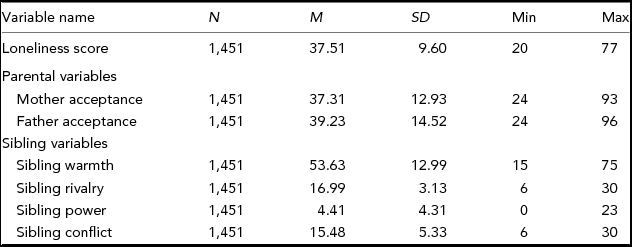
As can be seen in Table 1, the results of the descriptive statistics indicate that the mean score of the loneliness scale is M = 37.51 and SD = 9.60. The mother acceptance mean is 37.31 with an SD of 12.93. The mean of father acceptance is 39.23 (SD = 14.52) and higher than the mother acceptance mean. The results of descriptive statistics indicate the mean scores of sibling dimensions as sibling warmth (M = 53.62, SD = 12.99), sibling rivalry (M = 16.99, SD = 3.13), sibling power (M = 4.4, SD = 4.31), and sibling conflict (M = 15.48, SD = 5.33).
Summary of Descriptive Statistics for Study Variables

In order to reach reliable results, the required assumptions of hierarchical multiple regression analysis, including missing data, absence of outliers, multivariate normality, homoscedasticity, linearity, and multicollinearity were validated. Then a three-stage hierarchical multiple regression analysis was performed. In the analysis, loneliness is regarded as the outcome variable while gender, age, grade, school type, field of study, birth order, number of siblings, demographic variables, mother acceptance, father acceptance, sibling warmth, conflict, rivalry, and power are regarded as predictor variables.
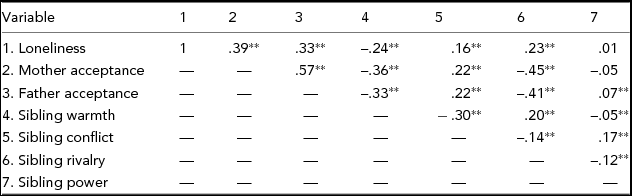
Computing correlations between study variables introduced significant results for each variable except sibling power. As can be seen in Table 2, there is a positive significant correlation between mother acceptance, father acceptance, and loneliness (r = .39, p < .01; r = .33, p < .01); as the mother and father acceptance increases, it means more rejection (midpoint is 60). Similarly, as the sibling conflict increases, loneliness increases significantly (r = .16, p < .01), but there is a significant negative correlation between sibling warmth and loneliness (r = −.24, p < .01) and sibling rivalry and loneliness (r = −.23, p < .01). Sibling power does not show a significant correlation with loneliness (r = .01, p > .01).
Bivariate Correlations Among Study Variables

Note: **p < .01 (two-tailed).
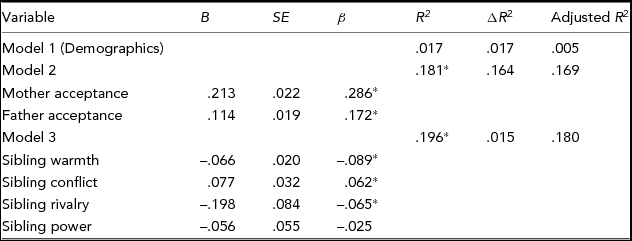
Model 1 explained 1.7% of the variance in loneliness, which includes gender, age, grade, field of study, birth order, school type, and number of siblings, but this first model did not give significant results (R 2 = .017, F inc (14, 1436) = .96, p > .05), therefore in Table 3, they are not given separately. In the second step, with the addition of mother and father acceptance-rejection, R 2 resulted in a significant increment and the R 2 change was 16.4%. Model 2 explained 18.1% of the variation in loneliness (R 2 = .181, Finc (16, 1434) = 19.17, p < .001). Mother rejection (β = .29, p < .001) and father rejection predicted loneliness positively (β = .17, p < .001). In the third step, the addition of sibling variables significantly contributed to explanation of variance in loneliness, and the model explained an additional 1.5% variation in loneliness and R 2 was 19.6% (R 2 = .196, F inc (20, 1430) = 16.396, p < .001) (see Table 3).
Summary of Hierarchical Regression Analysis for Variables Predicting Loneliness (N = 1,451)

Note: *p < .001.
The significant predictors of loneliness among sibling relationship qualities were warmth (β = −.088, p < .001), conflict (β = .062, p < .001), and rivalry (β = −.065, p < .001). Unique variances explained by the predictors in models 2 and 3 were calculated by the square of part values. Mother acceptance was the strongest predictor of loneliness and accounted for 5.4% of variance in loneliness, while father acceptance was 2.4%, sibling warmth was 1%, sibling conflict was 0.4% and sibling rivalry 0.3% of variance in loneliness.
Discussion
The goal of the present study was to examine whether acceptance in parent relations and sibling relationship quality predict loneliness after controlling for demographic variables. Results indicated that although demographic variables did not significantly predict loneliness, maternal and paternal acceptance and sibling relations significantly predicted loneliness. All variables together accounted for 19.6% of variance. The strongest predictor of loneliness in adolescence was mother acceptance. Correlations between loneliness and predictor variables showed that there was a significant positive correlation between maternal and paternal rejection and loneliness; similarly, sibling warmth and sibling rivalry were also negatively correlated with loneliness. There was a significant negative correlation between sibling conflict and loneliness, while sibling power did not significantly correlate with loneliness.
According to our results, parents being accepting and warm predicts a decrease in the loneliness of adolescents, and the results also showed that there is a highly significant inverse correlation between loneliness and mother and father acceptance; this conclusion was compatible with the findings of Buist et al. (Reference Buist, Deković and Gerris2011), Çeçen (Reference Çeçen2008), Jackson (Reference Jackson2007), Jackson et al. (Reference Jackson, Pratt, Hunsberger and Pancer2005), and Johnson et al. (2000). Good communication with parents and perceiving feelings of warmth from them could increase adolescents’ self-esteem and decrease feelings of loneliness, since they would feel closer, more valued, and better understood by their parents. Rejecting parents may result in poorer self-perception and increased loneliness in adolescents due to not allowing children to express themselves and not being sensitive to their needs. However, providing a loving atmosphere and not showing hostility or aggression, or indifference or neglect, will lessen reported levels of loneliness.
Adolescents who sense that their parents and siblings are distant and not providing intimacy and support experience more loneliness, and these results aligned with Dickstein et al. (Reference Dickstein, Seifer and Albus2009). Similarly, in Buist et al. (Reference Buist, Verhoeven, Hoksbergen, ter Laak, Watve and Paranjpe2016), almost all associations of sibling and parent-child relationship quality with externalising and internalising problems are statistically significant. In the state of perceived parental rejection, there is no or limited physical contact with the child, such as kissing or hugging, but rather aggression and neglecting behaviours towards children. Not meeting a child's physical or emotional needs and not responding to a child in a caring manner can be a source of loneliness. With regard to feelings of loneliness in connection with parents, the study showed that loneliness is influenced by perceptions of acceptance from both mothers and fathers. Since the mother acceptance is the most significant predictor, warmth, support, care and love from mothers can be the most important protective factor against loneliness.
Based on the results, paternal acceptance after controlling for demographics explained 18.1% of loneliness in the present study, and this conforms with Uruk and Demir's (Reference Uruk and Demir2003) comparison of peers and families on adolescents’ loneliness study that concluded that 14% of loneliness was predicted by family structure while peer relations explained 35% of variance in loneliness. When they are compared, in both studies family explains a similar amount of variance in the loneliness of adolescents. Since peer relationships tend to be a central preoccupation for adolescents (Brown & Klute, Reference Brown, Klute, Adams and Berzonsky2003), the strongest predictors of loneliness in adolescents might be their social relationships among friends
Participants who have a closer, warmer quality of sibling relationship reported less loneliness; lower rivalry was associated with greater loneliness, and conflict and loneliness had a significant positive correlation. The findings of each dimension were compatible with Ponzetti and James’ findings (Reference Ponzetti and James1997). Adolescents who have close and supportive sibling ties reported less loneliness in the present study, and the findings are consistent with Margalit (Reference Margalit2010) and Milevsky's (Reference Milevsky2005) findings. In accordance with Sherman et al.’s (Reference Sherman, Lansford and Volling2006) findings, the research has shown that participants who had harmonious (i.e., high warmth, low conflict) relationships with siblings had lower loneliness. Close, warm, and supportive sibling relationships may not only support children and adolescents’ self-esteem and adjustment but also help them in avoiding loneliness in the family and outside the home and may even compensate for parental distance. Lower rivalry, indicating perceiving the sibling as more favoured by parents, was associated with greater loneliness because parental favouritism may create negative feelings in adolescents, such as feelings of being less than the other or not being accepted. Different from findings of Buist et al. (Reference Buist, Metindogan, Coban, Watve, Paranjpe, Koot and Meeus2017), power was not a significant predictor of loneliness in the study.
Since the explained variance in the present study is small, researchers should consider the results from this study as preliminary. Future research with more diverse samples and more sophisticated methodologies is needed. Studies should mention the differences between family-related and peer-related loneliness among adolescents. In further studies, rather than using demographic variables, social support, peer relations or the personality characteristics could be the control variables. Besides, two siblings can experience the same family context in very different ways, hence studying the siblings and taking into account the perceptions of both sides regarding their sibling relationship in terms of loneliness would enrich our understanding of this issue with a more comprehensive study.
The family of an adolescent should encourage love, compassion, and tolerance between family members, and with family issues, the adolescent should also take an active role in finding a solution to problems, which will decrease the feeling of loneliness by allowing them to feel valued. Growing up in a comforting home and experiencing warm, stable, and secure relationships with parents and siblings is a valuable base for developing socialisation, which extends far beyond the boundaries of family life itself. Counsellors can develop psycho-educational groups for parents and adolescents to guide them in how to improve conflictual family relations. Adolescents can join such psycho-educational groups with their parents and siblings. Counsellors should consider parents’ acceptance or rejection behaviours as well as sibling relations when developing prevention and intervention programs for reducing loneliness in adolescents. In terms of guidance services, social skills training programs can help adolescents to have effective relationships with their family members, which would lessen loneliness and enable them to establish relationships more easily. Working with families (e.g., through family therapy) to address loneliness in adolescents may help to a certain degree because it seems to make sense to involve young people and their families in discussions about the nature and course of the loneliness. It would be advantageous to include parents’ perceptions about how they communicate with their adolescent children.
Acknowledgments
None.
Financial Support
This research received no specific grant from any funding agency, commercial, or not-for-profit sectors.
Conflicts of Interest
None.