Introduction
The history of the Ilkhanate—the Mongol polity in Iran—has been written for the most part since the early decades of the twentieth century on the basis of edited and translated narrative sources. In recent years, manuscripts have gained an increasing relevance in Islamic studies. Scholars have realized that limiting oneself to edited/printed sources results in only one version of a text being considered, thereby neglecting the multiple variations that a particular literary work might have experienced after its composition, as it was transmitted by various copyists, working at different times and in different locations. Until the early decades of the twentieth century, manuscripts were the primary means of disseminating literature in the Islamic world. Thus, a text might be copied multiple times, with copies travelling large distances, changing hands, and being transmitted by different copyists at various times and in various locations.
Unlike the standardization of a text produced by the modern press, the process by which manuscripts were produced makes them unique witnesses of the time in which they were manufactured. In addition, since paper was an expensive commodity, manuscripts were not only used as books to be read but also were reused, often with multiple annotations added in the margins or on the initial and final folios. These paratexts serve as unique sources that document the journey of the manuscript through the hands of multiple readers and the shelves of private or public libraries. Consequently, when studying a particular text in manuscript form, each copy available to us has the potential to reveal not only variations of the text, but also information on the production, distribution, and consumption of knowledge in the Islamic world.
The study of the text and the paratext contained in a codex can shed light on various aspects of the social, cultural, and economic history of a time and place. The characteristics of each region and historical period condition the nature of the information obtained and limit what we can extract from a particular manuscript about the society that produced it. The conditions in which these manuscripts were produced were unique, marked by the place and time of production; the people involved in copying, distributing, and reading the texts; and the selection of works that were copied on the precious and expensive paper used in the production of these codices. Looking at these textual and paratextual aspects of manuscript production can potentially contribute important information to the history of a particular time and place.
Concerning Ilkhanid Iran (1260–1335), there are several challenges in using this methodology, including the minimal knowledge we have about literary production in the period; the dispersal of manuscripts among different collections, resulting in difficult access to the material; and the lack of well-known literary corpora that would allow us to go beyond the analysis of specific codices. As a result, the use of manuscripts as sources for the study of the cultural history of the Ilkhanate has been largely underdeveloped thus far. In general, we lack knowledge of aspects of production, distribution, and consumption of knowledge during this period, aside from a few specific studies, mostly dealing with luxury manuscripts.Footnote 1 However, as more data is collected about surviving manuscripts of the period and this data becomes more accessible to researchers, we may be able to frame hypotheses concerning the cultural legacy of the period that supersede those based on the analysis of individual codices.
Often, studies conducted using multiple manuscripts have been done with the aim of reconstructing the literary history of a particular text, including its transmission, interpretation, and popularity at a given time and place. Less often, instead of looking at different versions of the same text, scholars have had the chance to focus on different works produced in the same place, at the same time, or by the same hand. This is the opportunity provided by the uncommon finding of a number of manuscripts allegedly copied by the same hand in early fourteenth-century Iran that can be referred to as the “Kāmūsī corpus.” This essay is a case study of the six manuscripts in this collection currently held at the Āstān-e Quds Library in Mashhad. Considering the textual and paratextual aspects of this small but unique literary corpus affords the opportunity to discuss aspects of production, circulation, and consumption of manuscripts in Ilkhanid Iran that are often neglected in the main narrative sources of the period.Footnote 2
The Production of the “Kāmūsī Corpus” in Northwestern Iran
The name of the copyist of this group of manuscripts is clearly provided in the colophons of all the codices as Aḥmad ibn Muḥammad al-Ḥājjī Kāmūsī (fl. 1300).Footnote 3 This name allows us to speculate about his possible origin (or that of his family), while also revealing some information about his social status. The nisba in his name suggests different possibilities for pinpointing the copyist's origin. His name possibly indicates that either he or his family originally came from Kamus (present-day Kāmū), a small town located in the northern part of the modern Iranian province of Isfahan. In fact, the town is relatively close to the modern city of Kashan, an area that, according to Muḥammad Rāvandī (fl. 1202), also a native of the region, was famous for its calligraphers.Footnote 4 The same nisba appears again only at the beginning of the sixteenth century, when a certain Zayn al-Dīn ʿAbd al-Islām Kāmūsī (fl. 1509) is mentioned in connection with the book al-Mashīkhah (Kanz al-sālikīn),Footnote 5 a work containing certificates and handwriting samples of various scholars that were issued to successive generations of learned men from Yazd.Footnote 6
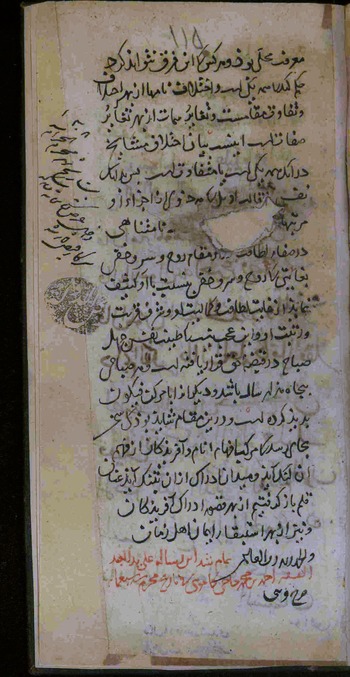
However, there is also a possibility that the nisba is referring to another town of the same name, located in northwestern Iran, in today's region of Western Azerbaijan. Today, there is a small town called Kamus (Kāmūs) in the rural district of Solduz near the city of Naqadeh in the proximity of Lake Urmia.Footnote 7 Like the area of Kashan, Western Azerbaijan produced many men of letters, scholars, and administrators during the Ilkhanid period. Individuals from this region worked especially for certain local dynasties in Mongol Anatolia.Footnote 8 Although the popularity of scholars from northwestern Iran and the geographical proximity of the area to the Mongol political center in Tabriz might tip the balance toward an Azerbaijani origin for Kāmūsī, a definitive answer on the origin of the copyist cannot be provided at this time. The nisba Kāmūsī does not appear in any of the major sources of the Mongol period, nor has Aḥmad ibn Muḥammad al-Ḥājjī Kāmūsī been recorded as the copyist of any other surviving manuscript of the period, beyond those mentioned in this article. Some further information on Kāmūsī can be inferred from the presence of the common laqab al-Ḥājjī in his name (Fig. 1). The epithet suggests that Kāmūsī most probably made the pilgrimage to Mecca, which would have granted him prestige among his contemporary Muslims and raised his profile as a copyist.
MS Āstān-e Quds 545, f. 115.

While the origin of the copyist is uncertain, a look at the four colophons in these manuscripts offers further information about the production of the texts. The most relevant insight is that manuscript AQ 587 mentions the manuscript being copied in the village (qeryeh) of Jāvarsān.Footnote 9 The toponym does not appear very frequently in Persian sources, but it is mentioned in the Muʿjam al-buldān, written in Arabic by Yāqūt ibn ʿAbd Allāh al-Ḥamawī al-Rūmī (d. 1229).Footnote 10 Yāqūt speaks of Jāvarsān as a villageFootnote 11 near the Iranian city of Hamadan. However, he never visited this village or the city of Hamadan and his description of these towns is based on the work of Shīravayh ibn Shahridār al-Daylamī (d. 1115), a fifth-century AH historian originally from Hamadan and famous for his compilation of hadith.Footnote 12 Yāqūt makes use of Shīravayh's Tārīkh-e Hamadhān, an important book that circulated widely in Iran in premodern times, but that unfortunately appears to have been lost sometime after the tenth century AH (seventeenth century CE). We only know about this work from secondary sources, but it has been suggested that it was a useful source of information not only on the geography of the region, but also on the spiritual life of medieval Hamadan. Unfortunately, the loss of this source prevents us from knowing more about the cultural life of pre-Mongol Hamadan, something which would have been very valuable as a point of comparison for the present paper.
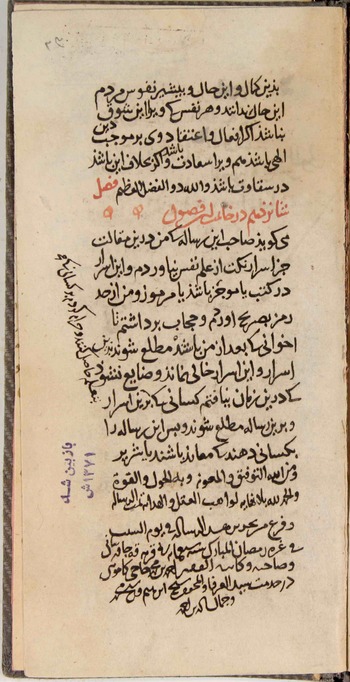
Manuscript AQ 587 is mentioned in an old edition of Abū ʿAlī Ibn Sīnā's work Risāleh-ye nafs, in which the modern editor, Mūsā ʿAmīd, reads the place of copying as the village (qeryeh) of qudsāvahjānī, in what appears to be a misreading of the clear word(s) qeryeh quh-jāvarsānī, as they appear in this colophon (see Fig. 2).Footnote 13 ʿAmīd does not provide any suggestions as to where this place might be and limits his description of the manuscript to mentioning that the writing style, orthography, and calligraphy of the text is rather archaic. It is possible that the prefix quh- could be a Turkified spelling of the Persian terms kuh or kih, meaning “small” or “little.”Footnote 14 If so, this line in the colophon could be read as “the village of lesser Jāvarsān,” possibly referring to the modern rural town of Javar Sineh, located in the Qazvineh district between the modern cities of Kermanshah and Hamadan, not far from the modern city of Kangavar.
MS Āstān-e Quds 587, f. 22.

Whether Kāmūsī was originally from Azerbaijan or Kashan, the reference to Jāvarsān as the place of copying in AQ 587 indicates that his place of residence at the time he copied these works was a small town that is almost halfway between the two possible places where Kāmūsī came from. It is remarkable that these manuscripts were not copied in one of the large or medium-sized urban settlements of Ilkhanid Iran, but rather in a small village located in a predominantly rural environment. This challenges our previous understanding of manuscript production in Ilkhanid Iran, which was often connected with larger cities such as Tabriz or Isfahan. However, evidence in these codices suggests that manuscript copying was an activity that was also carried out in rural areas that were close to medium-sized urban centers such as Hamadan, where urban elites could provide a market for the consumption of this literary production.Footnote 15
In addition to being attributed to the same copyist, these manuscripts also share the characteristic of being copied in a very short period of time. Five out of the six works in the four manuscripts were copied in the course of less than a year, between the months of Muḥarram and Ramażān of the year 700 (September 1300 – May 1301). The date in the colophon of the remaining work (AQ 3520) presents some difficulties in reading, but it seems to have been copied in Rajab I 698 (December 1298).Footnote 16 The dating in the colophons suggests that in the course of eight months, Kāmūsī managed to copy five of the six works included in this corpus. The manuscripts are not very long; they total in all 125 folios, varying from 58 folios—if the three works bound in the same codex (AQ 545, AQ 5915, and AQ 5916) are included together—down to only 26 folios in the case of AQ 587.
This would not have been too much work for a trained medieval copyist who was used to reproducing works relatively quickly, especially non-luxury manuscripts such as those in question. Nevertheless, certain characteristics suggest that perhaps these texts might not have been produced by one single person, but rather by several different people participating in the process. The fact that the layout of each of the works is similar, with all containing nineteen lines of text per page and using a similar type of paper, suggests that all the works were copied following similar design patterns, as if they were meant to be bound together later in one or more codices that formed a coherent book layout. Standardization in the production of these texts might have been the trademark of a small scriptorium in which Kāmūsī would have been the leading figure.
The suggestion that these manuscripts were the result of several different scribes is further supported by the fact that, when comparing the different available colophons and contrasting them with the main text of the works, there are a number of inconsistencies that make one suspect that these texts were not the sole work of Kāmūsī. Comparisons among the surviving colophons in these manuscripts show subtle but interesting variations in the scribal hands. Although the paleography of Islamic manuscripts is not as developed as Latin or Romance paleography, comparison of certain paleographic characteristics among these manuscripts offers insights into the production of the texts.Footnote 17
The core text of each manuscript is consistent with the late thirteenth- to early fourteenth-century script found in other manuscripts of the period. The most common shared characteristic that might suggest that these manuscripts were written by one person is the writing of the word “kī” with the stroke of the “ye” going to the right instead of the left. Another distinctive common characteristic suggesting a similar style of writing is found in the consistent use of z̲āl instead of dāl in all the manuscripts attributed to Kāmūsī. However, when comparing these manuscripts with one another, there are specific variations in the writing style which suggest that more than one person was involved in the production of the manuscripts. A comparison of the script reveals that certain letters are written differently in each of the manuscripts.Footnote 18 Although many of these differences may be subtle at first glance, they denote that there was no standard process of writing in the production of these codices.
The suspicion that different hands participated in the production of these manuscripts is increased when looking at their colophons. The most distinctive of the colophons is the one included at the end of the codex containing the three works AQ 545, AQ 5915, and AQ 5916 (see Fig. 1); unlike the others, it is written in red ink. Rubrics were mostly employed by medieval scribes to highlight parts of the text such as chapter titles, sections titles, or the names of relevant people within the text.Footnote 19 Here, red ink is used to emphasize the name of the copyist. In fact, this particular colophon seems to have been added a posteriori, in a different scribal hand from the one used for the main text. Similarly, AQ 587 also includes rubrics for chapter titles (Fig. 2). In this case, the red titles and the main text appear to be in the same hand, whereas the colophon is more cursive and written, unlike in the previous case, in black ink.
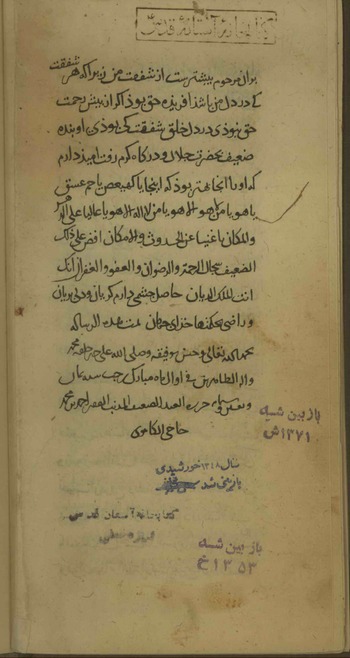
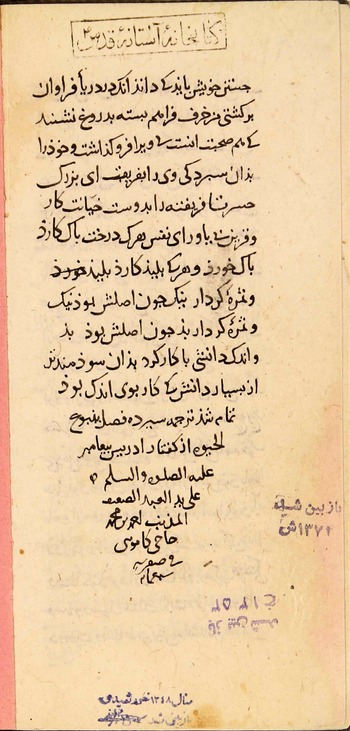
What is interesting when comparing these two examples is that the same hand could have written the colophons of both manuscripts (one in red for AQ 545 and one in black for AQ 587), but the main text appears to have been written by another person. The person writing these two colophons appears to be the same one who wrote the colophon and main text in AQ 3520 (Fig. 3).Footnote 20 Another interesting feature of these colophons is that, whereas those in AQ 3520 and AQ 587 begin in Arabic, those in both AQ 545 and AQ 3589 (Fig. 4) begin in Persian. In fact, all colophons show a mixed use of both Persian and Arabic, but combined in different ways, perhaps to show a particular literary style.
MS Āstān-e Quds 3520, f. 12b.

MS Āstān-e Quds 3589, f. 41b.

It is difficult to be conclusive regarding the number of copyists involved with this group of manuscripts. The evidence presented here could be interpreted differently or even disregarded by those with better eyes than mine. However, there are a number of elements suggesting that the scribal techniques used in these texts are not identical. Comparing colophons and main texts shows enough inconsistencies to raise the possibility that these texts were copied by different hands. If it is the case that different hands participated in copying these works, then all works would have been copied and then signed by Aḥmad ibn Muḥammad al-Ḥājjī Kāmūsī.
This opens the possibility of different interpretations. One possible scenario is that Kāmūsī added his signature to previously copied works, with the objective of selling the copies to a potential client. However, as we will see in the following sections, these works were not randomly copied together, but rather have an inner thematic and linguistic consistency that argues against a simple appropriation of texts by Kāmūsī to obtain monetary remuneration. Alternatively, Kāmūsī may have been the head of a team of copyists working together in a rather modest scriptorium in the vicinity of Hamadan. In this case, his signature would have certified or authenticated these copies. That these works have similar codicological characteristics, were copied in a relatively short period of time, and contain the signature of a valid copyist suggests that they may well have been copied by request, perhaps for a small but active scriptorium near Ilkhanid Hamadan.
Identifying the Works in the “Kāmūsī Corpus”
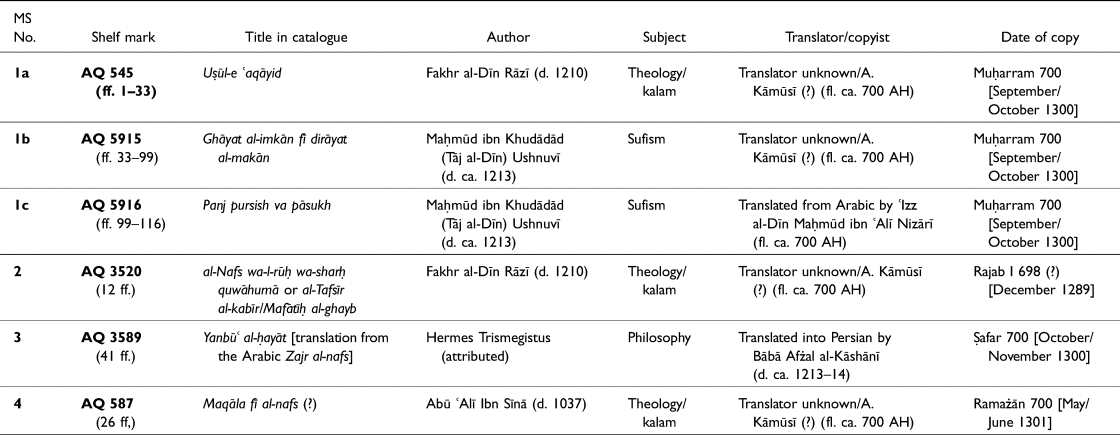
Giving an accurate identification of works copied in a medieval Islamic manuscript is often challenging, because there was no standardization of titles for such texts. Moreover, copyists often made mistakes in attributing works to the original author or copies were made from incomplete or defective exemplars. Copies of surviving medieval manuscripts are often fragmented and scribes commonly selected, rearranged, and/or edited the copied text when they transcribed it into a new codex. Consequently, an exact identification of the six works contained in these four codices requires a more in-depth analysis than that which is offered here. However, despite the difficulties, it is worth offering an approximation of the authorship and textual characteristics of the works included in the “Kāmūsī corpus,” (Table 1) since they may contribute to our limited understanding of the production of knowledge in Ilkhanid Iran.
Works as they appear in the catalogue of the Āstān-e Quds Library in Mashhad, Iran.

The starting point is the only multi-work codex included in this corpus, containing three works written in Persian. The first of these three works, AQ 545, is catalogued under the generic title Uṣūl-e ʿaqāyid. There are difficulties associated with identifying this work, but various catalogues have attributed it to the famous Islamic theologian and exegete Fakhr al-Dīn Rāzī (d. 1210).Footnote 21 Born in the city of Rayy to a migrant Arab family, Rāzī received some initial education from his father, who was the local preacher (khaṭīb). At an early age, the family moved to Maragheh, where Rāzī studied under Majd al-Dīn al-Jīlī (fl. twelfth century), who was previously also the teacher of Shihāb al-Dīn al-Suhrawardī (d. 1191), another contemporary Iranian intellectual connected with this corpus of texts.Footnote 22 Rāzī was a firm proponent of Ashʿarī theology and became a fierce defender of Sunnism.Footnote 23 He travelled extensively in Iran and Central Asia under the patronage of various local rulers, including those of the Ghurid and Khwarazmshah empires.Footnote 24 A well-versed theologian, he could certainly have been the author of a work like this one, which includes chapters dealing with both scientific and religious knowledge, including aspects of Islamic theology such as the afterlife (ākhirat), prophecy (nabwat), and the Imamate (imāmat), as well as components of Islamic law such as jurisprudence (fiqh) and legal reasoning (ijtihād).
The majority of Rāzī's works survive in Arabic. This is not surprising, considering both his family background and his large contribution to aspects of theology and Islamic law, which were primarily written in Arabic during the premodern period. His proficiency in Arabic did not prevent Rāzī from writing a number of different works in Persian, presumably more appealing to some of the Turkic courts where he found patrons for his works. His most recognized Persian work is perhaps the Jāmiʿ al-ʿulūm, an encyclopedic work aiming to be a source of definitions, scope, and principles of the different Islamic sciences.Footnote 25 Although the Uṣūl-e ʿaqāyid included in the “Kāmūsī corpus” is also in Persian and overlaps with the Jāmiʿ al-ʿulūm in some of the topics it covers, it is not encyclopedic in nature. Actually, its thematic arrangement has more in common with other works of Rāzī, such as al-Khamsīn fī uṣūl al-dīn (also al-Masāʾil al-khamsūn) or the Maʿālim uṣūl al-dīn, both concise treatises on Ashʿarī doctrine.Footnote 26 However, to correlate the uṣūl-e ʿaqāyid with these two texts is problematic and a quick comparison of them suggests that they do not correspond. On the one hand, even though the al-Khamsīn fī uṣūl al-dīn was dedicated to the Ghurid ruler Muʿizz al-Dīn Muḥammad (r. 1202–6) and was apparently composed in Persian, it has only survived in an Arabic translation allegedly made by Rāzī's students.Footnote 27 On the other hand, only certain parts of the Maʿālim uṣūl al-dīn are known to have definitively been written by Rāzī toward the end of his life in 1208. The text remains fragmentary, incomplete, and dispersed between different manuscripts.Footnote 28
There is still a possibility that the Uṣūl-e ʿaqāyid is a misattribution for AQ 545. If so, this is either not a work of Rāzī or perhaps we are actually in the presence of a copy of another, far less known work of his, entitled Taḥṣīl al-ḥaqq.Footnote 29 Shams al-Dīn Abū al-ʿAbbās Aḥmad ibn Muḥammad Ibn Khallikān mentions in his biographical dictionary, Wafāyāt al-aʿyān, that Rāzī wrote in his Taḥṣīl al-ḥaqq the line of scholars who transmitted knowledge to him, beginning with his father and going back all the way to Abū al-Ḥasan al-Ashʿarī (d. 936).Footnote 30 The reference to this line of teachers appears also in the Uṣūl-e ʿaqāyid, following the same enumeration of scholars.Footnote 31 This is enough evidence for Altaş to claim that these two are the same text, despite the fact that there is only one surviving copy of the Taḥṣīl al-ḥaqq in Persian, held at the regional library of Amasya, Turkey. The identification of the work is therefore uncertain. A more accurate understanding of the text requires a much more detailed investigation than we can provide here. However, as a preliminary conclusion, we cannot totally reject the authorship of Rāzī; possibly the text identified as Uṣūl-e ʿaqāyid is another copy of the Taḥṣīl al-ḥaqq. If nothing else, this would explain why AQ 545 contains many of the same precepts and teachings included in later works by Rāzī, such as the al-Khamsīn fī uṣūl al-dīn or the Maʿālim uṣūl al-dīn, even though it does not fully match their contents. Perhaps the Uṣūl-e ʿaqāyid was meant as an abridgment of these more extensive theological works but, considering that it was written in Persian, intended for a more vernacular audience. If so, this simplified Persian version could be accompanied by the Arabic original to facilitate the understanding of the text for students or readers with a limited proficiency in Arabic.
The second work included in this codex, AQ 5915, was originally written in Persian and is identified in the manuscript as the Ghāyat al-imkān fī dirāyat al-makān.Footnote 32 The authorship of this work has generated some confusion in recent times, resulting in misattributions in modern library collections. This short treatise was originally attributed to ʿAyn al-Quḍāt al-Hamadānī (d. 1131), a mystical philosopher and Sufi born in Hamadan into a family of scholars and judges, granting him the name of ʿAyn al-Quḍāt (Pearl of the Judges).Footnote 33 However, this appears to be a misattribution and the authorship of the work has been reassigned to Shams al-Dīn Daylamī (d. 1197), a little-known but influential Sufi author.Footnote 34 To further complicate matters, the text was revised by Tāj al-Dīn Maḥmūd ibn Khudādād Ushnuvī (d. ca. 1213), according to the hagiographer Jāmī (d. 1492), a disciple of Daylamī and an influential Sufi mystic at the turn of the thirteenth century.Footnote 35 Ushnuvī was famous for advocating for annihilation (fanāʾ) as the ultimate goal of the mystic in his spiritual path (sulūk), which resulted in him being categorized as an “intoxicated” or “non-sober” mystic.Footnote 36 He was born in the town of Oshnavieh in the region of Western Azerbaijan, Iran, and died in Herat, in today's Afghanistan. He came to be revered in Sufi circles connected to the Kubrawiyya order, which was at an embryonic stage at the time.Footnote 37 His ideas became influential among important religious personalities who lived in the Mongol Empire, such as Sayf al-Dīn Bākharzī (d. 1261).Footnote 38 The relevance of his teaching in Ilkhanid Iran is further attested by the fact that Ḥamd Allāh Mustawfī Qazvīnī (d. ca. 1349) includes Ushnuvī among the important shaykhs of the Mongol Empire.Footnote 39
The Ghāyat al-imkān fī dirāyat al-makān deals with different aspects of Islamic philosophy and mysticism and became popular from the seventeenth century onward, when many copies of it were produced and circulated widely in the Persianate world.Footnote 40 AQ 5915 appears to be the earliest surviving version of the work, and provides important evidence of the circulation of this particular Sufi text during the early fourteenth century.Footnote 41 The text has annotations in the margins in Arabic that connect the main text with other works and suggest some interesting intertextual connections with other Sufi authors that only surface when one looks at the specific composition of this manuscript. For example, at the end of this work, the text includes a number of different prayers in Persian, but with an interesting addition. The copyist has inserted within these common prayers a verse from the famous Sufi poet Abū al-Majd Sanāʾī al-Ghaznavī (d. ca. 1150).Footnote 42 The verse is part of a poem entitled Dar ibdāʿ guyid, which is included in Sanāʾī's didactic mathnavi poem Ḥadīqat al-ḥaqīqa and is dedicated by the author to Sultan Bahrāmshāh of Ghazna (d. 1157).Footnote 43
Additionally, following these verses and prayers, there is a short text in Arabic which has been added perpendicularly by a different hand, and which includes a biography of the Andalusian Sufi Ibn ʿArabī (d. 1240).Footnote 44 The text briefly explains the differences existing between Sufis and jurists (fuqahāʾ), according to the views of the Andalusian mystic, and reproduces the story of an alleged meeting between Ibn ʿArabī and Shihāb al-Dīn al-Suhrawardī, in which both Sufi leaders met face to face but then departed without speaking to one another.Footnote 45 This note seems to have been made no earlier than the second half of the fourteenth century.Footnote 46 There is no evidence, as far as I am aware, to support the historical veracity of the meeting. However, what is interesting is the connection that the anonymous annotator of the Ghāyat al-imkān fī dirāyat al-makān was trying to make between the two Sufi leaders, adding a new perspective on the reception of this text among Iranian Sufi circles of the post-Mongol period.
The final text in this multi-work codex, AQ 5916, shares some characteristics with AQ 5915, to the point where they could be seen as complementary readings. The title of this work is Panj pursish va pāsukh. According to the preface, it contains several mystical questions and answers about the soul (nafs) and its nature. The introduction to the work explains that a group of companions of the aforementioned Ushnuvī asked him questions while he was travelling between the holy cities of Mecca and Medina, recording the answers of the Sufi master in Arabic.Footnote 47 The work was translated from Arabic into Persian, at the request of Ushnuvī's students, by an anonymous translator who describes himself as a disciple of ʿAbd al-Salām Kāmūsī.Footnote 48 The unnamed translator additionally points out that he also translated into Persian ʿAwārif al-maʿārif, the classic work on Sufism by ʿUmar ibn Muḥammad Abū Ḥafṣ ʿUmar al-Suhrawardī (d. 1234).Footnote 49 This suggests that the author of this translation in AQ 5915 could have been either Qāsim Dāwūd Khaṭīb Darācheh (fl. 1241–42) or Ismāʿīl ibn ʿAbd al-Muʾmin ibn ʿAbd al-Jalīl ibn Abī Manṣūr Māshādeh (fl. 1266), two of the early translators of Abū Ḥafṣ ʿUmar al-Suhrawardī's works in the thirteenth century.Footnote 50
According to its preface, the fourth work, AQ 3520, was also authored by Rāzī.Footnote 51 In ten short chapters, the text explores different aspects of the soul (nafs) and the spirit (rūḥ), both of which are recurrent topics in Rāzī's works.Footnote 52 This text is possibly based on either al-Nafs wa-l-rūḥ wa-sharḥ quwāhumā or al-Tafsīr al-kabīr (Mafātīḥ al-ghayb), both well-known works by Rāzī in which the author deals with these topics.Footnote 53 However, these two works of Rāzī were written in Arabic and they are much lengthier than the Persian work contained in the “Kāmūsī corpus.” There is no indication that this work is a translation, as are other works in this corpus. Possibly it is a Persian summary of the two aforementioned texts by Rāzī, something which further textual analysis may bear out.Footnote 54
However, the preface also explains that Rāzī dedicated this work to Sultan Bahāʾ al-Dīn Sām ibn Muḥammad ibn Masʿūd, Sultan of Bamiyan, as a sign of condolence on the death of his son.Footnote 55 The name is clearly identifiable with Bahāʾ al-Dīn Sām II (r. 1192–1206), a local ruler of the region of Bamiyan in central Afghanistan who belonged to a branch of the Ghurid dynasty.Footnote 56 Bahāʾ al-Dīn Sām was a committed Muslim who fought against the Buddhist Qarakhitai and the Khwarazmshah in the final decades of the twelfth century.Footnote 57 We know from different sources that Rāzī resided in the court of Bahāʾ al-Dīn Sām from around the year 1198 until the death of the ruler in 1206.Footnote 58 Minhāj Sirāj Jūzjānī (d. ca. 1266) provides a vivid account of Rāzī's relationship with Bahāʾ al-Dīn Sām. He mentions that the scholar not only stayed under the protection and financial patronage of the sultan for a long period of time, but also composed a work in honor of the Ghurid prince entitled Risāleh-ye Bahāʾiyya during his time at the court.Footnote 59 Unfortunately, Jūzjānī neither comments on the contents of this work nor provides any further information on the book. I have been unable to find a book attributed to Rāzī with this name in any other manuscripts available in modern collections. All these elements suggest, pending further investigation, that the “Kāmūsī corpus” may hold the only known copy of the Risāleh-ye Bahāʾiyya mentioned by Jūzjānī.
The fifth work, AQ 3589 (Fig. 4), is the Yanbūʿ al-ḥayāt, a classical Greek work attributed by some to Plato, by others to Aristotle, and by still others to Hermes Trismegistus, the mythical figure who is considered to be the originator of the ancient Greek philosophy of Hermeticism.Footnote 60 The copy in the “Kāmūsī corpus” is presented as a translation into Persian of the original work, made via an Arabic version known as Zajr al-nafs, by the philosopher and poet Afżal al-Dīn ibn Ḥasan Kāshānī, also known as Bābā Afżal (d. ca. 1213).Footnote 61 This translation was well known already in thirteenth-century Iran, with at least one earlier copy of the work still extant.Footnote 62 The work was influential among scholars of the Mongol period and was widely distributed in manuscript form in Iran from the tenth century onward.Footnote 63 The translation of the text reflects the interest of Bābā Afżal in exploring the nature of the soul (nafs), an interest shared with the previous work by Rāzī and those mentioned above that are associated with Ushnuvī.
The sixth and final work in this corpus, AQ 587, is attributed to the aforementioned famous polymath Ibn Sīnā (d. 1037). The short preface included in the manuscript mentions that this untitled text was originally written in Arabic (tāzī), but is here presented in Persian (bārsī).Footnote 64 Like other works in this group of manuscripts, the main subject matter here is the concept of nafs (the soul), but its identification with a work of Ibn Sīnā is problematic. The first impulse would be to identify the text with the Kitāb fī al-nafs ʿalā sunnat al-ikhtisār, one of the earliest works by the famous philosopher.Footnote 65 However, whereas the standard Arabic version of this text is often rendered in ten chapters, the Persian translation included in the “Kāmūsī corpus” is divided into sixteen chapters.Footnote 66
Although the number of chapters and their titles do not match exactly between the modern Arabic edition and the medieval Persian translation, both share similarities in their approach to the topic of the soul. The preface also offers some extra information on the composition of the original Arabic text. It indicates that the work was written for a ruler (pādshāh) whose name is not provided by the translator and is consequently omitted in this copy. While Ibn Sīnā dedicated some of his works to contemporary personalities in exchange for patronage, the Kitāb fī al-nafs is the only one dedicated to a specific ruler.Footnote 67 The work was composed in the Central Asian city of Bukhara during the early years of Ibn Sīnā's studies and dedicated to Nūḥ ibn Manṣūr (d. 997), the Samanid ruler of the city.Footnote 68 Pending a more in-depth identification of the text, it is thus possible that, based on the subject and the dedication of the work, this Persian text may be at least an adaptation of Avicennean philosophy for Persian readers, if not a faithful translation of Ibn Sīnā's actual work on the soul.
The “Kāmūsī Corpus” in the Context of Ilkhanid History
The works included in the “Kāmūsī corpus” all share common aspects of manuscript production, such as copyist hand(s), layout, place of copying, and/or date of copying. When studied as a group, they also exhibit a number of common characteristics that allow the production of these texts to be contextualized within the wider context in which they were created. The production of the “Kāmūsī corpus” as a compendium of works on Islamic philosophy cannot be disentangled from the historical context of Mongol rule in Iran and the Ilkhanid religious environment at the turn of the fourteenth century.
Religious factionalism has been a constant in medieval Islamic history. However, the nature of religious tensions between Sunni and Shiʿi Islam varied in different periods. Ideologically led by the Seljuq vizier Niẓām al-Mulk, who considered Sunnism (both in Ḥanafī and Shāfiʿī rites) to be the “right religion” of government, the Great Seljuqs began promoting Sunnism over Shiʿism in eleventh-century Iran.Footnote 69 The Seljuqs managed to subordinate Shiʿism under a state-sponsored Sunnism through the establishment of madrasas that played a fundamental role as centers of production and dissemination of Sunni texts and ideas.Footnote 70 However, the Mongol invasions of the thirteenth century would erase the superiority of Sunni Islam over the religious landscape of medieval Iran and reinforce religious factionalism among elite circles in the region. The conversion of the Mongol Ilkhan Ghāzān Khān to Sunni Islam in 1295 marks a crucial step in the Islamization of the Mongols and has important political and religious implications for the development of the history of the Ilkhanate.Footnote 71 It has been observed recently that one of these implications was a general tendency toward “confessional polarization” among Ilkhanid elites of different religious confessions.Footnote 72 Religious groups appear to have increased their communal integration and opposition to one another, in a process that diverged from the more pluralistic religious character propagated by the Mongols before their conversion to Islam. This attitude has been observed in the rise of interconfessional apologetic and polemical works among Shiʿi and Syriac Christian authors in the Ilkhanate, as well as in the development of theology and philosophy among Muslim Sunni intellectuals.Footnote 73 It is in this intellectual context of a growing Sunni faction in Ilkhanid Iran that we can situate the reproduction of the works in the “Kāmūsī corpus.” The inclusion of texts by Sunni intellectuals of both rationalist and Sufi attitudes (such as Rāzī and Ushnuvī, respectively) seems to have been appropriate for satisfying the intellectual impetus of the expanding Muslim Ilkhanid elite during the reign of Ghāzān Khān.Footnote 74 Similarly, despite allegations that he came from an Ismāʿīlī background, Bābā Afżal, the translator of AQ 3589, declared himself that Sunnism was “the right path” and “his poetry and some of his letters are explicitly Sufi in tone.”Footnote 75
In addition to having a confessional proximity to Sunni Islam and Sufism, the individuals included in this corpus share a number of other similar features. The place where these texts were copied, the origin of the copyist, and the biographies of the authors of the works in the corpus all intertwine with one another. Various authors and possibly the copyist of the corpus have connections with northwestern Iran and Azerbaijan. The copyist Kāmūsī may be originally from the vicinity of Lake Urmia, the corpus was copied in Jāvarsān, Ibn Sīnā died in Hamadan (after living there during his latter years), and Rāzī studied in various madrasas in northwestern Iran, initially in the city of Marand and later in Hamadan.Footnote 76 Similarly, Ushnuvī's hometown was only 30 kilometers away from the village of Solduz, the most likely place of birth for Kāmūsī.
Although these geographical connections may be coincidental, what is clearly not coincidental is that the scholars authoring the “Kāmūsī corpus” are linked to one another by their intellectual activity. Ibn Sīnā's philosophy deeply influenced the writings of Rāzī, who composed a commentary (sharḥ) on the physics and metaphysics of Ibn Sīnā's Kitāb al-Ishārāt wa-l-tanbīhāt, one of the most important philosophical writings of his younger days.Footnote 77 The complementarity between the works of both authors in this period is further reflected in the survival of different manuscript compilations (majmūʿāt) that include works by both authors bound together and that were copied in the same time period as the “Kāmūsī corpus.”Footnote 78 In addition, Bābā Afżal, as part of a generation of scholars attempting to bridge Sufism and Islamic philosophy, was highly influenced by the ideas of Ibn Sīnā in his works.Footnote 79 Although he was an independent thinker, there seems to have been a general perception among copyists and compilers of medieval Iran that Bābā Afżal's philosophy was deeply connected to the ideas of Ibn Sīnā. Examples of this perception are the possible misattribution to him of the Sharḥ Ḥayy ibn Yaqzān, a commentary on a work of Ibn Sīnā, and the Mukhtaṣar-e dar hāl-e nafs, a translation into Persian by Bābā Afżal of an original Arabic work on nafs which is often attributed to Ibn Sīnā.Footnote 80
The works in the “Kāmūsī corpus” have a thematic coherence; all of them are concerned with Islamic philosophy and specifically with the concept of nafs (the soul). The term appears in the Qurʾan and has been a recurrent topic of kalām since the early centuries of Islam.Footnote 81 In Islamic philosophy, the idea of nafs soon became associated with mystical approaches to Islam and played a central position in the ideas of early Sufi thinkers, who saw in the spiritual transition between different stages of the human soul the key to achieving a spiritual state of mutual love between God and man.Footnote 82 The concept of nafs became a central part of the work of Islamic scholars such as Ibn Sīnā, Abū Ḥāmid al-Ghazālī (d. 1111),Footnote 83 Rāzī, and Ibn ʿArabī, all of whom incorporated different aspects of ancient Greek philosophy into their description of the nature of the human soul.Footnote 84 The philosophical dialogue between these scholars involved both agreement with and opposition to one another. Famously, Rāzī incorporated the understanding of nafs found in Ashʿarī and Muʿtazilī theology in order to challenge al-Ghazālī's mystical cosmology.Footnote 85
A detailed analysis of the evolution of the concept of nafs in Islamic philosophy is beyond the scope of this article. However, what is relevant to this research is that the thematic complementarity of the texts copied in the “Kāmūsī corpus” concerning the concept of the soul suggests that the process of producing these texts was not just circumstantial but was deliberately calculated and planned. If these works were meant to be bound together, as the similar layout of the manuscripts suggests, their production could be used to render a concise compendium of different interpretations of nafs. It is therefore possible to infer that these texts were produced with a particular recipient in mind. The thematic consistency and complementarity of the texts suggest that either these works were copied by Kāmūsī or the people in his scriptorium at the request of a potential buyer (whether institutional or individual), or they were compiled before being signed by Kāmūsī to certify them as a faithful and coherent compendium on nafs. We cannot know from the available evidence precisely who the intended recipient of these texts was. The only specific reference to a beneficiary of these works appears in the colophon of AQ 587, which mentions that this work was done in the service (dar khidmat) of Saʿīd al-ʿUrafā and the scholars (al-muḥaqqiqīn) Shaykh Muḥammad and Jamāl al-Dīn Aḥmad, none of whom I have been able to identify so far.Footnote 86 However, the common themes of the texts reflect the existence of a market for reading religious philosophy in Ilkhanid Iran and a means for the circulation of such texts within certain religious circles in Mongol Iran.
Perhaps an indication of the possible recipient of these works can be found in the language in which the texts in the “Kāmūsī corpus” were written. All the works in this corpus were originally composed in Persian or are Persian translations of Arabic works. The prominence of Persian as a literary and administrative language is a phenomenon that precedes the coming of the Mongols to Iran.Footnote 87 The popularization of Persian as a courtly language began already under the Samanids and Ghaznavids in Central Asia, expanded under the Seljuqs in the eleventh and twelfth centuries, and was adopted by the Mongols as a lingua franca of the Ilkhanate.Footnote 88 While we know that the production of works in Persian increased during the Ilkhanate, the scope and cultural significance of translations from Arabic into Persian remains only superficially understood.Footnote 89 As some of the texts included in the corpus suggest, there was an effort during this period by some Ilkhanid intellectual groups to disseminate knowledge in Persian that was originally composed in Arabic.Footnote 90 The general perception in scholarship involves a genre division, with Arabic remaining the main language used for writing religious, legal, and scientific texts, and Persian gaining ground as a language of literature, Sufism, and historiography in the early fourteenth century. The coexistence of Arabic and Persian in the literary world of Mongol Iran has driven some scholars to speak of a period of literary bilingualism in some areas of the Ilkhanid state.Footnote 91 However, as seen in the texts included in the “Kāmūsī corpus,” the bilingualism of scholars, copyists, and officials does not mean that all audiences could read or understand both languages. Thus, Persian translations such as those included in these codices were a crucial vehicle for the transmission of knowledge between different social, ethnic, and professional groups in Ilkhanid Iran.
That Persian was the administrative and literary language of the Ilkhanate suggests a possible connection between the production of these texts and the wealthy Ilkhanid elite of the fourteenth century.Footnote 92 Marlow has recently shown, based on manuscript evidence, how regional networks of manuscript production translated and adapted the literary legacy of ʿAlī ibn Abī Ṭālib, son-in-law of the Prophet Muḥammad, as a way of approximating Twelver Shiʿism during the early fourteenth century.Footnote 93 Similarly, the thematically planned combination of texts presented in the “Kāmūsī corpus,” in this case with a marked Sufi-Sunni theological orientation, denotes a clear effort to facilitate the reception of a particular set of Islamic precepts by a Persian-speaking community. In the context of confessional factionalism that was occurring during this period, the “Kāmūsī corpus” emerges as a potential testimony of an attempt to approximate Sunni theology, not only to the Persian-speaking elite, but perhaps also to a growing, newly converted Turco-Mongol audience that was increasingly using Persian as a language of communication.Footnote 94 The texts could be seen in the context of confessional competition for the favor of the recently converted Mongol khans (such as Ghāzān and Öljeytü) and Mongol noyans of Ilkhanid Iran.
No specific member of the Mongol court or Ilkhanid cultural elite is mentioned by name in any of the manuscripts in the “Kāmūsī corpus.” However, the place where these works were copied in the early fourteenth century, in Jāvarsān, near the city of Hamadan, situates the corpus within a larger milieu of Ilkhanid patronage of religious texts and institutions. In this period, Sufism received strong financial support from the Mongol court and Sufi hospices were built in northwestern Iran by Mongol rulers such as Ghāzān Khān, who founded a large khāneqāh in a village close to Hamadan.Footnote 95 The powerful vizier Rashīd al-Dīn Fażl Allāh Hamadānī (d. 1317) was born in the city of Hamadan and, although he left the city at an early age, he had accumulated extensive properties in Hamadan, including religious and charitable foundations, by the time he was in office in the early fourteenth century.Footnote 96
We know that Rashīd al-Dīn invested a considerable amount of his wealth in the production of manuscripts in different areas of the Ilkhanate and promoted this activity in places with a long-standing tradition of manuscript production, such as Hamadan.Footnote 97 For example, various Qurʾans were commissioned by Rashīd al-Dīn during the early fourteenth century, of which at least one was produced in Hamadan, while others were commissioned in cities such as Tabriz, Mosul, or Baghdad.Footnote 98 The magnificent work involved in the production of the Hamadan Qurʾan made it a valuable diplomatic gift; it was sent by the Ilkhan Abū Saʿīd (r. 1316–35) years later to Egypt as a royal gift to certify a newly established peace with the Mamluks.Footnote 99 The region of Hamadan was an active center of manuscript production during the reigns of both Ghāzān Khan and Öljeytü, with various manuscripts surviving from this period that were copied in scriptoriums in the city or in small towns nearby.Footnote 100 In addition, Rashīd al-Dīn's involvement in the cultural and religious life of the Ilkhanate was not restricted to his role as patron. Recent studies on the vizier's theological compositions have shown how the concept of soul (nafs) and some ideas expressed by Rāzī played an important role in the attempt of the Ilkhanid-Persian elite to form a new political discourse, based on a combination of Islamic and Mongol ideas of kingship, to legitimize Mongol rule in fourteenth-century Iran.Footnote 101 The “Kāmūsī corpus” should be seen in this context of a close cultural, religious, and economic integration between the Ilkhanid court and the region of Hamadan. The direct involvement of Rashīd al-Dīn in the production of the “Kāmūsī corpus” cannot be established from the evidence contained in the manuscripts. However, a connection between the vizier (or other members of the Ilkhanid court) in the production or reception of these texts cannot be ruled out.
Conclusion
The codicological analysis of these texts has revealed the existence of a center of manuscript production close to Hamadan during the Ilkhanid period. The production of the corpus may have been the enterprise of a single scribe, but certain inconsistencies in the composition of the texts cast some doubt on whether Kāmūsī was in fact the sole copyist of the texts or whether there were other people who participated in this project. Regardless, it seems that Kāmūsī was the person with the authority to guarantee that these were faithful reproductions of the original texts, and to prepare a coherent compilation of works for a client that remains to be identified. Although it contains the works of multiple authors, the “Kāmūsī corpus” forms a cohesive thematic, linguistic, and scholarly compendium that provides a unique insight into the little-known literary and textual culture of Ilkhanid Iran. The general understanding among scholars has been that the Mongols helped the development of Persian literary genres such as history, geography, hagiography, and literature (both prose and poetry). However, the texts included in this corpus suggest a much wider range of literary genres circulated in Persian during the fourteenth century. The nature of the corpus needs to be seen in the context of the Islamization of the Mongol rulers and the sectarian tensions among the Islamic communities of the Ilkhanate, a context which generated a demand for these works and stimulated the dissemination of religious and philosophical texts among members of social and sectarian groups which were often in dispute with each other.
Because the corpus was crafted in a short period of time and signed by one person, these texts seem to have been made on demand. They were most probably requested by a person or institution interested in acquiring the manuscripts, not to be left on a shelf as a luxury product but rather to be used as part of a religious curriculum or as sources for philosophical debates. Alternatively, the copyist may have produced these codices for sale or to be entrusted to an individual or an educational institution. Either way, the corpus shows the existence of a market among the cultural or religious elites for such Sunni-Sufi philosophical texts in the Persian language, in order to disseminate these ideas among people with limited or no knowledge of Arabic. The “Kāmūsī corpus,” with its textual and codicological characteristics, offers a glimpse into the still poorly understood patterns of knowledge consumption regarding Islamic theology and Sufi texts in Ilkhanid Iran at the turn of the fourteenth century. A holistic view of this group of manuscripts reveals aspects of the intellectual history of Ilkhanid Iran that are often omitted in the general historical narratives which dominate the historiography of this period.
Acknowledgments
I am grateful to Hadel Jarada, Shervin Farridnejad, and Ghasem Gharib for their help in my researching this article. My gratitude goes also to the staff of the Āstān-e Quds Library in Mashhad and especially to Mr. Rezapour (head of the manuscripts collection) and Dr. Abolfazl Hassanabady (director of the manuscripts office), for facilitating access to the manuscripts included in this study.
Financial Support
This work was supported by the Austrian Science Fund under grant FWF-START, Nomads’ Manuscripts Landscape, Y-1232 G30.