INTRODUCTION
Piseinotecus gabinierei (Vicente, Reference Vicente1975) is an aeolidian nudibranch (Mollusca: Piseinotecidae), endemic to the Mediterranean Sea, growing up to a maximum size of about 30 mm (Vicente, Reference Vicente1975; Rudman, Reference Rudman2003). The body is long shaped, transparent with opaque white blotches all over except for the cerata, through which the brown hepatic glands show. The spindle-shaped cerata are set in groups on either side of the body. The anterior clusters have a common stalk which may branch once. The rugose rhinophores are as long as the smooth oral tentacles and about one-quarter of the body length. The foot corners are tentaculiform (Cattaneo-Vietti et al., Reference Cattaneo-Vietti, Chemello and Giannuzzi-Savelli1990).
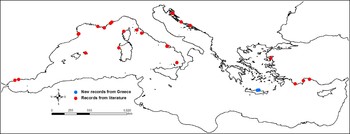
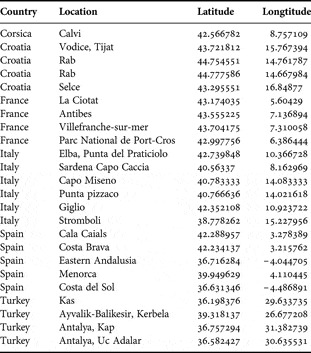
In the Mediterranean Sea P. gabinierei species has been reported from Spain (Cervera et al., Reference Cervera, Calado, Gavaia, Malaquias, Templado, Ballesteros, García-Gómez and Megina2004; Pontes, Reference Pontes2008), France (Vicente, Reference Vicente1975; Poddubetskaia, Reference Poddubetskaia2003; Horst, Reference Horst2008), Corsica (Cattaneo-Vietti et al., Reference Cattaneo-Vietti, Chemello and Giannuzzi-Savelli1990), Italy (Schmekel & Portmann, Reference Schmekel and Portmann1982; Koehler, Reference Koehler1996; Velling, Reference Velling2002; Mas, Reference Mas2008), Croatia (Koehler, Reference Koehler2000; Frijsinger and Vestjens, Reference Frijsinger and Vestjens2008) and Turkey (Aegean Sea and Levantine) (Akbatur, Reference Akbatur2003; Buyukbaykal, Reference Buyukbaykal2003; Yokes, Reference Yokes2009) (Figure 1; geographical coordinates in Table 1).
Map showing where specimens of Piseinotecus gabinierei have been reported from in the Mediterranean Sea (blue circle, new records from Greece; red circle, records from the literature).

The geographical coordinates for where specimens of Piseinotecus gabinierei have been reported from in the Mediterranean Sea.

MATERIALS AND METHODS
Diving activity by the author took place at two locations in December 2008 (see Results and Discussion). Ten dives in each location at a depth ranging between 2 and 20 m took place along the most vertical cliffs and vegetated rocks of these areas. Specimens were collected and transferred alive to the laboratory of the Natural History Museum of Crete for stereoscope vision and photography.
RESULTS AND DISCUSSION
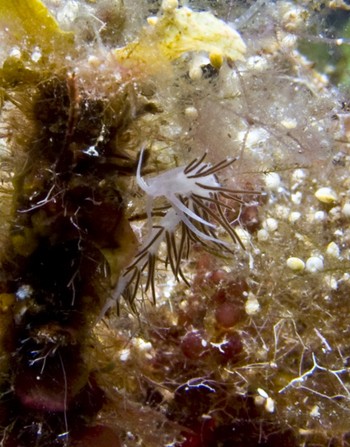
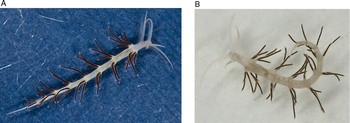
This is the first record of a P. gabinerei nudibranch in the Aegean Sea. The species was found twice in two different locations on the island of Crete. The first location was the island of Dia (coordinates 35.462889°N and 25.191013°E), north of the town of Heraklion. This island is protected by law against SCUBA diving (except for research purposes) and spear fishing by the Greek Archaeological Society, and generally it is not affected by tourism activities. Thus, this location seems to be a hot spot biodiversity area, with high diversity of fish and invertebrates. Other species of Opisthobranchia that are abundant in this area are Hypselodoris picta, Elysia timida, Thuridilla hopei and Hypselodoris tricolor. One individual of P. gabinerei, about 20 mm length, with wrinkled rhinophores, was observed and collected at 15 m depth on Cystoseira sp. vegetation with Eudendrium sp. colonies. The specimen was photographed in situ (Figure 2) and in the laboratory (Figure 3A dorsal view; Figure 3B ventral view).
Photograph of Piseinotecus gabinierei in situ.

(A) Photograph showing dorsal view of Piseinotecus gabinierei; (B) photograph showing ventral view of P. gabinierei.

The second location was the Gulf of Agia Pelagia (coordinates 35.405508°N and 25.018606°E). This is a closed and protected small gulf with shallow waters and mixed bottom substrata (rocky with sandy patches and patches of Posidonia oceanica meadows). At the opening of the gulf there are rocky formations, covered by algae, such as Padina pavonica, Acetabularia acetabulum and Cystoseira sp. Other species of Opisthobranchia that are abundant in this area are Elysia timida, Thuridilla hopei and Dendrodoris grandiflora which are found mainly at the beginning of the summer. One individual of P. gabinerei, about 25 mm in length, with smooth rhinophores, was observed and collected at 2 m depth on a small cliff covered with algae.
Both locations are rocky with algae and colonies of Eudendrium sp. on which P. gabinierei feeds (Schmekel & Portmann, Reference Schmekel and Portmann1982; Trainito, Reference Trainito2005). All specimens are deposited in the invertebrate collection of the Natural History Museum of the University of Crete in 96% alcohol.
The records for two new specimens of P. gabineri in both areas show that the presence of this opisthobranch may not be occasional; however, even if this species was rare due to its small size it is not easily located.
More than 160 (31%) opisthobranch species (Poursanidis et al., Reference Poursanidis, Koutsoubas, Gerovasilliou, Issaris and Zenetos2009) out of the 515 known Mediterranean species have been recorded in Greek waters (Aegean and Ionian Seas) to date. Further research is expected to reveal the occurrence of more species in the area and also species new to science, possibly including lessepsian immigrants due to global climate change.