INTRODUCTION
In Mainland Tanzania,Footnote 1 the institution of marriage is regarded as a cornerstone of society.Footnote 2 On many occasions, the High Court of Tanzania has maintained that marriage is a sacred institution that needs to be handled with extreme care,Footnote 3 because its breakdown has negative and serious consequences not only to the couples but also to the children of the marriage.Footnote 4 In Temba v Shirima,Footnote 5 it was held that marriage is a foundation of the family and society.Footnote 6 To counter potential marriage breakdowns, the Parliament of Tanzania established marriage conciliation boards (MCBs) under the Law of Marriage Act 1971 (LMA).Footnote 7 The major role of MCBs is to conduct reconciliation between spouses in divorce cases.Footnote 8 If they fail to reconcile, each party is then entitled to petition for divorce.Footnote 9 This was meant to ensure that couples in troubled marriages are not forced to live together in the circumstances of an irreparable broken marriage. The rationale is to free the couple from painful or difficult marriages that cannot be saved.Footnote 10 In this respect, access to MCBs for reconciliation would also mean access to the right of divorce, since one cannot be allowed to petition for divorce in a court of law unless there is a certificate from an MCB indicating failure to reconcile the parties.
Specifically, matters that surround access to justice in so far as reconciliation through MCBs is concerned may include: availability of fora; physical accessibility, taking into consideration distance and the nature of infrastructure; affordability of the costs to be incurred in commencing proceedings; the number of sittings; availability of competent and experienced personnel; and flexibility of the fora settling the dispute. Access to justice may also be hindered when parties lack sufficient knowledge to locate the appropriate forum for resolving their dispute. According to Othman, awareness of legal rights and access to legal information are of utmost significance to the majority of Tanzanians.Footnote 11 Echoing the argument on access to legal information, Sanderfur asserts that legal awareness is the first step in a journey to invoking the formal justice system.Footnote 12 Individuals have legal rights only in so far as they are aware of them and can expect to enforce them.Footnote 13 Access to legal information is further compromised by the fact that the majority of the population remain ignorant of many laws, thereby inhibiting them from seeking an appropriate forum for the reconciliation of their matrimonial difficulties.Footnote 14
A review of case law gives the impression that the majority of disputants who access formal mechanisms for the reconciliation of matrimonial disputes lack proper guidance on the fora that are legally recognized for the reconciliation of such disputes. As a result, many disputes end up being nullified, either for being referred to unrecognized reconciliatory fora or for being referred to improperly constituted fora.Footnote 15 Nullification leads to the prolongation of a matrimonial dispute, thus causing humiliation and adding pain to the parties whose marriage is in trouble, as the parties would be required to initiate fresh proceedings to ensure compliance with the law.Footnote 16
The LMA exempts six situations in which a spouse intending to petition for divorce is allowed to apply for a waiver or dispensation from referring the dispute to an MCB.Footnote 17
The LMA enhanced the reference of matrimonial disputes to MCBs by abolishing extra-judicial divorceFootnote 18 and by establishing two forms of MCB: state-based institutions, namely ward tribunals; and community boards, which are mainly established for religious communities.Footnote 19 It was believed that having the two forms of MCB would accord community members freedom to choose their own forum to which to refer their matrimonial difficulties, regardless of their faith.
Nevertheless, a review of case law and the available literatureFootnote 20 points to an irresistible inference that parties in divorce-related proceedings are not assisted by MCBs as had been expected. This trend motivated the current study, the objective of which was to investigate factors hindering spouses in matrimonial difficulties from accessing MCBs, prompting them to file cases without referring them to an MCB for reconciliation. The six factors identified as hindering easy access to MCBs by parties in troubled marriages were found to be: the set-up of the boards; the regulatory framework; physical accessibility; costs; choice of forum; and inadequate provisions governing the process followed by the boards. These factors are discussed below, but the discussion begins by outlining the background to the problem.
BACKGROUND TO THE PROBLEM
Before the LMA was enacted in 1971, several legal regimes governed marriage and divorce.Footnote 21 Court intervention was only necessary for divorces in civil and church marriages.Footnote 22 Husbands in Islamic marriages and in marriages under customary rites could divorce their wives by their unilateral action.Footnote 23 Although disputes from Christian and civil marriages went through the courts of law in the event of a petition for divorce, there were no requirements for referring such disputes to formal marriage reconciliatory fora.Footnote 24 This heterogeneous situation changed upon the enactment of LMA. The LMA prohibited extra-judicial divorceFootnote 25 and required all matrimonial disputes to be referred to the MCB before being instituted in a court of law, save for matrimonial disputes that fall under the statutory exceptions.Footnote 26 This initiative was a positive development for the law of marriage in Tanzania, which was considered in scholarly literature as the “most sweeping change”Footnote 27 under the LMA.
The LMA established MCBs to guard against the hasty and imprudent dissolution of marriages by restricting divorce on the basis of flimsy grounds.Footnote 28 This was meant to reconcile parties whose marriages are at the verge of dissolution.Footnote 29 On failure to save a marriage through reconciliation, the MCB issues a certificate.Footnote 30 It follows therefore that the creation of MCBs was to maintain a balance between saving marriages that are at the verge of dissolution from ending in divorceFootnote 31 and at the same time ensuring that couples are not forced to live together as husband and wife when their marriage has broken down irreparably.Footnote 32 Consequently, a certificate of failure to reconcile the parties proves to the court that a matrimonial dispute has been referred to an MCB and that there has been an unsuccessful attempt to reconcile the parties.Footnote 33 Indeed, a certificate of failure to reconcile the parties is prima facie evidence of marriage breakdown and is what confers jurisdiction on the courts to handle matrimonial disputes relating to divorce and separation.Footnote 34 On receipt of a petition properly accompanied by an MCB certificate, the court proceeds to determine the petition and grant divorce if it is satisfied that the marriage between the parties has broken down irreparably.Footnote 35
In order to put the object of the law into effect, the LMA provides for a two-tier MCB structure: boards established in every wardFootnote 36 and the designated communal boards.Footnote 37 Section 101 of the LMA imposes a mandatory requirement for prior reference of a matrimonial dispute to an MCB before a petition for divorce is filed in court.Footnote 38 Reference to an MCB means to a board established either under section 102(1) of the LMA, as amended by the Law Revision (Miscellaneous Amendments) Act,Footnote 39 or to a designated communal conciliatory board established under section 102(2) of the LMA.Footnote 40 For the sake of clarity and ease of reference, section 102 provides:
“(1) The Minister shall establish in every ward a Board to be known as a Marriage Conciliation Board and may, if he considers it desirable so to do, establish two or more such Boards in any ward.Footnote 41
(2) Where the Minister is satisfied that any community in Tanzania has established for itself a committee or a body of persons to perform the functions of a Marriage Conciliation Board and that it is desirable that such committee or body of persons be designated to be the Board having jurisdiction over the members of that community, the Minister may so designate such committee or body of persons.”Footnote 42
The two-tier MCB structure was meant to ensure that parties have freedom in selecting the forum that would be appropriate for the resolution of their matrimonial dispute. Commenting on the appropriate reconciliation forum for the purposes of the LMA, the High Court of Tanzania in Sedekia N Bizinduka Soweth v Natoria Musa Footnote 43 was of the settled view that the boards referred to under section 101 of the LMA have to be established under section 102 and composed in terms of section 103 of the same law.
A review of the literature and case law shows a number of inconsistencies in compliance with the requirements of section 101 of the LMA. The judges in many registries of the High Court are constantly and on their own volition discovering divorce decrees being granted by lower courts without the couples referring their matrimonial difficulties to an MCB. There are many examples to demonstrate this anomaly, including: Vicent Njila Chikoleka v Joyce Njila;Footnote 44 John v Bura;Footnote 45 Hassan Jumanne v Asha Mohamed;Footnote 46 Felix Rugakingira v Imelda Felix;Footnote 47 Paul Magu Nyahiti v Pendo Shole;Footnote 48 Raphael B Christopher v Lucy A Kaita;Footnote 49 Mary Jacob v Leonard Jacob;Footnote 50 and Athuman Said v Mariam Athuman.Footnote 51
In all these cases, petitions for divorce were filed in the respective court without the matrimonial dispute having been referred to an MCB.Footnote 52 The respective courts granted divorce decrees. As observed by Rwezaura and WanitzekFootnote 53 in a study conducted in Tanzania in 1988, trial courts were admitting matrimonial cases that had not first been referred to an MCB. The researchers attributed this practice to two reasons. First, imperfect understanding of the LMA and, secondly, the countervailing influence of certain customary rules that tended to blur trial courts’ perceptions of the applicable law.Footnote 54 Tanzania's civil justice system in subordinate courts today has moved far from the situation that existed in 1988. Then, primary courts were presided over by primary court magistrates who had completed a short legal course to enable them to know the basics of the law.Footnote 55 The annual output of graduates from the law faculty of the University of Dar es Salaam, which was the only institution in Tanzania producing first-degree holders in law, averaged 50 per year.Footnote 56 These degree holders could not be posted to subordinate courts, because there were insufficient of them.
Today in Tanzania, there is huge interest among students in studying law. In the 2017–18 academic year, 10,077 students were enrolled in various universities to pursue law studies at different levels (certificate, diploma, degree and postgraduate).Footnote 57 Of these students, 7,410 were enrolled in an LLB programme.Footnote 58 13,840 law students graduated between 2013 and 2017.Footnote 59 In turn, the judiciary is now employing LLB holders as magistrates in the primary and district courts. One could therefore argue that lack of knowledge of the law by subordinate court magistrates no longer holds. However, the cases cited above communicate a different message. This article examines this position by referring to the case of Said v Athuman.Footnote 60 This case came before the High Court on appeal. While composing the judgment, the honourable judge observed that the matter had not been referred to an MCB. The court file contained a letter dated 4 August 2017 from the Nyihongo Ward executive officer, thus prompting the honorary primary court magistrate in charge to authorize the filing of the matrimonial case. The judge summoned the parties in order to respond to the observation he made.Footnote 61 The following were the parties’ responses: “Appellant: There was no mediation at Nyihongo Ward Offices. Respondent: It is true. There was no mediation.”Footnote 62
The judge held, “there was not even a slightest attempt to reconcile them at Nyihongo Ward Executive Offices from which a letter that authorized the filing of the matrimonial petition originated”.Footnote 63 The proceedings of both lower courts were quashed for being a nullity. The resultant judgment, decree and orders were set aside.Footnote 64 What does this case imply? The parties knew they were required to refer their matter to the MCB first. They knew they had not referred it to the board, but they were able to secure a letter from the government officer introducing them to the trial magistrate in charge of Kahama Primary Court.
In another case, Christopher v Kaita,Footnote 65 the respondent filed a petition for divorce in Mbeya Urban Primary Court. The records show that the trial magistrate wrote to Rev Gabriel Mwakasita on 16 October 2014, requesting him to reconcile the parties and, in case of failure to do so, he was to inform the court of the outcome. Rev Mwakasita replied to the court's letter on 6 January 2015. The trial magistrate then proceeded to determine the case. A decree for divorce and division of the matrimonial property was granted. On appeal to the High Court, the judge nullified the proceedings and ordered the party interested in pursuing the matter to abide by the law.
This background motivated the researchers to conduct the current study. To the best of their knowledge, no study has so far been conducted to examine MCBs in Tanzania, in particular as to why some people shy away from referring their divorce-related problems to these bodies. This study aims to fill the knowledge gap in this area.
RESEARCH METHODS
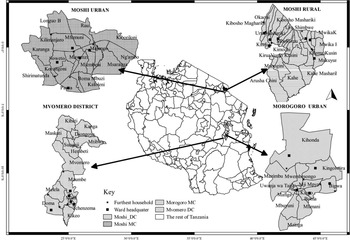
The study employed two data collection methods: documentary review and in-depth-interviews.Footnote 66 The documentary review included a review of legislation, case law,Footnote 67 journal articles, books, government reports, newspapers and MCB and court records.Footnote 68 The documentary review method was supplemented with in-depth interviews. The latter method was used to fill the gaps left by the former method. In this regard, interviews were conducted with respondents who were purposefully selected from 22 wards drawn from four districts in Kilimanjaro and Morogoro Regions. These were: Morogoro Urban and Mvomero District in Morogoro Region; and Moshi Urban and Moshi District in Kilimanjaro Region. The wards visited for the study are shown in Figure 1 below. A total of 97 respondents were drawn from the following categories: MCB members, ward councillors, ward executive officers (WEOs), mitaa [street] executive officers (SEOs), village executive officers (VEOs), community development officers, paralegals,Footnote 69 religious leadersFootnote 70 and persons who had gone through MCBs.
Map showing wards visited for the study

The data were processed and developed into notes and later qualitatively analysed through content analysis.Footnote 71 The findings were discussed and conclusions drawn. The researchers observed ethical principles, including seeking permission for the study from relevant authorities. Before conducting the interviews, informed consent was obtained from the respondents. Tight confidentiality was observed and guaranteed, including concealing the respondents’ identity in order to protect them from unfair suppositions. The respondents were assured that their responses would be utilized for research purposes only.
FACTORS HINDERING ACCESS TO MCBs
Often, before a dispute reaches any MCB, a mutual friend of the disputants, in a highly informal manner, attempts to bring about reconciliation. A go-between can either be asked by one of the parties to reason with the other, or interject her/himself if s/he is especially close to both parties. A go-between must know both parties well and have their trust. This informal procedure of settling family disputes continues today and is widely applied. The use of MCBs in settling family disputes in Tanzania, is a modern way of reconciling matrimonial disputes, bearing in mind the sophistication of social life in modern Tanzania.Footnote 72 However, MCBs do not seem to attract the needy spouses who are in matrimonial disputes. There follows a discussion of the factors hindering spouses from using MCBs effectively.
Set-up of the boards
The setup of an MCB at a ward level in Tanzania may be considered from different angles. This study took into consideration three aspects: location, naming and premises; composition; and qualifications of MCB members. Each of these aspects is examined below.
Location, naming and premises (venue)
Ward tribunals, established under the Ward Tribunals Act,Footnote 73 are empowered to constitute as MCBs when handling a matrimonial dispute relating to the breakdown or anticipated breakdown of a marriage.Footnote 74 The venues for tribunals to transact the reconciliation of a matrimonial dispute are located within the respective ward. The ward tribunals are not mobile and, as such, the needy people have to access the MCB at the ward's headquarters. In this respect, the convenience of the authority overrides the parties’ flexibility in choosing the venue for their reconciliation.
For instance, ward tribunals in Morogoro Urban District are situated as follows: in Tungi Ward, the venue is within Nanenane ground; in Bigwa Ward, the venue is at Bigwa Mwisho; and in Kilakala Ward, the tribunal is located at Kigurunyembe.Footnote 75 In Moshi District Council: the venue for the MCB for Uru South Ward is at Uru Kati;Footnote 76 in Makuyuni Ward, it is located at Himo Sokoni; while in Kindi, the MCB is situated at Sambarai. The headquarters of Marangu East Ward is Lyamsangara Village in the interior and cannot be easily accessed by someone travelling from Samanga Village or from the areas bordering the Mt Kilimanjaro National Park.Footnote 77 A similar situation was observed at Marangu West, although during the study period no ward tribunal existed. This ward covers an area of 7.5 square kilometres and consists of seven villages with 33 hamlets, 3,897 households and 18,976 residents.Footnote 78
The naming of MCBs is another aspect for consideration. MCBs have no posters in the streets indicating their locations. They are found in the ward administrative offices, with nothing to determine their identity. Their working tools and stamps read “land tribunals”,Footnote 79 not “marriage reconciliation boards”. This means that a person wishing to refer a matter to conciliation has to take the trouble to enquire about the whereabouts of the institution's location. The name also raises doubts in the minds of the potential consulting parties, as the emphasis is on land disputes and not the settlement of marriage disputes. According to nominalists, names matter.Footnote 80 For example, in African culture, calling or giving a person a “bad name” ruins the wellbeing or future of the bearer of that name.
Venue is another aspect with a bearing in the mindset of the parties in dispute. A person in difficulties would appreciate sitting in a tranquil environment or in a venue that is suitable for discussion and has no undue interferences. The LMA contains no provisions on confidentiality or privacy of the parties in dispute during the conciliation. Neither does the act address the nature of the venue for conciliation. When compared to other forms of dispute settlement, conciliation is characterized by the need for a very high degree of confidentiality and privacy.Footnote 81 Conciliation proceedings need to be held in private, so the onus is on the conciliators and the parties not to disclose any matter relating to the process.Footnote 82 The ward tribunals visited did not have venues specified for reconciliation activities. For instance, at Tungi, the venue used for marriage reconciliation is a multipurpose hall with no mechanism for maintaining confidentiality from intrusion by other ward staff. The venue is not free from noise and other normal ward activities. The hall is used as an office for the WEO, ward councillor, four street executive officers and members of the ward tribunal. This means that, when the tribunal is in session, attempting to reconcile a couple's differences, other officers may eavesdrop or interrupt the sessions. This is likely to limit the parties’ freedom in expressing the facts leading to the dispute. It is submitted that, without such facts, the role of a conciliatory board is rendered nugatory, as it will be unable to conduct inquiries. The authors expected that special rooms or halls designed for discussing confidential matters such as marriages would be set aside, but unfortunately not a single ward was found to have such a venue.
Composition
The composition of ward tribunals is regulated by three statutes, as explained below. Under the Ward Tribunals Act, the ward tribunals are constituted by no fewer than four and no more than eight members, who are appointed by the ward committeeFootnote 83 from the residents of the ward.Footnote 84 This composition is for handling minor disputes relating to dowry and land, in contravention of the customs and traditions of the area in the village or ward, adultery and any matter referred to the tribunal by the disputing parties for reconciliation and scheduled criminal offences.Footnote 85 The Land Disputes Courts Act,Footnote 86 on the other hand, prescribes a different set of members for handling land disputes. In this case, there are at least four and not more than eight members, of whom three shall be women who shall be elected by a ward committee.Footnote 87 In the case of matrimonial disputes, the LMA demands a composition of the chairman and no fewer than two and no more than five other members.Footnote 88
The empirical study conducted in Morogoro and Kilimanjaro regions revealed that the composition of ward tribunals for marriage reconciliation varied across wards. For instance, the composition of the ward tribunals visited in Mvomero District Council in Morogoro region greatly exceeded the LMA requirements. These tribunals had the following number of members: Mlali (16), Mgeta (11), Sangasanga (eight), Nyandira (seven) and Doma (11). The number of members of the wards visited in Moshi District Council was as follows: Kibosho West Ward (eight), Kindi (six), Makuyuni (12) and Uru South (six). It is submitted that the composition of MCBs is influenced by the existence of multiple laws with varied provisions on the composition of ward tribunals. Furthermore, ignorance among members of the ward tribunal of the requirements for how MCBs are constituted has also contributed to the violation of the LMA provisions, which mandate that the boards be constituted by a maximum of five members.
Qualification of MCB members
Section 5(1) of the Ward Tribunals Act does not expressly state the qualifications required for ward tribunal members. The act adopts the style of identifying the qualifications by way of exclusion. The excluded categories under section 5(1)(a)–(h) include members of the National Assembly, members of a village council or ward committee, civil servants and legally qualified persons or any person who is employed in the judiciary. Others include persons who have previously been convicted of a criminal offence involving moral turpitude and non-citizens. Critical analysis reveals that persons are excluded from membership if they are engaged in various official capacities in the ward or hold other civil service positions. There are also categories of persons who are excluded due to their lack of capacity; these include persons who are mentally unfit, below the apparent age of 18 or are presumed to lack sufficient ability to make a rational judgment.
However, it is argued that the reconciliation of married persons of varied age, education, religion and cultural background requires persons with more qualifications than those prescribed under the Ward Tribunals Act. The authors argue that a person previously convicted of a criminal offence involving moral turpitude is no different from a divorcé known to have wreaked his marriage on grounds of extreme cruelty. For instance, the cases of Robert Aranjo v Zena Mwijuma,Footnote 89 Said Mohamed v Zena Ally Footnote 90 and Mariam Tumbo v Harold Tumbo Footnote 91 reflect a high degree of cruelty exerted by husbands on their wives leading to the breakdown of their marriages. Similarly, in Elizabeth Kamulindwa v Austin Kamulindwa,Footnote 92 the husband was an alcoholic, negligent to the family and extravagant, and did not cooperate with the family; such a scenario should be captured in the law as a yardstick for excluding such persons from being elected.
Historically, disputes relating to family relations in communities in Tanzania were handled by elders and wise people who were highly respectable.Footnote 93 In Zanzibar for example, elders commonly known in Swahili as wazee play an important role in all matters relating to marriage and divorce.Footnote 94 They are regarded as the mandatory first step in the legal process.Footnote 95 It is only when a dispute persists that it can be referred to a sheha Footnote 96 or a kadhi.Footnote 97 Although the role of elders in the settlement of matrimonial disputes in Mainland Tanzania cannot be overestimated, there is no legal requirement compelling couples to approach the elders first before referring the dispute to an outside institution. Meanwhile, the LMA is silent on various aspects regarding the set-up of MCBs; for example, the mode of appointment of members, their qualifications and techniques in reconciliation leave much to be desired.
Regulatory framework
When MCBs were established in 1971, the minister responsible for legal affairs was vested with the power to establish an MCB in every ward.Footnote 98 The minister was also empowered to establish two or more boards whenever this was deemed desirable.Footnote 99 Furthermore, the minister is empowered to designate community boards, subject to the provisions of section 102(2) of the LMA. Sections 2 and 162 of the LMA show that the minister is responsible for implementing the provisions of the LMA. However, the 1996 LMA amendments (by virtue of Act No 9 of 1996) ended the minister's powers in respect of establishing MCBs in every ward. A cursory glance at the provisions of section 3 of the Ward Tribunals Act, under which ward tribunals are appointed as MCBs, indicates that the minister responsible for local government is empowered to establish two or more tribunals as he deems fit. Furthermore, ward tribunals are categorized as land courts under the purview of the Land Dispute Courts Act.Footnote 100 The Land Dispute Courts Act empowers the minister responsible for land matters to have control over the implementation of the functions of the ward tribunal in the performance of its jurisdiction as the land court. This means therefore that the regulatory authority (the minister for legal affairs) cannot fully implement his or her role to oversee MCBs established at the ward level without interference. This is because the organs appointed as MCBs (the ward tribunals) are also under the control of the minister responsible for local government authorities and the minister responsible for land matters.
It is noted that the powers of the minister responsible for legal affairs in respect of the designation of communal boards have remained intact since 1971. Research has shown that, once designated, communal boards have no mechanism to regulate their operations.Footnote 101 Each board works in accordance with its constitution or directives of the community. It is submitted in this regard that the lack of a clear regulatory mechanism governing MCBs in matters pertaining to their day-to-day operations contributes to their inefficiency.
Jurisdiction
MCBs are empowered to handle matrimonial disputes relating to divorce.Footnote 102 The intention is to use reconciliation to prevent such disputes from ending in divorce. Geographically, a board established at the ward where the husband resides exercises jurisdiction over the dispute.Footnote 103 In the event that the husband does not reside in Tanzania, the board established at the place where the wife resides exercises jurisdiction.Footnote 104 Communal boards exercise jurisdiction where both parties to a matrimonial dispute belong to the same community.Footnote 105
The study reveals some problems in respect of the jurisdiction of the ward tribunal in conducting reconciliation of divorce related matters. The designation of a ward tribunal as an MCB is unknown among ward officials and the majority of members of the ward tribunals.Footnote 106 An interview with a member of the ward tribunal at Tungi indicated that marriage related disputes are wrongly brought before the ward tribunals, which are only entitled to handle land matters and other minor civil and criminal disputes. This view was shared by the chairman of the ward tribunal established for Majengo Ward in Moshi Urban District. In both instances the emphasis was that marriage disputes are handled by social welfare institutions.
Costs
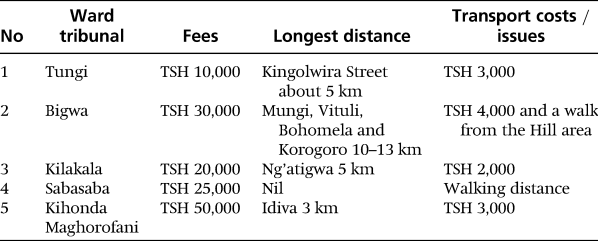
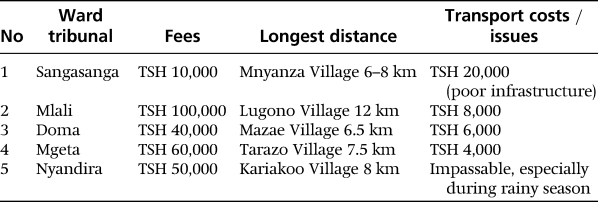
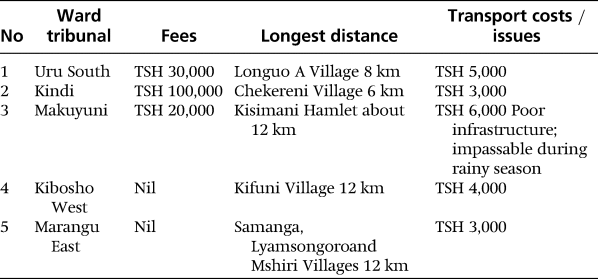
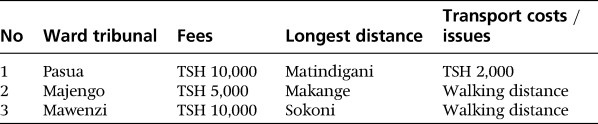
Traditionally, the reconciliation of disputing parties in Tanzania costs nothing, save for a drink and food to members of the reconciliation team.Footnote 107 There are still examples in Tanzania today where reconciliation is freely offered. The best example is mediation in a village land council.Footnote 108 Other fora that offer free mediation services include the Commission for Mediation and Arbitration.Footnote 109 However, reconciliation in matrimonial disputes in ward tribunals in Tanzania entails substantial costs, as shown in the tables below.
A review of legislation indicates that no legal provision, either under the LMA or under the Ward Tribunals Act, imposes charges on parties who refer their matrimonial difficulties to MCBs established at the ward level. However, interviews with councillors,Footnote 110 WEOs,Footnote 111 community development officers,Footnote 112 MCB membersFootnote 113 and respondents who received services from such boards revealed that a person referring a matter to the board is required to pay “fees” to enable the board to convene. According to the WEO from Kindi and Uru South Wards in Moshi District, the amount charged to the parties covers allowances for tribunal members and stationery. A similar response was reported by WEOs in another 15 wards. A different situation was observed at Kilimanjaro Ward in Moshi District, where the ward is responsible for stationery. The amount (TSH 10,000) received from the parties is used as an allowance for members present for the case.Footnote 114
The fees vary from one ward to another, as shown in Tables 1 to 4. Fees payable to ward tribunals range from TSH 5,000 to TSH 100,000 (approximately GBP 2 to GBP 36). A study by RwezauraFootnote 115 shows that the majority of petitioners in matrimonial cases are females,Footnote 116 who are generally economically poor compared to men.Footnote 117 A recent study by Tundui shows that women in Tanzania still lack access to finance, business skills and experience; women face a hostile business environment and are constrained by socio-cultural factors, which hinder them from accessing finance.Footnote 118 Men can face similar financial problems in areas where the monthly average income of an individual is estimated to be TSH 45,000 (approximately GBP 16).Footnote 119
Morogoro Municipal Council

Source: Interviews conducted with respondents in 2020
Mvomero District Council

Source: Interviews conducted with respondents in 2020
Moshi District Council

Source: Interviews conducted with respondents in 2020
Moshi Municipal Council

Source: Interviews conducted with respondents in 2020
The councillors who chair the ward development committee meetings indicated that they imposed charges because of a lack of funds to cover the tribunal's running costs. At this juncture, the question is whether the ward development committee has a statutory mandate to impose fees and what criteria they consider in setting the amount.Footnote 120 These questions arise because the study observes a lack of uniformity in the fees charged to the parties, even if the tribunals are located in areas with similar characteristics. The case of Kindi and Uru South Wards is a good example; at Kindi, the fees are TSH 100,000, while in Uru South they are TSH 30,000. The variations in the amount tribunals charge are attributed to a lack of legal provisions restricting tribunals from imposing fees on the parties. It may be noted that the Arbitration Tribunal Regulations 1969Footnote 121 (arbitration tribunals being the predecessor to ward tribunals) expressly prevented the levying of any fee on the parties.Footnote 122 It is submitted that the fees imposed by ward tribunals add an additional burden on the parties, discouraging them from accessing the boards.
It is observed that members who sit as assessors in Tanzania's primary courts are paid allowances, as specified by law. According to the Primary Courts (Remuneration of Assessors) Regulations 1973,Footnote 123 assessors are paid based on their attendance in accordance with a roster prepared by the primary court magistrate for each whole day or part day the assessor attends the court.Footnote 124 Members sitting as assessors at the district land and housing tribunals are also paid allowances, as specified by law. According to the Land Dispute Courts (the District Land and Housing Tribunal) Regulations,Footnote 125 allowances payable to the assessors in the district land and housing tribunals are determined by the minister upon recommendation from the registrar.Footnote 126 In recommending the allowances payable, the registrar shall take into consideration the tribunal's workload, transport costs, meals and accommodation costs where necessary, and the duration of the hearing.Footnote 127 The regulations clearly provide that the amount payable may differ from one tribunal to another depending on where it is established, which could be within the city area, municipality, township or district council.Footnote 128 The authors submit that MCBs should adopt the statutory regulation of charges and members’ allowances if it is necessary for the parties to incur expenses for reconciliation. Failure to regulate charges may result in unwarranted practices, thus prejudicing the intention of the law in establishing reconciliatory boards.
Apart from the fees charged to persons referring matrimonial disputes to the MCBs in the wards, another component of costs that the parties must bear involves travelling expenses. Three illustrations may suffice to show the level of burden on the parties. For instance, a person from Vituli, Korogoso and Bohomela Streets in Bigwa Ward, located about 13 kilometres into the hill areas of the ward, must travel long distances to the ward offices to access the services of ward tribunals. The ward covers an area of over 2,561 hectares, 13 streets, and 14,219 residents, as per the 2012 national census. The average travelling expenses for a person hiring a motorbike range from TSH 2,000 to TSH 3,000 per trip. In Makuyuni Ward in Moshi District Council, a person travelling from Kisimani hamlet would incur costs of TSH 6,000 to travel to access the services of the ward tribunal. A person from Mshiri and Lyamsongoro villages will incur TSH 3,000 in transport expenses or must walk over 9 kilometres to the ward tribunal. The charges imposed by the ward tribunals in handling matrimonial disputes, together with transport costs incurred by persons residing in the areas furthest from the ward offices, generally prevent parties from accessing reconciliation services as they cannot meet the expenses.
Choice of forum
The discussion in the previous section presents matters connected with the setup of MCBs, at both the ward and community board levels.Footnote 129 The findings show instances where no ward tribunal has been established in a ward to handle disputes as envisioned under the LMA. The situation is exacerbated when no registered communal boards exist in the ward. Another situation arises in areas where the ward tribunal exists, but no community board has been established and designated under section 102(2) of the LMA. Indeed, the two situations hinder parties from choosing the forum for reconciling their matrimonial disputes. The authors are aware of the situation under section 104(7) that the board's proceedings shall not be rendered invalid because it did not have jurisdiction under section 103(2) of the LMA. However, it is argued that this provision can only rescue imperfect proceedings found with a board properly established and recognized under the law. The documentary review indicates that the parties’ lack of freedom in choosing the forum for reconciliation is one of the challenges facing MCBs, suggesting that any reform of the boards should focus on flexibility to allow parties to exercise their options.Footnote 130
The designation of ward tribunals as MCBs was considered in the case of John v Bura Footnote 131 as a milestone in bringing the reconciliation service closer to the people, but the fact is that parties are facing difficulties in accessing the boards. In contrast to the position held in that case, the findings from in-depth interviews with six WEOsFootnote 132 and one street executive officer representing six out of 22 wards investigated, suggest that the set-up of ward tribunals is inadequate for people travelling from the farthest parts of a ward. For instance, a person living in Kitungwa on the border between Tungi and Kingolwira, has to travel about five kilometres to Nanenane ground to access the services. The same applies to Moslems, who travel from the extreme end of Bigwa to Morogoro town centre to seek reconciliation services.
In places such as Kihonda Magorofani there is no ward tribunal, nor is there a designated communal board. A resident of Kihonda Magorofani Ward belonging to the Muslim community has to travel to the marriage reconciliatory tribunal located along Boma Road in the city centre of Morogoro municipality. Similarly, one belonging to the Roman Catholic community and residing at Kyegeya in St Monica Parish has to travel to Kiwanja cha Ndege Parish, in Chamwino Ward, about seven kilometres away, to find services from the Kamati ya Tume ya Familia (Committee of the Family Tribunal) for Morogoro Diocese. Although Kiwanja cha Ndege Parish does not appear in the list of designated communal boards, the chairman of the committee indicated in the study that the committee is for the Morogoro Town Parish but sits at Kiwanja cha Ndege due to convenience and availability of space and facilities for reconciliation. The Appointment of Communal Conciliatory Boards Notice of 1971 reveals no other designated communal conciliatory board in Morogoro; irrespective of this, it is common knowledge and has already been noted that there are at least five well-established religious institutions in Morogoro.Footnote 133
Inadequate provisions governing the process followed by the boards
How do MCBs handle reconciliation? The LMA does not state procedures for reconciling parties to a matrimonial dispute. Section 104, which is entitled “Process of the boards” only provides for preliminary matters, such as parties’ attendance, their opportunity to be heard, witnesses’ attendance and the requirement for certification if there is a failure to reconcile. On the other hand, the Marriage Conciliation Boards (Procedure) RegulationsFootnote 134 prescribe the mode for reference to MCBs (that is, orally and in writing), the quorum, the notice to appear before the board, the board's decision and mode of certification.Footnote 135 The LMA and the regulations made under it do not appear to offer guidance to MCBs on the manner in which reconciliation is conducted.
Understanding of the reconciliatory process
The discussion above on the set-up of MCBs has shown that the LMA prescribes neither the mode of appointment of MCB members nor their qualifications. Interviews with WEOs and MCB members revealed that there is no training in the form of an induction course offered to newly elected members. The practice is therefore by way of intuition. During interviews with members of the ward tribunal at Uru South, a lack of understanding of the reconciliatory process was cited as one of the factors hindering the effective performance of their role in reconciliation. A similar finding was reported by members of MCBs in other areas visited.
In almost all MCBs, reconciliation was observed to follow the system of a normal civil suit hearing. A party referring the matter to the board is asked to give evidence, together with his or her witnesses. All the witnesses are cross-examined by the opposite side. Likewise, the party against whom the allegations are levelled is given the opportunity to provide evidence followed by cross-examination and the same is done in respect of his or her witnesses. The judgment is then written and the decision given to the parties. Upon a failure to reconcile, a certificate is issued to the party desiring to petition for divorce. There were many cases in which letters were written in the place of prescribed certificates.
Duration of reconciliatory process
The LMA does not specify the period within which an MCB must finalize a case brought before it. The practice observed in all wards visited is that only one day of the week is allocated for the ward tribunals to perform their functions. In that single day, the tribunal handles a variety of cases, including land, marriage and other minor disputes of a civil or criminal nature. The WEOs interviewed indicated that the time taken to handle and finalize a case depends on the availability of members. Sometimes, cases are adjourned due to a backlog of cases at the tribunal and non-availability of members. This finding suggests that parties with matrimonial difficulties are not assisted promptly in the reconciliation of their differences. It is submitted that the difficulties caused by such adjournments (which may include time and costs) increase the stress for the parties, thus discouraging them from seeking the services of the ward tribunals.
Practice where MCBs are non-existent
The visits to Kihonda Magorofani Ward, Marangu West and Kirima Wards showed that ward tribunals had not been established. The practice was that a WEO or SEO from a street where the parties reside or, in his or her absence, any SEO available at the ward office, may handle a matrimonial dispute singlehandedly.Footnote 136 There are circumstances where the SEOs obtain assistance from the ward community development officers.Footnote 137 According to the survey respondents, upon failure to reconcile the parties, a letter bearing the name and stamp of the WEO is written to refer the party to court to file a petition for divorce.Footnote 138 This was also observed at Marangu West Ward, where VEOs handle matrimonial disputes. The practice whereby persons other than MCB members handle matrimonial disputes was criticized in John v Bura Footnote 139 where the High Court held, “under section 101 of the Law of Marriage Act, powers of reference of the matter to court is the board's obligation. Such powers are not open to everybody who is not even a member thereof”.Footnote 140 In this case, a letter was written by the VEO, addressed to the magistrate in charge of the primary court. The court observed that the VEO did not appear to have been acting on behalf of the conciliatory board. It is worth noting that neither the WEO nor the VEO is entitled to handle the disputes referred to him or her under section 101 of the LMA.
A peculiar practice was found at Kirima Ward. At the time of the study, there was no ward tribunal. Interviews with the WEO, the VEO for Kirima Village and a resident from the ward showed that a tribunal had not existed for quite some time. According to the respondents, matrimonial disputes had been being presented before the village land council established in each village of the ward and such disputes had been successfully reconciled. The respondents believed that village land councils are competent to handle marriage disputes. The village land councils referred to by the respondents are established as one among the land courts under the Land Disputes Courts ActFootnote 141 with the purpose of mediating exclusively over land disputes at the village level.Footnote 142 These organs are never described as MCBs and therefore any reference to these councils does not serve the purpose and intent of section 101 of the LMA. This is because the councils are not one of the two forms of MCB established under section 102 of the LMA.Footnote 143
The findings from Bigwa and Kilakala Wards in Morogoro Municipality show that a Kamati ya Migogoro ya Ndoa [marriage dispute committee] and Kamati ya Migogoro na Usuluhishi [disputes and reconciliatory committee] have been established in the respective areas. These committees were established by the ward development committees of the respective wards. The findings from interviews with the councillor, WEO, community development officer and members of the tribunal from both wards show that members different from those sitting at the ward tribunal constitute the committee at Bigwa, while the one established for Kilakala Ward is chaired by the WEO. Other members include the community development officer and other reputable and experienced residents of the ward.Footnote 144 At Kilakala, the respondents revealed that, where the committee fails to reconcile a dispute, it refers it to the ward tribunal for issuance of a certificate on the failure of reconciling the parties. The practice at Bigwa shows that, on a failure to reconcile the parties, the same committee refers the parties to the court as if it were a board constituted at the ward tribunal.
Considering the manner in which the committees are constituted, one finds that it is contrary to what is envisioned under section 102(1) of the LMA, which only designated the ward tribunals as marriage conciliatory boards. The WEO, SEO / VEO and community development officer are among the persons excluded under section 5(1) of the Ward Tribunals Act from being members of the tribunals. These officers are civil servants. The question at this point is whether the government intended to use local government officials at the ward level to resolve disputes? This was definitely not the intention, otherwise the laws would have expressly stated so by showing the powers of ward committees in respect of establishing MCBs. In the authors’ humble view, in designating the ward tribunals as MCBs, the government intended that the same tribunal constituted as provided for under section 3 of the Ward Tribunals Act would be the appropriate forum for reconciliation. When handling matrimonial disputes for the purposes of the LMA, the tribunal would therefore be constituted as an MCB and the provisions of the LMA would apply.
CONCLUSIONS AND RECOMMENDATIONS
MCBs are institutions with the potential to bring harmony and maintain relationships between spouses and among family members. However, this potential is not fully exploited by those in need. Access to MCBs and subsequently to the courts is often blocked by the factors identified in this article. Spouses in potentially irreparably broken marriages are technically forced to continue to live in such marriages because their way is blocked. MCBs seem to attract minimal attention from the government and politicians. This is because the factors limiting spouses’ access to MCBs are within the government's power to fix. These include paying allowances to MCB members, training newly appointed MCB members regularly, encouraging religious institutions to apply for designation as MCBs and creating awareness of MCBs as institutions established for the reconciliation of spouses in troubled marriages.
MCBs are at the centre of life of a society. The closer the institution is to the people, the better it can perform. The government should give it special attention in terms of bringing it to the level of the street chairman and village land council. This set-up would minimize the need for parties to travel long distances and avoid using ward tribunals, which are already overloaded with many civil, criminal and land disputes.
It is further recommended that the laws governing MCBs (the LMA) and ward tribunals (the Ward Tribunals Act) and their subsidiary legislation should be harmonized in terms of members’ qualifications, tribunal composition, gender and confidentially. The law should strive to build forum seekers’ trust and confidence. It should attract members of society to see MCBs as fora readily available for reconciliation and promoting the institution of marriage; and, where the marriage has irreparably broken down, the parties should be assisted to seek divorce in a court of law. Law reforms should also cover the social welfare office under the Ministry of Social Welfare. To date, the High Court is divided on this. Some judges recognize that the office at all levels qualifies as an MCB; other judges do not hold so.
CONFLICTS OF INTEREST
None