Introduction
Odour and flavour are among the most important sensory attributes of meats. Often Western consumers find sheep meat too strong in flavour, especially when the animals are raised on pasture. Skatole (3-methylindole) and indole are compounds found in the adipose tissue of different animals. In pork, skatole is responsible for the unpleasant boar taint (Annor-Frempong et al., Reference Annor-Frempong, Nute, Whittington and Wood1997a), while in sheep, it is linked with typical species flavour (Young et al., Reference Young, Berdagué, Viallon, Rousset-Akrim and Theriez1997) and pastoral odour and flavour (Young et al., Reference Young, Lane, Priolo and Fraser2003). In ruminants, skatole is formed by ruminal microorganisms and it has been often found at higher concentrations in fat from lambs fed green herbages compared to animals given concentrates (Young et al., Reference Young, Berdagué, Viallon, Rousset-Akrim and Theriez1997 and Reference Young, Lane, Priolo and Fraser2003; Priolo et al., Reference Priolo, Bella, Lanza, Galofaro, Biondi, Barbagallo, Ben Salem and Pennisi2005). However, skatole has never been measured in the ruminal fluid of sheep fed green herbage as compared to animals given concentrates.
Tannins are phenolic compounds found in many forages, shrubs and tree leaves. Tannins have been extensively studied for their positive (McNabb et al., Reference McNabb, Waghorn, Peters and Barry1996) or negative (Priolo et al., Reference Priolo, Waghorn, Lanza, Biondi and Pennisi2000) effects on ruminant performance. In the last years, tannins have also been studied for their effects on ruminant meat quality (for a review see Priolo and Vasta, Reference Priolo and Vasta2007). Among the effects, it has been described that ruminal microorganisms are strongly impaired by dietary tannins (Molan et al., Reference Molan, Attwood, Min and McNabb2001) and several studies have demonstrated that tannins reduce skatole production in the ruminal fluid in vitro (Roy et al., Reference Roy, Fraser, Lane, Sinclair and McNabb2004; Tavendale et al., Reference Tavendale, Lane, Schreurs, Fraser and Meagher2005; Schreurs, et al., Reference Schreurs, Tavendale, Lane, Barry, López-Villalbos and McNabb2007a).
The problem of pastoral flavour in sheep is mostly linked to green herbage intake while species flavour can be linked to both grass and concentrate diets (Young et al., Reference Young, Lane, Priolo and Fraser2003). Consumers not accustomed to meat from animals raised on pasture often find this product too strong in flavour and therefore they dislike it (Sañudo et al., Reference Sañudo, Enser, Campo, Nute, María, Sierra and Wood2000). On the other hand, consumers consider meat from animals raised at pasture better than meat from animals fed concentrates for its image of safety, and being more natural and respectful of animal welfare (Prache et al., Reference Prache, Cornu, Berdagué and Priolo2005). Reducing pastoral flavour in meat from sheep raised on green herbages and reducing species flavour in sheep on either grass or concentrate feeding systems would be therefore extremely important. The employment of tannins as possible controllers of skatole has been applied so far exclusively with green herbage diets (Schreurs et al., Reference Schreurs, Marotti, Tavendale, Lane, Barry, López-Villalbos and McNabb2007b).
Here we have designed an experiment to compare skatole and indole in ruminal fluid and adipose tissue, and meat odour and flavour from lambs given herbage or concentrates. For both feeding systems we have added an external source of tannins directly to the diet.
Material and methods
The trial has been conducted at an experimental farm of the University of Catania (Italy). The protocol was approved by the University of Catania and by the Italian Ministry of University and Scientific Research. Animals were personally handled by the authors for the whole duration of the trial.
Experimental design, animals and diets
Twenty-eight male Comisana lambs born in mid-January 2007 were weaned at the age of 45 days and divided (20.6 kg ± s.d. 3.35 kg), according to a randomized complete block design with a 2 × 2 factorial arrangement of treatments to evaluate the effects of the feeding system (herbage v. concentrate) and supplementation (tannins v. none). All the animals were kept in singular pens for the duration of the trial. Fourteen lambs (herbage feeding system) were given fresh vetch (Vicia sativa; a legume herbage not containing tannins) ad libitum to ensure 15% refusal. The remaining 14 lambs (concentrate feeding system) received, as a sole diet, a pelleted concentrate comprising on an ‘as fed’ basis the following: barley (551 g/kg), alfalfa hay (300 g/kg), soybean meal (130 g/kg) and mineral and vitamin premix (19 g/kg). Half of the lambs from each feeding system (i.e., seven herbage and seven concentrate animals) received also a supplementation of quebracho (Schinopsis lorentzii) tannins (Figli di Guido Lapi S.p.A., Castelfranco di Sotto, Pisa, Italy). For the concentrate-fed lambs, quebracho powder (111 g added to each kg concentrate as fed) was added to the concentrate before pelleting at a temperature of 40°C. Considering the dry matter (DM) of the concentrate (89.2%), the quebracho supplied to the lambs corresponded to 8.93% DM. For the herbage feeding system, the tannins were mixed together with the vetch and adhered totally to it. Vetch DM was measured every day in order to give the same amount of quebracho tannins on DM basis as in concentrate-fed lambs.
All lambs were weighed at 0900 h every week on the same day. The food supplied to the concentrate groups was adjusted in order to attain similar growth rates compared to animals of the herbage groups. The herbage was cut daily and given fresh to the animals. Uneaten herbage and concentrates were removed and weighed daily at 0800 h for calculation of DM intakes before supplying fresh feed. Water was available for the animals at all times.
Feedstuffs analyses
Feed offered and refusals were analysed for NDF (Van Soest et al., Reference Van Soest, Robertson and Lewis1991) and CP (Association of Official Analytical Chemists (AOAC), 1995, method 984.13). Samples (200 mg) of feed offered (i.e. concentrate, vetch herbage, quebracho) and refusals were extracted in triplicate in aqueous acetone (70%, vol/vol) overnight at 4°C. After centrifugation (3000 × g/min, 4°C, 15 min), total phenols (TP) and total tannins were determined by the Folin–Ciocalteu reagent using tannic acid as a standard (Makkar et al., Reference Makkar, Blümmel, Borowy and Becker1993). TP and total tannins are expressed as tannic acid equivalent.
Slaughtering procedures and samplings
Animals were slaughtered at age 105 days. They had access to the experimental diets and water until approximately 15 min before slaughtering. Lambs were stunned by a captive bolt and exsanguinated.
The rumen was immediately taken and the ruminal content, obtained by a scalpel cut in the saccus ruminis ventralis, was filtered through two layers of cheesecloth. An aliquot of filtered ruminal fluid was sampled and immediately stored at −20°C for indoles analyses.
Carcass and meats sampling
The hot carcass was weighed, the caudal fat removed with a scalpel, wrapped in aluminium foil, vacuum packed and stored at −20°C awaiting indoles measurement. Then the carcasses were halved into sides. Within 20 min from slaughter, the right hind leg of each animal was removed. The hind leg was stored for 6 h at room temperature (18°C) and then transported to a cold room set to 4°C. At 96 h post mortem the semitendinosus muscle was excised, vacuum packed and stored at −20°C until sensory evaluation.
Indoles analysis in ruminal fluid and adipose tissue
Skatole and indole in caudal adipose tissue were extracted by simultaneous distillation/extraction and analysed by gas chromatography (Annor-Frempong et al., Reference Annor-Frempong, Nute, Whittington and Wood1997b). Caudal fat was allowed to thaw at room temperature (18°C) before being finely chopped with a scalpel. About 15 g of adipose tissue was homogenized in 80 ml of alkaline distilled water (pH 10 by KOH) and 5-methylindole (500 ng) was added as internal standard. This solution was subjected for 2 h to simultaneous distillation extraction using the Likens–Nikerson apparatus. The extracted volatile fraction, collected in pentane/diethyl-ether (9 : 1 vol/vol), was concentrated under a stream of oxygen-free nitrogen to a final volume of 500 μl and then subjected to gas-chromatographic analysis. For the determination of indoles in ruminal content, the filtered ruminal fluid (15 ml) was centrifuged at 3.000 × g for 5 min and the supernatant recovered. Ten micrograms of 5-methylindole was added to 2 ml of supernatant as an internal standard and the indoles were extracted twice by the addition of 5 ml of hexane/diethyl-ether (80 : 20 vol/vol), centrifugation at 3.000 × g for 5 min, and pooling the upper solvent layers. The pooled samples were concentrated until a final volume of 500 μl under nitrogen and then subjected to gas-chromatographic analysis. The gas chromatograph used was a Fisons 8000 Series in split mode (20 : 1) equipped with a Chrompak CP57 Wax CB capillary column (25 m × 0.32 mm i.d. df = 0.2 μm), using helium as carrier gas (0.4 ml/min), and a nitrogen–phosphorous detector (NPD) (flame ionisation detector (FID)–NPD). The operating conditions were as follows: injector temperature, 230°C; initial temperature, 60°C for 1 min, then increased to 200°C at a rate of 30°C/min, held for 5 min, increased (10°C/min) to 220°C and held isothermally for 5 min. The detector temperature was set at 250°C. The quantification of skatole and indole was achieved according to peak areas relative to the internal standard.
Sensory panel evaluation
The sensory profile method was established according to ISO 13299 (International Organization for Standardization (ISO), 2003). Nine assessors were selected among students and University personnel (five males and four females). The panellists were all trained in sensory analysis and ranging in age between 20 and 45 years. A preliminary session was performed, using sheep meat samples, to develop a common vocabulary that allowed assessors to use the same terms to describe their perceptions. The odour and flavour descriptors were selected by computing the number of times a term was elicited by the assessors (percentage occurring frequency terms no less than 20%), and agreed odour and flavour descriptors were decided by panellists.
Before each panel session, muscle samples were thawed for 24 h at the temperature of 4°C. Slices (2 × 2 × 2 cm) were cooked for 4 min in a microwave oven at 850 W and were served warm to panellists. All evaluations were conducted in a certified laboratory in partitioned evaluation booths according to ISO 8589 (ISO, 1988). At each of seven sessions, panellists evaluated four samples (one per treatment) presented at randomized order. A first sample of meat was smelled for the intensity of three odour attributes (sheep meat, liver and blood) and a second sample was eaten and assessed for three flavour attributes (sweet, bitter and sour). Panellists assigned to each sample in triplicate and for each sensory attribute a score between 1 (absence of the sensation) and 9 (sensation extremely intense) using a categorical scale.
Statistical analysis
Data were analysed as a completely randomized design using the GLM procedure (Minitab 14, 1995). The model included the feeding system (herbage or concentrate) and supplement (tannins or none) as factors and the interaction between the two factors. When no significant interaction was found (P > 0.05), the model was reduced to main effects only. Main effects only are reported in tables. However, when the interaction was significant (P < 0.05) means were separated by Pairwise comparison and data are reported in the text. The Anderson–Darling test was used for testing homogeneity of variance in skatole and indole data set. Where not normally distributed (P < 0.05), a log10 transformation of the data was performed before analysis of variance; back-transformed least-squares means values are presented. For sensory evaluation, the panellist was also included in the model as a fixed factor. Individual animals were considered as experimental units for all comparisons.
Results
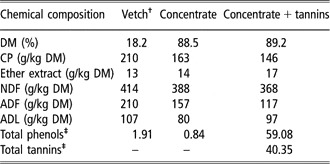
The inclusion of the quebracho tannins into the concentrate resulted in a slightly higher level of acid detergent lignin (ADL; +21%) and of ash (+18%) and in a lower level of acid detergent fibre (ADF; −26%) compared to the tannin-free concentrate (Table 1). The quebracho supplement contained 721 g equivalent tannic acid of TP and 456 g equivalent tannic acid of total tannins per kg DM (data not shown). The concentrate added with quebracho powder contained 59.08 g equivalent tannic acid of TP and 40.35 g equivalent tannic acid of total tannins per kg DM (Table 1). Compared to the concentrates, the herbage contained higher percentages of NDF and ADF and slightly lower ether extract content. The vetch contained higher percentages of protein compared to the C and the CT diets (21% v. 16.3% and 14.8%, respectively). The protein content of the herbage decreased from the beginning to the end of the trial, ranging from 25% to 18% on a DM basis.
The chemical composition of vetch and concentrates

DM = dry matter.
†Average of eight samplings.
‡Expressed as g tannic acid equivalent per kg DM.
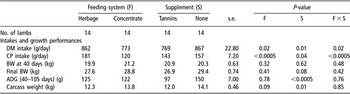
DM intake (Table 2) was higher for the animals offered green herbage as compared to those given concentrates (P < 0.05) and for the animals not supplemented with tannins as compared to those given tannins (P = 0.01). The interaction between the two factors (feeding system and tannins supplementation) was significant (P < 0.05): animals receiving vetch with tannins showed lower DM intakes as compared to those receiving the same herbage without supplementation (768 v. 956 g/day, respectively; P = 0.001). Animals receiving concentrates had similar DM intakes (P > 0.05) regardless of the tannins supplementation.
Effect of feeding system (herbage v. concentrate) and supplement (tannins or none) on lamb’s intakes and growth performances

DM = dry matter; ADG = average daily gain.
Crude protein intake was higher for the animals offered green herbage as compared to those given concentrates (P < 0.0005) and for the animals not supplemented with tannins as compared to those given tannins (P < 0.05). The interaction between the two factors (feeding system and tannins supplementation) was significant (P < 0.0005): animals receiving vetch with tannins showed lower CP intakes as compared to those receiving the same herbage without supplementation (161 v. 201 g/day, respectively; P = 0.001). Animals receiving concentrates had similar CP intakes (P > 0.05) regardless of the tannins supplementation.
Animal growth performances are reported in Table 2. In this trial the quantity of feed given to the concentrate-fed animals was regulated so as to obtain similar growth rates between the two feeding systems. The tannins-fed animals, however, showed lower (P < 0.001) average daily gain (ADG) compared to the animals not supplemented and the final BW tended to be lower for the tannin-supplemented animals (P < 0.1). Carcasses from the animals not supplemented were heavier (P = 0.01) compared to those of animals supplemented with tannins.
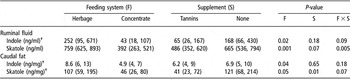
The Anderson–Darling test applied to the indole and skatole data showed that distribution was not normal (P < 0.05) for indole in ruminal fluid and for both indole and skatole in caudal fat. Indole and skatole concentrations in ruminal fluid were higher in lambs fed herbage compared to those given concentrates (P = 0.02 and 0.001, respectively; Table 3). Skatole was present at lower concentrations in ruminal fluid from animals that received the tannin supplementation (P = 0.07). However, there was a significant (P < 0.005) interaction between feeding system and tannin supplementation. Skatole was lower (P < 0.001) in ruminal fluid from animals fed concentrate with tannins (158 ng/ml) compared to the other three treatments, which did not differ significantly (P > 0.05) among themselves (average 777 ng/ml). Indole was also higher in the subcutaneous caudal fat of animals fed green vetch compared to those fed concentrate (P = 0.04). Skatole concentration was lower in the fat of lambs fed concentrates compared to those given herbage (P = 0.05) and was lower in the fat of animals supplemented with tannins compared to the animals not supplemented (P = 0.01).
Effect of feeding system (herbage v. concentrate) and supplement (tannins or none) on skatole and indole in ruminal fluid and in caudal fat

†Log10 transformed data have been analyzed. Back-transformed values of the least-square means are presented. Back-transformed values of the confidence limit (95%) data are in the parentheses.
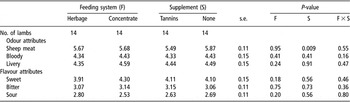
Results of meat sensory evaluation are reported in Table 4. According to our taste panel, sheep meat odour was lower in meat from animals supplemented with tannins compared to those not supplemented (P < 0.01). For all the other parameters tested, meat samples were comparable.
Effect of feeding system (herbage v. concentrate) and supplement (tannins or none) on meat odour and flavourFootnote †

† Data are expressed on a 9-point categorical scale (1 no odour/flavour; 9 extremely high odour/flavour).
Discussion
All the experiments that have so far been undertaken on the effects of tannins on meat quality have used polyethylene glycol (PEG) as a means to eliminate the effects of tannins, or, in some cases, different feeds containing high or low tannin concentrations have been employed. In one case (Schreurs et al., Reference Schreurs, Tavendale, Lane, Barry, McNabb, Cummings, Fraser and López-Villalbos2007c) tannins extracted from grape seed were given in an oral drench to animals. This is the first study in which the effects of tannins on meat quality have been directly evaluated by adding a tannin extract to the animal diet.
Growth rate can have some confounding effects on meat quality (Priolo et al., Reference Priolo, Micol and Agabriel2001) and it is known that when animals are allowed ad libitum diets, those given concentrates can attain higher average daily gains (ADG) compared to animals fed green herbages. Therefore, for this trial we have decided to feed ad libitum animals on the herbage treatments and to allow the animals on concentrates the same growth rates as the animals fed green vetch. Considering that our trial had a second factor (i.e. tannins supplementation), it was impossible to control growth rate for both factors and therefore animals supplemented with tannins showed lower ADG and final BW compared to animals not supplemented. The effect of dietary tannins on ADG has been extensively studied by the means of PEG. It is commonly reported that tannins, up to 4% DM, can have a positive effect on animal growth (Waghorn et al., Reference Waghorn, Ulyatt, John and Fisher1987); we have chosen a slightly higher percentage of tannins (i.e. 6%) to ensure an evident effect of tannins in our animals, whilst still maintaining adequate ADG.
This is the first study in which skatole concentration is measured in ruminal fluid from lambs fed green herbage as compared to concentrates. The higher level of skatole in the ruminal fluid of lambs fed vetch compared to those given concentrates was, however, highly expected. Formation of skatole results from degradation of tryptophan in the rumen by bacteria (Carlson and Breeze, Reference Carlson and Breeze1984). The high protein content and the high ratio protein/readily digestible carbohydrates of herbage diets would therefore increase the free tryptophan in the rumen (Young et al., Reference Young, Lane, Priolo and Fraser2003) with consequent higher skatole production. In our study we have observed also an effect of dietary tannins on ruminal skatole concentration. However, tannins reduced skatole in ruminal fluid only when associated with the concentrate diet. An effect of tannins on skatole concentration could have been expected if tannins had reduced CP intakes, thus causing a lower substrate availability for skatole formation. However, in this experiment we have observed the reduction of skatole formation despite the fact that tannins in the concentrate did not affect CP intakes (Results section). In vitro models have shown that both forages containing tannins, or tannins extract added to forages not containing tannins, can be effective in reducing skatole formation in ruminal fluid (Schreurs et al., Reference Schreurs, Tavendale, Lane, Barry, López-Villalbos and McNabb2007d). Tannins from grape seed extract slightly reduced skatole concentration in ruminal fluid in lambs fed white clover or perennial ryegrass (Schreurs et al., Reference Schreurs, Tavendale, Lane, Barry, McNabb, Cummings, Fraser and López-Villalbos2007c). However, this is the first study in which the effect of tannins on ruminal skatole is measured with a concentrate diet. Tannins from different plant species are very different in astringency (Min et al., Reference Min, Barry, Attwood and McNabb2003). Green herbage is characterized by a very fast degradability of proteins (Wales et al., Reference Wales, Doyle and Dellow1999). We suppose, therefore, that quebracho tannins were not strong enough to bind with and precipitate the easily degradable proteins of vetch, and were, for this reason, ineffective in reducing ruminal skatole. Additionally, it has been recently reported that the astringency of quebracho tannins is lower compared for example with tannins from acacia or carob (Vasta et al., Reference Vasta, Mele, Makkar and Priolo2008). In the case of animals fed concentrates, the lower CP level and a slower degradability of proteins has probably made it possible for quebracho tannins to bind proteins in the rumen at a sufficient level to reduce skatole formation.
The higher concentration of skatole in the fat from animals fed green herbage compared to those fed concentrates has been already described (Young et al., Reference Young, Berdagué, Viallon, Rousset-Akrim and Theriez1997 and Reference Young, Lane, Priolo and Fraser2003; Priolo et al., Reference Priolo, Bella, Lanza, Galofaro, Biondi, Barbagallo, Ben Salem and Pennisi2005) and is consistent with the higher levels of skatole in the ruminal fluid of the same animals. Skatole in the ruminal fluid and in subcutaneous fat was, as expected, positively correlated (r = 0.67; P < 0.0005). Sebastiàn et al. (Reference Sebastiàn, Viallon, Berge, Dransfield and Berdagué2003) and Priolo et al. (Reference Priolo, Cornu, Prache, Krogmann, Kondjoyan, Micol and Berdagué2004) did not find differences in skatole in the fat from lambs fed concentrates or grass. However, in both cases skatole in ruminal fluid was not measured.
In this experiment we have also found that tannins supplementation strongly reduced skatole in subcutaneous caudal fat. Schreurs et al. (Reference Schreurs, McNabb, Tavendale, Lane, Barry, Cummings, Fraser, López-Villalbos and Ramirez-Restrepo2007e) found that the tail fat of lambs grazing Lotus corniculatus (a herbage containing tannins) had lower concentrations of skatole as compared to animals on the tannin-free perennial ryegrass/white clover pasture. However, there is no evidence that the tannins were the only compounds responsible for this effect. Schreurs et al. (Reference Schreurs, Tavendale, Lane, Barry, McNabb, Cummings, Fraser and López-Villalbos2007c) reported that condensed tannins (from grape seed extract) orally drenched to lambs offered a white clover or a perennial ryegrass diet did not affect skatole concentration in intermuscular fat in the animals. We observed that the effectiveness of tannins in reducing skatole in the adipose tissue is improved when tannins are associated with a concentrate diet.
Although the typical sheep meat odour was significantly reduced by tannin supplementation and skatole in subcutaneous fat was also reduced by tannin supplementation, it is unlikely that skatole was the only reason for the difference in meat odour. Firstly, the correlation between skatole in the fat and sheep meat odour was not significant (r = 0.1; P = 0.363); secondly, skatole appeared to be affected in both ruminal fluid and tail fat, when tannins were added to concentrates rather than green herbage, while the effect of tannins in reducing sheep meat odour appeared to be clearly present in both feeding systems. On the other hand, the difference in sheep meat odour cannot be related to differences in intramuscular fat content, because tannin supplementation did not affect this parameter (data not shown). It has been demonstrated that dietary tannins strongly impair ruminal bio-environment (Molan et al., Reference Molan, Attwood, Min and McNabb2001; Vasta et al., Reference Vasta, Mele, Makkar and Priolo2008). It is therefore likely that other products of ruminal microorganisms have been affected and have indirectly reduced sheep meat odour. It has been reported that among the major compounds responsible for species-specific flavour/odour in sheep are the branched chain fatty acids, 4-methyloctanoic and 4-methylnonanoic acids (Young et al., Reference Young, Berdagué, Viallon, Rousset-Akrim and Theriez1997). These volatile compounds are formed from propionate originating in the rumen (Vasta and Priolo, Reference Vasta and Priolo2006). Dietary tannins can have an effect of reducing ruminal propionate production (Nuñez-Hernandez et al., Reference Nuñez-Hernandez, Wallace, Holechek, Galyean and Cardenas1991) and could therefore have indirectly reduced sheep meat odour.
In conclusion, we confirm that skatole in adipose tissue of lambs fed green herbage is present at higher concentrations compared to those given concentrates. Addition of quebracho tannins to lambs diet was effective in reducing both ruminal and fat-borne skatole. However, the reduction of ruminal skatole by tannins supplementation was higher when animals were fed concentrates compared to green herbage and a similar trend was also found for skatole in adipose tissue. Tannins appear to reduce the species-typical sheep meat odour, but the role of skatole seems at least to be accompanied by other compounds. A complete study on the effect of tannins on fat volatiles would be necessary to clarify this point.
Acknowledgments
This research was founded by the University of Catania (Ricerca di Ateneo, 2005). The authors are grateful to Corrado Di Mauro for advice in statistical analysis; to Mr Luca and Ms Maria, and to the students Valentino Aliffi and Danilo Ciciulla for their help during the experiment.