INTRODUCTION
In December of 2005, the U.S. House of Representatives passed an immigration reform bill that outraged immigrant rights groups. The bill, H.R. 4437, would have converted all undocumented immigrants into felons and also treated those who provided them with assistance—such as social workers and church officials—as felons (Broder 2006). Although this punitive immigration bill was never taken up in the Senate, in the spring of 2006 over one million individuals, mostly Hispanic immigrants, marched in several American cities to protest the proposed legislation (DiSipio Reference DiSipio2007; Suro Reference Suro2007). The protests culminated on May 1st, 2006 with a nationwide boycott of schools and businesses. The protests represented an impressive show of political support, but they also helped to mobilize opponents of more liberal immigration policies. In the spring of 2007, during the ensuing Congressional debate of a more moderate and bipartisan immigration reform proposal, a semi-organized campaign led by conservative talk radio helped defeat the bill (Allen 2007). The demonstrations of 2006 and the ongoing national debate about immigration that prompted them constitute one of the more important moments of inter-group conflict along ethnic or racial lines since the busing controversy of the 1970s.
Non-Hispanic Whites were not the only group troubled by the protest movement launched on behalf of immigrants. Although many African Americans were sympathetic to the protesters, they were also concerned about the political debate, in part because of what the growing economic and political clout of Hispanics might mean for their group. A New York Times article published shortly after the protests quoted a thirty-two-year-old Black male who reacted to the demonstrations by noting, “All of this has made me start thinking, ‘What’s going to happen to African Americans? What’s going to happen to our unfinished agenda?’” (Swarns 2006). This ambivalence was reflected in national opinion polls taken near the time of the protests. For example, the Pew Hispanic Center released a survey showing that African Americans were about twelve percentage points less likely than Whites to endorse the view that “illegal immigrants should be required to go home” (Doherty 2006). However, the same poll found that Blacks were about nine percentage points more likely than Whites to indicate that immigrants “take jobs away from U.S. citizens” (Doherty 2006). Thus, although Blacks and Whites remain divided on a broad range of issues, both of these primarily native-born groups are concerned about the increasingly important issue of immigration.
Why has immigration become such a hot-button issue? Although ostensibly a nonracial policy, it may be that views on this issue are driven by attitudes about Hispanics, who make up the majority of immigrants to this country. Perhaps some individuals are inclined to oppose immigration because they hold negative stereotypes or other prejudicial attitudes about Hispanics in particular, which can be exacerbated in times of recession (Higham Reference Higham1955). As discussed below, a number of scholars have explored the role that prejudice might play in shaping immigration attitudes. It is also possible that some supporters of more punitive immigration policies may be influenced by concerns about the relative status of their in-group as well as anti-Hispanic prejudice. That is, opposition to immigration may also be derived from the fear that the increasing presence of immigrant groups will somehow diminish the power and privileges of native-born Americans—as captured in the New York Times article quoted above. In this article, we examine each of these possibilities.
RACIAL PREJUDICE, RACIAL IDENTITY, AND GROUP THREAT
According to Gordon Allport (Reference Allport1954), prejudice or interracial hostility is generally associated with particular psychological dispositions characterized by inflexible stereotypes and irrational beliefs. These beliefs are typically developed in early childhood and, as a result, are not primarily based on objective information about the relevant out-group or real world conflicts over scarce resources (Sniderman et al., Reference Sniderman, Hagendoorn and Prior2004). Therefore, in theory, individuals might come to oppose immigration because of socially learned feelings of aversion and pre-adult acquisition of negative out-group stereotypes. Researchers have examined this proposition and found considerable support for it. Specifically, various studies have found that negative attitudes about Hispanics and/or Asians are associated with public opinion on immigration issues (Brader et al., 2008; Burns and Gimpel, Reference Burns and Gimpel2000; Citrin et al., 1997; Huddy and Sears, Reference Huddy and Sears1995; Kinder and Kam, Reference Kinder and Kam2009; Perez Reference Perez2010; Valentino et al., Reference Valentino, Brader and Jardina2013). Much of this work has focused on White attitudes, but at times researchers have also examined the effects that prejudice may have on immigration attitudes among African Americans. Some of this work finds comparable effects among Blacks and Whites (Cummings and Lambert, Reference Cummings and Lambert1997; Kinder and Kam, Reference Kinder and Kam2009), whereas others find that prejudice is more influential among Whites (Burns and Gimpel, Reference Burns and Gimpel2000).
A variant of the prejudice model—symbolic racism—presents a somewhat different perspective on racial attitudes.Footnote 2 According to this theory, since the end of the 1960s, Whites’ opposition to policies designed to reduce racial inequality can no longer be ascribed to a belief in innate racial differences. These views were largely discredited in the aftermath of World War II and particularly during the Civil Rights Movement (Mendelberg Reference Mendelberg2001; Schuman et al., 1997). Instead, proponents of this theory argue that opposition to equalitarian policies owes more to the belief that racial minorities do not sufficiently adhere to cherished American values such as hard work, thrift, and patriotism (Kinder and Sears, Reference Kinder and Sears1981; Kinder and Sanders, Reference Kinder and Sanders1996; Sears and Henry, Reference Sears, Henry and Zanna2005).
Unlike arguments concerning classical prejudice (also known as old-fashioned racism), the theory of symbolic racism was designed to explain White attitudes and thus there are few reasons to expect it to play a substantial role in Black attitudes on immigration.Footnote 3 Although originally conceived as a means to explain White attitudes about policies associated with African Americans, symbolic racism measures have been adapted and applied to other groups. For example, Lawrence Bobo and Mia Tuan (2006) demonstrate that the concept can be extended to include White attitudes about Native Americans. Similarly, Deborah Schildkraut (Reference Schildkraut2008), as well as David Sears and his colleagues (1999) have shown that the theory can be applied to White attitudes about immigration in general and Hispanics in particular (Huddy and Sears, Reference Huddy and Sears1995; Sears and Savalei, Reference Sears and Savalei2006). Thus, according to this logic, White opposition to immigration is at least partially a function of negative attitudes and stereotypes acquired in adolescence about distinctive out-groups linked with immigration issues, such as Hispanics. These attitudes will likely focus on the perceived cultural deficiencies of the relevant out-group and their supposed violation of norms that constitute American identity, rather than a belief in their inherent inferiority. Importantly, however, this new form of racism—as with classical prejudice—does not attribute opposition to immigration to in-group favoritism or concerns with maintaining in-group privileges.
Although the classical prejudice and symbolic racism perspectives view inter-group conflict as primarily the result of irrational psychological orientations, an alternative view places far more emphasis on concerns about the in-group. The group position theory (Blumer Reference Blumer1958) in particular maintains that inter-group hostility is not simply the product of negative affect or stereotypes, although these concepts do play an important role. Instead, Herbert Blumer highlights the desire to maintain or enhance the relative status and power of the in-group, vis-à-vis relevant out-groups, as a primary motive of prejudice. There are four major components to Blumer’s theory of group position. The first is in-group favoritism, or a generalized preference for the in-group. The second element in the group position framework is that in-group members will be inclined to view out-groups as different and alien. This perception is akin to notions of negative stereotyping and prejudice, discussed above. The third element is a sense among the in-group that they are entitled to certain rights, resources, and privileges. Fourth, and finally, this model maintains that in-group members fear that out-group members desire a larger, and illegitimate, share of the in-group’s rights and privileges. Thus, according to this theory, opposition to immigration is a consequence of in-group favoritism, out-group prejudice and stereotyping, and a concern that immigrants have designs on rights and resources that properly “belong” to native-born Americans.Footnote 4
Researchers have found that the constituent elements of the group position model are linked with attitudes about various group-relevant public policies, including opposition to bilingual education (Huddy and Sears, Reference Huddy and Sears1995), Native American treaty rights in Wisconsin (Bobo and Tuan, Reference Bobo and Tuan2006), affirmative action (Bobo Reference Bobo, Sears, Sidanius and Bobo2000), and immigration in Europe (Quillian Reference Quillian1995). Although initially designed with superordinate groups such as White Americans in mind, some scholars have also extended this theory to non-White groups. For example, Bobo and Hutchings (Reference Bobo and Hutchings1996) show that perceptions of zero-sum intergroup conflict among Whites, African Americans, Hispanics, and Asian Americans are moderately high and are associated with a shared sense of racial group grievance (Hutchings et al., Reference Hutchings, Wong, Jackson, Brown, Charles, Gerken and Kang2011). In a similar study also based on survey data collected in Los Angeles, they find that zero-sum perceptions of group relations are significantly linked to support for restrictive immigration policies among both Blacks and Whites (Bobo and Hutchings, Reference Bobo and Hutchings1994). Related work by Victoria Esses and her colleagues (2001), based on multiple experimental studies conducted in the United States and Canada, also finds that immigration attitudes are significantly influenced by perceived zero-sum competition, although these results are not broken down by race. Finally, Thomas Wilson (Reference Wilson2001) has shown that group interest considerations are associated with support for immigration policies—even after controlling for standard measures of anti-immigrant prejudice—for both Whites and non-Whites.
The research summarized above provides some indication that attitudes about immigration may be driven by concerns about preserving in-group privileges as well as negative views about immigrant groups. Still, there are reasons to reexamine the role of prejudice, both classical and modern, as well as group-conflict oriented explanations for attitudes about immigration. First, most of the literature examining public opinion on immigration focuses on the influence of economic or cultural considerations, with group conflict perspectives largely ignored. Thus, there are few studies that take a more holistic view, taking into account the influence of individual economic concerns, anti-Hispanic or anti-Asian bias, and concerns about group position. Second, although some previous work has shown that concerns about intergroup competition are implicated in contemporary attitudes about immigration (Bobo and Hutchings, Reference Bobo and Hutchings1994; Esses et al., Reference Esses, Dovidio, Jackson and Armstrong2001; Esses et al., Reference Esses, Jackson and Armstrong1998), this work is often based on local samples or confined only to a single race or ethnicity. When both Whites and African American samples are included in the analyses, researchers often have too few Black cases to draw firm conclusions about this group (Wilson Reference Wilson2001). Finally, in our view, Blumer’s group position model places particular emphasis on opposing racial group interests. Wilson’s (Reference Wilson2001) important work on the link between group threat perceptions and immigration attitudes focuses on the potential danger that immigrants pose for the country. His results are powerful, but by highlighting respondents’ national identity, he may have underestimated the influence of racial/ethnic group threat considerations.
For these reasons, this paper focuses on a more expansive, diverse, and racially targeted examination of the influence of prejudice and group position concerns on attitudes towards immigration. Specifically, we examine the influence of narrowly defined economic self-interest and classical and modern prejudice, as well as in-group preferences and racial group-oriented zero-sum perceptions. Given our theoretical interests in native-born Americans’ reactions to challenges to their group position, and the fact that large percentages of Asian Americans and Hispanics were born outside of the United States, we focus only on the attitudes of Whites and African Americans in this paper.Footnote 5
HYPOTHESES
The discussion in the previous section suggests a number of hypotheses regarding the determinants of attitudes about immigration. First, consistent with previous research focused on Whites, we expect that all respondents who derogate out-groups like Hispanics or Asians will also be predisposed to support limits on immigration. Additionally, classical and symbolic prejudice should be linked with support for stronger enforcement efforts to restrict immigration, negative assessments about the cultural benefits of immigration, opposition to the extension of greater rights to immigrants, and an increased likelihood of attributing negative economic consequences to immigration.
H1: Higher levels of prejudice will be associated with more negative views of immigrants and immigration.
As we have seen, the group position model would make similar predictions about the importance of out-group attitudes. One area where this model diverges from the old-fashioned and symbolic racism perspectives is in the explicit linkage of in-group favoritism with opposition to immigration. Although this relationship seems plausible, there is at best uneven support for the proposition that in-group attachments are necessarily associated with negative racial or ethnic attitudes in the political domain (Allport Reference Allport1954; Brewer Reference Brewer1999; Herring et al., 1999; Sears and Savalei, Reference Sears and Savalei2006). Nevertheless, this is one of the core expectations of the group position model, and recent work by Donald Kinder and Cindy Kam (2009) suggests that in-group favoritism should be associated with immigration attitudes.
H2: Higher levels of in-group favoritism should be associated with more negative views of immigrants and immigration.
In addition to the importance of in-group and out-group attitudes, the group position model also expects that individuals who view out-groups as competitors will also be inclined to oppose immigration and to view immigrants in a negative light (Bobo and Hutchings, Reference Bobo and Hutchings1994, Reference Bobo and Hutchings1996; Esses et al., Reference Esses, Dovidio, Jackson and Armstrong2001; Esses et al., Reference Esses, Jackson and Armstrong1998; Quillian Reference Quillian1995; Pettigrew et al., Reference Pettigrew, Wagner and Christ2007; Wilson Reference Wilson2001).
H3: Higher levels of perceived zero-sum racial group competition should be associated with more negative views of immigrants and immigration.
Our last hypothesis involves how these expectations may vary for Whites and African Americans. The models of prejudice, especially symbolic racism, were mostly developed to apply to Whites, but Blacks are certainly not immune from negative attitudes towards Hispanics (Bobo and Hutchings, Reference Bobo and Hutchings1996; Gay Reference Gay2006). Consequently, prejudice should influence the immigration attitudes of both Blacks and Whites, although there is some indication in the literature that the effects will be greater for Whites (Bobo and Hutchings, Reference Bobo and Hutchings1994, Reference Bobo and Hutchings1996; Burns and Gimpel, Reference Burns and Gimpel2000). With respect to in-group favoritism, previous work suggests that racial differences should be slight both in overall levels and in their effects on immigration policy (Bobo and Zubrinsky, Reference Bobo and Zubrinsky1996; Kinder and Kam, Reference Kinder and Kam2009). Finally, although there has been limited research on this question, the extant literature suggests that the immigration attitudes of Blacks and Whites should be more or less equally influenced by perceptions of inter-group threat (Bobo and Hutchings, Reference Bobo and Hutchings1994; Wilson Reference Wilson2001).
H4: Prejudice should have a greater influence on White attitudes about immigration than among Blacks. The effects of in-group favoritism and perceptions of competitive threat should not vary substantially across racial groups.
DATA AND METHODS
The National Politics Study (NPS) represents an ideal survey to explore the determinants of attitudes on immigration. The primary goal of the NPS was to gather comparative data about individuals’ political attitudes, beliefs, aspirations, and behaviors at the beginning of the twenty-first century. This survey went into the field in September of 2004 and concluded a few months later in February of 2005. All of the 3339 interviews were conducted over the telephone. The interviews were conducted in either English (88%) or Spanish (12%), depending on the preference of the respondent. The AAPOR Response Rate #3 was 30.63%, although this figure was slightly higher for Whites (34.14%) and somewhat lower for African Americans (29.61%). Telephone surveys typically have much lower response rates relative to face-to-face surveys such as the American National Elections Study (ANES) or the General Social Survey (GSS), but compared to other telephone surveys the NPS fares quite well. For example, the average response rate to telephone surveys at Pew Research, one of the most respected firms in the industry, was 25% at about the time that the NPS was fielded (Kohut et al., Reference Kohut, Keeter, Doherty, Dimock and Christian2012).
The NPS is among the first scholarly efforts to develop a multiracial and multi-ethnic national study of political and racial attitudes. Unlike previous efforts to study these issues, this survey does not focus on a single city (Bobo and Hutchings, Reference Bobo and Hutchings1994, Reference Bobo and Hutchings1996; Sears and Savalei, Reference Sears and Savalei2006), a single state (Bobo and Tuan, Reference Bobo and Tuan2006), or a small group of cities (Oliver and Wong, Reference Oliver and Wong2003). Instead, the NPS is based on a national sample of adults, from a variety of different racial and ethnic groups. Specifically, the study interviewed 756 African Americans, 919 non-Hispanic whites, 404 Caribbean Blacks, 757 Hispanics, and 503 Asian Americans. For reasons outlined above, we focus only on African American and White respondents for this paper.
The NPS included multiple survey questions designed to gauge most of the concepts discussed above. To measure classical prejudice, we asked our respondents two questions. First, to assess the concept of aversion or social distance, respondents were asked their views about interracial marriage.Footnote 6 The NPS provided a single item to measure levels of support for negative racial stereotypes. Respondents were asked to place each racial group (the order was randomized), including their own, on a 7–point scale with lower values indicating a propensity to be lazy and higher values indicating a tendency to be hard-working. The stereotype item was then constructed by subtracting the score for the out-group (i.e., Hispanics) from the in-group (i.e., Whites or Blacks), creating a stereotype difference measure. The results were then converted to a 0–1 scale, with values closer to one indicating that the out-group possessed more of the negative trait than the in-group.Footnote 7 Respondents grouped near the mid-point of the scale view their group and the out-group as equally likely to be hardworking.
The concept of symbolic racism has been measured with a generally consistent set of questions since its inception. Unfortunately, this battery of questions references African Americans rather than immigrant groups, which would be more appropriate given our research question. Thus, even if the traditional symbolic racism scale were associated with opposition to immigration, it would be unclear how we should interpret this result. In order to avoid this problem we relied on a single item that measures the perception that racial and ethnic minorities—by implication, including Hispanics and Asian Americans—do not try hard enough to get ahead.Footnote 8 This is one of the core components of the symbolic racism theory (Huddy and Sears, Reference Huddy and Sears1995; Sears and Henry, Reference Sears, Henry and Zanna2005), but we also reanalyzed our data with a two-item scale derived from the more traditional symbolic racism battery of questions.Footnote 9 Although the more traditional symbolic racism scale generates stronger results than the single-item we utilize in the analyses reported below, none of our other findings are substantively altered.
As indicated above, measuring the concept of group position requires items that tap out-group stereotyping as well as in-group favoritism and perceptions of competitive threat. There is no one canonical measure of preference for one’s in-group in the literature, but Kinder and Kam (Reference Kinder and Kam2009) suggest that the concept hinges on explicit comparisons between the in-group and an ill-defined out-group. Additionally, they suggest that the concept has both an affective and cognitive component (Bobo and Zubrinsky, Reference Bobo and Zubrinsky1996). The group closeness questions in the NPS represent a suitable approximation of the affective dimension. These questions asked how close respondents felt to Whites, Blacks, Asian Americans, and Hispanics in their ideas, interests, and feelings.Footnote 10 We created our measure of in-group favoritism by subtracting the average group closeness score for the three groups to which the respondent did not belong, from their in-group, in keeping with the strategy adopted by Kinder and Kam (Reference Kinder and Kam2009).
Perceptions of competitive threat were measured with an index of two items, originally developed for the 1992 Los Angeles County Social Survey (Bobo and Hutchings, Reference Bobo and Hutchings1996), focusing on the labor market and the political realm. The jobs question was worded as follows: “More good jobs for Hispanics means fewer good jobs for people like me.” The question concerning politics asked respondents whether, “The more influence Hispanics have in politics the less influence that people like me will have in politics.” Response options ranged from strongly agree to strongly disagree. These questions are conceptually similar to the items that Thomas Pettigrew and his colleagues (2007) developed for a German sample to measure what they refer to as “collective threat” (p. 21) and were designed to gauge whether the respondent viewed the success of a particular racial or ethnic group as necessarily coming at the expense of people like the respondent. These questions were asked about all of the racial and ethnic groups in the NPS, but for this article, we focus only on the items targeted at Hispanics.Footnote 11 As with the stereotype question, the order in which the target groups were mentioned was randomized.
Our dependent variables in this paper focus on the issue of immigration. Respondents were asked their overall views on this policy in three domains: entry, language, and impact. The specific wording for each of the six questions is provided in the appendix.
Lastly, we note that the main independent variables in our analyses are only moderately correlated with one another. Among Whites, the highest correlations occur for the zero-sum conflict measure and attitudes on interracial marriage (.34), as well as in-group favoritism (.33). Only one other association among these variables rises above .25, and this occurs between the measure of zero-sum conflict and modern prejudice (.29). Among Black respondents, the correlations are much weaker with the strongest linkage occurring between the conflict measure and in-group preference (.11).
RESULTS
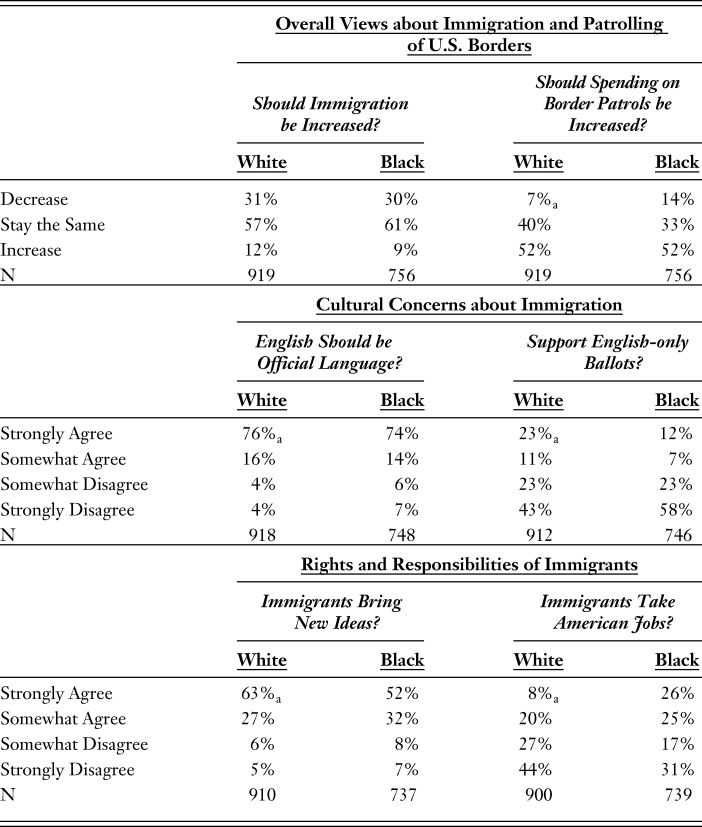
We begin by focusing on the distribution of support for each of our six dependent variables among Black and White Americans.Footnote 12 These results, which are based on the weighted data as in all subsequent analyses, are presented in Table 1. In the upper portion of the table we present overall levels of support for immigration on the left and support for increased spending on border patrols on the right. Perhaps the most striking result from this portion of the table is how little Blacks and Whites differ on both measures. On the general measure regarding immigration levels, there are no substantive or statistical differences across the two racial groups. In both cases, the majority of respondents adopt the moderate position that immigration levels should be kept at current levels, with a non-trivial minority calling for lower levels. Results differ somewhat on the issue of spending on border patrols. Here, a slight majority of both groups adopt the more conservative view calling for an increase in spending on this policy. Nevertheless, a sizeable minority is comfortable with spending levels as they currently stand on this issue and a small fraction, especially among Blacks, would actually prefer less spending. On balance, these results suggest that although immigration remains a contentious issue among political elites, for many Americans there is a good deal of agreement about this policy area.
Attitudes about Immigration by Race

Note: a indicates differences across racial groups are statistically significant at .05 level.
The questions in the middle portion of Table 1 are designed to tap some of the cultural concerns associated with increased immigration. One such concern involves perceived threats to the country’s reliance on the English language. Again, we find little difference between African Americans and Whites, as large majorities of both groups endorse the idea of making English the official language of the country. In contrast, majorities of both Whites and Blacks oppose the idea that ballots should only be printed in English, although Blacks are much more likely to reject this policy. This difference is not as large as traditional racial gaps on economic issues and race-based policies, but it is statistically significant and runs in the same direction.
The final questions in Table 1 focus on the perceived impact of immigrants, and here we find the largest racial differences. Combining the strongly agree and somewhat agree categories, only 28% of Whites believe that immigrants take jobs away from Americans. Among Blacks, however, the comparable figure is 51%. Moreover, almost half of Whites strongly reject this proposition whereas less than one-third of Blacks adopt a similar view. Given the historically precarious labor market position of many Blacks, perhaps this result should not be surprising. Regarding whether or not immigrants bring new ideas, racial differences also emerge, with almost two-thirds of Whites adopting the more liberal position compared to only a slight majority among Blacks. Still, substantively these differences are not as dramatic, since the majority of both groups either “strongly agree” or “agree” that immigrants enrich American culture.
Overall, the results from Table 1 suggest that Black and White Americans’ views about immigration are much more complex and ambivalent than some of the more highly charged political rhetoric would suggest. Also, on a range of issues associated with this debate, the preferences of Blacks and Whites are remarkably similar. Having described these views, we turn next to an examination of the demographic and attitudinal correlates of immigration attitudes. Additionally, we seek to determine whether the same factors account for Black and White public opinion on this issue. If the prejudice model represents the dominant explanatory variable—as most of the literature suggests—then negative stereotypes and a desire to maintain group boundaries should exert the most influence on policy preferences related to immigration. The group position perspective, on the other hand, acknowledges the importance of prejudice while also positing a role for in-group favoritism and perceptions of inter-group conflict. It remains to be seen whether or not these latter views are also associated with immigration attitudes and, if so, the extent to which they are influential among both Whites and African Americans.
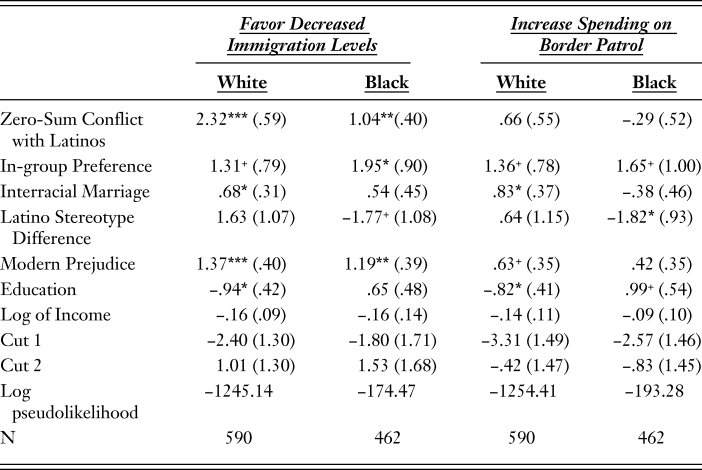
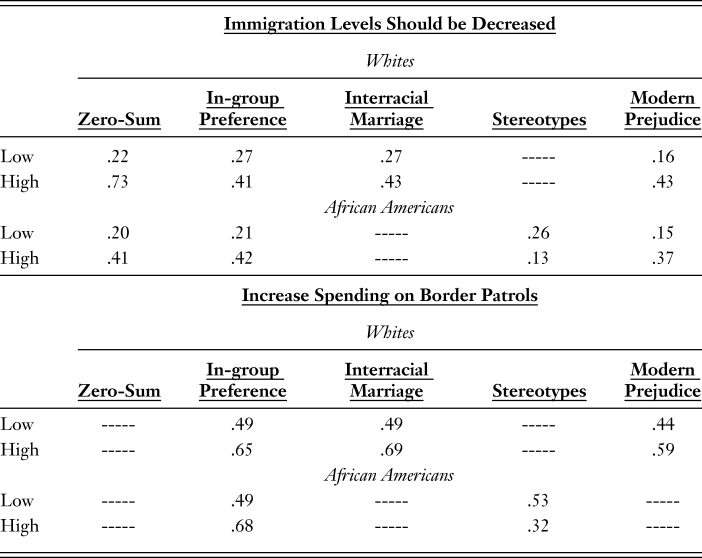
Our multivariate analyses of the effects of prejudice measures and indicators of a concern with group position begin in Table 2. All of the following analyses control for gender, age, education, income (logged), home ownership, employment status, residence in a southern state, (perceived) race of interviewer, partisanship, and ideology. Except for age and income, all independent and dependent variables were recoded onto a 0–1 scale. Also, the dependent variables in these tables have been rescaled such that the most conservative views are coded as equal to one. In the first half of Table 2, we focus on support for increasing or decreasing the overall levels of immigration. The first column of this table presents the coefficients of an ordered logistic regression model for White respondents. In keeping with other work in this literature, we find that less educated Whites are more likely to adopt more conservative positions on this issue (Espenshade and Calhoun, Reference Espenshade and Calhoun1993; Pettigrew et al., Reference Pettigrew, Wagner and Christ2007). Similarly, White respondents who were unemployed at the time of the survey were also inclined to favor lower immigration levels (results not shown). More importantly, we also find some support for all three of the theoretical models we examine (i.e., classical prejudice, modern prejudice, and group position theory). The magnitudes of the coefficients are difficult to interpret when using ordered logistic regression analysis. As a result, we have converted the coefficients into predicted probabilities, as shown in Table 3. In this table, we vary the value of the relevant independent variable from low to high, holding all other variables constant, in order to assess the effect on the dependent variable. Consistent with the classical prejudice model, we find that White respondents who oppose interracial marriage are significantly more likely to oppose increases in immigration relative to respondents with more liberal views on interracial marriage. The size of this effect among Whites is about 16 percentage points, as shown in the upper portion of Table 3.Footnote 13 The impact of negative stereotypes about Hispanics are also in the expected direction, although the results fall just short of statistical significance (p=.126).Footnote 14
The Effects of Perceptions of Group Conflict, In-group Preference, and Racial Prejudice on Opposition to Immigration and Support for Increased Spending on Border Patrols
Notes: Ordered logistic regression analyses with standard errors in parentheses. +p < .10; *p < .05; **p < .01; ***p < .001 for two-tailed test. Models also control for age, gender, homeownership, employment status, southern residence, perceived race of interviewer, partisanship, and ideology.
Predicted Probabilities on Immigration Attitudes and Border Patrols by Race
Note: Probabilities provided only for statistically significant results. See appendix for question wording. For the stereotype difference and in-group preference measures, “low” is represented by the mid-point (where respondent views Hispanics and their in-group as equally hard-working, or where the respondent is equally close to their in-group and all other groups). We find that the effect of moving from the lowest point on this two-item scale to the highest point decreases support for immigration by about 51 percentage points.
We find that, consistent with our first hypothesis, modern prejudice also contributes to White attitudes about immigration. The effects for this variable are also statistically significant, substantively large, and in the predicted direction. In this case, we find that White respondents who believe that racial and ethnic minorities who do not get ahead in life have only themselves to blame are much more likely to prefer lower levels of immigration. As shown at the top of Table 3, the predicted probabilities translate into a 27-point difference on the dependent variable between respondents who score very low on modern prejudice compared to those who score very high.
The group position theory is assessed with two sets of survey items: perceptions of zero-sum competition and in-group preference. The expectations here, as summarized in Hypotheses 2 and 3, were that higher levels of in-group favoritism and greater perceptions of competitive racial threat would be associated with more opposition to immigration. Both of these expectations were supported for White respondents, although the results for in-group favoritism only achieve borderline levels of statistical significance.Footnote 15 We find that the substantive effects of in-group preference are moderately large. As shown in Table 3, Whites at the low end of this scale have only a .27 probability of supporting decreased levels of immigration. However, this probability rises to .41 among Whites demonstrating the maximum level of in-group favoritism. While the impact of in-group favoritism is moderately large, the substantive effects for perceived zero-sum competition are considerably larger. Indeed, zero-sum perceptions of competition with Hispanics represent the most powerful predictor in these analyses. We find that the effect of moving from the lowest point on this two-item scale to the highest point decreases support for immigration by about 51 percentage points. Thus, as hypothesized by group position theory, opposition to liberal immigration policies is not simply the product of out-group prejudices but is also derived from a desire to maintain group privileges.Footnote 16
The attitudinal and demographic correlates of African American views on immigration levels present a somewhat different picture when compared to Whites. As shown in the second column of Table 2, measures of classical prejudice do not influence Blacks’ attitudes about immigration in the same way that they do for Whites, consistent with our fourth hypothesis. That is, attitudes about interracial marriage are unrelated to respondents’ preferred level of immigration and the coefficient for negative stereotypes about Hispanics is marginally significant but has the “wrong” sign. As shown near the top of Table 3, the substantive implication of this result is that African Americans most inclined to endorse the negative stereotype about the work ethic of Hispanics are about 13 percentage points less likely to oppose immigration relative to their less prejudiced counterparts.
The results for modern prejudice fare much better than classical prejudice among Black respondents. Here we find that respondents who are inclined to blame minorities for their inability to succeed are also likely to prefer lower immigration levels. In spite of the expectations summarized in Hypothesis 4, the size of this effect across the range of the variable, as shown in Table 3, is only slightly smaller than the comparable effect among Whites.
Concerns about the status of their in-group are also implicated in African American attitudes on immigration. We find that both in-group favoritism and perceptions of competitive threat with Hispanics significantly influence public opinion on preferred immigration levels (see column 2, Table 2). In the case of in-group favoritism, the substantive impact of this variable is slightly greater than was the case for Whites. Specifically, African Americans who feel closer to their racial group than to other groups are about 21 points more likely to prefer lower levels of immigration than Blacks who feel equally close to all groups in our study. The relationship between perceptions of competitive racial threat and preferred immigration levels is also in the hypothesized direction and moderately strong, as shown in Table 3. Here, however, we find that the effects for zero-sum perceptions are considerably weaker among Blacks compared to Whites.Footnote 17 Thus, for Blacks as well as Whites, broader attitudes on immigration are at least in part a function of concerns about the relative status of one’s racial group.Footnote 18
Having now discussed the effects of our independent variables on support for general immigration level preferences, we now move to more specific policies designed to address the controversy surrounding this issue. One such policy is increased border patrols. As we saw in Table 1, the distribution of support among Blacks and Whites does not differ dramatically on this question. But are the ingredients of support the same across both groups? These results are presented in the second half of Table 2. Turning first to White respondents, we find a different pattern of results regarding support for increased spending on border patrols than for the question about preferred overall levels of immigration. Perceptions of zero-sum competition are not associated with Whites’ support for this policy. The effects of in-group preferences are borderline significant, however, and in the anticipated direction. As shown in Table 3, Whites who score at the lowest end of the in-group favoritism scale are mostly indifferent about the prospect of increased government spending on border patrols. Respondents at the highest end of the in-group favoritism scale, in contrast, are much more supportive of this policy. Similarly, both modern prejudice (p=.067) and at least one form of old-fashioned prejudice—opposition to interracial marriage—leads to greater support for spending on border patrols.Footnote 19
With the exception of in-group favoritism none of our models fare very well when we examine African American respondents, as shown in the last column of Table 2. Consistent with Hypothesis 2, Blacks who prefer their racial group relative to other groups are significantly more likely to favor increased spending on border patrols. The magnitude of this effect is comparable to the equivalent effect among Whites, as shown in Table 3. However, we find that attitudes on interracial marriage, modern prejudice, as well as perceptions of zero-sum competition fail to account for attitudes on increased spending for border patrols. And surprisingly, the effect of the Hispanic stereotype item is significant and, again, has the “wrong” sign. Contrary to the prejudice and group position models, the negative sign on this coefficient suggests that Blacks who rate members of their racial group as more hard working than Latinos are actually less likely to favor increased spending on border patrols. In results not presented in Table 2, we also find that older Blacks, conservatives, and respondents who believe that non-African Americans have interviewed them are most supportive of increased spending on border patrols.
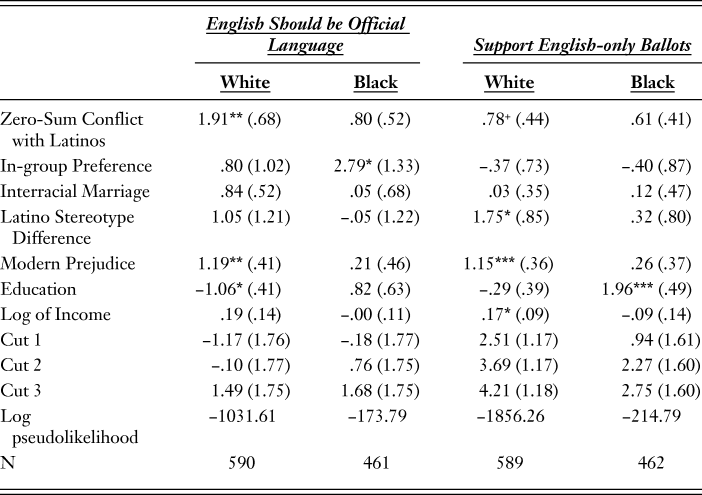
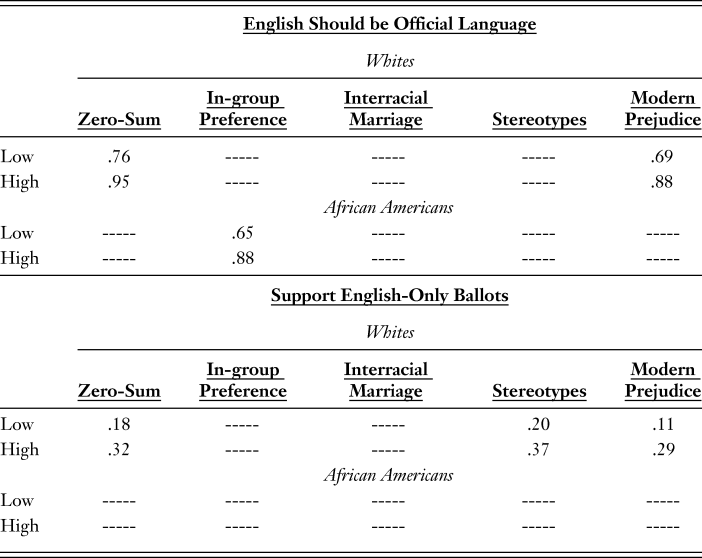
In the first half of Table 4, we examine the effects of the prejudice and the group position models on support for making English the official language in this country. As we saw in Table 1, most Americans overwhelmingly support this idea. In the case of Whites, shown in the first column, these views seem motivated by a variety of factors. First, perceptions of zero-sum competition with Latinos are significantly associated with support for this policy. As shown in Table 5, we find that respondents who embrace the inevitability of zero-sum conflict are about 19 points more supportive of making English the official language compared to respondents who reject the notion of zero-sum relations in the strongest terms. Second, modern prejudice also plays an important role in generating support for this policy. Substantively, support for making English the nation’s official language is about 19 percentage points higher among respondents who strongly endorse the notion that minorities are to blame for their disadvantaged lot in life, compared to respondents who strongly reject this proposition. Third, education also contributes to attitudes regarding making English the official language, with less educated Whites far more likely to adopt the more conservative view on this issue. Finally, and not surprisingly, Republicans and ideological conservatives are also more enamored of making English the official language of the United States (results not shown).
The Effects of Perceptions of Group Conflict, In-group Preference, and Racial Prejudice on Making English the Official Language and Support for English-only Election Ballots
Notes: Ordered logistic regression analyses with standard errors in parentheses. +p < .10; *p < .05; **p < .01; ***p < .001 for two-tailed test. Models also control for age, gender, homeownership, employment status, southern residence, perceived race of interviewer, partisanship, and ideology.
Predicted Probabilities on Immigration Attitudes and Border Patrols by Race
Note: Probabilities provided only for statistically significant results. See appendix for question wording. For the stereotype difference and in-group preference measures, “low” is represented by the mid-point (where respondent views Hispanics and their in-group as equally hard-working, or where the respondent is equally close to their in-group and all other groups). We find that the effect of moving from the lowest point on this two-item scale to the highest point decreases support for immigration by about 51 percentage points.
Results for African American respondents differ markedly from Whites in terms of the attitudinal correlates of making English the official language. For starters, neither classical nor modern prejudice has the anticipated effect on the dependent variable. The coefficient on the group conflict measure is also insignificant, although it has the correct sign and does approach significance (p=.124). Only in-group favoritism surpasses the conventional threshold for statistical significance. Translating the results into predicted probabilities, as summarized in Table 5, shows that Blacks with the highest levels of in-group preference are about 23 points more likely than Blacks who are at the low end of this scale to approve of making English the official language.
In Table 4 we also examine the effects of our primary independent variables on support for the proposition that election ballots should only be printed in English. Unlike the issue of making English the official language, this issue is less symbolic than it is about facilitating the political participation of immigrants who are legal residents or naturalized citizens. As in Table 2, the third column presents our results for White respondents. Classical prejudice does play a role here, but it is only in the form of anti-Hispanic stereotypes and not the social distance measure. As shown in Table 5, the substantive impact of moving from low to high on the stereotype difference variable is about 17 points. The modern prejudice variable also has a significant effect on the dependent variable. This effect translates into a 17–point increase in support for English-only ballots as one moves from low to high on this measure.
The effects for the group position measures are more uneven among Whites. We find that in-group preference is unrelated to attitudes about English-only ballots. However, perceptions of zero-sum competition have an impact that is borderline significant (p=.078). Regarding the substantive effects of this variable, moving from low to high on the conflict measure increases support for English-only ballots by about 14 points, as shown in Table 5.
In addition to the effects of prejudice and group conflict, we also find the economic circumstances of White respondents influence their views on English-only ballots. Contrary to much of the literature, however, we do not find that the less affluent generally favor the more restrictive policy. Surprisingly, it is Whites with higher incomes who are most likely to support the use of English-only ballots and unemployed respondents who are most likely to oppose this policy (results not shown).
Among Blacks (see column 4, Table 4), the indicators of classical and modern prejudice are substantively and statistically insignificant on the issue of English-only ballots. Similar null results are uncovered for the zero-sum conflict scale and in-group favoritism. Indeed, aside from partisanship, the only significant predictor among African Americans is education—and as with Whites, the direction of the effects run counter to conventional wisdom. Converting our results to predicted probabilities, we find that Blacks with at least some post-graduate or professional school experience are about 21 points more likely to support English-only ballots relative to Blacks who did not graduate from high-school. Of course, as we saw in Table 1, this policy proposal is unpopular among the vast majority of African Americans, but we see in Table 4 that it is particularly unacceptable among less educated Blacks. So, at least on this measure, economically more vulnerable respondents are not more punitive towards immigrants but instead are more tolerant.
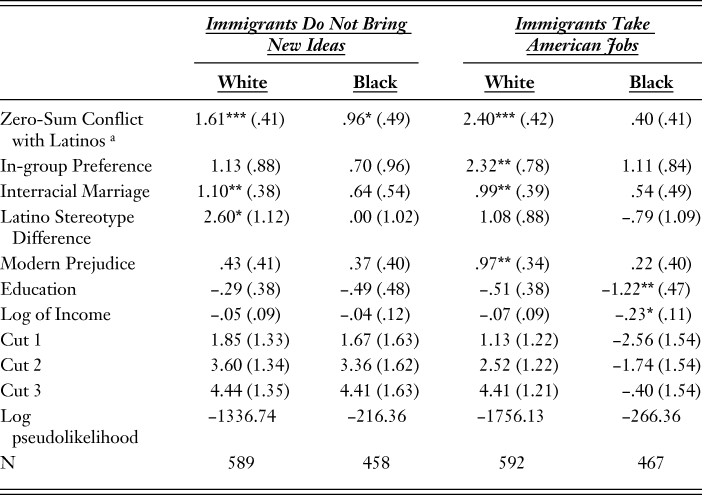
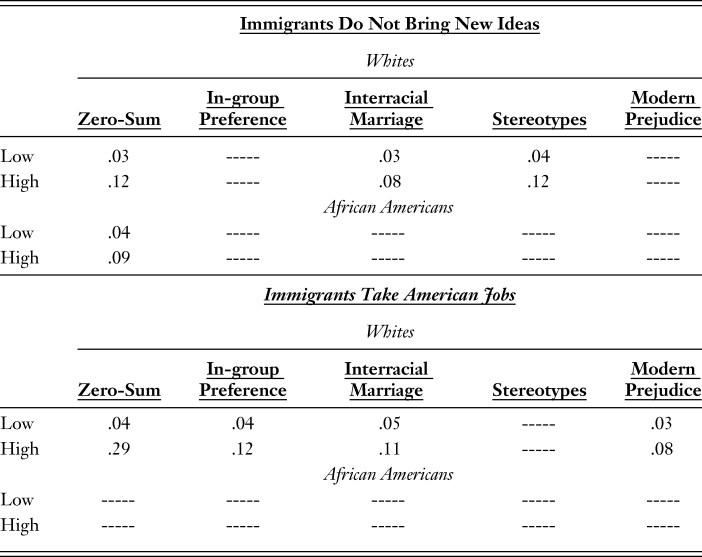
In the first half of Table 6, we assess the impact of our major independent variables on the perception that immigrants open Americans up to new ideas and cultures (reverse coded). A number of variables turn up significant in this model, although the substantive impact of these variables is typically quite small. This is likely due to the fact that the overwhelming majority of respondents indicate that immigrants do contribute to American culture. We find that among Whites, but not African Americans, prejudice is significantly linked with these perceptions. For example, Whites who strongly oppose interracial marriage are about 5 points more likely than comparable respondents at the opposite end of this measure to strongly disagree with the notion that immigrants bring new ideas. The stereotype difference measure has only a slightly larger effect (see Table 7). Surprisingly, the modern prejudice variable is not significantly associated with this dependent variable for Whites or African Americans. In-group favoritism is also unrelated to attitudes about immigrants opening Americans up to new ideas. The measure of zero-sum competition with Hispanics, however, is correlated with these views for both White and Black respondents. Indeed, among Blacks, it is the only attitudinal variable to achieve statistical significance. For Whites, moving from the bottom of the scale to the top results in a 9–point increase in respondents strongly disagreeing that immigrants bring new ideas into American culture. Among Blacks, the equivalent effect is about 5 points.Footnote 20
The Effects of Perceptions of Group Conflict, In-group Preference, and Racial Prejudice on Whether Immigrants Bring New Ideas to the U.S. and the Belief that Immigrants Take American Jobs
Notes: Ordered logistic regression analyses with standard errors in parentheses. +p < .10; *p < .05; **p < .01; ***p < .001 for two-tailed test. Models also control for age, gender, homeownership, employment status, perceived race of interviewer, partisanship, and ideology.a Only political conflict is examined with the jobs question.
Predicted Probabilities on Immigration Attitudes and Border Patrols by Race
Note: Probabilities provided only for statistically significant results. See appendix for question wording. For the stereotype difference and in-group preference measures, “low” is represented by the mid-point (where respondent views Hispanics and their in-group as equally hard-working, or where the respondent is equally close to their in-group and all other groups). We find that the effect of moving from the lowest point on this two-item scale to the highest point decreases support for immigration by about 51 percentage points.
In the second half of Table 6, we examine the effects of prejudice and the group position model on one of the most controversial claims surrounding immigration: that immigrants take jobs from people born in the United States. Given the nature of the dependent variable, for these analyses we only use the conflict item that focuses on political, rather than job, competition. Among White respondents, as shown in the third column, we find that most of our primary independent variables are statistically significant, with the anticipated signs. For example, consistent with the classical prejudice model, we find that opposition to interracial marriage—although not acceptance of negative anti-Hispanic stereotypes—is linked with the belief that immigrants take jobs away from American citizens. The magnitude of this effect is relatively modest, as shown near the bottom of Table 7. For example, respondents opposed to interracial marriage are about 6 percentage points more likely than respondents more tolerant of such unions to agree that immigrants take away American jobs. Our measure of modern prejudice is also linked to attitudes about whether immigrants take jobs from native-born citizens, albeit to only a limited degree. Respondents scoring at the highest end on the modern prejudice measure are about 5 points more likely than those scoring at the lowest end to strongly agree with this proposition.
In-group favoritism is also an important ingredient in shaping attitudes about whether immigrants threaten American jobs. The estimated effect among Whites is about 8 percentage points, moving from the lowest to the highest level on this scale as shown in Table 7. The measure of zero-sum competition also fares well among Whites, even shorn of the economic component. In fact, substantively, this variable turns out to be the most powerful in the model. For example, the effect of going from low to high on this variable translates into a 25–point increase in agreement with the view that immigrants take jobs from people born in the United States.
The results for African Americans are, again, much weaker than was the case for Whites. Contrary to Hypothesis 3, Blacks who view Hispanics as competitors in the political arena are not more likely to think that immigrants take jobs away from Americans. Similarly, Hypothesis 1 and 2 are also unsupported, as neither prejudice—classical or modern—nor in-group favoritism figures into these perceptions among Blacks.
Although most of our main independent variables fare poorly for Blacks, some of the demographic and control variables are significantly correlated with attitudes about immigrants taking American jobs. Unlike the analyses with Whites, for African Americans we find that indicators of social class, the perceived race of interviewer, and political ideology are all correlated with the dependent variable. Specifically, being low-income, less educated, unemployed (p=.09), and politically conservative increases the odds that one will view immigrants as competitors in the labor market; furthermore, a respondent’s belief that she was surveyed by a non-Black interviewer also increases her sense that immigrants take jobs from Americans. The estimated effect sizes are particularly strong for education and employment status. We find that the probability of strongly agreeing with the notion that immigrants take jobs at the expense of native-born Americans is 21 points higher among Blacks who did not graduate from high school compared to Blacks with graduate or professional school experience. Similarly, unemployed Blacks—about 10% of our sample—are 18 points more likely to strongly agree that immigrants are competitors in the job market relative to respondents who are employed or not part of the labor force. These results indicate that, unlike with Whites, African American anxiety about the impact of immigration on the job market are principally driven by self-interested economic considerations rather than concerns about the interests of their racial group.
CONCLUSION
This article has sought to describe and explain attitudes about immigration among a national sample of Black and White Americans. With some exceptions, we found that the distribution of these attitudes varied little across racial groups. More importantly, we examined the influence that various theoretical models had on immigration-related policy preferences. As noted at the outset, although some previous research has explored the influence of racial threat considerations on attitudes toward immigration, this literature has not typically considered differences across racial groups. Moreover, this work has generally not considered the full range of theoretical accounts (e.g., classical and modern prejudice, in-group favoritism, and perceptions of competitive threat) that were examined in this paper. Our investigation uncovered a number of noteworthy findings regarding the different factors that contribute to immigration attitudes among Blacks and Whites. In general, we found that theoretical accounts that were developed with Whites in mind did not necessarily translate effectively to African Americans. In particular, the influence of prejudice, group-position considerations, and self-interested motives varied considerably at times across racial groups.
First, consistent with some previous research, we found strong support for the notion that perceptions of competitive racial threat contribute to immigration attitudes among both White and African American respondents (Bobo and Hutchings, Reference Bobo and Hutchings1994, Reference Bobo and Hutchings1996; Esses et al., Reference Esses, Dovidio, Jackson and Armstrong2001; Esses et al., Reference Esses, Jackson and Armstrong1998; Pettigrew et al., Reference Pettigrew, Wagner and Christ2007; Quillian Reference Quillian1995; Wilson Reference Wilson2001). These results were generally stronger and more consistent among Whites. For example, perceptions of zero-sum competition with Hispanics were associated with respondents’ preferred immigration levels for each racial group (see Tables 2 and 3), but results were about twice as large for Whites compared to Blacks. Similarly, among Whites, this variable was significant in five of six analyses, as shown in Tables 2–7, whereas for African Americans this was true in only two of six instances. And, at least among Whites, the substantive effects of perceptions of zero-sum competition invariably rivaled or surpassed the effects of prejudice measures, self-interest, and at times ideological factors. This suggests that race-relevant policy disputes are not simply a consequence of out-group animus or race-neutral ideological differences. Instead, they are at least partially derived from perceived clashes of interests between “racialized” groups in society. These results also suggest that, although concerns about racial group competition with Hispanics are a reality among Blacks (Gay Reference Gay2006) as well as Whites, researchers may have overestimated the prevalence of inter-minority conflict (Morris Reference Morris2000). This may be in part because minority group members are more concerned with the competition emanating from Whites rather than from other racially marginalized groups in society (Hutchings et al., Reference Hutchings, Wong, Jackson, Brown, Charles, Gerken and Kang2011).
Regarding the influence of in-group favoritism, we found that this construct also plays an important role in structuring immigration related policy preferences. Among both Blacks and Whites, we found that this variable was significantly associated with the dependent variable in three of our six analyses. Unlike with perceptions of competitive threat, the substantive impact of this variable was generally somewhat greater among Blacks relative to Whites. Some recent work by Valentino and his colleagues has called into question the influence of in-group preferences (Valentino et al., Reference Valentino, Brader and Jardina2013); these scholars argue that the impact of in-group favoritism on immigration related policies is almost entirely driven by affective comparisons between Whites and Hispanics. In our analyses, we find that even when the closeness to Hispanics item is removed from the in-group preference measure this variable remains substantively and statistically significant in two of three instances (results not shown but available from authors upon request). Nicholas Valentino and his colleagues (2013) operationalize in-group favoritism differently than in our analyses and this may account for our discrepant results. In any case, based on the findings in this study, we conclude that in-group favoritism, and not just out-group animus, represents a contributing factor in public opinion on immigration.
Both modern and traditional forms of prejudice also influenced immigration attitudes, in keeping with much of the literature in this area (Brader et al., 2008; Burns and Gimpel, Reference Burns and Gimpel2000; Esses et al., Reference Esses, Dovidio, Jackson and Armstrong2001; Huddy and Sears, Reference Huddy and Sears1995; Perez Reference Perez2010; Valentino et al., Reference Valentino, Brader and Jardina2013). Our results, however, varied substantially across different types of prejudice and across racial groups. Negative stereotypes about Hispanics were the least consistent predictor among our three measures of prejudice. Among Whites, this variable was strongly associated with support for English-only ballots and, less powerfully, opposition to the notion that immigrants bring new ideas and cultures. Among Blacks, adherence to anti-Hispanic stereotypes actually worked in the “wrong” direction in our analyses of the preferred level of immigration and on the issue of spending on border patrols. In all other analyses, the coefficient on negative stereotypes fell well short of statistical significance among African Americans. Results for social distance and modern prejudice fared much better, at least among Whites. Here we found significant and moderately large effects in most of our analyses. Still, in partial support for Hypothesis 4, the hypothesized effects of traditional prejudice (i.e., negative stereotypes and social distance) were confined exclusively to White respondents. Modern prejudice, captured by assessing whether minorities are solely responsible if they don’t get ahead in life, was linked with immigration attitudes for both Blacks and Whites, but among African Americans this occurred only on the question about immigration levels. Thus, although prejudice does occasionally have the anticipated effect among Blacks, the most parsimonious conclusion from these analyses is that prejudice plays only a minor, and at times counterintuitive, role in structuring immigration attitudes for this group (Burns and Gimpel, Reference Burns and Gimpel2000).
Lastly, we discuss the implications of our results for the hypothesis that economic considerations significantly contribute to public opinion on immigration. Addressing this matter was not the main focus of our analyses, but our examination did include some measures of respondents’ economic self-interests, so our results can provide some insight on this question. Among Whites, we found that class indicators, especially education, did work in the anticipated direction about half of the time. Thus, consistent with much of the literature, we found that less educated Whites were generally inclined to adopt more conservative positions on immigration (Espenshade and Calhoun, Reference Espenshade and Calhoun1993; Pettigrew et al., Reference Pettigrew, Wagner and Christ2007; Valentino et al., Reference Valentino, Brader and Jardina2013). Interestingly, this pattern was much less evident among Blacks. Indeed, on the issue of spending on border patrols and English-only ballots, less educated African Americans were less likely to adopt the most conservative position. It is not clear why we uncover these counterintuitive findings, but they are not easily reconciled with the economic vulnerability hypothesis. One noteworthy exception to this pattern occurred on the jobs question. Here we found that individual-level economic disadvantage was the only important factor structuring these attitudes among Blacks. With Whites, on the other hand, only group-level and ideological factors were important. This suggests that the economic vulnerability hypothesis is a weak and inconsistent explanation for immigration related attitudes, especially among Blacks.
Overall, our results suggest a more extensive and complex set of considerations are responsible for White and Black Americans’ views on immigration. We find considerable support for the view that prejudice—both old-fashioned and modern—influences these views, particularly among Whites. However, what has often been overlooked is that group-oriented concerns also play an important role in shaping immigration attitudes. In the case of Whites, and to a lesser degree Blacks, perceptions of zero-sum competition play an important role in structuring these attitudes. Similarly, across both racial groups, in-group favoritism also plays an important role. The most compelling theoretical framework to account for these various contributing factors is the group position model (Blumer Reference Blumer1958; Bobo and Hutchings, Reference Bobo and Hutchings1996; Esses et al., Reference Esses, Dovidio, Jackson and Armstrong2001). This model envisions a role for out-group animus and in-group preference, as well as perceptions of competitive racial threat, in shaping group-relevant political attitudes. In light of our results, we encourage researchers to incorporate each of the constituent elements of the group position model into future examinations of public opinion on this high-profile issue. And, we also encourage researchers to analyze the attitudes of different racial and ethnic groups separately. We found in our examination of the 2004–2005 National Politics Study that, while Whites and Blacks may be remarkably similar in their attitudes about immigration overall, the underlying mechanisms driving their opinions are not necessarily identical.
APPENDIX: IMMIGRATION QUESTIONS
1. Do you think that the number of immigrants from foreign countries who are permitted to come to the United States to live should be increased, decreased, or left the same as it is now?
2. Now I would like to ask about various types of government programs. As I read each one, tell me if you would like to see spending for it increased, decreased or if you would leave it the same. How about patrolling the border against illegal immigrants?
3. Please tell me how strongly you agree or disagree with the following statement: English should be the official language of this country.
4. Please tell me how strongly you agree or disagree with the following statement: Election ballots should be printed in languages other than English in areas where lots of people don’t speak English.
5. Please tell me how strongly you agree or disagree with the following statement: Immigrants make America more open to new ideas and cultures.
6. Please tell me how strongly you agree or disagree with the following statement: Immigrants take jobs away from people who were born in America.