

Background
Health care for older adults takes place in a variety of settings, such as acute hospital, long-term care, and home care, and can also involve in-patient rehabilitation and outpatient clinics (Coleman, Reference Coleman2003; McLeod, McMurray, Walker, Heckman, & Stolee, Reference McLeod, McMurray, Walker, Heckman and Stolee2011; Sims-Gould, Byrne, Hicks, Khan, & Stolee, Reference Sims-Gould, Byrne, Hicks, Khan and Stolee2012; Toscan, Mairs, Hinton, & Stolee, Reference Toscan, Mairs, Hinton and Stolee2012; Toscan, Manderson, Santi, & Stolee, Reference Toscan, Manderson, Santi and Stolee2013). Care transitions are defined as periods of time when an individual either moves to a new care setting or changes levels of care within a setting. Transitions are often prompted by a change in functional or health status that requires a different level and/or intensity of care (Covinsky, Palmer, & Fortinsky, Reference Covinsky, Palmer and Fortinsky2003). Although the integration of health care services between different settings is essential to the quality of transitional care and patient safety (Coleman & Boult, Reference Coleman and Boult2003), older adults are most at risk during this time (Murtaugh & Litke, Reference Murtaugh and Litke2002). Older adults with complex medical issues such as hip fracture and stroke are especially vulnerable as their rehabilitation journeys are often lengthy and unpredictable.
Limited health system resources and a focus on moving care to the home through programs such as Aging at Home (Local Health Integration Network, 2013), Home First (Toronto Central Local Health Integration Network, 2013), and Hospital-at-Home (Leff, Reference Leff2009), have resulted in much shorter hospital stays and in older adults transitioning home before they have fully recovered (Kripalani, Jackson, Schnipper, & Coleman, Reference Kripalani, Jackson, Schnipper and Coleman2007). In this changing health care context, the role of family caregivers has become increasingly important in meeting the needs of the aging population, which is growing (National Centre for Social and Economic Modelling, 2004). In fact, use of formal, paid care has declined, and a reliance solely on family members for care has increased (Spillman & Black, Reference Spillman and Black2005). For example, the number of Canadians estimated to be providing care to family members with long-term health problems in 1997 was 2.85 million people (Cranswick, Reference Cranswick1997); more recently, it was estimated that over four million family caregivers in Canada provide approximately 80 per cent of services to community-dwelling older adults (Canadian Caregiver Coalition, 2008; National Advisory Council on Aging, 1999). These services represent more than five billion dollars of unpaid labour annually within the Canadian health care system (Pollara Research, 2006). There is a growing need, therefore, to support older adults and their families in the transition from a formal care setting, such as from a hospital to home, in their effort to self-direct and manage their care needs (Graham, Ivey, & Neuhauser, Reference Graham, Ivey and Neuhauser2009).
Transitions from hospital to home often involve a shift in the responsibility of care from health care providers to family caregivers. This transition has been identified as a period of intensified stress for family members who take on the caregiving role. This stress is often precipitated by a lack of necessary skills, knowledge, and tools to manage the care situation confidently and/or effectively (Covinsky et al., Reference Covinsky, Palmer and Fortinsky2003). As a result of feeling unprepared, family caregivers tend to experience heightened anxiety and stress levels (Coleman, Reference Coleman2003; Levine, Reference Levine2000; Naylor, Reference Naylor2000; Reference Naylor2002), and caregivers report feeling frustrated, angry, drained, guilty, or helpless (Center on Aging Society, 2005). This often has a significant impact on the quality of care experienced by older adults and their families, resulting in heightened risk for medication errors, therapeutic errors, and infection. Moreover, this situation leads to the potential for hospital readmission following discharge home (Coleman & Berenson, Reference Coleman and Berenson2004; Coleman & Boult, Reference Coleman and Boult2003; Naylor et al., Reference Naylor, Brooten, Campbell, Maislin, McCauley and Schwartz2004).
While research has focused on the negative outcomes of poorly executed transitional care, literature dedicated to the development of proactive strategies to support family caregivers has been limited (Bull, Reference Bull1990), resulting in significant barriers to developing relevant and meaningful interventions that support families in their caregiving role (Smale & Dupuis, Reference Smale and Dupuis2004). The Next Step in Care (United Hospital Fund, 2006) is an example of an online intervention developed to assist family caregivers in recognizing their needs in providing effective transitional care. This intervention appears to be innovative, but it was designed based on input only from an expert panel of clinicians rather than also incorporating the opinions and experiences of caregivers. According to the Canadian Association of Retired Persons (1999), caregivers are “silent victims in a silent system” (p. 73). Before caregiver-focused support programs and services can be effectively developed, a more holistic understanding of their transitional care experiences between hospital and home is needed.
The purpose of this study was to develop a more comprehensive understanding of family caregiver experiences of transitional care between hospital and home, and of caregiver needs for support during care transitions. We based this study on first-hand accounts of family caregivers and highlighted three components: (1) challenges and successes encountered; (2) ideas about the factors that contributed to these experiences; and (3) recommendations to improve support to family caregivers during transitions in care. We integrated insights with data from health care professionals in the development of a substantive grounded theory to guide successful care transitions from hospital to home and to contextualize the experiences of family caregivers.
Methods
Approach and Design
This qualitative study followed a grounded theory approach (Charmaz, Reference Charmaz2006; Glaser & Strauss, Reference Glaser and Strauss1967). Qualitative research methods are valuable for interpreting meanings that people attach to the experience of health and illness, and grounded theory has been instrumental in the development of “best practices” (Elliott & Lazenbatt, Reference Elliott and Lazenbatt2005). The major benefit of the grounded-theory approach is that it allows researchers to develop theories, which are “grounded in the realities of everyday clinical practice” (Streubert-Speziale & Carpenter, 2003). This is accomplished by examining and understanding how key players within the care context manage their diverse roles (Glaser & Strauss, Reference Glaser and Strauss1967), from multiple sources of information (Goulding, Reference Goulding1998). Within grounded theory, the emphasis is on developing an understanding of human experiences and interactions through a process of discovery and inductive reasoning, rather than deduction and hypothesis testing (Elliott & Lazenbatt, Reference Elliott and Lazenbatt2005). As discussed by Goulding (Reference Goulding1998), “the theory evolves during the research process itself and is a product of continuous interplay between data collection and analysis” (p. 51). The intended outcome of this approach is a theory or framework that conveys an understanding about a research situation (Glaser & Strauss, Reference Glaser and Strauss1967; Goulding, Reference Goulding1998). We used grounded theory methodology in the current study to explore the experiences of family caregivers during care transitions from hospital to home, drawing on data from both caregivers and health care professionals.
In an iterative process, our study methods occurred in three phases. Phase 1 consisted of recruiting case managers (n = 6) from one of the 14 Community Care Access Centres (CCAC) located in Ontario. Phase 2 consisted of recruiting family caregivers (n = 12) who were providing support to older adults with hip fracture and stroke. Phase 3 involved “member check” sessions, where we validated the findings with a sub-sample of the original interviewed participants (n = 9).
Phase 1: Contextualising the Transitional Care Experience
It was necessary to explore the context in which transitions occur before we considered family caregivers’ individual experiences. In Phase 1, we recruited case managers to elicit their perspectives of transitional care experiences and family caregiver involvement during the hospital to home transition. In Ontario, the Ministry of Health and Long-Term Care funds 14 CCACs. The CCACs offer community health services and provide case management by working with patients and their families to build customized care plans, either over the phone or in person (Community Care Access Centre, 2013). Part of the case manager role is to assist in navigating patients through the multitude of complex health care services available to them when they transition home. CCAC case managers also work with family caregivers to find a balance between their unique needs, concerns, and preferences while assisting them with solving service delivery problems (CCAC, 2013). Case managers, therefore, have experience collaborating with family members to manage care situations in the home, as well as the unique challenges that occur during care transitions between hospital and home.
Case managers working in one CCAC in southwestern Ontario were invited, by email from an established CCAC contact, to participate in the study. Six case managers volunteered to take part in the study. Of the participating case managers, four were resource managers, two were community managers and all had a clinical nursing background. The participants’ mean age was 42, with an average of 16 years of clinical experience. The majority of case managers were in their current position for fewer than five years with an average of 3.8 years.
One-on-one, semi-structured interviews lasting an average of 38 minutes were conducted with each of the case managers. We began interviews by asking case managers to describe the process of transitional care from hospital to home for an older adult who had experienced a hip fracture or stroke and their roles in the transition process (Appendix 1). The interviews then turned to exploring case manager perceptions of the transitional care experience for caregivers by probing details about family caregiver roles and needs during the transition process. Case managers were also asked to describe the challenges faced by family members and to identify factors, resources, and supports they believed were important to a successful transition from hospital to home. Themes and issues identified by case managers were explored further in Phase 2 interviews with family caregivers.
Phase 2: Understanding Transitional Care Experiences of Family Members
Phase 2 of our study focused on exploring the transitional care experiences of informal family caregivers who were supporting older adults with complex medical issues. To this end, we recruited a sample of individuals providing care and support to older adults who had experienced a recent hip fracture or stroke.
Hip fractures and strokes exemplify the complex care situations typically faced by older adults and their family caregivers. Older adults with these conditions are among the top one per cent of system users (Ministry of Health and Long Term-Care, 2012). Hip fractures are the most commonly cited injury requiring hospitalization of older adults, and 50-to-60 per cent of these individuals are discharged home to the community post-surgery (Lyons, Reference Lyons1997; Pickett, Hartling, & Brison, Reference Pickett, Hartling and Brison1997). Similarly, stroke is a medical crisis that is commonly faced by the aging population and a leading cause of adult disability in Canada. Approximately 350,000 Canadians are currently living with the effects of a stroke (Canadian Heart and Stroke Foundation [CHSF], 2013); one stroke occurs in older adults every 10 minutes (Hakim, Silver, & Hodgson, Reference Hakim, Silver and Hodgson1998, in CHSF, 2013). Of those who have experienced a stroke, 68-to-74 per cent are discharged home from hospital under the care of a family member (Han & Haley, Reference Han and Haley1999).
Hip fracture patients tend to have a complex health profile. Major challenges with this population include an increased level of frailty, a higher burden of co-morbid disease, and the fact that disability among seniors is multi-causal, which requires expertise from several subspecialties and professional disciplines (Hirdes, Reference Hirdes2006; Knoefel et al., Reference Knoefel, Helliwell, Borrie, Seabrook, Stolee and Wells2003; Wells, Seabrook, Stolee, Borrie, & Knoefel, Reference Wells, Seabrook, Stolee, Borrie and Knoefel2003). One study found that 44 per cent of individuals over the age of 65 reported at least one medical co-morbid condition (Hewitt, Rowland, & Yancik, Reference Hewitt, Rowland and Yancik2003). Similarly, the presence of three or more co-morbid conditions has been shown to be the strongest preoperative risk factor for hip fracture in older adults (Roche, Wenn, Sahota, & Moran, Reference Roche, Wenn, Sahota and Moran2005), and co-morbid health conditions such as congestive heart failure, chronic obstructive pulmonary disease, dementia, and cancer were found to produce a threefold risk of death one year post-fracture compared to matched controls (De Luise, Brimacombe, Pedersen, Sorensen, Reference De Luise, Brimacombe, Pedersen and Sorensen2008). Hip fractures often serve as the tipping point for frail individuals and can result in an emergency crisis of deteriorating health (Martin, 2010).
Although large numbers of the aging population are facing the harsh reality of complex, co-morbid health issues, many live quite independently with minimal external or visible symtoms (Gilleard & Higgs, Reference Gilleard and Higgs2011; Paganini-Hill, Reference Paganini-Hill2013). Often, in these situations, medical crises can create even more sudden and unexpected care situations (Mynatt & Rogers, Reference Mynatt and Rogers2001). Stroke tends to be exemplary of this situation, as its occurrence is often a sudden event, which can result in drastic changes to an individual’s health status leading to emergency situations and the need for formal and informal care (Wright, Hickey, Buckwalter, & Clipp, Reference Wright, Hickey, Buckwalter and Clipp1995). Therefore, we chose to focus on family caregivers of hip fracture and stroke patients to exemplify how individuals adapt to and manage a sudden, unexpected caregiving role.
Family caregivers were eligible to participate in this study if they were caring for an older adult (aged 65 or older) who had experienced a hip fracture or stroke with a care transition from hospital to home in the previous six months (King & Semick, Reference King and Semik2006). We included a variety of caregiver profiles in the sample to reflect the heterogeneity of Canadian caregivers.
Family caregivers were recruited in Phase 2 of this study through the same CCAC as the case manager participants. Designated CCAC representatives contacted eligible caregivers that case managers had identified as potential participants and obtained their consent to be contacted by the primary study author. Several family caregivers also self-identified as potential participants and called the researcher directly from advertisements posted in numerous community locations (i.e., library, grocery store, community centre). The primary author also directly contacted caregivers involved in a concurrent and related study to see if they would be interested in participating. Once in contact with potential caregiver participants from any of the above initial sources, the primary author held a telephone information session, provided interested caregivers with a recruitment letter and description of the study, and obtained written consent prior to their participation. This project received ethics clearance through the University of Waterloo Research Ethics Committee.
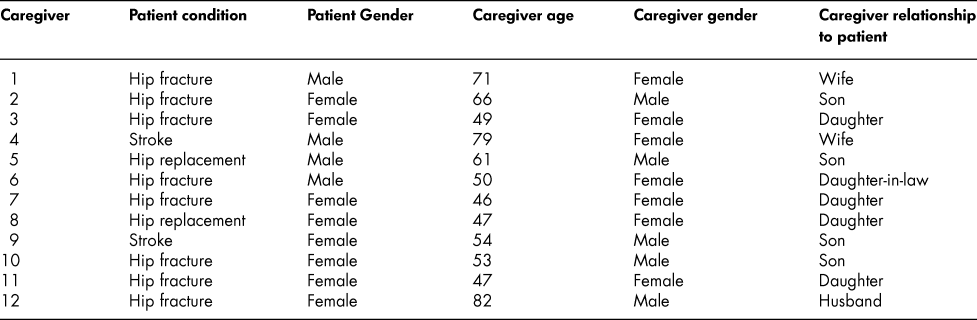
Twelve family caregivers were recruited, including 10 who were caring for individuals with hip fractures or replacements, and 2 for individuals who had a stroke (see Table 1). The mean age of caregivers was 58.75 years, with the majority of caregivers and their older adult relatives being female (58.3% and 66.7% respectively). In terms of the relationship of the caregiver to the older adult, 41.7 per cent were daughters or daughters-in-law, 33.3 per cent were sons, 16.7 per cent were wives, and 8.3 per cent were husbands.
Informal caregiver sample characteristics

One-on-one semi-structured interviews, lasting an average of 44 minutes, were conducted with the family caregivers and were scheduled based on a time, date, and place that were convenient for them. Researchers used a combination of scripted and spontaneous probes to capture the complexity of participants’ transitional care experiences (Lindlof & Taylor, Reference Lindlof and Taylor2002). Family caregiver interviews began with the interviewer asking them to describe their experiences surrounding the care transition of the older-adult care recipient (Appendix 2). Interviews then turned to exploring perceptions of their needs during the process, challenges they faced, what they found was most supportive or helpful to them, and how prepared they felt for their new care role once their relative had transitioned home. Finally, family members were asked, if they were to develop a program to help caregivers like themselves, what they would recommend as being most helpful.
Data Analysis
One of the most important concepts for conducting an effective grounded theory study is a cyclical method applied to data analysis. Glaser (Reference Glaser1998) referred to this process as the constant comparative approach, requiring researchers to collect and analyze multiple data sources concurrently during theory development to confirm, develop, elaborate, and test the applicability of emerging themes in the data (Glaser & Strauss, Reference Glaser and Strauss1967; Marshall, Reference Marshall1996). Beginning with the case manager interviews in Phase 1, followed by the caregiver interviews in Phase 2, each interview in our study was conducted and subsequently analyzed prior to recruiting the next participant. This helped us to identify, “fill out”, and explore relationships between emerging themes abstracted from the data and to purposefully guide recruitment decisions using theoretical sampling.
The primary author led the data analysis, but thematic interpretations were modified, extended, and validated through regular meetings held among researchers to ensure consensus throughout the entire research process (Charmaz, Reference Charmaz2006). Sampling in both Phase 1 and Phase 2 continued until theoretical saturation was reached: the point where adding further data no longer provided significant new contributions to theoretical insights, properties, or categories (Glaser, Reference Glaser2001).
All interviews were audio recorded and transcribed verbatim for analysis resulting in over 250 pages of transcribed text (74 pages for case managers and 138 pages for family caregivers). Researchers ensured anonymity and confidentiality of participants by using pseudonyms to de-identify the data, which were then securely stored on password-protected computers and in locked filing cabinets.
Analysis of interview transcripts followed the grounded-theory hierarchical coding method developed by Glaser and Strauss (Reference Glaser and Strauss1967). This coding strategy allowed the researchers to move from initial descriptions of transitional care experiences towards a conceptualization of caregivers’ needs and perceptions through abstracting key properties and concepts. Following each interview, the primary author read the transcripts multiple times to become increasingly immersed in the data during the collection process. Next, the primary author used three levels of coding to complete the hierarchical coding method. In the initial phase, open coding was conducted primarily by hand, using printed copies of transcripts, along with highlighters and pens, to assign codes to each line of the data in order to identify, name, and describe the phenomena that existed in the text. These codes were usually nouns and verbs, and often came directly from the text (Pandit, Reference Pandit1996). After performing this process by hand, the researcher transferred the written codes into electronic documents for further analysis within a qualitative data analysis software program, NVivo8 (QSR International Pty Ltd., 2008). Next, the primary author carried out the axial coding phase, electronically, using NVivo8. The researcher grouped codes into categories or themes and delved into elucidating the properties of each theme (Glaser & Strauss, Reference Glaser and Strauss1967). Such a process occurs through discovering relationships between codes using a combination of both inductive and deductive reasoning (Pandit, Reference Pandit1996). As grounded theorists emphasize causal relationships, theoretical sampling was especially useful during this phase. Theoretical sampling helped to confirm or negate discovered categorical relationships (Elliott & Lazenbatt, Reference Elliott and Lazenbatt2005), and it ensured that all possible relationships were adequately explored until the point of theoretical saturation.
Finally, researchers jointly conducted selective coding as the final phase in Glaser and Strauss’ (Reference Glaser and Strauss1967) hierarchical strategy. Selective coding describes the process of delineation, whereby researchers compared and contrasted characteristics of each emergent theme (Corcoran, Reference Corcoran2011) and chose a single property to represent the “core concept” of the grounded theory. All other properties were then related to the core concept and organized into a theoretical matrix. The core concept acts as the theory’s foundation; the overarching theme, which the convergence of all other properties elucidates (Glaser & Strauss, Reference Glaser and Strauss1967).
Phase 3: Verifying the Emerging Grounded Theory with Participants
Focus groups and interviews were used to engage participants in the member-check sessions during this phase once an initial grounded theory was developed. A focus group protocol and interview guide containing several general feedback questions were developed by the researchers to guide and support this process (Appendix 3) and to ensure credibility of the findings (Krefting, Reference Krefting1991). Subsequently, five case managers participated in a focus group session and were asked to provide feedback on the developing substantive theory of caregiver experiences and support needs during a care transition from hospital to home. Case managers were also asked to discuss the feasibility of different aspects of the theory. They were specifically asked what they consider to be the highest priority for improving the transitional care experience. In separate individual interviews, family members (n = 4) were asked to indicate the extent to which the theory captured their experiences and needs throughout the period of transitional care and were asked how they felt the suggested supports within the theory would meet their needs. Information gained from the focus groups and interviews verified that the theory was grounded in the data and new insights were integrated into the theory.
Results
A Theory of Caregiver Support Needs during Care Transitions from Hospital to Home
The thematic development of our theory integrated caregiver experiential data with health care provider insights from the original interviews, and member-check sessions. In total, six properties describing caregiver support needs during care transitions between hospital and home were identified: (1) assessment of unique family situation; (2) practical information, education, and training; (3) involvement in planning process; (4) agreement between formal and informal caregivers; (5) time to make arrangements in personal-life; and (6) emotional readiness. Specific activities and actions for addressing each support need were also identified (see Figure 1). Building on this analysis through selective coding, we organized the interrelationships we discovered between categories into a substantive theory within the context of the transitional care experiences of family caregivers. Caregiver support needs during care transitions between hospital and home arise at specific times in the transitional care timeline and, if met, can favorably impact the emotional journey of caregivers (Figure 1).
A theory of caregiver support needs during care transitions from hospital to home
The core concept of the theory is “building capacity to care”. Threaded throughout the entire dataset was the notion that although the experience of providing care and support is challenging, most caregivers felt they were both physically and mentally capable of providing some level of support to their family member. However, as a result of the emotional experience associated with a medical crisis, family caregivers may not be able to initially recognize, or assume, the care responsibilities surrounding the transition between hospital and home. From the data collected during interviews with study participants, it became clear that there is a need for health care providers to work closely with family members to identify and address their support needs during transitions between hospital and home. This support builds the family caregiver’s capacity to care during the hospital stay and prepares both them and the older adult for the transition home. An individual’s capacity to care is not a static concept, but has the potential to dynamically change and improve over time. This dynamic capacity for change is reflected in the stages of the transitional care timeline along with the mapped corresponding emotions of family caregivers (Figure 1).
Medical Crisis and Admission to Hospital
Often, the role of providing care to someone is neither planned nor prepared for but is triggered by a medical crisis. We consistently found, across interviews, accounts of the overwhelming nature of the medical crisis and hospital admission period, during which caregivers described feeling frustrated, fearful, stressed, and apprehensive, without adequate time to adapt to the new reality of their relationship with the older adult receiving care. Another challenge was sorting out the roles of other family members involved in providing care, which often resulted in additional stress and complications. Accordingly, both case manager and caregiver participants agreed that health care providers must take the time to assess the family caregiver’s knowledge base and family dynamics. This assessment assists providers in gaining a full understanding of each unique family situation and its influence on caregivers’ baseline capacity to provide care at the initial point in the transitional care timeline.
In terms of a caregiver’s knowledge base, both case manager and caregiver participants expressed that it would be important to ascertain, at patient admission to hospital, whether caregivers have any medical skills, the ability to comprehend medical terminology, and/or an understanding of how the broader health care system operates. One family caregiver interviewee was a retired nurse who therefore felt quite confident in her knowledge at the outset of her caregiver journey, but she expressed great concern for families without similar medical exposure. This concern was related to the notion that health care providers do not tend to scale or tailor their information-sharing approach with caregivers based on their knowledge:
Because I have medical knowledge and experience, I could fill in the gaps and ask the questions for answers I needed to know, but for those without that medical background I think they would go home not really knowing anything about what they should be doing.
Family caregivers stressed that health care providers cannot assume that having a medical skill set or knowledge base is directly related to their capacity to provide care. This is because knowledge does not guarantee a caregiver’s willingness or comfort level to provide care to their older adult family member. For example, a case manager expressed this thought:
A lot of people, I think, are really apprehensive about learning to do something like that [to care] for their family member because they feel like that’s something a nurse should be doing.
Study participants also discussed the challenges of taking on the role of providing care to an older adult family member when other family members are involved. Family dynamics – including the number of different perspectives, expectations, and disparate financial situations involved – can have a significant impact on who takes on the role of primary caregiver. It also affects the dynamics of how other family members provide care. For example, one caregiver discussed the challenges they faced on an ongoing basis in providing care to an older adult family member in light of their specific family situation:
It’s just the family dynamics, every family is different … We all have our own personalities, we all have our own way of looking at issues, and some of us handle them different than others.
Study participants felt strongly that health care providers should explore these family dynamics with the older adult care recipient and their family caregiver(s) as soon as possible on admission to hospital. This would help prevent any confusion and/or familial conflict from the outset of the transitional care timeline.
Acute Care
From the data, it became clear that although the acute-care phase of the transitional timeline was usually rather short, it was often a missed opportunity for health care providers to work with caregivers. This phase could otherwise be used to build the knowledge base of family caregivers and help them overcome feelings of stress and apprehension – to feel more supported and hopeful about what lies ahead in their care journey. Caregivers often described the hospital setting and procedures as uninviting, which discouraged conversations that could prepare them for future responsibilities at home. Several caregivers expressed their discontent with the lack of information they received to prepare for their new care responsibilities:
We were pulling it [looking for information] on our own because otherwise it was just a black hole … you’re kind of thirsting for information that whole time.
Developing a preliminary understanding of a caregiver’s unique family situation on admission allows health care providers to take advantage of the short time they have together with families in acute care. It also allows them to effectively provide practical information, education, and training that is relevant and tailored to the needs of family caregivers and enhances their capacity to care. One suggestion made by caregivers was for rehabilitation therapists to make more of an effort to engage them in hospital therapy sessions; allowing them to be proactive and ask questions before the transition to home occurs.
In addition to early involvement and observation of formal care activities within the hospital, family caregivers discussed the usefulness of raising their awareness of available community supports during the acute-care stage in the transitional timeline, to allow them to plan ahead. Caregivers shared the observation that, many times, this information is not given at all, or given too early (during the crisis and admission phase) or too late (once already back at home) in the transitional timeline. For example, one caregiver described receiving too much information during the admission process to hospital:
When everything comes at you at once, it’s hard to keep things straight – what someone told you, you know, at the hospital.
Instead, caregivers discussed the idea of having the opportunity to make necessary arrangements while their family member is being cared for by providers in acute care, in advance of their return home:
Walk the steps with someone: if you give them the community support information in the middle [of the hospital stay] so that they can educate themselves better in the middle – than when it comes time for someone to get home – they can know … what they can access when someone gets home.
Caregivers also felt that health care providers could do a better job of engaging them in important conversations about care. When asked if they were given the opportunity to offer insight on decisions about care for their family member, one caregiver replied:
No, I actually wasn’t [involved]. I was told kind of after the fact but I wasn’t included in the discussions ahead of time even though I requested to be included in all of the discussions.
Case managers stressed the need for health care providers to use an active and inclusive approach to involve caregivers in the care planning process during the acute stage of the transitional timeline:
I think if [it had] started to be talked about right from the start, then maybe that would lessen their anxiety and they would feel they were a bit more in on the planning process … not just getting “oh guess what, they’re coming home tomorrow.”
Additionally, case managers and caregivers described the necessity for everyone involved in patient care to be included in a discharge planning meeting with health care providers that takes place in advance of the physical discharge from hospital. This would ensure that everyone has the opportunity to provide input into the care plan prior to the older adult care recipient’s transitioning home. Caregivers said that they would have been very appreciative of this type of meeting, and one expressed surprise in not being asked to participate in such a meeting:
I thought there would have been, like, a little family conference … I’ve worked before on orthopaedic rehab or something [similar], and they have a discharge meeting with, a planning meeting, with the family.
A case manager also described the importance of a face-to-face meeting with family members at discharge to help them overcome any residual anxieties and to increase feelings of optimism about the transition:
You can provide them with paper with everything from A to Z on it that they could ever possibly need, but I think the face to face, the sitting down … that does help reduce a lot of the anxiety and make the transition smoother if they have the information directly.
Discharge
Discharge was described by our interviewees as a crucial process in the transitional care timeline for all involved (the older adult, family caregiver, and health care providers) to be on the same page regarding the care plan and next steps. The study participants described several instances of miscommunication and information-sharing errors that took place during the discharge from acute care. Information was typically shared verbally resulting in miscommunication, which was furthered by not having received written information that could be referred to on an ongoing basis. Caregivers suggested that health care providers work with them to fill out a written care outline, detailing their responsibilities for care in the home. Any ongoing CCAC services the older adult would be eligible to receive or would be assessed to receive and relevant contact information for additional community service providers could also be conveyed at this time. It was felt that such a document would build the caregiver’s trust that the health care provider team was dedicated to their older-adult family member’s continuity of care and would be accountable for their transitional care:
I really think that there needed to be a written outline for people as well as a definite time, maybe the day before when the nurses would have talked to the caregiver specifically and [given] them guidelines and asked if they had any questions, but I really did feel that Saturday morning – because he was being discharged [then] – that, you know, he was not [their] concern now.
Case managers agreed with the idea of a care agreement document:
And there should be some documentation … that the caregiver is comfortable with this role and that they understand the information that’s been given.
It was suggested that perhaps both the health care provider team and the caregiver could officially sign such a document to further formalize the process.
In-patient Rehabilitation
Caregivers described themselves as having busy personal lives with hectic professional and family schedules. Caregivers of older adults who were admitted to a short-stay rehabilitation facility following their discharge from acute care had the chance to make the necessary arrangements in their personal life to accommodate the care responsibilities they would be assuming when the older adult transitioned home. This extra transition provided caregivers with time to rearrange their schedule, organize the physical home environment, and take small steps towards engaging in added care responsibilities in order to feel more mentally prepared for the older adult’s return home. One family caregiver discussed the effect of rehabilitation on their confidence and comfort levels in providing care:
When I saw that she was finally getting on to walking and following exercises with the aides, the physio aides and that kind of thing was working with her, then I felt the comfort to go home.
Witnessing this small step in the older adult’s rehabilitation journey allowed the caregiver to feel more in control of the situation and ready to take on the additional responsibility of providing care.
Home
During interviews, study participants shared comments that the biggest challenge faced was that of isolation and doubt in their abilities to provide care. When asked how it would be possible to transform these negative emotions, caregivers discussed the need to have their emotions validated by others and to have someone they could contact to ask questions of or to talk with:
It would be nice to have someone to talk to, to refer to – you know, a person who is like the social workers, if you can get hold of them.
Case managers also recognized the need for caregivers to feel more supported in the home, because often the focus is so much on the older adults being cared for:
Sometimes they feel like the client is only supported and not the whole family … in the process [in] which you know a lot of the calls that will come through will be in regards to not the client but [for example] the wife doesn’t feel supported. They need to feel supported to make it all work, you know, so they don’t realize that sometimes the background of it is supporting both of them.
According to the study interviewees, providing this type of support on an ongoing basis can build and maintain caregiver self-confidence:
If they can’t do it because they don’t feel confident, then you give them the feedback that they need to make them confident. So [the need is to] understand right here what is preventing them from being confident and providing care, and accepting that role and fulfilling that role.
Confidence was thought to be essential for caregivers in maintaining their capacity to provide care and was viewed as being built over the course of the transitional care timeline.
Feedback and Theory Endorsement
During the member-check sessions in Phase 3, both case managers and caregivers endorsed the development of a theory of caregiver support needs during care transitions from hospital to home. Family caregivers appreciated the organization of the six categories of caregiver support needs according to the transitional care timeline and their corresponding emotional journey. They also felt that the developed theory was representative of their own experiences:
I appreciate the way it was laid out. It’s very comprehensive. I really liked the way you added the feelings across the bottom [of the theory]. You know, when I thought about my own caregiving experience, I really kind of remember going through most of that.
Moreover, both caregivers and case managers expressed strong endorsement for adopting the theory of caregiver support needs. The theory could be used to guide interactions between caregivers and health care providers during transitional care between hospital and home as well as “best practices”. One caregiver stated:
I was really impressed with it. Like how simple it was to follow, and how effective you were at getting a nice little model. It really helps to walk through the steps, and understand the emotions and, you know, I think if something like this was followed, it would mean better outcomes for folks.
Similarly, one case manager commented:
I think this model or theory would be really helpful in the hospital setting, in defining how family members can be involved.
Discussion
The main outcome of this study is the development of a substantive grounded theory of caregiver support needs during the transition between hospital and home. The core concept of this theory is “building capacity to care”, which involves assessing a caregiver’s unique family situation to tailor and provide relevant information, education, and training. This understanding will assist caregivers in the acquisition of their new role while adequately involving them in care planning activities. It will also allow caregivers to be well equipped and prepared to confidently provide care in the home environment with ongoing support. This concept is consistent with the current state of the literature. All individuals have unique needs, which change over time. Cameron and Gignac (Reference Cameron and Gignac2008) suggested that health care providers need to be cognizant of the dynamic aspect of caregiver needs, and must temper their communication, education style, and level of support accordingly. This is also recommended to support caregivers as they move across the transitional care timeline.
Research has reinforced the caregiver support needs for care transitions between hospital and home that this study has identified. Given, Sherwood, and Given (Reference Given, Sherwood and Given2008), for example, recognized that “assessing caregivers’ capacity to provide care and identifying caregivers who need assistance is essential to improving patient care” (p. 31). Enhancing caregiver involvement, training, and support during transitions also has the potential to reduce unnecessary re-hospitalizations and allows for better patient outcomes (Levine, Halper, Peist, & Gould, Reference Levine, Halper, Peist and Gould2010). The current literature points to the importance of employing practical, tailored education and information, as well as including caregivers in care planning activities.
Evidence exists that validates the caregivers’ emotional journey and the connection to caregiver support needs. Our study found that building self-confidence throughout the transitional care timeline was important to successfully overcome negative emotions and build capacity to provide care at home. This ability is often defined in the literature as self-efficacy. Schmall (Reference Schmall1995) described caregiver self-efficacy as the greatest predictor of positive outcomes for patients and family members during the self-management of a medical issue. Zeiss, Gallagher-Thompson, Lovett, Rose, and McKibbin (Reference Zeiss, Gallagher-Thompson, Lovett, Rose and McKibbin1999) described self-efficacy as the primary mediator for caregivers who are managing medical care situations. This notion of self-efficacy is reinforced by the work of Levine et al. (Reference Levine, Halper, Peist and Gould2010), whereby support through information promoted positive caregiver self-esteem, self-worth, and confidence in their care abilities.
Findings from our study point to the need for future research to validate and refine the substantive theory for addressing caregiver support needs during care transitions between hospital and home. A key factor in designing caregiver education and support is the recognition that relationships between health care providers and caregivers must be mutually beneficial. Building capacity to care must be, therefore, a joint effort among all parties involved in the circle of care. This collaboration promotes higher levels of self-confidence and feelings of support once the patient returns home to the community. Future studies, therefore, should be designed to develop, test, and evaluate interventions focused on assessing families’ knowledge and circumstances at admission. Studies should also focus on implementing a care agreement document at discharge. These two concepts were reinforced by all study participants as having the greatest impact on their ability to work together and ultimately improve caregiver capacity to provide care.
Given et al. (2009) similarly suggested that health care providers should evaluate initial caregiver capacity including knowledge, skills, family roles, and available resources, and to use these assessments to promote ongoing caregiver education throughout the formal hospital stay. Wells and Cagle (Reference Wells and Cagle2011) described a caregiver’s basic knowledge and circumstances as the foundation for building their skills to provide care in the community over time. It is important to understand a caregiver’s learning needs and then to target teaching methods to match these needs over multiple encounters during the hospital stay in an effort to reinforce learning (Wells & Cagle, Reference Wells and Cagle2011). Future studies should focus on the development and testing of a process and/or tool that will allow health care providers to learn about a caregiver’s unique family situation, happening as close to admission to hospital as possible. Questions about their medical skill sets, medical language comprehension, comfort levels, family involvement, expectations, and finances should also be included.
Brown-Williams et al. (Reference Brown-Williams, Neuhauser, Ivey, Graham, Poor and Tseng2006) suggested that a feedback loop be established between health professionals and families to maintain communication and promote a mutual understanding of ongoing care responsibilities. Kripalani et al. (Reference Kripalani, Jackson, Schnipper and Coleman2007) suggested, further, that providing patients and families with a written discharge summary has the potential to drastically improve the care a patient receives in the community. Future research needs to involve health care providers and caregivers in the co-design and testing of a care agreement document that would provide clear, consistent written information about the older adult’s ongoing care plan and services, caregiver responsibilities, and key contact information at hospital discharge.
Strengths and Limitations
The comprehensive nature of a theory that explicates three levels of caregiver need is an important strength of this study. The temporal aspect of caregiver needs provides the opportunity to develop targeted interventions that support caregivers during different phases of the caregiving role. According to Cameron and Gignac (Reference Cameron and Gignac2008), a clearer understanding of the common time-specific needs of all caregivers has the potential to streamline and decrease resources needed to provide individualized programs. Incorporating the emotional journey also strengthens a caregiver’s ability to relate to the model and understand its key phases, while alerting health professionals to the associated emotional reactions of families.
An additional strength was the agreement between health care professionals and family caregivers on needs to support caregivers during transitional care. This suggests that the issues and challenges described were inherent to transitional care specifically, and that minimal bias occurred due to the individual’s health-professional or lay perspective.
The researchers also faced some limitations throughout the study process. One limitation was the targeted sample population and focus on a specific transition in care, within one CCAC, between hospital and home. Tappen (Reference Tappen2011) observed that most studies on caregiving rely on a small, geographically restricted sample that lacks power and generalizability. Restricting the care recipient population to those experiencing hip fracture and stroke, and to the type of care transition as explored in this study, limits the applicability of the study findings to other medical situations and points of transition. However, the sample was appropriate for accessing caregivers dealing with medical crisis situations for older adults with complex medical issues. The congruence in the overall transitional care experiences of all caregivers interviewed suggests that the substantive theory contains a set of core elements that describe the overall care transition experience and support needs for different types of caregivers. This finding warrants further testing and theory refinement.
The researchers also faced several sampling issues, including a lack of representation of stroke caregivers in the study sample. Only 2 of the 12 informal family caregivers were of patients who had experienced a stroke. Although the researcher made efforts to direct interview questions to general caregiver needs during transitional care, rather than questions specific to managing a particular medical situation, the present theory of caregiver needs is potentially biased towards the needs of caregivers caring for a hip fracture patient.
Another study limitation in developing the theory of caregiver needs to support a successful care transition from hospital to home relates to the study’s inclusion of only one type of health professional. As only community and resource case managers were included in our sample, findings from the present study might be biased towards community care needs, rather than hospital care needs. Future research in the development and testing of interventions to address caregiver support needs should consider including hospital case managers and nursing staff in the co-design process to include more-varied perspectives.
Conclusion
Overall, case manager and caregiver interviews illustrated that the present context of transitional care is widely unsupportive of family caregivers. The developed theory of caregiver support needs during care transitions from hospital to home has the potential to be valuable for describing the family caregiver experience and support needs during transitions. Strong endorsement of the theory by participants suggests its usefulness in informing and guiding future interventions that address caregiver support needs. This theory also has the potential to help health care professionals provide more timely and appropriate support to caregivers of medically complex older adults during a hospital-to-home care transition.
Appendix 1: Case Manager Interview Guide
1. General Background Information about Case Manager
Year of birth: ____
Gender: □ Male □ Female
Resource Case Manager ____ Community Case Manager ____
1.1 How many years have you been employed in this position?
1.2 Overall, how many years of experience do you have as a CCAC case manager?
1.3 How many years of clinical experience do you have in total?
Opening Discussion Question
1.4 In your opinion, why do you think the transition from hospital to home following a medical crisis (i.e., hip fracture or stroke) has been identified in the literature as extremely challenging?
Probe: For whom?
2. Knowledge on Caregiver roles, needs, and challenges
2.1. Can you please describe the process of transitioning from hospital to home for a hip fracture/stroke patient?
Probe: planning discharge, communication, equipment, formal to informal care setting
2.2. What is your role during this transition?
Probe: interaction with caregivers – conversations, meetings, education, coordinates services
2.3. What is the transition experience like for informal caregivers?
(a) What role does an informal caregiver play during this transition?
(b) In your professional opinion, what are the needs of informal caregivers during this process?
Probe: informational, financial, and educational
2.4. From your professional experience, what challenges do family members experience during the transition from hospital to home?
Probe: financial, emotional, relational, vocational, environmental
2.5. What factors are most important in ensuring a successful transition from hospital to home?
2.5.1 What supports are available to families during a transition from hospital to home?
Probe: community supports, homemaking services, home care
2.5.2. What resources need to be in place to support a smooth transition from hospital to home?
Probe: important information, equipment
2.6. How can a caregiver be proactive in their role during the process of transitioning their loved one from hospital to home?
2.7. In your opinion, are there areas for improvement in terms of caregiver involvement in the transition from hospital to home?
If yes:
2.7.1. What could be improved?
2.7.2. Do you have recommendations for how?
Appendix 2: Family Caregiver Interview Guide
1. General Background Information about Caregiver
(a) Year of birth: ____
(b) Gender: □ Male □ Female
(c) Relationship to person receiving care (experiencing hip fracture or stroke): _________________
2. Exploring the Care Transition from Hospital to Home
Hospital Discharge
1. Can you tell me about the experience of your family member’s transition from hospital to home?
(a) What was it like for you?
(b) What was your role in this process?
2. What needs did you have during the transition process?
Probe: respite, education, support groups
(b) Were your needs met?
If no:
(c) How might your needs have been better supported during the transition process?
3. What did you find the most helpful or supportive during the transition from hospital to home?
(a) What information did you receive?
Probe: From whom? What format?
4. What challenges did you experience during the transition from hospital to home?
Probe: emotional, stress, vocational, environmental
Arriving Home
1. After arriving home from the hospital, how was your involvement in your friend/relative’s care different from your involvement before their hip fracture/stroke?
2. How did you feel about taking on the caregiver role after your friend/relative returned home?
(a) What made you feel this way?
3. Did you feel prepared to take on the role of caregiver for your friend/family member?
If yes:
(a) How did you prepare?
(b) What resources have you been able to access?
(c) Have you received any other support (community or relatives?)
If no: Why?
4. What were some of your concerns in providing care for your friend/relative once they returned home?
Probe: emotional, stress, time management, education, financial
5. What advice would you give someone who has just had a friend/relative come home after suffering a hip fracture/stroke?
6. If we were to develop a program to help caregivers like yourself, what would be most helpful?
Appendix 3: Focus Group Member-Check Session
Family Caregiver Focus Group Questions
1. According to your experience of providing care for your loved one during the transition from hospital to home, does this theory adequately represent the needs of family members during transitional care between a formal (hospital) setting and informal (home) setting?
2. Is the format easy to understand?
3. Are there items that you would change or remove?
4. Are there items you would add?
5. What do you think about the idea of a “Caregiver Assessment” process?
6. What do you think about the idea of a “Care Agreement Contract”?
7. Based on this theory, what area do you see as the highest priority for intervention and support? What would you suggest as an intervention?
Case Manager Focus Group Questions
1. According to your professional experience working with families during times of medical crisis for older adults, does this theory adequately represent the needs of family members during transitional care between a formal (hospital) setting and informal (home) setting?
2. Is the format easy to understand?
3. Are there items that you would change or remove?
4. Are there items you would add?
5. What do you think about the idea of a “Caregiver Assessment” process?
6. What do you think about the idea of a “Care Agreement Contract”?
7. Based on this theory, what area do you see as the highest priority for intervention and support? What would you suggest as an intervention?