1. Introduction
The age and nature of the crust and the timing of ocean basin closure are keys to understanding the evolution of suture zones (Dewey, Reference Dewey2005; Stern et al. Reference Stern, Reagan, Ishizuka, Ohara and Whattam2012; Draut & Clift, Reference Draut and Clift2013). Critical to developing accurate tectonic reconstructions of such sutures are detailed mapping and analysis of their usually complex and highly deformed rock suites (Dewey, Reference Dewey1977; Frassi et al. Reference Frassi, Pandolfi, Marroni, Göncüoğlu, Ellero, Ottria and Sayit2016; Saktura et al. Reference Saktura, Buckman, Nutman and Bennett2021 b).
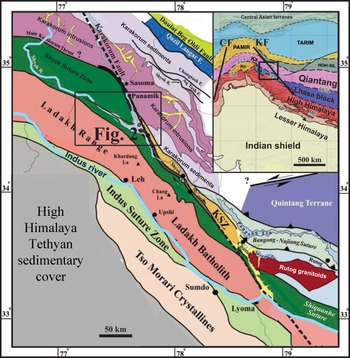
The Shyok (Northern) Suture Zone (SSZ) is the northernmost of two sutures that can be traced across the NW Himalayan syntaxis, from the Chaman fault zone to the Karakoram fault zone (Fig. 1), both of which are complex mid- to late Cenozoic collisional transform faults which connect the N-directed thrust of the North Pamir to the S-directed thrusts of the Makran and Southern Tibet (Zhang et al. Reference Zhang, Shan and Huang2011; Brookfield et al. Reference Brookfield, Chung and Shellnutt2017; Wallis & Searle, Reference Wallis, Searle and Duarte2019). East of the Karakoram fault zone, the southern Indus Suture Zone (ISZ) is usually equated with the Yarlung–Tsangpo suture zone (Hébert et al. Reference Hébert, Bezard, Guilmette, Dostal, Wang and Liu2012), while the SSZ is usually equated with the Bangong suture separating southern and central Tibet (Rolland et al. Reference Rolland, Mahéo, Pecher and Villa2009; Parsons et al. Reference Parsons, Hosseini, Palin and Sigloch2020). The SSZ, however, may be equivalent to the Luobadui–Milashan Fault with eclogites and blueschists in eastern Tibet, which separates the southern Lhasa block, with the Gangdise Batholiths, from the central Lhasa block, with a complete Palaeozoic section comparable with that of the Karakoram block (Gaetani, Reference Gaetani1997; Zhu et al. Reference Zhu, Zhao, Niu, Dilek, Hou and Mo2013; Liu et al. Reference Liu, Li, Sun, Cao, Wang and Pan2017; Yogibekov et al. Reference Yogibekov, Sang, Xiao, Windley, Mamadjanov, Yang, Huang, Aminov and Vatanbekov2020). The early Cretaceous Bangong suture zone is more likely equivalent to the Rushan–Pshart suture between the Central and South Pamir blocks (Schwab et al. Reference Schwab, Ratschbacher, Siebel, Mcwilliams, Minaev, Lutkov, Chen, Stanek, Nelson, Frisch and Wooden2004). West of the Chaman Fault Zone, the SSZ may be equivalent to the less compressed Kandahar fore-arc and Ras Koh arc (Kassi et al. Reference Kassi, Khan and Kasi2007; Shroder et al. Reference Shroder, Eqrar, Waizy, Ahmadi and Weihs2021) (Fig. 1). The nature and equivalence of the SSZ is nevertheless debatable. The SSZ is at altitudes of over 3000 m within even higher mountainous terrain, and is difficult to access in places, not only because roads and tracks are limited, but because it lies in politically disputed zones between Pakistan, India and China (Fig. 2a). Studies have been made in the areas on either side of the India–Pakistan line of control (summarized in Pudsey, Reference Pudsey1986; Robertson & Collins, Reference Robertson and Collins2002; Rolland et al. Reference Rolland, Mahéo, Pecher and Villa2009; Borneman et al. Reference Borneman, Hodges, Vansoest, Bohon, Wartho, Cronk and Ahmad2015), but the age and nature of components of the SSZ are still unresolved, as illustrated by the very different and incompatible geological maps published of the area (e.g. Rai, Reference Rai1982; Dunlap & Wysoczanski, Reference Dunlap and Wysoczanski2002; Saktura et al. Reference Saktura, Buckman, Nutman and Bennett2021 b). Estimates of the age of formation of the SSZ range from Cretaceous (Weinberg et al. Reference Weinberg, Dunlap and Whitehouse2000; Rolland et al. Reference Rolland, Villa, Guillot, Mahéo and Pêcher2006; Rehman et al. Reference Rehman, Seno, Yamamoto and Khan2011) to Eocene (Khan et al. Reference Khan, Walker, Hall, Burke, Shah and Stockli2009).
Geological map of Ladakh, showing location of Figure 2 (from Jain, Reference Jain2014). Inset shows location of map on terrane map of India–Asia collision zone (from Parsons et al. Reference Parsons, Hosseini, Palin and Sigloch2020). CF – Chaman fault; KF – Karakoram fault; Ko – Kohistan arc; Ka – Karakoram.

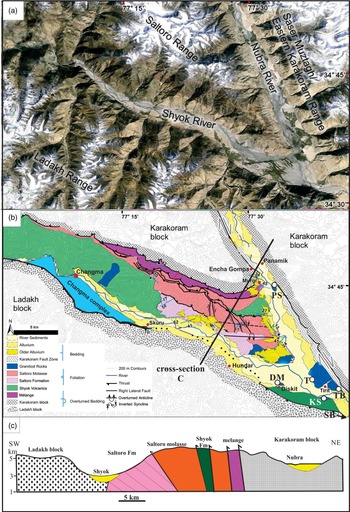
(a) Satellite view of study area. (b) Geological map of study area, modified from Borneman et al. (Reference Borneman, Hodges, Vansoest, Bohon, Wartho, Cronk and Ahmad2015), with changes from Saktura et al. (Reference Saktura, Buckman, Nutman and Bennett2021 b) and authors’ field observations, showing location of samples; cross-section modified from Upadhyay et al. (Reference Upadhyay, Sinha, Chandra and Rai1999) and Borneman et al. (Reference Borneman, Hodges, Vansoest, Bohon, Wartho, Cronk and Ahmad2015).

Detailed study of the individual components of the SSZ is needed in order to resolve its nature, development and age. We here discuss the petrology, geochemistry, age and nature of the Tirit granitoids and associated dykes at the Nubra–Shyok confluence, using a map based on Borneman et al. (Reference Borneman, Hodges, Vansoest, Bohon, Wartho, Cronk and Ahmad2015) and our own extensive fieldwork in the area (Fig. 2).
2. Geological overview
In the Nubra–Shyok confluence area, the SSZ forms a narrow highly tectonized belt, overthrust in the south by the Ladakh batholith and in the north by the Karakoram batholith (Fig. 2b, c; Rai, Reference Rai, Thakur and Sharma1983; Upadhyay et al. Reference Upadhyay, Sinha, Chandra and Rai1999; Rolland et al. Reference Rolland, Pecher and Picard2000; Borneman et al. Reference Borneman, Hodges, Vansoest, Bohon, Wartho, Cronk and Ahmad2015). The dominant rocks are ophiolitic fragments, basic to acid volcanics and intrusives, pelagic oceanic sediments, cherts and foraminiferal limestones similar to those of the ISZ to the south, with large olistoliths of Asian shelf sediments in places (Brookfield & Gupta, Reference Brookfield and Gupta1984; Rolland et al. Reference Rolland, Pecher and Picard2000; Robertson & Collins, Reference Robertson and Collins2002; Upadhyay, Reference Upadhyay2014; Upadhyay et al. Reference Upadhyay, Gautam and Awatar2014). All these have been highly tectonized and are unconformably overlain in Ladakh by coarse continental clastics of post-Oligocene age (Rai, Reference Rai1982).
The SSZ has various and divergent interpretations as: an oceanic suture (Gansser, Reference Gansser1977); a subduction zone, older than (Petterson & Windley, Reference Petterson and Windley1985) or younger than (Brookfield & Reynolds, Reference Brookfield and Reynolds1981; Reynolds et al. Reference Reynolds, Brookfield and McNutt1983) the ISZ; a tectonic repetition of the ISZ (Rai, Reference Rai1982, Reference Rai, Thakur and Sharma1983; Srimal, Reference Srimal1986); a back-arc complex related to the ISZ (Thakur & Misra, Reference Thakur and Misra1984; Dunlap & Wysoczanski, Reference Dunlap and Wysoczanski2002); and a marginal basin (Upadhyay, Reference Upadhyay2002). A popular view is that the SSZ is a site of probably Early to Late Cretaceous Ocean closure, while the ISZ is the younger main suture between the Indian continental plate and Asian continental plate (Srimal, Reference Srimal1986; Upadhyay et al. Reference Upadhyay, Sinha, Chandra and Rai1999; Rolland et al. Reference Rolland, Pecher and Picard2000; Robertson & Collins, Reference Robertson and Collins2002; Bhutani et al. Reference Bhutani, Pande and Venkatesan2009; Upadhyay, Reference Upadhyay2009; Borneman et al. Reference Borneman, Hodges, Vansoest, Bohon, Wartho, Cronk and Ahmad2015; Kumar et al. Reference Kumar, Bora and Sharma2016).).
South of the SSZ, the Ladakh block is mostly calc-alkaline batholiths and their extrusive equivalents (the Khardung Volcanics), with pendants and enclaves of pre-intrusive country rocks that include the Changmar and Shoyk Volcanics described below (Weinberg et al. Reference Weinberg, Dunlap and Whitehouse2000; Rolland et al. Reference Rolland, Picard, Pecher, Lapierre, Bosch and Keller2002 b; Thanh et al. Reference Thanh, Itaya, Ahmad, Kojima, Ohtani and Ehir2010; Saktura et al. Reference Saktura, Buckman, Aitchison and Zhou2021 a). The Ladakh batholiths consist mostly of coarse- to fine-grained granite to diorite intrusions with roof pendants and enclaves of ophiolites (Reuber, Reference Reuber1990; Rolland et al. Reference Rolland, Pecher and Picard2000), coarse mafic and acid intrusives (Kumar, Reference Kumar2010) and sedimentary rocks (Raz & Honegger, Reference Raz and Honegger1989). U/Pb zircon dates indicate that magmatism was concentrated during a 20 million year period from ∼65 Ma to ∼45 Ma (St-Onge et al. Reference St-Onge, Rayner and Searle2010; White et al. Reference White, Ahmed, Ireland, Lister and Forster2011). More basic intrusives on the north range give U/Pb of ∼66 to 60 Ma, whereas the main granite intrusions give a U/Pb date of ∼50 Ma (St-Onge et al. Reference St-Onge, Rayner and Searle2010; Thanh et al. Reference Thanh, Itaya, Ahmad, Kojima, Ohtani and Ehir2010; Shellnutt et al. Reference Shellnutt, Lee, Brookfield and Chung2014). These correspond to two main episodes of magmatism, with a change in composition from I-type to S-type granites and adakaites, attributed to crustal thickening during the ‘hard’ collision between Indian and Asian continental crust (Shellnutt et al. Reference Shellnutt, Lee, Brookfield and Chung2014).
On the northern side of the Ladakh Range, the Khardung Volcanics overlie, are intruded by and are overthrust by the Ladakh batholith (Upadhyay et al. Reference Upadhyay, Sinha, Chandra and Rai1999; Rolland et al. Reference Rolland, Pecher and Picard2000; Weinberg et al. Reference Weinberg, Dunlap and Whitehouse2000). The Khardung Volcanics consist of basalts, andesites, dacites, rhyodacites and rhyolites with associated pyroclastics, and become more acidic upwards (Upahdyay, Reference Upadhyay, Gautam and Awatar2014). The lower andesites (U/Pb zircon date of ∼70 Ma) switch to rhyolites (U/Pb zircon dates of ∼65 ± 2 Ma), and these persist until ∼52 Ma (Lakhan et al. Reference Lakhan, Singh, Singh, Sen, Singh, Khogenkumar, Singhal and Oinam2020; Saktura et al. Reference Saktura, Buckman, Aitchison and Zhou2021 a), with Ar/Ar whole-rock dates of ∼55 Ma (Bhutani et al. Reference Bhutani, Pande and Venkatesan2009; White et al. Reference White, Ahmed, Ireland, Lister and Forster2011). Like the Ladakh batholith, the volcanics become more acidic upwards and are thus likely co-magmatic with it, as they have comparable ages.
From south to north, the units in the Shyok belt are as follows:
-
1. The Changmar complex consists of norites, gabbronorites, plagiogranites, harzburgites and serpentinites (Saktura et al. Reference Saktura, Buckman, Nutman and Bennett2021 b). It is intruded by the Ladakh Batholith, intrudes the Shyok Volcanics to the north and possibly forms the oceanic substrate to the Shyok volcanic arc (Rolland et al. Reference Rolland, Pecher and Picard2000; Saktura et al. Reference Saktura, Buckman, Nutman and Bennett2021 b).
-
2. The Shyok Volcanics consist of calc-alkaline basaltic to andesitic volcanics metamorphosed to greenschist facies (Weinberg et al. Reference Weinberg, Dunlap and Whitehouse2000; Thanh et al. Reference Thanh, Rajesh, Itaya, Windley, Kwon, Park, Ngac, Liem and Nam2012; Sivaprabha et al. Reference Sivaprabha, Bhat, Ahmad, Tanaka, Balakrishnan, Asahara and Mukhopadhyay2022). Along the Shyok River, the unit is intruded by gabbroic dykes probably related to the Changmar conplex (Saktura et al. Reference Saktura, Buckman, Nutman and Bennett2021 b). One of the dykes gave a Lower Cretaceous 40Ar/39Ar hornblende age of 125.6 ± 6.1 Ma (Aptian) (Borneman et al. Reference Borneman, Hodges, Vansoest, Bohon, Wartho, Cronk and Ahmad2015).
-
3. The Saltoro Formation is overthrust by the Kharduing Volcanics south of Khalsar, but may rest unconformably on the Shyok Volcanics to the northwest (Upadhyay et al. Reference Upadhyay, Sinha, Chandra and Rai1999; Borneman et al. Reference Borneman, Hodges, Vansoest, Bohon, Wartho, Cronk and Ahmad2015) (Fig. 2). The lower part, sometimes separated out as the Tsoltak Formation, consists of deeper water thinly and mostly even-bedded, highly fissile and cleaved slates, phyllites, and siltstones, with intercalations of thinly to medium-bedded grey fossiliferous limestones and marbles, with possibly late Jurassic bryozoa (Upadhyay et al. Reference Upadhyay, Sinha, Chandra and Rai1999). A tectonically isolated thick recrystallized limestone, called the Hundiri Formation, contains abundant mollusc and Lower Cretaceous (Aptian – early Albian) foraminifera (Juyal, Reference Juyal2006). To the southeast, the lower part of the formation contains Middle Jurassic (Callovian) ammonites (Ehiro et al. Reference Ehiro, Kojima, Sato, Ahmad and Ohtani2007). The upper part of the Shyok Formation consists of shallower-water sandstones and mudstones with bivalves and gastropods passing up into Lower Cretaceous (Albian) limestone conglomerates and acidic tuffs (Matsumaru et al. Reference Matsumaru, Ehiro and Kojima2006). The age of the Saltoro Formation overlaps with that of the Shyok Volcanics and may be a back-arc basin to a Shyok Volcanic oceanic arc (Upadhyay et al. Reference Upadhyay, Sinha, Chandra and Rai1999).
-
4. The Saltoro Molasse consists of coarse- to fine-grained continental clastic sediments, at least 3.2 km thick, unconformable on, and overthrust onto, the Shyok Volcanics and Saltoro Formation (Rai, Reference Rai, Thakur and Sharma1983). The rounded fluvial orthoconglomerate pebbles range from 0.1 to 1 m, and are dominated by Shyok Volcanic greenstones, with subordinate granite, phyllites and schists (Rai, Reference Rai, Thakur and Sharma1983). The molasse is a typical deposit of near-source alluvial fans (Blair & McPherson, Reference Blair, McPherson, Parsons and Abrahams2009).
-
5. An ophiolitic mélange is the topmost unit within the Shyok suture zone, overthrusts the Saltoro Molasse and is overthrust by the Karakoram block (Weinberg et al. Reference Weinberg, Dunlap and Whitehouse2000). It is c. 1 km thick and contains decimetre- to kilometre-scale blocks of phyllite, limestone, red chert, basalt, gabbro and peridotite (Rai, Reference Rai, Thakur and Sharma1983).
Numerous felsic to mafic dykes also cut all SSZ units, except the ophiolitic mélange, and thus predate the southward thrusting of the Karakoram block. Some individual dykes can be traced over 1 km in the field. The felsic to intermediate composition dykes typically have an aplitic texture and are often heavily altered and crumbly in hand specimen.
-
6. The Karakoram block overthrusts the ophiolitic mélange, and consists of metamorphosed Palaeozoic to Upper Cretaceous host rocks (Rai, Reference Rai, Thakur and Sharma1983; Sinha et al. Reference Sinha, Rai, Upadhyay and Chandra1999; Rolland et al. Reference Rolland, Picard, Pêcher, Carrio, Sheppard, Oddone and Villa2002 a) intruded by Lower Cretaceous (110–100 Ma) calc-alkaline and Upper Cretaceous (85 Ma) alkaline granitoids. This Cretaceous magmatism is attributed to the development of an Andean arc on the southern edge of Asia (Rolland et al. Reference Rolland, Picard, Pecher, Lapierre, Bosch and Keller2002 b). Younger Cenozoic collisional magmatism and metamorphism occurred in several phases during the hard collision of India and Asia (Rolland et al. Reference Rolland, Mahéo, Guillot and Pêcher2001), with Oligocene to Miocene (26 to 21 Ma) leucogranites intruded during thrusting of the Karakoram block over the SSZ and right-lateral displacement on the Karakoram Fault (Schärer et al. Reference Schärer, Copeland, Harrison and Searle1990; Allen & Chamberlain, Reference Allen and Chamberlain1991; Debon & Khan, Reference Debon and Khan1996; Rolland et al. Reference Rolland, Mahéo, Guillot and Pêcher2001, Reference Rolland, Villa, Guillot, Mahéo and Pêcher2006, Reference Rolland, Mahéo, Pecher and Villa2009; Horton & Leech, Reference Horton and Leech2013; Brookfield et al. Reference Brookfield, Chung and Shellnutt2017; Pundir et al. Reference Pundir, Adlakha, Kumar and Singhal2020).
3. Tirit granitoids and associated dykes
Tirit granitoid and dyke samples were collected at outcrops at Khalsar (KS), Tegart (T), Diskit (DM), Tirit Bridge (TB) and Sati Bridge (SB) (Fig. 2).
3.a. Tirit granitoids
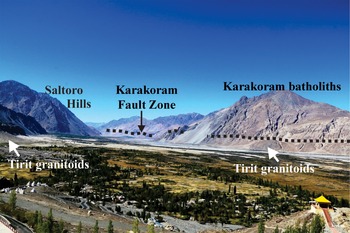
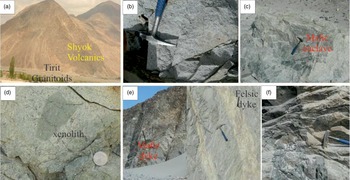
The Tirit granitoids outcrop in four areas: around Tirit, north and south of Diskit and northeast of Hundar. They intrude the Saltoro Formation, and are faulted against the Karakoram block at the Karakoram Fault Zone east of Tirit (Figs 3 and 4a). These outcrops were originally a single plutonic body and are now isolated by a cover of Quaternary alluvium (Rao & Rai, Reference Rao and Rai2009). The granitoids are dark-coloured, relatively rich in ferromagnesian minerals and range from granodiorite–tonalite to gabbro–diorite in composition. Mafic sub-rounded to rounded igneous enclaves up to 30 cm in diameter are quite common in these granitoids and possibly derive from the Shyok Volcanics (Fig. 4).
View up Nubra valley from Diskit showing eastern outcrops of Tirit granitoids.

Field photographs showing (a) intrusive contact of Tirit granitoids with Shyok Volcanics near Tirit Village Nubra Valley; (b) Tirit granitoids relatively rich in ferromagnesian minerals; (c) diffuse mafic enclaves in Tirit granitoids at Tirit Bridge, Nubra Valley; (d) xenoliths in Tirit granitoids at Tegar, Nubra Valley; (e) mafic and felsic dykes in Tirit granitoids near Tirit Bridge; (f) displacement of mafic enclave in Tirit granitoids near Tirit Bridge.

3.b. Dykes
Mafic dykes intrude the Tirit granitoids east of Tirit at Sati Bridge (SB) (Fig. 2), The NE–SW-trending parallel mafic dykes are doleritic (Fig. 4e), with thicknesses varying between 30 cm and 1.5 m, and displaced up to 0.5 m by post-emplacement faulting (Fig. 4f). They show no evidence of chilling against the walls of granitoids, indicating that the host rocks were still hot when the dykes intruded. They are comparable in orientation and possibly age, but not in composition, to E–W- and NE–SW-striking late-stage andesitic dykes of the Ladakh batholith (∼45 Ma) west of Leh (Heri et al. Reference Heri, Aitchison, King and Villa2015).
3.c. Petrography
3.c.1. Tirit granitoids
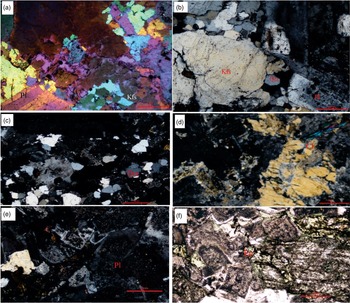
Major minerals are plagioclase, K-feldspar, quartz, biotite and hornblende, with zircon and magnetite as accessory minerals (Fig. 5). Point counts show that: the granites have 24–27 % K-feldspar, 5–7 % plagioclase and 14–22 % quartz; the granodiorites have 9–34 % K-feldspar, 11–19 % plagioclase and 15–29 % quartz; the trondhjomites have 20–29 % K-feldspar, 29–35 % plagioclase and 2–16 % quartz; and the quartz–diorites have 14–23 % K feldspar, 14–16 % plagioclase, and 20–24 % quartz. Euhedral plagioclase laths within subhedral grains of K-feldspar and quartz signify early increments of growth (Fig. 5a), followed by later development of K-feldspar and quartz grains which show graphic intergrowths (Fig. 5b). Quartz grains have undulose extinction and cataclastic textures in places (Fig. 5c). Some biotite grains show chloritization (Fig. 5d), and some plagioclase grains show sericitization (Fig. 5e); while both show marginal epidotization in places (Fig. 5f), indicating hydrothermal alteration.
Photomicrographs of Tirit granitoids showing (a) plagioclase laths enclosed within subhedral grains of K-feldspar and quartz (PPL); (b) plagioclase with euhedral crystal faces in contact with K-feldspar and quartz grains (XPL); (c) plagioclase mineral grains exhibiting simple and polysynthetic twinning; (d) epidotization at the margins of plagioclase and biotite mineral grains (XPL); (e) alteration of biotite into green chlorite and the sericitization of plagioclase (XPL); and (f) epidotization of biotite, alteration of plagioclase and zircon inclusions (XPL). Kfs: K-feldspar; Qtz: quartz; Bt: biotite; Zr: zircon; Pl: plagioclase; Cl: chlorite; Ms: muscovite; Mc: microcline; Ap: apatite; Ti: titanite; Hb: hornblende.

3.c.2. Dykes
The mafic dykes are dark grey to black, and fine- to medium-grained in texture. Major minerals are plagioclase, clinopyroxene and magnetite, with accessory amounts of chlorite and opaque mineral phases. They commonly exhibit porphyritic texture with plagioclase and clinopyroxene phenocrysts embedded in fine-grained groundmass of plagioclase, clinopyroxene, chlorite and glass (Fig. 6a). Plagioclase crystals show a preferred orientation due to magmatic flow showing trachytic texture. A few clinopyroxene crystals show alteration into chlorite along grain boundaries and fracture planes (Fig. 6b). Opaque minerals occur as small discrete grains within the fine-grained plagioclase and clinopyroxene groundmass (Fig. 6c).
Photomicrographs of Tirit dykes showing (a) plagioclase phenocrysts embedded in fine-grained groundmass of clinopyroxene, chlorite and glass (XPL); (b) plagioclase grains with a preferred orientation due to magmatic flow exhibiting trachytic texture (XPL); (c) opaque minerals within the fine-grained groundmass of plagioclase and clinopyroxene. Pl: plagioclase; Mg: magnetite; Op: opaques; Cpx: clinopyroxene.

4. Geochemistry
4.a. Methods
Thirteen representative samples of Tirit granitoids and eight samples of mafic dykes were analysed for major, trace and rare earth elements (REE) at the National Geophysical Research Institute (NGRI), Hyderabad, India. Major elements were determined by X-ray fluorescence (XRF) spectrometer on powder pellets using a Philips Model PW-2440 Spectrometer. United States Geological Survey (USGS) G-2 geological rock standard was used for calibration and quantitative estimation of chemical elements. Trace elements including REE and high-field-strength elements (HFSE) were determined by high-resolution inductively coupled plasma mass spectrometer (HR-ICP-MS). Reference materials from the Geological Survey of Japan (JB-2, JB-3, JB-1a) and USGS (BHVO-1, BCR-1, BIR-1) along with a couple of procedural blanks were also analysed, with the sample batches as controls on accuracy.
Whole-rock major elemental analyses of dykes were carried out by XRF spectrometery techniques. Trace elements including REE were determined by ICP-MS techniques at Wadia Institute of Himalayan Geology (WIHG), Dehradun, Uttarakhand, India.
4.b. Results and interpretation
4.b.1 Tirit granitoids
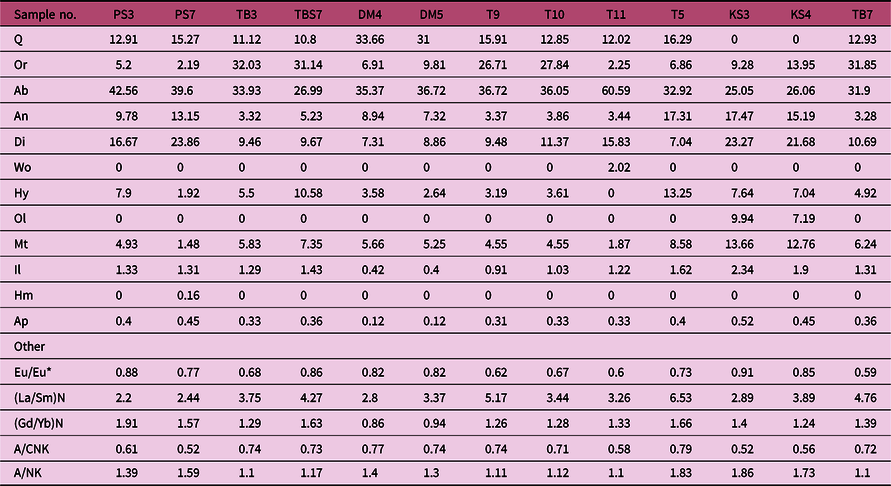
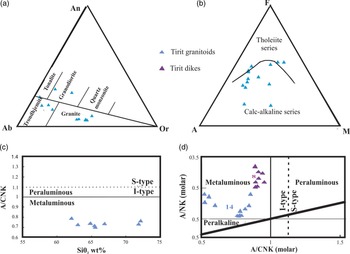
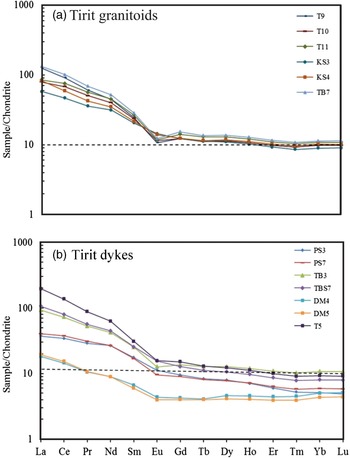
Geochemical data for the Tirit granitoids are provided in Supplementary Table S1, and CIPW norms in Table 1. The Tirit granitoids have a wide range of chemical compositions, with SiO2 = 50.91–72.11 wt %, TiO2 = 0.21–1.23 wt %, Al2O3 = 11.42–14.00 wt %, MgO = 1.69–10.69 wt % and CaO = 3.24–9.31 wt % (Supplementary Table S1). The high content of certain oxides like MgO and Al2O3 suggests the mafic components in the source region. Major elements exhibit linear trends against SiO2, confirming the role of magmatic differentiation in their evolution. Harker Variation plots show a positive trend of SiO2 with Na2O and Al2O3 and negative trend with MgO, FeO(t), TiO2 and P2O5 (Supplementary Fig. S1). The positive trend of Na2O with silica reflects increasing modal plagioclase and K-feldspar. However, negative variation trends of MgO, TiO2 and P2O5 indicate the fractional crystallization of hornblende, magnetite, titanite and apatite. Harker Variation trace element plots against SiO2 show decreasing Ni, Ta, Pb and Sr but no correlation of Rb, Ba, Y and Zr (Supplementary Fig. S2), which may be due to variable amounts of minerals rich in these elements (Pearce & Norry, Reference Pearce and Norry1979). The Tirit granitoids fall within the granite, granodiorite and trondhjomite fields on a normative albite (ab) – anorthite (an) – orthoclase (or) plot (Fig. 7a); on the calc-alkaline differentiation trend on an AFM ternary plot (Fig. 7b); in the metaluminous field on A/CNK and A/NK plots (Fig. 7c); and are I-type on the Chappell & White (Reference Chappell and White1974) plot (Fig. 7d). They show similar patterns on a bulk rock REE normalization to chondrite (Boynton, Reference Boynton and Henderson1984), although with differences in abundance, showing considerable enrichment in the light REE (LREE; (La/Sm)N = 2.20–6.53) compared to the heavy REE (HREE; Gd/Yb)N = 0.86–1.91) (Fig. 8).
Tirit granitoids CIPW norms

Tirit granitoids: (a) An–Ab–Or classification diagram (after O’Connor, Reference O’Connor1965); (b) AFM diagram (after Irvine & Baragar, Reference Irvine and Baragar1971); (c) A/CNK versus SiO2 wt % diagram (after White & Chappell, Reference White and Chappell1977); (d) molar A/CNK versus A/NK plots showing their metaluminous nature (after Shand, Reference Shand1943).

Rare earth elements (REE) chondrite-normalized pattern diagrams of Tirit granitoids (a) and Tirit dykes (b). Chondrite values of Boynton (Reference Boynton and Henderson1984).

4.b.2. Tirit dykes
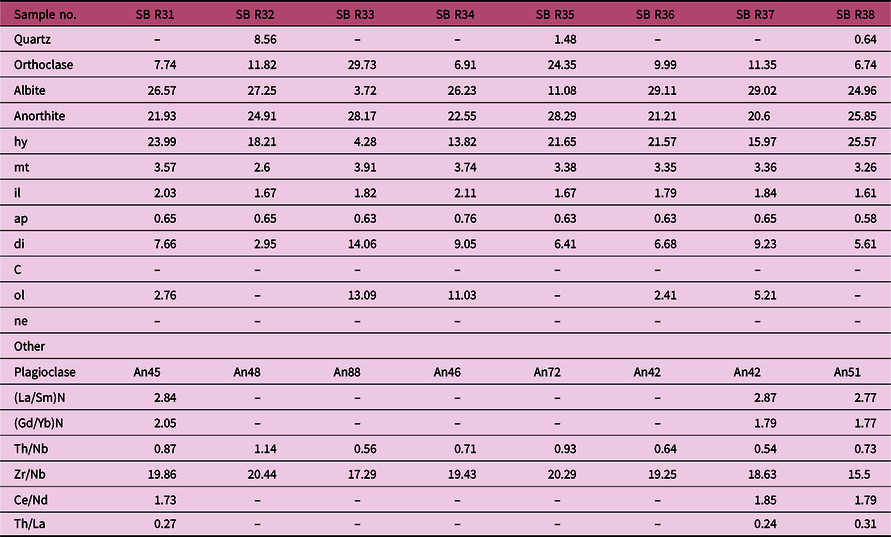
Geochemical data for the Tirit dykes are reported in Supplementary Table S2., and CIPW norms in Table 2. The dykes have a low but wide range of SiO2 (48.95 to 57.49 %), are enriched in Al2O3 % (14.62 to 16.98 %), and have a markedly low TiO2 content (0.64 to 1.11 %). MgO ranges from 5.77 to 10.31 wt % and total iron FeO(t) from 8.36 to 10.01 %. Na2O ranges from 0.44 to 3.44 wt %. The K2O ranges from 1.17 to 5.03 wt %.
Tirit dykes CIPW norms

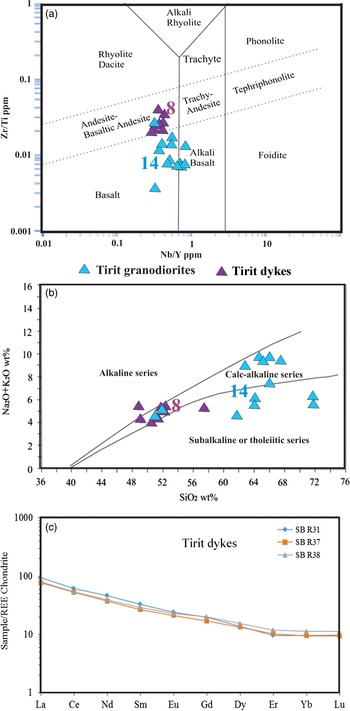
During low-grade metamorphism, Zr (ppm) is considered to be relatively immobile (Winchester & Floyd, Reference Winchester and Floyd1977; Macdonald et al. Reference Macdonald, Wilson, Thorpe and Martin1988). Hence, Zr can be used as a parameter for evaluating the elemental mobility and also to understand the differentiation/fractional crystallization of magma. In order to assess the fractional crystallization and also the mobility of major elements of Tirit dykes during the post-crystallization processes, these elements has been plotted against Zr. Most of the major elements including FeO(t), MgO, MnO, CaO and TiO2 show a negative relationship with Zr. The SiO2 wt %, Al2O3 and P2O5 wt % show a positive correlation with Zr. The normal negative and positive relationships probably indicate the primary magmatic characteristics for these major elements. However, the scattering of Na2O wt % and K2O wt % against the Zr indicate the mobile nature of Na2O wt % and K2O wt % during the post-crystallization processes (Supplementary Fig. S3). Binary plots of trace elements against Zr display positive trends with Nb, Th, Y and Sr and negative trends with Rb, Cr, Ni and U (Supplementary Fig. S4). In volcanic suites, the Nb/Y ratio is an indicator of alkalinity and the Zr/Ti ratio is a differentiation index (DI) (Pearce & Cann, Reference Pearce and Cann1973). When plotted together they define compositional fields (Winchester & Floyd, Reference Winchester and Floyd1977), in which the Tirit dykes fall in the andesite – basaltic-andesite field (Fig. 9a). They are calc-alkaline on a (Na2O + K2O versus SiO2 plot (Fig. 9b). They are moderately enriched in LREE ((La/Sm)N = 2.76–2.87) and show relatively flat HREE ((Gd/Yb)N = 1.76–2.05) (Fig. 9c).
(a) Zr/Ti versus Nb/Y plot on immobile elements classification diagram for Tirit granitoids and dykes showing andesite – basaltic-andesite composition (after Winchester & Floyd, Reference Winchester and Floyd1977). (b) Na2O + K2O wt % versus SiO2 wt % plot for Tirit granitoids and dykes, showing their calc-alkaline nature (after Kuno, Reference Kuno, Hess and Poldervaart1968). (c) Rare earth elements (REE) pattern for Tirit dykes showing enriched LREE and relatively depleted HREE (chondrite-normalizing values of Sun & McDonough, Reference Sun, McDonough, Saunders and Norry1989).

4.c. Petrogenesis
The Tirit granitoids show a continuous trend from mafic-rich (trondhjomite) to felsic-rich (granodiorite and quartz–diorite), with high Na2O (av. 4.22) and low K2O/Na2O (av. 0.70), average molar A/CNK of 0.67 and A/NK of 1.36 (Table 1). Their metaluminous characteristics, high contents of TiO2, Al2O3, MgO and high Sr and Ni indicate mafic components in the source region (Chappell & Stephens, Reference Chappell and Stephens1988). Decrease in CaO % in rocks from low to high SiO2 content is a result of crystal fractionation of plagioclase and calcic amphiboles. Zircon content and the regular pattern of decreasing P2O5 with increasing SiO2 are characteristic of mafic low-temperature I-type granitoids (Chappell & White, Reference Chappell and White2001; Chappell et al., Reference Chappell, White, Williams and Wyborn2004), whose petrogenesis is commonly attributed to variable interactions of mantle-derived mafic magmas with the continental crust, or to simple remagmatization of older crust with subsequent fractional crystallization and/or restite crystal fractionation (Chappell, Reference Chappell1996). The negative Eu/Eu* (0.59–0.91) anomaly in these granitoids suggests the removal of plagioclase feldspar from the source magma by fractional crystallization or residual feldspar in the source.
HFSE are least mobile, but show moderate degrees of fractional crystallization and are sensitive to partial melting and source inhomogeneities (Ahmad & Tarney, Reference Ahmad and Tarney1991). The ratios of Th/La, Th/Nb, Zr/Nb and Ce/Nd reveal the source characteristics and are higher in Tirit dykes than those of the primitive-mantle ratios (Sun & McDonough, Reference Sun, McDonough, Saunders and Norry1989), indicating their derivation from enriched mantle sources (Table 2). The occasional higher Sr in these dykes suggests the fractionation of calcic plagioclase (Sun & McDonough, Reference Sun, McDonough, Saunders and Norry1989). The moderate degrees of LREE enrichment, and flat HREE of the dykes (Fig. 9c) are typically shown by arc-related basalts and indicate an origin in a shallow (spinel–lherzolite) mantle (Murphy, Reference Murphy2007).
4.d. Tectonic setting
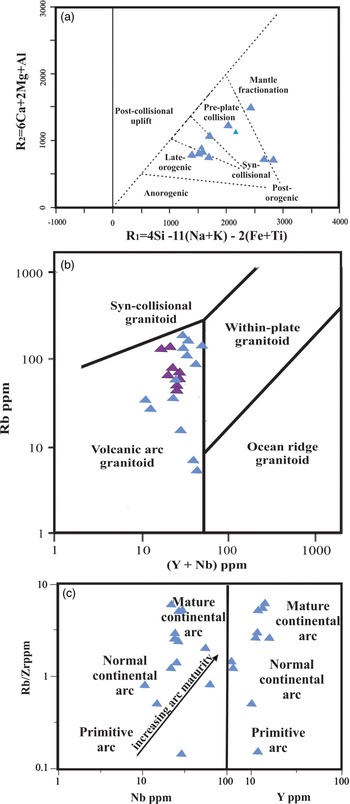
Maniar and Piccoli (Reference Maniar and Piccoli1989) distinguished seven types of granitoids based on their tectonic setting. However, the Tirit granitoids show divergent settings. On the tectonic discrimination parameters R1 (= [4Si − 11(Na + K) − 2(Fe + Ti)]) and R2 (= [6Ca + 2Mg + Al]), most of the Tirit granitoids samples are in the post-collisional uplift, syn-collision and pre-plate collision fields (Fig. 10a). On the relative trace element Y + Nb versus Rb plot, however, they are in the Volcanic Arc Granites (VAG) field (Fig. 10b). Furthermore, on the Rb/Zr ratio against Nb and Y ppm plots of Brown et al. (Reference Brown, Thorpe and Webb1984), the samples are scattered and show no pattern (Fig. 10c).
(a) Multi-cationic R1 versus R2 tectonic discrimination diagram for Tirit granitoids of Nubra–Shyok Valley showing pre-plate collision and post-collision uplift of Tirit granitoids (after Batchelor & Bowden, Reference Batchelor and Bowden1985); (b) Rb versus Y + Nb tectonic discriminant diagrams for Tirit granitoids and dykes (after Pearce et al. Reference Pearce, Harris and Tindle1984); (c) Rb/Zr versus Nb and Y for Tirit granitoids showing transitional nature (after Brown et al. Reference Brown, Thorpe and Webb1984).

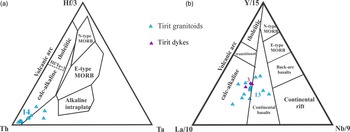
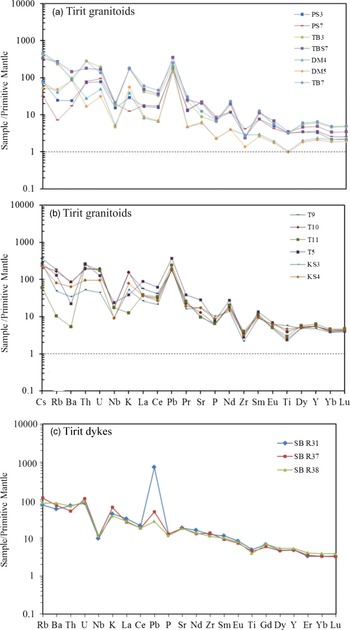
Primitive-mantle-normalized spider diagrams for Tirit granitoids show negative anomalies of Nb, Ti, Zr, Ba and P along with positive anomalies of Th, U, K, Nd, Sm and Pb (Fig. 11), which suggests that they were derived from partial melting of juvenile crustal material possibly within a supra-subduction setting (Pearce et al. Reference Pearce, Harris and Tindle1984; Qi et al. Reference Qi, Luhua, Grimmer and Hu2014). Fluids and melts derived from the subducted oceanic slab led to metasomatism of the upper mantle wedge and negative anomalies of Nb (Cox et al. Reference Cox, Bell and Pankhurst1979; Chappell, Reference Chappell1999). The positive anomalies in Pb and K, however, are attributed to metasomatism of mantle wedge by fluids derived from the subducted slab and/or contamination with continental crust (Kamber et al. Reference Kamber, Ewart, Collerson, Bruce and McDonald2002).
(a) Hf–Tb–Ta plot of Tirit granitoids, showing dominantly in calc-alkaline field and extreme Hf and Ta depletion; (b) Y–La–Nb plot of Tirti granitoids and dykes showing dominantly calc-alkaline nature.

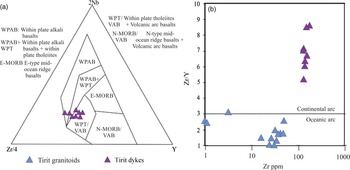
On the ternary 2Nb – Zr/4 – Y plot of Meschede (Reference Meschede1986), the Tirit dykes scatter across several fields (Fig. 12a), while on the binary Zr/Y – Zr plot of Pearce (Reference Pearce, Hawkes and Norry1983) they plot firmly in the continental arc basalts field, with higher Zr/Y than oceanic basalts (Fig. 12b). The primitive-mantle-normalized plot of the dyke elements is similar to the Tirit granitoid plot, and shows enrichment in U and Pb, and depletion in Nb and Ti (Fig. 13a), with the the negative Nb anomaly in both granitoids and dykes caused by subduction-related enrichment of lithospheric mantle (Kepezhinskas et al. Reference Kepezhinskas, McDermott, Defant, Hochstaedter, Drummond, Hawkesworth and Bellon1997).
Multi-element spider plots of Tirit granitoids and dykes showing negative anomalies of Rb, Ba, Nb, Pr, P, Zr, Ba and P along with positive anomalies of U, K, Pb, Nd and Sm (normalized values of Sun & McDonough, Reference Sun, McDonough, Saunders and Norry1989).

(a) 2Nb – Zr/4 – Y ternary plot for Tirit dykes in dominantly volcanic arc basalt and within-plate tholeiite fields (after Pearce, Reference Pearce, Hawkes and Norry1983). (b) Zr (ppm) versus Zr/Y plot for Tirit granitoids and dykes: oceanic arc for granitoids, continental arc for dykes (after Pearce, Reference Pearce, Hawkes and Norry1983).

5. Geochronology
Previous U/Pb ion-microprobe ages from a tonalite at Tirit range from 66.8 ± 2.0 to 70.7 ± 0.8 Ma (11 spots; 6 slightly younger ages are considered altered) with a weighted mean of 68 + 1 Ma (Weinberg et al. Reference Weinberg, Dunlap and Whitehouse2000). A best-fit intercept U/Pb date from a granodiorite at Tirit gave 71.40 ± 0.36 Ma (Upadhyay, Reference Upadhyay2008); an Ar/Ar integrated total gas cooling age on hornblende from a diorite north of Khalsar was 73.6 ± 2.0 Ma, which is statistically the same as the age spectrum date of 73.1 ± 2.2 Ma (Weinberg et al. Reference Weinberg, Dunlap and Whitehouse2000); and an albite porphyroblast from a greenschist NW of Tirit gave a date of 65.4 ± 3.3 Ma, though abundant phengite inclusions may have affected the date (Thanh et al. Reference Thanh, Itaya, Ahmad, Kojima, Ohtani and Ehir2010). Zircons from a granite at Hundar – supposedly from the Ladkah batholith, but probably from enclaves within it (Kumar, Reference Kumar2020) – gave a weighted mean average (of three dates) of 66.6 ± 2.1 Ma (Upadhyay et al. Reference Upadhyay, Frisch and Siebel2008). All errors have been increased, where necessary, from cited 1σ to 2σ, in keeping with normal practice, as 1σ gives an unacceptable 1-in-3 chance of being wrong, while 2σ gives a more acceptable 1-in-20 chance (Wyatt et al. Reference Wyatt, Privalsky and Datlu1998).
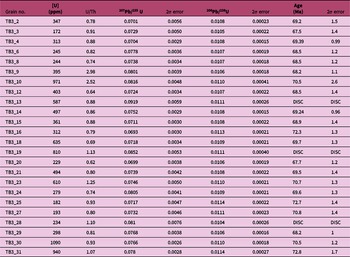
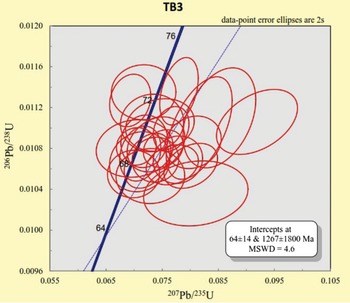
We analysed zircons in a tonalite (TB3) from Tirit Bridge (TB3) locality, using LA-ICP-MS with methods described in Liu & Stockli (Reference Liu and Stockli2020) (Table 3; Fig. 13b). The most concordant zircon gives an age of 69.24 ± 0.96 Ma, with a lower intercept age for the 26 acceptable zircons of 64 ± 14 Ma, and MSWD = 4.6.
LA-ICP-MS geochronology, sample TB3 of Tirit granitoids

The dates are consistent with intrusion of the more mafic Tirit granitoids being somewhat older than the more felsic granitoids, spanning ∼74 to 66 Ma. The dykes are younger than this.
6. Tectonic significance
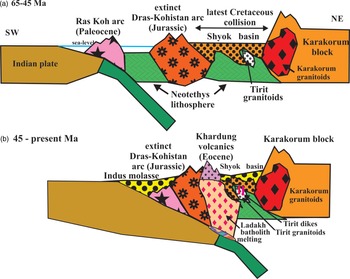
The northward motion of India from the Mid Cretaceous to Eocene was accommodated by northward subduction of Neo-Tethys lithosphere along the ISZ and SSZ (Coward et al. Reference Coward, Windley, Broughton, Luff, Petterson, Pudsey, Rex, Khan, Coward and Ries1986; Debon et al. Reference Debon, Le Fort, Dautel, Sonet and Zimmermann1987; Heuberger et al. Reference Heuberger, Schaltegger, Burg, Villa, Frank, Dawood, Hussain and Zanchi2007; Kumar et al. 2017), sporadically producing very large volumes of diversified granitoids. The Tirit granitoids were intruded during a relatively short episode of latest Cretaceous island arc development that is contemporary with the Spong island arc of the Indus suture zone to the south (Catlos et al. Reference Catlos, Pease, Dygert, Brookfield, Schwarz, Bhutani, Pande and Schmitt2018) prior to the latest Cretaceous obduction of the Spongtang and other ophiolite nappes onto the northern Indian margin in the middle of the Tethys Ocean (Corfield et al. Reference Corfield, Searle and Pedersen2001; Gibbons et al. Reference Gibbons, Zahirovic, Müller, Whittaker and Vadakkeyakath2015). In that case a Palaeocene – early Eocene magmatic arc is required to obliterate the oceanic lithosphere between northern India and Asia, and this might be represented by the calc-alkaline, island arc plutonic bodies of the Leh pluton (60 ± 5 Ma), the Chang La pluton (57.6 ± 1.4 Ma to 53.4 ± 1.8 Ma) (Debon et al. Reference Debon, Le Fort, Dautel, Sonet and Zimmermann1987; Upadhyay et al. Reference Upadhyay, Frisch and Siebel2008) and the Palaeocene Ras Koh arc in SW Pakistan (Nicholson et al. Reference Nicholson, Khan and Mahmood2010) (Fig. 14). The final ‘hard’ collision of India and Asia then occurred in the early Eocene between 50 and 45 Ma (Rex et al. Reference Rex, Searle, Tirrul, Crawford, Prior, Rex and Barnicoat1988; Rolland, Reference Rolland2002; Upadhyay, Reference Upadhyay2008; Khan et al. Reference Khan, Walker, Hall, Burke, Shah and Stockli2009; Jain, Reference Jain2014), following which further northward movement of the Indian Plate and compression and uplift formed the Himalaya (Fig. 15). The younger mafic dykes trending NW–SE in the Tirit granitoids may be related to the activity on the strike-slip Karakoram fault. Evaluating the complex and competing versions of this history, however, requires a more detailed (and expanded) study (Andjić et al. Reference Andjić, Zhou, Jonell and Aitchison2022).
Concordia 207Pb/235U versus 206Pb/238U diagram for zircons from TB3 sample of the Tirit granitoids.

Diagram showing (a) 65–45 Ma emplacement of Tirit granitoids during initial collision of extinct Ladakh arc with Karakoram Andean arc and development of Palaeocene arc to south, followed by (b) 45 Ma – present hard collision of India with Asia and partial melting of subducted Indian slab to give Ladakh batholith and associated volcanics with emplacement of the Tirit dykes.

7. Conclusion
The integrated field, petrographical, geochemical and geochronological data indicate that the calc-alkaline Tirit granitoids were emplaced between ∼71 and 58 Ma, during the later stages of an Upper Cretaceous to Palaeocene arc. They were further deformed during the India–Asia collision along the Indus Suture Zone around 45 Ma. The younger Tirit dykes, with high Th/La, Th/Nb, Zr/Nb and Ce/Nd ratios, have subducted components, inherited from the subcontinental mantle lithosphere in a post-collisional setting, and could also be related to the development of the NW–SE Karakoram fault.
Supplementary material
To view supplementary material for this article, please visit https://doi.org/10.1017/S0016756823000134
Acknowledgements
Nazia Kowser gratefully acknowledges the Department of Earth Science, University of Kashmir, Srinagar, J&K for providing laboratory facilities. The authors would also like to thank the director and scientists in charge of the analytical laboratories of the National Geophysical Research Institute (NGRI), Hyderabad, India, for their help throughout the analytical work. The authors express gratitude to the scientists of the (LA-ICP-MS laboratory at the Jackson School of Geosciences, University of Texas at Austin, who provided geochronological data for the present study. Yann Rolland did a comprehensive and very helpful review.
Declaration of interest
The authors declare none.