Implications
Tail docking causes a pain-induced distress response in pigs. It would be beneficial to pig welfare and the pig industry to develop commercially viable ways to reduce the pain associated with this procedure. However, none of the methods evaluated in this study were effective in eliminating the pain-induced distress response to conventional tail docking. More research is needed to optimize current methods or evaluate new methods to practically induce anesthesia or analgesia that could be used to alleviate the pain caused by tail docking in pigs or to find methods to eliminate tail-biting behavior, thus making the procedure of tail docking unnecessary.
Introduction
Tail docking is a management practice conducted routinely on commercial pig farms to prevent tail-biting behavior in pigs, the occurrence of which is a welfare problem (Schrøder-Petersen and Simonsen, Reference Schrøder-Petersen and Simonsen2001; Sutherland et al., Reference Sutherland, Bryer, Krebs and McGlone2009b) and a problem that is of economic concern for producers (Penny and Hill, Reference Penny and Hill1974). Tail-biting behavior is likely to cause both acute pain in the pigs that are being bitten and can result in long-term consequences such as weight loss (Wallgren and Lindahl, Reference Wallgren and Lindahl1996; Sutherland et al., Reference Sutherland, Bryer, Krebs and McGlone2009b) and secondary infections (Schrøder-Petersen and Simonsen, Reference Schrøder-Petersen and Simonsen2001; Kritas and Morrison, Reference Kritas and Morrison2007). Therefore, tail biting not only affects the welfare of the pigs being bitten directly, but the procedure of tail docking as a means to prevent tail biting can cause pain and hence is also an animal welfare issue.
The physiological and behavioral response to tail docking in pigs has been assessed in the literature. Cortisol concentrations were higher in pigs tail docked using cutting pliers compared with control-handled pigs 60 min after docking (Sutherland et al., Reference Sutherland, Bryer, Krebs and McGlone2008). The occurrence of tail jamming and tail wagging (Noonan et al., Reference Noonan, Rand, Priest, Ainscow and Blackshaw1994) were greater in tail docked compared with control-handled pigs for up to 90 s after docking. Furthermore, tail docked pigs produced more grunts (Noonan et al., Reference Noonan, Rand, Priest, Ainscow and Blackshaw1994) and higher peak vocal frequencies during tail docking (Marchant-Forde et al., Reference Marchant-Forde, Lay, McMunn, Cheng, Pajor and Marchant-Forde2009) compared with control-handled pigs. These results suggest that pigs experience pain during and in the hours following tail docking. However, currently pigs are commonly tail docked without analgesia or anesthesia.
Anesthesia is defined as the loss of feeling or sensation (Blood and Studdert, Reference Blood and Studdert1995). A local anesthetic agent provides anesthesia by blocking nerve transmission in the area that is affected by the presence of the drug. Local anesthetics can be injected into the tissue near the target nerve or applied topically onto the area where nerve block is required. General anesthetic agents cause a state of unconsciousness and thereby a complete absence of pain sensation. The ability of local and general anesthetic agents to effectively mitigate pain caused by painful husbandry procedures, such as tail docking and castration in lambs and pigs has been evaluated in the literature (McGlone et al., Reference McGlone, Nicholson, Hellman and Herzog1993; Graham et al., Reference Graham, Kent and Molony1997; Kent et al., Reference Kent, Molony and Graham1998; Gerritzen et al., Reference Gerritzen, Kluivers-Poodt, Reimert, Hindle and Lambooij2008). However, research describing the efficacy of local or general anesthesia to alleviate pain caused by tail docking in pigs is limited.
Several species are commonly tail docked, including pigs, lambs, dairy cows and dogs. However, the majority of research on evaluating methods to alleviate the pain caused by docking has been conducted in lambs. Injecting local anesthetic subcutaneously into the tail reduced the cortisol response to ring docking in lambs (Graham et al., Reference Graham, Kent and Molony1997; Kent et al., Reference Kent, Molony and Graham1998). One disadvantage of using local anesthesia is the necessity to repeatedly handle the animal; once to administer the local anesthetic and the second time to perform the painful procedure, possibly leading to increased stress experienced by the animal (Marchant-Forde et al., Reference Marchant-Forde, Lay, McMunn, Cheng, Pajor and Marchant-Forde2009). Therefore, it would probably be advantageous to the animal if the anesthetic drug could be administered immediately before docking and still be effective in providing pain relief for this procedure. In lambs, local anesthetic injected subcutaneously or using a needle-free system immediately before docking has been shown to reduce the cortisol response and performance of active behaviors and abnormal postures in response to ring docking (Kent et al., Reference Kent, Molony and Graham1998). It would, therefore, be beneficial to determine if injecting local anesthetic immediately before surgical tail docking in pigs would reduce the pain caused by this procedure.
Topical application of local anesthetics is used in both human and veterinary medicine as a form of pain relief and can be applied easily and painlessly as a spray or gel, therefore topical application of local anesthetic may be suitable as a practical on-farm method of pain relief for pigs after docking. In lambs, local anesthetic applied topically to the scrotum and the tail stump after surgical castration and tail docking reduced wound hyperalgesia (Lomax et al., Reference Lomax, Dickson, Sheil and Windsor2010) and the peak cortisol response (Paull et al., Reference Paull, Lee, Colditz and Fischer2009). Furthermore, local anesthetic applied topically after mulesing in lambs reduced indications of primary and secondary hyperalgesia and pain-related behaviors as compared with lambs given a placebo (Lomax et al., Reference Lomax, Sheil and Windsor2008). At present, limited data are available with regard to the efficacy of topical application of local anesthetics to reduce the pain associated with tail docking in pigs, but research in lambs suggests that topical application of local anesthetics may provide some pain relief for surgical procedures and therefore is worthwhile evaluating in pigs.
The ability of injected or inhaled general anesthetic agents to alleviate the pain caused by castration in pigs has been described in the literature (McGlone et al., Reference McGlone, Nicholson, Hellman and Herzog1993; Walker et al., Reference Walker, Jäggin, Doherr and Schatzmann2004; Hodgson, Reference Hodgson2006; Axiak et al., Reference Axiak, Jäggin, Wenger, Doherr and Schatzmann2007). However, the prolonged recovery period from these anesthetic agents could increase the risk of pigs being crushed by the sow and reduce feeding opportunities. Recently, carbon dioxide gas (CO2) has been used to induce general anesthesia for castration in pigs (Kohler et al., Reference Kohler, Moens, Busato, Blum and Schatzmann1998, Gerritzen et al., Reference Gerritzen, Kluivers-Poodt, Reimert, Hindle and Lambooij2008). Among the advantages of using CO2 to induce anesthesia to alleviate the pain caused by tail docking are the speed at which CO2 can be administered, the rapid reversal of the anesthetic effects of this gas, the fact that CO2 is not a restricted drug that has to be administered by a veterinarian, and lastly there are no issues with drug residues (Gerritzen et al., Reference Gerritzen, Kluivers-Poodt, Reimert, Hindle and Lambooij2008). Currently, limited literature exists describing the effectiveness of CO2 to alleviate the pain caused by tail docking in pigs.
The objective of this study was to evaluate the efficacy of local or general anesthesia to reduce the pain associated with tail docking in pigs using a multi-disciplinary approach incorporating both physiological and behavioral indicators of pain-induced distress.
Material and methods
Pigs used in these studies were from PIC USA (Hendersonville, TN, USA) genetics using the Camborough-22 sow line. All sows were multiparous and housed individually in conventional farrowing crates (0.6 × 2.0 m) during lactation. Heat lamps were used to provide an external heat source for the piglets. All animal procedures were approved by the Texas Tech University Animal Care and Use Committe.
Pilot study
A pilot study was conducted to determine if 100% CO2 or 70% CO2 + 30% oxygen (O2) gas mixture would be less aversive to pigs as a means of inducing general anesthesia. At approximately 3 days of age (±1 day), pigs were allocated to one of three treatment groups: (i) control handled (CON; n = 5), (ii) 100% CO2 gas (CO2-100%; n = 5) or 70% CO2 + 30% O2 gas mixture (CO2-70%; n = 5). A hose was attached to a regulator on a gas canister containing either a 100% CO2 or a gas canister containing a pre-mixture of 70% CO2 + 30% O2. A surgical gas mask was fitted to the other end of the hose. The surgical gas mask was large enough to fit over the snout of the pig and cover the entire mouth of the pig firmly, so that no gas could escape and no atmospheric air could enter the pig's mouth. The pig was held in one hand and the gas mask was fitted over the pig's mouth. Once the mask was snuggly placed over the pig's mouth the gas was turned on. After 30 s the gas was turned off and the animal was placed in a cart to recover. Pigs in the CON treatment group were handled and restrained for approximately the same length of time as CO2-100% and CO2-70% pigs, but were not masked and did not receive any gas. Before (baseline) and 30 min after exposure to the gas, pigs were held in a supine position in a V-shaped trough, one person restrained the pig manually while a second person took the blood sample. Blood was taken from the anterior vena cava and collected into 4 ml vacutainers containing sodium heparin (BD, Franklin Drive, NJ, USA) using 21.0 gauge × 25.4 mm blood collection needles (BD, Franklin Drive). Blood samples were centrifuged and plasma collected for analysis of cortisol using an enzyme immunoassay kit (Assay designs, Ann Arbor, MI, USA). On the basis of the results from this pilot study, 100% CO2 was used for general anesthesia in the main study.
Experimental design
The objective of this research was to evaluate the effect of local or general anesthesia on the physiological (experiment 1) and behavioral (experiment 2) response of pigs to tail docking. This study comprised of six treatment groups: (i) sham docking (CON); (ii) docking using conventional cutting (CUT) with side-cutting pliers ; (iii) CUT docking plus local anesthetic injected immediately before docking (LA); (iv) CUT docking plus short-acting local anesthetic applied topically to the tail wound (SHORT); (v) CUT docking plus long-acting local anesthetic applied topically to the tail wound (LONG) and (vi) CUT docking while the pig was anesthetized with CO2. Pigs from 10 litters were used in experiment 1 (n = 10 pigs/treatment) and pigs from 10 litters were used in experiment 2 (n = 10 pigs/treatment). All six treatments were represented within each litter. Both intact male and female pigs were used in this study. The same number of pigs of each gender was represented in all treatments.
During administration of the treatments, one person held the pig while the second person performed the treatment. The same person performed the treatments for experiment 1 and 2. Pigs in the CON treatment group were restrained and their tails sham cut by placing two fingers, one on each side of the tail, and making a cutting motion on the tail. Pigs in the CUT group were restrained and their tails cut using stainless steel cutting pliers (Meador TNSC, Meador swine health developers, Gretna, NE, USA). Pigs in the LA treatment group were restrained, given one subcutaneous injection of local anesthetic (0.5 ml, 2% Lidocaine, Vedco Inc., Saint Joseph, MO, USA) at the base of the tail (∼2 cm from the point where the tail was cut), and then the pig was tail docked immediately in the same manner as CUT pigs. Pigs in the SHORT treatment group were tail docked in the same manner as the CUT pigs and then a topical anesthetic (Cetacaine®, Cetylite Industries, Inc., Pennsauken, NJ, USA) was sprayed (∼2 s) onto the tail wound immediately after cutting. Pigs in the LONG treatment group were tail docked in the same manner as the CUT pigs and then a topical anesthetic (Tri-Solfen, Animal Ethics, Victoria, Australia) was applied to the tail wound immediately after cutting. Tri-Solfen comes in a viscous gel so the tail stump was dipped in the Tri-Solfen solution in such a way that the gel fully covered the tail wound. Finally, pigs in the CO2 treatment were anesthetized by placing a mask over the pigs’ snout and were administered 100% CO2 gas for 30 s. After 30 s, the mask was removed and the pig was docked immediately in the same manner as CUT pigs. All tails were cut to a length of approximately 2 cm, so the remaining tail stump covered the vulva or equivalent length in males.
Camcorders (DCR-SR85, Sony, NY, USA) were used to record vocalizations before and during tail docking and handling in experiment 1 and 2. Vocalizations were analyzed using an automatic stress call monitoring system (STREMODO, Forschungsinstitut für die Biologie landwirtschaftlicher Nutztiere, Dummerstorf, Germany). The STREMODOD system is described in detail by Schön et al. (Reference Schön, Puppe and Manteuffel2004), but briefly, the system differentiates between high-frequency sounds emitted by the pig and background high-frequency sounds. The output is given as the percentage of stress (high frequency) vocalizations emitted by the pigs within 10 s periods. In this study, the percentage of stress vocalizations elicited during handling and during the performance of the treatments was averaged. Vocalization data were not analyzed for some animals due to poor picture or sound quality.
Pigs were weighed immediately before tail docking and 24 h after tail docking. Wound healing of tail docking wounds was assessed every other day using a scoring system previously described by Sutherland et al. (Reference Sutherland, Bryer, Krebs and McGlone2008) until pigs were weaned (at ∼21 days of age) and moved into the nursery. Briefly, a 1 to 5 scoring system was used: score 1 = completely healed wound with no scab remaining, 2 = a slight scab at the tip of the tail, 3 = a fully formed scab over the wound, which was dark in color and thick and bumpy in appearance, 4 = a fully formed scab over the wound, which was red in color and thin in appearance and 5 = no scab present over the wound and the wound still had the appearance of fresh blood.
Experiment 1: physiological response to tail docking
At 3 days (±1 day) of age, all pigs from one litter were removed at the same time and taken to an adjoining room separated by a closed door, so as not to disturb the remaining sows and pigs in the farrowing room. Pigs were transported in a wheeled cart. Pigs were weighed, allocated to one of the six treatment groups (balanced for gender and body weight (BW)), individually marked, docked or handled depending on the treatment allocation, and then returned to the cart. Once all pigs received their allocated treatment they were returned to the sow at the same time. Pigs were separated from the sow for approximately 10 min. For litters that consisted of more than six pigs, the non-experimental pigs were left undisturbed in the cart and were returned to the sow at the same time as the experimental pigs.
The experiment was conducted from 0900 h to 1800 h over four consecutive days. The treatments were randomized over time, so that treatment order did not confound the results. Pigs had experienced no other management procedures (e.g. castration, teeth clipping, etc.) before this experiment. None of the experimental pigs were cross-fostered over the course of the experiment.
Before (baseline), and 30, 60 and 120 min after tail docking 4 ml of blood was obtained by anterior vena cava puncture. Pigs were held in a supine position in a V-shaped trough: one person restrained the pig manually while a second person took the blood sample. This procedure lasted approximately 30 s. Pigs remained with the sow between sampling periods. Approximately 2 min before sampling, all pigs from one sow were removed from the farrowing crate, placed in a cart, and taken to an adjoining room to be sampled. Blood was collected into 4 ml vacutainers containing sodium heparin (BD) using 21.0 gauge × 25.4 mm blood collection needles (BD). Whole blood was analyzed to determine white cell counts and differential leukocyte counts (Cell-Dyn® 3700, Abbott laboratories, Abbott Park, IL, USA) and the neutrophil to lymphocyte (N : L) ratio was calculated by dividing the percent of neutrophils by the percent of lymphocytes. Blood samples were then centrifuged at 660 × g for 20 min and plasma was collected and stored at −20°C for further analysis. Plasma was used for analysis of cortisol using an enzyme immunoassay kit with a sensitivity of 0.56 ng/ml (Assay designs).
Experiment 2: behavioral response to tail docking
At approximately 3 days of age (±1 day), pigs were allocated to one of six treatment groups: CON, CUT, LA, SHORT, LONG and CO2. Treatments were performed in the same manner as described in experiment 1.
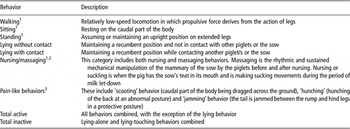
About 60 min before tail docking, all pigs from one sow were removed at the same time and taken to an adjoining room separated by a closed door, so as not to disturb the remaining sows and pigs in the farrowing room. Experimental pigs were weighed, individually marked with a heavy-duty marking pen (Super mark pen, Fearing International Ltd, Northampton, UK), and then returned to the sow at the same time. After 60 min, all pigs from one sow were removed and taken to an adjoining room to be tail docked. Pigs were tail docked depending on which treatment they were allocated to. After tail docking, all pigs were returned to their home pen at the same time and the behavior of each individual pig was recorded using 1 min scan samples (direct observations) for 120 min (Martin and Bateson, Reference Martin and Bateson1993). The observer sat directly behind the sow to prevent disturbing her as much as possible, but the observer still had a complete view of all pigs in the farrowing crate. Behaviors and postures measured included lying without contact, lying with contact to the sow or other pigs, nursing/massaging, standing, sitting, walking and pain-like behaviors and postures (Table 1).
Description of behaviors

1Hurnik et al. (Reference Hurnik, Webster and Siegel1995).
2Hay et al. (Reference Hay, Vulin, Génin, Sales and Prunier2003).
3Noonan et al. (Reference Noonan, Rand, Priest, Ainscow and Blackshaw1994).
Statistical analysis
All data were tested for constant variance and departures from normal distribution using the univariate procedure in Statistical analysis software (SAS) version 9.1 (SAS Institute, Inc., Cary, NC, USA). Data lacking normality and transformed logarithmically included, leukocyte counts, cortisol concentrations and all behavioral data and wound healing scores. Data were subjected to analysis of variance (ANOVA) using the mixed model procedure of SAS. Each litter contained all six treatments. A total of 10 litters were used in the physiological response (experiment 1) and another 10 litters were used in the behavioral response experiment (experiment 2). Several animals had to be removed from the vocalization data set due to the inability to accurately analyze the recordings because of too much background noise or inadequate picture. For physiological measures, the main fixed effects were treatment, time and gender. Litter was a random effect. The interactions between treatment by time, treatment by litter and treatment by gender were included in the model. The model had a repeated structure on time allowing incorporation of heterogeneity of variances across time. For the leukocyte data, baseline values were used as a covariate in the analysis to compensate for the large baseline variations and then analyzed in the same way as the other measures. Behavioral data were also analyzed using ANOVA using the mixed model procedure of SAS. The 120 min behavior observation period was divided into eight 15-min periods based on initial graphic inspection of the data. For behavioral measures, the main fixed effects were treatment, gender and period. Litter was a random effect. The interaction between treatment by time and treatment by litter were included in the model. Graphs and tables display actual data (not transformed) summarized by least square means ± s.e.
Results
Pilot study
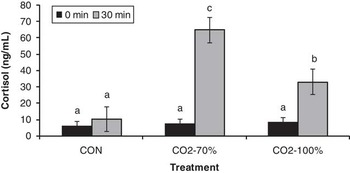
Cortisol concentrations tended (P = 0.064) to be greater in CO2-70% compared with CO2-100% pigs, 30 min after the administration of the gas (Figure 1).
Cortisol concentrations at 0 (baseline) and 30 min after administration of carbon dioxide gas (CO2) at a concentration of 100% for 30 s (CO2-100%; n = 5), administration of 70% CO2 + 30% O2 gas mixture for 30 s (CO2-70%; n = 5) or sham docked (CON; n = 10). Bars accompanied by different letter subscripts differ (P < 0.065).

Experiment 1: physiological response to tail docking
The time it took to conduct the different treatments was measured. The start of the treatment was considered to be the time the handler administered the local anesthetic (LA treatment), took hold of the tail (CON, CUT, SHORT and LONG treatments) or placed the anesthesia mask on the snout of the pig (CO2 treatment). The end of the treatment was considered to be the time the pig was ready to be placed back in the cart. Conventional tail docking without pain relief had the shortest (P < 0.001) duration and docking in combination with using CO2 gas as a general anesthetic took the longest (P < 0.05) time to perform. (CON: 11.7 ± 6.37 s; CUT: 8.6 ± 6.37 s; LA: 36.1 ± 6.37 s; SHORT: 23.9 ± 6.37 s; LONG: 24.4 ± 6.37 s and CO2: 78.6 ± 6.37 s)
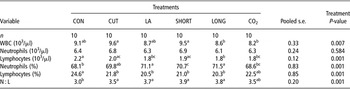
Total white blood cell (WBC) counts, lymphocyte counts, the percentage of neutrophils and lymphocytes and the N : L were affected by tail docking treatment, but there was no significant treatment by time interaction, so only the treatment data are presented in Table 2. Total WBC counts of all docked pigs regardless of anesthetic treatment did not differ (P > 0.05) from controls. Pigs anesthetized with CO2 gas before docking or given a long-acting topical anesthetic after docking had lower (P < 0.01) WBC counts than pigs docked without pain relief. There was no treatment effect (P > 0.05) for neutrophil counts. Lymphocyte counts were greater (P < 0.05) in controls compared with LA, LONG and CO2 pigs and lower (P < 0.05) in pigs given a long-acting topical anesthetic after docking compared with CUT pigs. The percentage of neutrophils was lower (P < 0.05) in CUT, LA, SHORT and LONG pigs compared with control-handled pigs. The percentage of neutrophils did not differ (P > 0.05) among docked pigs regardless of anesthetic treatment. The percentage of lymphocytes was greater (P < 0.05) in LA, SHORT and LONG pigs compared with control-handled pigs. The percentage of lymphocytes did not differ (P > 0.05) among docked pigs regardless of anesthetic treatment. The N : L was greater (P < 0.05) in CUT, LA, SHORT and LONG pigs compared with control-handled pigs. The N : L did not differ (P > 0.05) among docked pigs regardless of anesthetic treatment. There were no treatment × time interactions (P > 0.05) in leukocyte counts or percentages. There was no gender effect (P > 0.05) on leukocyte values.
Leukocyte values of pigs after tail docking using CUT, LA, SHORT, LONG, CO2 or CON

CUT = conventional cutting; LA = CUT with local anesthetic injected immediately before cutting; SHORT = CUT with short-acting anesthetic administered topically onto the tail wound immediately after cutting; LONG = CUT with long-acting anesthetic administered topically onto the tail wound immediately after cutting; CO2 = CUT while the pig was anesthetized with carbon dioxide gas; CON = sham docked; WBC = total white blood cell count; N : L = neutrophil-to-lymphocyte ratio.
a,b,cLeast squared means with different superscripts within a row are different (P < 0.05).
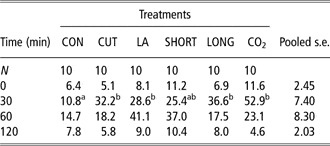
Cortisol concentrations did not differ (P > 0.05) among treatments before tail docking or handling (Table 3). At 30 min, cortisol concentrations were greater (P < 0.05) in pigs tail docked with and without pain relief compared with CON pigs, but similar (P > 0.05) between SHORT and CON pigs. Cortisol concentrations did not differ (P > 0.05) among any treatments 60 or 120 min after docking. Neither administration of local, topical nor general anesthetic reduced the cortisol response to tail docking as compared with pigs tail docked without pain relief at any time point. There was no gender effect (P > 0.05) on cortisol concentrations.
Cortisol concentrations of pigs after tail docking using CUT, LA, SHORT, LONG, CO2 or CON. Cortisol concentrations differed (P = 0.012) among treatments over time

CUT = conventional cutting; LA = CUT with local anesthetic injected immediately before cutting; SHORT = CUT with short-acting anesthetic administered topically onto the tail wound immediately after cutting; LONG = CUT with long-acting anesthetic administered topically onto the tail wound immediately after cutting; CO2 = CUT while the pig was anesthetized with carbon dioxide gas; CON = sham docked.
a,bLeast squared means with different superscripts within a row are different (P < 0.05).
Pigs weighed 2.2 (±0.45) kg on the day of the experiment. Change in BW did not differ (P > 0.05) among treatment groups 24 h after tail docking or sham handling (CON: 0.17 ± 0.023 kg; CUT: 0.14 ± 0.022 kg; LA: 0.19 ± 0.022 kg; SHORT: 0.16 ± 0.022 kg; LONG: 0.16 ± 0.022 kg and CO2: 0.18 ± 0.022 kg).
No difference (P > 0.05) in wound healing scores was found among treatments regardless of time after docking (CUT: 2.9 ± 0.06; LA: 3.0 ± 0.07; SHORT: 2.9 ± 0.07; LONG: 2.9 ± 0.09 and CO2: 2.9 ± 0.06).
Experiment 2: behavioral response to tail docking
The percentage of stress vocalizations did not differ (P > 0.05) among treatments before docking or sham handling (Table 4). The percentage of stress vocalizations was greater (P < 0.05) in CUT, SHORT and LONG pigs during tail docking and application of anesthetic compared with the percentage of stress vocalizations elicited before commencement of the treatments; however, the percentage of stress vocalizations did not differ (P > 0.05) in CON, LA and CO2 pigs in response to docking and application of anesthetic treatment. The percentage of stress vocalizations peaked at a higher level (P < 0.05) while pigs were being docked compared with handling before docking regardless of anesthetic treatment, but the peak percentage of stress vocalizations was similar in CON before and during manipulation (Table 4).
The percentage of stress vocalizations (percentage of high-frequency vocalizations over time) prior (Pre) to the administration of the treatment and during (During) administration of the treatment: CUT (n = 16), LA (n = 16), SHORT (n = 16), LONG (n = 15), CO2 (n = 16) or CON (n = 15)

CUT = conventional cutting; LA = CUT with local anesthetic injected immediately before cutting; SHORT = CUT with short-acting anesthetic administered topically onto the tail wound immediately after cutting; LONG = CUT with long-acting anesthetic administered topically onto the tail wound immediately after cutting; CO2 = CUT while the pig was anesthetized with carbon dioxide gas; CON = sham docked.
a,bFor each treatment, least squared means with different superscripts denote that Pre and During values differ at P < 0.05.
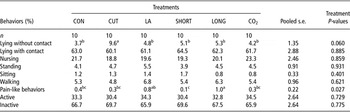
There was no interaction (P > 0.05) between tail docking treatment and period of observation for any of the behaviors measured (Table 5). The percentage of time pigs spent lying without contact after tail docking tended to be greater (P = 0.06) in CUT pigs compared with all other tail docking treatments and CON pigs. The percentage of time pigs spent performing pain-like behaviors after tail docking was greater (P < 0.03) in LA and LONG pigs compared with SHORT pigs.
The percentage of time pigs spent performing different behaviors after being tail docked using CUT, LA, SHORT, LONG, CO2 or CON

CUT = conventional cutting; LA = CUT with local anesthetic injected immediately before cutting; SHORT = CUT with short-acting anesthetic administered topically onto the tail wound immediately after cutting; LONG = CUT with long-acting anesthetic administered topically onto the tail wound immediately after cutting; CO2 = CUT while the pig was anesthetized with carbon dioxide gas; CON = sham docked.
a,b,cLeast squared means with different superscripts within a row are different (P < 0.05).
Discussion
Tail docking is routinely conducted on pig farms worldwide to prevent tail-biting behavior. Tail docking reduces the incidence of tail biting in pigs, but the procedure itself can cause pain. In this study, tail docking without pain relief resulted in elevated cortisol concentrations and N : L ratio and an increase in the percentage of stress vocalizations. Therefore, it is important to find methods to alleviate the pain caused by tail docking until alternatives to tail docking can be established. In this study, we wanted to determine if administering local anesthetic subcutaneously or topically or inducing general anesthesia using CO2 would mitigate the pain caused by tail docking in pigs.
Changes in leukocyte numbers and percentages were observed in pigs in response to tail docking with and without pain relief. Lymphocyte counts were significantly or numerically reduced in all tail docked pigs regardless of anesthesia treatment as compared with control-handled pigs, conversely the N : L was increased in pigs docked regardless of the anesthesia treatment. Changes in leukocyte numbers and percentages have been observed in pigs in response to several different stressors including transport (McGlone et al., Reference McGlone, Nicholson, Hellman and Herzog1993; Sutherland et al., Reference Sutherland, Bryer, Davis and McGlone2009a) and weaning (Niekamp et al., Reference Niekamp, Sutherland, Dahl and Salak-Johnson2007), and in lambs in response to surgical and ring castration (Paull et al., Reference Paull, Lee, Colditz and Fischer2009). A rapid decrease in the number of blood lymphocytes may reflect a redistribution of lymphocytes from the circulation into other organs, lymph nodes, etc. This phenomenon is known as leukocyte trafficking and is thought to be an adaptive response that may increase immune surveillance during stressful situations (Dhabhar, Reference Dhabhar2002). These changes in leukocyte counts and percentages may reflect possible modulation of the immune system as a result of the pain-induced distress response elicited by tail docking, if so, it is possible that painful husbandry procedures may have a detrimental effect on the pigs’ immune system, which could consequently have implications for pig health and welfare. However, this would require further investigation.
Pigs injected subcutaneously with local anesthetic immediately before tail docking had similar cortisol concentrations 30 min after docking as compared with pigs docked without pain relief. In previous studies in lambs, cortisol concentrations after docking were markedly reduced when local anesthetic was administered immediately before docking (Graham et al., Reference Graham, Kent and Molony1997; Kent et al., Reference Kent, Molony and Graham1998). Lambs are commonly tail docked by applying a constrictive rubber ring to the base of the tail, thereby reducing blood flow to the distal portion of the tail. Using the ring procedure the anesthetic would have 10 to 15 s to take effect before the rubber ring stops the flow of blood (Cottrell and Molony, Reference Cottrell and Molony1995). However, in this study, the local anesthetic would not have had enough time to take effect before cutting the tail. In this study, the percentage of stress vocalizations were similar before and during administration of treatment in pigs injected with local anesthetic before docking suggesting that the local anaesthetic may have provided some level of pain relief for these animals.
In this study, a short- or a long-acting local anesthetic was applied topically to the tail wound of SHORT and LONG pigs immediately after docking. The topical anesthetics were not applied to the skin of the tail before docking as intact skin acts as a diffusion barrier against local anesthetics (Huang and Vidimos, Reference Huang and Vidimos2000), whereas anesthetics act more rapidly when administered directly onto the mucous membrane (Huang and Vidimos, Reference Huang and Vidimos2000), lacerations or open wounds (Young, Reference Young2007). Therefore, in this study the topical anesthetic was aimed at mitigating the post-operative pain caused by docking. In lambs, topical application of local anesthetic was shown to reduce wound hyperalgesia in response to surgical castration and tail docking (Lomax et al., Reference Lomax, Dickson, Sheil and Windsor2010) and mulesing (Lomax et al., Reference Lomax, Sheil and Windsor2008) and reduce the peak cortisol response to surgical castration and tail docking as compared with lambs not given anesthesia (Paull et al., Reference Paull, Lee, Colditz and Fischer2009). In this study, applying a short- or long-acting local anesthetic topically onto the tail stump immediately after docking did not reduce the cortisol response as compared with pigs docked without pain relief. However, the cortisol response of pigs given a short-acting topical anesthetic was similar to control-handled pigs 30 min after docking, suggesting that this treatment may have had some beneficial effect.
Cortisol concentrations peaked 60 min after docking in pigs injected with local anesthetic before docking and in pigs that had a short-acting local anesthetic applied to the tail wound after docking. In calves, local anesthetic reduced the initial cortisol response to dehorning, but once the local anesthetic wore off, cortisol concentrations increased to similar levels as calves dehorned without pain relief (Petrie et al., Reference Petrie, Mellor, Stafford, Bruce and Ward1996; Sutherland et al., Reference Sutherland, Mellor, Stafford, Gregory, Bruce and Ward2002), regardless of the length of action of the local anesthetic agent used. It has been suggested that the local anesthetic blocks the initial nociceptive barrage caused by cutting the tissue, but once the local anesthetic wears off the animal experiences pain due to stimulation of the nociceptors by inflammatory mediators causing the subsequent rise in cortisol concentrations (Petrie et al., Reference Petrie, Mellor, Stafford, Bruce and Ward1996). This concept is supported by research showing that the cortisol response to dehorning is eliminated when cattle are given local anesthetic and a non-steroidal anti-inflammatory drug before dehorning (McMeekan et al., Reference McMeekan, Stafford, Mellor, Bruce, Ward and Gregory1998). The duration of action of 2% Lidocaine is approximately 60 min and Cetacaine is approximately 30 to 60 min. It could therefore be possible that the delay in the peak cortisol response, observed in this study, is due to the return in sensation at the site of amputation perceived by the pig once the anesthesia begins to wear off. Furthermore, a corresponding delay in the peak cortisol response was not observed in pigs that had a long-acting local anesthetic topically applied to the tail wound. Tri-Solfen contains the local anesthetic Bupivicaine, which has a duration of action of approximately 2 to 6 h, it would therefore be interesting to determine if the cortisol response peaked later in pigs given a long-acting topical after docking or if giving pigs a non-steroidal anti-inflammatory drug in combination with a local anesthetic would eliminate the cortisol response to docking.
General anesthetics prevent animals experiencing noxious sensations by inducing unconsciousness. In this study, pigs were given CO2 as a general anesthetic. CO2 is not currently a commonly used general anesthetic for surgical procedures as it known to be aversive to pigs and cause a sense of breathlessness (Raj and Gregory, Reference Raj and Gregory1995; Gregory, Reference Gregory2005). However, the advantages of using CO2 as a method of anesthesia on-farm include, the speed at which CO2 can be administered, the rapid reversal of anesthesia, the fact that CO2 is not a restricted drug that has to be administered by a veterinarian and lastly there are no issues with drug residues (Gerritzen et al., Reference Gerritzen, Kluivers-Poodt, Reimert, Hindle and Lambooij2008). In the literature, varying concentrations of CO2 have been used to induce anesthesia in pigs (Kohler et al., Reference Kohler, Moens, Busato, Blum and Schatzmann1998; Gerritzen et al., Reference Gerritzen, Kluivers-Poodt, Reimert, Hindle and Lambooij2008). Therefore, before the start of this experiment, a pilot study was conducted to determine if pigs would find a mixture of 70% CO2 with 30% O2 less aversive than 100% CO2. From this pilot study, it was concluded that 3-day-old pigs did not find 70% CO2 any less aversive than 100% and unconsciousness was achieved more quickly at concentrations of 100%. It was decided that a concentration of 100% CO2 would be used in this study as 100% CO2 did not appear to be more aversive to pigs compared with 70% CO2, and 100% CO2 is cheaper and therefore a more practical concentration to use on commercial farms.
The cortisol response of pigs anesthetized with CO2 before tail docking was greater than controls and similar to pigs tail docked without pain relief; suggesting that pigs anaesthetized with CO2 experienced stress as a result of this procedure even though they probably did not experience the initial noxious sensory input caused by cutting the tail. Forslid and Augustinsson (Reference Forslid and Augustinsson1988) observed that adrenalin and noradrenalin concentrations increased in pigs in response to stunning using 80% CO2. Adrenocorticotropic hormone and β-endorphin concentrations were greater in pigs in response to castration under general anesthesia with 80% CO2 compared with pigs castrated without pain relief (Kohler et al., Reference Kohler, Moens, Busato, Blum and Schatzmann1998) and were similar among castrated and non-castrated pigs that were anesthetized with CO2 (Kohler et al., Reference Kohler, Moens, Busato, Blum and Schatzmann1998), suggesting that exposure to CO2 alone is sufficient to elicit a stress response. Furthermore, Kohler et al. (Reference Kohler, Moens, Busato, Blum and Schatzmann1998) concluded that CO2 anesthesia caused pig's considerable stress due to the struggling, vocalizations and strenuous breathing that was observed during induction. It has been suggested that lower CO2 concentrations in combination with O2 may decrease the aversion to CO2 during induction (Gerritzen et al., Reference Gerritzen, Kluivers-Poodt, Reimert, Hindle and Lambooij2008). In this study, the cortisol response to induction with 70% CO2 tended to be higher than the response to induction with 100% CO2. A single breath of CO2 at a concentration of 35% was sufficient to elicit a sympathetic and hypothalamic–pituitary–adrenal response in normal human subjects (Kaye et al., Reference Kaye, Buchanan, Kendrick, Johnson, Lowry, Bailey, Nutt and Lightman2004), suggesting that CO2 concentrations as low as 35% is sufficient to cause distress in animals. However, previous studies have shown that anesthetizing rats with CO2 at concentrations >70% can have an anti-nociceptive effect in response to thermal and mechanical nociceptive tests for up to 60 min (Mischler et al., Reference Mischler, Alexander, Battles, Raucci, Nalwalk and Hough1994; Mischler et al., Reference Mischler, Hough and Battles1996). It is, therefore, unlikely that even at low concentrations CO2 is acceptable from a welfare perspective as a form of anesthesia to mitigate the pain caused by docking in pigs, unless the benefits of CO2-induced anti-nociception outweigh the initial stress caused by induction. More research is needed to investigate CO2 anesthesia as a method of pain relief for pigs in response to painful husbandry procedures.
Wound healing was scored on all pigs after tail docking until pigs were weaned to determine if any of the docking methods would have a detrimental effect on wound healing that could possibly lead to complications if these methods were used on-farm. Wound healing appeared to be slightly delayed in pigs given a short-acting topical anesthetic after surgical castration (Sutherland et al., Reference Sutherland, Davis, Brooks and McGlone2010). However, no difference in wound healing among the different docking methods was observed in this study. Future studies could include more sensitive measures of inflammation throughout the healing process, such as acute phase protein concentrations or temperature using infrared thermography, in order to more accurately determine the effects of anesthetics on inflammation and wound healing.
Pig's tail docked without anesthesia spent more time lying without contact compared with control-handled pigs and pigs given pain relief at the time of docking. Sutherland et al. (Reference Sutherland, Davis, Brooks and McGlone2010) found that pigs castrated without anesthesia spent more time lying without contact compared with castrated pigs that received either a short or long-acting topical anesthetic after castration. McGlone and Hellman (Reference McGlone and Hellman1988) observed that pigs castrated without anesthesia spent more time lying away from the heat lamp than control pigs. Pigs that spend more time lying away from a heat source, such as other pigs, the sow, or a heat lamp may become more vulnerable to hypothermia, especially as young pigs have poor thermoregulatory capacity because of their lack of fur and brown adipose tissue (Herpin et al., Reference Herpin, Damon and Le Dividich2002). Even though there were few physiological changes indicative of pain relief in pigs given anesthesia in this study, these behavioral results suggest that providing pigs with anesthesia immediately before or after docking may have some beneficial effects.
Pigs injected with a local anesthetic before docking or given a long-acting topical anesthetic after docking spent more time performing pain-like behaviors than pigs given a short-acting topical anesthetic after docking. The percentage of time pigs spent performing these behaviors was very low so it is difficult to interpret these results. It is hard to accurately measure behaviors that are performed infrequently using scan sampling methodologies (Mitlohner et al., Reference Mitlohner, Morrow-Tesch, Wilson, Dailey and McGlone2001). Previous studies have recorded pig behavior and vocalizations during processing in response to different tail docking methods (Noonan et al., Reference Noonan, Rand, Priest, Ainscow and Blackshaw1994; Marchant-Forde et al., Reference Marchant-Forde, Lay, McMunn, Cheng, Pajor and Marchant-Forde2009). Pain-like behaviors, including tail jamming and tail wagging (Noonan et al., Reference Noonan, Rand, Priest, Ainscow and Blackshaw1994) and vocalizations, including grunts and high-peak vocal frequencies (Marchant-Forde et al., Reference Marchant-Forde, Lay, McMunn, Cheng, Pajor and Marchant-Forde2009) were greater in tail docked compared with control-handled pigs. In this study, the percentage of stress vocalizations was greater in pigs during docking compared with pre-docking values, but pigs that were anesthetised with CO2 or given an injection of local anesthetic before tail docking produced similar stress vocalizations before and during processing, suggesting that these two anesthetic treatments may have provided some pain relief during docking. Measuring the behavioral response and percentage of stress vocalizations during processing may be a more sensitive indicator of acute pain caused by docking in pigs; however, it would be beneficial to develop more sensitive measures of chronic pain-induced distress in pigs caused by docking.
In this study, none of the anesthesia treatments tested eliminated or significantly reduced the pain-induced stress response to surgical tail docking. Until the practice of tail docking can be abolished without compromising the long-term welfare of the pig due to tail-biting behavior, it is necessary to find practical on-farm methods to reduce the pain caused by docking.
Acknowledgments
This research was supported by the National Pork Checkoff. The authors thank Cody Lanier for his assistance with this project.