Introduction
The time between ejaculatory events, or abstinence time, is one of the leading modifiable intrinsic factors that affect semen quality. However, the World Health Organization‘s (WHO) Manual for the Examination and Processing of Semen has undergone many updates since 1980; until the last edition in 2021, the duration of sexual abstinence remained unchanged (Barbagallo et al., Reference Barbagallo, Cannarella, Crafa, La Vignera, Condorelli, Manna and Calogero2023). There is no distinct document that supports the best ejaculatory abstinence (EA) time recommended for routine semen analysis is 2–7 days (De Jonge et al., Reference De Jonge, Lafromboise, Bosmans, Ombelet, Cox and Nijs2004). The European Society of Human Reproduction and Embryology and the Nordic Association for Andrology suggest a shorter abstinence time of 3–4 days (Ayad et al., Reference Ayad, Horst and Plessis2018a). However, scientific documents do not sufficiently support the basis for these recommendations and require more evidence. Optimizing the best time for abstinence is important to ensure both the quantity and quality of sperm, which are necessary for successful, natural and assisted conception (Agarwal et al., Reference Agarwal, Gupta, Du Plessis, Sharma, Esteves, Cirenza, Eliwa, Al-Najjar, Kumaresan, Haroun, Philby and Sabanegh2016b).
Some studies challenged the recommended time of 2–7 days by showing semen parameters improvement after different abstinence intervals (Levitas et al., Reference Levitas, Lunenfeld, Weiss, Friger, Har-Vardi, Koifman and Potashnik2005). Also, it was found that shorter abstinence is accompanied by better results in the aim of assisted reproductive technology (ART).
Abstinence duration has been shown to impact various sperm parameters in different ways. For example, short duration improves sperm motility while decreasing total sperm count (Sokol et al., Reference Sokol, Drakopoulos and Polyzos2021). There is a controversy in the study’s results regarding the best time for abstinence. It was found that in normozoospermic samples, semen parameters will be improved by the increase in EA. Still in oligozoospermic samples, motility and morphology will be decreased (Levitas et al., Reference Levitas, Lunenfeld, Weiss, Friger, Har-Vardi, Koifman and Potashnik2005). In another study, it was shown that short abstinence time has no detrimental effect on sperm quality in normozoospermic samples and is also recommended for reducing sperm DNA Fragmentation Index (DFI) (Agarwal et al., Reference Agarwal, Gupta, Du Plessis, Sharma, Esteves, Cirenza, Eliwa, Al-Najjar, Kumaresan, Haroun, Philby and Sabanegh2016b). Furthermore, in an analysis of 9,489 oligospermia samples, the results showed that just one day of sexual abstinence is accompanied by better sperm quality. Sperm collection with the aim of standard analysis or cryopreservation for donor samples should not exceed ten days of abstinence (Levitas et al., Reference Levitas, Lunenfeld, Weiss, Friger, Har-Vardi, Koifman and Potashnik2005).
On the other hand, in contrast to prolonged abstinence, one theory is that lengthy abstinence could increase reactive oxygen species (ROS) exposure, which is generated mainly by abnormal spermatozoa and granulocytes. High levels of ROS have damaging effects on sperm DNA (Agarwal et al., Reference Agarwal, Gupta, Du Plessis, Sharma, Esteves, Cirenza, Eliwa, Al-Najjar, Kumaresan, Haroun, Philby and Sabanegh2016b). In this regard, it was shown that higher abstinence time decreased intrauterine insemination outcomes and increased oxidative stress (OS) (Degirmenci et al., Reference Degirmenci, Demirdag, Guler, Yildiz, Erdem and Erdem2020, Jurema et al., Reference Jurema, Vieira, Bankowski, Petrella, Zhao, Wallach and Zacur2005). It may be because of senescence and functional damage of sperm, which are not identified by standard semen analysis (Jurema et al., Reference Jurema, Vieira, Bankowski, Petrella, Zhao, Wallach and Zacur2005).
Sperm parameters have a high impact on assisted reproductive outcomes, and growing concerns have been raised regarding the effect of different EA intervals on various semen parameters (Ayad et al., Reference Ayad, Horst and Plessis2018a). Due to the conflicting nature of the current evidence, no clear recommendations can be made regarding the ideal abstinence time (Hanson et al., Reference Hanson, Aston, Jenkins, Carrell and Hotaling2018a). Interestingly, many results favoured extremely shorter periods, ranging from 1 to 4 hours (Ayad et al., Reference Ayad, Horst and Plessis2018a).
While there is much evidence that supports the shortening of the abstinence period (AP) compared to the conventional recommendation (standard), few studies have examined the efficacy of a very short abstinence time (1–2 hours) in the sperm parameters of oligo-astheno-teratozoospermia (OAT) patients. There is a growing interest in a very short time for abstinence (second ejaculation after the first) in infertile men, to improve sperm quality as well as ART outcomes, especially in the OAT. Besides, there is some controversy in the reported data on this population. This challenge may be a simple way to improve sperm quality, especially in cases of very poor semen analysis. So in this study, the aim was to evaluate the effect of short abstinence of 1–2 hours (h) on sperm quality based on functional parameters compared to the standard recommendation, in the OAT males.
Material and methods
Ethical approval and consent to participate
This study was approved by the Ethics Committee of Esfahan Medical University, Esfahan, Iran, which follows the Helsinki Declaration of 1975 (RI.MUI.REC.1403.002).
This study was designed as a prospective study in the Maryam Infertility Center, Isfahan, Iran, for four months, from April to July 2024. The enrolled population was OAT patients who were referred to our fertility centre after signing informed consent. According to the WHO 2010, OAT is defined as when the concentration is < 15 million/ml, progressive motility < 32% and morphology < 4% (Organization, Reference Organization2021).
Inclusion criteria were as follows: infertile men aged 20 to 45, at least one previous semen analysis result with a sperm concentration of less than 15×106/ml with an AP of 2–7 days, no history of previous testicular/penile surgery or vasectomy, and no history of cancer, radiation therapy, or chemotherapy. Candidates should have been ungratified for 2–7 previous days to collect study samples. The exclusion criteria consisted of severe azoospermia and oligospermia, a frozen sample, and a history of treatment with particular drugs.
According to the time of semen collection (AP), samples were classified into two groups: (1) after 2–7 days of abstinence (standard recommendation), and (2) semen samples collected 1–2 h later than the first sample. Each case was a control for himself.
Semen sample collection and sperm parameters
Samples were collected in a sterile plastic container from 50 volunteers by masturbation. The usual information was recorded about the exact duration of abstinence (the time between the current and previous ejaculations) for each participant. Delivered samples were incubated in a water bath at 37°C until analysis. Sperm parameters were analyzed according to WHO guidelines immediately after liquefaction (Organization, Reference Organization2021).
For this purpose, the semen sample was well mixed, and 10 µl of non-diluted liquefied sample was loaded in the middle of a Neubauer counting chamber, and subsequently covered with a cover glass and observed under 400× magnification. Information regarding sperm volume, total sperm concentration, motility, morphology, viscosity and sperm DNA damage were recorded.
Semen volume and sperm count
After liquefaction, semen volume was measured using a conical tube, and concentration was determined by counting the spermatozoa using a validated Makler chamber (mill/ml). Total sperm count was calculated by multiplying the semen volume with the sperm concentration (mill/ejaculation).
Sperm motility
Motility was evaluated using Computer Aided Sperm Analysis (SCA2000, Microptic, Barcelona, Spain) software based on the criteria of the World Health Organization. Accordingly, motility is classified as A, rapid progressive motility; B, slowly progressive; C, non-progressive motility; and category D, immotile sperm. According to our centre, which modifies this classification, classes A and B were merged into one group, so in the present study, three motility categories were as follows: progressive (A+B), non-progressive (C), and immotile sperm (D).
Sperm morphology
Morphology was checked using a Diff Quick staining kit, based on Kruger’s strict criteria, which is summarized and performed as follows: About 20 microliters of the diluted sample were placed on the slide, and the prepared smear was dried at room temperature. Then, it is placed in three solutions: methanol (for the slide fixation), orange eosin solution (for cytoplasm staining) and dark blue thiazine solution (for DNA staining). After drying at room temperature, 200 spermatozoa in each slide were assessed using a light microscope (×100 magnification).
Sperm viability, sperm membrane integrity
Viable motile sperm was identified with the laser-assisted immotile sperm selection method, a fast, simple, repeatable and safe method with no need for any chemical compounds. In this system, one single laser shot of 129 μJ of approximately 1.2 Ms is emitted (OCTAX Laser Shot®, MTG, Germany). If the sperm tail is coiled in response to the laser shot, it is considered viable. Besides (Nordhoff, Reference Nordhoff2015).
Semen viscosity measurement
According to a previous study, the semen viscosity was measured using a disposable eight chamber 20-μm depth slide (SC 20-01-08-B; Leja® Products B. V., Nieuw-Vennep, the Netherlands). The mechanism is based on the time for filling one chamber, and the results are presented in the unit centipoise (Pc) (Ayad et al., Reference Ayad, Van Der Horst and Du Plessis2018b).
Quality control
To ensure quality control and minimize probable variations in the assessment, the two technicians, who were well-trained in this field (andrology), analyzed all the procedures. All the instruments were calibrated because high accuracy is important in assisted reproductive techniques. The lab supervisor performed the laboratory’s daily quality control (daily, weekly, or monthly, as recommended).
Sperm DNA fragmentation assay
Terminal Deoxynucleotidyl Transferase dUTP Nick End Labeling was used to detect sperm DNA damage. After labelling, DFI was analyzed by flow cytometry, according to Chatzimeletiou et al. (Chatzimeletiou et al., Reference Chatzimeletiou, Fleva, Sioga, Georgiou, Nikolopoulos, Markopoulou, Petrogiannis, Anifandis, Patrikiou, Kolibianakis, Giannakou and Grimbizis2022). For this purpose, 100 μl of each semen sample was washed in PBS (Sigma-Aldrich, Germany) and centrifuged (5 min at 300 g). The obtained precipitant was added to a mixture of TNE buffer (NaCl (0.15M), Tris HCL (0.01M), Ethylenediaminetetraacetic acid (0.0011M), pH 7.4, and detergent solution (NaCl 0,15M, TRITON X-100) (Bioline Scientific, Athens, Greece). After 5 min, acridine orange (Bioline Scientific Athens Greece) was added, and incubation was continued for a further 5 min in the dark.
Finally, the prepared stained samples were analyzed via a flow cytometer (BD FACSCalibur U.S.A.). The intact sperm is detected in the green detection region (wavelength of 546 nm), and fragmented ones (Acridine orange inserted into the fragmented portion of the sperm) are detected in the red detection region (wavelength of 670 nm). DFI is calculated by dividing the total red and green fluorescence (Chatzimeletiou et al., Reference Chatzimeletiou, Fleva, Nikolopoulos, Markopoulou, Zervakakou, Papanikolaou, Anifandis, Gianakou and Grimbizis2023).
Statistical analysis
For each sperm parameter, comparisons were made within each time frame of abstinence (short vs. conventional recommendation) using paired T-tests. To describe the relationship between each semen parameter value and abstinence time, the linear mixed-effects model was used, and a linear slope was estimated (with a 95% confidence interval (CI). The significance was established at P < .05.
Results
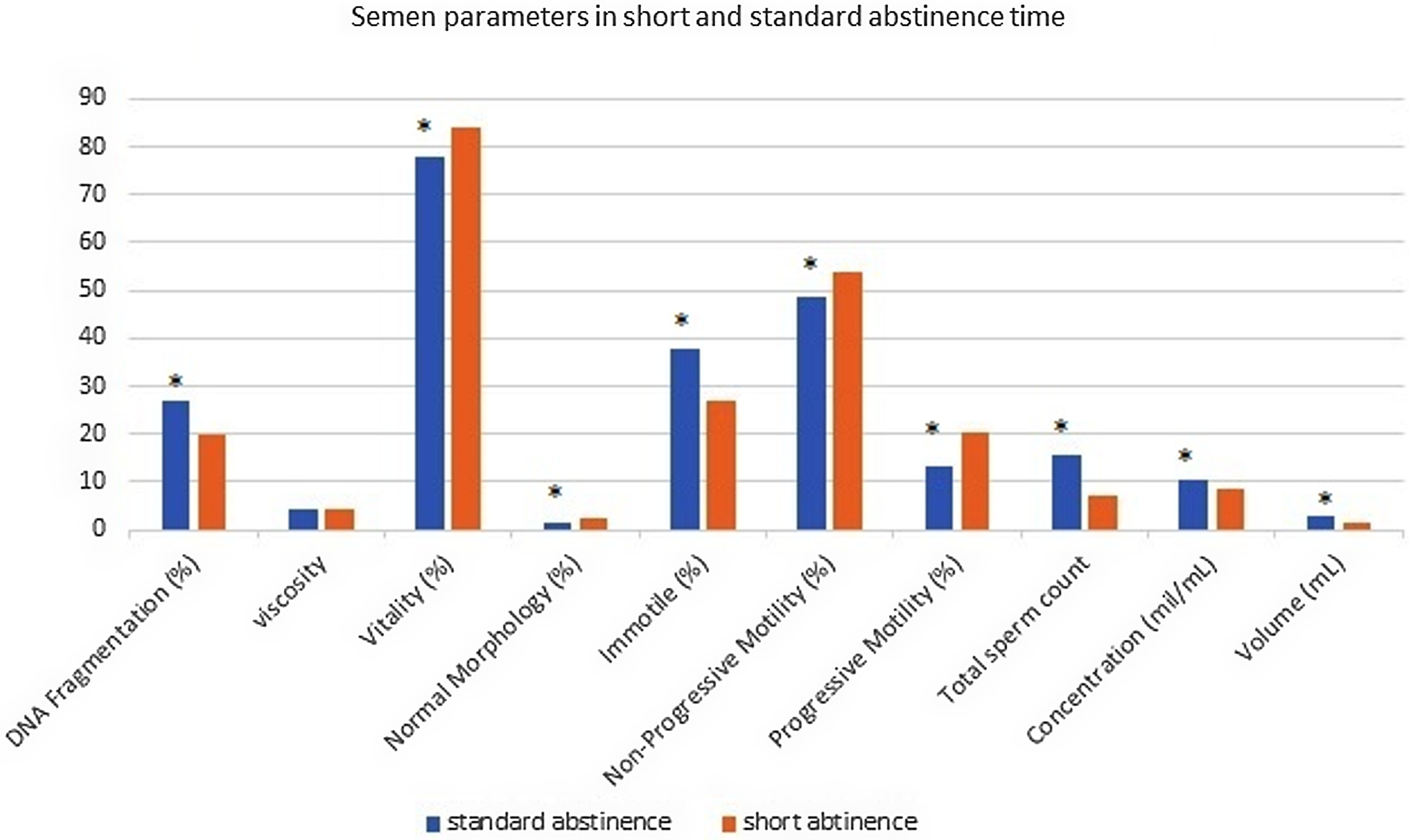
A total of 100 semen specimens were obtained from 50 infertile men with oligo-asthenic-teratozoospermia. After two periods of abstinence, 10 primary and advanced semen characterizations were evaluated. Figure 1 shows the variation in semen volume, sperm concentration, total sperm count, progressive, non-progressive, immotile sperm, normal morphology, viability, viscosity and DNA fragmentation.
Semen parameters in short and standard abstinence time: semen volume (decrease, P < .05), sperm concentration (decrease, P < .05), total sperm count (decrease, P < .05), progressive motility (increase, P < .05), non-progressive (increase, P < .05), immotile (decrease, P < .05), normal morphology (increase, P < .05), vitality (increase, P < .05), viscosity (unchanged), DNA fragmentation (decrease, P < .05).

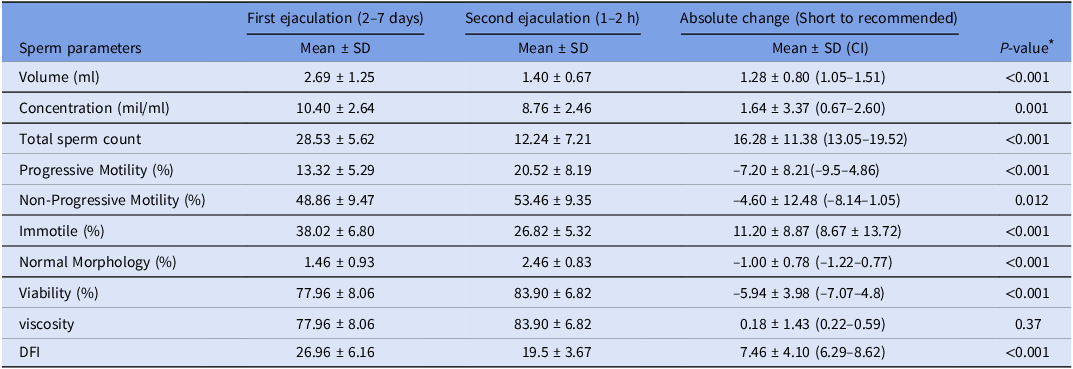
Semen volume (2.69 vs. 1.40, in first and second ejaculation, respectively), sperm concentration (10.4 vs. 8.76) and total sperm count (28.53 vs. 12.24) remained below the 2010 WHO 5th percentile in the short abstinence of 1 –2 h (P < .05). It’s in while that progressive (13.32 vs. 20.52), non-progressive motility (48.86 vs. 53.46), normal morphology (1.46 vs. 2.46) and sperm viability (77.96 vs. 83.90) increased during second ejaculation (P < .05). Short abstinence was accompanied by lower immotile (P < .05), and lower DNA fragmentation index (P < .05), and semen viscosity was relatively unchanged (Table 1).
Semen parameters after World Health Organization recommended (2–7 days), and short abstinence (1–2 h)

* Paired sample T-test showed semen volume, sperm concentration and total sperm count were below the WHO percentile in the short abstinence of 1–2 h. It’s in while that progressive, non-progressive motility, normal morphology and sperm viability increased during the second ejaculation. Lower DNA fragmentation was found in the short abstinence time. The P-value P < .05 was considered significant.
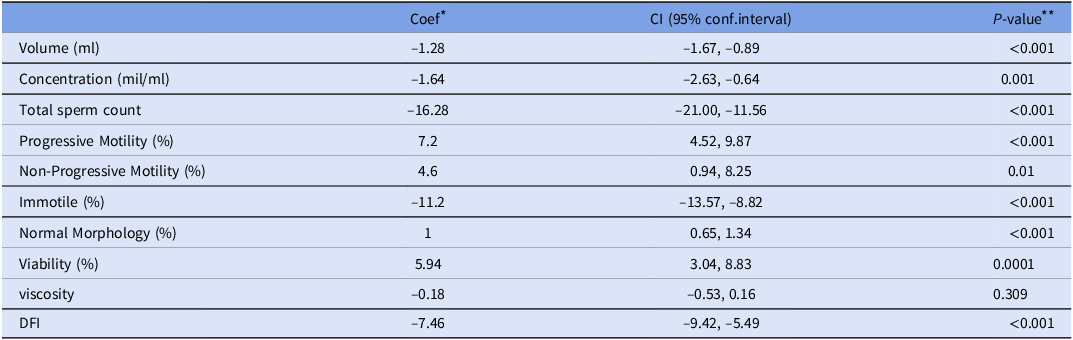
In Table 2, the linear mixed model showed the relationships of the changes observed in the semen parameters during the different AP. As expected, progressive, non-progressive motility, normal morphology and viability showed a positive slope (P < .001). These parameters increased with shorter AP and decreased with lengthier AP. Although, volume concentration and total sperm count decreased with the shorter AP, immotile sperm, sperm DNA fragmentation also decreased (P = .001). Viscosity showed no relationship with AP.
The association between sperm parameters and ejaculatory abstinence length

* Coefficient regression
** Linear mixed model analysis showed progressive, non-progressive motility, normal morphology and viability increased with shorter AP and decreased with lengthier. Volume, concentration, total sperm count, immotile sperm and sperm DNA fragmentation also decreased with the shorter AP (P < .05). Viscosity showed no relationship with AP. The P-value P < .05 was considered significant.
Discussion
Duration of EA is one of the factors that may affect routine semen analysis. This study showed that, except for viscosity, other conventional and advanced semen parameters (semen volume, sperm concentration, total sperm count, sperm motility, morphology, vitality and DFI) were influenced significantly by abstinence time. Also, the previous findings suggested that shorter APs may be beneficial for men with OAT in improving sperm parameters. One possible explanation for this phenomenon is that longer APs can lead to sperm DNA damage and decreased sperm quality in men with OAT.
The results showed that the magnitude of changes was greater for total sperm count than sperm concentration (2.33 vs. 1.18 fold respectively) over the same period. It’s because that total sperm count is more related to semen production consisting of secretions from multiple organs (the testis and epididymis (∼10%), prostate (∼25%), periurethral glands (∼1%) and seminal vesicles (∼65%)) (Drabovich et al., Reference Drabovich, Saraon, Jarvi and Diamandis2014), so this parameter is affected by the frequency of ejaculation (the reserve decreased by the increase in the ejaculatory frequency) (Taaffe et al., Reference Taaffe, O’meara, Stiavnicka, Byrne, Eivers, Lonergan and Fair2022). On the contrary, sperm viability (slope = 5.94), motility (slope = 7.2) and morphology (slope = 1) were positively affected by AP. According to the mixed linear statistical model, immotile sperm (slope = –11.2) and DNA fragmentation (slope = –7.46) have indicated inverse trends with shorter AP. It may be explained by the fact that spermatozoa are more exposed to higher levels of OS when they stay longer in the epididymis (OS arising from dead spermatozoa and leukocytes) (Borges et al., Reference Borges, Zanetti, Setti, Braga, Provenza and Iaconelli2019). The same OS may be more harmful to semen with abnormal characteristics compared to a normozoospermic sample (Barbagallo et al., Reference Barbagallo, Cannarella, Crafa, Manna, La Vignera, Condorelli and Calogero2022). Yet, the viscosity remained unchanged for both long and short ejaculatory APs.
Some studies have assessed sperm parameters in consecutive ejaculates. In line with our research, Sokol et al. (Reference Sokol, Drakopoulos and Polyzos2021) showed that progressive motility, sperm morphology and vitality increased during short abstinence. Still, semen volume, sperm concentration and total sperm count decreased. They also reported DNA fragmentation improved, and embryo euploidy rates and pregnancy outcomes increased in short abstinence time (Sokol et al., Reference Sokol, Racca, Ballester, Rodríguez and Polyzos2023).
We found that semen volume and sperm count decreased in the short abstinence time. It’s in line with the other studies, which showed a decrease in sperm count with a reduction in abstinence time (Hanson et al., Reference Hanson, Aston, Jenkins, Carrell and Hotaling2018b), and showed that longer abstinence is associated with increases in semen volume and sperm count (De Jonge et al., Reference De Jonge, Lafromboise, Bosmans, Ombelet, Cox and Nijs2004), and higher numbers of sperm and higher semen volume were achieved with an increase in abstinence duration (De Jonge et al., Reference De Jonge, Lafromboise, Bosmans, Ombelet, Cox and Nijs2004). But there is also some controversy result. For example, one systematic review and meta-analysis study found an increase in sperm count in OAT patients in the second ejaculation (within 4 h) (Barbagallo et al., Reference Barbagallo, Cannarella, Crafa, Manna, La Vignera, Condorelli and Calogero2022). One reason for this may be the different population studies and the time for categorizing short and long abstinence. For example, in one retrospective study, the authors suggested that in the aim of fertility treatments, in oligozoospermia patients, semen samples should be collected after only one day of sexual abstinence to reach the highest percentage of sperm motility and morphology, but in normozoospermic patients, semen parameters could further improve through 7 days of abstinence (De Jonge et al., Reference De Jonge, Lafromboise, Bosmans, Ombelet, Cox and Nijs2004).
Similar to strong evidence in the literature that suggests that sperm motility, especially progressive motility, and velocity will be increased with the decline in semen volume and sperm concentration in shorter APs (Ayad et al., Reference Ayad, Horst and Plessis2018a), our results also showed better sperm motility in the shorter AP.
In our study, the other semen parameter that improved by the short abstinence was sperm morphology. It is in line with the previous research, which showed that in oligozoospermic samples, motility and morphology are inversely related to AP (Levitas et al., Reference Levitas, Lunenfeld, Weiss, Friger, Har-Vardi, Koifman and Potashnik2005). The author believed that among oligozoospermic samples, worsened sperm motility and morphology by prolonged abstinence time is related to higher levels of ROS in infertile semen compared with fertile samples.
In line with our study, it was shown that sperm viability decreased by prolonged abstinence (Comar et al., Reference Comar, Petersen, Mauri, Mattila, Vagnini, Renzi, Petersen, Nicoletti, Dieamant, Oliveira, Baruffi and Franco2017, Agarwal et al., Reference Agarwal, Gupta, Du Plessis, Sharma, Esteves, Cirenza, Eliwa, Al-Najjar, Kumaresan and Haroun2016a). They also believed that in long abstinence, sperm are more exposed to the harmful effects of ROS while they are stored in the epididymis (Agarwal et al., Reference Agarwal, Gupta, Du Plessis, Sharma, Esteves, Cirenza, Eliwa, Al-Najjar, Kumaresan and Haroun2016a).
The study‘s findings on sperm DNA fragmentation are in line with recent studies that showed lower DFI in the second ejaculation in consecutive ejaculates (Kulkarni et al., Reference Kulkarni, Kaingade, Kulkarni, Bhalerao and Nikam2022, Karavani et al., Reference Karavani, Juvet, Lau, Lajkosz, Mullen, Lo, Grober, Akroof, Kattan and Jarvi2023, Barbagallo et al., Reference Barbagallo, Cannarella, Crafa, Manna, La Vignera, Condorelli and Calogero2022). There is emerging evidence that has suggested a possible link between reactive oxygen species (ROS), DNA fragmentation, Mitochondrial Membrane Potential (MMP) and reproductive outcomes (Bonanno et al., Reference Bonanno, Romeo, Asero, Pezzino, Castiglione, Burrello, Sidoti, Frajese, Vicari and D’agata2016, Treulen et al., Reference Treulen, Uribe, Boguen and Villegas2015). The parameters that, when combined, may be more robust in the prediction of natural conception than the standard semen parameters (Vončina et al., Reference Vončina, Golob, Ihan, Kopitar, Kolbezen and Zorn2016). In this regard, Shen et al. found a significant improvement in DNA integrity, higher total antioxidant capacity, and higher MMP in the short abstinence (second ejaculation after 1–3 h) compared to the longer time (3–7 days) (Shen et al., Reference Shen, Shi, Wang, Jiao, Shang, Wu, Zhou, Cao, Du and Wang2019). From these findings, it can be speculated that in lower abstinence time, the sperm is less exposed to male reproductive tract ROS than in higher abstinence time. Sperm DNA damage induced by ROS is associated with male infertility (Hosen et al., Reference Hosen, Islam, Begum, Kabir and Howlader2015), poor embryo development (Wdowiak et al., Reference Wdowiak, Bakalczuk and Bakalczuk2015), lower pregnancy rates after both IVF and intracytoplasmic sperm injection (ICSI) (Simon et al., Reference Simon, Zini, Dyachenko, Ciampi and Carrell2017), and recurrent pregnancy loss (Shamsi et al., Reference Shamsi, Venkatesh, Pathak, Deka and Dada2011).
Also, in one retrospective study including 479 ICSI cycles, two APs were compared for autologous and donor oocytes as short (≤ 2 days) or long (≥ 3 days), respectively. The results showed that short abstinence time is accompanied by improved fertilization and implantation rates, lower abnormal oocyte rates and increased ongoing pregnancy rates in oocyte donation cycles. One of the mechanisms for this was related to decreased sperm DNA fragmentation. (Pujol et al., Reference Pujol, Romera, Lafuente, Popovic and Mataró2023).
In one study in 2023, it was assessed if clinical outcomes in oocyte autologous and donation cycles were related to male sexual abstinence or not. The results showed that long abstinence time was linked to higher sperm concentration, short abstinence improved fertilization and implantation rates, and lower abnormal zygote rates (1PN, 3PN, >3PN and degenerated oocytes) in oocyte donation cycles. As well, ongoing pregnancy rates were increased compared to prolonged abstinence in both oocyte donation and autologous cycles (Pujol et al., Reference Pujol, Romera, Lafuente, Popovic and Mataró2023). Longer periods of abstinence might have an impact on the degree of sperm DNA fragmentation, a characteristic that cannot be found in the routine semen analysis.
In practice, these results have several implications. First of all, it showed that, however, short AP in men with OAT sperm reduced limited parameters such as sperm count and volume and is not detrimental to many others. Remaining conventional semen parameters within the established WHO reference value, the sperm DNA integrity is minimal. The results indicate that long AP is detrimental to males diagnosed with OAT, and daily intercourse may improve sperm quality in these cases. Historically, it‘s recommended that couples who attempt to conceive naturally have intercourse every other day.
The other implication is that reduced AP may be a good strategy for lowering sperm DNA fragmentation and increasing the chances of successful assisted reproduction in OAT patients. Many studies showed that sperm DNA integrity is critical to the successful outcome of pregnancy, whether natural or assisted reproduction (Rilcheva et al., Reference Rilcheva, Ayvazova, Ilieva, Ivanova and Konova2016, Ribas-Maynou et al., Reference Ribas-Maynou, Novo, Torres, Salas-Huetos, Rovira, Antich and Yeste2022, Alahmar et al., Reference Alahmar, Singh and Palani2022).
In this study, we investigated if a short time of 1–2 h vs. The routine recommended time (2–7 days) for abstinence could improve the sperm parameters in the OAT or not. One of our limitations was the small sample size, as well as having no data regarding pregnancy rates or ART cycles. From these data, it‘s hard to support the conclusions regarding the influence of short APs on OAT patients’ sperm parameters. These findings, along with other future data (E.g., embryo transfer outcomes), will provide rigorous evidence for supporting shorter abstinence times, to improve IVF outcomes in these patients. Future similar studies with a larger sample size are recommended to investigate the best time for abstinence in OAT patients, which also focus more on sperm DNA health as well as ART outcomes.
Conclusions
Our findings provide further evidence behind short APs in OAT samples, which found an increase in semen volume, sperm concentration, sperm motility, morphology and viability. Also, there‘s a substantial improvement in DNA integrity. Taking all data into account, an additional short AP may be a simple and helpful strategy to obtain better sperm quality in couples with male infertility causes, especially in OAT patients. The recommended current guidelines regarding the AP may need to be revisited in severe male factors.
Acknowledgements
The authors thank all the members of the Clinical Center for Infertility, Shahid Behashti Hospital, Isfahan, Iran, for their kind help and valuable support.
Competing interests
There are no conflicts of interest to be declared.
Funding
Not applicable.
Ethical standards
The authors assert that all procedures contributing to this work comply with the ethical standards of the relevant national and institutional committees on human experimentation and with the Helsinki Declaration of 1975, as revised in 2008.