Introduction
On Indian Independence Day in 2008 a colossal bronze statue of Bhagat Singh was inaugurated in the forecourt of the national Parliament in New Delhi. The 18 feet high statue is not far from where Bhagat Singh was arrested on 8 April 1929 in the Legislative Assembly (now the Lok Sabha), along with his comrade B. K. Dutt. The two young revolutionaries had thrown two low-impact bombs, fired two shots from a pistol, and scattered propaganda leaflets into the Assembly before offering themselves for arrest. In doing so, the pair interrupted the passing of two controversial Bills, while simultaneously registering their protest at the imperial-capitalist order on behalf of their party, the Hindustan Socialist Republican Association.Footnote ** Within days of his arrest, Bhagat Singh was implicated in the Lahore Conspiracy Case, which centred around the 1928 murder by the Hindustan Socialist Republican Association of a police officer, John Poyantz Saunders, in Lahore. This was a political murder; a reprisal for the lathi (baton) charge on a protest aimed at the Simon Commission in October 1928, in which the elderly Punjabi Congess leader Lala Lajpat Rai sustained serious injuries and later died.Footnote 1 Bhagat Singh was put on trial and executed, along with his accomplices Shivram Rajguru and Sukhdev Thapar on 23 March 1931. By the time of his death Bhagat Singh had become a household name in India, and was widely eulogized and mourned as a nationalist martyr.Footnote 2 Consequently, bringing Bhagat Singh back to the national parliament, nearly 80 years after his surrender, was seen by many as being long overdue.Footnote 3 However a controversy erupted in the media as soon as the statue was unveiled, largely revolving around its headwear.
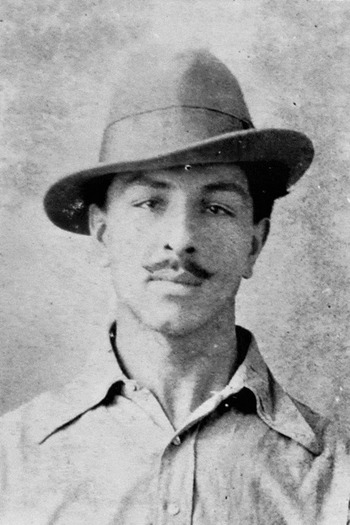
In India, headwear frequently acts as an index to its wearer's regional, religious and/or caste identity.Footnote 4 The debate in 2008 largely revolved around whether the brass statue's turban—tied in the manner of a Sikh, with a shamla (tail) falling over his shoulder—was an accurate reflection of Bhagat Singh's identity, and ultimately his politics. Some argue that Bhagat Singh's renunciation of Indian dress (Figure 1) equated to his ideological appreciation of Marxism and subscription to atheism, which he wrote about shortly before his death.Footnote 6 Others claim that his rather stylish hat was simply a disguise that he adopted in order to carry out his anti-imperial politics. For those who subscribed to this latter view, it was a triumph ‘to see that he looked tall and turbaned, and every inch himself’.Footnote 7 Arguably, the turbaned statue might be seen as a means of evoking and celebrating memories of Panjabi Sikh contributions to the Indian independence movement. Its positioning within the parliamentary complex might also be seen as a way of negating the claims of radical groups who see Bhagat Singh as an icon of militant opposition to the state.Footnote 8
Bhagat Singh, posing for Ramnath Photographers in Delhi, April 1929.Footnote 5

Members of Bhagat Singh's family, however, were quick to object to the new statue. Jagmohan Singh, the son of Bhagat Singh's sister, ‘reacted in outrage’, pointing out that Bhagat Singh was wearing ‘a European hat’ when he was arrested in 1929 in the parliament, thus the statue was historically inaccurate.Footnote 9 The statue's creator, the famous sculptor Ram Sutar, devolved it to his son to protest: ‘The [Joint Parliamentary] Committee [on Portraits and Statues] asked us to prepare a statue similar to the one in Hussainiwala [a small town on the Indo-Pakistan border], where he was cremated. In that Bhagat Singh does wear a turban’.Footnote 10
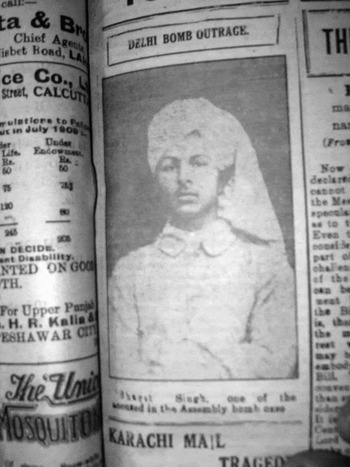
Herein lay the problem: since independence, memorialization of Bhagat Singh has followed many different trajectories. In his home state of Punjab, he is frequently styled in regional dress, including a turban.Footnote 11 Such statues recall a photograph taken of Bhagat Singh in college in the early 1920s (Figure 2), and a Criminal Intelligence Department photograph, taken while he was in jail in 1927,Footnote 12 as opposed to the widely distributed photograph, taken in 1929 shortly before his arrest, of him wearing a hat.Footnote 13 In recent years there has been a trend towards the representation of a turbaned Bhagat Singh beyond the Punjab, in urban spaces in north India, most noticeably in the capital. While posters, t-shirts and car stickers of a turbaned Bhagat Singh are increasingly commonplace in Delhi, the positioning of him on Independence Day in such a prominent, official space sparked a debate about the true history of Bhagat Singh.
A portrait of Bhagat Singh, cropped from a class photograph taken in 1924 at Lahore Central College.Footnote 14

While the controversy might be seen as another in a long genealogy of debates about the politics and conventions that inform the erection of statues, a well established mode of political discourse in India,Footnote 15 it is also indicative of an ongoing struggle for hegemony between popular and academic histories.Footnote 16 Differing constructions of the life of Bhagat Singh are only partially the product of different historical methodologies and political sensibilities. Crucial to the problematic of polarized popular and academic histories is understanding why Bhagat Singh's story has for so long been the domain of vibrant popular histories, as opposed to its somewhat dowdy but more authoritative academic counterpart.
Recent scholarship makes it clear that Bhagat Singh's story has been, since 1929 when he first came to public prominence after his arrest and long, drawn-out trial, deeply enmeshed in popular narratives and genres. Ishwar Dayal Gaur has written a lengthy account describing how Bhagat Singh is uniquely remembered in vernacular songs and poems as a colourful folk hero ‘rooted in the heroic and chivalric traditions of the Punjab’.Footnote 17 A large body of Bhagat Singh literature has been produced since the 1930s in both Hindi and Bengali (linguistic regions where he was briefly active during his short life),Footnote 18 and writings in regional languages such as Marathi, Gujarati and Tamil, speak of an enduring all-India appeal.Footnote 19
Christopher Pinney argues that Bhagat Singh's extraordinary prominence in Indian visual culture, when measured against his neglect by historians, is ‘one of the puzzles of twentieth-century Indian history’.Footnote 20 Pinney is struck by the fact that ‘official history has diverged so fundamentally from the popular narrative’,Footnote 21 and he contends that exploring a visual history has the potential to illuminate popular narratives and unveil histories repressed by the biases of conventional academic methodologies and nationalist history writing.Footnote 22 While this is a productive mode of inquiry, the problem is not simply one of visual versus written histories. Written sources do exist, but they have been relegated to forms of chronicling the past which have, until relatively recently, been eschewed by academics. It is true, however, that the vibrant lithographs and colourful calendars featuring Bhagat Singh which populate Indian urban spaces even today are the most visible referent of a broader historiographical problem.
The following is an attempt to understand why Bhagat Singh's life has been predominantly celebrated outside academic history-writing. I argue that censorship and censure of Bhagat Singh's activities by the colonial state have combined to deliver his memorialization to the multifaceted domain of the popular. Indeed, Bhagat Singh's life has been the preserve of the popular domain for so long, that any attempt to wrest it back—in effect, to determine a history of the legend—from the decentred and diverse grasp of popular cultures is bound to be met with resistance, as was seen when the statue was unveiled in the National Parliament in 2008.
Clandestine histories
Bhagat Singh's life has necessarily been the preserve of the popular since his death, because several levels of censorship have colluded to frustrate the documentation and retrieval of his story. The first among these was self-censorship. As a key member of several organizations labelled ‘seditious’ by the colonial government—namely, the Nau Jawan Bharat Sabha, and the Hindustan Republican Army, after 1928 known as the Hindustan Socialist Republican Association—Bhagat Singh's actions and whereabouts in the years before his arrest were necessarily secretive. Members of the Hindustan Socialist Republican Association were informed of ‘actions’, as they dubbed their strategic attacks on selected imperial officials, purely on a need-to-know basis; as a result, only members of the inner circle were informed of party plans or the activities of key members at any given time.Footnote 23 The organization had learned much from the Kakori Conspiracy Case, in which the testimonies of three former members were key in capturing 39 Hindustan Republican Army members, leaving few active members at large (‘absconding’, in imperial legalese), and in sending four of the accused to the gallows.
Bhagat Singh had once been pressured to turn government witness himself, after his first arrest in May 1927, in connection with the Dussehra Bomb Case in Lahore. Bhagat Singh was innocent on this count, but he was regarded with suspicion by colonial authorities; not only did he hail from a family of revolutionaries, but he was connected with several leftist youth movements which had, as the Bureau of Intelligence put it, ‘adopted as their ideal the inculcation of revolutionary sentiments and of disloyalty to the government’.Footnote 24 Bhagat Singh was contemptuous of the offer, of not only freedom but a reward, in return for a statement.Footnote 25 Realizing the intense pressure that was brought to bear by inquisitors on suspects and under-trial prisoners, the Hindustan Socialist Republican Association conducted operations with as much discretion as possible, to give interrogated members the benefit of deniability.Footnote 26 Thus, the statements of approvers could be both informative and frustrating. Jai Gopal, a Hindustan Socialist Republican Association member whose testimony helped to convict Bhagat Singh and his comrades in the Lahore Conspiracy Case, made frequent reference in his testimony to the fact that Sukhdev ‘used to keep all the facts concealed’ from him, additionally forbidding him explicitly from ‘divulging any secret of the society to Pandit Yashpal’, who himself was a party member.Footnote 27
Similarly, the extensive use of multiple aliases in the party served as a tactic to confuse investigators. While Sukhdev was identified in the courtroom as ‘Sukhdev alias Dayal alias Swami alias Villager’, many of Bhagat Singh's identities remained uncompromised.Footnote 28 In the late 1920s, Bhagat Singh was known to many as Balwant, and he used several adjectival pen-names when he wrote for newspapers and periodicals, among which were Vidrohi (rebel), Agyat (unknown) and Sainik (soldier).Footnote 29 David Petrie in the Home Department declared that the evidence was ‘incontrovertible’ that Bhagat Singh was ‘Balraj, Chief of the Hindustan Socialist Republican Association’, the signatory of the manifesto showered on the Assembly and the author of posters fixed in public places throughout Lahore after Saunders’ murder.Footnote 30 This was contradicted decades later by a member of the Hindustan Socialist Republican Association inner circle, Shiv Verma, who disclosed that Balraj was none other than Chandrashekhar Azad.Footnote 31 Similarly, the use of coded language among party members requires today, as then, an inner party member to decipher the meaning of party communications. Few would guess that a letter requesting the recipient to observe a shraddha ceremony on a given date was in fact an invitation to attend a provincial Hindustan Republican Army council session, as Sohan Singh ‘Josh’ revealed in an interview in the 1960s.Footnote 32
Similarly, Hindustan Socialist Republican Association members adopted different disguises as a means of passing through the various towns in which they operated undetected. Criminal Intelligence Department investigators had detailed physical descriptions of the key party members, in which sartorial choices, including regional styles, were often noted. Bhagat Singh, according to a 1926 Criminal Intelligence Department description, reliably wore ‘khaddar’.Footnote 33 It was to spoil assumptions such as this that he abandoned his usual kurta-pyjama and styled himself as a Gujarati businessman, wearing a dhoti and coat.Footnote 34 According to Shiv Verma, Bhagat Singh was the hardest of all party members to disguise, because he was well known to police, and besides, he ‘was a handsome figure—amongst hundreds of people, obviously, he would be spotted’.Footnote 35 His most famous and elaborate disguise of all was as an Anglo-Indian sahib, wearing a trilby, accompanied on a train to Calcutta by Durga Devi Vohra and her son who posed as his family, as he escaped the police net in Lahore after Saunders’ murder in late 1928.Footnote 36
The shadowy movements of ‘absconding’ Hindustan Socialist Republican Association members have established an unstable narrative which allows for contention and allegation. It is often presumed that Bhagat Singh attended the Calcutta Congress in disguise, in the weeks overlapping late December 1928 and early January 1929, where he had fled to avoid capture after Saunders’ murder on 18 December.Footnote 37 Durga Devi Vohra denied this in an interview she gave in 1972, remembering that while in Calcutta Bhagat Singh stayed indoors during the day to avoid detection, only going out at night, and disguised all the while.Footnote 38 Sohan Singh ‘Josh’ recalled meeting Bhagat Singh on 24 December 1929 in Calcutta at a secret location—a shaving saloon: ‘Just think! Josh entering a shaving saloon in Calcutta with a flowing beard and all the Sikh paraphernalia about him, and the CID[Criminal Intelligence Department] shadowing him and hunting everywhere for Bhagat Singh’.Footnote 39 Chhabil Das, his former teacher from Lahore College, happened to catch a fleeting glimpse of Bhagat Singh in the home of a Calcutta-based Panjabi merchant. Das was asked by Hindustan Socialist Republican Association ideologue, Bhagawati Charan Vohra not to tell anyone of the chance meeting, or even that Bhagat Singh was in town.Footnote 40 Das presumed that Bhagat Singh was attending sessions of the Congress meeting. This was not an altogether unreasonable assumption, given that he had attended earlier Indian National Congress meetingsFootnote 41; or that there were members in the Congress who supported the revolutionaries.Footnote 42
Moreover, as was well known by the Criminal Intelligence Department at the time, it was the ‘consistent practice of revolutionaries from various parts of India to take advantage of the annual sessions of the Congress in order to discuss their plans in secret, and to interchange their views’, and this almost certainly accounts for Bhagat Singh's activities in early January 1929.Footnote 43 Other revolutionaries confirm that Bhagat Singh tried to establish contacts with Bengali organizations, including the Anushilan Samiti, during this period, as the Hindustan Socialist Republican Association oriented its focus to bomb-making.Footnote 44 By early 1929, the Hindustan Socialist Republican Association had refocussed its activities in the United Provinces, with its headquarters based in Agra, while maintaining several satellite operations. Lalit Kumar Mukherji, in an approver testimony, claimed to have met a Sardar (Sikh gentleman) using the name of Ranjit—another alias that Bhagat Singh used—in Allahabad in January 1929, at a secret meeting in which they discussed assassinating Criminal Intelligence Department officers.Footnote 45 The Intelligence Bureau had registered that Bhagat Singh was ‘wandering about India in a most suspicious manner during the past few months’ but until his attack on the Legislative Assembly, no concrete evidence could be pinned on him.Footnote 46 Given these layers of secrecy—disguises, codes, and aliases—there is a certain amount of flexibility inherent in the narrative of Bhagat Singh's revolutionary life.
Proscribed histories
A related element in the repression of information on the activities of revolutionaries was the censorship that the government applied to all seditious literature. The inherently subversive nature of revolutionary organizations meant that publicizing their aims and objectives—necessary for winning broader public support—was dangerous and risked undermining the entire revolutionary project. Few mainstream newspapers, fearful of repressive press legislation that could levy punitive fines and briskly bring financial ruin on a publisher, were willing to print revolutionary material. Whenever the Hindustan Socialist Republican Association managed to raise enough funds to produce their own propaganda, it was quickly labelled seditious and proscribed.Footnote 47 They were therefore largely reduced to carrying out their clandestine politics, as contrary as this seems, with minimal publicity.
It was frustration at the limitations of publicizing their cause and philosophy that Bhagat Singh's final ‘action’, dubbed by the press as the ‘Assembly Bomb Case’, was devised. Whereas the British read the act of the actual attack on the Assembly as being the moment of subversion, for Bhagat Singh, it was just the beginning.Footnote 48 He knew that the trial would be transcribed and duly reported in the press, and that it could therefore be used as an opportunity to communicate the aims and objectives of the organization. It was for this reason that Bhagat Singh, with his talent for oration, was chosen for the ‘action’ at the Assembly, even though the party knew that he would certainly be connected to Saunders’ murder after arrest.Footnote 49 When he went to perform the Assembly Bombing with B. K. Dutt, Bhagat Singh and his comrades knew he was walking into a death sentence.Footnote 50
Once the trial began, the magistrate presiding, F. B. Pool, recognized that their lengthy statement was a manifesto devised as an attempt to evade censorship controls. On 9 June 1929, Pool ruled that sections of Bhagat Singh's statement were ‘expunged’, and that the expunged portions ‘cannot be referred to here, nor being irrelevant, could they affect the case’, despite the fact that the attack on parliament had everything to do with the deleted ideology.Footnote 51 Unfortunately for the prosecutors, an abridged version of the testimony had already been published in the press.Footnote 52 A full Bengali translation of it was being distributed in revolutionary circles in the form of a pamphlet in Calcutta in October 1929.Footnote 53 Nevertheless, the deletion had a great bearing on the case's progression in the courts. In an appeal before the High Court Bench, Bhagat Singh argued that removing the rationale for the attack on the assembly from their statement had the effect of reducing the revolutionaries to the status of madmen and fanatics.Footnote 54
The growing global consternation in Euro-America at the growth of communism in the 1920s, combined with its utility in the imperial situation, served to justify the Government's attempts to curtail activities of radical leftist groups such as the Hindustan Socialist Republican Association. Throughout the protracted court case, the accused made their socialist politics clear through their frequent sloganeering, particularly ‘Long Live the Revolution’. Asked to elaborate on what was meant by this, Bhagat Singh reasoned that
‘Revolution’ does not necessarily involve sanguinary strife nor is there any place in it for individual vendetta. It is not the cult of the bomb and the pistol. By ‘Revolution’ we mean that the present order of things, which is based on manifest injustice, must change. Producers or labourers in spite of being the most necessary element of society, are robbed, by their exploiters, of the fruits of their labour and deprived of their elementary rights. The peasant who grows corn for all, strives with his family, the weaver who supplies the world market with textile fabrics, has not enough to cover his own and his children's’ bodies, masons, smiths and carpenters who raise magnificent palaces, live like pariahs in the slums.Footnote 55
Marxist ideology was more than seditious; its transnational aspirations made it globally subversive. Moreover, it was sympathizers and activists in the broader socialist movement who brought Bhagat Singh's predicament to the world stage. Hindustan Socialist Republican Association members corresponded with a Polish student who wrote in support to the Bhagat Singh Defence Committee in Lahore, and who subsequently ‘proved a very good propagandist for us in foreign countries’.Footnote 56 In March 1931, the Secretariat of the Communist Party of Great Britain issued circulars requesting comrades to organize demonstrations in protest at Bhagat Singh's impending execution, protesting that:
this so-called trial, unparalleled in the history of political persecution, is characterized by the most inhuman and brutal treatment which is the outcome of a frantic desire on the part of the Labour Imperialist Government to strike terror into the hearts of an oppressed people.Footnote 57
Weeks later, the New York-based Daily Worker would describe Bhagat Singh's hanging as ‘one of the bloodiest deeds ever undertaken by the British Labour Government’.Footnote 58 The refrain of ‘Congress Keerthanai’, a Tamil song, added to the proscribed list by the Government of Madras in early 1932, was not exaggerating when it valorized Bhagat Singh as ‘world renowned’.Footnote 59
While comrades were perhaps the most vehement global supporters of Bhagat Singh, his plight also came to the attention of others. Concerns about the torture and ill-treatment of prisoners accused of political violence, including the Government's attempts to tailor legislation and ordinances to allow them to hold and prosecute suspects without due process, were widely expressed in the mainstream nationalist press.Footnote 60 The Society of Friends dispatched one Professor Horace Gundry Alexander to Delhi in 1930 to research a book, Political Prisoners In India. It was not released until 1937—by which time the revolutionaries had been largely suppressed—but the Intelligence Bureau viewed the Society of Friends’ report as an unwelcome intervention, particularly after it failed to influence Alexander's findings.Footnote 61 ‘Rubbish!’ was pencilled in the margins next to the Professor's statement that ‘it is often the finest students, men or women of outstanding ability, integrity and courage, who get carried into the revolutionary movement’.Footnote 62
This pencilled outburst is indicative of a larger problem in the colonial archives, which provide the most resources for historians piecing together Bhagat Singh's story, many of which were only declassified relatively recently.Footnote 63 The bulk of the existing documents relating to his activism, trial and execution were authored by a coterie of imperial investigators, administrators and prosecutors, whose determination to convict him largely inhibited any attempt to understand the revolutionary phenomenon. There is ample evidence that many revolutionaries of the 1920s were just as Alexander described, but to allow this would be to accept that a reasoned critique of imperialism underpinned their recourse to violence. The discourse of condemnation in the various reports, telegrams, and memoranda that passed between intelligence officers and various provincial authorities, the Home Department and the Viceroy, is pervasive—and provides a stark contrast to nationalistic writings that celebrate Bhagat Singh.
Aggrieved histories: eulogy literature
Although British attempts to manage seditious literature was frustrating for the revolutionaries, the body of literature that was proscribed was collected and held in the India Office, where it remains today, a useful resource for historians.Footnote 64 A similar collection exists in the library at the National Archives of India, and a recently published volume brings readers a taste of banned materials that relate to Bhagat Singh.Footnote 65 The editor of this volume, Gurdev Singh Sidhu, has traced 153 proscribed publications, predominantly in Hindi, but also in Tamil, Panjabi, Urdu, Gujarati and Sindhi.Footnote 66 The exhaustive lists of freshly proscribed material published in Fortnightly Reports in 1931 suggest that literature memorializing Bhagat Singh in the charged months after his death found wide and receptive audiences.
Most of these writings, predominantly small tracts and booklets, were produced in the immediate aftermath of the executions, constituting a powerful collection of eulogy literature. Given that eulogies compiled in this tumultuous period constitute the first histories of Bhagat Singh's life, this phenomenon is worth considering in some depth. To give an indication of the density of banned material, in one fortnight in Bengal alone, a month after the executions, three booklets (Desh Bhagat by Chaudhury Nathulal Jamal, published in Lucknow; Shahid Bhagat Singh, by Sambhu Prasad Misra; and Amar Shahid Bhagat Singh, published in Calcutta) were added to the proscribed list, as were three different pictures, each featuring Bhagat Singh, Sukhdev and Rajguru on the scaffold.Footnote 67 The eulogy literature captured by the net of British intelligence and registered in Fortnightly Reports, along with the regal, if unlikely, command that all copies ‘be forfeited to his Majesty’ forthwith, is not likely to be an exhaustive list of what was produced. Many examples of eulogy posters survived the remaining decades of empire to be eventually sold on the collectors’ market, and many private collections have tracts unlisted by the British Library.Footnote 68
The intensity and volume of eulogy literature was reflective of the extraordinary response to the executions, which many hoped would be commuted at the last minute. Several public movements to have the death sentence reduced to transportation for life sprang up after the revolutionaries lost an appeal before a Special Tribunal in 1930, and consequently suffered a cursory dismissal by the Privy Council in February 1931. While demonstrations by the Nau Jawan Bharat Sabha, in Lahore on 20 March 1931, might have been expected, given the close relationship between it and the Hindustan Socialist Republican Association, the protest of the Nationalist Muslim Youth Association in support of the revolutionaries, speaks of broader appeal,Footnote 69 as does the observance of ‘Bhagat Singh Day’ in Lahore on 5 March, which was attended by ‘mammoth’ crowds and evidenced by three photographs reproduced in the Tribune the following day.Footnote 70
In early March, no date had been revealed for the executions, leaving followers and family alike guessing, pinning their hopes on furtive appeals.Footnote 71 The relatives of the three were called for an interview on 4 March, leading to speculation that execution was imminent,Footnote 72 sparking a flurry of ‘Pray Stay Execution’ telegrams to the Viceroy.Footnote 73 A number of formal appeal committees and private individuals sent appeals to all levels of government.Footnote 74 Subhas Chandra Bose later reflected that the volume of appeals had induced Lord Irwin to tell Gandhi that he would
postpone their execution for the time being and give serious consideration to the matter, but beyond that he did not want to be pressed . . . the conclusion which the Mahatma and everybody else drew from this attitude of the Viceroy, was that the execution would be finally cancelled and there was jubilation all over the country.Footnote 75
And yet the trio were hanged on 23 March 1931.
Not only were the executions unexpected, but the manner in which they were carried out added to an overwhelming sense of grievance. By the 1930s, the British had considerable experience in martyr-making, and had come to understand something of the process. The death of Jatindranath Das, a Hindustan Socialist Republican Association member and friend of Bhagat Singh, who had fasted beyond the point of no return in protest at jail conditions in September 1929, had gained the revolutionaries much public sympathy.Footnote 76 The prison authorities had duly handed Das's wasted body over to family members, who, with the support of the Bengal Provincial Congress, repatriated him to Calcutta by train, where his remains were taken on procession, accompanied by wailing crowds.Footnote 77 Keen to avoid such a situation with the hangings of the condemned trio in the Lahore Conspiracy Case, the Home Department resorted to subterfuge.
Firstly, the date of the executions, secretly fixed for 24 March, was abruptly moved to 23 March, with no prior warning, and the time of the execution put at 7.00 pm, instead of the standard execution time of daybreak. Secondly, when the families of Sukhdev and Bhagat Singh arrived for their final interview on the afternoon of 23 March, such a large crowd of extended relatives arrived that the prison authorities refused them entry, stipulating that only immediate family were eligible for interview. Heavily aggrieved, Bhagat Singh's family refused to accept this, instead boycotting the right for a final meeting, and they were joined by Sukhdev's family.Footnote 78 ‘No “Last Interview” with Relations’ was widely reported in the nationalist press.Footnote 79 Finally, after the execution was carried out, the bodies were not given over to the families. Instead they were secreted out of the prison and ‘disposed of according to a pre-arranged plan, being taken at night to the bund of the Sutlej near Ferozepore and cremated with due ceremony’.Footnote 80 This unorthodox night-time cremation was allegedly carried out in the presence of representatives of the Hindu, and Arya and Sikh faiths; by 5.00 a.m., the bodies were ‘completely burnt’ and ‘the ashes were thrown midstream in the Sutlej’.Footnote 81
The authorities felt that depriving the families of their sons’ bodies would remove a focal point for public grieving, which they anticipated would be intense.Footnote 82 From his office in the Home Department, Emerson prevailed upon Gandhi to do all he could in his power to ‘check the creation of conditions which, if uncontrolled, may have serious consequences’.Footnote 83 Gandhi declined.Footnote 84 Writing in ‘strict secrecy’ and in cipher, the Home Department instructed District Magistrates around the country to expect, at some stage in the coming weeks, a simple, one-word telegram which would signal impending execution: ‘Tomorrow’.Footnote 85 This would alert them to rally troops to standby in case of emergency.Footnote 86 Once the news of the executions spread, Lahore, Bombay, Kanpur and Madras observed hartal,Footnote 87 and in Calcutta, ‘intense excitement prevailed and armed flying squads patrolled the city’.Footnote 88
Jai Dev Gupta, a lifelong friend of Bhagat Singh, was with a crowd of mourners in Lahore who had been tipped off about a cremation late in the night of 23 March. Finding a spot on the Sutlej where the sand was hot and the smell of kerosene strong, Gupta found a long bone, ‘cut in a diagonal form at the wrist’, which he suspected was evidence that the bodies had been mutilated.Footnote 89 The mourners gathered what they could, and it was these remains that Sardar Kishan Singh, Bhagat Singh's father, took to the Karachi Congress on 5 April to show the audience that gathered to hear him speak about his son.Footnote 90 The Tribune's front page asked ‘Was Bhagat Singh's body mutilated?’Footnote 91 The Punjab Provincial Congress undertook an inquiry into the issue, headed by Doctors Gopi Chand Bhargawa and Satya Pal; the ensuing report ruled that the cut was accidental.Footnote 92 However the idea that the bodies had been maliciously desecrated was widespread and impossible to retract. Yashpal would later reflect in his autobiography that
the people's hearts filled with fierce, helpless hatred toward the foreign government. Consequently they spread stories about the cruelties inflicted on Bhagat Singh and his companions and of their courage as they faced the gallows. To demonstrate their hatred and anger towards the Government and their reverence for the martyrs, the people exaggerated these stories. Whoever heard them added something, and that is how those tales gained currency.Footnote 93
Such contentions have resurfaced recently with the publication of Some Hidden Facts: The Martyrdom of Shaheed Bhagat Singh, based on the reminiscences of Dalip Singh Alahabadi, (a Criminal Intelligence Department officer in the 1930s), as told to Giani Tirlok Singh Kooner, as told to Kulwant Singh Kooner.Footnote 94 The book extends the desecration narrative, claiming that Bhagat Singh, Rajguru and Sukhdev were tortured, half-hanged and then shot by Saunders’ vengeful family members. Given the gaps in the historical record, combined with the deeply ingrained grievance around the manner of Bhagat Singh's death, and a general post-colonial scepticism of British governance and legal proceedings,Footnote 95 it is no surprise that this book has found an audience. The theory has not been widely accepted,Footnote 96 but has nonetheless been added to the lore surrounding the subterfuge and perfidy of the British rulers’ attempts to suppress the nationalist movement.
The political environment in which Bhagat Singh was executed was a charged one, which was reflected in eulogy literature. The opening months of 1931 were intended to mark a period of rapprochement in British India with the Gandhi-Irwin pact, concluded in early March, following in the wake of the Civil Disobedience Movement and the Round Table Conference in London. As a result of the pact, Gandhi had called an end to Civil Disobedience, and the British freed all non-violent political prisoners who had been arrested during its course. It was in this atmosphere of truce that many hoped that the sentences on Bhagat Singh, Sukhdev and Rajguru would be commuted, and considerable pressure was brought to bear on Gandhi to make it one of the conditions of the pact. Subhas Chandra Bose was of the opinion that ‘Gandhi did try his very best’ to stay the executions, and so ‘it was [a] most painful and unexpected surprise when on March 24th, while we were on our way to Karachi from Calcutta, the news was received that Sardar Bhagat Singh and his comrades had been hanged the night before’.Footnote 97
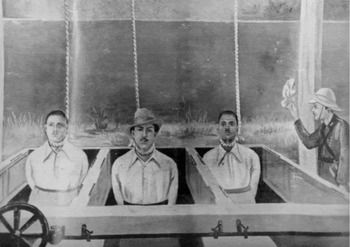
It is no exaggeration to say that the announcement that Bhagat Singh, Rajguru and Sukhdev had been executed was met with devastation. The newspapers were filled with reports of condolence meetings, hartals, fasts and mass observances of death rituals. In Amritsar's Jallianwalah Bagh, the site of the infamous 1919 massacre, 30 police who had been sent to keep the peace at a condolence meeting were stoned, injuring 23.Footnote 98 Terrible violence broke out in Kanpur, where existing tensions were inflamed when Hindu shopkeepers attempted to enforce a Congress-declared hartal on their Muslim neighbours. The death toll was placed at approximately 300.Footnote 99 A motion for the adjournment of the Legislative Assembly in Delhi in protest at the executions failed when put to the vote, but the debate on its desirability ‘gave an opportunity for the delivery of a number of speeches from which glorification of murder and eulogy of the Lahore assassins was not absent’.Footnote 100 The executions were widely read as being vindictive, in Jawaharlal Nehru's words, ‘an act of wanton vengeance and a deliberate flouting of the unanimous demand for commutation’.Footnote 101 This is perhaps best encapsulated in the proscribed poster (Figure 3), in which a British officer in a sola topi solemnly farewells the trio on the scaffold.
A proscribed poster of Rajguru, Bhagat Singh and Sukhdev on the scaffold, circa 1931.Footnote 103

The announcement of the hangings caused such grief and shock that the more radical newspapers, such as Kirti, Bande Mataram, Milap, and Tufan, went to press with direct incitements to violence. One Lahori newspaper, Zamindar (Landlord), urged its readership to:
Give an answer to England with action and not with words. India esteems these three martyrs more than the whole British nation. We cannot fully avenge them even if we kill thousands and lakhs of Englishmen. The revenge can only be complete if you free India. Thus the glory of England will be mixed with dust. O Bhagat Singh, Rajguru, and Sukh Dev! The British are glad that they have murdered you but they are mistaken. They have not murdered you but have supplied a knife to their future. You are alive and will ever remain so.Footnote 102
Literature compiled in this heavily charged atmosphere of grief included plays (a report of one such drama, performed ‘40 miles from Mangalore in the “far south”’, had it that the entire village began to wail when the hanging scene was enacted),Footnote 104 poems and songs which drew on images of Bhagat Singh as a brave hero who played holi with his own blood. Faced with an ‘epidemic of murderer-adulation’ literature, the Home Department began to keep a ‘Bhagat Singh Celebration File’, with a view to proving that ‘the eulogy of “martyrs” is a subtle method of incitement to violence which usually escapes prosecution’.Footnote 105
Many of these writings were biographical in nature, some of which were written by persons who had known Bhagat Singh.Footnote 106 Chandravati Devi, who had attended National College in Lahore, was one such author. She wrote a ‘small booklet of 100 to 150 pages in prattling style and lacking in coherence’ about his life, recounting his childhood in fond detail (once, running to get sweets, he fell over, and his nose bled profusely), giving a sketch of early indications of his revolutionary proclivities (he was trained as a cultivator, but planned to open a gun shop when he grew up).Footnote 107 Bhagat Singh's comrades also submitted materials for publication; in a letter that was smuggled out of jail, B. K. Dutt wrote to Bhagat Singh: ‘Mother India is running mad in your memory’.Footnote 108 Other articles divulged facts and occurrences which revealed that the writers had followed the events closely in the press, or knew or had heard first hand from family members of the final days of the condemned. Watan de Lal (Rubies of the Nation), for example, included details about a letter Bhagat Singh wrote to his young brother Kultar before his execution, which reflected on seeing Kultar's tears in their final meeting and urged him to be brave.Footnote 109
But in the immediate aftermath of the executions many writings purporting to be histories sprang up, some of which made questionable claims. One example is Rishabhcharan Jain's ‘Hartal’, written during the strikes in the aftermath of the executions, overtly claiming to constitute an itihas (history), arguing that Bhagat Singh was ‘in fact’ innocent of the Lahore Conspiracy Case.Footnote 110 Such an idea might have been formed by Sardar Kishan Singh's final petition to the courts, written in late 1930,Footnote 111 which argued that his son could not possibly have been involved in Saunders’ murder because he was in Calcutta at the time (Bhagat Singh had responded to this, contradicting his father in an open letter).Footnote 112 C. S. Venu's Sirdar Bhagat Singh also argued that the trio were innocent of Saunders’ murder, extending well-founded scepticism with the imperial justice system, by alleging that the police had planted false evidence in order to convict the trio.Footnote 113 Other writings, whose authors were too far away and disconnected to the events in Lahore, also made claims which were uncorroborated, satisfying an overwhelming demand for information in the absence of any.Footnote 114 Thus one 1931 publication mourned the death of B. K. Dutt, who in fact survived both his life sentence and the British Raj, before he succumbed in a Delhi hospital in 1965.Footnote 115 But in the atmosphere of grief in which Bhagat Singh loomed large as a martyred hero, to point out such inaccuracies would seem churlish, or worse, to mitigate the oppression of the imperial order.
The intensity of eulogy literature in the Punjab alone caused much consternation among the British—the Zamindar's reference to killing ‘lakhs of Englishmen’ had been underlined in pencil by an alarmed official—that they re-introduced a Special Press Ordinance which had been originally devized to muzzle the press during the Civil Disobedience campaign, but which had since expired.Footnote 116 In 1933, this press ordinance was credited in an official report with bringing an era of ‘laudation of murderers in the press’ to a definitive close, thereby reducing the incidence of revolutionary violence.Footnote 117
Counter Congress
Arguably the most powerful censure of Bhagat Singh's politics and thus his story has been the imperial allegation that his resort to violence was illegitimate; as such, he was consistently styled by the British as a ‘terrorist’. As governments do, the British viewed any nationalist recourse to violence as fundamentally different to their own. As we have seen, dismissing Bhagat Singh as a ‘terrorist’ gave the British the necessary pretext to expunge elaborate arguments in court that explained and qualified his resort to violence. In his memoirs, Sohan Singh ‘Josh’ contended that the persistent use of ‘terrorist’ terminology served to defame the revolutionaries ‘in the eyes of the Indian people’.Footnote 118
The revolutionary resort to violence stood in sharp distinction to the Gandhian platform of non-violence, which dominated Congress policy throughout the 1920s and beyond. Gandhi's insistence on non-violence was perhaps best exemplified by his response to the outbreak of violence in Chauri Chaura in 1921, which was to unilaterally suspend the non-cooperation movement. While outbreaks of violence during subsequent campaigns did not lead to such drastic measures, as long as Gandhi could influence the Congress platform, any use of violence was formally condemned. In practice, the platform of non-violence faced considerable resistance, and in some cases was ignored by rank and file Congress members. The Intelligence Bureau dedicated much energy to documenting instances where Congress leaders and workers made statements that seemed to endorse revolutionary violence. Foremost amongst these was a resolution, initiated by Gandhi at the 1929 Lahore Congress, which congratulated Lord and Lady Irwin on their ‘providential escape’ from a failed attack on their train, masterminded by Hindustan Socialist Republican Association operative Yashpal. ‘This resolution was passed it was true’, observes a “Brief note on the Alliance of Congress with Terrorism”, ‘but only by a majority of 148, no fewer than 794 votes being recorded against it.’Footnote 119
In their rejection of Bhagat Singh's methods the British no doubt received great comfort from Gandhi's comprehensive disapproval at the revolutionary resort to violence. Gandhi implied that the revolutionaries were random and irrational, referring rhetorically to revolutionary praxis as ‘the Bomb’, arguing that it was underpinned by a philosophy of ‘mad revenge and impotent rage’.Footnote 120 This was true, to a point: the Hindustan Socialist Republican Association themselves declared that Saunders’ murder was to avenge the death of Lala Lajpat Rai. However, the Hindustan Socialist Republican Association was a largely well-disciplined organization. Such terms as ‘mad’ failed to reflect their strategic choice of targets and their attempts to minimize harm to bystanders.Footnote 121 The posters issued by the party in the wake of Saunders’ murder revealed the extent to which the action was planned, indicating a sense of organizational formality in the proclamation, plastered around Lahore: ‘Under the rules and regulations of the Hindustan Socialist Republican Association (Rule 10th B & C), it is hereby notified that this was a retaliatory action of none but a direct political nature’.Footnote 122 Later in a similar document, they twice expressed remorse for taking human life, explaining that in Saunders they saw ‘the representative of an institution which is so cruel, lowly and so base that it must be abolished’.Footnote 123
Bhagat Singh's critique of Gandhian non-violence has rhetorically positioned him in opposition to the Congress Party as a whole. This is despite the fact that the Hindustan Socialist Republican Association had many interesting and at times close interactions with the broader Congress movement.Footnote 124 Many prominent Congress leaders went to visit Bhagat Singh in jail or in court, including Subhas Chandra Bose, Motilal Nehru and Jawaharlal Nehru.Footnote 125 Leading Congress members in the Punjab constituted and supported the Bhagat Singh Defence Committee and the Bhagat Singh Memorial Fund.Footnote 126 Bhagat Singh was well acquainted with the Congress programme, and had in fact been a part of the Non-cooperation movement in the early 1920s. Like many, he had been elated at Gandhi's promise of freedom within a year; with his friend Jai Dev Gupta he went to the homes of well-to-do Lahore families and asked for their foreign clothes, which they then took to the Congress office to be burned.Footnote 127 When Gandhi suspended Non-cooperation they became despondent and embarked upon a distinct revolutionary programme. A former Hindustan Socialist Republican Association member, Manmathnath Gupta argued that the revolutionaries were critical of, but by no means hostile to Gandhi—‘we always welcomed Gandhi's movements and his men whenever they came. The satyagrahis also became our good friends’.Footnote 128
Bhagat Singh's rhetorical opposition to Gandhi reached a crescendo in the month before his hanging, as the latter was pressured to make clemency a condition of his pact with the Viceroy, negotiated in early 1931. Whether Gandhi did all he could to save the trio has for long been a matter of contention, but as Neeti Nair notes, the debate ‘has long been decided against’ Gandhi.Footnote 129 Sukhdev wrote a polemical open letter to Gandhi, which was delivered posthumously by his younger brother Mathura Das Thapar, which explained the revolutionaries’ position, which the Mahatma published and responded to in Young India.Footnote 130 Many feared that the Karachi Congress, held within days of the executions, would herald yet another split over the issue of Gandhi's failure to save Bhagat Singh,Footnote 131 and others supposed that the execution had been timed precisely to do just that.Footnote 132
After the Mahatma's murder in 1948, and the ongoing reaction to it in the Indian body politic, many of Gandhi's critics—including those who attacked his most cherished and broadly appreciated contribution, non-violent conflict resolution—were marginalized. This censure of violent narratives of nationalism has further contributed to a relative neglect of revolutionary history. Manmathnath Gupta went so far as to label this as a ‘conspiracy’, which he attributed to the ‘hired historians’ of the independent nation state who, he alleged, sought to downplay the revolutionary contribution to the struggle for independence.Footnote 133 The dominance of the Congress Party in post-independent India has undoubtedly informed a party-centric teleology in history-writing. When the independent nation state set about crafting the history of the freedom struggle, it was the Gandhian narrative that took centre stage; this is perhaps best exemplified in the mammoth state-sponsored project The Collected Works of Mahatma Gandhi.Footnote 134
By comparison, Bhagat Singh's Jail Notebook—admittedly a very different form of prose—was not published until 1994.Footnote 135 In the years after Bhagat Singh's trial and death, Jai Dev Gupta revealed that his family faced harassment and intimidation from unnamed elements, who knew that the colonial police force would not intervene.Footnote 136 Such an atmosphere encouraged the family to keep a low profile and to suppress any memorabilia, for fear of it being confiscated. As many as four manuscripts written by Bhagat Singh in jail have been lost, after they were smuggled out of jail and placed in the custody of the Bhagat Singh Defence Committee.Footnote 137 According to Shiv Verma, the custodian of the works was fearful that the Criminal Intelligence Department would discover the manuscripts during raids on nationalist activists during the Quit India movement, so he destroyed them.Footnote 138
While this situation of censure began to be reversed in the decades after independence, most notably in the state of Punjab, it remained a source of bitterness to families of revolutionaries that they were excluded from the state benefits that ‘Freedom Fighters’ were entitled to.Footnote 139 A change in the attitudes towards revolutionaries was discernible by the 1960s.Footnote 140 A number of statues were erected remembering Bhagat Singh, Rajguru, and Sukhdev, such as the Shaheed Smarak in Husainiwala; and the Punjab government issued a series of commemoration volumes.Footnote 141 Bhagat Singh's mother, Srimati Vidyavati, was publicly honoured as ‘Mother of the Punjab’ in the 1970s, and after her passing she was given a state funeral. It was also in the 1970s that the Nehru Memorial Museum and Library's Oral History Project began to document the recollections of surviving revolutionaries amongst its interviews with freedom fighters, many of whose testimonies have been drawn upon here.
The dramatic story of Bhagat Singh's life and untimely death, redolent with stirring anti-imperial themes—what Avinash Kumar has aptly called ‘thriller nationalism’Footnote 142—made it eminently translatable to celluloid. Several films have been made on his life since independence, and many television dramas. Whilst the ‘Bhagat Singh in Bollywood’ phenomenon deserves an article of its own,Footnote 143 it is important to note here that the frequent remakes of Bhagat Singh's story have strongly influenced public conceptions of historical narrative, even as they have been challenged for their facticity. The first film, Shaheed-e-Azam (directed by Jagdish Gautam), was released in 1954 and even in production was the subject of considerable debate about its representation of history. The Central Board of Film Censors was lobbied by the board of editors of a Bhagat Singh Commemoration Volume and the Punjab Congress Committee, including one of Bhagat Singh's brothers, who made submissions about what the film should, and should not, depict. They were successful in appealing to have two cuts made from the film, but were still unhappy with the result.Footnote 144
A second film was made in 1963, starring Shammi Kapoor; and in 1965 came the third and perhaps the most enduring version, Shaheed, starring Manoj Kumar; arguably Shaheed established Kumar's persona as the quintessential patriotic hero. The film's opening scenes carried a disclaimer warning viewers that
every care has been taken in this film to present the heroic struggle and personality of the famous revolutionary personality Shaheed Bhagat Singh.[. . .]But it is possible that the depiction of certain incidents, costumes, procedures etc. might have involved some inadvertent deviation from actuality for the purpose of cinematic presentation.
The influence of Kumar's film has been felt in other visual cultures, overseeing a revival in Bhagat Singh as a favourite subject in calendar art from the 1960s. Pinney notes that scenes from Manoj Kumar's film were frequently referenced in popular posters of Bhagat Singh produced by the prolific Meerut-based artist, H. R. Raja.Footnote 145
In 2002, came no less than three Bhagat Singh movies: 23 March 1931: Shaheed (starring Bobby Deol) and—released on the same day—The Legend of Bhagat Singh (featuring Ajay Devgan in the titular role). Deol's film was released with the byline: ‘Some stories are not written—they write themselves’.Footnote 146 Within weeks, Shaheed-e-Azam (with Sonu Sood as Bhagat Singh) hit the cinemas.Footnote 147 The release of the three films prompted Professor Jagmohan Singh, Bhagat Singh's nephew and General Secretary of the Bhagat Singh Research Committee, to issue a press release protesting that the films were ‘distorting Bhagat Singh's legacy’.Footnote 148 None of the 2002 films could be called box office hits, although in 2006, Rang de Basanti (directed by Rakeysh Omprakash Mehra), which featured Bhagat Singh and his revolutionary colleagues in a subplot which slowly comes to inform and highlight the film's main narrative, enjoyed considerable success and was India's official (but unsuccessful) entry in the Academy Awards that year in the Best Foreign Film category.
In recent years, enduring and popular cultural commodities such as posters, comics, and bazaar histories featuring Bhagat Singh have been matched by innumerable virtual tributes, particularly on social networking sites, wikis and blogs.Footnote 149 Bhagat Singh's popularity have made it tempting for a wide range of groups to claim Bhagat Singh's legacy, which given multiple narratives and uncertainties described above, creates heated contestation.Footnote 150 Pritam Singh's tally of such groups span the political spectrum and include ‘Gandhi-inspired leftists, Hindu nationalists, Sikh nationalists, the parliamentary Left, [and] the pro-armed struggle Naxalite Left’.Footnote 151 As a result a particular anxiety—represented by the very existence of a Shaheed Bhagat Singh Research Committee—can be discerned around the need to pare back the accretions of popular tellings of Bhagat Singh's story.
Accounting for popular histories
The centenary of Bhagat Singh's birth in 2007 was celebrated by a number of unrelated publications and celebrations, including several Central Government-sponsored initiatives, among which was the installation of a certain statue. Many of these publications advocated a return to primary sources: the publication of a multivolume series of historical documents connected to his trial and executionFootnote 152; fresh editions of revolutionary memoirsFootnote 153; an exhibition of historical documents and memorabilia at the Supreme Court Museum in Delhi and at the Nehru Memorial Museum; the establishment of a Bhagat Singh Chair at the Jawaharlal Nehru UniversityFootnote 154; and the production of a documentary backed by the Nehru Memorial Museum and Library, specifically aimed as a corrective to the narrative posed in popular Hindi films.Footnote 155 This project, Inquilab, was aimed at senior school students, featuring interviews with academic historians, and drew on press clippings to illustrate the narrative, unlike a Doordarshan production released in the same year—also called Inquilab—which featured montages from several of the above mentioned Bollywood films to provide the necessary visuals. Footnote 156
Above I have accounted for the main reasons why Bhagat Singh's history has been predominantly celebrated in the domain of the popular, locating the related issues of censor and censure as being key inhibitors to the establishment of a clear chronicle of his life. As Chandravati Devi reflected in 1931, ‘in these days is it easy to write the life of Bhagat Singh? Can the Sardar's true life be written in this slave country or if written can it be printed and if printed can it ever be published?’.Footnote 157 These issues are further beset by the multiple and competing narratives which were born in the charged atmosphere of Bhagat Singh's execution, and the clamour to save him from his fate. These factors, along with a not unreasonable suspicion of colonial justice systems and of the clandestine operations of imperial investigators, have left a legacy of accounts which variously challenge the colonial narrative, including the very accusations that led him to the gallows.
The difficulties in working around the constraints of censor and censure were effectively counteracted by the fact that Bhagat Singh's story was a compelling one, combining elements of extraordinary bravery and patriotism with the tragedy of his young death. As a result, his story remains the basis of much contemporary popular culture, such as bazaar literature, invariably published unreferenced and predominantly in vernacular languages, in which new twists and turns of narrative have been added to the palimpsest that has become his biography. Add to this the phenomenon of the Bhagat Singh ‘historical’ film—one of which self-consciously celebrates ‘the legend’ of Bhagat Singh—and the estrangement of popular and academic accounts of a revolutionary life is understandable, and perhaps irrevocable.