Introduction
Traditionally, Emergency Medical Service (EMS) systems have performed spinal immobilization (SI) with a long spine board for patients with suspected spine injuries; however, there has been little evidence to support this practice. To the contrary, there is mounting evidence that use of the long spine board is associated with patient discomfort, transport delays, tissue ischemia, respiratory compromise, and increased radiologic imaging. Reference Clemency, Tanski and Chambers1–Reference Schafermeyer, Ribbeck, Gaskins, Thomason, Harlan and Attkisson5 Notably, the vast majority of patients placed on the backboard did not have an unstable thoracolumbar fracture. Reference Clemency, Tanski and Chambers1 Once on the long spine board, a patient often remained on it for an hour or more. Reference Cooney, Wallus, Asaly and Wojcik6
Over the past decade, EMS systems across the United States reduced backboard use as they transitioned from SI protocols to spinal motion restriction (SMR) protocols. Spinal motion restriction aims to limit movement of the spine, but does not necessitate the use of the long spine board. This change was supported by a 2018 joint position statement from the American College of Surgeons Committee on Trauma (ACS-COT; Chicago, Illinois USA), the American College of Emergency Physicians (ACEP; Irving, Texas USA), and the National Association of EMS Physicians (NAEMSP; Overland Park, Kansas USA). Reference Fischer, Perina and Delbridge7
The change from SI to SMR has been shown to be associated with a decrease in long spine board use but no change in the incidence of spinal cord injuries. Reference Castro-Marin, Gaither and Rice8 The effect of this change in practice on neurologic outcomes has yet to be studied in a single United States EMS system. In 1998, Hauswald found the rate of disabling spinal cord injuries was less among injured patients in Malaysia, where SI was not used, compared to New Mexico (USA), where it was ubiquitous. Reference Hauswald, Ong, Tandberg and Omar9 In 2015, New York (USA) adopted a state-wide protocol change which included SMR instead of SI. 10 The goal of this study was to determine if the change in protocol was associated with a change in the incidence of disabling spinal cord injuries, using methods similar to those employed by Hauswald, et al.
Methods
This was a retrospective before-and-after study of patients who were transported by EMS to a single Level I trauma-designated hospital with spine or spinal cord injury due to blunt trauma. The hospital has an annual emergency department census of 75,000 patients and is the only adult trauma center in an eight-county region. A query of the hospital trauma database was performed for all patients who were transported directly to the trauma center from the scene by ground or air EMS, had a blunt mechanism of injury (MOI), and had at least one International Statistical Classification of Diseases and Related Health Problems (ICD) code for spine injury or spinal cord injury. This study protocol was reviewed and approved by the University at Buffalo Institutional Review Board (Buffalo, New York USA; Study #00003611). Due to the nature of the study, a waiver of consent was utilized.
Patients arriving at the trauma center from January 1, 2013 through December 31, 2014 were designated as the SI group. Patients arriving at the trauma center from January 1, 2015 through December 31, 2015 were excluded due to the transition in the SI to SMR protocols. Patients arriving at the trauma center from January 1, 2016 through December 31, 2017 were designated the SMR group. Patients were initially excluded if they were less than 18 years old, died prior to arrival at the hospital, had a penetrating MOI, were transferred from an outside hospital, did not arrive by EMS, had isolated brachial plexus injuries, died of a cause clearly unrelated to their spinal cord injury, had defects clearly unrelated to their spinal cord injury, or if their hospital record could not be found.
Data Elements
Time period, age, gender, MOI, and ICD codes for spine injures and for spinal cord injuries were extracted from the trauma database. The MOI was characterized as Ground Fall, Motor Vehicle Crash (MVC), High Velocity Low Mass (HVLM), Fall from Height, or Other. The highest level of spinal injury was determined by using a list of ICD-9 and ICD-10 codes to record the most cephalad fracture in the spinal column and categorizing it as Cervical, Thoracic, Lumbar, or Sacral.
Finally, all injuries were classified as disabling or not disabling based on a multistep review of the hospital electronic medical record. Patients with no spinal cord injury code were classified as not having disability. For each patient with a spinal cord injury code, the case was coded as disabling or not disabling based on the hospital discharge summary and rehabilitation note. Patients with complete quadriplegia or paraplegia, inability to ambulate without assistance, incontinence, or the need for chronic catheterization, and those who died were classified as having disability. Patients who could not be classified using the prior to steps were reviewed by two Emergency Medicine physicians acting independently. These patients were classified into the two groups based on whether the physicians thought the injury would interfere with normal functioning. These criteria were based on those used by Hauswald. Reference Hauswald, Ong, Tandberg and Omar9 If the two physicians disagreed on if the classification met the criteria as a disabling injury, a third Trauma Surgery physician reviewed the case to make a final determination.
Analysis
Data comparison between patients in the two time periods was performed using a one-way analysis of variance (one-way ANOVA) and chi square (χ2) tests, as appropriate. A binary logistic regression was used to associate the effects of time period, sex, age, level of injury, and MOI with the likelihood that the patient had significant disability. Time period and sex were dichotomous, level of injury and MOI were coded as categorical variables, significant disability was coded as binary, and age was coded as an integer. Odds ratio (OR), 95% confidence intervals (CI) for the OR, and P values were calculated. All tests were two-tailed with an α = 0.05. This analysis method was similar to the one used by Hauswald, which initially looked at the rate of spinal cord injuries and neurological injury when comparing SI protocols to no organized SI. Reference Hauswald, Ong, Tandberg and Omar9 A pre-hoc power analysis was not performed.
Data management and tabulation was prepared using Microsoft Excel (2016 Build 16.0.4266.1001; Microsoft Corporation; Redmond, Washington USA). Data analysis was completed using SPSS (Build 1.0.0.1298; IBM Corporation; Armonk, New York USA).
Results
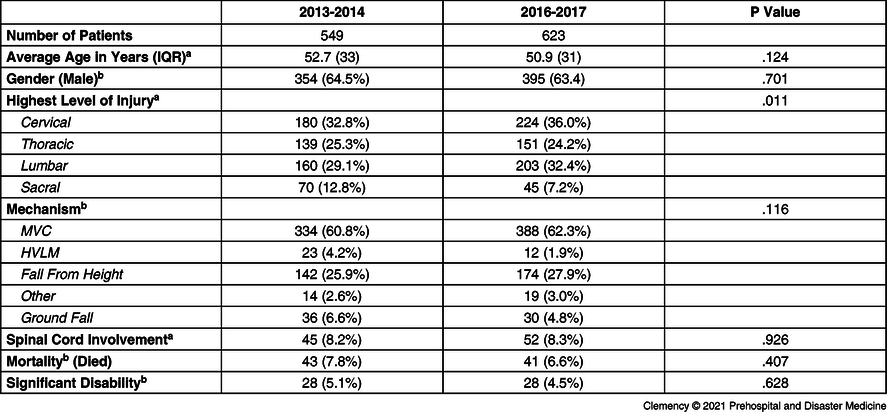
There were 549 patients in the SI period and 623 patients in the SMR period included in the analysis (Figure 1). Fourteen cases were reviewed by a third physician in the instance the first two physician reviewers disagreed. Table 1 shows that the subjects were relatively similar between the two study time periods, with univariate analysis finding a difference in level of spine injury between the two groups (P = .01). The SMR group had more cervical injuries compared to the SI group.
Inclusion/Exclusion Flowchart.
Abbreviation: EMS, Emergency Medical Services.

Population Demographics and P Value for Appropriate One-Way ANOVA or Chi Square Comparison Analysis

Abbreviations: MVC, Motor Vehicle Crash; HVLM, High Velocity Low Mass.
a One-way ANOVA.
b Chi square.
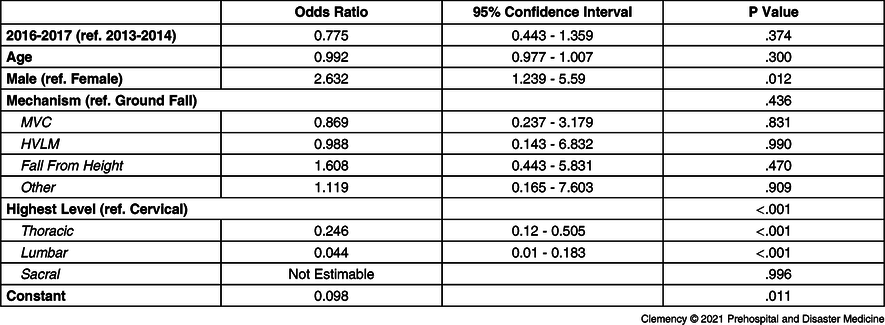
All variables were placed in a logistic regression model to examine the effects of SI versus SMR protocol time period, age, gender, MOI, and highest level of spinal injury on the likelihood that the patients experienced significant disability after they were injured. After adjusting for age, gender, MOI, and highest level of spinal injury, the change from SI to SMR did not show a statistically significant change in significant disability (OR: 0.78; 95% CI, 0.44 - 1.36; Table 2).
Binary Logistic Regression to Predict Significant Disability

Abbreviations: MVC, Motor Vehicle Crash; HVLM, High Velocity Low Mass.
Discussion
This study found that there was no change in disability after spinal injury in a single trauma center following a state-wide change to the EMS protocols for spinal injury care. This finding is similar to one conducted more than two decades ago, which compared SI by examining two EMS systems in different countries during a single time period. Reference Hauswald, Ong, Tandberg and Omar9 Neither study demonstrated a benefit from SI. This study allowed for a more homogenous comparison between groups than could have been achieved comparing EMS systems in two countries with disparate EMS and health care systems. More recently, Castro-Marin showed that there was no change in incidence of spinal cord injuries following the transition from SI to SMR. Reference Castro-Marin, Gaither and Rice8 The findings in the present study support and go one step further by examining patients’ functional disabilities.
These data did not show a significant difference between the incidence of significant disability between the groups despite having a higher incidence of cervical injuries in the SMR group. It has been suggested that the subsequent movement after an injury is minor, when compared to the initial insult, so it is unlikely that the lack of SI caused further injury. Reference Hauswald, Ong, Tandberg and Omar9 Multiple studies have measured the biomechanical movement of the spine during vehicle extrication using video and motion capture systems. Reference Dixon, O’Halloran and Cummins11–Reference Dixon, O’Halloran, Hannigan, Keenan and Cummins13 Despite experimenting with a variety of extrication techniques, they repeatedly found self-extrication with a cervical collar provided similar or less movement when compared to SI, as subjects appear better able to control their own bodies instead of being manipulated by external forces. More recently, McDonald measured Head-Neck (H-N) motion on the stretcher during loading, transport, and unloading in a sample of trauma patients with suspected spinal injuries. Reference McDonald, Kriellaars, Weldon and Pryce14 No effect difference in acceleration or kinematics was noted between the patients who only received a cervical collar versus a cervical collar, head blocks, and backboard. Interestingly, whether the patient was compliant or non-complaint with immobilization had a significant effect on both displacement and acceleration. The lack of evidence to support SI protocols, and the mounting evidence of potential harm, supports the transition to SMR-based EMS protocols.
Similar to Hauswald’s findings, this study did not demonstrate a difference in significant disability for those who used SI, as compared to those who used SMR, or had no organized spinal care. Reference Hauswald, Ong, Tandberg and Omar9 While the outcomes are similar, the study is notable in that it takes place in current times and uses a larger and more homogeneous population from a single location. This allows for comparison of disabling spinal cord injuries before and after changes to EMS protocol.
Limitations
This retrospective before-and-after study has some important limitations. The case identification was based on ICD coding, which can be imperfect, and which changed from version ICD-9 to version ICD-10 during the study period. The hospital trauma registry does not include those who were discharged from the emergency department, thus there is likely a reduced incidence of disability secondary to spinal cord injury than reported. Patients who died of causes clearly unrelated to spinal injury were included in the registry, but excluded from the data set, therefore their outcomes regarding significant disability are unknown. The study utilized a binary outcome of significant disability, which does not provide a continuum of how severe the disability is. Also, subjects were assigned to their group based on the date of their care, rather than the management of their individual spine injury. This study does not examine if subjects had significant disability prior to the traumatic event. Disability following major trauma is often multifactorial; causes, other than the spinal cord injuries, may have contributed to patients’ functional deficits. Furthermore, patients’ deficits at the time of hospital discharge may be different from their final functional status after longer term rehabilitation. Generalizability of these finding are limited due to the fact that it was conducted at a single trauma center in the United States. Future multicenter studies would be required to ensure external validity.
Conclusion
Significant disability rates were not found to be statistically different for SI versus SMR protocols when accounting for age, sex, MOI, and highest level of spinal injury. Unlike past studies, this research looks at the direct effect on the patients’ neurologic outcomes in a single trauma center switching from an SI to an SMR protocol. This study supports the mounting evidence that shifts from SI to SMR protocols do not lead to increased disability.
Conflicts of interest/funding
Dr. Clemency is a speaker for Stryker. Dr. Clemency was supported by the National Heart, Lung, and Blood Institute, National Institutes of Health award number K12HL138052 to the University at Buffalo and by the National Center for Advancing Translational Sciences of the National Institutes of Health under award number UL1TR001412 to the University at Buffalo. All other authors have no conflicts of interest to disclose. This article’s contents are solely the responsibility of the authors and do not necessarily represent the official views of the NIH.