Introduction
para1There are currently 24 species of Cyrtandra J.R.Forst. & G.Forst. (Gesneriaceae–Didymocarpoideae–Cyrtandreae) recorded from Sulawesi (including those newly described here), and more await description. The four species described here all grow in the Latimojong Mountains, South Sulawesi (Fig. 1), in the vicinity of Gunung Rantemario (the highest point on the island; 3478 m a.s.l.), in Montane or Tropalpine habitats (sensu Cannon et al., Reference Cannon, Summers, Harting and Kessler2007). However, the flora of Sulawesi is poorly known (Mendum & Atkins, Reference Mendum and Atkins2004) and additional undescribed species may well be found in the future.
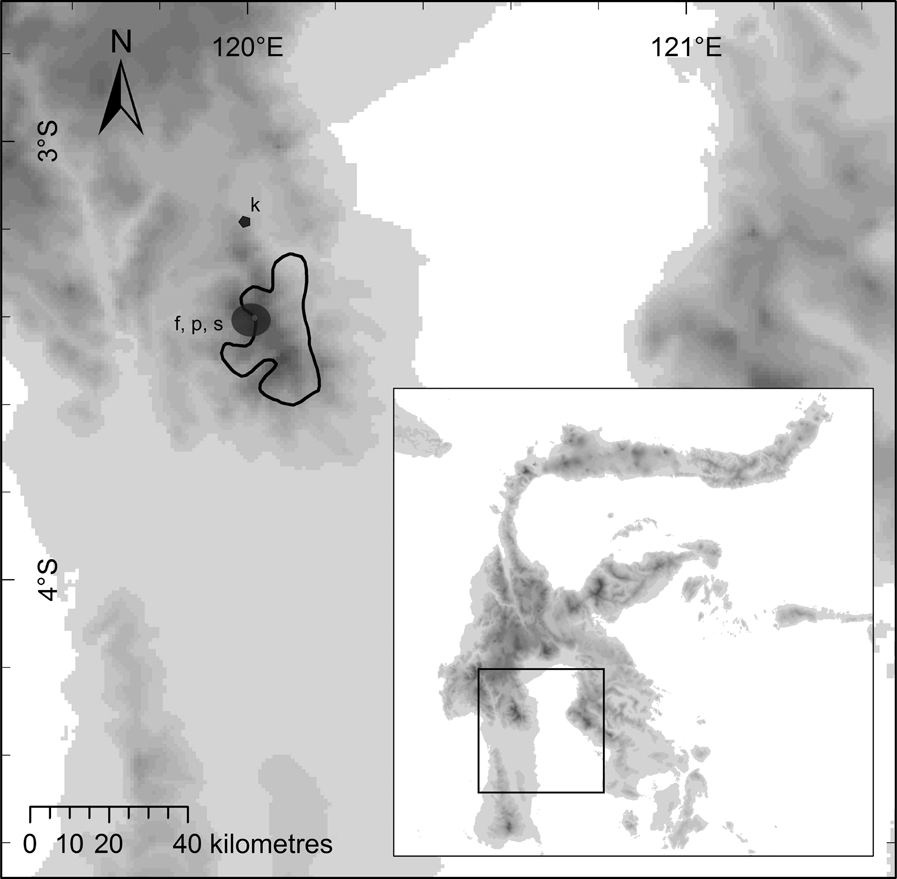
Distribution map showing collection localities for four new species of Cyrtandra. Cyrtandra floccosa (f), C. purpureofucata (p) and C. spectabilis (s) are all known from specimens collected in the vicinity of Gunung Rantemario in the area highlighted by a grey ellipse. Cyrtandra kjellbergii (k) is represented by a single specimen from Buntu Poka Pindjang to the north. The boundary of the Pegunungan Latimojong Protection Forest is shown as a continuous black line. Topographical variation is indicated by five shades of grey: 0–500 m (the lightest shade), 500–1000 m, 1000–1500 m, 1500–2000 m, and 2000 m (the darkest shade).

South Sulawesi has the highest density of anthropogenic pressure on the island, and both lowland and upland vegetation has been extensively converted or cleared. At higher altitudes (> 1500 m a.s.l.) the Montane and Tropalpine forest types were classed as the least endangered in a recent study by Cannon et al. (Reference Cannon, Summers, Harting and Kessler2007). Even at these altitudes, however, land is in demand for small-scale agricultural plots, which include coffee plantations. Anthropogenic disturbance now extends into the 510 km² Pegunungan Latimojong Protection Forest (IUCN VI) east of Buntu Rantemario (Fig. 1; Thomas et al., Reference Thomas, Ardi, Hartutiningsih and Hughes2009).
In addition to the four new species of Cyrtandra described here, new species in other plant groups, such as Begonia, have been found on recent expeditions to the area (Thomas et al., Reference Thomas, Ardi, Hartutiningsih and Hughes2009, Reference Thomas, Ardi and Hughes2011). Further exploration of this region could significantly increase our knowledge of the Cyrtandra flora of Sulawesi. However, effective conservation measures are needed if montane vegetation is not to suffer the same fate as that of lower altitudes. High species-level endemism is reported for the Didymocarpoideae (as Cyrtandroideae − Mendum & Atkins, Reference Mendum and Atkins2004) and, given the altitudinal and topographical barriers to gene flow in Montane and Tropalpine habitats, it is likely that many Cyrtandra species will have narrow distributions.
Materials and Methods
para1All available Cyrtandra specimens from A, BM, BO, CANB, E, K, L and S were examined. Material was compared using a binocular microscope and flowers were dissected after boiling (cf. Bridson & Foreman, Reference Bridson and Foreman2004). In addition, photographs of plants growing in the field were consulted when available. A lack of collecting activity in Sulawesi, compared to other Indonesian islands (Cannon et al., Reference Cannon, Summers, Harting and Kessler2007), means that little material is available for comparison. All material cited (as type material and, when available, additional specimens) comprises the extent of our knowledge of these species.
Proposals for IUCN conservation categories were made following the IUCN Red List Categories and Criteria (IUCN, 2012). Forest types (Montane and Tropalpine) referred to in these notes follow the definitions stated in Cannon et al. (Reference Cannon, Summers, Harting and Kessler2007). When more than two collection localities were known for a species, precise geographical coordinates of collection localities from specimen labels, or geo-referenced place names, were used to estimate extent of occurrence (EOO) and area of occupancy (AOO; sensu IUCN criterion B1) using a 2 km by 2 km grid cell in GeoCAT (Bachman et al., Reference Bachman, Moat, Hill, de la Torre and Scott2011). Because the Latimojong Mountains are underexplored (and these species undersampled) these calculations probably underestimate true EOO and AOO values. However, we feel that their inclusion helps to emphasise the urgent need for more extensive surveying in the region to adequately assess threats to these species.
Species Descriptions
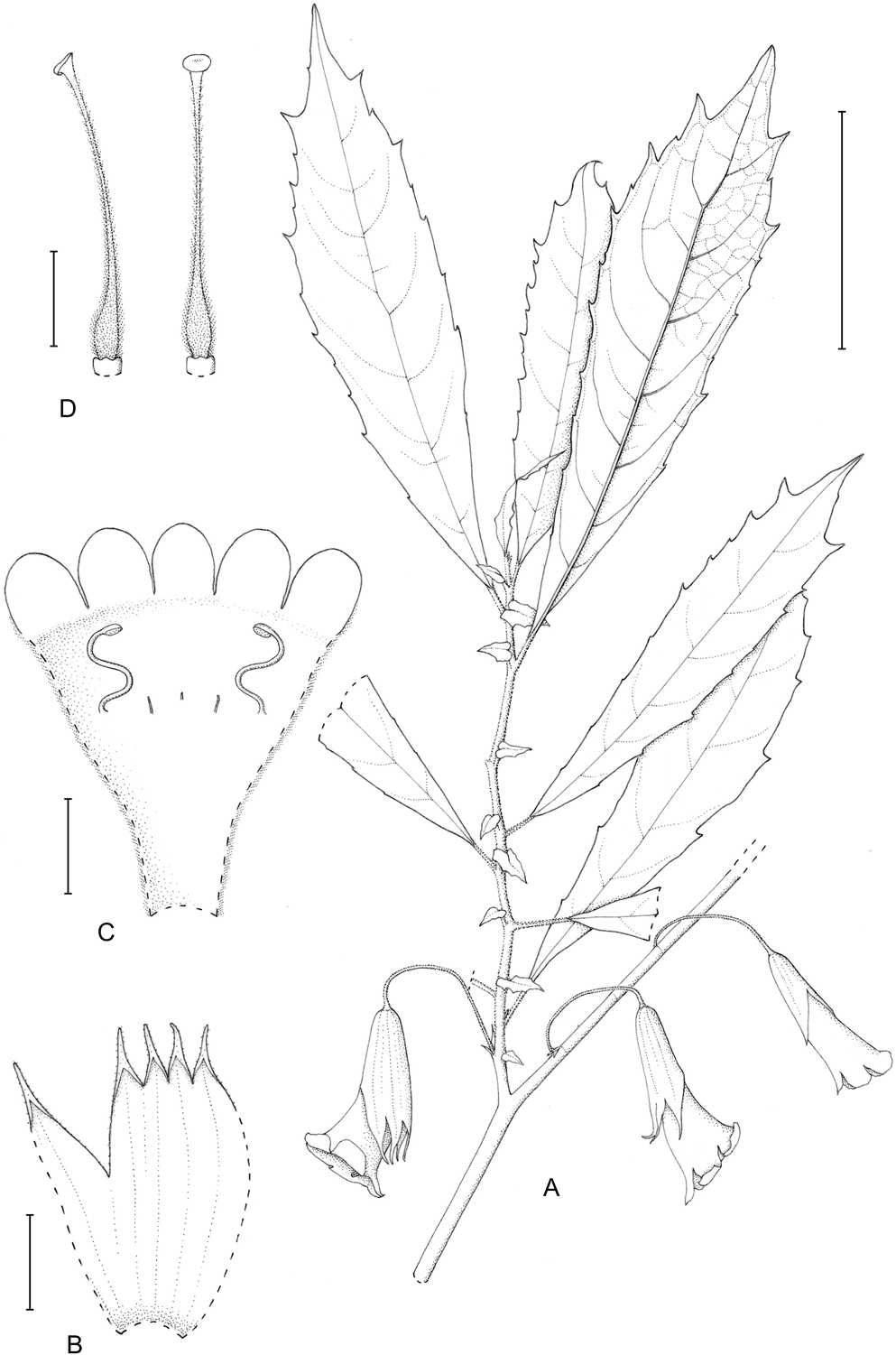
plantnameCyrtandra floccosa R.Bone & H.J.Atkins, sp. nov.Fig. 2.
diagnosisDiffers from other species in South Sulawesi by the presence of a ‘rusty’ floccose indumentum, the large fleshy yellow flowers borne on a distinct peduncle, and the leaves drying black. − Type: Sulawesi, Gunung Rantemario, 2940 m, 26 iv 2009, D.C. Thomas & W.H. Ardi 09-90 (holo E; iso BO, L).
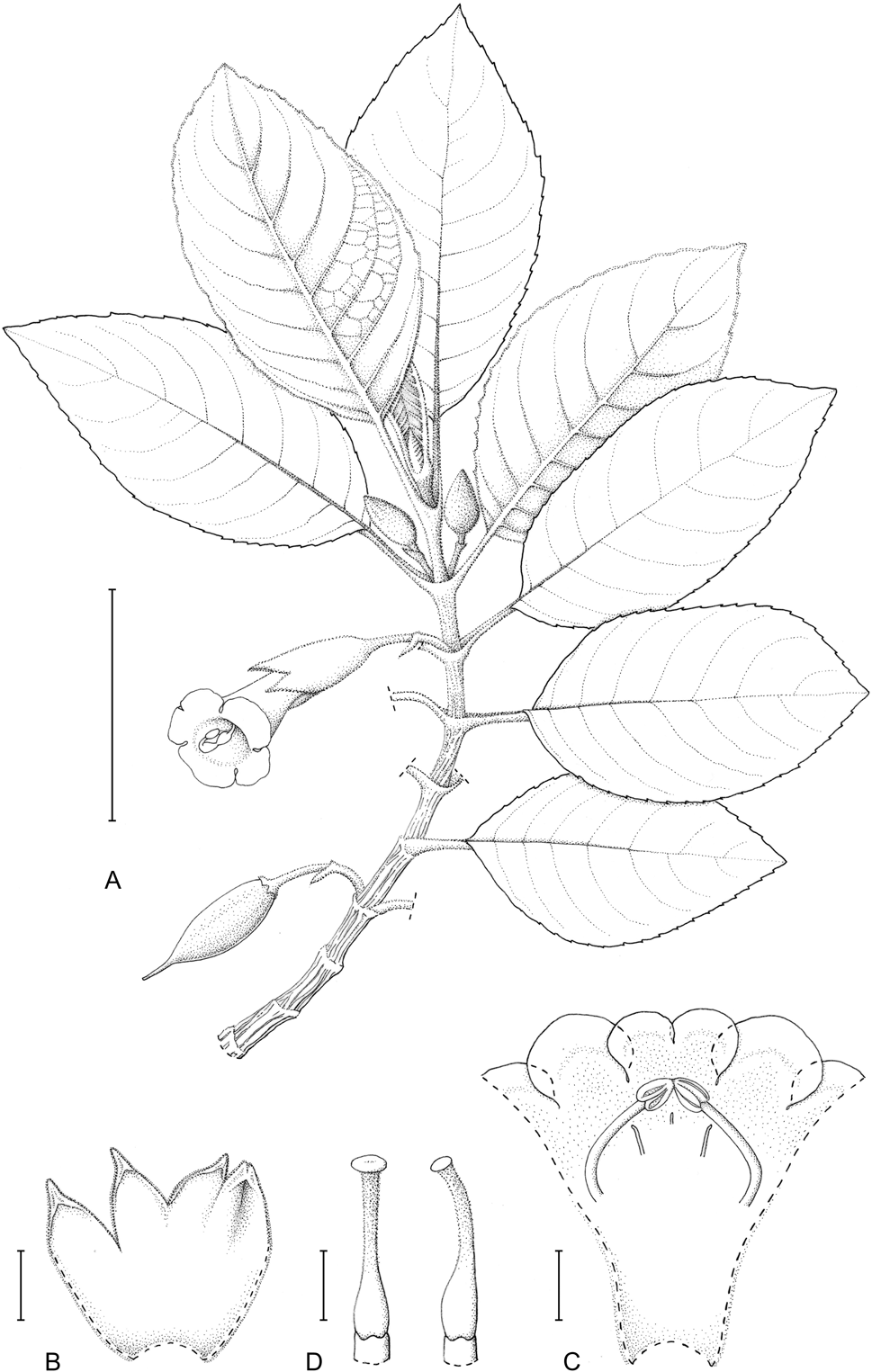
Cyrtandra floccosa R.Bone & H.J.Atkins. A, habit; B, calyx; C, corolla showing positions of the stamens and staminodes; D, gynoecium and disk. Scale bars: A = 5 cm; B−D = 1 cm. Drawn by Claire Banks.
para1Shrub or tree 2−4 m. Stems strongly fenestrated, often with conspicuous swollen nodes, glabrescent, densely orange-floccose, rusty coloured when young. Leaves isophyllous; petiole 12–25 mm, orange-floccose; lamina somewhat coriaceous, usually drying dark brown or black, elliptic to ovate, 6.5–13 × 3–6 cm, apex acute, base acute or rounded, 7−9 pairs of secondary veins, margin crenate to serrate, apex of teeth acute or obtuse, primary and secondary veins of upper and lower surface sparsely to densely orange-floccose, lower surface orange-floccose between veins, juvenile leaves more densely hairy, venation of lower leaf surface conspicuous. Inflorescences in leaf axils, 1-flowered; bracts 3–5(−7) mm, at junction of peduncle and pedicel, triangular to ligulate, leafy (with midrib); peduncle c.6–11 mm; pedicels 7–20 mm, densely orange-floccose. Calyx olive green, coriaceous, tubular, bilabiate, 19–34 mm, densely orange-floccose outside, dividing into lobes at apex, the two lateral lobes splitting on ventral side of corolla at c.1/3 to 1/2 of length of the calyx; lobes c.8–16 mm, acute, the three dorsal lobes united ± to apex forming what appears to be one large dorsal sepal with a tri-dentate apex (sometimes obscure). Corolla 26–45 mm, lemon yellow, fleshy, orange-floccose to glabrescent outside, becoming sparsely hairy distally at ends of lobes, glabrous inside at base becoming glandular-hairy distally; tube narrow at base, widening and becoming slightly pouched at c.1/3 of length, limb 5-lobed; lobes reflexed, two small dorsal lobes c.5 mm long, two large lateral lobes c.12 mm long, one ventral lobe c.7 mm long. Stamens 2, borne c.20 mm from base of corolla tube; filaments glabrous?, 9–10 mm long; anther thecae cohering at tips before and during dehiscence, becoming free, 3–4 mm long (when dehiscing), dehiscing longitudinally; staminodes 3. Disk c.4 mm, cupular, undulate with 5 shallow lobes. Gynoecium c.29 mm; ovary glabrous; style sparsely glandular-hairy at base, becoming dense distally; stigma large, c.3 mm wide, peltate, surface densely papillose; stigma and stamens visible beyond corolla mouth. Fruit green, drying black, 15–25 × 6–8 mm, elliptic, glabrous; calyx usually not persistent in fruit.
cheadDistribution. Indonesia: Sulawesi Selatan: Gunung Rantemario and Latimojong Mountains, above 2500 m.
cheadHabitat and ecology. On steep, mossy slope, Tropalpine forest with ferns, tree ferns, Ericaceae (including Rhododendron spp.), Podocarpus spp.
cheadEtymology. The specific epithet refers to the floccose indumentum that characterises this species. It is particularly dense on juvenile leaves and shoots.
cheadProposed IUCN conservation category. Least Concern (LC). Cyrtandra floccosa has been collected on three different botanical expeditions in the Latimojong Mountains (in 1929, 1969 and 2009). It occurs in the same habitat type and altitudinal range as Cyrtandra purpureofucata (Tropalpine vegetation at > 2500 m a.s.l.) in and around the western boundary of the Pegunungan Latimojong Protection Forest. Because this habitat type is in good condition and not considered at risk (Cannon et al., Reference Cannon, Summers, Harting and Kessler2007; D. C. Thomas, pers. comm., 2012), and due to the natural protection afforded to this area by the steep and inaccessible terrain, we consider it unlikely that this species is in decline.
Based solely on the EOO and AOO this species would be in the Endangered Category (based on 2 km × 2 km grid cell size) under the B criteria. However, threats to the survival of the species cannot be identified, thereby not fulfilling the criteria needed for any of the threat categories. Further survey work in the region is required to assess population size and health for this species and enable more accurate application of the IUCN criteria.
specimens1Additional specimens examined. Indonesia. South Sulawesi: Gunung Rantemario, 2788 m, 26 iv 2009, D.C. Thomas & W.H. Ardi 09-89 (BO, E, L); B. Rante Mario, 3000 m, 1929, Kjellberg 4046 (BO, S); Latimojong Mts south of Ninimori, 2950 m, 23 x 1969, Sands 296 (E, K); ibid., Sands 344 (K).
plantnameCyrtandra kjellbergii R.Bone & H.J.Atkins, sp. nov.Fig. 3.
diagnosisSimilar to Cyrtandra engleri Koorders from the north of Sulawesi in both being shrubs with strongly anisophyllous leaves and densely hairy calyces, corollas and fruits but differs in corolla colour (white in C. engleri vs. yellow in C. kjellbergii) and leaf margin (subentire to serrulate in C. engleri vs. deeply incised in C. kjellbergii). − Type: Sulawesi, B. Poka Pindjang, 2300 m, river bank, 27 v 1929, Kjellberg 1459 (holo BO; iso S).
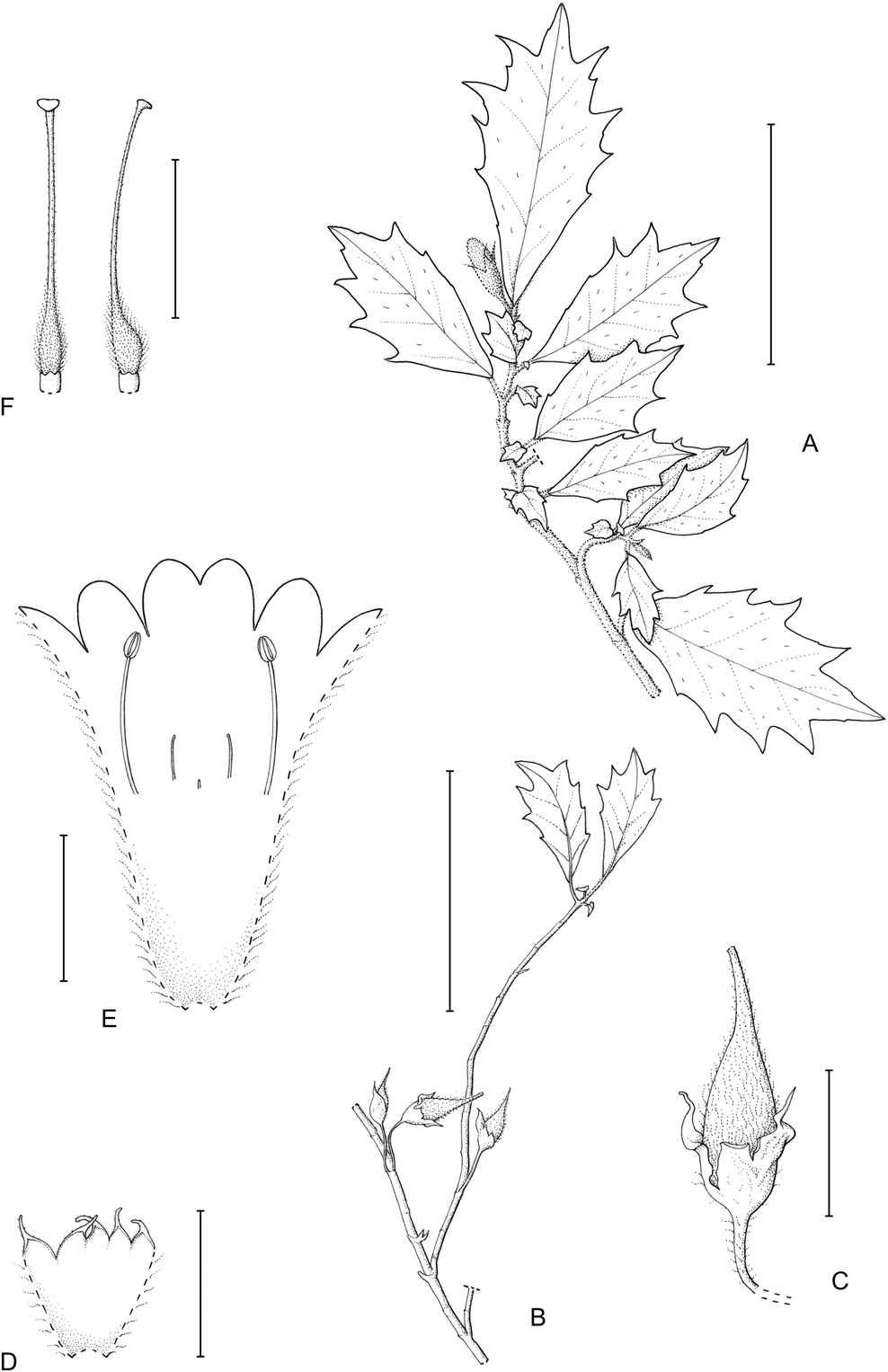
Cyrtandra kjellbergii R.Bone & H.J.Atkins. A, habit; B, fruits on stem; C, fruit; D, calyx; E, corolla showing positions of the stamens and staminodes; F, gynoecium and disk. Scale bars: A, B = 5 cm; C−F = 1 cm. Drawn by Claire Banks.
para1Shrub. Stems terete, glabrescent, densely tomentose when young. Leaves subequal to markedly anisophyllous; petiole 4–6 mm, sparsely whitish orange hairy; larger leaf lamina herbaceous, elliptic to obovate, 4–6 × 1.9–3 cm, base cuneate, 4−5 pairs of secondary veins, margin deeply incised with c.3–7 lobes along each margin, glabrous to sparsely ciliate, upper surface very sparsely pilose, lower surface sparsely hairy on primary and secondary veins, glabrescent between veins, hairs whitish. Inflorescences in leaf axils, 1-flowered; bracts c.2 mm, often caducous, elliptic to ligulate, hairy; peduncle absent; pedicels 5–10 mm, sparsely hairy. Calyx bilabiate, c.6–11 mm, pilose; lobes connate at base, c.2–5 mm, caudate. Corolla 28 mm, sulphur yellow, pilose outside, glabrous inside; tube narrow, ± parallel-sided, widening slightly towards mouth, limb 5-lobed; upper lobes c.5 × 3 mm, the two adjacent dorsal lobes orbicular, c.5 mm × 4.5 mm, the two ventral lobes connate along central axis, c.5 × 3 mm. Stamens 2, borne c.17 mm from base of corolla; filaments glabrous, 9–10 mm long; anther thecae free at maturity (when dehiscing), 1–1.5 mm long; staminodes 3, one highly reduced, glabrous. Disk c.1 mm, cupular, undulate, glabrous outside. Gynoecium 16–20 mm long; ovary densely long whitish orange villous; style glabrescent to sparsely hairy, hairs glandular; stigma capitate, 1 mm wide, surface papillose. Fruit 12–13 × 4–5 mm, conical, narrowing to tip formed by persistent style, indumentum sparse, orange; calyx usually persistent.
cheadDistribution. Indonesia: South Sulawesi: Subdivision Enrekang, c.3°30′S, 120°00′E. Known only from the type.
cheadHabitat and ecology. Recorded from a river bank at 2300 m.
cheadEtymology. This species is named after Gunnar Konstantin Kjellberg (1885–1943), who made an important botanical investigation of Sulawesi in 1929.
cheadProposed IUCN conservation category. Near Threatened (NT). Cyrtandra kjellbergii is known only from the type material, collected in 1929 at 2300 m a.s.l. The collection locality is not in a protected area or national park (Fig. 1) and little is known about the habitat of this species (only ‘river bank’ was recorded on the specimen label). The altitude suggests that it grows in the Montane forest type (1500−2500 m) although nothing is known of the associated vegetation. Cannon et al. (Reference Cannon, Summers, Harting and Kessler2007) rank Montane forests as being at low risk. However, Thomas et al. (Reference Thomas, Ardi and Hughes2011) report ‘moderate to strong anthropogenic disturbance’ in primary forest between 1300 m and 2200 m a.s.l., with some species persisting in primary forest remnants rather than occurring in extensive forested areas.
A lack of specimens of Cyrtandra kjellbergii precludes estimations of EOO and AOO. Until more intensive botanical exploration can be made of this area it is assumed that this species is restricted to the type locality. If the threats to the area are real (specifically forest clearance for agriculture) then the only known population of this species could be at risk of decline or extinction in the near future. However, for the time being, we cannot comment on latent threats to the population with any certainty. We recommend that this species is categorised as Near Threatened (NT), but again emphasise the importance of carrying out further survey work in this region.
plantnameCyrtandra purpureofucata R.Bone & H.J.Atkins, sp. nov.Fig. 4.
diagnosisDiffers from other species in Sulawesi by its unusual urceolate, villous corolla with strongly reflexed purple lobes. − Type: Sulawesi Selatan, Gunung Rantemario, 2788 m, on mossy steep slope Tropalpine forest with ferns, tree ferns, Ericaceae, 26 iv 2009, D.C. Thomas & W.H. Ardi 09-88 (holo E; iso BO, L).
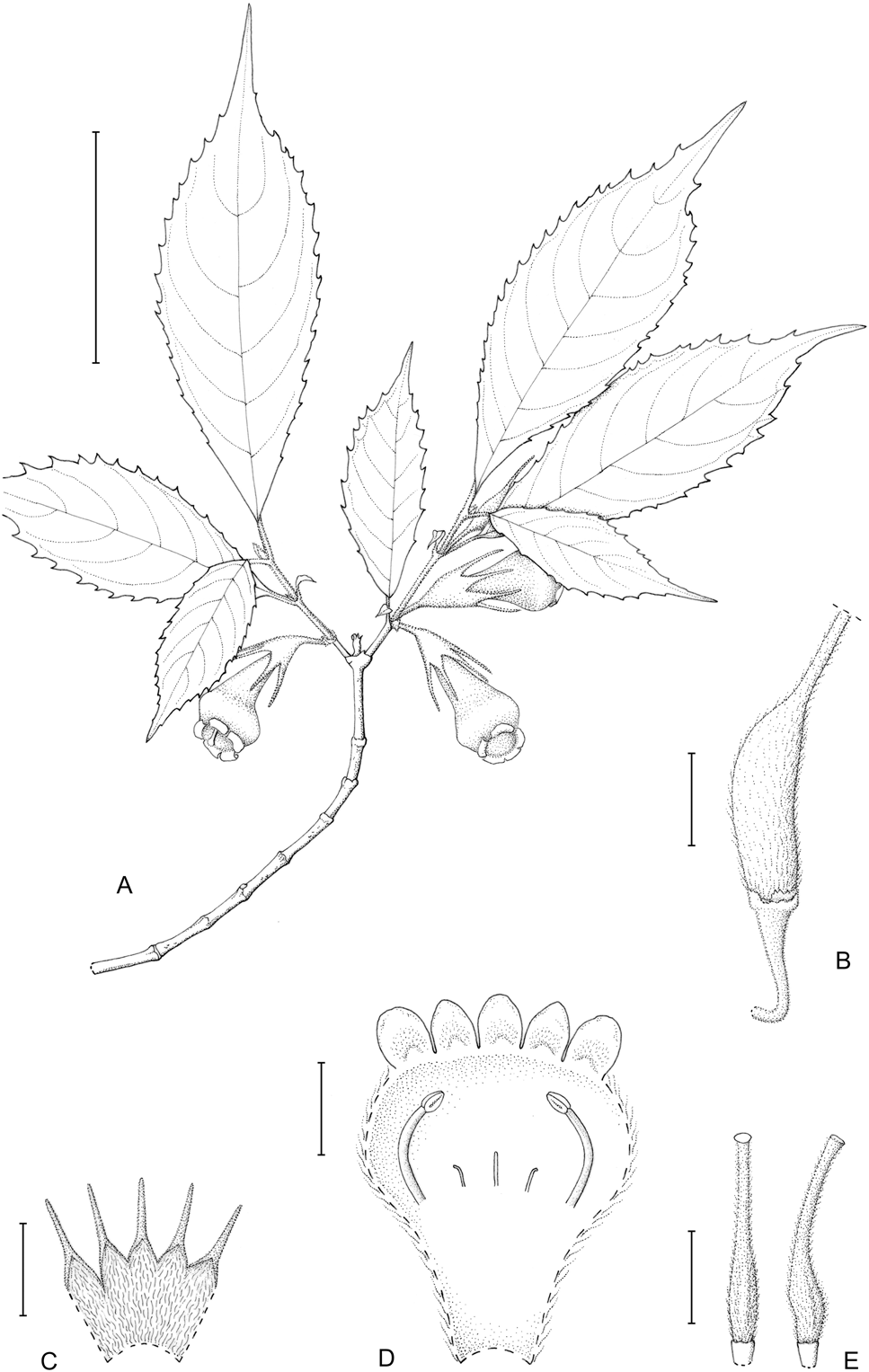
Cyrtandra purpureofucata R.Bone & H.J.Atkins. A, habit; B, fruit; C, calyx; D, corolla showing positions of the stamens and staminodes; E, gynoecium and disk. Scale bars: A = 5 cm; B−E = 1 cm. Drawn by Claire Banks.
para1Herb or shrub 1−4 m. Stems woody, terete, warty, orange-pilose, densely so when young. Leaves subequal to markedly anisophyllous or pseudo-alternate; petiole 6–10 mm, orange-brown pilose; larger leaf lamina herbaceous, drying olive-green to grey, elliptic to somewhat obovate, 4.5–10 × 1.5–3 cm, apex attenuate to acuminate, base cuneate, margin serrate, upper surface glabrous, lower surface with appressed pilose hairs on primary and secondary veins, glabrescent between veins, juvenile leaves more densely hairy. Inflorescences in leaf axils, 1-flowered, pendulous; bracts 2–5 mm long, sometimes caducous?, triangular to linear-attenuate; peduncle absent; pedicels 5–19 mm, densely orange-silky. Calyx green, coriaceous, 11–15 mm, hairy with orange villous silky hairs shorter than those on corolla tube, ± evenly 5-lobed but with the division on the ventral side being deeper than all other divisions, connate at base; lobes 4–10 mm, apex narrowly caudate to linear. Corolla 25–37 mm, deep pink externally, pale pink internally with dark purple lobes, densely villous outside becoming sparsely glandular-hairy on lobes; tube narrow in basal half becoming wider and pouched in apical half, narrowing again at mouth, limb 5-lobed; lobes strongly reflexed, the three dorsal lobes being slightly larger than the ventral two, c.4 × 4 mm. Stamens 2, borne c.20 mm from base of corolla; filaments glabrous, or with tuft of hairs at point of fusion with corolla tube, 9–11 mm long; anther thecae facing one another and cohering at tips before dehiscence, free at maturity, 1–2 mm long; staminodes 3, one reduced. Disk c.2 mm, cupular, undulate with broad rounded lobes, lobes long-ciliate with non-glandular hairs, glabrous outside. Gynoecium 25–32 mm; ovary and style densely hairy, hairs non-glandular; stigma capitate to flattened. Fruit c.35 × 6 mm wide, narrowly ovate, asymmetric, narrowing to tip formed by persistent style, pilose, thick-walled, many seeded; seeds c.0.4 × 0.25 mm, brown, elliptic.
cheadDistribution. Indonesia: South Sulawesi: Tinabang.
cheadHabitat and ecology. On mossy, steep slopes in Tropalpine forest at 2500–3000 m.
cheadEtymology. The epithet purpureofucata, meaning painted purple, refers to the reflexed corolla lobes.
cheadProposed IUCN conservation category. Least Concern (LC). Cyrtandra purpureofucata has been collected on botanical expeditions to montane areas of South Sulawesi in 1929, 1937 and more recently in 2000 and 2009. All four specimens were collected in Tropalpine vegetation at 2500–3000 m a.s.l., including one collecting locality within the Pegunungan Latimojong Protection Forest (Fig. 1). The type locality lies just outside the western boundary of this National Park and is described as steep sloping ground with Tropalpine vegetation of ferns and Ericaceae forming ‘pristine primary forest’, where the only anthropogenic disturbances are hiking and camping groups who clear vegetation along the single hiking trail to the summit of Gunung Rantemario (D. C. Thomas, pers. comm., 2012). In addition, Tropalpine and Montane forests were ranked as the least endangered habitats of Sulawesi by Cannon et al. (Reference Cannon, Summers, Harting and Kessler2007), with a high proportion of Tropalpine forest classed as ‘Great to Good’ in quality.
Based solely on the EOO and AOO this species would be within the Endangered Category (EOO < 5000 km2; AOO < 500 km2) under the B criteria. However, the lack of identifiable threats or evidence of decline precludes application of any of the IUCN threat categories. However, surveys should urgently be carried out in the region to determine the size and health of the population so that the criteria can be applied more rigorously.
specimens1Additional specimens examined. Indonesia. South Sulawesi: Tinabang, West side of the Rante Mario, 3000 m, 17 vi 1937, Eyma 696 (A, BO, K, L); Rantemario, above Rantelemo, 2800 m, 6 iii 2000, Mendum, Argent & Hendrian 00252 (BO, E, K, L); B. Rante Mario [Buntu Rantemario], 2500 m, vi 1929, Kjellberg 4039 (BO, S).
para1In phylogenetic analysis of ITS sequences, Cyrtandra purpureofucata was resolved in a moderately supported clade (bootstrap 85%) with C. roseiflora H.J.Atkins from Sulawesi and several unidentified Cyrtandra spp. from southern and northern Sulawesi, Papua, West Papua and the northern Philippines. This suggests an eastern affinity for this species (as opposed to a Malaysia-Borneo affinity; Bone, Reference Bone2003).
plantnameCyrtandra spectabilis R.Bone & H.J.Atkins, sp. nov.Fig. 5.
diagnosisDiffers from other species in Sulawesi by its pendulous flowers, borne either in cauliflorous clusters or solitary in the axils, delicate maroon calyx and yellow corolla. − Type: Sulawesi, Subdivision Enrekang District, Latimojong Mountains, c.1.5 km to the north of Bunte Tjejeng, 1900 m, 1 xi 1969, Sands 331 (holo E; iso K).
Cyrtandra spectabilis R.Bone & H.J.Atkins. A, habit; B, calyx; C, corolla showing positions of the stamens and staminodes; D, gynoecium and disk. Scale bars: A = 5 cm; B–D = 1 cm. Drawn by Claire Banks.
para1Erect, spreading shrub to 2.5 m. Stems terete, glabrescent or with short brown hairs. Leaves anisophyllous or pseudo-alternate; petiole 4–10 mm, woolly, hairs whitish to brown; larger leaf lamina herbaceous, 8−11 × 2−3.2 cm, narrowly elliptic to narrowly obovate, apex acute, base cuneate, 5−7 pairs of secondary veins, margin serrate, serrations irregularly and distantly spaced (c.5–24 mm apart), apex of teeth acute to acuminate, with small tufts of hair at apex, upper surface glabrous, lower surface with pilose woolly indumentum on primary and secondary veins, hairs whitish to pale brown, glabrescent to pilose between veins, juvenile leaves more densely hairy. Inflorescences in leaf axils, 1-flowered, or cauliflorous fascicles of up to 7 pendulous flowers; bracts c.2–3 mm, linear to oblanceolate, woolly, indumentum whitish-orange, leafy (with midrib); peduncle short, 2–4 mm, woolly, indumentum whitish-orange; pedicel 30–40 mm, slender, glabrescent to sparsely woolly, indumentum whitish-orange. Calyx maroon, drying dark purplish brown, membranaceous, bilabiate, 20–25 mm, split on ventral side c.1/4 to 1/2 the length of the calyx, dorsal sepals fused to at least 3/4 length of calyx, free distally, glabrescent or sparsely pilose, indumentum whitish; lobes c.4–7 mm (in immature flowers the calyx is not so deeply divided on the ventral side and the calyx is more obscurely bilabiate), apex broad acuminate. Corolla 30–40 mm, very pale lemon yellow to cream, glabrous inside, pilose to villous or cobwebbed externally, indumentum whitish-orange; tube narrow at base, gradually widening to mouth, lobes c.7 × 6 mm. Stamens 2, cream, borne c.24 mm from base; filaments glabrous, 11 mm long; anther thecae cohering at tips becoming free (on?) after anthesis, 1.5 mm long; staminodes 3, one highly reduced, glabrous. Disk c.1.2 mm, cupular, undulate with irregular broad, shallow lobes, glabrous. Gynoecium c.30 mm; ovary densely long villous, indumentum whitish, non-glandular; style white, sparsely glandular-hairy, indumentum orange; stigma c.0.8 mm wide, light green, peltate, stigma and stamens reaching corolla mouth but not protruding beyond it in specimen seen. Fruits not seen.
cheadDistribution. Indonesia: South Sulawesi: Latimojong Mountains, c.1.5 km to the north of Bunte Tjejeng. Known only from the type.
cheadHabitat and ecology. Reported from a valley of mixed oak–Podocarpus montane forest on a steep landslide above a stream in deep shade on heavy loam and stone.
cheadEtymology. The specific epithet, spectabilis, meaning attractive, is used here to describe the striking pendulous flower with yellow corolla and maroon membranaceous calyx.
cheadProposed IUCN conservation category. Near Threatened (NT). Cyrtandra spectabilis is known only from the type material, collected in 1969, to the west of the Pegunungan Latimojong Protection Forest boundary (Fig. 1). Information on the specimen label suggests good quality vegetation at that time (mixed oak–Podocarpus montane forest). Although Cannon et al. (Reference Cannon, Summers, Harting and Kessler2007) rank the threats to Montane forests as low, ‘moderate to strong anthropogenic disturbance’ has been reported in primary forest in the Latimojong Mountains at between 1300 m and 2200 m a.s.l. (Thomas et al., Reference Thomas, Ardi and Hughes2011).
A lack of specimens of Cyrtandra spectabilis precludes estimations of EOO and AOO. As with all other species described in this paper, more intensive botanical exploration is needed in the region before thorough conservation assessments can be made. Like Cyrtandra kjellbergii, it is assumed that C. spectabilis is restricted to the type locality but a lack of information means that specific threats to this species cannot be accurately assessed. Given the reported anthropogenic disturbances in this habitat type (Thomas et al., Reference Thomas, Ardi and Hughes2011), however, we consider this species to be at risk due to habitat destruction. We therefore suggest that this species is categorised as Near Threatened (NT).
Acknowledgements
We thank the curators of the herbaria cited in the text for loans of material, Mark Hughes (RBG Edinburgh) for providing map files for Fig. 1, Claire Banks for the illustrations, Steve Bachman (RBG Kew, GIS Unit) and Philip Thomas (RBG Edinburgh) for helpful comments on the conservation recommendations, and the reviewers who helped to improve the manuscript. This work formed part of the MSc thesis of the first author, who gratefully acknowledges the financial support provided by the Bishops Fox’s Educational Foundation, the Studley College Trust and the Kew Guild that made enrolment on this programme possible.