Introduction
International scientific societies recommend early interaction between oncologic and palliative care as one of the most important tasks of modern oncology practice (Zagonel et al., Reference Zagonel, Franciosi and Brunello2017; Ferrel et al., Reference Ferrell, Temel and Temin2017; Davis et al., Reference Davis, Strasser and Cherny2015). Some recent clinical trials and literature reviews showed that early integration of palliative care could improve the quality of life of patients with cancer and symptom management, but the impact on survival still remains a matter of debate (Davis et al., Reference Davis, Temel and Balboni2015; Bakitas et al., Reference Bakitas, Tosteson and Li2015; Temel et al., Reference Temel, Greer and Muzikansky2010; Haun et al., Reference Haun, Estel and Rücker2017). A prompt symptom evaluation is the first step of that process and should be an integral part of the “basic basket of services” that must be guaranteed for every patient. A recent study further validated the importance of early symptom assessment, reporting that it could improve survival by up to 5 months (Basch et al., Reference Basch, Deal and Dueck2017). Indeed, Basch and colleagues conducted a clinical trial involving patients with advanced cancer undergoing chemotherapy, who were randomly assigned to either usual care or the use of “electronic patient-reported outcomes” (PRO). When the PRO group participants reported a severe/worsening symptom, an automatic alert was emailed to the clinicians. Intriguingly, PRO group patients had a significantly longer overall survival, as compared with the usual care patients (Basch et al., Reference Basch, Deal and Dueck2017).
Nevertheless, assessment is challenging in everyday practice, because of restricted time resources; a survey conducted by the Italian Association of Medical Oncology reported that only 20% of oncologists regularly use validated tools to evaluate symptoms (Zagonel et al., Reference Zagonel, Torta and Franciosi2016). Moreover, although early palliative care is increasing, only a few oncologists provided a systemic evaluation of symptoms (Giusti et al., Reference Giusti, Verna and Iacono2017; Porzio et al., Reference Porzio, Valenti and Aielli2005). The lack of systematic evaluation probably stems from many different causes; the workload of outpatient cancer care centers leads clinicians to underestimate symptom burden, and oncologists might be focused on disease-oriented therapies as they consider these therapies of primary importance (Grávalos et al., Reference Grávalos, Salvador and Albanell2012; Greer et al., Reference Greer, Jackson and Meier2013). Several questionnaires and scoring tools have been investigated for symptom assessment; among them, the Edmonton Symptom Assessment Scale (ESAS) is the best known and most often used (Bruera et al., Reference Bruera, Kuehn and Miller1991; Chang et al., Reference Chang, Hwang and Feuerman2000). Recently, a new questionnaire, called “PERS2ON score,” has been designed. It assesses 7 items: pain, eating (loss of appetite/weight loss), rehabilitation (physical impairment), social situation (possibility for home care), suffering (anxiety/burden of disease/depression), O2 (dyspnea), and nausea/emesis, on a scale ranging from 0 (absence) to 10 (worst imaginable), resulting in a score ranging from 0 to 70. In the first study, the “PERS2ON score” was shown to be feasible for symptom assessment in an advanced palliative care setting (Masel et al., Reference Masel, Berghoff and Schur2016). Our study group recently investigated the feasibility of a modified version, called the “PERSONS score,” in a simultaneous care context in patients on active treatment, changing just 1 item and replacing “social situation” with “sleep.” We reported that the PERSONS score is a feasible tool for screening and monitoring symptoms because it was “user friendly” (Cortellini et al., Reference Cortellini, Porzio and Masel2018).
We designed a prospective study to evaluate the PERSONS score in both home care and outpatient care settings, to test its interrater reliability, validity, and ability to detect symptom changes (responsiveness).
Materials and Methods
The PERSONS score and study design
The PERSONS score includes the following items: pain, eating (loss of appetite), rehabilitation (asthenia), sleep (sleep disorders), O2 (dyspnea, cough), nausea/emesis, and suffering (anxiety/depression). Each item is rated on a numeric scale between 0 (no burden) and 10 (worst imaginable burden). All 7 points are summed, resulting in an overall score between 0 and 70 (Supplementary file 1)
The aim of this prospective multicenter study was to investigate the PERSONS score, both in a “simultaneous care” and a “supportive care” setting using the ESAS scale as a comparator. Patients were enrolled from both outpatient and home care settings; they were either recruited at Medical Oncology of St. Salvatore University Hospital, in L'Aquila, Italy, or by the home care service of the Tuscany Tumors Association, in Florence, Italy. PERSONS and ESAS questionnaires were administered during “pre-chemotherapy administration” visits and during routine home visits, at baseline, after 1 month, and after 2 months. The questionnaires were administered independently by clinicians in each center. Continuous data were tested initially for equality of variances using the Levene test. The Shapiro normality test was subsequently used for normality. Based on these findings, statistical comparisons were performed using parametric tests. To analyze whether the Eastern Cooperative Oncology Group Performance Status (ECOG-PS) could affect baseline PERSONS scores, linear regression and correlation analyses were performed, considering the following 4 ECOG-PS categories: 0, 1, 2, and 3–4. Reliability indicates both the “internal consistency” of a scale and the “reproducibility” of scores for the different ways of estimating it. Internal consistency reliability, usually measured by Cronbach alpha, was not investigated as it was inappropriate for a symptom scale (Moro et al., Reference Moro, Brunelli and Miccinesi2006). We estimated the interrater reliability with intraclass correlation coefficients (ICCs). ICCs and their 95% confidence intervals (CI) were based on a mean rating (k = 3), consistency agreement, and 2-way random-effects model to assess inter-interviewer (ICC2,1) and intra-interviewer (test-retest) (ICC2,k) reproducibility, respectively (Shrout & Fleiss, Reference Shrout and Fleiss1979; Koo & Li, Reference Koo and Li2016). Estimated ICCs were interpreted as follows: ≤0.25, poor agreement; 0.26–0.49, fair agreement; 0.50–0.69; moderate agreement; 0.70–0.89, high agreement; and 0.90–1, very high agreement (Portney & Watkins, Reference Portney Gross and Watkins2009). To evaluate the validity of the PERSONS score, the ESAS scale was chosen as a comparator. The relationship between the total PERSONS score and total ESAS score at baseline and the final assessment was investigated using Pearson correlation coefficient (r) with 95% CIs. The Pearson correlation coefficients (r) were interpreted as follows: ≤0.19, very weak correlation; 0.20–0.39, weak correlation; 0.40–0.69, moderate correlation; 0.70–0.89, strong correlation; and 0.90–1.00, very strong correlation (Evans, Reference Evans and Pacific1996). To assess responsiveness, we considered the PERSONS scale as a “diagnostic test” for discriminating between improved and unimproved patients; with this hypothesis, we used the receiver operating characteristics (ROC) curve to describe the PERSONS’ ability to detect improvement or deterioration. The ROC curve was calculated, assessing the minimal clinically important difference (MCID) for improvement and deterioration of the total PERSONS score. The ROC curve was constructed with the sensitivity–specificity approach on the y-axis and x-axis, for differences in the score values. In plotting the ROC curve, ESAS cutoffs estimated by Hui et al. were used: ≥+3 points for improvement, and ≤–4 for deterioration (Hui et al., Reference Hui, Shamieh and Paiva2015). Then, the AUC related to PERSONS was calculated, and the optimal cutoff was determined for improvement and deterioration using Youden's J statistic. The analyses were performed separately for outpatients and home care patients using STATA statistical software version 14.2 (Stata Statistical Software College Station, TX: StataCorp LP). MedCalc Statistical Software version 16.4.3 (MedCalc Software bvba, Ostend, Belgium; http://www.medcalc.org; 2016) was used for the ROC analysis. The level of statistical significance was set at a p of ≤0.05.
Patient eligibility
This study enrolled consecutive patients with cancer who had a histologically proven cancer diagnosis. In the outpatient group, all patients underwent a concomitant disease-oriented antineoplastic treatment (intravenous and/or oral), and, in the home care group, patients who were “out of treatment” were also enrolled.
Results
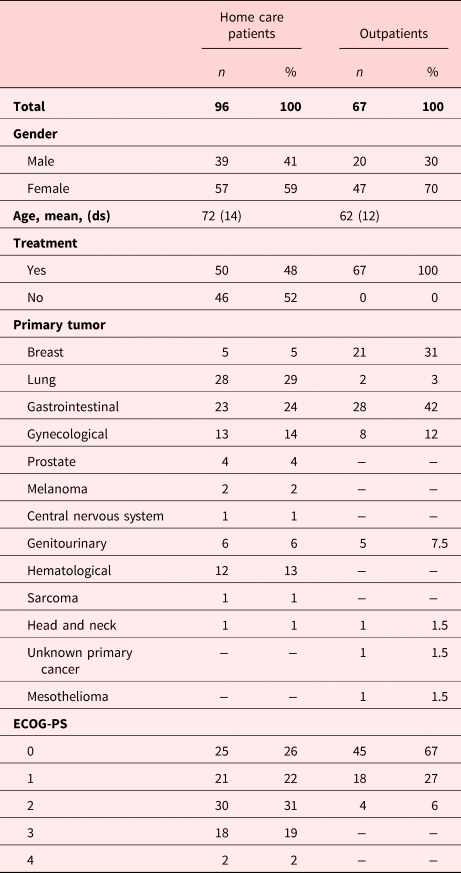
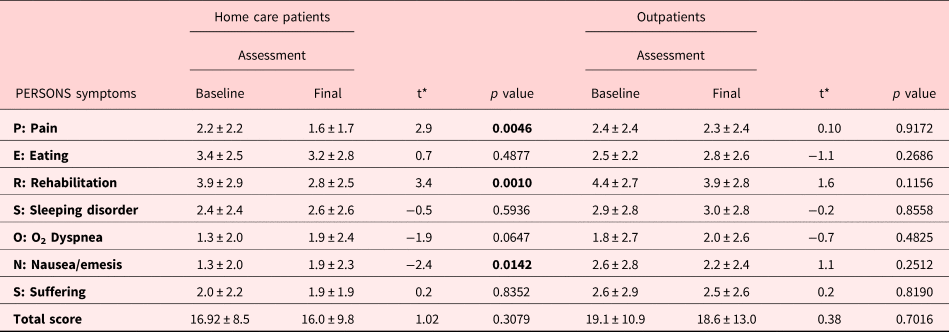
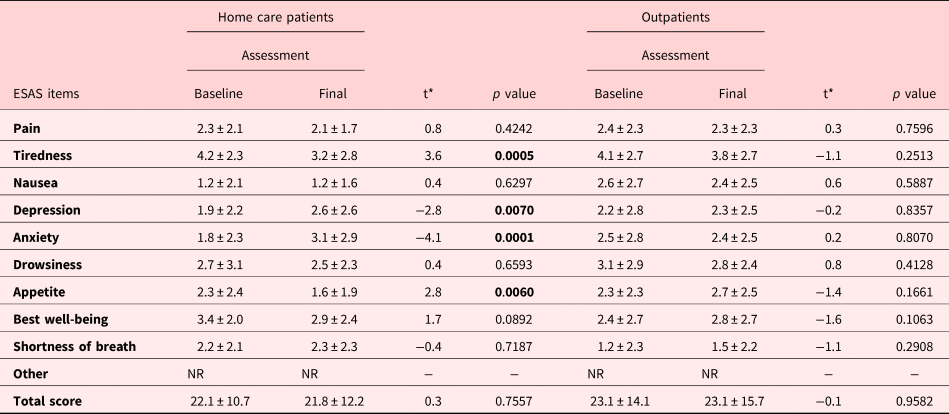
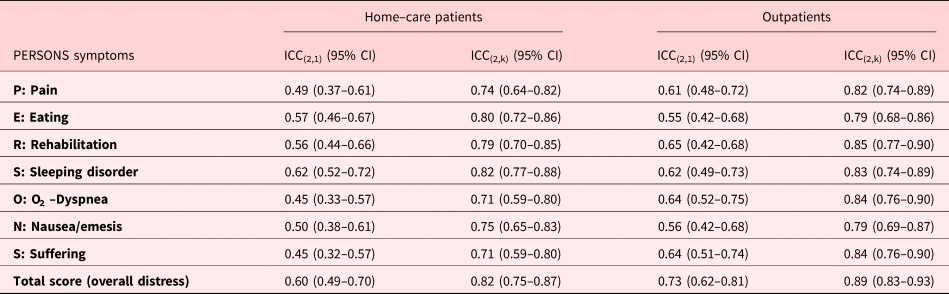
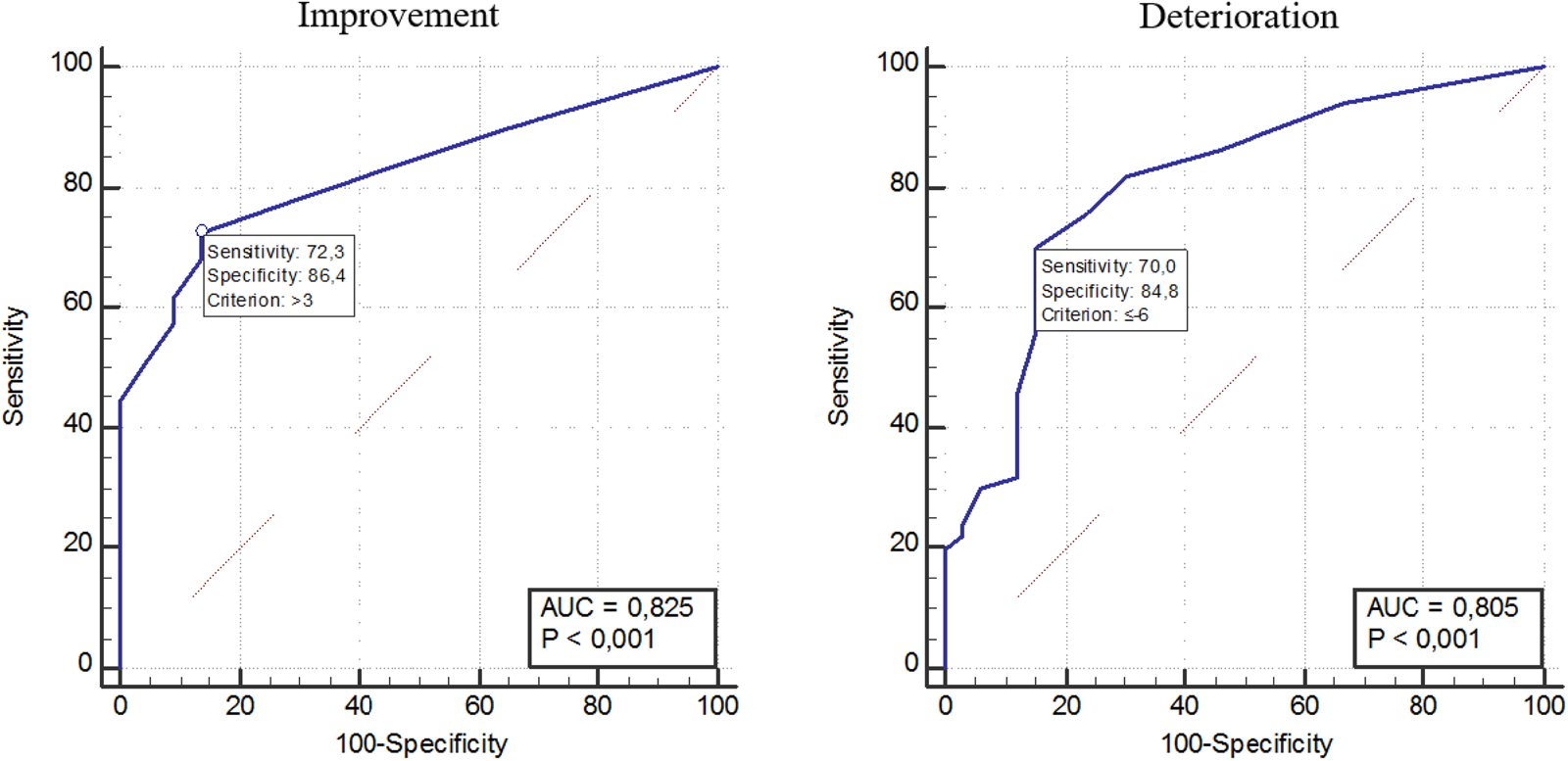
From November 2017 to April 2018, 67 and 110 consecutive patients were enrolled in the outpatient and home care cohort, respectively. Among the home care cohort, 14 patients (13%) were excluded, because they were lost to follow-up and because of a lack of data availability. The final study population consisted of 163 patients. Baseline demographic and clinical characteristics of the patients are reported in Table 1. Notably, 50 patients (52%) from the home care cohort underwent disease-oriented treatments, and 46 patients (48%) were out of treatment. No significant relationship between baseline PERSONS scores and ECOG-PS levels were observed in the entire cohort (r = 0.1506; p > 0.05, beta = 1.36, p = 0.055, respectively). There were no significant changes over time in total PERSONS scores. Significant changes were reported only for pain, rehabilitation, and nausea/emesis items in the home care patient group as shown in Table 2. Similarly, there were no significant changes over time in total ESAS scale scores. Significant changes were reported only for tiredeness, depression, anxiety, and appetite in the home care patient group as shown in Table 3. Table 4 reports the ICC2,1 and ICC2,k, showing high inter-interviewer reproducibility (test-retest) in each group of patients. The coefficients (r) between total PERSONS score and total ESAS score showed high correlations. As for the home care patients, they were 0.778 (95% CI 0.684–0.846 [CIs for Pearson's product-moment correlation was based on Fisher's transformation], p < 0.05) at baseline and 0.789 (95% CI 0.698–0.854 [CI for Pearson's product-moment correlation was based on Fisher's transformation], p = < 0.05) at the final assessment. Similarly, for outpatients, the coefficients of correlation were 0.904 (95% CI 0.847–0.940 [CI for Pearson's product-moment correlation was based on Fisher's transformation], p < 0.05) at baseline and 0.942 (95% CI 0.907–0.964 [CI for Pearson's product-moment correlation was based on Fisher's transformation], p = < 0.05) at the final assessment. The mean PERSONS and ESAS scores between home care patients and outpatients were not different, at neither baseline nor the final assessments (Table 5). ROC for the total PERSONS score revealed that the AUC was 0.825 and 0.805 for improvement and deterioration, respectively, indicating good responsiveness. The minimal clinically important difference (MCID) for improvement was >3 scale points, and for deterioration, it was ≤–6 (Figure 1). The MCID calculated by groups for improvement was >3 (sensitivity = 66.7; specificity = 92.3) for home care patients and >7 (sensitivity = 64.7; specificity = 100.0) for outpatients. The MCID calculated by groups for deterioration was ≤–6 (sensitivity = 71.4; specificity = 82.4) for home care patients and ≤–5 (sensitivity = 77.3; specificity = 81.2) for outpatients.
Patients’ features

PERSONS scores at baseline and the final assessment by group. Values are expressed as mean and standard deviation

*Paired t test. Bold values stand for p < 0.05.
Edmonton Symptom Assessment Scale (ESAS) scale scores at baseline and the final assessment by group. The values are expressed as mean and standard deviation

*Paired t test. Bold values stand for p < 0.05.
Inter-interviewer reproducibility ICC(2,1); intra-interviewer reproducibility ICC(2,k) by group (ICCs).

Differences in PERSONS and ESAS scale between home care patients and outpatients. *unpaired t test.

Receiver-operating characteristic curves (ROC) in improvement and deterioration for the PERSONS total scores.

Discussion
To reach the coveted early integration of supportive care into oncological practice, we have to define the goals clearly and how to reach them with available time and tools (Verna et al., Reference Verna, Giusti and Marchetti2016). Guidelines, scientific society, and position papers recommend a prompt symptom evaluation as the first step of this process. In today's clinical practice, there are several tools for symptom evaluation that “fit” both in terms of acceptability by patients and in terms of efficiency. Among them, the ESAS scale is the best validated and universally recognized one. To be clear, we used the ESAS scale to validate the PERSONS score right because it is the most widely used. Our aim was not to establish superiority nor inferiority of one over the other. Therefore, any comparative evaluation, in terms of performance, would be inappropriate. Our speculations will, therefore, focus on what we think are still gray areas on the topic, despite all efforts. In our opinion, the question is: do these tools also “fit” for clinicians? Probably not. In addition to the abovementioned data regarding the poor attitude of oncologists in regularly using validated tools to evaluate symptoms (Zagonel et al., Reference Zagonel, Torta and Franciosi2016), a recent study showed that there are several barriers to using the ESAS scale in daily practice among cancer care professionals (Pereira et al., Reference Pereira, Chasen and Molloy2016). Providing an explanation for these findings is not simple; does the increasing interest in disease-oriented treatments divert attention from supportive care? Could it be explained by the lack of time and workload in outpatient care centers? Surely, oncological practice is becoming more complex; we are going towards “precision oncology” that requires time and resources. In such a complex scenario, being realistic, we need to carve out a space for symptom assessment, and we must do it using simple tools that do not add “complexity to complexity.” Moreover, we must not forget that the majority of patients are followed in peripheral cancer centers, without availability of a palliative care consultant, so a simple tool could be of service, particularly in centers with limited resources. Aware of these gaps, we moved toward searching alternative easy to apply tools that could be better transposed into everyday clinical practice. While considering the results of the pilot studies in both advanced palliative care and simultaneous care settings (Masel et al., Reference Masel, Berghoff and Schur2016; Cortellini et al., Reference Cortellini, Porzio and Masel2018), PERSONS has proven to be the “user friendly tool” that we seek.
The study population was from a dual setting: the outpatients represented the typical sample of patients to whom “ideal simultaneous care” is devoted, in whom symptoms have to be assessed independently from the disease stage and the cause that triggered them (disease and/or treatments). Indeed, 20 out of 67 enrolled patients (30%) were on adjuvant chemotherapy. The home care patients represented the advanced population to whom “palliative care” has been historically provided. Despite that, 50 out of 90 enrolled patients (48%) were on active disease-oriented treatment. In this study, the PERSONS score showed high reliability in each group of patients, with high correlations between PERSONS and ESAS, both at baseline and the final assessment. ROC curves revealed AUC of 0.825 and 0.805 for improvement and deterioration, respectively, and, thus, confirmed good diagnostic ability. Although it was not an objective of the current study, it is correct to note that there were no significant changes over time in total PERSONS scores contrary to what we observed before (Masel et al., Reference Masel, Berghoff and Schur2016; Cortellini et al., Reference Cortellini, Porzio and Masel2018). However, there were also no significant changes in total ESAS scale scores, so the differences in the populations enrolled might have played a role. Moreover, in the palliative care setting, symptoms might not improve on a numeric level because of declining clinical conditions.
Conclusion
With this study, we can confirm that the PERSONS score is a good diagnostic tool for symptom assessment/monitoring. Our intention was to try to provide simple answers to complex questions; in our opinion, the PERSONS score could be that tool that not only “fits” for the patients, but also “fits” for the clinicians. We hope that other researchers want to test the PERSONS score in other settings, to improve the early integration of supportive care in oncological clinical practice.
Ethical statement
All patients provided informed consent to participate to this observational non-interventional study. The procedures followed were in accordance with the precepts of Good Clinical Practice and the Declaration of Helsinki. The study was conducted following the rules of the local bioethical committee competent on human experimentation (Comitato etico per le province di L'Aquila e Teramo). All authors declare no competing interests on the topic of the study. This was a spontaneous study, without sponsors nor a funding source.
Availability of data and materials
The datasets used during the present study are available from the corresponding author upon reasonable request.
Supplementary material
To view supplementary materials for this article, please visit https://doi.org/10.1017/S1478951519000543
Conflict of interest
The authors declare no competing interest.
Acknowledgements
none.
Funding source
none.