


School bullying is a malicious process in which youths are subjected to unwanted aggressive behaviours from either another youth or group of youths who are neither intimate partners nor siblings (Centers for Disease Control and Prevention, 2016). It encompasses three major characteristics: intentionality, repetition, and power imbalance (Olweus, Reference Olweus1993). Worldwide, the World Health Organization (WHO) has surveyed and reported the bullying prevalence rate among 42 countries around the world in their annual report Health Behavior in School-Aged Children (HBSC) that up to 11% of students have reported being involved in school bullying or victimisation (WHO, 2016). Studies have emphasised that bullying may have detrimental effects on students’ physical and mental health (Liu, Lan, Hsu, Huang, & Chen, Reference Liu, Lan, Hsu, Huang and Chen2014; Mitsopoulou & Giovazolias, Reference Mitsopoulou and Giovazolias2015; Ttofi, Farrington, Lösel, Crago, & Theodorakis, Reference Ttofi, Farrington, Lösel, Crago and Theodorakis2016). Consequently, the prevention and response to school bullying has become an important issue, not only in Europe, America and Oceania (see Lin, Reference Lin2014; Smith, Kwak, & Toda, Reference Smith, Kwak and Toda2016), but also more recently in Asian countries (see Chung, Reference Chung2017; Smith et al., Reference Smith, Kwak and Toda2016).
Scholars have gradually explored several aspects of school bullying in the Taiwan context, such as bullying prevalence and types of bullying behaviours. Wu, Luh, and Yen (Reference Wu, Luh and Yen2013) investigated the bullying prevalence of 3441 students from 20 secondary schools in Taiwan and found the rates of self-reported bullies, victims and bully-victims among students to be 8.71%, 7.01% and 2.91% respectively. Chen, Wong, and Feng (Reference Chen, Wong and Feng2015) surveyed 1816 students from 22 primary schools in Taiwan. Their study indicated that the rates of self-reported bullies, victims, bystanders and bully-victims among students were 13.7%, 14.5%, 37.2% and 5.4% respectively. According to the above data, it can be determined that around 10–20% of students are involved in school bullying in Taiwan primary and secondary schools. As for the types of bullying behaviours, studies have shown that both verbal bullying (e.g., swearing, mocking, nicknaming, insulting characteristics of victims) and physical bullying (e.g., intimidation, threats, physical attacks, deliberately tripping victims) are relatively common among primary and secondary school students. In contrast, cyberbullying is the least common among these (Chen et al., Reference Chen, Wong and Feng2015; Chiu, Reference Chiu2002; Mok, Wang, Cheng, Leung, & Chen, Reference Mok, Wang, Cheng, Leung and Chen2014). In order to reduce school bullying, in 2012 the government of Taiwan announced national antibullying policies and planned corresponding school-based practices for implementation in primary and secondary schools. These school-based practices included the following three domains: (1) school campaigns, involving the implementation of a variety of anti-bullying courses and activities to help students, teachers and parents to gain a comprehensive understanding of school bullying, thereby raising their awareness of school-bullying prevention, and the construction of a school security network with communities to prevent school bullying; (2) treatment of school bullying, involving the establishment of relevant procedures and mechanisms to recognise and manage bullying incidents, such as regular investigations into bullying prevalence, recruitment of teachers and staff to build an antibullying committee in each school, the introduction of appeal channels of incident reporting by students and parents, and the obligation of teachers and staff to report suspected bullying incidents to the antibullying committee team; and (3) intervention and counselling, involving the implementation of relevant strategies to address school bullying, such as investigations into bullying incidents by the antibullying committee, the reporting of each bullying incident, and the dispatch of investigation reports to the Ministry of Education within a set deadline, as well as treatment for the students involved (Chen & Chen, Reference Chen and Chen2018; Chung, Reference Chung2017). These strategies are similar to well-known antibullying programs used around the world, such as the Kiusaamista Vastaan (KiVa) program in Finland (Salmivalli & Poskiparta, Reference Salmivalli and Poskiparta2012) and the Olweus Bullying Prevention Programme (OBPP) in Norway (Olweus, Reference Olweus1993; Olweus & Limber, Reference Olweus and Limber2010). Both not only emphasise providing the stakeholders with school bullying resources and training relevant to bullying prevention, but also focus on the establishment of a specific team consisting of teachers and staff members to assist in tackling school bullying. In addition, they also attach importance to collaboration among schools, parents and communities for bullying prevention.
To reduce school bullying more effectively, it is necessary to reflect on these school-based practices and thereby reduce the weaknesses (Jiménez-Barbero, Ruiz-Hernández, Llor-Esteban, & García, Reference Jiménez-Barbero, Ruiz-Hernández, Llor-Esteban and García2012; Nickerson, Reference Nickerson2019). Since bullying could be considered a significant risk to health and safety issue, the framework of risk management theory (Charles & Kim, Reference Charles and Kim1988) — organising management according to various goals and the specific timing of an intervention — could assist in examining the weakness of this school-based practice more carefully (Carter, Reference Carter2012; Rossouw & Stewart, Reference Rossouw and Stewart2008). Risk management theory divides the management of risk events (e.g., school bullying) into three phases. First, a preparation and alleviation phase focuses on the appropriate steps for the prevention of school bullying, which should be implemented before it occurs, thereby preventing it from happening. Second, a reaction phase focuses on the implementation of immediate intervention when school bullying does occur. Immediate intervention aims to stabilise a mob scene as soon as possible, minimising its potential harm to students, reducing further deterioration and preparing actors to accept restorative actions. Third, the recovery phase focuses on a recovery plan that should be developed and implemented after school bullying occurs. The plan aims to help students involved in bullying resolve and recover from the incident. This might also alleviate the cause(s) of bullying and victimisation, thereby preventing reoccurrence. It is worth noting that the school-based practices currently adopted by Taiwan’s schools and teachers are classified as either preventing bullying incidents from occurring (e.g. strengthening supervision in schools, setting appeal channels for incident reporting) or restoration, implemented after bullying occurs (e.g., providing a possible intervention for the students involved, such as counselling, discipline, and a parents’ meeting; Chen, Reference Chen2018). In terms of teacher empowerment, most training still focuses on either prevention or restoration through, for example, enhancing teachers’ basic understanding of national antibullying policies and corresponding school-based practices (Chung, Reference Chung2017), training teachers to correctly identify school bullying (Chen, Sung, & Cheng, Reference Chen, Sung and Cheng2017), guiding teachers to adopt a restorative justice approach to tackle school bullying (Oliver Branch Center, Reference Branch Center2014), and training teachers to strengthen students’ understanding of school bullying (Wang & Lee, Reference Wang and Lee2018) and relevant coping strategies (Fang, Reference Fang2016; Ferng & Yen, Reference Ferng and Yen2013). However, actions related to helping teachers — the front-line workers in dealing with school bullying —intervene in school bullying when it occurs still attract relatively less attention in these school-based practices (S.M. Huang, Reference Huang2018).
The above trend also exists in international antibullying programs or relevant interventions, especially in relation to teacher empowerment; available activities or training are mainly related to bullying prevention. For instance, the OBPP and KiVa programs focus on strengthening teachers’ basic knowledge of school bullying (Kärnä, Voeten, Little, Poskiparta, Kaljonen, & Salmivalli, Reference Kärnä, Voeten, Little, Poskiparta, Kaljonen and Salmivalli2011; Olweus & Limber, Reference Olweus and Limber2010), and some antibullying interventions focus on instilling antibullying beliefs and attitudes in teachers (Dedousis-Wallacea, Shuteb, Varlowa, Murrihya, & Kidmana, Reference Dedousis-Wallacea, Shuteb, Varlowa, Murrihya and Kidmana2014; Pytash, Reference Pytash2013) that can assist in changing their behaviours so that they react to school bullying in a positive direction (Hajdaraj, Reference Hajdaraj2017), thereby preventing it from occurring (Espelage & Swearer, Reference Espelage and Swearer2003). Other activities or training mainly emphasise teachers’ competencies in relation to the development and implementation of recovery approaches. For example, in the Method of Shared Concern, teachers need to be able to host a specific meeting with the students involved in which they express appropriate concerns, thereby solving the bullying incident in an effective way (Wurf, Reference Wurf2012). With regard to immediate intervention, while its importance seems to be emphasised by some well-known international antibullying programs, such as the OBPP and the KiVa (Olweus, Reference Olweus2005; Salmivalli & Poskiparta, Reference Salmivalli and Poskiparta2012), some of the content and training regarding teachers’ effective and immediate intervention in school bullying when witnessing it are still inadequate in antibullying programs.
Teachers play an important role in terms of bullying intervention (Olweus & Limber, Reference Olweus and Limber2010; Rigby, Smith, & Pepler, Reference Rigby, Smith, Pepler, Smith, Pepler and Rigby2004; Yoon & Bauman, Reference Yoon and Bauman2014), but some lack the competencies to handle school bullying in a timely way (Begotti, Tirassa, & Maran, Reference Begotti, Tirassa and Maran2017; Chiu & Chang, Reference Chiu and Chang2012), which may lead to problems; for example, critical opportunities may be missed to intervene in time (Hazler, Miller, Carney, & Green, Reference Hazler, Miller, Carney and Green2001) and to prevent a negative impact on students (Messias, Kindrick, & Castro, Reference Messias, Kindrick and Castro2014). Eventually, a bullying case may become too difficult to resolve. There is thus an urgent need to develop the appropriate training to enhance teachers’ competence in immediately intervening in school bullying (CIISB). In view of the lack of clarity of the nature of this competence, its construct has to be clarified first.
Competence in intervening in school bullying
Competence is generally defined as the mastery of an integrated set of knowledge, skills and attitudes that are reflected in observable behavior in a context (Deakin Crick, Reference Deakin Crick2008; Kunter et al., Reference Kunter, Klusmann, Baumert, Richter, Voss and Hachfeld2013). Few studies have focused on CIISB; however, studies that have examined teachers’ immediate intervention in student aggression may reference sources in terms of gaining a preliminary understanding of the competencies needed for dealing with school bullying because they share some common features — for example, both are considered emergency situations on campus, and bullying can be seen as a specific type of student aggression intended to hurt others (Berkowitz, Reference Berkowitz1993; Cascardi, Brown, Iannarone, & Cardona, Reference Cascardi, Brown, Iannarone and Cardona2014).
In light of the framework for immediate intervention in student aggression proposed by Meese (Reference Meese1997) and Goldstein, Palumbo, Striepling, and Voutsinas (Reference Goldstein, Palumbo, Striepling and Voutsinas1995), a feasible format for intervention by teachers when witnessing student aggression might be described as follows. First, stay calm: The teacher should stay calm to maintain his/her objectivity and professionalism when addressing the aggression. Second, obtain assistance: The teacher should rapidly evaluate the event, check the identities of the actors and onlookers, and check whether assistance is needed to tackle the aggression. Third, use defusing tactics: The teacher should adopt safe strategies to stop the aggression, such as approaching the actors calmly, staying outside their personal space and providing face-saving advice, as well as making firm requests to end the aggressive behaviour. Fourth, control the crowd: The teacher should disperse onlookers to reduce the complexity of the aggression and ensure maximum safety. Fifth, discuss with actors: If necessary, the teacher can cooperate with other teachers to separate the actors and induce cooling down. Ultimately, the teacher should talk with the actors to clarify the cause of the aggression and develop a recovery plan.
In addition to concrete actions and steps, the literature emphasises the need to adopt appropriate attitudes. For instance, it highlights the need to establish trust on the part of the students involved (Spaulding, Reference Spaulding2005; Tsao, Reference Tsao2009), which means the teacher needs to implement the following measures during the immediate intervention: first, adopt a friendly and supportive demeanour towards the actors; second, provide the actors with sufficient opportunities to express their perspectives; third, handle the aggression fairly and show no partiality; and fourth, control their own emotions.
The present study
This study aims to explore the constructs of CIISB and thereby identify the processes that experienced teachers apply when intervening immediately in a bullying case, using a qualitative approach. The present study assumed that the constructs of CIISB may be partly similar to those regarding immediately intervention in student aggression because some of the characteristics are shared. However, some differences still exist; for example, students involved in a situation characterised by aggression may hold equal power, whereas there is a power imbalance in bullying (Cascardi et al., Reference Cascardi, Brown, Iannarone and Cardona2014). Moreover, bullying is mainly a recurrent experience, whereas a situation in which aggression is expressed may be a one-off event (Olweus, Reference Olweus1993). In this respect, relevant studies have argued that a bullying intervention should be differentiated from an intervention in student aggression in order to enhance the effectiveness and feasibility of programs for dealing with school bullying (Cascardi et al., Reference Cascardi, Brown, Iannarone and Cardona2014; Greif & Furlong, Reference Greif and Furlong2006). This inspired the present study to involve experienced teachers in exploring the constructs of CIISB.
Methods
Participants
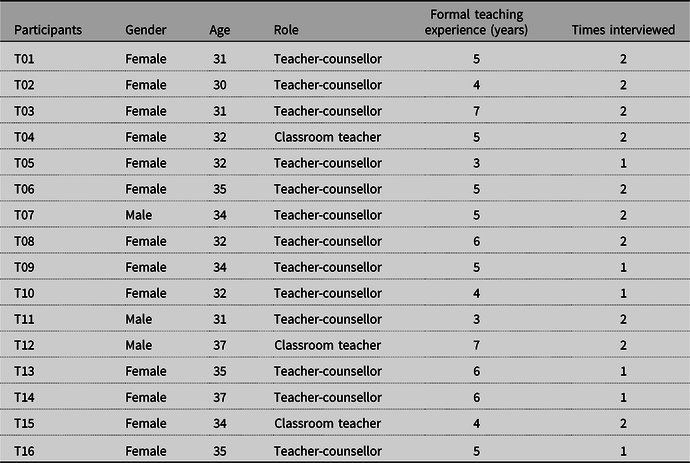
As bullying behaviours are commonly observed among secondary school students (Espelage & Colbert, Reference Espelage, Colbert, Holt, Grills, Holt and Grills2016), secondary school teachers were the appropriate potential subjects in this study. The inclusion criteria adopted were: (1) participants had at least three years of teaching experience and (2) they possessed relevant experience of promptly intervening in common types of school bullying incidents (e.g., physical, verbal and relational bullying). With regard to participant invitation, three approaches were adopted: (1) announcing research details (e.g., such as the purpose and procedure of the study, the sampling criteria and contact information) in several online Taiwanese teacher communities (e.g., Facebook and Line) to recruit potential participants; (2) identifying potential participants and contacting them by email, phone and social media (purposive sampling) to confirm their willingness to participate in the study; and (3) inviting participants to put forward names of other potential participants (snowball sampling). A total of 16 secondary school teachers were recruited and interviewed (3 males, 13 females; 3 classroom teachers, 13 teacher-counsellors; 9 from the north of Taiwan, 4 from central Taiwan, 3 from southern Taiwan; average teaching experience, 5 years; average age, 33.25 years). In total, 26 interview transcripts were generated because some teachers were interviewed twice to explore the constructs of CIISB in detail. The term ‘classroom teachers’ refers to those teachers responsible for maintaining contact with parents and managing all student affairs in the class; teacher-counsellors were included in the study because they not only perform guidance duties but also, in a Taiwanese context, teach guidance-related subjects. The demographics of the participants in the study are shown in Table 1.
Demographics of Interview Participants

Research instrument
Semistructured interviews were used to collect qualitative data. Two interview outlines were adopted in this study. The first interview outline was originally developed by consulting previous studies related to the intervention in student aggressions (e.g., Goldstein et al., Reference Goldstein, Palumbo, Striepling and Voutsinas1995; Meese, Reference Meese1997; Spaulding, Reference Spaulding2005; Tsao, Reference Tsao2009) and school-bullying interventions (e.g., Tu, Reference Tu2015; Yoon & Bauman, Reference Yoon and Bauman2014). Afterwards, this original outline was refined according to the feedback from a pilot study. The revision was as follows: interviews began by discussing teachers’ experiences of witnessing bullying incidents to gain a better understanding of these bullying incidents and to develop a shared knowledge base for discussing the intervention process.
Eventually, this revised outline was employed in the first round of data collection. The interview questions were as follows:
-
1. Have you ever witnessed a student-bullying incident? What was happening?
-
2. Have you ever intervened immediately in a student-bullying incident? Could you please share these experiences?
-
3. What competencies should teachers possess to address school bullying effectively and in a timely manner? Why are these competencies important? What important steps should be included during the intervention process?
-
4. What factors (e.g., different bullying types) influence the adoption of different steps in a school-bullying intervention? Why?
The second interview outline was adopted in the second-round data of collection to clarify unclear aspects identified after the analysis of the data collected from the first round, thereby enriching the results of this study. The interview questions were as follows:
-
1. Under the structure of the immediate intervention you mentioned, could you describe the immediate intervention process step by step? What are the necessary competencies corresponding to these steps?
-
2. How do you attempt to separate the student involved (i.e., students who bully others and/or are bullied) from other students? If it is not possible to proceed without separating the students involved from other students, how would you continue the follow-up immediate intervention, especially for incidental and intentional learning?
-
3. Could you share with us your opinions on seeking collaboration with other resources in the process of immediate intervention?
-
4. What is your perception of the role of developing relationships with the students involved in the process of immediate intervention?
Procedure
The research procedures of this study were reviewed and approved by the review board of Ghent university in order to ensure that the relevant rights of the participants would be protected during this study.
Pilot interviews and formal interviews
After recruiting the participants, two pilot interviews were arranged. These were not only beneficial in refining the interview outline in order to accurately collect participants’ experiences relevant to the research questions, but also assisted in understanding participants’ experiences in advance so that the researchers could prepare for follow-up formal interviews and enrich the data collection (Kim, Reference Kim2011; Nunes, Martins, Zhou, Alajamy, & Al-Mamari, Reference Nunes, Martins, Zhou, Alajamy and Al-Mamari2010). The interview data were not included in the analysis but were used to revise the first interview outline.
Before conducting the formal interviews, the researchers invited the participants to complete the informed consent forms and explained that the interviews would be documented through recording with pen recorders and by the taking of notes. The participants were allowed to determine the venue for the interview. All participants had relevant experience of immediate intervention in at least one of the common types of school bullying (i.e., physical bullying, verbal bullying or relational bullying). The data collection mainly focused on their opinions about effective and prompt intervention in school bullying, generated through their reflections on their previous relevant experiences. Two rounds of data collection were implemented in this study. Because overlaps in participants’ narratives appeared with some regularity during the later period of the first round of data collection, the data collection was stopped after interviews with 16 participants in this round. Put differently, data saturation seemed to be achieved at that time. However, after conducting preliminary analysis of the collected data, some unclear features were still identified (e.g., the roles of incidental and intentional learning, collaboration, and establishment of positive relationships with students in immediate intervention), which needed more elaboration. Therefore, theoretical sampling was adopted in the second round of data collection to reach data saturation. The unclear concepts were close to clarification after interviews with eight previous participants in this round. Data collection was stopped after interviews with 10 previous participants because no extra data were added (i.e., no more new perspectives and statements were obtained). This means data saturation was achieved.
Data analysis
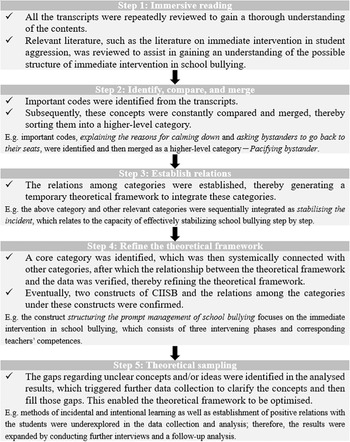
All the data were transcribed verbatim. These transcripts were then coded by one of the researchers. The data analysis in this study was mainly built on the basis of the ladder of analytical abstraction (Carney, Reference Carney1990) and the concept of constant comparative analysis (Glaser, Reference Glaser1965) was adopted to assist in the analysis. The procedure for the data analysis is shown in Figure 1.
The data analysis procedure.

Relevant approaches were adopted to ensure the quality of the present study in terms of its credibility, transferability, dependability and confirmability, thereby strengthening the trustworthiness of the qualitative analysis (Merriam, Reference Merriam2002).
Credibility
Peer debriefing was adopted in this study. Colleagues were invited to discuss and provide feedback on the preliminary results to enhance the results’ credibility and validity (Cooper, Brandon, & Lindberg, Reference Cooper, Brandon and Lindberg1997). For instance, after discussion with colleagues, we realised not only that structuring the immediate management is an essential competence for the implementation of immediate intervention, but also that ways of building positive relationships with the students involved during the immediate intervention should be considered.
Transferability
The results from this study were presented as clearly as possible, and the participants’ interview excerpts were appropriately quoted.
Dependability
An audit trail was employed in this study, meaning that the research methods, procedures and processes of data analysis were clearly described, thereby making the results transparent.
Confirmability
Two approaches were adopted in this study: member checking (Birt, Scott, Cavers, Campbell, & Walter, Reference Birt, Scott, Cavers, Campbell and Walter2016) and self-reflection (Cope, Reference Cope2014). Member checking can be used for inviting participants to review the analysis and interpretation of interview data so as to make the analysis reflect participants’ contexts based on their feedback (Birt et al., Reference Birt, Scott, Cavers, Campbell and Walter2016). With regard to member checking adopted in the present study, the preliminary results summarised by the analysis of the interview data collected in the first round were sent to participants via an email in which they were invited to review the results. Some of them replied to us and even highlighted a lack of clarity in the results that needed further elaboration. Therefore, in light of their comments, we reviewed the relevant literature and discussed it with research colleagues and then conducted the second-round data collection with some of the participants. Afterwards, the analysis of the results was refined and sent to the study participants for agreement through a process of consensus; eventually, they all agreed with the analysis. Moreover, research memos were used to record the personal reflections of the researchers about the impact of their perspectives on both data collection and analysis. This helped remind the researchers to maintain disciplined subjectivity to reduce bias impacts. For example, one researcher noted that reviewing studies about intervention in student aggressions during the process of data analysis might have influenced the coding by limiting the researcher’s interpretation on categories or themes. However, this process of self-reflection reminded the researcher to keep the characteristics of school bullying in mind in order to focus more on research data related to immediate intervention in bullying during the data analysis.
Results
The study identified two constructs of competence regarding the way in which teachers effectively and immediately intervene in school bullying: structuring the prompt management of school bullying and setting the appropriate atmosphere. These constructs are composed of several elements presented below (see also Figure 2).
The constructs of Competence in Immediately Intervening in School Bullying (CIISB).

Construct 1: Structuring the prompt management of school bullying
Phase 1: Identifying the incident
Noticing and identifying the bullying incident
Teachers should be vigilant with regard to bullying incidents and should stop teaching when bullying happens in the classroom. Teachers can collect information related to an incident by observing the interactions of those involved (i.e., students who bully others and/or are bullied) or by asking bystanders relevant questions, thereby identifying whether it was a bullying incident. Participant T07 proposed practical strategies: ‘I also ask some friendly students (bystanders) to confirm whether it is a bullying incident. I would ask them whether this student (the victimised student) is often criticised by them. Why? What are their views of this student?’
Phase 2: Stabilising the incident
Stopping the bullying incident
After confirming that the incident is a bullying incident, the teacher should first stop the bullying to avoid further deterioration of the situation. To do this, the teacher should let students know that they are concerned about the incident and that the authorities are available to intervene immediately. They should ask students to stop bullying and to cooperate. An example of how to verbally show the teacher’s concern and authority to stop a bullying incident was provided by T04: ‘I would let every student know that I have noticed these behaviours. For instance, “Don’t you think you are doing something wrong?” and “I already noticed it. Because I am teacher, I have the right and responsibility to stop it”.’
Pacifying bystanders
Bystanders are those present when bullying occurs. They may disturb or even aggravate the incident, especially in cases of verbal and physical bullying. Therefore, the teacher needs to be able to pacify bystanders after stopping the bullying if need be. In this regard, it can be useful to explain the relevant reasons to bystanders and to exert authority to ask them to comply with instructions. T11 suggested a way to pacify bystanders: ‘I told the bystanders, “I have already noticed this incident, and you guys should keep calm so that this scene will not become more chaotic. I will let you guys express your thoughts about this incident later”.’ If unsuccessful, teachers can use the bystanders’ fear and respect for the school authorities to ask them to follow instructions, such as going back to their seats and keeping calm.
Calming down the students involved
Like the bystanders, the students involved in bullying (i.e., students who bully others and/or are bullied) might still be emotional. In this regard, a priority for teachers is to calm down and persuade them to cooperate with the follow-up intervention. To accomplish this, teachers can empathise with the students involved and help them to express their emotions. Moreover, teachers can clearly express their intention to help the students resolve the problem. The above strategies are useful for calming down the students involved so that the follow-up intervention can proceed. An example is provided below.
I would actively listen to and appease them [the students involved], but I would interrupt them at the right moment and say, ‘I know you have many complaints about each other but you cannot explain them comprehensively in a short period. So … I expect you can stay calm and follow my instructions, and then I will give you the opportunity to clarify what was going on and I will collaborate with you to solve this problem. (T16)
Separating the students involved from other students if necessary
In certain circumstances during the process of stabilising the bullying incident, teachers need to separate the students involved from other students to keep all students safe and to proceed with the follow-up intervention. These particular circumstances include the following: when one party of the students involved (i.e. students who bully others and/or are bullied) cannot be calmed down; when the teacher is not capable of handling the students and bystanders simultaneously; when the majority of the students involved and bystanders express negative feelings towards the victimised student(s); and when the incident involves physical bullying or when someone has been hurt in the incident. T01 and T08 explained why teachers should separate the students involved from other students when encountering these situations:
If most bystanders do not like the victim, the victim may be constantly attacked by them, thereby worsening this situation. (T01)
If bullies and victims are still emotional, I prefer to separate them from other students because they are not able to follow my instruction for follow-up intervention. (T08)
To separate the students involved from other students successfully, the teacher needs to empathise with their feelings, state explicitly the reasons for the separation, and ask them to cooperate. T06 said:
I usually empathise with their emotions and tell them ‘I perceive you are angry now … but we cannot deal with this incident effectively if you get yourself into a state. I expect you to give me an opportunity to clarify this incident; hence, I hope you can go with the other teacher to the counselling room to calm down first.
If the students involved accept the separation, the teacher can contact others (teachers or trustworthy students) to assist in moving the students involved to separate spaces. However, if the students involved does not accept the separation, other strategies can be adopted, such as constantly empathising with them, giving them an early warning regarding the negative consequences, and working with other teachers to persuade them to accept the separation. T04 suggested a way to encourage the students involved to collaborate: ‘I might say to them, “I will ask your parent or the staff of student affairs office to come to resolve this problem together”. The option is not one they want, so they tend to accept separation.’
Phase 3: Clarifying incidents and implementing incidental and intentional learning
Clarifying the situation
After pacifying the students involved (i.e., students who bully others and/or are bullied), the teacher can immediately organise a discussion with bystanders and/or the students involved. Such a discussion helps to clarify the circumstances of the bullying incident, facilitates students’ antibullying attitude and responsibility for properly handling the actual incident, and prevents the situation from deteriorating further.
To facilitate students’ willingness to participate in this discussion, the teacher can first explain their perspective on the incident (e.g., their thoughts and feelings about it) and their responsibilities in dealing with it. T03 outlined corresponding practical strategies and highlighted their importance:
I would say ‘Because I must protect every student, I have to discuss this incident with you to clarify it and help you resolve the problem.’ Moreover, I would let them know what role I would play in resolving this incident, which makes me more trustworthy to them. Gaining more of their trust will help in solving the problem successfully.
Subsequently, the teacher can help the students to understand the procedure and goals in a short follow-up discussion, as suggested by T01: ‘This often comes as a relief to them and even helps them realise that I do not mean to make things difficult for them, which makes them more likely to comply with my instructions.’
At the beginning of this discussion, the teacher can collect relevant information regarding the incident. This clarifies the circumstances and the details of the students’ inappropriate behaviour, which feed into the follow-up plan for restoring order between the students. If the students involved have not been separated from bystanders, the teacher can focus on their perspectives first by asking questions relevant to the bullying incident, since they are the key players involved in it. Then, the teacher can invite bystanders to share their perspectives. As an example, T04 suggested one way to ask such questions:
I would ask the bully to tell me what was happening, what his/her thoughts and feelings are about the incident. Then it is the victim’s turn. Eventually, I would ask bystanders if they had anything to add regarding this incident. However, if the bully and victim are separated from students, I will ask bystanders to share their views directly.
In doing so, they are more likely to understand each other’s thoughts and feelings so that any misunderstandings between them in terms of their interactions are brought to light. In particular, when students explain their views, the teacher should actively listen and provide appropriate replies, increasing the students’ willingness to share.
Facilitating students’ empathy and invoking responsibilities
Many teachers in this study argued that bullying incidents mostly originate because of the inappropriate thoughts and actions of both students. Therefore, after clarification, the teacher should implement incidental and intentional learning for students. Incidental and intentional learning is defined here as a learning process in which the occurrence of a bullying incident is viewed as a learning opportunity to assist students in establishing both correct and suitable attitudes and approaches to tackle this issue. In this regard, encouraging students to be introspective about their thoughts and behaviours is important for incidental and intentional learning. It builds their empathy and helps them understand their personal responsibilities in an incident. If the students involved (i.e., students who bully others and/or are bullied) have not yet been separated from other students, the teacher can clearly summarise their thoughts, feelings and responses and those of bystanders regarding the incident, to help students to understand the positions of others. If the students involved have already been separated from bystanders, the teacher can summarise these elements for the bystanders (i.e., the remaining students). T04 outlined her corresponding practical strategies: ‘I often organise what they said according to their role in the bullying incident and the attributes of the contents … like positive, negative and neutral. Then I will articulate them and thereby make a summary.’ Afterwards, the teacher can adopt critical inquiry skills to lead the students into introspection about the negative consequences of their behaviours and how their behaviours resulted in the bullying incident. As an example, T15 suggested ways of asking students such critical questions:
I would ask bystanders ‘Who should take responsibility for this incident? How do you think about your bystander behaviour in this incident? Don’t you find that your behaviours also had some negative consequences in relation to this incident?’ Eventually, they come to realise that they should take some responsibility for the incident. (T15)
During this process, a student who bullies others might start to rationalise his/her bullying behaviour and blame the victimised student. To overcome this, the teacher can listen actively to the former’s complaints and empathise. After the former calms down, the teacher can invite the latter to express his/her thoughts and feelings, and then use inquiry skills to prompt the former to reflect on their behaviour, as T11 suggested:
I would lead him (the student who bullies others) to reflect on his bullying behaviours by asking some questions. For instance, ‘I think you are good at observation because you listed a lot of problems regarding the victim; however, I believe this incident was caused by the interaction between you guys. You guys should take responsibility for this incident. Don’t you think you should improve yourself? What should be improved?’
During the above process, the teacher also needs to point out relevant inappropriate thoughts and behaviours as well as any observations and analysis if necessary, thereby pushing the student who bullies others to take responsibility for the incident.
Afterwards, to trigger students’ empathy towards the victimised student, the teacher can explain to the former the feelings and thoughts of the latter regarding constant victimisation. As T03 explained: ‘I often invite bullies or bystanders to write down their own bullying/victimising experiences or others’ experiences that they have seen before. Summarising these experiences enhances their empathy towards the victims.’
Furthermore, a basic understanding of school bullying (definitions, impact and legal liability) can be provided to guide students’ responsibility for improving their inappropriate behaviours, preventing bullying, and modifying the nature of bystander behaviour.
Closing the discussion in view of future restoration activities
Before finishing the discussion, the teacher can concisely help to develop the appropriate coping strategies in all students to prevent similar bullying incidents from happening again. This is also an essential part of incidental and intentional learning. If the students involved (i.e., students who bully others and/or are bullied) have not yet been separated from the other students, the teacher can first focus on the students involved to clarify how they should interact appropriately. With regard to the bystanders, the teacher can discuss with them ways of preventing and tackling school bullying. During the above process, the teacher also needs to provide appropriate suggestions when they fail to develop strategies or come up with something inappropriate. An example is presented here:
I often let the bully know, ‘You can express dislike for the victim’s behaviour or character by verbal expression but you cannot harm them by using verbal or physical attacks.’ Then, I teach the bully what can be done to address the conflict with the victim. (T13)
Afterwards, the teacher can clearly state his/her antibullying expectations to encourage students to pay close attention to school bullying and related inappropriate thoughts and behaviour. If the students involved have not been separated, the teacher can ask both to talk with him/her after the discussion to develop a formal plan to address their chronic bullying and victimisation problems. T16 said: ‘I would ask the bully and victim to come to me after class. School bullying is a continuous process, so you must understand the whole context of their bullying/victimising situation and then develop formal restorations to thoroughly resolve their problems.’ If the students involved have been separated from other students, the teacher can let the bystanders know about possible follow-up plans to address the bullying and ways of dealing with the students involved and themselves. This helps to alleviate bystanders’ worries and serves as a warning to them about the consequences if they bully others.
Construct 2: setting the appropriate atmosphere
Constructing and maintaining a positive relationship
Setting the appropriate atmosphere for the immediate management of the incident is beneficial. The teacher should therefore establish a positive relationship with all the students involved. This helps to create an environment in which the students feel safe and are willing to follow the teacher’s instructions.
The following strategies can help: first, provide students with opportunities to express their perspectives on the incident; second, adopt basic guidance skills for interacting with students, such as actively listening, empathy, resolution, concreteness, abstract thinking and clarification; and third, avoid jumping to conclusions before clarifying the bullying incident. Relevant examples are presented below.
If you can listen to what they (the involved students) want to say and make them perceive your willingness to understand their perspectives, they will be more likely to accept your immediate management and less likely to feel there has been any unfairness. (T06)
Do not immediately jump to any conclusions about their behaviours. Perhaps the victim should take some responsibility for his part in the victimising process. (T09)
Maintaining a calm, serious and fair attitude when intervening in a bullying incident
The teacher should maintain a calm, serious and fair attitude when intervening in a bullying incident. This helps the students to take the incident and its management seriously and convinces them to follow the teacher’s instructions. With regard to effective strategies, the teacher should first control their own emotions; the teacher should not lash out at students or appear nervous during the immediate intervention. Second, the teacher should make clear to the students his/her antibullying attitude and standpoint. The inappropriate intervention of a situation by one of her colleagues and the importance of emotional management was shared by T02:
She yelled at the bystanders and bullies before clarifying what had happened in the incident. I think this kind of behaviour can break any chance of collaboration with the students and even lose their trust.
The following strategies help project teacher impartiality. First, a teacher should take equal care of every student involved in an intervention; for instance, the teacher should give every student equal time and opportunity to express their thoughts and vent their emotions, and should ask all the students involved in bullying (i.e. students who bully others and/or are bullied) to agree to be separated from other students if necessary. Second, a teacher should invoke introspection in every student and address inappropriate behaviour by all students because bullying is a consequence of inappropriate interactions among students. T08 said:
It is inappropriate to show bias towards victims just because of the stereotype that the victim is always vulnerable. Instead, teachers should distinguish what is right and what is wrong, give both sides enough time to express their ideas and even ask both sides to make improvements with regard to their undesirable characteristics.
To sum up, the elements mentioned above could be helpful for the implementation of immediate intervention so that a bullying incident can be effectively stabilised as soon as possible.
Towards integration
After analysing the above results, the final model was developed, as shown in Figure 2. The figure shows two clear constructs that can be identified in teachers’ immediate intervention in school bullying.
The first construct is structuring the prompt management of school bullying, in which the teacher focuses on three phases during the immediate intervention. The first phase is identifying: when bullying occurs, the teacher notices and identifies whether the incident can be labelled as a genuine bullying incident. The second phase is stabilising the incident: the teacher stops the bullying, pacifies the bystanders, calms the students involved and separates them from other students. These measures help to stabilise a chaotic situation. The third phase is clarifying the incident and implementing incidental and intentional learning: the teacher resolves the incident and tries to implement incidental and intentional learning in all the actors. This strengthens the students’ appropriate attitudes and their sense of responsibility in coping with future school bullying.
The second construct is setting the appropriate atmosphere, in which the teacher establishes an atmosphere of trust. Teachers are able to build and maintain a positive relationship with students and adopt a calm, serious and fair attitude during the intervention.
Discussion
This study aimed to explore key constructs that ground CIISB by investigating effective and prompt intervention. Two constructs were clarified above.
The theory of risk management (Charles & Kim, Reference Charles and Kim1988) was initially used to develop a picture to map the constructs within a bullying-focused competence (Forthun & McCombie, Reference Forthun and McCombie2011). However, this theory did not provide concrete guidance for structuring an intervention. In this regard, the results of the present study helped to reveal a bullying-oriented intervention based on the input of experienced teachers, which also demonstrated that some aspects of the original aggression-oriented management approaches in the literature (e.g., Goldstein et al., Reference Goldstein, Palumbo, Striepling and Voutsinas1995; Meese, Reference Meese1997) are potentially applicable to school bullying interventions, especially for elements included in phase 1 and phase 2 of Construct I in the present study. This is likely because both school bullying and student aggression are considered to be specific types of risky event (Carter, Reference Carter2012; Rossouw & Stewardt, Reference Rossouw and Stewart2008); therefore, these scenarios should be recognised and stabilised as soon as they occur to avoid their further deterioration, according to the main purpose of the reaction phase in risk management theory. Notably, compared to previous studies (e.g., Goldstein et al., Reference Goldstein, Palumbo, Striepling and Voutsinas1995; Meese, Reference Meese1997), the results of this study provided more detailed and concrete contexts for the handling strategies to be implemented in prompt intervention in school bullying. Taking ‘pacifying bystanders’ as an example, the present study not only highlighted its importance but also provided concrete strategies to achieve it. For instance, teachers can calm down bystanders by giving convincing reasons and using their authority. This meets the needs of stakeholders of a bullying intervention, such as teachers, enabling them to more effectively intervene in school bullying (K.F. Huang, Reference Huang2020; Shetgiri, Espelage, & Carroll, Reference Shetgiri, Espelage and Carroll2015). In addition, some results in this study are worthy of note, especially with regard to bullying management, which are discussed as below.
The priority of prompt intervention – correctly identifying school bullying
First, the intervening process to structure an immediate intervention for school bullying emphasises that teachers need to be able to identify whether an emergent bullying incident is happening, which is in line with the first and second steps of the model of Latané and Darley (Reference Latané and Darley1970): recognising the problem and interpreting the problem as an emergency. Correctly identifying school bullying can be helpful in prompting teachers to take immediate follow-up action to intervene (Chiu & Chang, Reference Chiu and Chang2012). However, studies have shown that teachers’ identification of school bullying is not always accurate because they do not fully understand the definition of school bullying and instead build on implicit perspectives to identify it (Chiu & Chang, Reference Chiu and Chang2012; Hazler et al., Reference Hazler, Miller, Carney and Green2001). Therefore, this study recommends that priority be given to enhancing teachers’ ability to identify bullying in order to ensure that they intervene in school bullying in a timely manner. Of the strategies identified in this study, observing interactions among students and asking students questions to clarify the situation are two competencies that may help teachers to identify school bullying more accurately.
Taking bystanders into consideration during prompt intervention
The findings also emphasise the importance of taking bystanders into consideration when intervening, which echoes many extant antibullying programs that focus on the role of bystanders and their influences during bullying interventions (see Thornberg et al., Reference Thornberg, Tenebaum, Varjas, Meyers, Jungert and Vanegas2012; Storer, Casey, & Herrenkohl, Reference Storer, Casey and Herrenkohl2017). According to Bronfenbrenner’s (Reference Bronfenbrenner, Husen and Postlethwaite1994) idea of ecological systems, all parts of a system — including bystanders — play a role in the behaviour of the student who bullies others, lending support to this focus. To make bullying interventions more effective, it is important to prevent bystanders from facilitating bullying (Kärnä et al., Reference Kärnä, Voeten, Little, Poskiparta, Kaljonen and Salmivalli2011) and to increase the possibility of encouraging bystanders to be assistants in bullying interventions (Polanin, Espelage, & Pigott, Reference Polanin, Espelage and Pigott2012). In this regard, the results of this study could guide teachers in performing the relevant competencies and actions during the immediate intervention (e.g., the elements in ‘pacifying bystanders’ and ‘clarifying the situation’ shown in Construct I; see Figure 2), thereby pacifying bystanders to reduce the risk of facilitating bullying and even taking their perspectives into account in terms of clarifying the bullying incident to develop an appropriate plan to resolve the current bullying and prevent future bullying (Tu, Reference Tu2015).
The importance of incidental and intentional learning
This study also emphasises the importance of implementing incidental and intentional learning during immediate interventions in school bullying, a factor that is ignored in the management of student aggression (e.g., Goldstein et al., Reference Goldstein, Palumbo, Striepling and Voutsinas1995; Meese, Reference Meese1997). The result empirically supports the initiative of previous studies to differentiate bullying intervention from intervention in student aggression in order to strengthen its effectiveness and feasibility for tackling school bullying (Cascardi et al., Reference Cascardi, Brown, Iannarone and Cardona2014; Greif & Furlong, Reference Greif and Furlong2006). School bullying is a long-term problem that tends to occur repeatedly (Olweus, Reference Olweus1993) and involves more students than acts of student aggression (Salmivalli et al., Reference Salmivalli, Lagerspetz, Björkqvist, Österman and Kaukiainen1996). Accordingly, it may have a greater negative impact; in particular, students are more likely to imitate or continue bullying behaviour to satisfy their own needs if it appears acceptable (Hasekiu, Reference Hasekiu2013). Therefore, incidental and intentional learning is necessary when a bullying incident occurs in order to cultivate students’ appropriate attitudes towards bullying. Moreover, bystanders usually play a crucial role in aggravating or inhibiting school bullying (Espelage, Holt, & Henkel, Reference Espelage, Holt and Henkel2003; Salmivalli et al., Reference Salmivalli, Lagerspetz, Björkqvist, Österman and Kaukiainen1996). Accordingly, teachers should encourage them to become assistants to inhibit school bullying when it occurs. In this respect, this study developed an evidence-based process for the implementation of an effective incidental and intentional learning program in which corresponding handling strategies were provided, as shown in phase 3 of Construct I (see Figure 2). Such educational processes need to encourage the development of empathy towards the victimised students (Garandeau, Vartio, Poskiparta, & Salmivalli, Reference Garandeau, Vartio, Poskiparta and Salmivalli2016), invoke reflection on inappropriate behaviour (Mazzone, Camodeca, & Salmivalli, Reference Mazzone, Camodeca and Salmivalli2018), remind students of their responsibilities in preventing school bullying (Pozzoli & Gini, Reference Pozzoli and Gini2010), and assist students in cultivating knowledge and strategies in regard to bullying (Storer et al., Reference Storer, Casey and Herrenkohl2017). These are also proven to be key points not only in facilitating students’ collaboration with teachers in bullying intervention (Hong, Lee, Lee, Lee, & Garbarino, Reference Hong, Lee, Lee, Lee and Garbarino2014), but also in establishing antibullying attitudes that help prevent future bullying (Yoon & Bauman, Reference Yoon and Bauman2014).
The way to facilitating the effect of prompt intervention–setting an appropriate atmosphere
An increasing number of studies have argued recently that in order to strengthen the impact of a bullying intervention, not only the intervention itself but also relevant factors that have a positive impact on the effectiveness and implementation of bullying intervention should be considered (Saarento & Salmivalli, Reference Saarento and Salmivalli2015; Wang, Swearer, Lembeck, Collins, & Berry, Reference Wang, Swearer, Lembeck, Collins and Berry2015). Previous studies have found that setting an appropriate atmosphere during intervention in student aggression can facilitate its successful implementation (Spaulding, Reference Spaulding2005; Tsao, Reference Tsao2009). In this respect, the results of this study not only proved that setting an appropriate atmosphere is important for the implementation of immediate intervention in school bullying, but also determined two key points regarding how to create an appropriate atmosphere, which refers to the building of positive relationships with the students involved and showing appropriate attitudes. This is because the establishment of positive relationships between teachers and students can enhance students’ willingness to cooperate with teachers when implementing an intervention (Storer et al., Reference Storer, Casey and Herrenkohl2017). Again, to draw on the ecological systems approach of Bronfenbrenner (Reference Bronfenbrenner, Husen and Postlethwaite1994), teachers’ behaviours and attitudes have an impact on students. In this respect, if a teacher can show an appropriate attitude, such as dealing seriously with bullying incidents, the other students will realise that bullying is unacceptable (Veenstra, Lindenberg, Huitsing, Sainio, & Salmivalli, Reference Veenstra, Lindenberg, Huitsing, Sainio and Salmivalli2014), and this may increase their own willingness to reorient inappropriate attitudes towards bullying and may encourage them to intervene (Wang, Berry, & Swearer, Reference Wang, Berry and Swearer2013). Accordingly, an antibullying atmosphere and a set of appropriate norms can also be created (Pozzoli, Gini, & Vieno, Reference Pozzoli, Gini and Vieno2012). To sum up, in view of the importance of creating the appropriate atmosphere for successfully implementing an immediate intervention in school bullying, the results of this study could be a useful guide, providing teachers with the appropriate practical and concrete strategies (see the element included in Construct II shown in Figure 2).
To summarise, the intervention model put forward in the present study seems to provide interventions that have a positive impact. According to social information processing (SIP) theory (Crick & Dodge, Reference Crick and Dodge1994; van Reemst, Fischer, & Zwirs, Reference van Reemst, Fischer and Zwirs2016), bullying behaviour is caused by a social-cognitive process through which an individual inappropriately interprets a social situation and thereby makes a biased self-judgment when reacting to the situation; for example, students who bully others reflect an aggression-related bias towards social situations and therefore resort to bullying behaviour, while students who bully others and are bullied have difficulty integrating internal and external social information to make appropriate judgments about their behaviours and to correct them (Toblin, Schwartz, Gorman, & Abou-Ezzeddine, Reference Toblin, Schwartz, Gorman and Abou-Ezzeddine2005). The above model for CIISB can be implemented in a SIP-based learning process because it may induce thinking and reflection processes in the students involved that may lead to a reinterpretation of bullying incidents and help students to consider their own biases in judging situations, which in turn may lead to them realising that some thoughts and behaviours are less appropriate (e.g., bullying others, aggravating bullying, misunderstanding the thoughts and feeling of the victimised students). This is the basis for pushing individuals to adjust and improve their inappropriate and/or undesirable behaviour (Fujita & Han, Reference Fujita and Han2009).
Practical implications
Overall, the results contributed practical implications in terms of teacher education and bullying management. First, the study clarified the constructs of teachers’ competence with regard to effective and timely intervention in school bullying. This can provide the basis for schools and teacher educators to check whether the stakeholders in bullying prevention (e.g., in-service teachers, other staff, preservice teachers) are equipped with this competence, thereby filling the identified gaps. Second, the study further develops the CIISB model (see Figure 2), which specifies the concrete and effective handling strategies for immediate intervention, such as showing concern and declaring one’s authority and responsibility for stopping bullying. This can be a useful reference for teachers and schools in terms of implementing an immediate intervention in school bullying. It is worth noting that CIISB is an integrated model that was mainly constructed by the reflections of experienced teachers on their immediate intervention experience in relation to common types of school bullying (i.e., physical, verbal and relational bullying); in this regard, theoretically this model can be applied to deal with those common types of bullying. However, to ensure both the applicability and feasibility of this CIISB model, especially in real educational settings, this study recommends that teachers consider the conditions and nature of the particular bullying incident (e.g., its type, level of severity and level of urgency) when applying the model, in order to intervene more appropriately and effectively. For example, if the incident involves severe physical bullying and harm to those involved, the teacher should consider separating the students involved from other students, whereas if it is merely verbal bullying and no bystanders are involved, the teacher can skip the step of pacifying bystanders while tackling the situation. Third, in view of the fact that teachers need more training to strengthen their bullying intervention competence (Marshall, Varjas, Meyers, Graybill, & Skoczylas, Reference Marshall, Varjas, Meyers, Graybill and Skoczylas2009), the research results present a basis for the development of training related to bullying intervention competence. As CIISB is a competence emphasising how teachers solve practical problems related to bullying in real educational settings, clinical simulation is a promising approach that puts preservice and in-service teachers in real-life settings (face to face or online) that lead to personal reflection, discussion, and the sharing of interpretations and practices. This is more useful for the development of such a competence (Dotger, Reference Dotger2013).
Limitations and Future Directions
Some of this study’s limitations have to be highlighted. First, the research data were coded by one of the researchers. A number of techniques were adopted during the process of data analysis so as to ensure the trustworthiness of the qualitative analysis, such as peer debriefing, audit trail, member checking and self-reflection (Merriam, Reference Merriam2002). However, the current study still suggested that in future studies qualitative data could be analysed by two (or more) trained coders, and intercoder reliability could also be calculated in order to avoid potential problems such as researcher bias. Second, the study primarily examined CIISB for three types of school bullying: physical bullying, verbal bullying and relational bullying. Therefore, the results may not be applicable to dealing with cyberbullying. The focus of future studies on the latter could help to broaden the nature of CIISB. Third, quantitative research could strengthen the current findings, since the teacher experiences in this study were personal. Fourth, this study focused on classroom settings, so the results may not be generalisable to settings outside the classroom. Future studies could focus on a wider range of settings. Fifth, this study mainly explored how teachers immediately intervene in school-bullying incidents. It did not consider follow-up plans to restore order and the relationship among those involved in school bullying. Future studies should focus on these pre- and post-bullying phases. Lastly, the sample of this study mostly consisted of teacher-counsellors, with a clear imbalance in genders (i.e., 3 males and 13 females). Although this matched the gender ratio of Taiwanese secondary school teacher-counsellors (i.e., a male-to-female ratio of 17:83; Department of Statistics, 2018), the gender imbalance of the sample is still a potential issue for the results of this study. For example, female teachers place more emphasis on empathising with victimised students than do male teachers (Duy, Reference Duy2013). In this regard, future studies should pay attention to the gender issue and collect more information about immediate interventions from male teachers, thereby refining the results of the present study.
Funding
The authors received financial support from the Ministry of Science and Technology in Taiwan (107-2917-1-110-002).
Conflicting of interest
None.