

Introduction
What does it mean to study Classics in a community college? While the discipline of Classics has been the subject of substantial reflection and reform within four-year institutions, much less attention has been paid to its presence – and disappearance – within the largest sector of American higher education: community colleges. These institutions, which are relatively unique to the United States, offer two-year degrees and serve as entry points to higher education. Designed to be affordable, local, and inclusive, community colleges enrol nearly 40% of all undergraduate students in the United States, including large numbers of students from first-generation, low-income, and underrepresented backgrounds (California Community Colleges Chancellor’s Office 2025). In California, the state with the largest community college system, 116 colleges collectively enrol more than 1.8 million students annually as of 2025.
For many students, community colleges are the only place where they may encounter the ancient Mediterranean world. Unlike research universities or liberal arts colleges, community colleges are rarely studied as sites of disciplinary formation in Classics. Yet, they are many students’ first (and sometimes only) exposure to general education courses in literature, history, philosophy, and languages. Understanding where and how Classics is taught in this sector is therefore essential to equitable access to the discipline.
This article offers the first long-term, data-driven account of how Classics has been taught – and increasingly not taught – across California’s community colleges. Drawing on over three decades of course records and administrative archive data, we trace the rise and sharp decline of Classics-related coursework between 1993 and 2024, with particular attention to ancient language courses. Our findings raise urgent questions for Classics educators and advocates: Where is our field accessible? To whom? And how have institutional changes shaped not only what gets taught, but whether Classics is taught at all?
We assembled a dataset of over five million course offerings held in California community colleges over the past 30 years. From this, we identified nearly 25,000 courses likely to contain Classical content, defined here as the study of ancient Mediterranean culture, language, literature, history, and philosophy, roughly between 3500 BCE and 500 CE. Courses were classified based on title, content indicators, and their likelihood of sustained engagement with Classical material. Each was further coded by sub-field, including mythology, philosophy, history, and languages.
We find that Classics-related course offerings rose steadily through the late 1990s and early 2000s, peaking in 2006, before experiencing a sudden and dramatic collapse beginning in the 2007–2008 academic year. From 1997 to 2007, California’s community colleges offered an average of over 2,000 Classics-related course sections per year. In the decade that followed, that average fell by 38%. The most dramatic contraction occurred in Classical language instruction: Latin offerings dropped by 86%, from an average of 53 sections per year before 2008 to just 7 sections in the years that followed.
In this article, which we envisage as the first in a series about the role of Classics in California community colleges, we argue that these curricular shifts are the result of changing institutional priorities, budget constraints, and the narrowing of curricular scope, especially in areas not seen as directly tied to career pathways or transfer efficiency. As Classics courses disappeared, so too did many students’ first opportunities to encounter ancient languages, foundational myths, and Mediterranean history in a classroom setting.
Background
While community colleges and the field of Classics have both been extensively studied, there is limited research specifically addressing the intersection of the two. This project aims to help fill that gap by examining how broader trends in community college reform and access affect the teaching and study of Classics, particularly in relation to transfer pathways, curricular offerings, and language instruction.
Community colleges in the United States
Community colleges in the United States are public institutions that offer two-year programmes leading to associate degrees or certificates. They provide an affordable and accessible pathway to higher education, often serving as a bridge to four-year universities or as a place to gain vocational training. Open to a wide range of students, including recent high school graduates, working adults, and returning learners, community colleges play a vital role in promoting educational equity and workforce development.
Despite this critical role, recent research highlights a national decline in community college enrolment since its peak around 2010, with particularly sharp drops among full-time students and adult learners. The American Association of Community Colleges attributes this trend in part to shifting demographics and economic conditions, though it also notes increased racial and ethnic diversity, especially among Hispanic students (American Association of Community Colleges 2019). Still, community colleges remain critical for providing affordable, accessible education, even as enrolment has declined from its 2010 high (Ma and Baum Reference Ma and Baum2016). These institutions continue to serve as one of the most important engines of social mobility (Romano and Eddy Reference Romano and Eddy2017), workforce development (O’Banion Reference O’Banion2019), and civic inclusion (Annenberg Public Policy Center 2024) in the United States.
California-specific projections from the Public Policy Institute of California forecast modest enrolment growth in the state’s community college system through the mid-2030s, with longer-term declines anticipated (Johnson and Perez Reference Johnson and Perez2024). While the University of California system is expected to expand, community colleges may struggle without targeted reforms and support.
Equity reforms and student success in California community colleges
The extensive curriculum reforms and equity initiatives within the California Community Colleges (CCC) system have yielded notable achievements in student outcomes. The system has seen a significant increase in the number of students earning credentials, with a 27% rise since the 2016–2017 academic year. Furthermore, the number of students earning an Associate Degree for Transfer (ADT) has experienced a substantial five-year increase of 74% (2022 State of the System Report: Equity for Every Student 2022).
AB-705 (Seymour-Campbell Student Success Act of 2012: Matriculation: Assessment 2017) and AB-1705 (Irwin. Seymour-Campbell Student Success Act of 2012: Matriculation: Assessment 2022) are landmark California laws that reformed how community colleges place students into English and math courses. AB-705 requires colleges to place transfer students directly into transfer-level courses unless there is strong evidence they are unlikely to succeed without remediation. This policy shift responded to research showing that placement tests often funnelled students, especially students of colour and first-gen students, into remedial classes that delayed progress. AB-1705 builds on this by further restricting remedial placement and requiring colleges to support student success in transfer-level coursework, making remedial enrolment a rare exception.
The reforms in remedial education, particularly driven by AB-705 and AB-1705, have led to dramatic improvements in foundational course completion. One-year completion rates for transfer-level English surged from 49% to 67% (Mejia et al. Reference Mejia, Rodriguez, Johnson and Perez2021). Direct placement rates into these transfer-level courses now stand impressively high, at nearly 99% for English and 98% for mathematics, with racial equity gaps in placement almost entirely closed (California College Promise Program 2025). This indicates a significant success in ensuring equitable access to college-level coursework for all student groups.
Classics in US higher education
In recent decades, the field of Classics has experienced a decline in enrolment, making it a representative case study of shifting educational priorities in the United States. In the past 10 years, several elite institutions have closed their Classics departments (e.g. Carthage College, Howard University) or phased out their Classics programmes (e.g. Calvin University, Illinois Wesleyan University, etc.) (Hall Reference Hall2021). This decline reflects a broader trend: the increasing national emphasis on STEM and career-oriented disciplines at the expense of the humanities. As Trepanier (Reference Trepanier2023) notes, Classics accounted for 17.2% of humanities degrees at four-year institutions in 1967 but had fallen to just 6.5% by 2013. Our analysis of community college course offerings reveals a parallel decline in the two-year sector, suggesting that this reprioritisation has had widespread institutional effects.
One of the defining features of a Classics degree in the United States and beyond has traditionally been the study of ancient languages, particularly Ancient Greek and Latin. This linguistic training distinguishes Classics from related disciplines such as history or literature. However, recent developments have challenged the centrality of these requirements (cf. Vereeck et al. Reference Vereeck, Bracke, Herdt and Janse2024). In a particularly high-profile example, Princeton University eliminated its undergraduate language requirement for Classics majors, sparking significant debate (Princeton Classics 2021). The change, intended to promote racial equity, drew criticism from scholars like Columbia linguist John McWhorter, who argued that it reinforced rather than reduced racial disparities (McWhorter Reference McWhorter2021). Others defended the decision as a step towards dismantling structural barriers that have historically excluded students without prior access to Latin or Greek (Walden Reference Walden2021).
Community colleges have historically helped address this gap by offering introductory Latin and Greek courses, allowing students to prepare for the language requirements of four-year institutions. Unfortunately, these efforts are often undermined by transfer credit policies. Many community colleges do not offer credit-bearing courses in ancient languages, which puts transfer students at a disadvantage compared to their peers who have had access to Latin or Greek instruction earlier in their academic careers (Burns et al. Reference Burns, Bucciantini and Davidson2022).
Data and methodology
Data acquisition
This study draws on publicly available administrative data from the California Community College Chancellor’s Office’s DataMart, a state-run portal that records information on every course offered within the CCC system. With 116 institutions and over 1.8 million enrolled students as of 2025, CCC represents the largest system of public higher education in the United States. DataMart serves as the most comprehensive source for tracking curricular offerings across this system over time. Between academic years 1992–1993 and 2023–2024, the CCC system offered over five million courses across all subject areas. Each course entry in the dataset includes institutional identifiers, course titles, subject classifications, term of offering, and the number of sections offered.
Because the raw dataset was not structured to isolate Classics or even broader humanities content, a significant amount of filtering and annotation was required to extract relevant courses. This process is described in detail in the following subsections. However, it is worth emphasising here that the breadth and granularity of the Chancellor’s Office dataset make it uniquely suited to long-term, system-wide analysis of curricular trends.
Identification of courses relevant to classics
Identifying courses relevant to Classics required a multi-stage filtering and annotation process. The dataset includes every course offered across the 123 colleges in the system between 1992 and 2024.Footnote 1 Courses are organised using the Taxonomy of Programs (TOP), a standardised classification system employed across California’s public colleges to label subject areas such as ‘History’, ‘Philosophy’, ‘Foreign Language’, or ‘Humanities’. While ‘Classics’ is a TOP code in the CCC system, the term is frequently applied to courses in general humanities, canonical English literature (e.g. Shakespeare), or even film and music labelled as ‘classics’, making the TOP code unreliable for isolating Greco-Roman or ancient Mediterranean content.
To identify potentially relevant courses, we first conducted a comprehensive review of the TOP codes and their associated course titles. We evaluated each TOP classification for its likelihood of containing Classical material. For example, fields such as ‘World History’, ‘Humanities’, ‘Philosophy’, and ‘Foreign Language – Latin’ were retained for further inspection, while unrelated fields (e.g. ‘Business Law’ or ‘Environmental Studies’) were excluded. This process yielded a preliminary subset of approximately 33,000 courses across subjects in which Classics content might plausibly appear.
It is important to note that our classification of courses was based solely on the course title and the associated department or TOP code listed in the dataset. We do not have access to syllabi or enrolment numbers for individual courses. While our method provides a consistent and systematic approach to identifying Classics-related offerings across institutions, it does have limitations. Course titles and departmental codes do not always capture the full scope or content of a class, and interdisciplinary or thematically relevant courses may fall outside our parameters. Thus, it is likely that there are courses teaching Classics-related content that are not in our dataset. Nevertheless, this approach represents the fullest extent of the available data and offers a valuable, if conservative, estimate of the curricular presence of Classics, including Latin, Greek, Classical literature, and ancient history, across an entire state education system over more than three decades.
Each course title was hand-annotated to determine its relevance to Classical studies. Our team defined Classics broadly as the study of ancient Mediterranean culture – including literature, philosophy, religion, art, and language – between approximately 3500 BCE and 500 CE. While we initially considered extending the timeframe to include late antiquity and early medieval material, we ultimately chose to prioritise content that remained firmly rooted in ancient contexts.
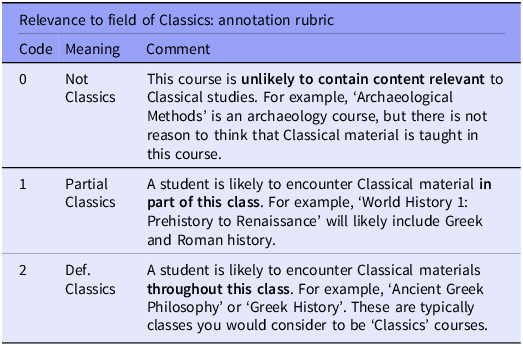
Each course was assigned a numerical relevance code based on its title and anticipated content: 0 for courses unlikely to include Classical material (e.g. ‘Archaeological Methods’ with no specific focus on the ancient Mediterranean); 1 for courses likely to include some Classical content alongside other material (e.g. ‘World History I: Prehistory to Renaissance’); and 2 for courses focused primarily or entirely on Classical subjects (e.g. ‘Greek Mythology’ or ‘Ancient Greek Philosophy’). To facilitate more specific analysis, each course was also tagged with a thematic code indicating its disciplinary focus. These markers included: Language (e.g. Latin, Greek, or Aramaic); History (e.g. Greek or Roman History); Literature; Mythology; Philosophy; Religion; Biblical Studies (e.g. ‘Life of Jesus’ or ‘The Bible as Literature’); Art or Art History; Archaeology; Experiential courses (e.g. travel study programmes to Classical sites or museums); and courses that were mistakenly included and later marked for removal. This allowed us to track not only the general presence of Classics in the curriculum, but also the distribution of sub-fields within the discipline.
In our analysis, we focus on the number of course sections offered rather than simply the number of courses because section count provides a more accurate measure of student access and instructional presence. A single course (e.g. ‘Greek Mythology’) may be taught in multiple sections across different campuses or terms, each representing a separate opportunity for enrolment. By tracking section counts rather than course titles alone, we are able to capture how widely a course was taught and, by extension, how many students were likely exposed to Classical material. This approach reflects not just curricular offerings in theory, but the actual scale and reach of Classics instruction across the CCC system.
To more accurately reflect how institutions plan and implement curricula, we grouped all course sections by academic year, which includes Fall, Winter, Spring, and Summer terms. Because academic calendars are typically organised and funded on an annual cycle that begins in the Fall, this method offers a more accurate lens for evaluating curricular change than organising data by calendar year. For example, if Latin I was offered in both Fall 2004 and Spring 2005, both sections are counted under the 2004–2005 academic year.
The result of this process was a curated and coded dataset of 24,786 courses, offered as 47,564 individual sections, across 117 community colleges (Note: some colleges have since closed, which accounts for the discrepancy with the current total of 116 California community colleges) that either focus on or meaningfully include Classical material. This dataset forms the evidentiary basis for the historical and quantitative analysis that follows.
Aggregate trends in classics offerings
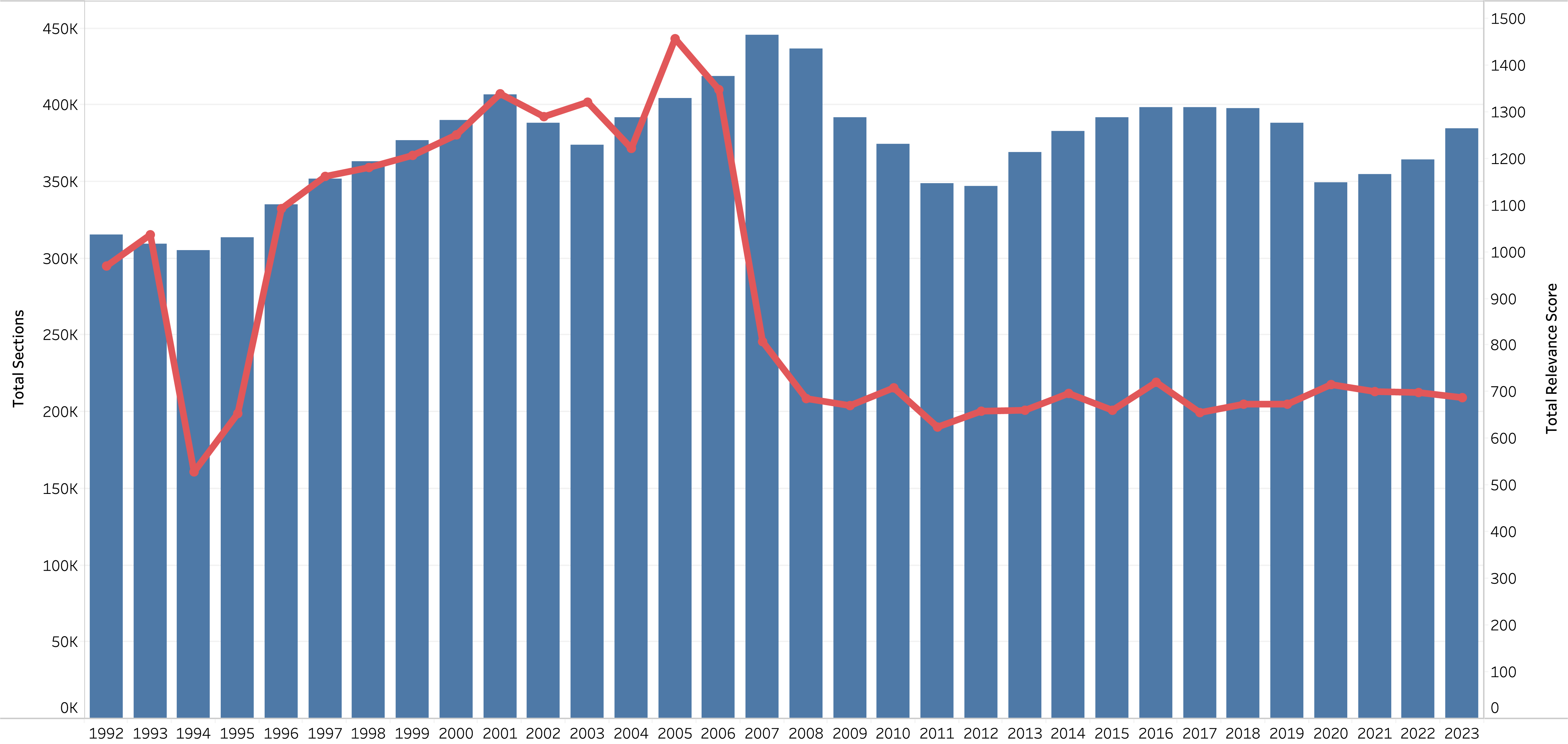
Across the 31 academic years from 1992–1993 to 2023–2024, the data reveal a clear and striking pattern in the presence of Classics and Classics-relevant instruction within California’s community colleges (see Figure 1). We observe three distinct phases in the curricular history of Classics within the CCC system.
Course offerings and Classics-content relevance in California community colleges, 1992–2023. The blue bars (left axis) show the total number of course sections taught statewide in each academic year (e.g. 1993 = 1993–1994). The red line (right axis) represents the sum relevance of all sections to Classics-content, a measure of how much of the statewide curriculum engaged with Classics material. The overlay illustrates that the overall volume of course sections rose through the mid-2000s, dipped during the recession, and partially rebounded in the 2010s. The relative presence of Classics content peaked just before 2007–2008 and has since declined and flattened, showing a decoupling from the broader recovery in course offerings.

The first is a period of growth (1994–2006), during which offerings of Classics-related courses increased steadily. Beginning from a modest base in the early 1990s, the number of annual course sections rose throughout the late 1990s and early 2000s, peaking at 2,378 sections in the 2005–2006 academic year. This expansion reflects broader investment in the humanities during this period, as many colleges prioritised general education and cultural heritage courses.
This growth was followed by a sharp collapse in the 2007–2008 academic year. Course sections fell from 2,378 in the 2005–2006 academic year to 1,232 by the 2007–2008 academic year, representing a 48% decrease in just two years. This decline aligns with the financial crisis that reached its peak in 2008 and coincides with early signs of shifting institutional priorities, and in particular, reductions in courses not directly tied to transfer pathways or workforce development. The speed and severity of the drop suggest a systemic reorganisation of curricular offerings.
The final phase, from 2008 to 2024, is best described as a flatline. Following the collapse, the number of Classics-related sections stabilised at a significantly reduced level, fluctuating between 1,032 and 1,232 sections per year. Compared to the pre-collapse average of 2,017 annual sections (1997–2007), the post-2008 average of 1,127 sections per year reflects a 38% decrease. This sustained plateau marks a new institutional baseline: while Classics was not eliminated, its curricular presence was dramatically curtailed and never returned to earlier levels.
These aggregate trends suggest that the decline of Classics in the CCC system was not gradual but abrupt and structural, reflecting broader changes in institutional priorities and posing urgent questions about access, equity, and the long-term health of the field.
Analysis of classical sub-fields
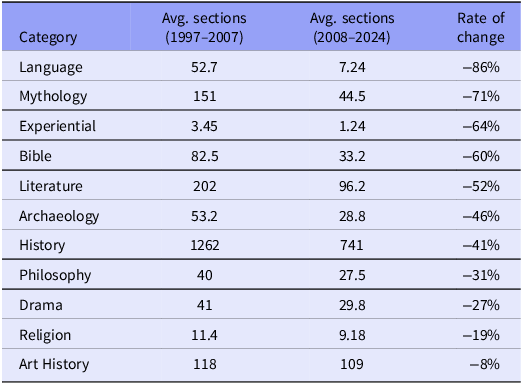
Different sub-fields within Classics have declined across California community colleges from the late 1990s to the present (Figure 2). Language courses (Greek, Latin, and Hebrew) experienced the most dramatic drop, with an 86% decrease in average annual course sections, falling from 52.7 in the 1997–2007 period to just 7.24 after 2008 (Table 1). This steep decline in linguistic training reflects the diminishing institutional support for one of the core competencies of a traditional Classics education.
Distribution of Classics-related course sections by subject category in California community colleges, 1992–2023. Stacked bars show the total number of course sections per academic year, with colours indicating disciplinary categories (e.g. Archaeology, Art History, Biblical Studies, Dramatic Arts, Experiential, History, Language, Literature, Myth, Philosophy, Religion). The figure highlights two major trends: (1) a peak in offerings across nearly all categories in the mid-2000s, followed by a steep contraction around 2007–2008, and (2) a long-term restructuring in which Literature and History dominate the field, while other categories such as Archaeology, Art History, and Philosophy remain comparatively minor but consistent contributors. The figure illustrates how curricular breadth narrowed after the recession, even as a core set of disciplines continued to sustain Classics-related content.

Average Number of Course Sections by Category in California Community Colleges Before and After the 2007–2008 Recession (1997–2007 vs. 2008–2024), with Rate of Change. The Table Highlights Steep Declines in Courses with Strong Classics-Content – Especially Language (−86%) and Mythology (−71%) – While Broader Humanities Categories Such as Art History and Religion Show Only Modest Reductions. This Shift Underscores How Curricular Contraction Disproportionately Affected Courses Most Directly Tied to the Field of Classics

Table 1. Long description
The table presents data on the average number of course sections in different sub-fields within Classics at California community colleges for two periods: 1997-2007 and 2008-2024. It includes the rate of change for each category. The table has three columns: Category, Avg. sections (1997-2007), Avg. sections (2008-2024), and Rate of change. The categories listed are Language, Mythology, Experiential, Bible, Literature, Archaeology, History, Philosophy, Drama, Religion, and Art History. Each row provides the average number of sections for the two periods and the rate of change. Notable trends include significant declines in Language (-86%), Mythology (-71%), and Experiential (-64%) courses, while Art History shows the smallest decline (-8%).
Mythology followed closely with a 71% decline, suggesting that general education courses rooted in myth have become increasingly rare. This is particularly significant because for many students, a myth course is their first point of contact with the ancient world and often serves as the initial spark of interest in Classics as a discipline. Greek myth, in particular, holds a prominent place in the broader public imagination and functions as a gateway to the ancient Mediterranean for students from diverse academic backgrounds. Myth courses introduce students to Classical literature, religion, art, and cultural history in accessible and interdisciplinary ways. Their disappearance from the curriculum threatens not only enrolment but also the visibility and accessibility of the field to new and diverse student populations.
Literature offerings display further internal differentiation. Courses focused specifically on Classical texts – courses assigned a relevance score of 2 and include titles that specify study of the Homeric epics, Greek tragedy, or Roman poetry – declined by 80%, from an average of 72.9 course sections annually to just 14.4 sections after 2008. This represents the second steepest drop after language instruction. By contrast, literature courses that include Classical material as part of a broader syllabus – courses assigned a relevance score of 1 and include titles such as world literature surveys or themed humanities classes – declined more gradually, by 36%, from 129 sections to 81.8 sections annually. This discrepancy suggests that while ancient texts still circulate within general education contexts, sustained and specialised engagement with Classical literature is becoming increasingly rare. The trend may reflect changes in general education requirements, textbook availability, or the diminishing number of instructors with graduate training in Classics.
Other traditional pillars of classical education also saw significant declines: Bible-related courses fell by 60%, Classical Literature (including courses of relevance 1 and 2) by 52%, Archaeology by 46%, and History by 41%. Notably, History remains the most widely taught sub-field in absolute terms but still lost over 500 annual course sections. Even high-enrolment areas have not been immune to broader institutional shifts.
In contrast, some sub-fields within the broader Classics umbrella have proven more resilient. Philosophy and Drama declined by 31% and 27%, respectively, while Religion fell by only 19%. However, Religion was also one of the smallest categories to begin with, averaging just 11.4 course sections per year between 1997 and 2007, and dropping only slightly to 9.18 after 2008, second only to Experiential courses in scarcity.
The most striking exception to the overall downward trend is Art History. While it initially declined after 2008 – averaging 86.1 course sections per year from 2008 to 2017, a 27% drop from the previous decade – it rebounded significantly in the years that followed. From 2018 to 2024, Art History averaged 141 annual sections, surpassing its 1997–2007 levels by 20% and rising 64% from its post-2008 low. It is the only sub-field to recover and exceed its earlier average. This resilience likely stems from its firm integration into general education and visual arts curricula, which may provide institutional stability even as standalone Classics departments falter.
Taken together, these data demonstrate that the contraction of Classics has not been uniform. Sub-fields perceived as having interdisciplinary relevance or practical curricular value – such as Art History, Philosophy, and Drama – have been better able to weather institutional shifts. In contrast, more specialised areas of the discipline, particularly those rooted in ancient languages and dedicated literary study, have experienced the steepest losses. This uneven pattern underscores the need for strategic rethinking: revitalising Classics in community colleges will likely require not only advocacy for the value of core competencies, such as language instruction, but also innovative curricular models that highlight the field’s relevance across disciplines and to contemporary student interests.
Temporal outliers and pivotal years
While the overall trajectory of Classics instruction in California community colleges can be broadly divided into three phases – growth, collapse, and flatline – certain years stand out as significant deviations from the prevailing trends. One such anomaly occurs during the 1995–1996 academic year, which shows a noticeable but unexplained drop in course section counts during what is otherwise a period of steady expansion.
In 1995, the National Endowment for the Humanities (NEH) experienced the most significant funding cut in its history: its budget fell by over a third, from $295.7 million in FY1995 to $185.8 million in FY1996 (adjusted for inflation). This sharp contraction had immediate effects on humanities programming across the country. Its impact may have been especially acute in California, where – as of 2014 – the state humanities council relied almost exclusively on NEH funding. In contrast to other states that drew support from local governments and private foundations, California’s heavy dependence on federal funds would have made it particularly vulnerable to national cuts, potentially leading to downstream reductions in programming across sectors, including community colleges.
Indeed, 1995 was a moment of broader concern for the future of higher education in the state. At a Board of Governors meeting that year, the CCC system hosted a session titled ‘A State of Emergency? Higher Education in California’, reflecting deep anxieties about fiscal sustainability and the role of the public sector (Agenda 1995). Degree production across the CCC system had also slowed: the 1994–1995 academic year saw a 2.4% drop in associate degrees awarded, though this trend reversed in subsequent years (Report on Transfers and Degrees and Certificates 1998–1999 2000, p. vi). Despite some signs of fiscal improvement – including a $500 million uptick in the state’s budget and lower-than-expected K–12 enrolment – the 1995–1996 budget year was widely anticipated to be a difficult one (Minutes of Committee Meeting 1994). These data points suggest that institutions may have pre-emptively scaled back lower-priority courses or delayed curricular expansion, even amid mild signs of recovery.
However, the causal relationship between the NEH cuts and the decline in CCC Classics offerings remains speculative. CCC budgets are supported by a variety of revenue streams (including state and local funding, student fees, and federal support) and humanities council allocations represent only one piece of this larger fiscal landscape. Moreover, a more substantial budgetary contraction occurred in 2002–2004, when CCC revenues declined by approximately $400 million (Johnson et al. Reference Johnson, Reyes and Bohn2013, p. 9) yet Classics course offerings remained relatively stable during that period. This suggests that the steep decline in the mid-1990s was not solely the result of budget reductions, nor were Classics courses consistently deprioritised during financial downturns. The 1995–1996 decline, then, may reflect a confluence of factors, including shifting institutional priorities, broader disinvestment in the humanities, and the immediate ripple effects of federal cuts, rather than a simple response to budgetary constraints alone.
By contrast, the most consequential and well-documented inflection point in the history of Classics instruction occurs in 2008, which marks the beginning of a long plateau that extends through the present. The years leading up to this shift saw a rapid and dramatic collapse: the number of Classics-related course sections dropped from a peak of 2,378 in 2005–2006 to just 1,232 by 2007–2008 – a 48% decline in two years. From 2008 onward, offerings have stabilised at a substantially lower baseline, averaging just 1,127 course sections per year, compared to an average of 2,017 per year from 1997 to 2007. This represents a 38% reduction in Classics-related instructional presence.
This steep decline aligns closely with broader economic and policy changes affecting the entire California higher education system. While the Great Recession officially began in December 2007, colleges and universities began bracing for financial cuts earlier. Between 2007–2008 and 2011–2012, the CCC faced cumulative budget reductions totalling nearly $1.5 billion – by far the largest contraction in the system’s history (Johnson et al. Reference Johnson, Reyes and Bohn2013). These cuts disproportionately affected the arts and humanities. For-credit courses in fine arts and humanities were among the first to be eliminated, while non-credit offerings – often tied to community engagement or lifelong learning – declined rapidly as well. Humanities subjects like Classics, which often fall outside workforce development priorities, were particularly vulnerable to these austerity measures.
At the same time, structural changes in state and federal policy pushed colleges to streamline curricular pathways. The push for ‘efficiency’ in transfer and degree completion led many institutions to focus on courses that fulfilled explicit general education or ADT requirements. Disciplines like Classics – especially those not embedded in transfer sequences or lacking clear vocational outcomes – were deprioritised in favour of fields aligned with STEM, social sciences, and professional programmes. This was not just a fiscal contraction, but a philosophical one: a narrowing of curricular scope that de-emphasised broad liberal arts education in favour of credentialing and expediency. CCC enrolment remained robust throughout much of this period, peaking in the early 2010s. Thus, the decline in Classics course offerings was not driven by a shrinking student body or by student disinterest, but by institutional choices about what kinds of education were worth sustaining in a constrained funding environment.
Together, the anomalies of 1995–1996 and the watershed of 2008 underscore that the decline of Classics in the CCC system has been shaped by more than simple budget arithmetic. These pivotal years reflect the broader vulnerability of the humanities to economic downturns and policy shifts, particularly in institutions that serve as critical access points to higher education for nontraditional and underrepresented students. Understanding these moments is essential not only for diagnosing past decline, but for imagining future strategies of resilience.
Trends in classical languages
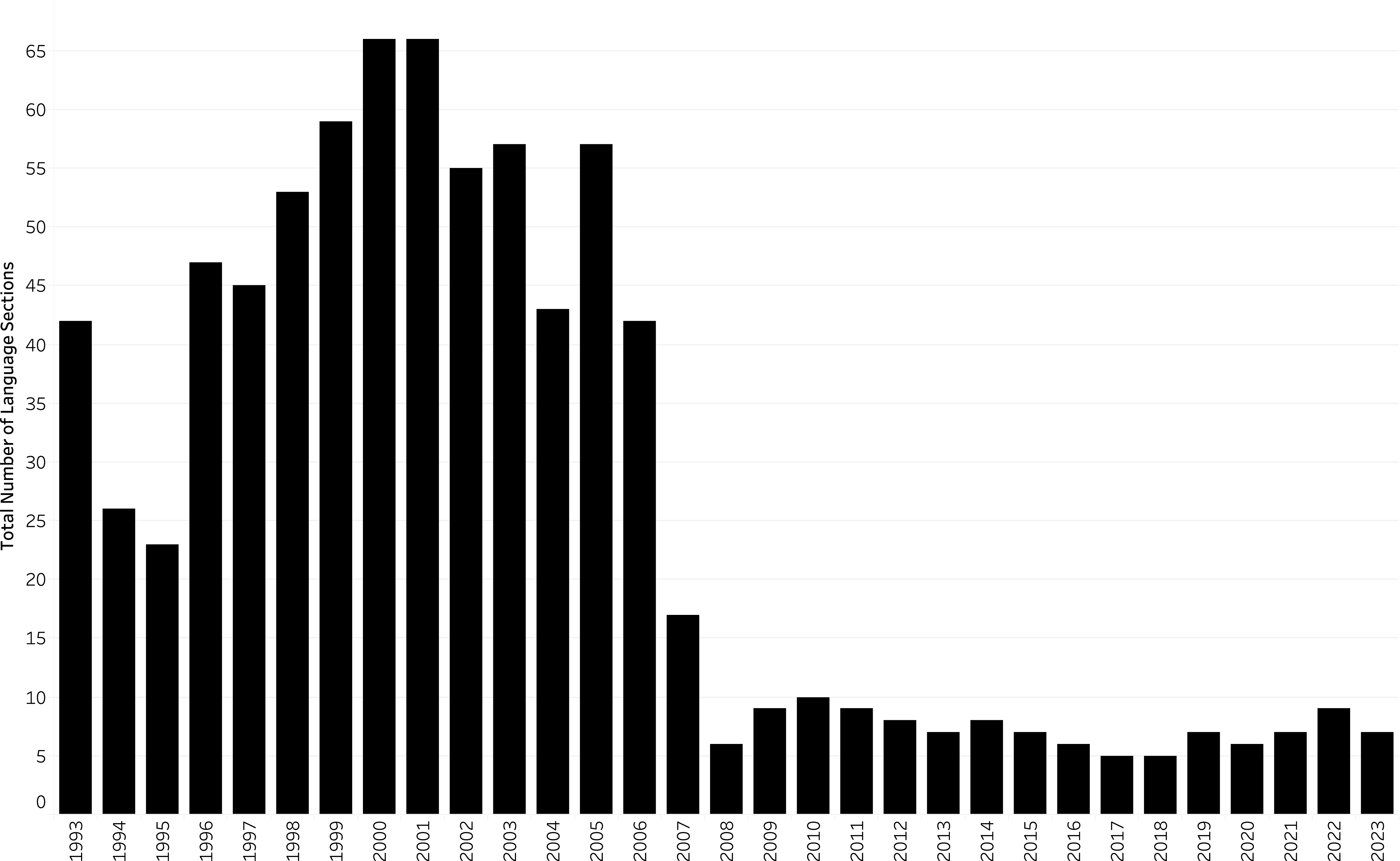
Among the various sub-fields of Classics offered in California community colleges, Classical languages experienced the most dramatic decline following the 2008 inflection point (Figure 3). Of these, Latin was by far the most commonly taught. While Greek and Hebrew occasionally appeared in course listings, they were offered only sporadically and never in large numbers; thus, the trajectory of Classical language instruction in the CCC system is effectively the trajectory of Latin.
Total number of Language course sections offered in California community colleges, 1992–2023. Offerings rose steadily through the 1990s, peaking in the early 2000s at more than 60 sections per year. After the 2007–2008 recession, Language courses experienced a dramatic collapse, stabilising at fewer than 10 sections annually. This decline represents the steepest contraction of any Classics-related category, underscoring the vulnerability of language instruction in times of curricular retrenchment.

Latin once held a more prominent place in the community college landscape. At least five California community colleges offered associate degrees in Latin: Los Angeles City College, Merritt College, Modesto Junior College, Pasadena City College, and Santa Monica College. In addition, San Diego Evening College offered a certificate programme in Latin (Master Plan and Inventory of Programs 1980). These programmes reflect an earlier era in which Latin was not only taught regularly but also embedded within formal degree pathways, an institutional investment that has largely disappeared in the decades since.
During the pre-2008 period, particularly between 1997 and 2007, community colleges offered an average of 52.7 Latin course sections per year, with a median of 53. These figures suggest that Latin had a modest but consistent presence across the system, likely serving a mix of transfer, humanities, and general education purposes. After 2008, however, Latin offerings fell sharply. From 2008 to 2024, the average number of Latin sections dropped to just 7.24 per year, with a median of 7. This represents an 86% decrease in Classical language instruction, making it the single most affected area within the broader field of Classics.
This steep decline reflects not only budgetary constraints but deeper structural shifts in the perceived value of ancient languages within the community college curriculum. As institutional priorities increasingly favoured transfer efficiency, career alignment, and measurable outcomes, Latin, lacking a direct and immediate vocational application, was deprioritised or eliminated altogether. The resulting disappearance of Latin from most CCC campuses signals a significant narrowing of the disciplinary and intellectual range available to students, particularly those encountering the ancient world for the first time at the community college level.
Comparative analysis with other sub-fields
While Classical languages experienced the most dramatic proportional decline, other sub-fields within the broader discipline of Classics also saw substantial reductions in course offerings after 2008. History, for instance, remained the most frequently offered category in absolute terms, but it nonetheless experienced a significant 41% decrease in course sections between the pre- and post-2008 periods. Given that many ‘World History I’ and ‘Ancient History’ courses include substantial Classical content, the reduction in history offerings had a widespread impact on how students encountered Greco-Roman antiquity, particularly in general education pathways.
When comparing sub-fields, language instruction suffered the steepest proportional decline, with Latin offerings reduced by 86%. This contrast highlights a critical shift not only in course availability but also in the kinds of intellectual and disciplinary experiences being prioritised – or deprioritised – within the curriculum. Whereas courses in history or mythology may survive due to their alignment with general education requirements, Classical languages often lack that institutional protection, making them more vulnerable to cuts.
These disparities have broader implications for transfer readiness and linguistic equity. For students beginning their academic careers at community colleges, the absence of Latin or Greek eliminates key opportunities to engage with the ancient world in its original languages, experiences that can be essential for success in upper-division coursework at four-year institutions. This creates a structural disadvantage for transfer students, particularly those from underrepresented backgrounds, who are disproportionately enrolled in community colleges. The uneven availability of Classics sub-fields thus reinforces existing inequities in access to the full disciplinary range of the humanities.
The disappearance of Latin from California community colleges carries important institutional and pedagogical consequences that extend beyond the language classroom. Within the study of the humanities, Latin has historically served as a gateway to advanced engagement with premodern texts and ideas. It provides students not only with linguistic tools, but with access to a deeper understanding of ancient, medieval, and early modern intellectual traditions. For many students – especially those without prior exposure to Classical education – community college Latin courses represented a crucial first encounter with the linguistic foundations of Western literature, philosophy, theology, and law.
The widespread removal of Latin from the curriculum, then, is not merely a logistical or budgetary adjustment; it signals a broader disinvestment in premodern cultural literacy. As colleges increasingly prioritise contemporary relevance and workforce alignment, disciplines rooted in historical depth, textual complexity, and linguistic training have come under pressure. The loss of Latin from community college offerings reflects this trend – and may also reinforce it, as fewer students are now positioned to pursue advanced coursework in Classics, medieval studies, or early modern history at the university level.
Pedagogically, the absence of Latin alters the intellectual ecosystem of the community college. It reduces opportunities for students to develop close reading skills, comparative historical frameworks, and the kind of cultural perspective that comes from engaging with a world structured by different assumptions, languages, and values. In doing so, it narrows not only the field of Classics, but the broader educational mission of the humanities in public institutions. For educators committed to access and disciplinary continuity, these trends raise urgent questions about how to sustain meaningful engagement with the ancient world in increasingly constrained curricular environments.
Conclusion
The data presented in this study reveal a clear and consequential shift in the place of Classics within California’s community college system. The most significant finding is the post-2008 collapse in Classics-related course offerings, which marked the end of a period of steady growth and ushered in a long plateau at significantly reduced levels. While all sub-fields of Classics were affected to varying degrees, Classical languages – particularly Latin – experienced the most dramatic decline, with an 86% drop in average annual section offerings. This reduction has had both immediate curricular effects and broader implications for how, where, and by whom the ancient world is studied.
Several external factors help contextualise this collapse. The 2008 financial crisis placed immense pressure on California’s public colleges, triggering funding cuts and staffing reductions that led to the elimination of courses not considered essential. In this environment, disciplines like Classics – especially courses without clear vocational outcomes or required transfer alignment – were often among the first to be reduced or removed. At the same time, statewide policy changes aimed at streamlining transfer pathways and reducing time to degree began to reshape general education priorities, further disadvantaging fields that emphasised depth, cultural heritage, or intellectual breadth over immediate applicability.
Compounding these pressures is the ongoing misalignment between community college curricula and university-level disciplinary expectations. While universities continue to offer upper-division courses in Latin, Greek, and Classical literature, community colleges have increasingly been unable to provide the foundational coursework that prepares students to enter those pathways. As a result, students who begin their academic careers in the community college system, particularly those without prior exposure to Classics, face significant structural barriers to pursuing the field at more advanced levels.
These developments have clear implications for educational equity. Classics has long been perceived as an elite field, historically associated with private schooling, affluent institutions, and advanced linguistic training. For a brief period in the 1990s and early 2000s, California’s community colleges disrupted that pattern by offering widespread access to Classical history, literature, and language. That access has now eroded. The disappearance of Latin and the overall contraction of Classics-related coursework mean that students from underrepresented or nontraditional backgrounds, who are disproportionately enrolled in community colleges, are losing access to foundational humanities education. If the ancient world is no longer available to students in the most accessible sector of higher education, we must ask: who still gets to study Classics? And what does that say about the future of the field?
The history of Classics in California community colleges, as revealed through this 30-year dataset, offers both a cautionary tale and a call to action. The collapse of Latin and Greek instruction after 2008, along with the broader reduction in Classics-related coursework, reflects not only institutional responses to economic and policy pressures, but also a deeper shift in educational priorities that increasingly sidelines the humanities in favour of narrowly defined outcomes.
Within this trend, Classical languages stand out as a bellwether. Their disappearance signals more than just a decline in enrolments; it reveals a systemic retreat from investment in premodern studies, historical depth, and linguistic complexity. As such, the fate of Latin and Greek may be understood as an early warning for the marginalisation of the humanities more broadly, particularly in institutions that serve the most diverse and economically vulnerable student populations.
This study also highlights the urgent need for data-informed approaches to curriculum history, especially at the level of state and regional systems. By documenting long-term patterns in course offerings, we can begin to understand the structural forces shaping what and where students are allowed to study. We hope this work encourages further collaboration between Classicists, educational researchers, and institutional decision-makers to better track, interpret, and respond to the social impacts of programme contraction.
Financial support
This research was funded in part by the Ralph Gallucci Internship Fund through the Department of Classics at the University of California, Santa Barbara and the Faculty and Undergraduate Research Grant through the Humanities and Fine Arts Division of the University of California, Santa Barbara.
Appendix A. Annotation rubric
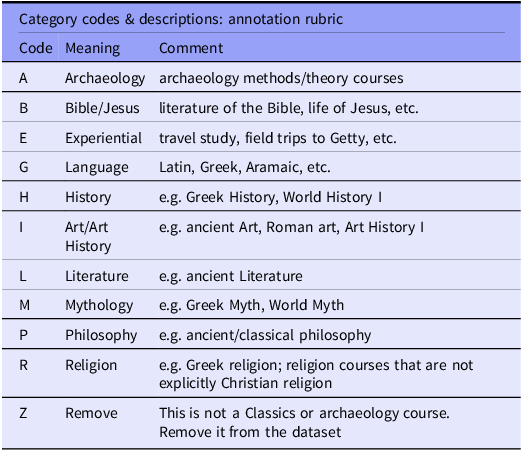
For the purposes of this project, Classics is defined as the study of ancient Mediterranean culture, history, and language between 3500 BCE and 1250 CE. Courses were categorised with this time frame in mind, with several clarifications guiding inclusion and exclusion (Table A1). We agreed that general courses such as Introduction to Literature, Introduction to World Literature, or broad Humanities surveys, along with museum studies courses, are not considered Classics unless they include a clear chronological indicator (e.g. Introduction to World Literature I: Ancient to Renaissance) that signals coverage of ancient material. Similarly, the term ‘prehistoric’ is treated as relevant to the period of interest and therefore considered at least partially Classical. In cases where courses are numbered or sequenced, such as World History I or World History A, we take the designation as an indicator that the course includes early or ancient world history and thus falls at least partially within the scope of Classics, whereas a general World History course without such specification does not. Archaeology courses are also being tracked, even when they fall outside the strict boundaries of Classics, since they frequently intersect with the field. Finally, courses with titles such as ‘History up to’ or ‘History through’ a relevant time period – but not limited exclusively to that period – are classified with a designation of ‘1’ to reflect partial relevance to Classics (Table A2).
Category Codes and Descriptions used for Annotating California Community College Course Sections

Table A1. Long description
A table with three columns: Code, Meaning, and Comment. The table lists various category codes used for annotating California Community College course sections. Each row provides a code, its meaning, and a comment describing the category. The table includes the following rows: Row 1: Code A, Meaning Archaeology, Comment archaeology methods/theory courses. Row 2: Code B, Meaning Bible/Jesus, Comment literature of the Bible, life of Jesus, etc. Row 3: Code E, Meaning Experiential, Comment travel study, field trips to Getty, etc. Row 4: Code G, Meaning Language, Comment Latin, Greek, Aramaic, etc. Row 5: Code H, Meaning History, Comment e.g. Greek History, World History I. Row 6: Code I, Meaning Art/Art History, Comment e.g. ancient Art, Roman art, Art History I. Row 7: Code L, Meaning Literature, Comment e.g. ancient Literature. Row 8: Code M, Meaning Mythology, Comment e.g. Greek Myth, World Myth. Row 9: Code P, Meaning Philosophy, Comment e.g. ancient/classical philosophy. Row 10: Code R, Meaning Religion, Comment e.g. Greek religion; religion courses that are not explicitly Christian religion. Row 11: Code Z, Meaning Remove, Comment This is not a Classics or archaeology course. Remove it from the dataset.
Relevance-to-Classics Annotation Rubric for California Community College Courses. Each Course Section was Assigned a Code Reflecting the Likelihood that Students would Encounter Classical Material: 0 = Not Classics, Where Content is Unrelated (e.g. Archaeological Methods Without Classical Focus); 1 = Partial Classics, Where Classical Content Appears as a Component of a Broader Curriculum (e.g. World History I: Prehistory to Renaissance); and 2 = Definite Classics, Where Classical Material is the Central Focus of the Course (e.g. Ancient Greek Philosophy, Greek History). This Rubric Enables Consistent Scoring of Courses for Their Relevance to the Field of Classics Across Multiple Disciplinary Categories

Table A2. Long description
A table titled ‘Relevance to field of Classics: annotation rubric’ with three columns: Code, Meaning, and Comment. The table has three rows with the following data: Row 1: Code 0, Meaning Not Classics, Comment This course is unlikely to contain content relevant to Classical studies. For example, ‘Archaeological Methods’ is an archaeology course, but there is not reason to think that Classical material is taught in this course. Row 2: Code 1, Meaning Partial Classics, Comment A student is likely to encounter Classical material in part of this class. For example, ‘World History 1: Prehistory to Renaissance’ will likely include Greek and Roman history. Row 3: Code 2, Meaning Def. Classics, Comment A student is likely to encounter Classical materials throughout this class. For example, ‘Ancient Greek Philosophy’ or ‘Greek History’. These are typically classes you would consider to be ‘Classics’ courses.
The data collected for this project are made available in open-source form to ensure transparency and facilitate further research. Raw data is available through the California Community Colleges Chancellor’s Offices’ Management Information Systems Data Mart (datamart.cccco.edu); annotated data is available through the Harvard Dataverse (Lamar et al. Reference Lamar, Gadkari, Robathan-Wu and Saona2026). In addition, all code used for data cleaning, processing, and the generation of statistics is provided alongside the datasets, likewise in an open-source format. This ensures that others may replicate our analyses, adapt our workflows for related projects, and build upon the resources we have produced.
Appendix B. CRediT
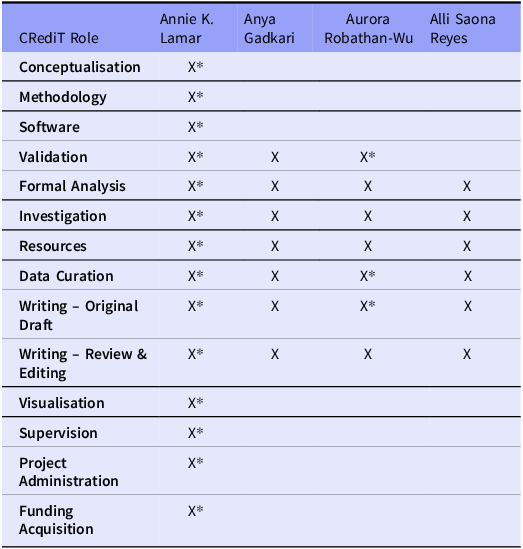
The CRediT (Contributor Roles Taxonomy) system provides a standardised way to describe authorship by specifying the distinct roles individuals play in a research project, rather than relying only on name order. By distinguishing who did what, CRediT promotes transparency, reduces authorship disputes, recognises forms of labour often overlooked, and supports accountability and equity in scholarly publishing (Allen et al. Reference Allen, O’Connell and Kiermer2019). In Table B1, ‘X’ indicates a contribution and ‘X*’ indicates primary contribution in a category.
CRediT Matrix for Current Article (Anonymized for Review)

Table B1. Long description
A table with 13 rows and 5 columns. The columns are labeled CRediT Role, Anon, Anon, Anon, and Anon. The rows are labeled Conceptualisation, Methodology, Software, Validation, Formal Analysis, Investigation, Resources, Data Curation, Writing - Original Draft, Writing - Review & Editing, Visualisation, Supervision, Project Administration, and Funding Acquisition. Each cell contains an X or is empty. X indicates a contribution, and X* indicates a primary contribution in a category. Row 1: Conceptualisation, X*, empty, empty, empty. Row 2: Methodology, X*, empty, empty, empty. Row 3: Software, X*, empty, empty, empty. Row 4: Validation, X*, X, X*, empty. Row 5: Formal Analysis, X*, X, X, X. Row 6: Investigation, X*, X, X, X. Row 7: Resources, X*, X, X, X. Row 8: Data Curation, X*, X, X*, X. Row 9: Writing - Original Draft, X*, X, X*, X. Row 10: Writing - Review & Editing, X*, X, X, X. Row 11: Visualisation, X*, empty, empty, empty. Row 12: Supervision, X*, empty, empty, empty. Row 13: Project Administration, X*, empty, empty, empty. Row 14: Funding Acquisition, X*, empty, empty, empty.


 Open access

