1. Introduction
Definiteness and specificity can be expressed in a number of ways—through position (Diesing 1991), case, verbal aspect (Leiss 1994, 2000; Abraham 1997; Philippi 1997), or, of course, through a determiner. The DP cycle involves demonstratives becoming articles. When the demonstrative in its turn is renewed, it is often done so through a locative adverb. For instance, the Old English masculine demonstrative pronoun develops into the definite article the, and the neuter one into a demonstrative, that. The latter is often reinforced in more recent stages by the adverbs there/here. In many languages, the articles are subsequently reanalyzed as affixes, as, for example, the Scandinavian definite suffixes.
In what follows, I use a framework where articles are heads in D that arise from elements in specifier position in accordance with certain Economy Principles. Articles, expressing only definiteness or specificity, are not that frequent cross-linguistically (see Himmelmann 1997, Lyons 1999), but demonstratives are. The latter mark location as well. Demonstratives interact and overlap with articles in languages that have articles and can, therefore, easily be reanalyzed as articles. In many cases, it is hard to decide whether or not an element is an article semantically, making possible a reanalysis in a way suggested by Economy Principles. I consider a noun phrase to be definite if its referent is known to the speaker. I am, however, mainly concerned with the position of the demonstrative and article, not with the meaning.
In section 2, I first briefly review some views on definiteness and specificity. In section 3, Minimalism and Economy Principles are out-lined. Section 4 shows how Economy Principles are relevant to the definite/DP-cycle. I argue that features are lost in this cycle and then replaced by new semantic ones. Sections 5, 6, and 7 discuss stages in the DP cycle in the history of Scandinavian, English, and Afrikaans, respectively. Section 8 presents the conclusion.
2. Definiteness, Specificity, and the DP
As Chomsky (2002:113) makes clear, “the semantics of expressions seems to break up into two parts [. . . ]. There's the kind that have to do with what are often called Thematic relations, such as Patient, Experiencer, etc.; and there's the kind that look discourse related, such as new/old information, specificity, Topic, things like that.” Marking the thematic positions can be done through pure Merge (as in Chinese and English) or inherent case and adpositions (Sanskrit, Latin, Malayalam, Japanese, and Tagalog). Definiteness and specificity are the second semantic aspect that needs to be marked. As mentioned, specificity/definiteness can be marked through case (Finnish and Persian), through aspect (Russian), through position (Chinese), or through a combination of position and articles as in Dutch and German, for example. The latter is the focus of this article.
Much has been written about the difference between definiteness and indefiniteness, and between specificity and nonspecificity. Specificity can be defined through identifiability, or—as in Frawley (1991:69)—as “the uniqueness of the entity,” for example, a particular man in 1, not just any man.

Specificity is relevant for whether to refer to a man as him (for specific) or as one (for nonspecific) in English, and whether to use indicative or subjunctive in Spanish, as in 2 (from Frawley 1991:70).

Many languages mark specificity through morphological or syntactic means, namely definiteness marks specificity and indefiniteness non-specificity. As 1 shows, this connection is not always straightforward. A very common way to mark definiteness is through a demonstrative or an article. Both have an identifying function, but demonstratives have an additional locational or temporal function and find a place in the DP.
Since the mid 1980s, the basic structure in 3 has been current for nominals.

The specifier of the DP contains demonstrative pronouns or possessive nominals (the latter moved from a lower position), and the D head contains articles and possibly the genitive marker 's in English. There are restrictions on the co-occurrence of definite markers. Thus, in English, either the specifier or head can be present but not both, as 4 shows.

The structure in 3 can be expanded with agreement and case features, or through a Num(ber) Phrase or a Kase Phrase, for example. It can also be expanded following Zamparelli (1995), who divides the DP into three layers—the SDP (with a strong determiner), PDP (the predicative layer), and KIP (kind-denoting)—each with a semantic function. Since Abney 1987 and others, the parallelism between CP (the Complementizer Phrase) and DP has been emphasized. Thus, both include similar thematic roles and both serve as arguments. As a result, the DP is considered the outer layer, similar to CP; NumP the grammatical layer, comparable to TP; and nP is seen as on a par with the vP. There are many other proposals, but I ultimately adopt Julien's 2005 and Roehrs' 2006 proposals for Scandinavian, though I simplify the DP whenever possible. The NP is now regularly seen as consisting of an nP layer, but I leave that out unless it is directly relevant.
As to feature checking inside the DP, I assume that there is a probe (with uninterpretable phi-features, such as person and number) looking for phi-features on a nominal in its c-command domain and that these probes have to be heads. This set of grammatical features ensures that a noun can be interpreted in the discourse. Since demonstratives are in the specifier position, one expects them to have interpretable features and they have this for deixis and person but not for number (in Modern English). This raises a question, which is unclear in current Minimalism: do the uninterpretable features probe from the Specifier position? I claim instead that there must be an empty D with uF probing down the tree, as in 5a, and the demonstrative specifier agreeing with that. When the demonstrative is (re)analyzed as an article, it shifts position and has only uninterpretable features. Articles are clear probes in D, as in 5b, with uninterpretable features checking with the phi-features of the noun.1
In 5, [i-. . .] stands for interpretable location and person features; whereas [u-. . .] stands for uninterpretable features.

In the next section, I suggest that the change from demonstrative to article is determined by (a) the shift from specifier to head, and (b) the (complete) loss of interpretable features (iF), that is, by Feature Economy. The exact mechanism of probing/feature checking presented in 5 remains to be made more precise.
3. Minimalism and Economy
Within a pre-Minimalist system (for example, Chomsky 1986), a clause consists of an outer layer (the Complementizer Phrase, or CP), an inner layer (the Tense Phrase, or TP), and a thematic layer that contains the verb and its arguments (the traditional Verb Phrase, or VP). The outer layer is responsible for encoding discourse information and for linking one clause to another; the inner layer is involved in the marking of tense and agreement, either through morphology or auxiliaries; and the thematic roles are determined in the lowest layer. Each of these layers can be expanded, and when the sentence is negative a NegP is added. DPs play a role as arguments in this system and they too have layers, which, as mentioned above, can be expanded or not.
In this framework, syntactic structures are built up using general rules; each phrase consists of a head (X in 6), a complement (ZP), and specifier (YP).

This holds for both lexical (N, V, A) and grammatical categories (C, D, T).
In the Minimalist Program (see Chomsky 1995, 2004, 2006), phrase structures are abandoned in favor of a general rule, Merge. Merge combines two bundles of features and from Merge, the relations in 6 should follow automatically. In this approach, a Modern English derivation proceeds through the following steps. First, there is a selection of items from the lexicon, which Chomsky (2006:4) suggests has “atomic elements, lexical items LI, each a structured array of properties.” Abstracting away from features, a lexical array could be {saw, it, T, aliens}. Second, elements are merged, such as saw and it in 7, and one of the two heads projects, in this case V, to a higher VP.

Third, after adding a (small) v and subject aliens to 7, as in 8, functional categories such as T (and C) are merged to VP. Agree ensures that features in TP (and CP, when present) find a noun or verb with matching (active) features to check agreement and case. So, T has interpretable tense features but uninterpretable phi-features. It probes (that is, searches) for a nominal to agree with that it c-commands. It finds this nominal, or goal, in aliens and each element values its uninterpretable features, which then delete. The final structure looks like 8 where the features that are not “struck through” are interpretable and not subject to elimination. The subject moves to Spec TP, or in other terms is merged from an internal position for language-specific reasons, determined by discourse. Thus, subjects in English are topics, definite or specific (see Diesing 1991), which is one of the reasons there are features in the DP in 5 above.

The derivation in 8 uses early lexical insertion, that is, a lexicalist approach, as in Chomsky 1995, 2004, though nothing hinges on that for the present analysis, and the CP layer is not shown.
At some point, the derivation is handed over to the Sensorimotor (SM) and Conceptual-Intentional (CI) interfaces. These interfaces correspond to PF and LF levels, respectively, in an older framework. The former is responsible for linearization, such as which copies are spelled out; in 8, for instance, the highest copy of aliens is spelled out. For the CI interface, two aspects are relevant, the theta-structure (determined in English through position but in other languages through inherent case) and the discourse information. The topic and focus can be determined through aspect or case (Abraham 1997, Philippi 1997), as well as through definiteness markers or through position, as in Chinese, where the post-verbal object is indefinite in 9a and the pre-verbal one is definite in 9b (Yi Ting Chen, p.c.).

As Chomsky (2002:113) points out, the semantic component expresses thematic as well as discourse information. There are even two mechanisms responsible for the two, external and internal Merge, respectively. In many languages, marking the thematic positions is done through pure Merge (for example, Chinese and English), but in some languages, inherent case and adpositions mark thematic roles (for example, Sanskrit, Latin, Malayalam, Japanese, and Tagalog). This special marking has come about through grammaticalization of location and instrument markers to case markers, and these in turn can become discourse/definiteness markers. I now turn to Economy in this model.
Within Minimalism, Principles of Economy play an important role, For instance, “fewest steps,” “last resort,” and “least effort” are all relevant in syntactic derivations. This means that in building derivations there are ways to resolve ambiguous structures. “Notice that this approach tends to eliminate the possibility of optionality in derivation. Choice points will be allowable only if the resulting derivations are all minimal in cost” and “economy considerations select among convergent derivations” (Chomsky 1995:146, 348). Economy is part of the syntax and not the processing system, as in Hawkins (1994:31). In the remainder of this section, I outline a few Economy Principles that are part of our general cognitive abilities.
Van Gelderen (2004) justifies principle 10, a cognitive principle that helps a child acquire its grammar and one that is maintained in the internalized grammar of the adult.2
Hawkins' (1994) efficiency principle has a Minimize Forms, a much less specific principle than the HPP. Also, Minimize Forms is a performance principle. Optimality Theory has economy principles as well, such as STAY (“do not move”) and TELEGRAPH (“do not spell out FCs”). These OT constraints are ordered differently cross-linguistically, however, unlike the Head Preference and Late Merge ones.

This means that a learner will analyze a DP preferably as 11b, if the given evidence is compatible, in principle, with either. The grammars that speakers have internalized build structures such as 11b rather than 11a, if at all possible. Accordingly, cognitive principles continue to be used in the narrow syntax. The FP stands for any functional category; a pronoun (other categories such as adverb or preposition could occur too) is merged in the head position in 11b, but occupies the specifier position in 11a.

The Head Preference Principle is relevant to a number of historical changes, as listed in table 1. Whenever possible, a word is seen as a head rather than a phrase. In this way, pronouns change from emphatic full phrases to clitic pronouns to agreement markers, and negatives from full DPs to negative adverb phrases to heads. This change is slow, however, since a child learning the language will continue to have input, for instance, of a pronoun as both a phrase and a head. For example, coordinated pronouns are phrases and so are emphatic pronouns. If they remain in the input, phrases will continue to be triggered in the child's grammar. Lightfoot (1999) develops an approach regarding the input a child needs before it resets a parameter, for example, from OV to VO. In the case of pronouns changing to agreement markers, the child will initially assume the unmarked head option, unless there is a substantial input of structures that provides evidence to the child that the pronoun is a full phrase.

Within early Minimalism, there is a second Economy Principle (see, for example, Chomsky 1995:348). To construct a sentence, we need to select lexical items from the lexicon, put them together, or Merge them, and Move them. In early Minimalism, Merge “comes ‘free’ in that it is required in some form for any recursive system” (Chomsky 2001:3) and is “inescapable” (Chomsky 1995:316, 378), but Move requires additional assumptions. This means that it is less economical to merge early and then move than to wait as long as possible before merging. This is expressed in 12.

Principle 12 works most clearly in the case of heads. Thus, under Late Merge, the preferred structure would be 13a with the auxiliary base generated in T, rather than 13b with the auxiliary in a lower position and moving to T. The LMP accounts for the change from lexical to functional head or from functional to higher functional head so frequently described in the grammaticalization literature (such as Heine & Kuteva 2002).

The question can be asked which lexical items are “prone” to a reanalysis under the LMP? If non-theta-marked elements and non-theta-marking elements can wait to merge outside the VP (Chomsky 1995: 314–315), they will do so. This means that if a child hears might in a high position in the tree and sees no real reason to associate it with something lexical, it might analyze it as a more grammatical element. This happens in the case of demonstratives, whose source of renewal (after they are reanalyzed as heads) in some languages is an adjective or adverb.
Chomsky uses the terms “external merge” for the initial merge (the traditional Merge) and “internal merge” for one where an element is merged for a second time (the traditional Move). Since Move is seen as a special case of Merge, it is not less economical than Merge (see Chomsky 2005:12). One could argue that 12 is still valid since the special Merge (that is, internal merge) requires steps additional to the ones Merge (that is, external merge) requires. Traces are no longer allowed, since they would introduce new material into the derivation after the initial selection, and therefore copies are included in the derivation, as in 8 above. Move/internal merge is not Move but “Copy, Merge, and Delete.” Since the derivation contains more copies of the lexical item to be internally merged, and since those copies have to be deleted, 12 could still hold as an Economy Principle. In addition, Chomsky (2005:14) suggests that there is a real difference between the two kinds: external merge is relevant to the argument structure, whereas internal merge is relevant for scope and discourse phenomena. This indicates a crucial difference between the two kinds of operations and that difference is expressed in the LMP.
It is possible to think of syntax as inert, and reformulate Late Merge in terms of feature change and loss. From Chomsky 1995 on, features are divided into interpretable (relevant at LF) and uninterpretable (only relevant to move elements to certain positions). Interpretable features are acquired before uninterpretable ones, as argued in Radford 2000, but are later reinterpreted as uninterpretable features, triggering the functional/grammatical system. The same happens in language change, in that changes can be accounted for by arguing that the (initially) semantic features are reanalyzed as interpretable ones and then as uninterpretable, as formalized in 14.

For instance, the light verb go has the semantic features of [motion, future, location], but if it occurs in the numeration with another verb, such as bring (I'm gonna bring that), just one of the semantic features of go can be activated, in this case [future], rather than all. Demonstratives might originate as adjectives (adjuncts in 14), but be analyzed by a subsequent language learner as situated in the Specifier of the DP.
Principle 14 provides an account for principles 10 and 12 combined and phrased in terms of features not structure. Chomsky (2004, 2006:2–3) argues that we need to attribute as little as possible to Universal Grammar and instead rely as much as possible on principles not specific to the faculty of language. Many Economy Principles (10, 12, and 14 included) fall into this latter category in that they reduce the computational burden.
In conclusion, Late Merge, like the Head Preference Principle, is argued to be a motivating force of linguistic change, accounting for the change from specifier to higher specifier and head to higher head. The reason is that these Principles help a child reanalyze its linguistic input. I have reformulated these principles in terms of a Feature Economy Principle: as phrases are reanalyzed as heads and higher heads, they lose semantic and formal features.
4. The DP/Definiteness Cycle and Economy
Greenberg (1978) describes a cycle in which demonstratives first become articles (stage I), then non-generic markers (stage II), and finally noun class markers (stage III). After this stage, the erstwhile demonstrative can be seen as an agreement marker. Greenberg's examples come from Niger-Congo languages, Semitic, and many other languages. He emphasizes that the cycle “constantly generates concordial phenomena” (Greenberg 1978:75). Diessel (1999), Lyons (1999), and Hawkins (1994) expand on these stages and see the initial loss of the deictic aspect as crucial (distance from the speaker/hearer). What is left is an anaphoric reference to something in the text.
The definiteness cycle can be represented as in 15. Using a DP structure, the descriptive Greenbergian cycle of 15a translates into 15b. The specifier becomes a head, which subsequently disappears and is replaced by a new specifier. In 15c, the changes involving the features are listed.

Figure 1 shows the stage in (a) where the demonstrative is in the Specifier, and in (b) where it is in the head position. In (c), it is a clitic being joined by the noun, resulting in a reanalysis where the specifier is renewed again by an adjunct moving from a lower position.

Figure 1 The DP cycle.
Stage (a) of Figure 1 is reanalyzed as (b) due to the Head Preference Principle. Head-movement of the N to D makes it possible to reanalyze the features as zero, after which a new specifier is created.3
Apart from simply disappearing or being incorporated into the nominal as a class marker, there is another path for the definite article, namely by incorporation into a preposition. The result is a head-marked preposition. This happens in Dutch (i), German (ii), French (iii), and Italian (see Giusti 2001:57).

I do not go into the question of how definites may initially mark a focus position and then a topic one.4
Definiteness ultimately serves to mark topic and focus. Demonstratives may mark focus, whereas definite articles often mark topics. In the history of German, definite DPs have initially been associated with focus positions (see Leiss 2000, Abraham 2007, among others), but then came to indicate topic.

The numeral is frequently reanalyzed as an indefinite article, which happened for example in English from ane ‘one’ to a(n), and in Kurdish, a Western Iranian language, as in 17 (both from Lyons 1999:95).

Sorbian also grammaticalized the numeral one to indefinite marker. In Upper Sorbian, jedyn ‘one’ is usually jen when used as article. This change can be represented as in 18a (see Lehmann 2002:46–47). The syntactic change, as in 18b, depends on one's theoretical assumptions on what numerals are and where indefinite articles are in the DP. It could be expressed easily as a cycle and through a loss of interpretable features as in 18c (where F is number), though I am only concerned with definiteness and specificity marking here.

So far, I have given background on definiteness, the DP, Economy, and on how to account for the DP cycle in terms of Economy Principles. I now turn to more detailed examples of the cycle. The history of Scandinavian shows that demonstratives go through the entire cycle of Figure 1, and section 5 provides this evidence. The complicating factor is the intricate nature of the DP with multiple definite layers. Demonstratives in the history of English, as shown in section 6, are quite complex, but I simplify the structure. They show most of the stages of the cycle. Afrikaans, discussed in section 7, reinterpreted Dutch demonstratives as articles and renewed the demonstratives.
5. Old Norse to Modern Scandinavian
In Proto-Indo-European and Proto-Germanic, there are no definite and indefinite articles. These articles appear in Old Norse, but are then replaced by earlier demonstratives.
In Old Norse, there are several ways to express definiteness, as shown most recently by Faarlund (2004, 2007, to appear) and Lohndal (2007). An independent definite article (h)inn can be used preceding an adjective as in 19a, and the noun can be inflected for definiteness, as in 19b, when no adjective precedes the noun.5
Faarlund provides a rare instance of doubling that I do not discuss:


The article and demonstratives (both proximal and distal) in Old Norse are inflected for case, gender, and number. Thus, hinn in 19a is a nominative singular masculine article, nir in 19b is nominative plural masculine, and þann in 19c is accusative singular masculine.
Having the demonstrative and article occur together is also possible, as in 20a–c, and this could indicate that it is in the D head and the demonstrative þat is in the specifier position of a DP, as I argue below.

A possessive pronoun can also precede the article, as in 21, though of course a possessive precedes a noun regularly on its own, as in þinn hamar ‘your hammer’.

The tree for 21 might be as in 22, with the article hitt moving to a position higher in the DP, but this structure is revised below where the article is concerned (a word marked by strikethrough is a copy that is not to be spelled out).

I have not found sentences like 21 with a possessive and a demonstrative, which I take to indicate that the possessive can also check deictic features (see Wood 2007). Sentences 20a–c have the same structure, with the demonstratives þat and þau in the specifier and the it and in in the D head moving there from the n head where it originates.
Faarlund (2004, 2007, to appear) suggests a double DP for the sentences in 20 and 21 (one DP and one RP, for Reference Phrase). His main argument for the double structure is that a noun may appear before the demonstrative, as in 23. I argue that in these sentences the demonstrative (þat in 23) is a D head and that the preposed nominal is in the specifier of DP. Thus, demonstratives in Old Norse are ambiguous between specifier and head.

I am not completely clear about what goes on in 24. This could be an appositive.

Julien (2005), Roehrs (2006), and Lohndal (2007) suggest a slightly different tree than 22 with definite markers present in both the DP and in the nP phrase just above the NP. I adapt their structure and suggest 25 for Old Norse.

The DP in 25 has a specifier that can be occupied either by a possessive, as in 21, or a nominal, as in 23. I assume that the demonstrative is analyzable as specifier, as in 20a, or as head D, as in 23, since there is evidence for both to the language learner. The head position has the grammaticalized demonstrative. The n head is what renders the noun root referential, that is, Greenberg's (1978) noun class marker. This head (inn in 25) can be joined by the head noun, as in 19b above, before it moves to D. It can also move to D on its own if an adjective intervenes, as in 20 and 21.
I now turn briefly to features. In section 2, it was claimed that a D head has uninterpretable phi-features and that the phrase in the specifier position has (mainly) interpretable features. The Old Norse uninterpretable phi-features on D include number and gender, and they probe the noun's interpretable features. If a demonstrative with interpretable locative/deictic features is used, the D can be empty, as in 19c, or the n head may move there, as in 20a. As to the features of the n probe, they probe for phi-features (in fact before D does) to ensure the root is a noun (in Chomsky 1995, these would be categorial features).
In terms of the cycle, the historical development described above is what we would expect in terms of demonstratives being reanalyzed as articles. What follows in the remainder of this paragraph is speculative. It has been argued that the “older” languages have no DP since they express their information structure quite differently (see Abraham 1997, 2007), for example through aspect. Lohndal (2007:296) argues that Proto-Old Norse has no nP, but this is problematic if we always need an n or v to lexicalize a root. My account is that there is an nP but no DP. At some point, let us say Proto-Old Norse, a locative adverb hinn/hitt ‘here’ is incorporated as part of the nP. It is then reanalyzed as a head and as a clitic nominal marker in Old Norse sentences, such as 19b. This is the origin of Modern Norwegian and Swedish -en/-et, which Faarlund (2007, to appear) argues is an affix. Old Norse then renews its locative marker through a demonstrative, such as sa, þat, or þann, possibly appositive initially. Since these are deictic elements, a DP is triggered and they are incorporated as specifiers of the DP. Aspectual prefixes are also lost and this may have contributed to this reanalysis as well. These demonstratives correspond to det and den in Modern Norwegian and Swedish. Examples of this later stage in Modern Swedish are shown in 26a,b.

Renewal of deixis in Scandinavian has two sources, one locative that is incorporated into the DP in a low position and an appositive demonstrative pronoun that is incorporated quite high in the DP.
The analysis of the doubly definite constructions, as in 26a, has remained controversial (see, for example, Taraldsen 1990, Delsing 1993, and Julien 2005. As mentioned above, Julien accounts for them in terms of an nP structure, where -en/-et are in n with the noun moving to it. If no modifier is present to block the movement of the nP to the specifier of DP, the nP moves to the specifier of the DP, as shown in 27.

In this way, it is possible to see the -en as making a nominal out of the root bok. In Julien's approach, the AP would be closer to the D and nP would not be able to move to Spec DP; hence the expletive den with adjectives.6
There are other alternatives. Roehrs (2006:56) has an Art(icle)P(hrase) above the nP, and his demonstrative moves from the specifier of the ArtP to that of the DP. Roehrs uses this to account for Old Norse, where both noun-demonstrative and demonstrative-noun orders occur. The modern languages would have lost the N-fronting option.
Dahl (2004:178) argues that there are really two grammaticalizations going on independently in Scandinavian, but external factors make the situation opaque. In his view, the suffix strategy, as in 28a from Danish, is basically the northeastern option and the prenominal demonstrative, as in 28b, the southwestern one (that is, most Danish dialects).

From the point of view of the DP cycle, the northeastern situation represents the older stage, where the head has not yet gone to zero, and the southwestern situation gives evidence for the stage where the head has been replaced.
We have seen renewal of the definite marker (h)it by more deictic elements, such as þat in 20a. With a possible erosion of the deictic element in 28a,b, a renewal of demonstratives is indeed going on in the modern Scandinavian languages. Josefsson (2000:738) mentions 29a and Bondi Johannessen (2006) argues Norwegian encodes psychological deixis, for example uncertainty about the hearer's knowing the person, as in 29b.

There is, of course, also the adverb reinforcement with där, as in 30a, and the use of a more specific denna in 30b.

This type of renewal in other languages is discussed below.
6. Old to Modern English
In Old English, there are no articles but there are demonstratives such as ða in 31a. These occur together with possessives (see 31b), which, according to Wood 2003, is possible because the possessive is not yet in D.

Traugott (1992:173) argues that se is a topic third person ‘he’. (Thanks to Johanna Wood for pointing this out).
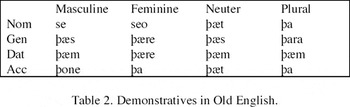
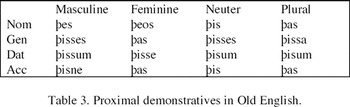
Tables 2 and 3 show the different forms. The masculine nominative se is the source of the in later English; the neuter þæt is reanalyzed as the singular demonstrative that; and the plural þa ends up as those.


It is difficult to determine when the article first appears in English. In the northern Lindisfarne Gospels, there is a nominative masculine þe, as in 32a,b, but this may be a variant of the demonstrative se.

By late Old English, however, there is clear evidence that the demonstratives are weakening phonologically, as in 33a, where, instead of þe, þæs is expected (but then þone should be þæm as well); also in early Middle English, as in 33b.

More evidence for the changing structural status of the demonstrative can be found in data provided by Traugott (1992), Wood (2007), and others, namely that the possessive often precedes the demonstrative, as in 34a and 35a, even if there is no demonstrative in the original Latin. Wood argues that this shows that the demonstrative is in the head position by late Old English. One of her arguments is that toward the end of the Old English period the possessive is in complementary distribution with the demonstrative, as shown by a scribe's rendering of the same sentences in 34b and 35b some 100 to 150 years later.


Of the 16 possessive-demonstrative constructions that occur in both the earlier C-text and the later H-text, 15 are replaced by just the demonstrative in the later text. According to Wood (2003), the reason is a reanalysis of the possessive between Old and Middle English from indefinite to definite. In Old English, the possessive can be adjectival or originate from below the D and move to the specifier of DP if the demonstrative is (already) a head. The disappearance of the combination of possessive and demonstrative pronouns shows the possessive being reanalyzed as a D head. The complementarity means that both possessive and demonstrative are in the head D with uninterpretable phi-features.
Two other stages of the cycle can be found in the history of English, namely further reduction of the to th' and renewal of the demonstrative. In Early Modern English (EModE), there is a stage with a definite clitic, as in 36a,b, and possessive and indefinite articles enter into assimilation with the following word, as in 36c,d. According to the Helsinki Corpus, this reduction starts as early as the 1550s, as seen in The Diary of Henry Machyn and The Diary of Edward VI.

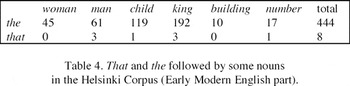
The Early Modern stage, however, is not one with a lot of demonstrative pronouns, as would be expected if the article is weakening. Based on the Helsinki Corpus, Early Modern English, parts 1–3, I found minimal use of that/those compared to the. Some numbers are given in table 4 for nouns immediately following these, but there is no difference when an adjective intervenes.

Standard English never develops into a stage where the article is lost and needs a new reinforcement. There are many dialects with just t', however, like in the fictional 37a, and as reported in Rupp & Verhoeff 2005, who claim that older speakers at the North Yorkshire-Lancashire border used t' when referring to something identifiable (37b).

This use is very common. There are also many dialects (both in Britain and the United States) with new demonstratives, as in 38a–d. The use in 38c,d is typical for non-standard urban dialects (see, for example, Cheshire et al. 1993).

We can put the changes in the history of English in terms of changes to the structure, namely, first a reanalysis of the Old English demonstrative se as a head the through the HPP or the reanalysis of interpretable as uninterpretable features. A demonstrative in the shape of that occurs as well. Second, a renewal of deictic features of that takes place through the incorporation of the postmodifying locative as a higher element in accordance with the LMP, or the reanalysis of semantic to interpretable features. These changes are shown in 39; the left arrow (a) points to the Old English demonstrative in specifier position reanalyzed as head the, and arrow (b) indicates where the renewal comes from. The basic structure is a DP with an NP (leaving out the nP for convenience).

In conclusion, the history of English shows almost a full DP cycle, from specifier to head to clitic. I have accounted for that in structural terms as well as in terms of a reanalysis of the kind of features.
7. Afrikaans, Pennsylvania Dutch, and “New” Languages
In Afrikaans—arguably a creole based on Dutch with some lexical and syntactic borrowings from English, Malay, Bantu languages, Khoisan languages, Portuguese, and other European languages—die is the definite article, where Dutch die ‘that’ is a demonstrative. Dié, hierdie, and daardie (or daai) are the determiners, as in examples 40a,b.8
Example 40a is from http://home.unilang.org/main/families.php?l=af, and 40b from http://www.anc.org.za/ancdocs/history/mandela/1997/sp971128.html).

There has been prescriptive pressure against hierdie and daardie in the past (see Donaldson 1993:142–3), but this is no longer evident in the media. To a Dutch speaker reading newspapers, however, it seems that the latter two are still not as frequent as demonstratives in Dutch.
In short, one of the Dutch demonstratives, namely die, was analyzed in Afrikaans as the article. The reason for this may be that the Dutch article shows a gender distinction and the demonstrative does not. The Dutch demonstratives show a proximal (dit/deze ‘this/these’) and distal (dat/die ‘that/those’) distinction and this distinction appears in Afrikaans in hierdie and daardie.9
Dutch dit ‘this’ corresponds to the same form in Afrikaans but with the meaning ‘it’; Dutch dat is restricted in Afrikaans to the complementizer; and Dutch deze ‘this’ is not present in Afrikaans.
Pennsylvania Dutch also has a construction with an agreeing demonstrative (sell ‘that’) and a locative (datt ‘there’), as in 41a, from Old Order Amish speakers. Putnam (to appear) shows that the younger generation of Pennsylvania Dutch speakers is introducing a new form with the specifier and the head merged, as in 41b.

The emerging “street languages” in European countries show similar evidence of the DP cycle. These languages are multi-ethnic youth-languages and they have emerged, for instance, in The Netherlands, Germany, Sweden, and Denmark. For example, so ‘such’ has become an article in 42, though it is an adverb in the standard languages.

Thus, we can describe the DP cycle as going from deictic to definite because some features are lost, or analyzed in a more economical fashion, as shown in 43, which is a slight reformulation of 14 and 15 above. Renewal comes either from above (by incorporation of a demonstrative) or from below (through an adverb). The DP cycle follows from Feature Economy and, put in structural terms, from the Head Preference and Late Merge Principles.

8. Conclusion
Demonstratives are very frequent across the world's languages and express definiteness and location relative to the speech event. Articles convey just definiteness or specificity and appear in Indo-European, Austronesian, Afro-Asiatic, Hungarian, Uto-Aztecan, Yuman, Salish, Algonquian, Niger-Congo, and in Creoles to name a few. They are emerging in some languages, such as Salish ones and Finnish (see Laury 1997 for Finnish). Himmelmann (1997:195, 198), Royen (1929), Lyons (1999), & Diessel (1999) provide further references for these languages. In this article, I have given evidence from Germanic, in particular Scandinavian, English, and Afrikaans, for the DP/definiteness cycle and have provided a possible explanation for these unidirectional changes.
I suggested that some of these changes affecting definiteness marking can be seen in terms of a DP cycle where demonstratives in specifier positions are reanalyzed as heads. The deictic meaning originally connected with the demonstrative is lost when it bleaches to an article, but the deictic function is then renewed through other means and, hence, the cycle. This change can also be seen in non-structural terms, namely as features being reanalyzed from semantic to formal.