Classic developmental models have characterized adolescence as a period of increased risk taking (Arnett, Reference Arnett1999; Steinberg & Morris, Reference Steinberg and Morris2001). Indeed, contemporary research shows that during adolescence there are increased incidences of norm-breaking behavior, substance abuse, and risky sexual behavior (Arnett, Reference Arnett1992). The rate of risk behavior seems to peak in middle or late adolescence, followed by a decrease in emerging adulthood (Steinberg, Reference Steinberg2005). Thus, based on observational evidence it is thought that this life period may be the most vulnerable for risk taking or the kind of behavior that has the potential to lead to negative consequences for self or other.
Laboratory evidence, however, remains inconclusive about risk-taking changes in adolescence (Boyer, Reference Boyer2006). Several studies have confirmed that adolescents, relative to adults, are slower in learning which different options are most advantageous in the long run in terms of future gain (Crone & van der Molen, Reference Crone and van der Molen2004; Hooper, Luciana, Conklin, & Yarger, Reference Hooper, Luciana, Conklin and Yarger2004; Overman et al., Reference Overman, Frassrand, Ansel, Trawalter, Bies and Redmond2004). However, other studies have reported that the ability to estimate risks and proportions is already at adult levels before adolescence (van Leijenhorst, Westenberg, & Crone, Reference van Leijenhorst, Westenberg and Crone2008). Thus, risk-taking changes in adolescence seem to occur only under some circumstances, most likely when the decision requires future orientation or a selection between two rewarding alternatives (Steinberg, Reference Steinberg2004). The developmental trajectories are also influenced by large individual differences in sensation-seeking (SS) tendencies, which influence the developmental results and which may predispose some adolescents to take risks in real life (Boyer, Reference Boyer2006; Krain et al., Reference Krain, Hefton, Pine, Ernst, Xavier Castellanos and Klein2006; Lejuez, Aklin, Zvolensky, & Pedulla, Reference Lejuez, Aklin, Zvolensky and Pedulla2003).
Here, we propose that risk taking is modulated by the perspective that adolescents take when confronted with a risk scenario. We define perspective taking as the ability to judge a situation from the viewpoint of another person (Blakemore & Coudhury, 2006). Earlier studies have demonstrated that perspective taking undergoes developmental changes until late adolescence (Choudhury, Charman, Bird, & Blakemore, Reference Choudhury, Charman, Bird and Blakemore2007). In two experimental studies, we examined (a) developmental changes and (b) individual differences in risk taking by asking adolescents to make choices from different personal perspectives. Our hypotheses are informed by evidence that separable brain regions are important for risk judgment and perspective taking, which have protracted developmental trajectories (Choudhury et al., Reference Choudhury, Charman, Bird and Blakemore2007; Steinberg, Reference Steinberg2005).
Competing Brain Mechanisms Account for Risk-Taking Behavior
Between childhood and adolescence there are important changes in brain structure (Gogtay et al., Reference Gogtay, Giedd, Lusk, Hayashi, Greenstein and Vaituzis2004; Sowell et al., Reference Sowell, Thompson, Leonard, Welcome, Kan and Toga2004), function (Casey, Tottenham, Liston, & Durston, Reference Casey, Tottenham, Liston and Durston2005), and connectivity (Olesen, Macoveanu, Tegner, & Klingberg, Reference Olesen, Macoveanu, Tegner and Klingberg2007), especially in brain regions that are important for taking risks (Steinberg, Reference Steinberg2005). In particular, gray matter volume peaks during different phases of childhood and adolescence, with the latest changes occurring in the prefrontal cortex (PFC) and the parietal cortex (Gogtay et al., Reference Gogtay, Giedd, Lusk, Hayashi, Greenstein and Vaituzis2004). In addition, myelination continues to increase linearly until late adolescence or early adulthood (Sowell et al., Reference Sowell, Thompson, Leonard, Welcome, Kan and Toga2004). Prior studies in adults have consistently reported that regions within the PFC are important for risk estimation, risk choices, and the ability to evaluate short- versus long-term consequences (Cohen, Heller, & Ranganath, Reference Cohen, Heller and Ranganath2005; Galvan et al., Reference Galvan, Hare, Davidson, Spicer, Glover and Casey2005). Therefore, changes in brain structure and function across adolescence may underlie the differences that are observed in risk-taking behavior. These assumptions have been tested using both neuropsychological and neuroimaging studies.
Neuropsychological studies have shown that patients with damage to a specific region of the PFC, the ventromedial PFC (VMPFC), take many risks in real-life situations and are often characterized as impulsive and childlike. Bechara and colleagues (Bechara, Damasio, Damasio, & Anderson, Reference Bechara, Damasio, Damasio and Anderson1994; Bechara, Damasio, Tranel, & Damasio, Reference Bechara, Damasio, Tranel and Damasio1997) developed a gambling task, the Iowa gambling task (IGT), which resembles real-life situations in the way it represents reward, punishment, and uncertainty. The task involves a selection of cards from four possible decks, from which two decks always result in a high reward and two decks result in a lower reward. The decks that result in high reward also give high penalties on 10–50% of the trials, leading to a net loss; therefore, these decks are disadvantageous in the long run. In contrast, the decks that result in a lower reward give smaller penalties on 10–50% of the trials, leading to a net gain; therefore, these decks are advantageous in the long run. All individuals initially sample most from the disadvantageous decks, which result in high reward but also involve a risk for high penalties. As the task progresses, healthy adults start selecting from the advantageous decks, whereas VMPFC patients keep choosing the disadvantageous decks (Bechara et al., Reference Bechara, Damasio, Tranel and Damasio1997). Before the selection of disadvantageous decks, healthy adults show a galvanic skin response, which may serve as a somatic signal indicating that the deck is risky and long-term disadvantageous. This somatic signal is not observed in VMPFC patients, even though these patients show normal galvanic skin responses following punishment (Bechara, Tranel, Damasio, & Damasio, Reference Bechara, Tranel, Damasio and Damasio1996).
Several studies have now examined the developmental time course of IGT performance, and these studies consistently report that children ages 6–12 years sample mostly from the disadvantageous decks (Crone & van der Molen, Reference Crone and van der Molen2004; Crone, Vendel, & Van der Molen, Reference Crone, Vendel and Van der Molen2003). During adolescence, participants start to select from advantageous decks as the task progresses, but adult level is not reached until late adolescence (ages 18–22; Hooper et al., Reference Hooper, Luciana, Conklin and Yarger2004; Overman, Reference Overman2004; Overman et al., Reference Overman, Frassrand, Ansel, Trawalter, Bies and Redmond2004). Like patients with VMPFC, children and adolescents fail to show a galvanic skin response prior to disadvantageous choices, whereas they show normal galvanic skin responses following penalties (Crone & Van der Molen, Reference Crone and Van der Molen2007). These findings led researchers to conclude that the VMPFC may be one of the brain regions which still matures during adolescence.
Functional neuroimaging studies have extended this interpretation by studying the brain regions that are involved in risky decision making in vivo. For these experiments, researchers have made use of simple experiments associated with uncertainty, reward, and punishment, taking into account the challenges of comparing brain activation between children, adolescents, and adults under equal experimental conditions. These studies have resulted in two important findings. When taking risks (usually presented in a Wheel of Fortune context), adolescents show underrecruitment of cognitive control areas in the PFC, including the ventrolateral PFC (VLPFC) and anterior cingulate cortex (ACC; Eshel, Nelson, Blair, Pine, & Ernst, Reference Eshel, Nelson, Blair, Pine and Ernst2007). Second, when adolescents perform a task in which cues signal a high reward or a low reward, adolescents (ages 12–17) show increased brain activation in the nucleus accumbens (part of the basal ganglia) for high reward cues relative to children (ages 7–11 years) and adults (ages 18–30; Galvan et al., Reference Galvan, Hare, Parra, Penn, Voss and Glover2006). Thus, neuroimaging data implicated that adolescents’ vulnerability to engage in risky behavior, is associated with increased activation in emotion-related limbic brain regions and under activation in control-related areas in the PFC. The increased reward sensitivity in limbic brain regions is thought to coincide with the onset of puberty, and may therefore result from changes in the influence of hormone function on brain activity (Nelson, Leibenluft, McClure, & Pine, Reference Nelson, Leibenluft, McClure and Pine2005).
Even though these studies provide important new insights in understanding risk-taking behavior in adolescence, there are still many inconsistencies in the interpretation of brain activation results. For example, whereas Ernst et al. reported underrecruitment of the VLPFC and ACC when adolescents estimate risks, van Leijenhorst, Crone, and Bunge (Reference van Leijenhorst, Crone and Bunge2006) demonstrated that the simple estimation of probabilities is associated with increased ACC activation in 9- to 12-year-old children relative to adults. The ACC is a brain region that is associated with response conflict in choice behavior (Botvinick, Nystrom, Fissell, Carter, & Cohen, Reference Botvinick, Nystrom, Fissell, Carter and Cohen1999). Therefore, under some circumstances young children may experience more response conflict than adults (such as when choosing between probabilities), whereas in other circumstances adolescents may experience less response conflict than adults (such as when taking a gamble). In addition, Galvan et al. (Reference Galvan, Hare, Parra, Penn, Voss and Glover2006) reported that the nucleus accumbens was more activated in adolescents than adults when anticipating a large reward, but Bjork et al. (Reference Bjork, Knutson, Fong, Caggiano, Bennett and Hommer2004) reported that adolescents failed to activate this region when there was a chance of winning money. Finally, Galvan et al. (Reference Galvan, Hare, Parra, Penn, Voss and Glover2006) reported that children and adolescents show more activation in the orbitofrontal cortex (OFC, a region that also includes the VMPFC) than adults, but the neuropsychological literature shows that adolescents perform on a gambling task like patients with damage to the VMPFC (Hooper et al., Reference Hooper, Luciana, Conklin and Yarger2004). These studies indicate that developmental differences in brain activation are highly task dependent and may signal strategy differences rather than a simple failure to activate a certain brain area. Despite these inconsistencies, developmental functional magnetic resonance imaging (fMRI) studies to date are consistent in hypothesizing a vulnerable balance between brain regions that support reward-related approach behavior (such as the nucleus accumbens) and the brain regions that are important for behavioral regulation (such as the OFC, VLPFC, and ACC).
Risk Advances and Perspective Taking
Prencipe and Zelazo (Reference Prencipe and Zelazo2005) recently demonstrated that the failure to delay gratification, a commonly observed phenomenon in 3-year-olds (Mischel, Shoda, & Rodriguez, Reference Mischel, Shoda and Rodriguez1989), is only observed when these children make choices for themselves. When they are asked to make these choices for the experimenter, 3-year-old children are already able to delay gratification, demonstrating an understanding of different motives for the experimenter. In contrast, 4-year-olds made more delayed choices for themselves and relatively more immediate gratification choices for the experimenter. This demonstrates that 4-year-olds appreciate that the experimenter might have a desire for immediate reward also, indicating an integration of first- and third-person perspectives. The hypothesis that choices made by individuals are dependent on the perspective they take when making these choices may explain the seemingly inconsistent pattern of risk taking in adolescents where they sometimes take risks while knowing that this decision is disadvantageous (Steinberg & Morris, Reference Steinberg and Morris2001). The brain imaging literature suggests that when making choices from the experimenter's perspective (thus when forced to deliberate about the decision), brain areas associated with more rational decision making (e.g., parts of PFC) will be activated, resulting in more conservative choices. In contrast, when making choices for themselves, individuals may rely more on emotion networks (and therefore respond more impulsively).
Self and other referential processing, or the ability to set oneself apart from others, has been associated with the involvement of a separate prefrontal brain region, the medial PFC (Gallagher & Frith, Reference Gallagher and Frith2003). For example, increased activation in medial PFC is observed for social collaboration (Rilling et al., Reference Rilling, Guttman, Zeh, Pagnoni, Berns and Kilts2002), trust (McCabe, Houser, Ryan, Smith, & Trouard, Reference McCabe, Houser, Ryan, Smith and Trouard2001), and moral judgment (Greene, Sommerville, Nystrom, Darley, & Cohen, Reference Greene, Sommerville, Nystrom, Darley and Cohen2001). It is important that this region is only active when individuals believe that they are playing with another person but not when they believe they are playing against a computer, emphasizing the social nature of this region. Given that the medial PFC is active when individuals refer to others as well as their own state of mind, it is hypothesized that this region is important for mentalizing in general (Adolphs, Reference Adolphs2003). With mentalizing, we refer to the ability to explain and predict behaviors of others by attributing independent mental states, such as thoughts, beliefs, and desires. In Experiment 1, we examined whether the developmental differences in risk taking are modulated by the perspective that participants are asked to take when making their decision.
Experiment 1: Developmental Differences in Risk and Perspective Taking
Whereas developmental changes in risk taking are consistently reported in paradigms that required learning of advantageous contingencies, such as the IGT and the balloon task (Hooper et al., Reference Hooper, Luciana, Conklin and Yarger2004; Lejuez et al., Reference Lejuez, Aklin, Zvolensky and Pedulla2003), developmental differences are not consistently reported for studies that focused exclusively on risk judgment (van Leijenhorst et al., Reference van Leijenhorst, Westenberg and Crone2008). One of the difficulties with prior risk judgment paradigms is that there is not a clear distinction between scenarios in which it was advantageous in the long term to take a risk, and scenarios in which it was disadvantageous in the long term to take a risk. For example, in a Wheel of Fortune task, it may be beneficial to take a risk when it is possible to win more money (say, $10 relative to $1) with the least likely option (25% chance of winning). Further, the designs of these tasks were such that when participants decided to select the high-risk option, they automatically decided not to select the low-risk option, leaving them with no escape option. Taking into account these difficulties, we designed a new risk-taking task that required participants to make a risk decision on each trial, which was presented against a simple baseline-escape option. For high-risk trials, it was disadvantageous in the long run to take a risk. In contrast, for low-risk trials, it was advantageous in the long run to take a risk.
Participants were selected from four age ranges—prepubertal children (8–9 years), young adolescents (11–12 years), middle adolescents (14–15 years), and late adolescents (16–18 years)—to allow for a detailed comparison of risk-taking changes. All choices were preceded by a cue that indicated whether the choice was made from the self-perspective or the other perspective (choices made for the experimenter).
We hypothesized that for the self-perspective, high-risk choices would decrease with age, and low-risk choices would increase with age, demonstrating an age-related increase in the ability to dissociate between beneficial risk choices. We further hypothesized that fewer risk choices would be made for the experimenter perspective, but that this difference would be larger for the younger age groups.
Method
Participants
Four age groups participated in the present study, 20 children ages 8–9 years (M = 8.65, 13 boys), 18 young adolescents ages 11–12 years (M = 11.89, 9 boys), 17 middle adolescents ages 14–15 years (M = 14.88, 8 boys), and 17 older adolescents ages 16–18 years (M = 16.53, 11 boys). Chi-square analysis revealed that gender did not differ significantly between age groups, χ 2 (3) = 4.65, p = .20. All participants were recruited by contacting schools. Healthy children and adolescents were selected with the help of their teachers, and their primary caregivers signed consent letters for participation. Participants received points during the experimental task that were described as money, but these were not translated into actual money. All participants completed a computerized version of the Raven Standard Progressive Matrices (SPM) task to provide an estimate of their IQ. Estimated IQ scores were 111, 113, 120, and 124 for the 8- to 9-year-olds, the 11- to 12-year-olds, the 14- to 15-year-olds, and the 16- to 18-year-olds, respectively. A one-way analysis of variance (ANOVA) performed on the estimated IQ scores revealed a significant difference between age groups, F (3, 68) = 8.398, p = .000. Post hoc Tukey comparisons indicated that the 8- to 9-year-olds differed significantly in their IQ from the 14- to 15-year-olds (p = .013), and from the 16- to 18-year-olds (p = .000). The 11- to 12-year-olds differed significantly in their IQ only from the 16- to 18-year-olds. An analysis of covariance (ANCOVA) demonstrated that IQ scores could not account for the developmental patterns reported below.
Experimental task
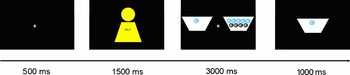
All participants completed the self–other gambling task. The trial sequence started with a cue (1,500 ms) that indicated whether participants had to make a decision for themselves or for the experimenter. This cue was followed by the presentation of a stimulus display, during which participants had to respond (Figure 1). Participants were required to respond within a 3,000-s interval. For responses that were too slow, “te langzaam” (too slow) was presented on the screen for 1,000 ms. This occurred on 1.4% of the trials. For all responses that were made within the 3,000-ms time window, a feedback display (1,000 ms) replaced the stimulus display showing the amount of coins won or lost.
An example of stimulus display. Participants were presented with a fixation cross, followed by a cue that signaled the identity of the player. Next, they were presented with two baskets, and participants were instructed to select between the two alternatives. Following their choice, an outcome screen was presented that indicated the number of coins won (top symbols, blue) or lost (bottom symbols, black). See text for further details. [A color version of this figure can be viewed online at journal.cambridge.org/dpp]

Before the actual experimental phase started, participants received written instructions and performed a practice block of 32 trials. During the experimental phase, participants performed four blocks of 56 trials (224 trials). Each trial (6,000 ms total) consisted of two options: a nonrisky escape option and a risky option (Crone, Bunge, De Klerk, & van der Molen, Reference Crone, Bunge, De Klerk and Van der Molen2005). The nonrisky option always provided participants with one coin. The risky option consisted of a low-risk level or a high-risk level. In both conditions, there was a 50% chance for winning or losing, which was visually presented for each choice. In the low-risk condition, the participant could win five coins (50% of the trials) or lose one coin (50% of the trials). In this condition, it was advantageous to choose from the risky option because the net result was higher than the net result of the nonrisky option (2 vs. 1). In the high-risk condition, the participant was able to win five coins (50% of the trials), but could also lose four coins (50% of the trials). In this condition, it was disadvantageous to choose from the risky option because the net result was lower than the net result of the nonrisky option (0.5 vs. 1). The locations of the nonrisky and risky options were counterbalanced (either on the left side or the right side of the computer screen) and participants could make their selection by pressing the corresponding response key. Each decision was followed by a feedback display that indicated the amount of coins won or lost. At the end of each block, participants were provided with information indicating the total amount of money they themselves and the experimenter had at that time. At the end of the task, participants were provided with information about the total amount of money they had earned during the experiment (0–5 €).
Instructions
Participants were provided with the following instructions: “On the computer screen you can see two baskets which contain a certain amount of coins. In a minute, you will have to make a decision between these two baskets. If you choose the left basket (nonrisky option), you are certain to win one coin. The right basket has two rows: an upper row and a lower row. The upper row always includes five coins, which you can possibly win, half of the times you select this basket. They are presented in blue. The coins in the lower row are black. These are the ones you can possibly lose, half of the time you select this basket. In some cases, the lower row contains one coin and in other cases four. After you have made a decision, the total amount of coins you have won or lost appears on the computer screen. Before the two baskets appear on the screen, either a red or a yellow figure will be shown. If the figure on the computer screen is red/yellow you will have to make a decision for yourself, and if the figure on the screen is red/yellow you will have to make a decision for the experimenter. In the latter case, try to imagine what decision the experimenter would make. Keep in mind that this is not a competition. You cannot win or lose from another person. Furthermore, decisions you made are unknown to the experimenter. Decisions are never right or wrong. Do you have any questions?”
Design and procedure
All participants completed the experiment individually in a quiet laboratory. The task took approximately 20 min to complete. Thereafter, the Raven SPM was administered, which took an additional 20 min. Including instructions and breaks, participants spent approximately 50 min in the laboratory.
Results
The first set of ANOVAs focused on three questions: (a) the developmental changes in risky choices, (b) the differentiation between high-risk versus low-risk choices, and (c) the differentiation between choices made for “self” and choices made for “other,” where other referred to the experimenter. These questions were examined in Age × Risk × Perspective ANOVAs by comparing the percentage or risky choices and the speed of making risky and nonrisky choices.
Percentage or risky choices
For the first analysis, we computed the percentage of risky choices, which was defined by the proportion of choices that could result in losing relative to the total number of choice options (i.e., [number of risky choices]/[number of risky choices + number of safe choices] × 100). These values were submitted to an Age Group (8 to 9, 11 to 12, 14 to 15, 16 to 18 years) × Risk (High vs. Low) × Perspective (Self vs. Other) repeated-measures ANOVA.
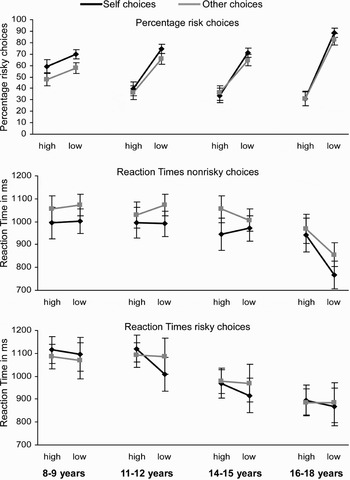
The ANOVA resulted in the expected main effect of risk, F (1, 68) = 92.38, p < .001, showing that participants made more risky choices in the low-risk condition relative to the high-risk condition, and a main effect of perspective, F (1, 68) = 17.56, p < .001, showing that participants made more risky choices for themselves than for the experimenter. A Risk × Perspective interaction, F (1, 68) = 7.53, p < .01, showed that the increase in risky choices for self relative to other was found in both the low-risk condition, F (1, 68) = 4.45, p < .001, and the high-risk condition, F (1, 68) = 21.03, p < .05, but the effect was magnified in the low-risk condition (Figure 2).
Choice behavior and reaction times for nonrisky and risky choices in Experiment 1. With age the participants made fewer high-risk choices and more low-risk choices, and the difference between choices for self and other decreased across adolescence. Across age groups, the RTs were shorter for self than for other choices, but only for the nonrisky choices.

Even though there was no main effect of age group for the general percentage of risky choices, F (1, 68) = .86, p = .46, there were interactions between Age Group × Risk, F (3, 68) = 7.35, p < .001, and Age Group × Perspective, F (3, 68) = 2.62, p = .05. As can be seen in Figure 2, with age, participants started to differentiate between low-risk and high-risk options. In the high-risk condition there was a significant decrease with age in percentage risky choices, F (3, 68) = 2.96, p < .05, and post hoc Tukey comparisons indicated that the 8- to 9-year-olds made significantly more risky choices than the 16- to 18-year-olds, whereas the 11- to 12-year-olds and the 14- to 15-year-olds did not differ significantly from either the youngest or the oldest age group. In contrast, in the low-risk condition, there was a significant increase with age in risky choices, F (3, 68) = 5.03, p < .005, and post hoc Tukey comparisons showed that only the 16- to 18-year-olds made more risky choices than the three younger age groups, who did not differ from each other.
The Age Group × Risk × Perspective interaction was not significant (p = .45), but given the clear developmental differences for high- and low-risk conditions, the Age Group × Perspective interaction was followed up with separate comparisons for high- and low-risk conditions. In the high-risk condition, the Age Group × Perspective interaction, F (3, 68) = 4.27, p < .01, showed that the decrease in risky choices for other versus self was only significant for the 8- to 9-year-olds (p = .002) but not for the 11- to 12-year-olds (p = .34), the 14- to 15-year-olds (p = .22) or 16- to 18-year-olds (p = .92). In contrast, in the low-risk condition, the Age Group × Perspective interaction was not significant, F (3, 68) = .57, p = .64, and comparisons for each age groups separately confirmed that the decrease in risky choices for other versus self choices was significant (or close to significant) in each age group (p = .009 for 8- to 9-year-olds, p = .03 for 11- to 12-year-olds, p = .05 for 14- to 15-year-olds and p = .08 for 16- to 18-year-olds).
Together, the results show that age differences in risky decision making are dependent on the context in which the risk is presented. That is, risky decisions increase with age when it is beneficial to take a risk, but decrease with age when it is disadvantageous to take a risk. Further, the percentage of risky decisions decreases when participants are asked to take the perspective of an adult, and this effect is larger for the youngest age group.
Reaction times (RTs)
The second analysis examined the RTs for each condition and age group. For this analysis, we differentiated between risky and nonrisky choices, which resulted in an Age Group (8 to 9, 11 to 12, 14 to 15, 16 to 18) × Risk (High vs. Low) × Perspective (Self vs. Other) × Choice (Risky vs. Nonrisky) repeated-measures ANOVA. Because the number of observations was low for some specific conditions, we selected only those individuals who made fewer than 90% low-risk choices and more than 10% high-risk choices. This resulted in an ANOVA with 19 8- to 9-year-olds, 16 11- to 12-year-olds, 15 14- to 15-year-olds, and 13 16- to 18-year-olds.
As can be seen in Figure 2, choices were made faster for low-risk relative to high-risk trials, main effect risk: F (1, 56) = 5.08, p < .05, and faster for self-choices than for other choices, main effect perspective, F (1, 56) = 5.15, p < .05. A Perspective × Choice interaction revealed that the latter effect was only found for nonrisky choices, main effect perspective, F (1, 56) = 13.65, p < .005, but not for risky choices, main effect perspective, F (1, 56) = .23, p = .62. None of these effects were affected by age group.
Together, the RT analysis showed that low-risk choices were made faster than high-risk choices, and choices for self were made faster than choices for other. The latter effect was found only when participants decided to make a nonrisk choice. There were no differences between age groups, suggesting that the age differences in choice behavior were not affected by age differences in speed of decision making.
Discussion
This study resulted in three main results: (a) with age, participants made fewer high-risk choices and more low-risk choices; (b) choices for self were more risky than for other, and nonrisky choices were made faster for self than for other; (c) the self/other distinction was observed for all age groups, but it was larger for the youngest group and was only present for the low-risk choices for the older adolescents.
The differentiation between high- and low-risk choices may explain the inconsistent risk-taking pattern in prior studies. The results of this study show a clear age-related decrease in risk choices for the high-risk condition (i.e., where it is disadvantageous in the long term to take a risk), consistent with the hypothesis that risk-taking behavior is most pronounced in younger children. It should be noted that the results do not fit well with the assumption that risk-taking behavior increases over the course of adolescence, as observed in real-life scenarios. According to these studies, a peak in risk-taking behavior should be observed in early and middle adolescence. Here, we demonstrate that risk-taking behavior decreases, rather than increases, from childhood to young adolescence. Possibly, there is a general decrease in risk taking over the course of childhood and adolescence, but this decrease is offset in some cases by decreased parental control in early and middle adolescence. During this period, children focus more on the roles of their peers in forming judgments, and therefore have more opportunities to display reckless behavior (Westenberg, Hauser, & Cohn, Reference Westenberg, Hauser and Cohn2004). Indeed, the results from the current study are consistent with the hypothesis that risk-taking behavior is less pronounced in older adolescents (ages 16–18) than in young and middle adolescents (ages 11–15).
The differentiation between the self and the other person's perspective is consistent with the observation that adolescents sometimes make risky decisions, despite rationally knowing that the choice may have bad consequences (Steinberg & Morris, Reference Steinberg and Morris2001). Indeed, when participants are asked to make a choice from the perspective of the experimenter, their choices are generally less risky. These choices most likely require increased mentalizing (Blakemore, Reference Blakemore2008), which is confirmed by slower reaction times when nonrisky choices were made for other versus self. This difference is largest for 8- to 9-year-old children, but diminishes with age, indicating that the ability to integrate different perspectives becomes more efficient over time. These findings parallel earlier findings by Prencipe and Zelazo (Reference Prencipe and Zelazo2005), who reported that 4-year-olds could appreciate the experimenter's desire for immediate reward, thus integrating first- and third-person perspectives. Here, we show that this effect is also observed in adolescence using a task that is challenging for this specific age group. Together, these findings suggest that even though important changes in perspective taking occur in early childhood, the ability to differentiate between self and other perspectives may continue to develop across childhood and adolescence.
One of the challenges when interpreting adolescent behavior concerns the individual differences in SS and future orientation. In Experiment 2, we further examine risk and perspective taking in adolescence by focusing on individual differences in SS in middle adolescents.
Experiment 2: SS, Risk Taking, and the Role of Perspective Taking
The extent to which adolescents are prone to make risky decisions on laboratory tasks depends heavily on individual differences in SS tendencies (Crone et al., Reference Crone, Vendel and Van der Molen2003; Lejuez et al., Reference Lejuez, Aklin, Zvolensky and Pedulla2003). Brain imaging studies have confirmed that adolescents who score high on impulsivity questionnaires show more activation in the nucleus accumbens, a reward-sensitive brain area (Galvan, Hare, Voss, Glover, & Casey, Reference Galvan, Hare, Voss, Glover and Casey2007). Therefore, we expect that adolescents who score high on SS will also make more high-risk decisions on the gambling task.
It is a well-known phenomenon that risk behavior increases when adolescents are in the company of peers (Erickson & Jensen, Reference Erickson and Jensen1977; Vinokur, Reference Vinokur1971). The extent to which peers participate in risk activities is a strong predictor for risk behavior in real-life circumstances (Bosari & Carey, Reference Bosari and Carey2001; Kandel, Reference Kandel1996). A laboratory study confirmed that adolescents, especially, make more risk choices in the presence of peers (Gardner & Steinberg, Reference Gardner and Steinberg2005). Therefore, the differentiation between risk behavior for self and other decisions may be dependent on the social identity and similarity of the other person. In Experiment 1 we showed that adolescents make fewer risk choices when these choices are made from the perspective of the experimenter. These results may indicate a tendency to imagine that other individuals in general, or possibly adults in particular, are less prone to take risks than they themselves are. In Experiment 2, we examined whether adolescents make self and other choices based on their knowledge of the identity of the other individual.
To maximize the variability in SS tendencies, participants were selected from a high school that included children with a high profile of risk-taking behavior. These participants were presented with scenarios of two individuals from the same age group: an “other” person with low SS tendencies and an “other” person with high SS tendencies. They were then asked to perform the gambling task in which they were asked to make risk choices for themselves, the low SS individual and the high SS individual. To confirm differential patterns of choice behavior for different perspectives, we included a second reward selection task, the temporal discounting task (Scheres et al., Reference Scheres, Dijkstra, Ainslie, Balkan, Reynolds and Sonuga-Barke2006), in which choices had to be made for self and other perspectives. We hypothesized that participants would make more risk choices and delay gratification less for the high SS person than for the low SS person. The performance of individuals who rated themselves as low SS was expected to resemble the choice behavior observed for the “other” person with the low SS profile. In contrast, the individuals who rated themselves as high SS individuals were expected to resemble the choice behavior observed for the “other” person with the high SS profile.
Method
Participants
Sixty-one boys ages 13 to 16 years (M = 14.0) participated in this study. All subjects were recruited from a high school in The Netherlands with children who have a high potential to perform risk-taking behavior. All participants completed the Zuckerman's Sensation Seeking Scale (SSS; Zuckerman, Eysenck, & Eysenck, Reference Westenberg, Hauser and Cohn1978), standardized for Dutch adolescents (Feij & Kuiper, 1984). The adolescent version of the SSS consists of five subscales measuring extraversion, emotionality, impulsivity (IMP), thrill and adventure-seeking aspects of SS (TAS), and disinhibition and experience seeking aspects of SS (Dis/Es). Participants completed the TAS, Dis/Es, and IMP subscales. The TAS subscale consists of 11 true/false items, such as “I prefer to be in a place where there is a lot going on,” the Dis/Es subscale consists of 8 true/false items, such as “I would like to experience what it is like to use illegal drugs,” and the IMP subscale consists of 9 items, such as “I usually don't make a decision until I have weighted all the pros and cons.” The TAS, Dis/Es and IMP subscales have an internal consistency of .79, .69, and .62, respectively.
Experimental task
In the first part of the experiment, participants completed the self–other gambling task. This task was similar to the task described in Experiment 1, however this time participants had to make decisions for themselves, a member of Group A (risk avoiding/low status), or a member of Group B (risk seeking/high status). This was indicated with a cue on the screen (see Figure 1).
In the second part of the experiment, all participants completed a modified version of the delayed-gratification task (Barkeley, Edwards, Laneri, Fletcher, & Metevia, Reference Barkeley, Edwards, Laneri, Fletcher and Metevia2001). Participants were asked to make a series of choices regarding a fictional amount of money they would obtain immediately or after a certain delay interval, which could be 1 month, 1 year, 5 years, or 10 years. Both types of rewards were shown simultaneously with the immediate reward presented on the left side of the computer screen, and the delayed reward presented on the right side of the screen. Participants could make their selection by pressing the corresponding response key. The experiment involved two types of delay tasks: a 100 € delay task and a 1,000 € delay task. The reward after the delay remained constant (100 or 1,000 €), but the immediate reward varied; it ascended or descended in increments of 10 € (in the 100 € trials) or 100 € (in the 1,000 € trial).
Participants first performed the 100 € delay task, which consisted of a block of four trials. In the first trial of the 100 € delay task participants had to make a decision between an immediate reward presented in an ascending order from 1 to 100 € and a reward of 100 € with a delay of 1 month. In the second trial, the same immediate reward values were presented (now descending from 100 to 1), but the delay period was set at 1 year. In the third trial, the delay period was set at 5 years, and the same immediate reward values were presented in ascending order. In the fourth trial of the 100 € delay task, the delay period was set at 10 years and the immediate reward values were presented in descending order. After participants completed the 100 € delay task, they started the 1,000 € delay task, which again consisted of a block of four trials. The delay periods set for these trials were similar to those described above, but now, the immediate reward values ascended or descended between 100 and 1,000 €.
Both delay tasks had to be performed three times. The first time the participants had to make decisions for themselves. The second time they were asked to make decisions for a member of Group A (risk avoiding/low status). The third time all subjects had to make decisions for a member of Group B (risk seeking/high status). The tasks were presented blocked and in a fixed order to avoid influence of perspective taking on self choices.
Design and procedure
All participants were tested individually in a quiet laboratory. Prior to the experimental tasks, participants completed the Zuckerman's SSS, which took approximately 10 min. Thereafter, they performed the self–other gambling task and the modified version of the delayed-gratification task. The completion of both experimental tasks took approximately 40 min. Including instructions and breaks, participants spent approximately 50 min in the laboratory.
Instructions
The instructions were similar to the instructions described in the first experiment, but with the critical difference that the participants were introduced to two cues, representing the low-risk profile boy versus the high-risk profile boy. The participants were told that they could recognize the low-risk profile boy by the book he was carrying in his hands, whereas they could recognize the high-risk profile boy by the cigarette in his hands (see below for detailed descriptions). Thus, similar to the situation in the first experiment, participants were asked to try to imagine what decision the low-risk or the high-risk profile boy would make.
Member group A: Low-risk profile and low reputation and preference based status
This boy likes to read and enjoys searching the Internet for everything about stars and planets. He prefers to stay at home. He does not like to consume alcohol, has never smoked hashish, and does not like wild parties. He bikes to school every day, because he believes that that is healthy. He does not like to take any kind of risk, and he always sticks to the rules. According to his classmates, he is a little bit boring; he rarely speaks, and never jokes around. His classmates do not ask him to play around anymore, because this is not exciting. He has two friends who have similar interests. On Saturdays he works at the library, and he saves the money he earns.
Member group B: High-risk profile and high reputation and preference based status
This boy enjoys wild parties, likes to drink a lot of beer, and smokes hashish because this boosts up the party. He likes to take a ride on his scooter, and has recently eluded the police by speeding away on his scooter. He likes to take risks, because this gives him a kick. He just does what he wants to do. His classmates always ask him to play around, because this is always exciting. His friends look up to him and want to act in a similar way. On Saturdays he works as a pizza courier, but he always spends his salary very quickly.
Results
Participants were divided in low and high SS adolescents based on their score on the adolescent version of the Zuckerman SSS (Zuckerman et al., Reference Zuckerman, Eysenck and Eysenck1978). A median split resulted in two groups; the low sensation seekers had an average SS score of 10.25 (SD = 3.4, n = 28) and the high sensation seekers had an average SS score of 20.13 (SD = 2.4, n = 31). These groups were added to the analysis of risk taking and temporal discounting for self, other low-SS and other high-SS perspectives.
Risk task
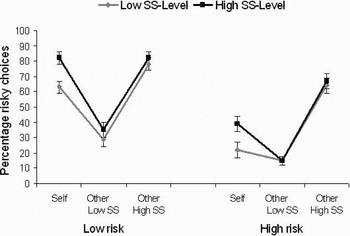
The SS level (2) × Risk (2) × Perspective (3) ANOVA resulted in three main effects. Low SS adolescents made fewer risk decisions than high SS adolescents, F (1, 57) = 4.18, p < .05. Participants made fewer high-risk choices relative to low-risk choices, main effect risk, F (1, 57) = 82.87, p < .001, and participants made the fewest risk choices for other low SS, more for self and most for other high SS, main effect perspective, F (2, 114) = 107.04, p < .001, confirmed with post hoc comparisons. The analysis also resulted in two interaction effects, Risk × Perspective, F (2, 114) = 32.41, p < .001, and SS Level × Perspective, F (2, 114) = 3.37, p < .05. As can be seen in Figure 3, participants made more low-risk than high-risk choices in all the perspective conditions (self, other low SS, other high SS, all ps < .01), but the difference between high- and low-risk choices was larger for the “self” condition than for both the “other” conditions. In addition, participants with a high SS level generally made more risk choices (both low risk and high risk) than participants with a low SS level, F (1, 57) = 10.96, p < .001, whereas low and high SS groups did not differ in their choices for other low SS, F (1, 57) = .24, p = .63, or for other high SS, F (1, 57) = .35, p = .55.
Choice behavior for individuals with high and low sensation-seeking (SS) profiles in Experiment 2 for choices for self decisions, decisions for another high SS individual, or decisions for another low SS individual. SS groups differed most in their self choices.

Temporal discounting task
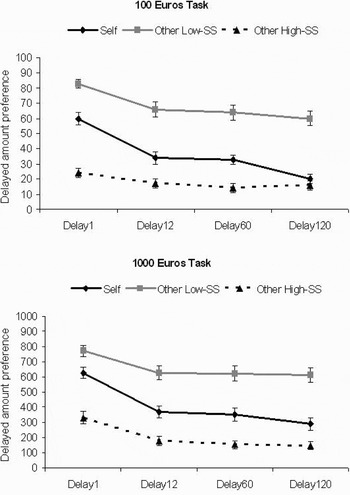
The analysis of the temporal discounting task was performed for the 100 and 1,000 € conditions separately (Barkeley et al., Reference Barkeley, Edwards, Laneri, Fletcher and Metevia2001). The data were analyzed with a 2 (SS Level) × 4 (Delay) × 3 (Perspective) ANOVAs. For the 100 € task, the ANOVA resulted in main effects of delay, indicating temporal discounting with increasing delays, F (3, 168) = 44.46, p < .001, and perspective, indicating more discounting for other high SS than for self, and the lowest discounting for other low SS, F (2, 112) = 106.10, p < .001, confirmed with post hoc comparisons. There was also a Delay × Perspective interaction, F (6, 336) = 8.63, p < .001. As shown in Figure 4, delay-related discounting was significant for all perspectives, but was less steep for the “other” perspectives relative to the self-perspective. For the 1,000 € task, the ANOVA resulted in the same pattern of results. A main effect of delay shows that participants discounted the value of money with increasing delays, F (3, 168) = 37.43, p < .001, and a main effect for perspective shows most discounting for other high SS, less for self, and the least discounting for other low SS, F (2, 112) = 63.70, p < .001, confirmed with post hoc comparisons. The Perspective × Delay interaction shows that delay-related temporal discounting was significant for all perspectives, but less steep for both “other” perspectives relative to the self-perspective, F (6, 336) = 3.20, p < .005. None of these effects was influenced by SS level (all ps > .10).
Discounting scores in Experiment 2 for three perspectives: self, another individual with a low SS profile (low-SS), and another person with a high SS profile (high-SS), for 100 and 1,000 € amounts. Delays are presented in months (1, 12, 60, or 120), and the data are plotted in terms of the amount necessary to prefer a delayed payment.

Discussion
The results of Experiment 2 replicate the general risk-taking patterns that were observed in Experiment 1. That is, participants made more low-risk choices than high-risk choices for self decisions. Furthermore, the decisions made for themselves were different than the decisions made for the other person. The findings from Experiment 2 extend the results of Experiment 1, by demonstrating that adolescents made “other” choices based on their expectations of the behavior of the other individual. Whereas in Experiment 1 participants generally made fewer risk choices for other than for self, in Experiment 2 this was only the case for the other condition in which the individual was described as a low sensation seeker. In contrast, when the individual was described as a high sensation seeker, participants made more risky decisions for this individual. A similar pattern was found for the delayed discounting task, demonstrating that the described findings are not task specific (see also Prencipe & Zelazo, Reference Prencipe and Zelazo2005). The findings are consistent with the hypothesis that making choices for another person requires perspective taking and mentalizing about the other person's desires (Blakemore, Reference Blakemore2008). Most likely, in Experiment 1 the participants made more low-risk choices for the other person because in this case, the other person represented the experimenter; an adult who is unlikely to engage in risk taking.
The results are also consistent with previous reports that demonstrate that high sensation seekers are more likely to engage in risk-taking behavior (Lejuez et al., Reference Lejuez, Aklin, Zvolensky and Pedulla2003; van Leijenhorst et al., Reference van Leijenhorst, Westenberg and Crone2008). Thus, the risk-taking task employed in this study most likely reflects a good index of risk-taking tendencies that are observed in real-life situations, as assessed with Zuckerman's SSS. It is interesting that these differences in risk taking were only observed when decisions had to be made for the self, but not when decisions had to be made for the other person. These results suggest that even though high SS adolescents are more likely to engage in risk behavior in the prospect of winning money, when they are asked to step into the shoes of another individual (i.e., deliberate), they make similar decisions as the low SS adolescents. This finding is consistent with Steinberg's notion of the distinction between knowing, in the present study manipulated by mentalizing about another person, and doing, thus making decisions for yourself (Steinberg, Reference Steinberg2004). These two types of decisions are possibly subserved by different brain circuitries; emotional decision making for the self, subserved by the limbic system, and rational decision making for others, subserved by the medial PFC (see also Blakemore & Choudhury, Reference Blakemore and Choudhury2006).
General Discussion
Changes in risk taking in adolescence have remained poorly understood. Whereas risk taking is a commonly observed phenomenon in observational studies (e.g., risky driving, small criminal violations; Arnett, Reference Arnett1992, Reference Arnett1999; Steinberg, Reference Steinberg2004), the laboratory evidence has reported inconsistent findings (e.g., Boyer et al., 2004). In this study, we developed a task in which it was possible to examine risk-taking differences between age groups by differentiating between different choices. That is, immediately rewarding choices could either be disadvantageous in the long run, or could be advantageous in the long run. When collapsing across the disadvantageous and advantageous conditions, no age differences were observed, but when analyzing these choices separately, the results showed that throughout adolescence, participants start to make fewer high-risk choices and more low-risk choices, with differences being present until late adolescence.
The validity of the risk-taking task was confirmed in Experiment 2, in which we demonstrated that adolescents who score high on the SS questionnaire (which assesses risk behavior in real life), also make more risky choices for themselves. In general, these findings are in agreement with recent neurobiological models, such as the triadic model of Ernst Pine, and Hardin (2006), which show that adolescents are prone to take risk because of a vulnerable balance between emotion-inducing and emotion-regulating brain regions. In particular, the triadic model argues that adolescents are overresponsive to reward, as shown by a hypersensitive striatum circuitry, underresponsive to punishment, as shown by a hyposensitive amygdala system, and have poor regulatory abilities, as shown by inefficient functioning of the OFC. Evidence for the model comes from neuroimaging research showing overactivation in the nucleus accumbens and OFC when anticipating large rewards in adolescents relative to adults (Galvan et al., Reference Galvan, Hare, Parra, Penn, Voss and Glover2006).
Steinberg (Reference Steinberg2004, Reference Steinberg2005) suggested that risk-taking differences in adolescents are not necessarily seen in rational or hypothetical judgment tasks. In contrast, risk taking is especially prominent when an experimental task demands (a) future orientation, thus when adolescents have to balance between immediate reward and future outcomes (Crone & Van der Molen, Reference Crone and van der Molen2004; Hooper et al., Reference Hooper, Luciana, Conklin and Yarger2004), (b) when different rewarding alternatives are presented, and (c) when decisions have to be made in the presence of peers (Gardner & Steinberg, Reference Gardner and Steinberg2005). All these scenarios rely heavily on emotional brain regions and have the potential to result in overactivity in regions such as the striatum. Even though the presence of peers may result in increased risk taking, this is likely to be a different process than mentalizing about intentions of peers, as was required in the current study. In other words, emotional brain regions (i.e., the limbic system) might underlie more impulsive decisions as seen in the presence of peers, for example. In contrast, “mentalized” decisions about potential intentions of peers might be subserved by more rational brain regions. These type of decisions are thought to rely on the temporoparietal junction (TPJ) and the medial frontal cortex (Blakemore, Reference Blakemore2008). The TPJ is thought to play a role in the prediction of observed patterns of behavior to understand the mental states underlying this behavior (Frith, Reference Frith2007). In contrast, the medial frontal cortex is active when participants think about the psychological states, goals, and intentions of others (Gallagher & Frith, Reference Gallagher and Frith2003; McCabe et al., Reference McCabe, Houser, Ryan, Smith and Trouard2001), and in addition, when tasks involve thinking about mental states of others in relation to the self (Ochsner et al., Reference Ochsner, Knierim, Ludlow, Hanelin, Ramachandran and Glower2004). Our instructions to make decisions from the perspective of another individual most likely resulted in increased mentalization and therefore increased recruitment of medial frontal cortex. The results of the current study are consistent with the suggestion that medial frontal cortex may mediate risk-taking differences observed across age and levels of SS. By the additional recruitment of the mentalizing network, age differences in risk taking decreased and individual differences in SS were less pronounced, relative to choices from the self-perspective.
According to the mentalizing perspective offered above, we argue that differences for first- and third-person perspective are influenced by the need to, in addition, activate the medial frontal cortex associated mentalizing network (Blakemore, Reference Blakemore2008). This hypothesis suggests that young adolescents, as well as high SS adolescents, are capable of making low-risk decisions when they are forced to think about these decisions from a third-person perspective. An alternative, but related explanation is offered by the first- to third-person integration hypothesis postulated by Barresi and Moore (Reference Barresi and Moore1996). According to this theory, in the second year of life children learn to represent independent and individual preferences for themselves and for others (Repacholi & Gopnik, Reference Repacholi and Gopnik1997). This differentiation is important for participation in social interactions, in which actions of the self and others need to be matched for smooth social interactions. Once this differentiation is acquired, however, children will need to learn to integrate first- and third-person perspectives so that the representation of intentions can be applied equivalently to observation of actions of both the self and the other. In the context of the current study, younger children may show a greater differentiation between first- (self) and third- (other) person perspectives because, although realizing that other individuals would make fewer risky choices, they are not yet able or inclined to apply this knowledge to their own decision making. With age, the integration of their own urge for risk and their conceptual knowledge of what other individuals would do become more efficient, leading to fewer risk choices. That is, they no longer need to be forced into considering another person's perspective to make fewer high-risk choices. This explanation was also proposed by Prencipe and Zelazo (Reference Prencipe and Zelazo2005), who observed that 3-year-old children responded differently when choosing for self versus other, whereas 4-year-olds responded similarly for self and other, and were also more likely to delay their own gratification. Even though large changes in first- to third-person integration occur in early childhood, this ability may continue to develop across adolescence, explaining the commonly observed discrepancy between knowing and acting in adolescents (Steinberg, Reference Steinberg2004). The first- to third-person integration hypothesis is not necessarily inconsistent with the mentalizing hypothesis. It has been argued that medial PFC is increasingly engaged both when individuals are required to think about intentions of others and self-referential processing (Frith, Reference Frith2007; Gallagher & Frith, Reference Gallagher and Frith2003). Possibly, the integration of first and third person perspectives also depends on medial frontal cortex functioning, because this process will put high demands on mentalizing, that is, the need to think about intentions of others relative one's own intentions.
In conclusion, in two experiments, we demonstrate that risk taking is dependent on the perspective individuals take when making the risky choice. The age-related decrease in high-risk choices may be associated with increasing regulation capacities by the PFC, which can control the oversensitive emotion system as observed in early adolescents (Ernst et al., Reference Ernst, Pine and Hardin2006; Steinberg, Reference Steinberg2005), and it may involve an integration of others’ perspectives into one's own decision making. When asked to make risky decisions from the perspective of another individual, the risk-taking pattern corresponds to the actual decisions those individuals would take (fewer risks for adults and low SS adolescents, more risks for high SS adolescents), demonstrating an understanding of intentions by others. We hypothesize that these modulations in risk taking are the result of medial frontal cortex recruitment, which is important for the ability to mentalize about intentions of others (Blakemore, Reference Blakemore2008). It is interesting that only the decisions made for the self were modulated by the individual level of SS tendencies, showing that real-life decision-making patterns predict individual differences in laboratory risk taking, whereas the conceptual knowledge of risks (third-person perspective decisions) does not differ between high and low sensation seekers. Together, these results suggest that risk-taking behavior in young individuals may be able to be modulated by training that requires thinking about others’ intentions. Whether this can be achieved in real life, when actions are committed before the possibility to think about outcomes, is open to debate (Steinberg, Reference Steinberg2004). Alternatively, the current results teach us about the motives of risk taking actions by adolescents and provide the possibility for society to anticipate adolescent behavior, rather than to change it.