Introduction and Background
Large public gatherings, such as sporting events, religious congregations, and others are called mass gatherings, and these gatherings typically have more than 1,000 people in attendance.Reference Milsten, Maguire, Bissell and Seaman 1 Participants at a World Health Organization (WHO) workshop agreed to define mass gatherings as “an occasion, either organized or spontaneous, that attracts sufficient numbers of people to strain the planning and response resources of the community, city, or nation hosting the event.” 2 While gatherings encompass many disciplines, in health care, the importance of a gathering is its potential to involve a delay in medical response to patients in the field due to barriers of the environment and the gathering itself.Reference Arbon 3 Medical resources are necessary at various points of a mass gathering to prevent illness, injury, and to deliver effective care to the targeted population. Human and capital assets, such as medical supplies, ambulances, and effective communications infrastructure, are required during mass gatherings to ensure individuals receive timely medical care.
Mass gatherings carry an increased risk for participant health problems for several reasons: (1) exposure to variable weather conditions; (2) potential for traumatic injury; (3) widespread substance use; (4) transmission of communicable diseases; and (5) the activity of participants within an event (such as walking and running).Reference Milsten, Seaman, Liu, Bissell and Maguire 4 In addition, the nature of the gathering and the underlying characteristics of the participant population raise the risk for medical problems.Reference Milsten, Seaman, Liu, Bissell and Maguire 4 There are two types of planning for health care during mass gatherings: (1) planning for preventive measures through safeguarding food conditions, hygiene, water sanitation, and waste disposal and (2) planning for the management of health problems during events, such as on-site treatment capacity for minor conditions, and emergent medical response capacity (medical providers, ambulances, clinics, and hospitals) when more advanced services are required. A review in 2002 explored how various characteristics of the environment and population contribute to the utilization rate for on-site health problems, specifically the patient presentation rate (PPR).Reference Milsten, Maguire, Bissell and Seaman 1 Several issues were raised in the review regarding the literature on mass gatherings, specifically, that there were: (1) a lack of uniform standard measures; (2) minimal evidence about the effectiveness of and needs for various interventions during a mass gathering; and (3) few reports of the types of illness encountered and their severity. In addition, much of the existing literature on health-related problems during mass gatherings has focused on communicable diseases, such as infectious disease. To the authors’ knowledge, there has been no systematic review focusing specifically on noncommunicable health issues, specifically heat-related illness, trauma, or more serious emergencies, such as asthma or acute myocardial infarction.
A systematic review was conducted of mass-gathering research to report data on the rate of medical service use for noncommunicable health issues.
Materials and Methods
Review Design
A review of the literature published in 2003 or later on noncommunicable health problems during mass gatherings was conducted. The research period was started in 2003 because the publication date of the last review on interventions during mass gatherings was the previous year; however, the scope of the review was more narrow as only articles that reported data on noncommunicable health issues were only included.Reference Varon, Fromm, Chanin, Filbin and Vutpakdi 5 - Reference Arbon 21 This review did not include any medical records or review of personal health information.
A database search strategy was created and the following databases were used: MEDLINE (Medline Industries, Inc., Mundelein, Illinois USA), Ovid (Ovid technologies, Inc., New York City, New York USA), CINHAL (EBSCP Industries, Inc., Ipswich, Massachusetts USA), EBSCOHost (EBSCP Industries, Inc., Ipswich, Massachusetts USA), National Library of Medicine (NLM) (U.S. National Library of Medicine, Bethesda, Maryland USA), Agency for Healthcare Research and Quality (AHRQ) (Agency for Healthcare Research and Quality, Rockville, Maryland USA), Elsevier (Elsevier, Inc., Philadelphia, Pennsylvania USA), Scopus (Elsevier, Inc., Philadelphia, Pennsylvania USA), and Proquest (Proquest, L.L.C., Ann Arbor, Michigan USA). The Ovid search used a combination of keywords including “mass,” “gathering,” and “medicine.” These terms were translated to equivalent terms for other databases. No language, age, or publication limits were applied. Given the heterogeneity of designs, interventions, and outcome measurements in the reports of the studies in this field, a qualitative systematic review was conducted rather than a quantitative meta-analysis.
For the review, the definition of a mass gathering was a place where a sufficient number of individuals gather for an event causing a potential delay for an effective emergency response because of features of limited access through the environment and location.Reference Arbon 3 The research only included reports of original data on mass gatherings that met the following criteria:
-
1. Papers published after December 2002;
-
2. Articles that reported one or more of the prehospital measures of: patient presentation rates (PPR) – number of patients presenting during an event per 1,000 people in attendance; transfer to hospital rates (TTHR) – number of patients transported to hospitals during an event per 1,000 attendance; and medical usage rate (MUR) – percentage of visits as patients requiring medical care per 10,000 in attendance (percentage of patients per ten thousand);Reference Milsten, Maguire, Bissell and Seaman 1 , Reference Arbon 3
-
3. Articles that reported data on noncommunicable health problems in prehospital settings. Noncommunicable health problems were defined as any health issue for which participants sought care with the exclusion of communicable health issues such as infectious diseases.
Data Collection and Processing
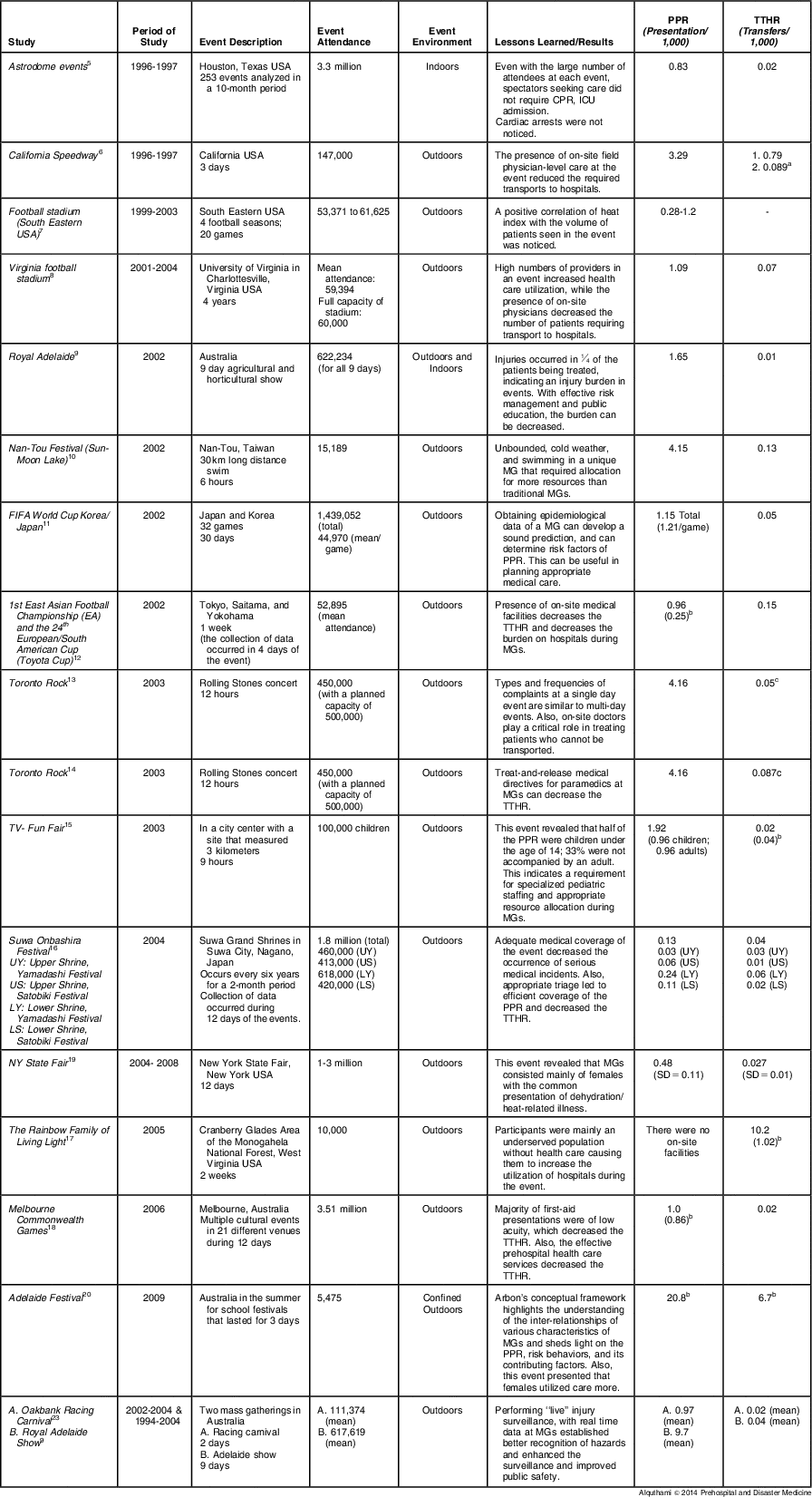
Data were collected and processed by a single author who was trained through a series of meetings between the authors to discuss the purpose of the study, search terms, and inclusion criteria. For each database, the reviewer screened all retrieved titles and abstracts for eligibility. Articles meeting inclusion criteria through the screening process underwent a full-text review, and bibliographies of full-text articles were screened for additional articles to be included in the full-text review. All included studies underwent data abstraction directly into Table 1. The data extracted from included articles were description of event, number of attendees, description of the environment (indoors/outdoors, humidity, month event occurred, and weather), description of intervention of prehospital planning (interventions or outcomes generated by the articles), PPR, and TTHR.
Articles Published 2003 or Later on Mass-Gathering Events that Discussed Prehospital Measures and Described Conclusions and Outcomes on Noncommunicable Health Issues

Abbreviations: CPR, cardiopulmonary resuscitation; ICU, intensive care unit; MG, mass gathering; PPR, patient presentation rate; TTHR, transport to hospital rate.
aThe first TTHR represents the ambulance transports without on-site physicians; the other TTHR represents the ambulance transports with physicians on site.
bValue as presented in the paper. This value is not the same as calculated by the authors of this study.
cThe discrepancy in TTHR between the Toronto Rock events is because the first study used 22 ambulance transports to offsite hospitals, while the second used all the on-site and off-site hospital transfers (total of 39).
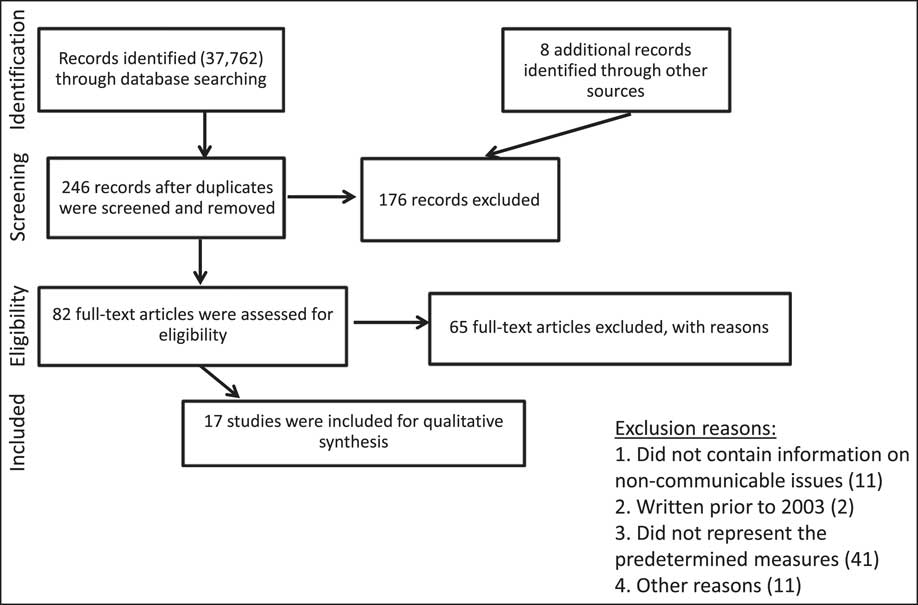
To summarize evidence accurately and reliably, the review followed the Preferred Reporting Items for Systematic Reviews and Meta-analyses (PRISMA) guidelines.Reference Moher, Liberati, Tetzlaff and Altman 22 A PRISMA flow diagram with its four phases was created (Figure 1). In order to create comparable prehospital measures between multiple-day and single-day events, researchers averaged the total number of attendees to the number of attendees per day, patient presentations per day, and ambulance transfers to hospitals per day in multiple-day events so they could be interpreted as single-day measures for comparison. Also, researchers used multiple-events (multiple locations across multiple days) and multiple-day events interchangeably.
Flow of Information Through the Phases of a Systematic Review Using the PRISMA ApproachReference Moher, Liberati, Tetzlaff and Altman 22 Abbreviation: PRISMA, Preferred Reporting Items for Systematic Review and Meta-Analysis.

Results
The literature search identified 37,762 related records, with 318 articles available in the databases that had the combination of keywords. After duplicates were removed, 246 articles remained. Of those, 172 articles were excluded following title and abstract review. A total of 82 full-text articles were reviewed to assess whether or not they met inclusion criteria. References of the reviewed articles were assessed and eight additional articles were identified to include in the review.
A total of 17 articles ultimately were included, spanning 18 events. Of those, seven were multiple-day events, four were single-day events, and seven involved multiple events (Table 1). The number of attendees ranged from 5,475 at the Adelaide Schoolies FestivalReference Hutton, Munt, Zeitz, Cusack, Kako and Arbon 20 to 3.5 million at the Melbourne Commonwealth Games.Reference Dutch, Senini and Tylor 18 The articles also showed that 16 of the events were outdoors and two were indoors. Across the included papers, the PPR ranged from 0.13-20.8 patients per 1,000 attendees and the TTHR was 0.01-10.2 ambulance transports per 1,000 attendees.
Some of the common themes across the included articles were: events with on-site providers (physicians, paramedics, and clinics) had lower ambulance transfers (four studies),Reference Varon, Fromm, Chanin, Filbin and Vutpakdi 5 , Reference Morimura, Katsumi and Koido 11 , Reference Feldman, Lukins, Verbeek, MacDonald, Burgess and Schwartz 13 , Reference Yazawa, Kamijo, Sakai, Ohashi and Owa 16 the smaller the number of attendees the higher the rate of prehospital medical use (seven studies),Reference Grange, Baumann and Vaezazizi 6 , Reference Zeitz, Zeitz and Kadow-Griffin 9 , Reference Chang, Chang, Huang, Huang, Chien and Tsai 10 , Reference Feldman, Lukins, Verbeek, MacDonald, Burgess and Schwartz 13 - Reference Thierbach, Wolcke, Piepho, Maybauer and Huth 15 , Reference Hutton, Munt, Zeitz, Cusack, Kako and Arbon 20 the presence of noncommunicable health issue surveillance systems (three studies),Reference Bossarte, Sullivant and Sinclair 17 , Reference Hutton, Munt, Zeitz, Cusack, Kako and Arbon 20 , Reference Zeitz, Zeitz, Arbon, Cheney, Johnston and Hennekam 23 and abundant availability of health resources increased the rate of utilization (two studies).Reference Feldman, Lukins, Verbeek, MacDonald, Burgess and Schwartz 13 , Reference Zeitz, Zeitz, Arbon, Cheney, Johnston and Hennekam 23
The most frequent noncommunicable health issues presented in mass gatherings were headaches (seven studies, comprising 24%-27% of cases),Reference Varon, Fromm, Chanin, Filbin and Vutpakdi 5 , Reference Grange, Baumann and Vaezazizi 6 , Reference Chang, Chang, Huang, Huang, Chien and Tsai 10 - Reference Feldman, Lukins, Verbeek, MacDonald, Burgess and Schwartz 13 , Reference Dutch, Senini and Tylor 18 and abdominal complaints (seven studies, comprising 1.4%-31% of cases),Reference Varon, Fromm, Chanin, Filbin and Vutpakdi 5 , Reference Grange, Baumann and Vaezazizi 6 , Reference Martin-Gill, Brady and Barlotta 8 , Reference Chang, Chang, Huang, Huang, Chien and Tsai 10 - Reference Morimura, Takahashi and Katsumi 12 , Reference Dutch, Senini and Tylor 18 . These were followed by presentations of abrasion/lacerations (five studies)Reference Varon, Fromm, Chanin, Filbin and Vutpakdi 5 , Reference Grange, Baumann and Vaezazizi 6 , Reference Zeitz, Zeitz and Kadow-Griffin 9 , Reference Chang, Chang, Huang, Huang, Chien and Tsai 10 , Reference Dutch, Senini and Tylor 18 with a prevalence of 15%-60% across events, orthopedic lesions (five studies),Reference Varon, Fromm, Chanin, Filbin and Vutpakdi 5 , Reference Grange, Baumann and Vaezazizi 6 , Reference Zeitz, Zeitz and Kadow-Griffin 9 , Reference Morimura, Katsumi and Koido 11 , Reference Morimura, Takahashi and Katsumi 12 ocular injury (five studies),Reference Varon, Fromm, Chanin, Filbin and Vutpakdi 5 , Reference Grange, Baumann and Vaezazizi 6 , Reference Zeitz, Zeitz and Kadow-Griffin 9 , Reference Chang, Chang, Huang, Huang, Chien and Tsai 10 , Reference Dutch, Senini and Tylor 18 and syncope/dizziness (five studies);Reference Varon, Fromm, Chanin, Filbin and Vutpakdi 5 , Reference Martin-Gill, Brady and Barlotta 8 , Reference Chang, Chang, Huang, Huang, Chien and Tsai 10 , Reference Morimura, Katsumi and Koido 11 , Reference Feldman, Lukins, Verbeek, MacDonald, Burgess and Schwartz 13 and by burns (four studies),Reference Varon, Fromm, Chanin, Filbin and Vutpakdi 5 , Reference Grange, Baumann and Vaezazizi 6 , Reference Zeitz, Zeitz and Kadow-Griffin 9 , Reference Dutch, Senini and Tylor 18 chest pain (four studies),Reference Varon, Fromm, Chanin, Filbin and Vutpakdi 5 , Reference Grange, Baumann and Vaezazizi 6 , Reference Martin-Gill, Brady and Barlotta 8 , Reference Morimura, Katsumi and Koido 11 and heat-related illness (four studies).Reference Varon, Fromm, Chanin, Filbin and Vutpakdi 5 , Reference Grange, Baumann and Vaezazizi 6 , Reference Morimura, Katsumi and Koido 11 , Reference Feldman, Lukins, Verbeek, MacDonald, Burgess and Schwartz 13
Discussion
The research assessed papers on mass-gathering events published over 10 years and reported data on noncommunicable health issues. Variation was found in the reported rates of both on-site medical usage (treat and release, 0.13-20.8 presentations per 1,000), and ambulance transport rates (0.01-10.2 transports per 1,000). De Lorenzo and colleagues found that PPRs varied from 0.14-90 patients per 1,000 attendees, with most values ranging from 0.5-2 patients per 1,000 attendees.Reference Arbon, Bridgewater and Smith 24 A low PPR of 0.13 was reported in the Suwa Onbashira Festival, a religious event, and could have been due to lower rates of substance use or the tendency to defer medical care in order to keep participating.Reference Yazawa, Kamijo, Sakai, Ohashi and Owa 16 By comparison, a PPR of 20.8 was observed in the Adelaide Schoolies Festival which had a small number of attendees.Reference Hutton, Munt, Zeitz, Cusack, Kako and Arbon 20 Both reporting of low and high rates may represent a reporting bias. In the case of the Adelaide Schoolies Festival, the high rate may be the result of the fact that all utilization of care required documentation. This differs from other events where many health issues go unrecorded for reasons such as going to offsite providers for care, deferring care until after the event, and minor or other health issues not documented because of incomplete data collection. The variation in presentation rates also may be a result of different methods of capturing prehospital data.
A similar wide variation in the TTHR was found, ranging from 0.01-10.2 ambulance transfers per 1,000 attendees. The lowest TTHR of 0.01 was in the Royal Adelaide Festival of 2002; this could have been low due to proper event planning for both staffing and available resources with the proper communication which limited the need for transportation to hospitals.Reference Zeitz, Zeitz and Kadow-Griffin 9 Another possible reason for the small numbers of transports to hospital is the study only reported injuries and not noncommunicable medical complaints. By comparison, the Rainbow Family of Living Light had a high rate of 10.2 ambulance transfers per 1,000 attendees; this could have been so high because of the lack of on-site health providers.Reference Bossarte, Sullivant and Sinclair 17
Four of seven studies involving on-site providers (physicians, paramedics, and clinics) reported lower ambulance transports to hospitals.Reference Varon, Fromm, Chanin, Filbin and Vutpakdi 5 , Reference Morimura, Katsumi and Koido 11 , Reference Feldman, Lukins, Verbeek, MacDonald, Burgess and Schwartz 13 , Reference Yazawa, Kamijo, Sakai, Ohashi and Owa 16 This may be because many minor complaints often can be evaluated and treated by on-site providers; only the more serious cases would require transport to the hospital after screening. On the other hand, three articles, reporting on a Virginia football stadium,Reference Perron, Brady, Custalow and Johnson 7 the Suwa Onbashira Festival,Reference Yazawa, Kamijo, Sakai, Ohashi and Owa 16 and the New York State Fair,Reference Grant, Nacca, Prince and Scott 19 had high patient presentations and high ambulance transport rates because the ambulance presence of on-site providers allowed spectators to over-utilize the services. In most cases, multiple-day events were associated with higher rates of medical use, confirming the previous systematic review of data before 2002 on this topic;Reference Milsten, Maguire, Bissell and Seaman 1 however, the “Toronto Rock” single-day event had higher rates of use than many of the multiple-day events due to the youthful crowd, the usage of alcohol, and the confined space.Reference Milsten, Maguire, Bissell and Seaman 1 Somewhat paradoxically, smaller events had higher rates of use of medical resources, confirming findings from the Milstein et al article.Reference Milsten, Maguire, Bissell and Seaman 1 The reasoning was that decreased attendee flow allowed more spectators to utilize health services. By contrast, the FIFA 2002 World Cup article,Reference Morimura, Katsumi and Koido 11 which pertained to a multiple-day, multiple-location event, reported no relation between crowd attendance and presentation rates; this could be due to indoor settings and limited number of spectators.
One study reported a positive correlation of heat index with the rate for medical use during an event.Reference Perron, Brady, Custalow and Johnson 7 By contrast, the authors of the paper on the Sun Moon Lake Festival concluded that very cold weather, too, can increase the need for medical usage.Reference Chang, Chang, Huang, Huang, Chien and Tsai 10 This indicates that extremes of weather are contributors to higher rates of medical use, confirming the findings of Milstein and colleagues.Reference Arbon 3
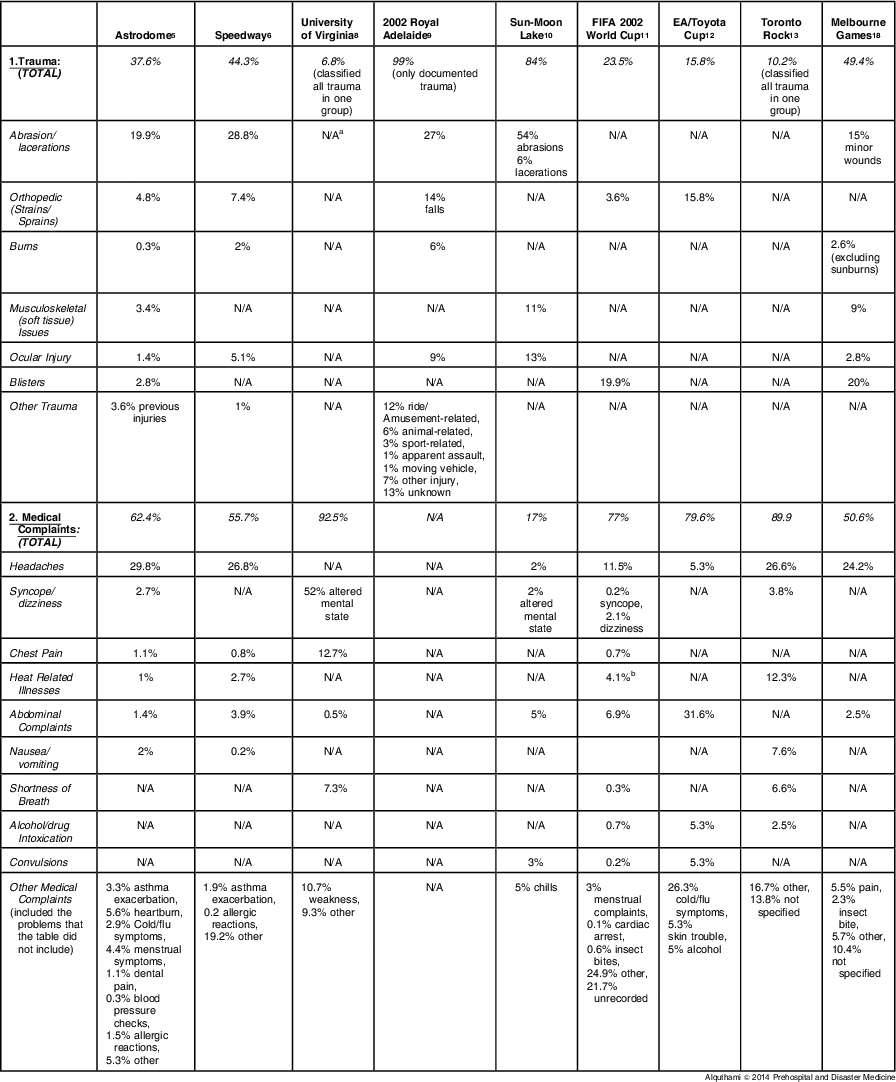
Table 2 illustrates the frequency and severity of cases of noncommunicable health issues found during mass gatherings. Non-emergent cases in events were mainly headaches, abdominal complaints, and abrasions/lacerations. Emergent cases that posed a significant threat to life, such as cardiac arrest (0.1% in the FIFA 2002 World Cup),Reference Morimura, Katsumi and Koido 11 allergies (0.2-1.5% in two studies),Reference Varon, Fromm, Chanin, Filbin and Vutpakdi 5 , Reference Grange, Baumann and Vaezazizi 6 and asthma (0.9-1.3% in two studies)Reference Varon, Fromm, Chanin, Filbin and Vutpakdi 5 , Reference Grange, Baumann and Vaezazizi 6 were relatively rare, confirming findings in a prior study.Reference Milsten, Seaman, Liu, Bissell and Maguire 4
Type and Frequency of Noncommunicable Health Issues During Mass Gatherings (only 9 articles presented reported clinical data)

aN/A: Information was not available in the article.
bThe study did not indicate the reason for the heat-related illness in the cold weather.
An important observation from this review of noncommunicable health issues is that they seem to vary according to the nature and characteristics of the event. For example, cardiac arrest that occurred in the FIFA World Cup of 2002 was associated with the strenuous exercise.Reference Morimura, Katsumi and Koido 11 In addition, insect bites were noticed at outdoor events, as seen in the FIFA World CupReference Morimura, Katsumi and Koido 11 and the Melbourne event.Reference Dutch, Senini and Tylor 18 Several studies suggested heat-related illness as a major issue in mass-gathering events, but it only represented 1%-12% of the cases; this could have been under diagnosis of heat exhaustion with headache.Reference Varon, Fromm, Chanin, Filbin and Vutpakdi 5 , Reference Grange, Baumann and Vaezazizi 6 , Reference Morimura, Katsumi and Koido 11 , Reference Feldman, Lukins, Verbeek, MacDonald, Burgess and Schwartz 13
Limitations
First, this review included only studies conducted for the explicit purpose of evaluation of noncommunicable health issues post 2002 in mass gatherings; this could have caused sampling bias. This method may have excluded certain descriptive studies that readers might consider relevant to the field of mass-gathering medicine with regards to planning, preparation, and delivery of care. During the review selection, a single reviewer assessed and made decisions about inclusions for title, abstract, and full-text review. The researchers were unable to assess objectively whether this process excluded articles; however, there was substantial training with multiple sample full-text reviews with the reviewer, and any questions about inclusion were resolved between the two authors. In addition, the bibliographies of all full-text articles were screened to find additional articles of interest.
It was challenging to draw definitive conclusions when comparing each of the reference studies, given the differences between interventions and outcomes. Studies were performed at different locations, which limits the ability to assess each researcher's understanding of the subject matter of mass gatherings. Generalizations of outcomes from interventions in each study reviewed may be biased because of the multinational nature of reported data.
Future research could be directed towards the assessment of the severity and acuity of noncommunicable disease. In addition, follow-up of patients during mass gatherings could be assessed to identify the efficacy of these planned measures on patient outcomes. Another important aspect is the use of information technology to assess and better understand the dynamics of interday variability of events.
Conclusion
This article explored prehospital measures during mass gatherings for noncommunicable issues in the last 10 years. Several observations were made: (1) during large events, there were paradoxically low presentation rates; (2) single-day events can utilize as many resources, if not more, as some multi-day events; (3) headaches and abdominal complaints were the most frequent disorders documented; and (4) emergent cases (such as cardiac arrest, allergies, and asthma) contributed to a small portion of the documented complaints.